Rwenzori Trekking Expeditions Experts, also known as Uganda’s Rwenzori Mountains Specialist, provide the #1 Rwenzori trekking services, including guides on routes, costs, peaks, itinerary packages, certified guides, and what to pack and wear, all-inclusive in the Rwenzori Mountains National Park.
Experience exciting Rwenzori trekking safaris in the Rwenzori Mountains National Park with certified and knowledgeable mountaineering guides from the foothills of the Rwenzoris to the highest points of Weismann Peak, Margherita Peak on Mount Stanley, Vittorrio Emanuele on Mount Speke, Chepetegei Peak, and Edward Peak on Mount Baker. As we explore the fabled Mountains of the Moon, Rwenzori Trekking Expeditions Ltd offers expert guides, secure routes, breathtaking views, and unwavering support.
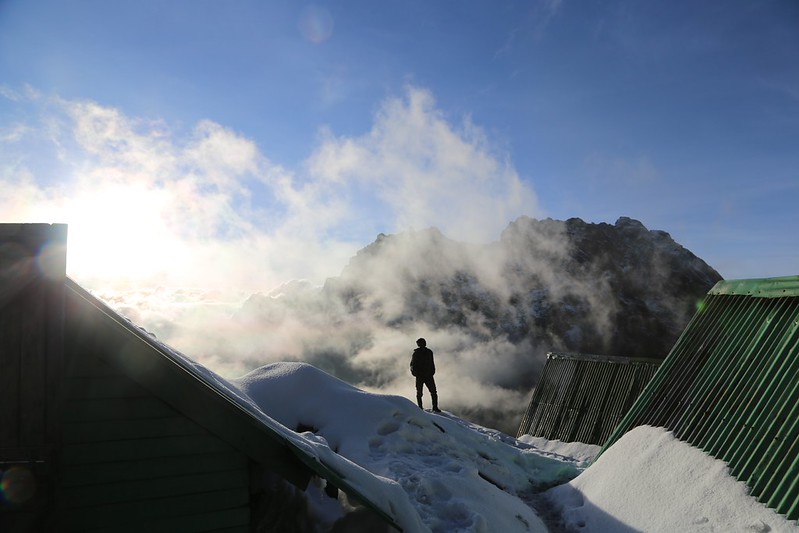 The Rwenzori Mountains, sometimes referred to as the “Mountains of the Moon,” offer a breathtaking backdrop for an exceptionally challenging and thrilling African trekking adventure. Enter a world where clouds kiss ancient glaciers, where strange animals hide in exotic rainforests, and where every path tells a story.
Somewhere in western Uganda, not far from where the map says the equator runs, the ground rises until it touches snow. Not the snow of altitude clichés or travel brochure promises, but real snow, real glaciers, and real ice on a real summit at 5,109 meters above sea level, straddling the border between Uganda and the Democratic Republic of the Congo, in a mountain range that a Greek geographer named the Mountains of the Moon nearly two thousand years ago. The Rwenzori Mountains are Africa’s third highest range, a UNESCO World Heritage Site, and one of the last places on Earth where you can stand on an equatorial glacier before breakfast. They are extraordinary. They are time-limited. And the guide team waiting to take you there has spent their professional lives learning every meter of these extraordinary, time-limited places.
We are Rwenzori Trekking Expeditions Ltd, a Uganda-owned operator that works exclusively in the Rwenzori Mountains. Every guide and porter on our team is a certified Bakonzo mountain professional whose family has worked these slopes for generations, and every itinerary on this site, from a one-day Nyabitaba hut forest walk to the full 18-day, eight-peak traverse, is one we plan, staff, and run ourselves. We deliver the complete map of that expertise: every route, every peak, every honest answer to the questions that matter before you commit your time and money to the Rwenzori mountains. Rwenzori Trekking Expeditions covers the three trekking routes and how to choose between them, the six major peaks and Margherita’s summit day in specific detail, an honest account of the difficulty (including how it compares to Kilimanjaro), the gear this mountain actually requires, what it costs, when to go, and how to combine it with gorilla trekking, chimpanzee tracking, and the rest of Uganda’s wildlife circuit.
Africa has no shortage of magnificent mountains. Kilimanjaro is iconic. Mount Kenya is technically serious. The Virunga volcanoes are extraordinary in their own right. The Rwenzori occupies a category of its own, and altitude is not the reason. The reason is everything that surrounds the climbing: the terrain, the biodiversity, the remoteness, and a persistent sense of strangeness that no other East African mountain matches.
 Start with the numbers. The Rwenzori receives on the order of 1,000 trekkers a year across all routes combined; Kilimanjaro receives tens of thousands. That is not a marketing claim; it is simply the consequence of a mountain that demands more of its visitors and therefore draws fewer of them, and it means the wilderness you encounter here has not been processed for mass tourism the way Kilimanjaro’s Marangu and Machame routes have been.
Then there is the landscape itself. The Rwenzori’s five vegetation zones: montane forest, bamboo, heathland, Afro-alpine moorland, and the glaciated nival zone,ar e more visually dramatic, in sequence, than the equivalent zones on any other African mountain. The Afro-alpine belt in particular, with three-meter giant lobelias and five-meter giant groundsels rising out of the mist, produces a landscape so botanically alien that even well-traveled mountain trekkers consistently call it the strangest environment they have stood in.
Insight Trekkers who have done both Kilimanjaro and the Rwenzori usually ask which is better. My honest answer: they are different mountains, not competing ones. But if I had to choose one to climb for the landscape, the wildlife, and the sense of being genuinely apart from the world, I would choose the Rwenzori without hesitation. |
Rwenzori vs. Kilimanjaro: A Side-by-Side Comparison
Rwenzori (Margherita Peak) | Kilimanjaro (Uhuru Peak) | |
Summit elevation | 5,109 m | 5,895 m |
Mountain type | Non-volcanic block-fault range | Dormant stratovolcano |
Terrain character | Saturated bogs, root and rock climbing, exposed alpine scrambling | Well-graded volcanic paths, predictable gradients |
Summit-day technicality | Glacier crossing with crampons, ice axe, and fixed ropes above Elena Hut | Steep scree walk; no glacier travel required on standard routes |
Typical annual visitors | ~1,000 across all routes | Tens of thousands |
Recommended minimum days | 7–8 days for Margherita Peak | 6–8 days on longer routes |
Typical guided cost (7–8 days) | USD 1,200–3,500 per person | USD 2,500–4,000+ per person |
Overall difficulty | Generally rated harder, primarily due to terrain rather than altitude | Rated hard primarily due to altitude |
Every year, hundreds of thousands of people fly to Kilimanjaro to walk one of the best-managed, best-signposted, busiest mountain tourism routes in Africa. It is a remarkable experience. But it is not the only African mountain experience, and for a significant number of the people who have done it, it produces a specific appetite for something harder, stranger, wilder, and more genuinely remote. The Rwenzori Mountains is the answer to that appetite.
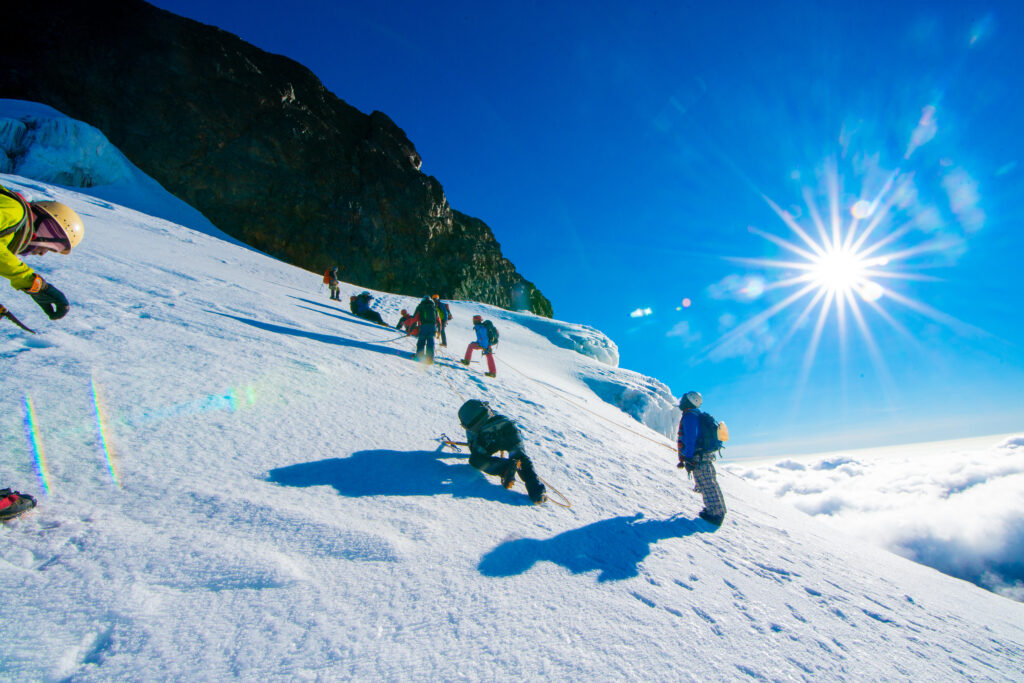 The Rwenzori Mountains are harder than Kilimanjaro in the ways that matter to serious mountain trekkers. The Rwenzori trails are rooted, muddy, and technically demanding in ways that Kilimanjaro’s manicured paths are not. The ecological complexity of the Rwenzori Mountains, with five vegetation zones that are utterly distinct from one another, is unmatched on any other East African summit. The summit of Margherita Peak, at 5,109 meters, requires a real glacier crossing with real equipment, leading to a real summit that commands a real panorama of Central Africa’s western horizon. And in any given week, there are fewer people on this entire mountain than there are on Kilimanjaro’s Marangu Route on any single morning.
The Rwenzori Mountains also offer something that no other African mountain experience can deliver: the glaciers. Not the distant white cap visible from the plains below, but the actual ice, the Elena Glacier underfoot at 5,000 meters before dawn, the crampon points biting the surface, and the rope team moving in the cold dark toward Africa’s third highest summit. These glaciers will not be here in thirty years. The opportunity to stand on equatorial ice in Africa is narrowing with measurable speed every year. The Rwenzori Trekking Expeditions guide team has watched it happen, summit by summit, season by season.
“The Rwenzori asks you to earn it. And then it gives you something that nothing else in Africa can.”
Three trailheads of Kilembe, Central Circuit, and Bukurungu Trail provide access to the Rwenzori from the Ugandan side, and choosing between them is one of the most consequential planning decisions a trekker makes. Each has a distinct character, infrastructure, and summit access.
The Central Circuit Trail
The original Rwenzori route and still the most popular first choice, the Central Circuit begins at Nyakalengija near Ibanda village and loops through the heart of the range along the Bujuku Valley, over Scott Elliot Pass, and up to the high camps beneath the Stanley Plateau. Its huts, Nyabitaba (2,651 m), John Matte (3,414 m), Bujuku (approximately 3,962–3,977 m, trip reports and operator figures vary slightly), Elena (4,541 m), and Kitandara (4,023 m), are solid metal refuges spaced to build a sound acclimatization rhythm. This is the route for trekkers who want the widest traversal of the vegetation zones and the broadest set of summit options, and it is the natural choice for the 7-day Margherita Peak itinerary.
The Kilembe Trail
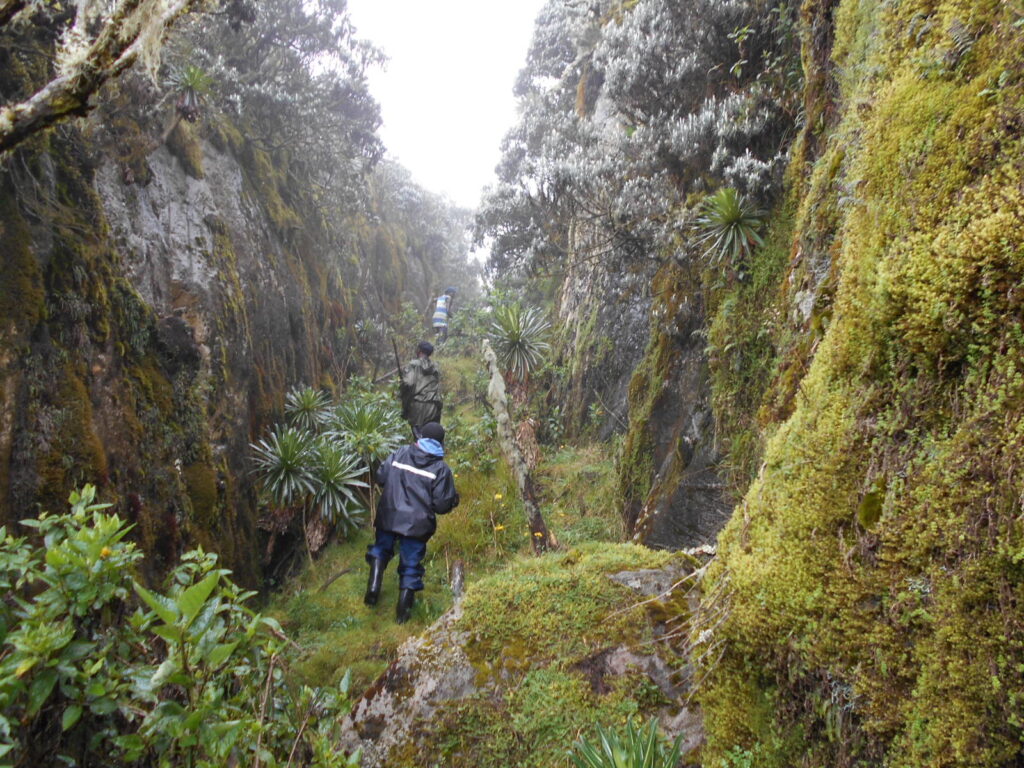 Starting at the former copper-mining settlement of Kilembe, roughly 13 km from Kasese, the Kilembe Trail climbs through the Nyamwamba Valley, a different, arguably even more dramatic sequence of landscapes than the Central Circuit, including a run of waterfalls in the lower forest. Its 8-day itinerary to Margherita Peak is one of the most consistently recommended, because the extra day meaningfully improves acclimatization and summit outcomes compared to a 7-day Central Circuit attempt.
The Bukurungu Wilderness Trail
Developed by the Uganda Wildlife Authority and WWF in 2018, Bukurungu is the range’s genuine frontier route: no permanent huts, everything carried in, and perhaps a few dozen visitors a year. The trail passes four high-altitude alpine lakes: Irene, Mughuli, Bukurungu, and Bujuku, and is best suited for experienced trekkers who have already completed a main route and want to go further off the map.
Central Circuit vs. Kilembe Trail — Which Route Is Right for You?
Central Circuit Trail | Kilembe Trail | |
Trailhead | Nyakalengija, near Ibanda | Kilembe, ~13 km from Kasese |
Best for | First-time Rwenzori trekkers wanting the classic full loop | Trekkers wanting Weismann Peak, waterfalls, or a second Rwenzori trip |
Typical Margherita itinerary | 7 days | 8 days (extra acclimatization day) |
Signature scenery | Bujuku Valley, Scott Elliot Pass, widest vegetation-zone traverse | Nyamwamba Valley waterfalls, distinct ridge views |
Wildlife highlights | Chimpanzees and L’Hoest’s monkeys in the lower forest | Three-horned chameleons, forest birdlife |
Wildlife: The Albertine Rift Biodiversity Hotspot
 Rwenzori Mountains National Park sits within the Albertine Rift Biodiversity Hotspot, the world’s most concentrated repository of endemic vertebrate species in Africa. More than 217 bird species, 70 mammal species, and hundreds of endemic plants inhabit the park’s five vegetation zones. The Rwenzori Turaco’s crimson wing-flash and liquid call in the lower forest canopy. Blue Monkeys moving through the upper canopy in family groups on the morning ascent. The three-horned Rwenzori chameleon on a bamboo stem at eye level. The Malachite Sunbird hovers at a giant lobelia flower spike at 3,800 meters. Rock hyraxes call from the boulder fields above Bujongolo Rock Shelter at dusk. These are the wildlife encounters that belong specifically to the Rwenzori, available to trekkers guided at an observation pace by naturalist guides who know exactly where to look.
For the complete species guide, primates by zone, bird endemic list, mammal profiles, and seasonal observation calendar, visit the Rwenzori Wildlife Guide
Vegetation Zones of Rwenzori: Five Worlds in One Mountain
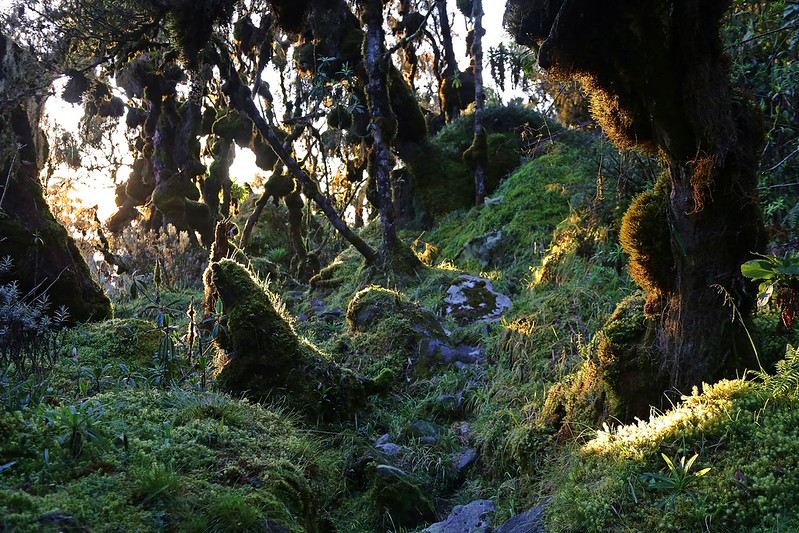 No other mountain in East Africa contains as much ecological diversity per unit of altitude as the Rwenzori. The ascent from the trailhead to the summit passes through five entirely distinct vegetation worlds, including Afro-montane rainforest, bamboo zone, giant heather forest, Afro-alpine moorland, and alpine ice, each with its climate, its own botanical character, and its wildlife community. The giant lobelias and groundsels of the Afro-alpine moorland are the range’s most celebrated ecological feature: six-meter silver-grey botanical towers that stand in open communities above 3,500 meters in a landscape that has no visual equivalent anywhere else in Africa. Understanding what each zone looks like, feels like, and sounds like before arriving transforms the experience from a walk through beautiful scenery into a coherent ecological journey with a beginning, middle, and extraordinary end.
Geology of Rwenzori: Two Billion Years Underfoot
The Rwenzori Mountains are not volcanic. This single geological fact distinguishes them from every other significant East African mountain and explains everything distinctive about their ecology, their terrain, their stability, and their visual character. They are a fault-block range of ancient Precambrian crystalline rock, granite, gneiss, and amphibolite estimated at 500–700 million years old, pushed upward by tectonic forces along the fault line of the Western Rift Valley over the past three to five million years. The deep U-shaped valleys, the cirques, and the polished rock surfaces are the legacy of Pleistocene glaciation that once covered the upper mountains to 2,500 meters. The glaciers currently retreating from the summits are the last survivors of that ancient ice age.
History and Culture: Two Thousand Years of the Mountains of the Moon
The Rwenzori Mountains have been documented for two thousand years, a fact that makes them unusual among African destinations where recorded history often begins only with European exploration. Claudius Ptolemy’s second-century reference to the Lunae Montes was the first; Henry Morton Stanley’s 1888 confirmation was the most significant European milestone; the Duke of Abruzzi’s 1906 first ascents established the modern climbing history. But older than any of these external narratives is the Bakonzo people’s relationship with the range, a cultural knowledge system embedded in the oral traditions, agricultural practices, and place names of the community that has inhabited the mountain’s lower slopes for centuries. The Bakonzo guide team of Rwenzori Trekking Expeditions carries this knowledge onto every trail, every day, and in every season.
Glaciers of Rwenzor: Equatorial Ice in the Age of Climate Change
 The Rwenzori glaciers are retreating. This is not alarmism or travel marketing hyperbole; it is a measured, documented, scientific fact supported by photographic comparison from the Duke of Abruzzi’s 1906 expedition to present-day satellite imagery. Total glacier area has reduced from approximately 6.5 km² in 1906 to approximately 1.0–1.3 km² by the early 2020s, a reduction of over 80 percent. Current projections suggest the remaining glaciers will disappear entirely between 2030 and 2050. The opportunity to stand on equatorial glacial ice in Africa is a time-limited experience measured in years, not decades. For the complete glacier guide, retreat data, glacier locations, climate science context, and what to expect on summit day, read more
UNESCO Status and Conservation
Rwenzori Mountains National Park has been a UNESCO World Heritage Site since 1994, recognized for its outstanding natural beauty and its extraordinary Albertine Rift biodiversity. The designation carries active conservation obligations that Uganda Wildlife Authority must maintain, report on, and defend against identified threats. The primary current threat, glacier retreat driven by climate change, is the most carefully monitored conservation issue in the park’s World Heritage monitoring documentation. Every Rwenzori Trekking Expeditions package includes the UWA conservation fees that fund park management, trail maintenance, guide training, and the community partnerships that make long-term conservation economically viable for the families who live at the mountain’s base.
The Rwenzori Mountains is not a one-route, one-objective mountain. Our full Rwenzori Trekking Safaris & itinerary packages span everything from a one-day in the forest to an 18-day Rwenzori expedition summiting every named peak in the range, built for trekkers with very different fitness levels, time budgets, and ambitions.
Short Treks: Forest and Lower Mountain (1–4 Days)
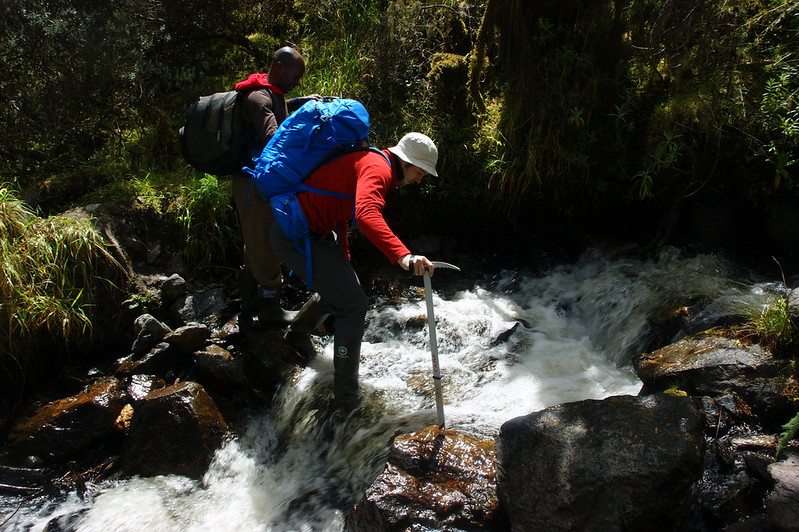 For travellers combining the Rwenzori with a wider Uganda itinerary or wanting to sample the range before committing to a full summit expedition, the short options are genuine introductions, not watered-down versions of the main routes. A 1-day hike to Nyabitaba Hut, 2-day trips to Lake Mahoma or 2-day Sine Camp, and 3–4 day options to Mutinda Lookout or the Kilembe waterfalls all deliver real forest and heathland immersion, chimpanzee and colobus sightings, and on the Mutinda route a taste of the upper mountain above 3,900 m without a full expedition commitment.
Classic Summit Treks: Reaching Margherita Peak (5–9 Days)
The core of the program is the classic Margherita Peak summit expedition, moving through all five vegetation zones to the glacier crossing above Elena Hut and the 5,109 m summit. Seven days is the recommended minimum via the Central Circuit trail; eight days via the Kilembe Trail is the preferred benchmark for reliable acclimatization and a stronger summit outcome. For trekkers with more time, 9-day itineraries combine Stanley, Speke, and Baker in a single continuous traverse, one of the most rewarding programs available anywhere in African mountaineering.
Multi-Peak Rwenzori Expeditions:
For those wanting to complete the range comprehensively, the multi-peak program is where the Rwenzori reveals its full depth. A 10-day itinerary targeting Margherita, Speke, Weismann, and Baker introduces the upper mountain’s breadth. A 13-day, 6-peak grand expedition, summiting Stanley, Speke, Baker, Emin, Gessi, and Luigi di Savoia, is the most complete Rwenzori trekking itinerary that most operators can deliver safely, and very few can deliver at all. At the summit of ambition sits the full 18-day, all-peaks expedition: every named summit in the range in one continuous trip.
Every itinerary below is available as a private departure on any requested date year-round, subject to guide and permit availability. Rwenzori Trekking Expeditions manages all fully guided, all-inclusive expeditions from trailhead to trailhead.
Trek | Days | Trail | Summit | Highlights | Difficulty |
Lake Mahoma Trek | 2 | Lake Mahoma 2,500 m | Crater lake, ancient forest, endemic birds | Moderate | |
Sine Camp Trek | 2 | Sine Hut 2,596 m | Enock’s Falls, bamboo forest, Turaco | Moderate–Challenging | |
Sine & Samalira Camp | 3 | Kilembe Trail | Samalira Camp 3,170 m | Bamboo corridor, heather zone, waterfalls | Moderate–Challenging |
Portal Peaks Trek | 6 | Central Circuit Trail | Kuhuma Peak 4,134 m | Two summits, giant lobelias, no glacier | Moderate–Challenging |
Baker & Weismann Expedition | 7 | Kilembe Trail | Edward Peak 4,843 m + Weismann 4,620 m | Dual summit, Bamwanjara Pass panorama | Hard |
Margherita Peak (Kilembe) | 7 | Kilembe Trail | Margherita Peak 5,109 m | Elena Glacier, Africa’s 3rd highest summit | Very Strenuous |
3-Peaks Central Circuit | 9 | Central Circuit | Speke, Baker, Margherita 5,109 m | Full circuit, Bujuku Valley, Kitandara Lakes | Strenuous—Very Strenuous |
4-Peak Expedition | 10 | Both trails | 4 major summits to 5,109 m | Complete inner mountain traverse | Expedition |
6-Peak Grand Expedition | 13 | Central Circuit Trail | All 6 major massifs | Full Rwenzori mastery, every peak | Expedition |
Each Rwenzori Trekking Safari itinerary has a dedicated full-length page with a complete day-by-day narrative, camp profiles, altitude charts, packing guidance, and package pricing. Browse all Rwenzori trekking packages.
Private Expedition: Your Mountain, Your Pace, Your Team
A private Rwenzori expedition is precisely what the name suggests: your group, on your dates, with a dedicated guide team, a dedicated porter team, and a dedicated mountain chef whose menu is adapted to your dietary requirements and whose kitchen schedule is set by your team’s daily rhythm rather than a shared camp timetable. Private expeditions are available for every itinerary in the Rwenzori Trekking Expeditions menu, from the 2-day Lake Mahoma Trek to the 13-day 6-Peak Grand Expedition. They offer complete flexibility in pace, acclimatization management, and the ability to extend specific camp stays or adjust summit day timing to weather windows. They are the right choice for couples seeking an intimate mountain experience, families who want the mountain adapted to their children’s pace, and small groups of friends or colleagues for whom a shared itinerary on someone else’s schedule is not the right fit. Private expeditions at Rwenzori Trekking Expeditions receive the same guide-to-trekker ratio, the same glacier equipment standards, and the same safety protocols as every other Rwenzori trekking itinerary in the company’s portfolio.
Small Group Departures, Shared Logistics, Complete Quality
For solo travellers and couples who want the financial efficiency of a shared departure without the compromises of a large-group itinerary, Rwenzori Trekking Expeditions operates small group departures on selected dates throughout the year. We deliberately keep group sizes small, with a maximum of eight to twelve trekkers on most itineraries, and we maintain guide ratios regardless of group size. The quality of guiding, the completeness of catering, and the mountain accommodation are identical to the private expedition standard. The difference is in the cost per person, which shared logistics naturally reduce.
The Real Rwenzori Mountains Expedition Story (Facts You Can’t Miss)
Summit Day on Margherita Peak: A Guide’s Account
The team leaves the Margherita High Camp at 2:30 AM. The temperature outside the shelter is approximately -7°C. At 4,800 metres, the stars are physically lower and denser than at any altitude most of these trekkers have previously experienced, creating a ceiling of light rather than a background. Head torches on. Crampons fitted in the cold dark by the guide, each bail checked by feel. The glacier entry is approximately 200 meters above camp. The rope goes on at the ice margin for four trekkers, one lead guide, and one assistant guide, with sixty meters of dynamic rope in a sequence that is the same on every departure because it is correct. The Elena Glacier in January has a firm, predictable surface: the crampon points bite cleanly, the line is clear, and the guide moves at a pace that is deliberately slower than the team’s instinct and exactly right for the conditions and altitude. The Stanley Plateau at 5,000 metres opens to the first grey of pre-dawn light. The final approach to Margherita Peak is steep and short. The summit arrives as peaks do, suddenly, with an authority that the long hours of climbing did not predict.
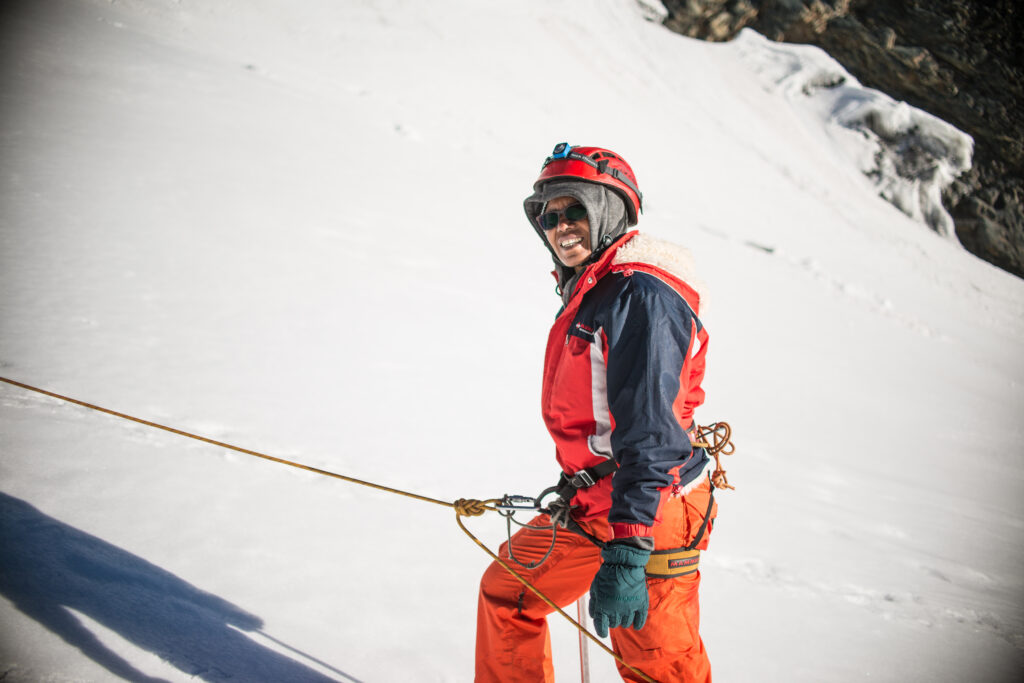 The guide photographs the team. The team stands in silence. Africa falls away on all sides in the clear early morning air. The glaciers below are pale in the growing light. This peak is the summit. This is Margherita Peak. This peak is the reason for everything that came before it.
Day 2 on the Kilembe Trail: The Bamboo Zone
The trail from Sine Hut into the bamboo zone begins within two hundred meters of the camp, immediately imposing an entirely different world on the senses. The light changes first, the dense, open forest below replaced by the filtered green luminescence of a bamboo corridor where the pale eight- to twelve-meter stems create a ceiling that turns morning light into something specific and atmospheric. The sound changes second: the bamboo dampens all external sound and replaces it with its own clicking and whispering in the mountain wind, a white noise of vegetation that is peculiarly calming after the relative loudness of the lower forest. The guide stops where a bamboo stem at eye level shows the subtle shape of a three-horned Rwenzori chameleon, still as carved stone, one foot mid-repositioned, its turret eyes tracking the trekking team with the patient attention of an animal that has been watching humans pass through its bamboo zone for as long as its species has existed here. The trekkers stop. The guide says nothing. The chameleon does not move. The morning is quietly, specifically extraordinary.
Training for Rwenzori Trekking: How to Prepare Your Body
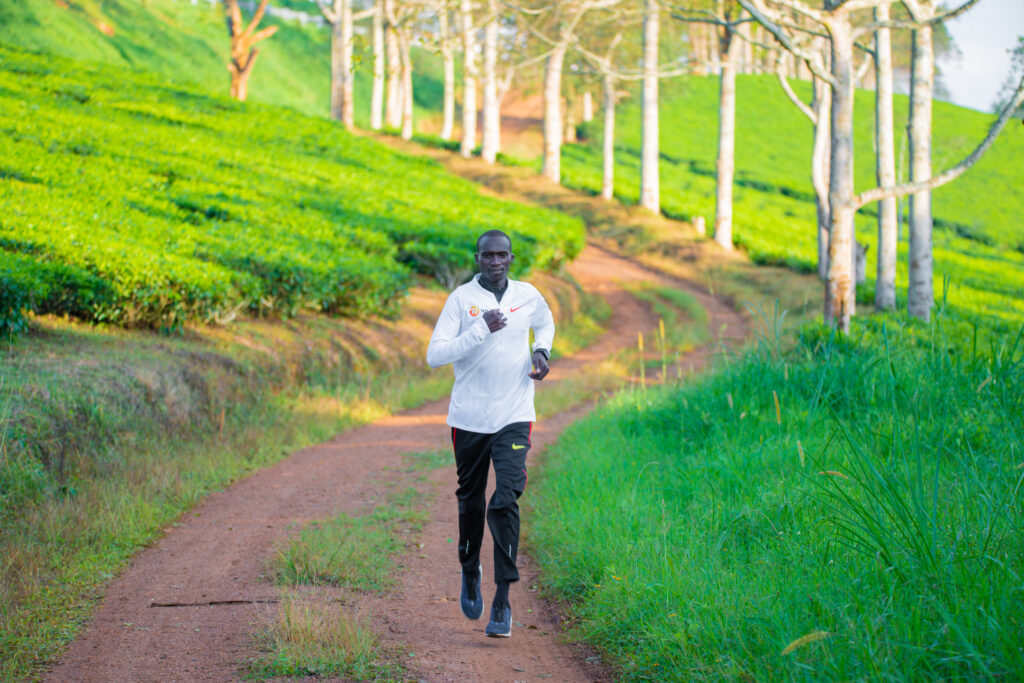 Trekkers who arrive physically prepared consistently have the best experiences: they summit more reliably, they enjoy the journey rather than just enduring it, and they come back to do it again. Preparation should focus on the specific physical qualities this mountain tests: cardiovascular endurance for sustained steep ascents, lower-body strength for uneven, heavily loaded terrain, ankle stability for lateral demands on root and rock, and core strength for balance on rough ground.
The single most useful training exercise is loaded hiking: a weighted pack, uneven terrain, ideally including steep descents, for three-plus hours at a stretch. This is the movement pattern the mountain will demand of you for six to eight hours a day, and no treadmill or flat park path replicates the specific fatigue it produces. If you have hills, use them; if not, a stair climb with a loaded pack is a reasonable substitute.
The Cost of Rwenzori Trekking
Rwenzori trekking costs range from approximately USD $350 to USD $450 per person for two-day itineraries to USD $1,600 to USD $1,900 and above for 7-to-9-day Margherita Peak summit expeditions. Every Rwenzori Trekking Expedition package is all-inclusive on the mountain: Uganda Wildlife Authority park permits, a certified guide team, a porter team, a mountain chef, all meals, all mountain accommodation, trailhead transfers, and glacier equipment for summit expeditions. International flights, Uganda visas, travel insurance, and personal gear are not included. A fully guided Rwenzori expedition to Margherita Peak, covering mandatory park fees, guide and porter wages, mountain hut accommodation, and agency logistics, typically runs USD 1,200–3,500 per person for a 7–8-day itinerary, with the exact figure depending on group size, route, and season. Shorter lower-mountain treks (2–4 days) start considerably lower. Multi-peak expeditions of 10–18 days scale up proportionally.
It is worth comparing the Rwenzori directly with Kilimanjaro. A comparable 7–8-day guided Kilimanjaro summit expedition through a reputable operator typically runs USD 2,500–4,000 or more per person, driven by Tanzania’s higher park fees and a far more competitive guide-and-porter market. By almost any measure, the Rwenzori delivers a more exclusive, more biodiverse, and more technically engaging mountain experience at a lower overall cost.
What’s Included, and What Governs the Park Fee
- Uganda Wildlife Authority gate fee:
- USD 35 per person, per day: set by UWA and applied to every route and itinerary length
Typical inclusions across our itineraries: UWA park fees, mountain hut or camping accommodation, all meals on the mountain, a certified guide and the necessary porter team, and summit-day technical equipment (crampons, ice axe, harness, and rope). Typical exclusions: international flights, Uganda visa fees, travel insurance with high-altitude evacuation cover, pre- and post-trek accommodation in Kasese, and guide/porter tips.
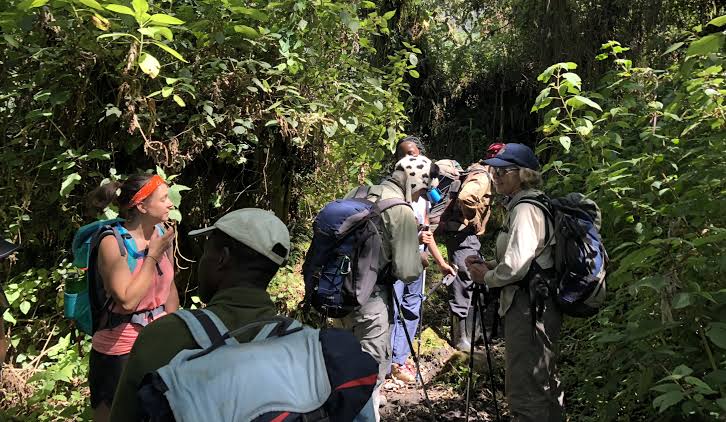
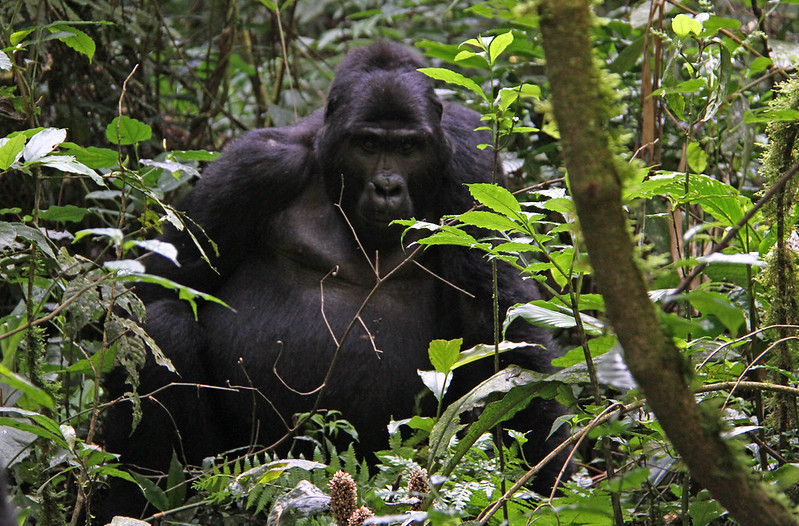 Uganda is arguably East Africa’s most wildlife-dense country per square kilometer, and the Rwenzori Mountains sit at the center of a region packed with national parks and world-class wildlife experiences. Combining a Rwenzori trek with a broader Uganda safari is, in our experience, one of the finest two- to three-week itineraries available anywhere in Africa, and one we design and run year-round.
The most requested combination pairs Rwenzori trekking with gorilla trekking in Bwindi Impenetrable Forest, roughly four hours from Kasese. Going from a high-altitude glacier crossing one week to sitting on a forest floor with a wild mountain gorilla family the next is an extraordinary contrast, and no other itinerary in Africa delivers that range of experience inside a two-week window. Further combinations are possible with chimpanzee tracking in Kibale Forest, Queen Elizabeth National Park’s tree-climbing lions and Kazinga Channel boat safari, Murchison Falls in the north, and white-water rafting on the Nile at Jinja. Our 19-day Uganda Grand Safari brings all of these together for travelers who have the time to experience the country in depth.
Rwenzori + Uganda Combination Options
Combination | Approx. duration | Highlights |
12 days | Margherita Peak summit, Bwindi gorilla trek, Queen Elizabeth NP | |
16 days | Adds Kibale Forest chimpanzee tracking | |
18–19 days | Adds Murchison Falls, Nile activities, and a broader Big Five circuit |