Yes. Rwenzori Trekking Expeditions operates every itinerary in the range, from the 2-day Lake Mahoma Trek to the 9-day Margherita Peak Central Circuit expedition, throughout every month of the year. The mountain does not close. The trails remain passable, the huts remain operational, the guide teams remain qualified and available, and the mountain’s fundamental character (its extraordinary ecological diversity, its primate-rich lower forests, its giant lobelia moorlands, & its glaciated summit) is present in every month without exception.
What changes between months is the quality of the experience for specific objectives. Summit day visibility on Margherita Peak is statistically better in the primary dry seasons of June through August and December through February. Trail surfaces are firmer and river crossings safer in these same windows. The forest is at its most vivid and lush in the wet seasons of March through May and September through November. Waterfalls are most dramatic when the rains are heaviest. The mountain is most crowded in July and August. The trails are most private in April and May. Each of these realities is neither better nor worse than the others; they are simply different versions of the same extraordinary Rwenzori mountains, available in different months to different trekkers with different priorities.
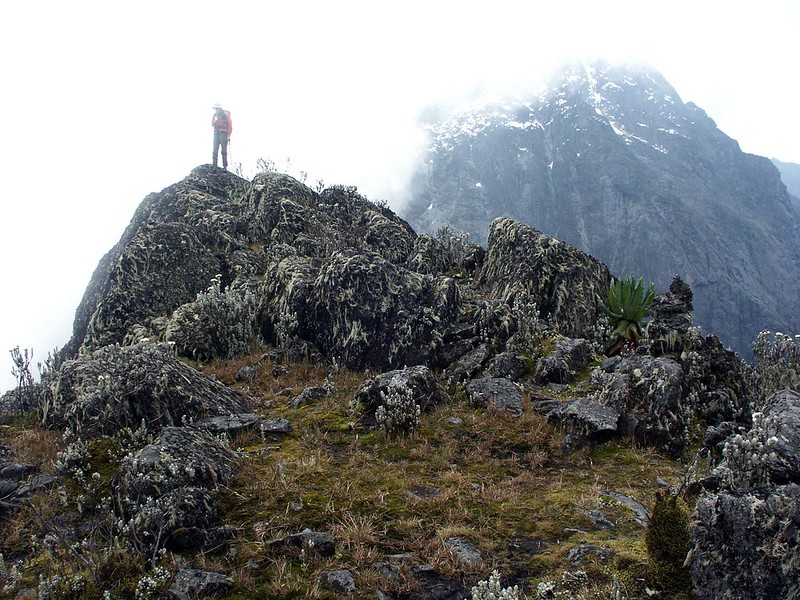
Understanding the Rwenzori Mountains Climate
The Rwenzori Mountains sit directly on the equator in western Uganda, sharing the Albertine Rift’s western scarp with the Democratic Republic of Congo. Their position at the equator means they receive two inter-tropical convergence zone passages per year, in April–May and October–November, producing the characteristic bimodal rainfall pattern of equatorial East Africa. Their altitude, rising from 1,640 meters at the Nyakalengija trailhead to 5,109 meters at Margherita Peak, creates a temperature gradient of more than forty degrees Celsius within thirty kilometers of horizontal distance, generating five distinct vegetation zones, each with its own microclimate.
The glaciers that cling to the Rwenzori’s highest peaks exist because the combination of altitude and equatorial sun produces an environment where ice can persist despite the equatorial location. The same dynamics that maintain the glaciers produce the range’s persistent cloud cover; moisture-laden air from the Congo basin is forced upward by the mountain’s mass, cooling as it rises and precipitating as rain, mist, snow, and hail across the different altitude zones. Average annual precipitation in the upper zones exceeds 3,000 millimeters, more than most of Europe’s wettest regions receive in a year, and it falls across every month with only relative variation between the drier and wetter periods.
This is the critical understanding for planning a Rwenzori expedition: the range is always wet. The dry seasons produce less rain, not no rain. The difference between a dry-season day on the Kilembe Trail and a wet-season day is not the presence or absence of precipitation but its duration, intensity, and frequency. A dry-season morning may be completely clear with long-range views to the Congo basin, followed by a wet afternoon. A wet-season morning may begin in mist and clear unexpectedly for a spectacular midday window. Rwenzori mountain weather is mountain weather plural, changeable, and fundamentally resistant to the certainty that good travel planning would prefer.
Rwenzori Seasons at a Glance
Season | Months | Typical Conditions | Best For |
Primary Dry Season | June – August | Often drier; firmer trails; stable glacier conditions | Summit attempts, Margherita Peak, photography, first-timers |
Secondary Dry Season | December – February | Often clear mornings; good visibility; quieter trails | Trekking, scenic views, New Year expeditions, less crowded |
Long Rains | March – May | Wetter; lush forest; dramatic waterfalls; fewer trekkers | Lush photography, waterfall drama, solitude seekers |
Short Rains | September – November | Mixed and variable; improving through November | Flexible travellers, birdwatching, shoulder pricing |
Month-by-Month Guide to the Rwenzori Mountains
The following profiles cover every month of the year, drawing on ground-level observations from years of guiding on both the Central Circuit Trail and Kilembe Trail. They describe typical patterns rather than guaranteed conditions.
January: The Mountain at Its Clearest
January is one of the finest trekking months in the Rwenzori Mountains and consistently one of the most popular booking windows for summit expeditions. The short dry season that began in December reaches its most settled phase in January, and mornings across both trail systems frequently open clear, sometimes spectacularly so, with long-range views from the high camps extending to the Congo basin in the west and the Albertine Rift lakes in the east. The Elena Glacier on Margherita Peak is at its most stable condition of the year in January, making it the primary recommended month for first-time glacier-crossing trekkers. Trail surfaces are firmer than the wet season months, river crossings are at their most manageable, and the camp experience above 3,000 meters involves the clarity of cold mountain air rather than persistent mist. Wildlife is active year-round in the lower forest, but January’s relative dryness produces better visibility for both primate and bird observation. The primary limitation: advance booking is essential as January fills quickly for popular itineraries, particularly private Margherita Peak departures.
February: Excellent Conditions, Decreasing Crowds
February continues January’s favorable pattern with slightly fewer trekkers, the post-Christmas rush has subsided, and the March–May wet season has not yet begun to fill the calendar for adventurous wet-weather trekkers. Morning cloud cover on the high mountain is often minimal in February, and summit day visibility on both the Margherita Peak expeditions and the Portal Peaks trek is consistently excellent. The heather zone above John Matte and Mutinda Camps is dry enough to allow unhurried observation of the rock hyraxes and sunbirds that colonize the boulder fields, and the giant lobelias in the Afro-alpine zone above 3,500 meters are at their most architecturally impressive in the thin, clear air of the late dry season. February is an underrated month for photography: the morning light quality in the clear dry-season air produces a luminosity in the forest canopy that the mistier wet-season months cannot replicate.
March: The Forest Begins to Transform
March marks the transition into the long rains, and the transformation of the Rwenzori is both immediate and extraordinary. Within two to three weeks of the season’s onset, the lower Afro-montane forest deepens several shades of green, the moss carpets on every rock and root surface thicken visibly, the waterfalls begin to fill, and the birdsong in the forest increases in both volume and variety as the wet-season food sources, fruiting trees, and insect populations respond to the moisture. Trail surfaces begin to muddy, particularly on the steep sections below Sine Hut on the Kilembe Trail and below Nyabitaba on the Central Circuit Trail. March is a transitional month: the wet season is beginning but has not reached its peak, producing some days of excellent clarity and some days of sustained rain. For trekkers flexible enough to accept both conditions in the same week, March offers the Rwenzori at the beginning of its annual ecological reawakening, genuinely beautiful, genuinely challenging, and significantly quieter than January or February.
April: Deep in the Long Rains
April is typically the wettest month of the year in the Rwenzori Mountains National Park, and it is also the month that the mountain most fully reveals its identity as one of Africa’s most extraordinarily lush highland environments. The waterfalls on both the Central Circuit Trail and the Kilembe Trail are at their most dramatic: Enock’s Falls at Sine Hut pounds the valley below with continuous thunder, and the unnamed falls in the Namusangi Valley section of the Kilembe Trail run full and white against dark rock. Trail surfaces are at their most challenging, rooted, muddy, and slippery, requiring the full waterproofing system and rubber gumboots as the primary footwear choice for most sections. The giant lobelias in the moorland above 3,500 metres collect water in their rosette cups and drip continuously in the afternoon cloud. The forest is extraordinary in its greenness. Trails are at their most private. This is the Rwenzori for trekkers who want the mountain’s full, unfiltered, wet character and who come prepared for it.
May: The Long Rains Begin to Ease
May brings a gradual easing of the long rains toward month’s end, but the mountain remains wet, the trails remain muddy, and the waterfalls remain impressively full. The ecological richness of the wet season reaches its peak in May: the moss gardens around Nyabitaba Hut on the Central Circuit trail are at their most vividly green, the bamboo zone on the Kilembe Trail drips with a productive energy that makes the corridor feel alive in a way the drier months do not replicate, and the forest floor is carpeted with fungi, emerging seedlings, and the botanical activity of a mountain ecosystem at the height of its productive season. Birdwatching in May is excellent; the Rwenzori Turaco is particularly active and vocal in the lower forest canopy, and the African Green Broadbill’s buzzing call is a reliable accompaniment to the bamboo zone traverse.
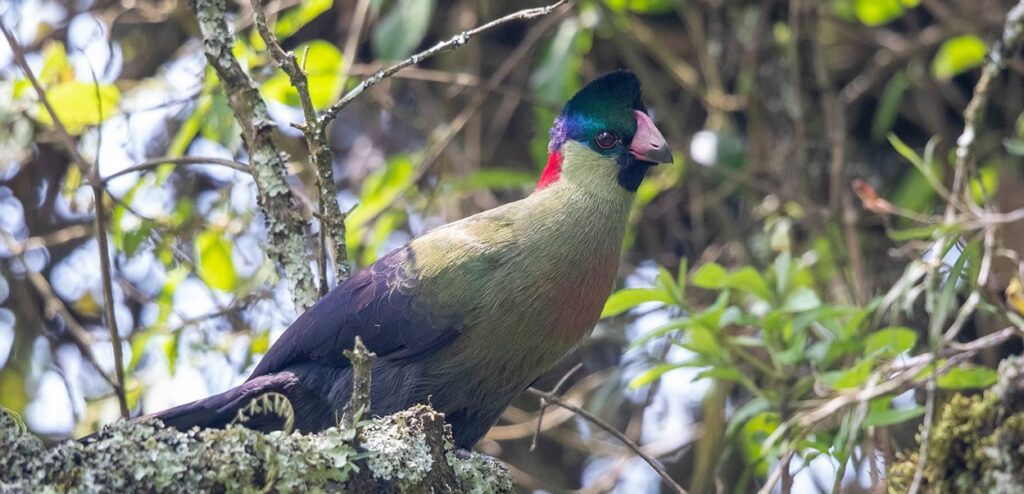
Trekkers who are experienced with wet mountain conditions and who want the Rwenzori at its most ecologically intense find May genuinely rewarding.
June: The Season Turns
June is the month the Rwenzori most noticeably shifts toward the primary dry season, and for most trekking purposes it marks the beginning of the year’s most reliable window. Rainfall decreases across all elevation zones, mornings begin to open more consistently, and the trail surfaces progressively firm through the month as the long rain’s moisture dissipates. The transition from wet to dry produces a specific atmospheric quality in June that is consistently described as among the most beautiful of the year: the forest still carries the deep green of the wet season’s legacy, the waterfalls are still impressively full from the preceding months, but the mornings are beginning to clear and the views from the high camps are returning to the extended panoramas of the dry season. By mid-June, the Kilembe Trail to Bugata Camp and beyond is in reliably excellent condition, and the Central Circuit trail approach to John Matte opens into the clear-day views toward Mount Stanley that define the Bujuku Valley experience. Booking volume begins to increase sharply in June.
July: The Peak of the Primary Dry Season
July is the single most popular month for Rwenzori trekking expeditions, and the reasons are consistent across all itineraries and all traveller types: it is the most reliably dry month of the primary dry season, summit day conditions on Margherita Peak are at their most stable, the trail surfaces are at their firmest, the morning views from the high camps are most consistently clear, and the full range of Rwenzori trekking itineraries operates at its highest success rate.
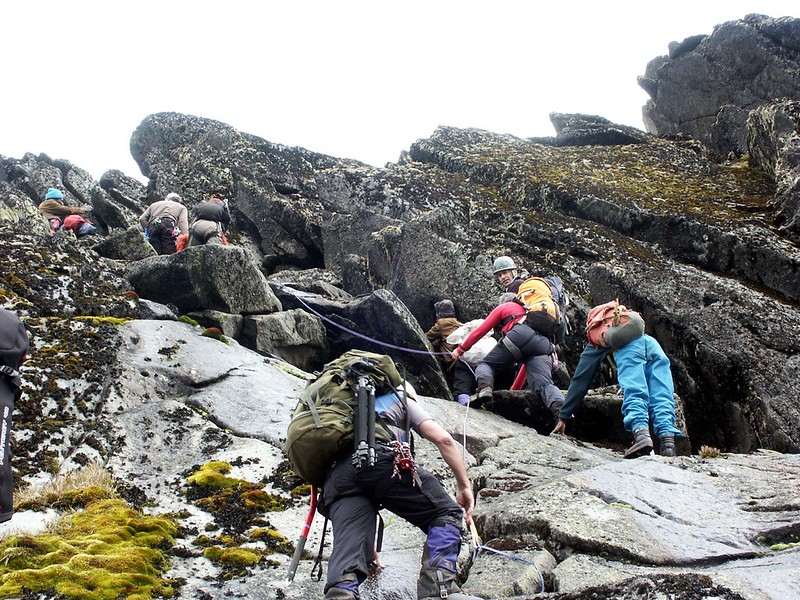
The Elena Glacier in July is typically in its best accessible condition, the crevasse system is predictable, the ice surface is firm, and the early morning approach produces the spectacular pre-dawn star views at 4,800 metres that guides describe as among the finest moments in Rwenzori guiding. The limitation of July is its popularity: this is the month when the mountain accommodates the highest number of trekkers across all itineraries, and private departures on premium dates require booking several months in advance. The camps are busier, the trails carry more teams, and the solitude that other months provide is at its most reduced in July.
August: Excellent Conditions, Increasing Availability
August continues July’s favorable conditions and gradually sees the decrease in trekker numbers that marks the approaching transition to the short rains of September. It is an excellent compromise month: conditions remain excellent for all trekking objectives, summit success rates on Margherita Peak remain high, and the decreasing crowd levels from peak July produce a quieter mountain experience without any meaningful reduction in condition quality. Photography in August benefits from the clear morning light that the dry season produces, while the occasional afternoon cloud adds dramatic interest to landscape shots from the high camps. The Bujuku Valley on the Central Circuit Trail and the Namusangi Valley section of the Kilembe Trail are at their most photogenic in August’s combination of clear air and occasional dramatic cloud build-up. August is one of the guide team’s consistently recommended months for trekkers who want good conditions without maximum crowd levels.
September: The Transition into Short Rains
September sees the gradual onset of the short rains, which in most years is a more measured and variable process than the long rains’ relatively definite March onset. Morning conditions in September can still be excellent, the dry season’s character lingers in the first half of the month, but afternoon precipitation becomes increasingly common, and trail surfaces in the lower forest zones begin to soften. September is the birdwatching month par excellence in the Rwenzori forest zones: the activity level in the lower Afro-montane forest and bamboo zones increases as resident species respond to the renewed moisture and food availability. The Rwenzori Turaco is most vocal in September, and the African Green Broadbill, Handsome Francolin, and Rwenzori Batis are regularly encountered with experienced guides working the lower trail at observation pace. For trekkers whose primary objective is wildlife observation rather than summiting, September represents a compelling window with diminishing crowds and increasing ecological activity.
October: The Short Rains Deepen
October typically brings the peak of the short rains, with increased precipitation across most elevation zones. October weather is variable; some years it produces sustained clear periods on the upper mountain, while in others it brings consistent cloud and rain throughout. What is reliable about October is its wildlife richness: the forest is increasingly active, the moss gardens are vibrant, the waterfalls are regaining the volume lost over the August dry period, and the lower trail zones on both the Central Circuit trail and the Kilembe Trail reward the attentive observer with an abundance of ecological activity that the drier months, for all their trail-condition advantages, cannot match. October is also the month in which the Rwenzori Nightjar, the mountain’s signature nocturnal bird, heard at the heather zone camps on clear evenings, is most regularly heard at Sine Hut and Nyabitaba. Trekkers comfortable with October’s mixed conditions will find it a genuinely rewarding month in a particularly private version of the mountain.
November: The Short Rains Ease and the Mountain Quietens
November is a month of improving conditions that many experienced Rwenzori trekkers have come to appreciate as a particularly rewarding time in the seasonal calendar. The short rains begin to ease through the month, with November’s second half frequently producing clear mornings and excellent trail conditions at all elevations. The mountain at this point has been through both rainy seasons and the full ecological cycle: the vegetation is at its richest, the waterfalls still carry significant volume, and the trail and camp infrastructure has had a full year of maintenance. Trekker numbers in November are low, the school-holiday high seasons are over, and the December increase has not yet begun, producing a quiet, unhurried mountain experience that is difficult to find in the peak months. November is specifically recommended for experienced trekkers who value solitude and ecological richness over guaranteed summit-day visibility and for photographers who want the Rwenzori’s dramatic, variable autumn-light character without the competition for camp positions that July and August involve.
December: The Secondary Dry Season Opens
December marks the opening of the secondary dry season and a return to reliably improving trekking conditions across both trail systems. The first two weeks of December are transitional, conditions improving but not yet settled, while the second half of December typically delivers the clear mornings and firmer trails that define the December–February window. The Christmas and New Year period is a particularly special time in the Rwenzori Mountains: trekking teams are small, the camps are quiet, and the festive season adds an unexpected warmth to the evenings in the mountain huts that experienced guides describe with genuine fondness. Celebrating New Year at 3,500 metres in the heather zone of the Rwenzori Mountains National Park, with stars visible through the cloud gaps above and the sound of mountain streams in the valley below, is an experience that belongs to a very small and very fortunate group of people. December is an increasingly popular booking month and advance planning for the Christmas–New Year window is essential.
Weather by Elevation: How Conditions Change with Altitude
The dramatic difference in conditions between the trailhead and the summit is one of the most important and frequently underestimated aspects of Rwenzori trekking planning. The table below describes the approximate climate character of each vegetation zone:
Vegetation Zone | Elevation | Daytime Temp | Night Temp | Rainfall Character | Key Experience |
Afro-Montane Forest | 1,600–2,500 m | 18–25°C | 10–15°C | Year-round; higher in the wet season | Birdsong, primates, moss-draped canopy |
Bamboo Zone | 2,200–3,000 m | 12–20°C | 6–12°C | Frequent; bamboo drips constantly. | Atmospheric green corridors, chameleons |
Heather-Rapanea Zone | 2,800–3,800 m | 6–14°C | 0–6°C | Mist and cloud frequent; fog-drip significant | Giant heather forest, lichen, hyraxes |
Afro-Alpine Moorland | 3,500–4,500 m | 0–10°C | -3 to 2°C | Snow is possible at any time; hail is common | Giant lobelias, groundsel, open sky |
Summit Zone | 4,500 m+ | -2 to 4°C | -6 to -12°C (wind chill) | Snow, ice, and wind conditions change rapidly. | Elena Glacier, Margherita Peak summit |
Understanding elevation-specific conditions matters practically: the trekker who packs appropriately for the forest base but underestimates the High Camp conditions at 4,800 metres will find Day 6 of a Margherita Peak expedition genuinely uncomfortable. Every Rwenzori Trekking Expeditions guest receives a route-specific packing list that accounts for all elevation zones encountered on their specific itinerary.
Best Time to Climb Margherita Peak (5,109 m)
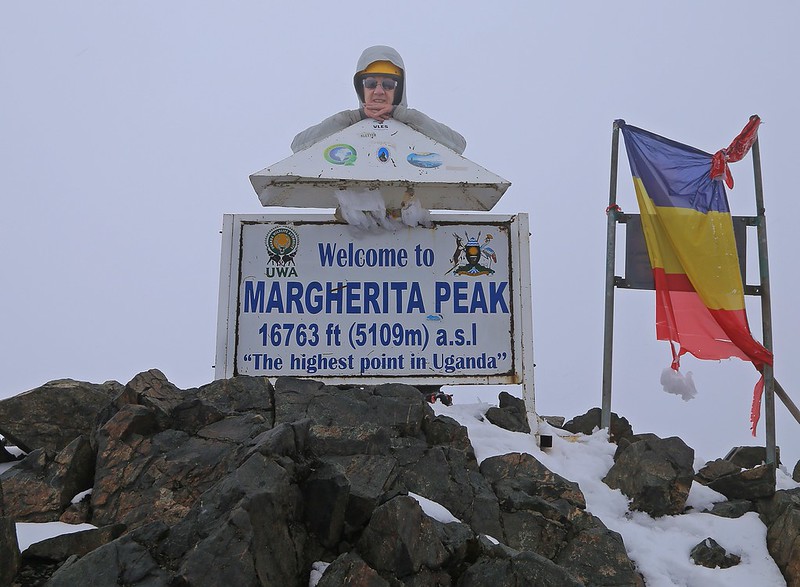
Margherita Peak at 5,109 meters is the primary summit objective for the most ambitious Rwenzori trekkers, and the timing of a Margherita expedition involves considerations that shorter itineraries do not share. On summit day, climbers must cross the Elena Glacier with crampons, ice axes, and rope, and the glacier is not a fixed surface. Its character changes seasonally, and those changes have practical implications for the safety and success of the crossing.
January and February: Primary Recommendation
The secondary dry season’s January and February window represents the most stable glacier conditions of the year and the primary recommendation for first-time Margherita Peak trekkers. In January and February, the Elena Glacier offers a firm ice surface and predictable crevasse distribution, allowing guides to establish safe crossing lines with unmatched consistency. Morning visibility at the High Camp is frequently excellent, summit day clear-sky probability is at or near its seasonal peak, and the approach from the Margherita High Camp to the glacier margin in the cold pre-dawn dark is managed with the most reliable footing conditions of the year.
June to August: Secondary Recommendation
The primary dry season’s June through August window is the second most recommended period for Margherita Peak expeditions and the busiest summit window in the Rwenzori calendar. Glacier conditions in July and August are generally very favourable summit day visibility is statistically higher than the wet season months, and the approach through the five vegetation zones in the drier conditions of the primary dry season is physically and logistically more comfortable than the wet-season alternative. The limitation of the July–August window is primarily logistical: it is the busiest period, private departure slots fill months in advance, and the mountain is most crowded.
Wet Season Margherita Expeditions
Margherita Peak expeditions in the wet seasons of March–May and September–November are viable with experienced guidance but present meaningfully greater challenges on the glacier. Wet-season ice conditions can lead to softer ice surfaces, more crevasse activity, and ice accumulation on the rocky approach sections to the glacier margin. Rwenzori Trekking Expeditions operates Margherita expeditions year-round but requires a specific pre-departure conditions consultation for wet-season bookings. The guide team’s assessment of glacier conditions in the week before a wet-season summit attempt is the determining factor in departure decisions.
Best Time for Wildlife in the Rwenzori Mountains

Birdwatching: September to November and March to May
The Rwenzori Mountains National Park supports over 217 bird species, of which 37 are Albertine Rift endemics. Birdwatching is outstanding year-round in the lower Afro-montane forest and bamboo zones, but the shoulder seasons of September through November and March through May produce the highest bird activity levels. The increased moisture and food availability in these periods drives increased feeding and territorial behavior, making birds more visible, more active, and more vocal than in the drier months. The Rwenzori Turaco, the African Green Broadbill, the Handsome Francolin, the Rwenzori Batis, and the Malachite Sunbird are all more reliably observed during these periods. For dedicated birding expeditions, Rwenzori Trekking Expeditions guides with specialist ornithological knowledge can design itineraries specifically timed for maximum species observation.
Primates: Year-Round
Blue Monkeys, Black-and-White Colobus Monkeys, and L’Hoest’s Monkeys are present and observable in the lower forest zones of both the Central Circuit Trail and Kilembe Trail throughout the year. Primate activity is not significantly seasonal in the Rwenzori range, as the forest provides food sources across every month. The key variable for primate observation is not month but pace: slower trekking with observation-focused guides produces significantly better primate encounters than faster-paced teams moving through the forest without stopping. Every Rwenzori Trekking Expeditions’ guide is a trained naturalist who adjusts pace and route to maximize wildlife observation on request.
Giant Lobelia and Groundsel Flora: Most Dramatic After Rains
The Afro-alpine moorland’s giant lobelias and giant groundsel trees are present year-round but are most dramatically lush and fully saturated after the wet seasons. Giant lobelias in May, their rosettes full of collected rainwater, and their spike inflorescences in full development have a biological intensity that the drier months cannot match. The Malachite Sunbird’s feeding activity on lobelia flower spikes is most frequent and most visible in the months when the lobelias are in active flower, typically from March through May and from September through October. Giant groundsels dripping with morning mist in the heather zone above John Matte Camp on a post-rain July morning are one of the defining landscape experiences of the Central Circuit trail and are available in some form throughout the year.
Best Time for Photography in the Rwenzori Mountains
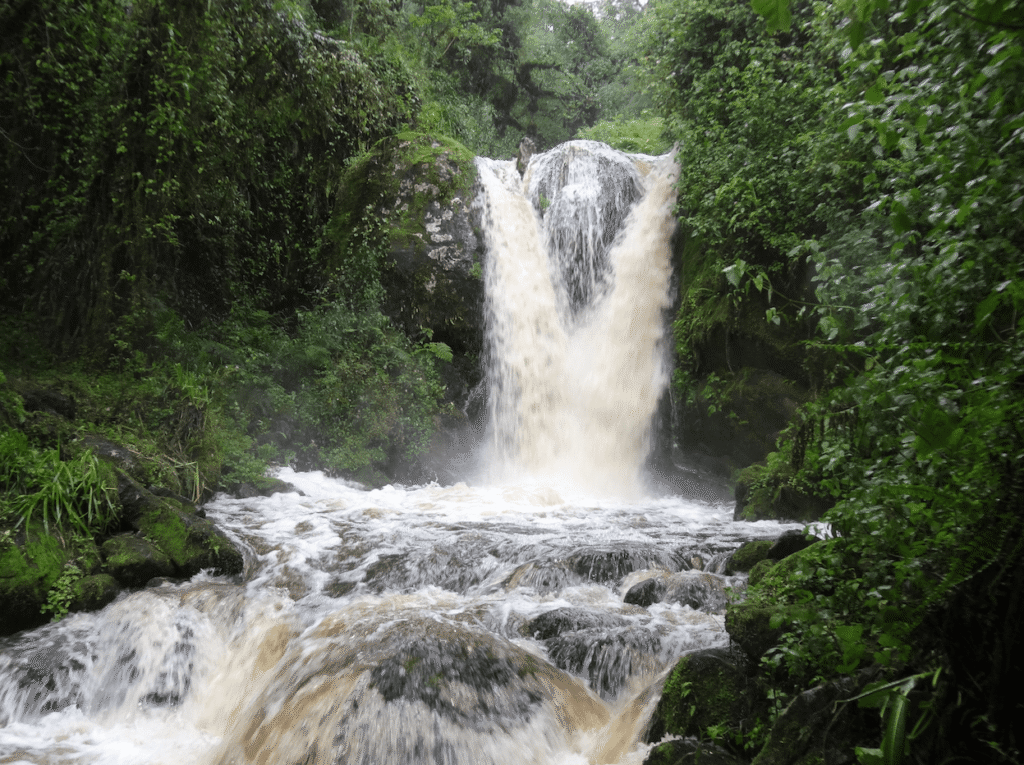
Lush Forest and Waterfall Photography: March to May
The long rains of March through May produce the Rwenzori’s most photogenic forest conditions. The depth of green, the moss saturation, the volume of the waterfalls, and the mist threading through the bamboo corridor and heather zone create photographic conditions that the dry season simply cannot replicate. Enock’s Falls at Sine Hut in April is among the most photographically compelling natural subjects in the Rwenzori range, a full-volume cascade through hanging ferns and lichen in the perpetual mist of its own making. The forest floors in the Nyabitaba and lower Central Circuit trail zones in March and April are carpeted with wild orchids and botanical detail that rewards wide-angle and macro photography equally.
Summit and Mountain Clarity Photography — June to August and December to February
For wide-angle mountain landscape photography, long-range summit panoramas, and the specific quality of clear-air light on the heather zone and glacier zones, the dry seasons produce conditions that the wet seasons cannot match. Morning light on the giant lobelias in the Bujuku Valley in July, viewed from the John Matte Camp ridge with Mount Stanley in the background, is a photographic subject of international quality. Pre-dawn glacier photography on the Elena Glacier during a January or July summit approach. The stars above, the ice surface catching the headtorch light, and the summit mass dark against the pre-dawn sky require no technical elaboration to justify. These conditions exist primarily in the dry season windows.
Atmospheric and Mist Photography: Year-Round, Peak in Wet Season
The Rwenzori’s perpetual mist is one of its most distinctive visual qualities, and mist photography rewards the trekker in every month. The morning mist clearing through the heather trees above Bukurungu Rock Shelter to reveal the Portal Peaks summit ridge, the cloud threading through the bamboo corridor at Sine Hut in the early afternoon, and the mist rising from the Nyamwamba Valley gorge at dawn—these are photographic subjects available in some form throughout the year but at their most dramatic and sustained in the shoulder and wet seasons.
Rwenzori Waterfalls: When Are They Most Impressive?
Waterfalls are among the Rwenzori Mountains‘ most celebrated visual features, and their character is one of the most dramatically seasonal aspects of the mountain experience. Enock’s Falls at Sine Hut on the Kilembe Trail, the Namusangi Valley falls above Mutinda Camp, and the unnamed cascades in the Nyamwamba Valley gorge are at their most spectacular during and immediately after the wet seasons, March through May and September through November. In peak wet season, these waterfalls operate at full volume: thunder rather than cascade, mist rather than spray, filling the valley below with both sound and atmosphere. The Kilembe Trail’s waterfall sequence in April is one of the finest waterfall experiences in East Africa.
In the dry seasons, the same waterfalls run at reduced volume but are still visually impressive and far more accessible; the approach paths are firmer, the viewpoints are clearer, and the photography benefits from better light conditions without the mist and rain that can make wet-season waterfall photography technically challenging. The guide team recommends both seasonal experiences for different reasons: wet season for drama and volume, and dry season for access and light.
Seasonal Flora: How the Rwenzori Landscape Changes Through the Year
The Rwenzori’s botanical character is profoundly seasonal in a way that rewards repeat visitors and surprises first-timers who expect an equatorial forest to be uniform throughout the year. In the wet seasons, the lower Afro-montane forest reaches its maximum photosynthetic intensity, every surface saturated, the canopy dense and dripping, the forest floor an unbroken carpet of liverwort, moss, and emerging seedlings. Wild orchids flower prolifically in the March through May period in the bamboo and lower heather transition zones. Giant lobelias are in active spike development between March and May and again in September through October, producing their most dynamic ecological appearance during these periods.

In the dry seasons, the forest pulls back slightly from its wet-season intensity, the moss surfaces dry to a paler, more silvery green, the bamboo zone loses the dripping aliveness of the wet season, and the heather zone’s Usnea lichen shifts from vivid silver-green to a drier, more muted grey. This seasonal shift in color temperature is one of the landscape photography considerations that experienced Rwenzori photographers account for when choosing their shooting month, wet season for saturation, and dry season for clarity and contrast.
Best Time for Specific Rwenzori Treks
Trek / Itinerary | Duration | Best Season | Viable Year-Round? | Season Notes |
Lake Mahoma Trek | 2 days | Jun–Aug & Dec–Feb | Yes. | The trail is muddier in the wet season; the forest is lush and atmospheric. |
Sine Camp Trek (Kilembe) | 2 days | Jun–Aug & Dec–Feb | Yes. | Enock’s Falls is more dramatic in the wet season; the approach is steeper in mud. |
Sine & Samalira Camp | 3 days | Jun–Aug & Dec–Feb | Yes. | Bamboo zone is very atmospheric in rains; heather is beautiful year-round. |
Portal Peaks Trek | 6 days | Jun–Aug & Dec–Feb | Yes. | Summit rocks are slippery when wet; extra care on Day 4 in the wet season. |
Baker & Weismann (Kilembe) | 7 days | Jan–Feb & Jun–Aug | Yes (with guidance) | The baker upper section can ice in the wet season; guide assessment is critical. |
Margherita—Kilembe Trail | 7 days | Jan–Feb & Jun–Aug | Yes (with guidance) | Glacier conditions are most stable Jan–Feb; wet season adds ice risk. |
Margherita — Central Circuit | 9 days | Jan–Feb & Jun–Aug | Yes (with guidance) | The 9-day structure supports better acclimatisation; it is the most popular route. |
4-Peak Expedition | 10 days | Jan–Feb & Jun–Aug | Specialist only | Full expedition; guide assessment of conditions is paramount |
Best Season by Traveller Type
The right month depends not only on conditions but also on what each traveller is specifically seeking. The guide below matches traveller profiles to the seasons that are most likely to deliver their ideal experience:
Traveler Type | Recommended Season | Why |
First-Time Trekkers | June–August or January–February | Firmest trails, most predictable conditions, highest guide availability |
Summit Climbers (Margherita) | January–February or June–August | Most stable glacier conditions; best summit day visibility |
Birdwatchers | September–November or March–May | Peak bird activity, seasonal movement, excellent forest conditions |
Photographers | March–May (lush/waterfalls) or June–Aug (clarity) | Different photographic rewards each season — both outstanding |
Families with Children | June–August | Warmest and most stable; best for shorter trails and comfort |
Wildlife Observers | Year-round; September–November best for birds | Primates year-round; birds most active in shoulder seasons |
Solitude Seekers | March–May or September–November | Fewer trekkers; wilder, quieter trails; more atmospheric conditions |
Adventure Trekkers | Any month with preparation | The Rwenzori is a year-round destination for the well-equipped |
Honeymoons / Couples | December–February | Quieter trails, New Year ambience, excellent scenery, romantic camps |
Month-by-Month Comparison Table
Month | Trekking | Photography | Wildlife | Crowd Level | Summit Suitability |
January | Very Good | Very Good | Good | Moderate–High | Very Good |
February | Very Good | Very Good | Good | Moderate | Very Good |
March | Good | Excellent (lush) | Good | Lower | Moderate |
April | Moderate | Good (waterfalls) | Good | Low | Moderate |
May | Moderate | Good (waterfalls) | Good | Low | Moderate |
June | Very Good | Good—Very Good | Good | Moderate–High | Very Good |
July | Very Good | Very Good | Good | High | Very Good |
August | Very Good | Very Good | Good | High | Very Good |
September | Good | Good | Very Good (birds) | Moderate | Good |
October | Good | Good | Very Good (birds) | Moderate | Good |
November | Good—Very Good | Good | Very Good | Lower | Good—Very Good |
December | Very Good | Very Good | Good | Moderate | Very Good |
Seasonal Packing Guide: What to Bring (Pack & Wear) for Each Season
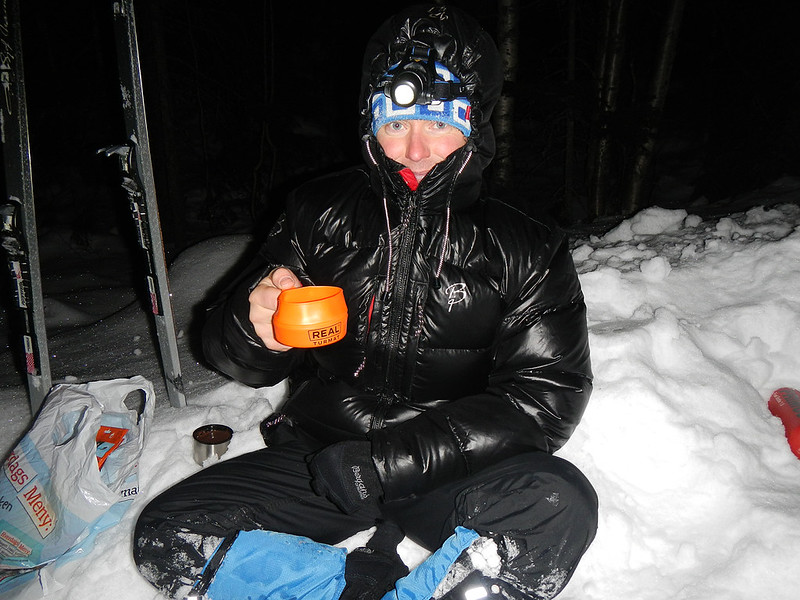
The single most important packing principle for the Rwenzori Mountains in any season is waterproofing. A fully waterproof hardshell jacket with sealed seams, waterproof shell trousers, and a waterproof pack liner are non-negotiable in every month. The Rwenzori is the wettest mountain range in East Africa, and the difference between seasons is not the presence or absence of rain but its frequency and duration. Cotton is not appropriate at any time of year on any Rwenzori trail.
Dry Season Packing (June–August & December–February)
In the dry seasons, the layering system can be slightly lighter in the lower forest zones, and the temperature is more consistently warm at the trailhead and in the bamboo zone, but the high camp and summit requirements remain unchanged regardless of season. A waterproof jacket (still essential even in the dry season), a fleece or insulated mid-layer, a moisture-wicking base layer, and a warm summit insulation jacket for high camp nights above 4,000 metres are the core layers for any dry-season Margherita Peak expedition. Trekking poles, gaiters, and a sleeping bag rated to -5°C for high-camp nights are standard across all seasons. Sun protection, SPF 50 sunscreen, UV-rated sunglasses, and lip balm, is more critical in the dry season when UV exposure through clearer skies is at its highest.
Wet Season Packing (March–May & September–November)
Wet season packing adds specific items to the standard kit. Waterproof gaiters become essential rather than recommended; the lower forest trails in April and May produce mud that enters boots without gaiters within the first hour. Additional waterproof socks or wool sock pairs are important for managing foot moisture across long trail days. A waterproof cover for the camera bag or a fully waterproof camera housing is a practical priority for photographers. Rubber gumboots, provided free at both Nyakalengija and Kyanjuki trailheads, are the footwear of choice for the guide and porter teams in wet conditions and are strongly recommended for trekkers in the wetter months. Extra dry bags for sleeping bags and spare clothing protection are essential. The overall layering system remains the same as the dry season; the addition of wet-season-specific items adds modest weight to the pack but makes an extraordinary difference to the experience.
How Season Affects Trail Difficulty
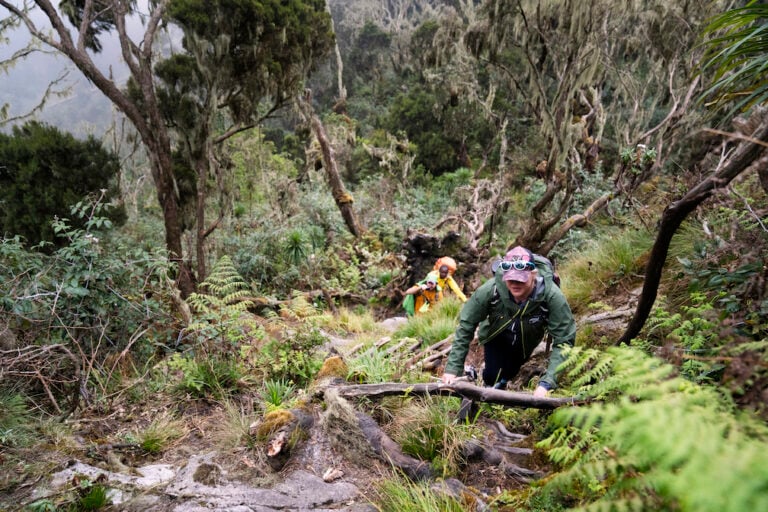
Seasonal conditions change the physical demands of Rwenzori trekking in specific and meaningful ways. In the dry season, trail surfaces are firmer, rooted sections are easier to navigate, river crossings are at their safest levels, and the overall physical effort required to cover the same distance is measurably lower than in the wet season. The steep approach sections, below Sine Hut on the Kilembe Trail and below Nyabitaba on the Central Circuit Trail, are significantly more demanding when the roots are wet and the ground is saturated. The Bamwanjara Pass crossing at 4,450 meters, exposed and wind-affected in any weather, is more challenging in wet conditions when the rock surfaces are slippery and visibility is reduced.
In the wet season, the daily pace slows, not because trekkers are less fit but because the terrain requires more deliberate footwork, more rest stops to allow surface conditions to be read carefully, and more frequent use of trekking poles and careful crampon-like engagement with the root and rock surfaces. The wet season in Rwenzori is not more dangerous for well-prepared trekkers with appropriate equipment; it is more demanding, more technical at the level of footwork, and more fatiguing over a full trail day. The guide team’s pace management in wet conditions is one of the key differentiators between operators: a well-paced wet-season trek is exhausting but manageable; a poorly-paced one is unnecessarily punishing.
First-Hand Seasonal Insights from the Trail
These observations come from years of guiding on both the Central Circuit trail and Kilembe Trail every month of the year. They are practical rather than absolute, the mountain does not follow rules, but they reflect patterns that repeat consistently enough to be useful planning tools.
Morning Light and Afternoon Cloud
Across all seasons, the Rwenzori Mountains follow a broadly consistent diurnal pattern: mornings tend to be clearer, with cloud building from the Congo basin during the afternoon and reaching the higher elevations by mid-afternoon. Summit day pre-dawn departures from the Margherita High Camp, timed for 2:00–3:00 AM, are specifically structured around this pattern: reaching the summit in the clear early-morning window before the afternoon cloud arrives. This pattern is most consistent in the dry seasons but is observable to some degree even in the wet season months. The practical implication for photography is that morning light is almost always available. Plan high-camp photography for first light and be prepared for the afternoon to close in.
The Bamboo Zone is Always Atmospheric
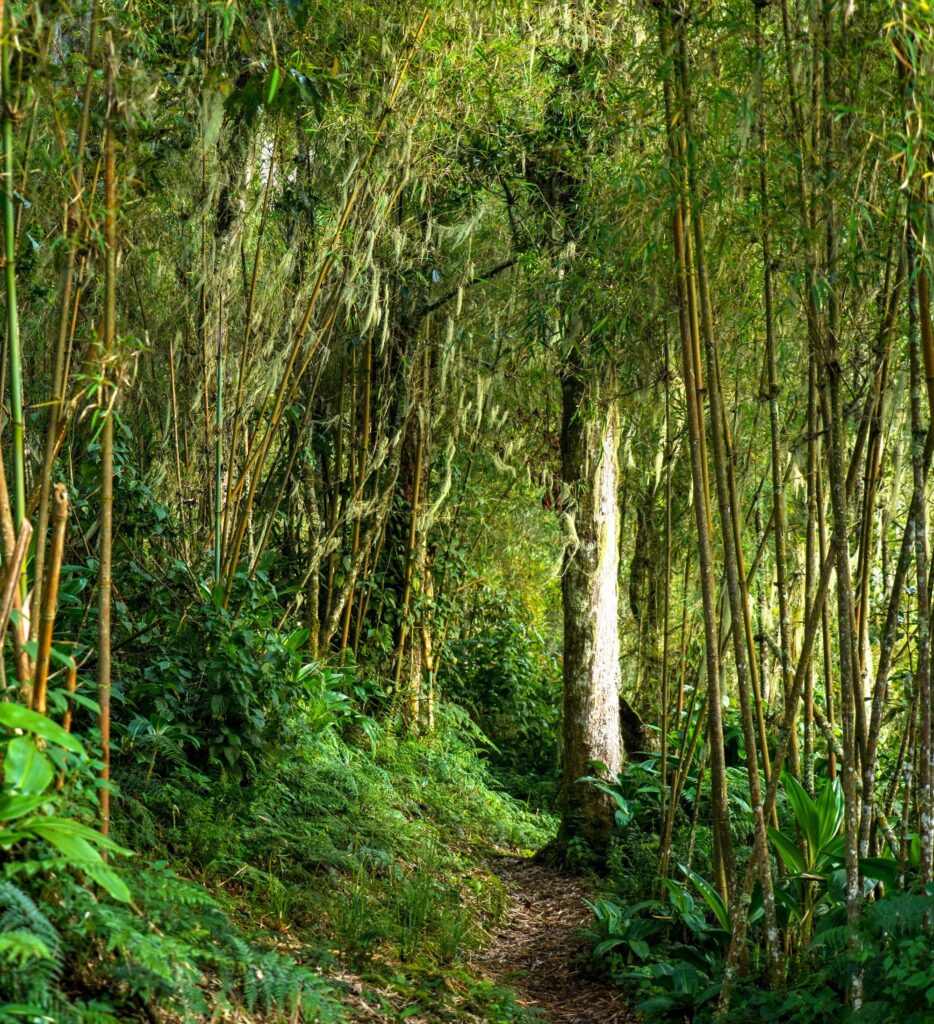
Regardless of season, the bamboo zone on the Kilembe Trail between Sine Hut and Kalalama Camp is one of the most memorable sections of any trail on the mountain. In the wet season it drips and whispers; in the dry season it clicks and filters light in precise shafts. The three-horned chameleons that inhabit it are present year-round. You can reliably hear the Rwenzori Turaco here in all months. The guide team consistently recommends slowing to observation pace in this zone regardless of the day’s schedule, it rewards the slowest walker most generously.
High Camp Nights Are Always Cold
Whatever the season, a night at the Margherita High Camp at approximately 4,800 meters is a cold experience. Wind chill can reduce effective temperatures to below -10°C in any month. The sleeping bag rated to -5°C is the minimum in the dry season and should be considered the baseline rather than the maximum across all seasons. The guide team has seen trekkers under-equipped for summit nights in July, the warmest, most popular month, who spent a miserable night too cold for genuine rest before the hardest day of the expedition. Pack for cold always, regardless of month.
Flexibility is the Most Important Planning Skill.
The Rwenzori consistently rewards trekkers who hold their plans loosely. Weather windows that do not appear in the forecast open unexpectedly. Summit days that trekkers planned under clear clouds before they reached the glacier. Mornings that promised rain produce extraordinary light. The guide team’s ability to read the mountain’s specific signals, the cloud formation character above Bamwanjara Pass at 4:00 AM, the wind direction at the Margherita High Camp before departure, and the colour of the eastern sky from the Elena Glacier at 5:00 AM, is accumulated knowledge that no weather app provides. Trusting the guide and holding the plan flexibly is the planning attitude that the mountain consistently rewards.
Recommended Itineraries for Each Season
The following itinerary recommendations match specific Rwenzori Trekking Expeditions packages to the seasons where they deliver their most complete experience.
June to August:Primary Dry Season Itineraries
The 9-Day 3-Peaks Central Circuit to Margherita Peak, Mount Speke, and Mount Baker is the signature expedition for the primary dry season. July’s stable glacier conditions, clear summit day visibility, and consistently firm trails make it the optimal month for this ambitious multi-peak itinerary. The 7-Day Kilembe Trail to Margherita Peak offers an equally compelling summit in a more focused point-to-point structure. For families and first-timers, the 6-Day Portal Peaks Trek via the Central Circuit delivers two 4,000-meter summits in excellent dry-season conditions without glacier demands. Contact Rwenzori Trekking Expeditions at trek@rwenzoritrekkingexpeditions.com to confirm July availability well in advance.
December to February: Secondary Dry Season Itineraries
January and February are the primary recommendations for first-time Margherita Peak trekkers; both the 7-Day Kilembe Trail and the 9-Day Central Circuit expeditions benefit from January’s particularly stable glacier conditions. The 2-Day Lake Mahoma Trek in December, with the secondary dry season’s clear morning views from the crater lake shore and the quiet of the Christmas and New Year trail period, offers the finest short Rwenzori experience of the year for couples and small groups wanting an intimate mountain encounter during the festive season.
March to May: Long Rain Season Itineraries
The 3-Day Sine and Samalira Camp Trek on the Kilembe Trail is at its most atmospheric in April, with Enock’s Falls in full flood, the bamboo zone dripping, and the heather zone wreathed in mist. The 2-Day Sine Camp Trek is the finest entry-level wet-season Rwenzori experience: the waterfall drama is at its peak, the forest is extraordinary in its lushness, and the two-directional forest traverse rewards the slower, observation-focused pace that wet-season conditions both require and reward. Photography-focused trekkers in May find the 6-Day Portal Peaks Trek delivers a combination of lush forest ascent and close-range high mountain views that the dry season’s clearer but drier conditions provide differently.
September to November: Short Rain Season Itineraries
September through November is the birdwatching season in the Rwenzori Mountains, and the 2-Day Lake Mahoma Trek combined with a dedicated lower forest birding morning from the Nyakalengija trailhead area is the recommended specialist birdwatching package. The 6-Day Portal Peaks Trek in October and November, with its extended forest approach and two days in the heather and alpine zones, provides excellent species diversity across four vegetation zones. The guide team can design a pace specifically calibrated for birding observation on any itinerary in this season.