The Central Circuit Trail Route is the most popular and traditional trekking trail, leading through the five vegetation zones to Margherita Peak (5,109 m) in the spectacular Rwenzori Mountains National Park in western Uganda. The Central Circuit is a multi-day trekking route that takes hikers deep into the heart of this UNESCO World Heritage Site, offering access to some of the most breathtaking scenery in Africa, including Mount Stanley, Mount Speke, Mount Baker, glacial valleys, alpine lakes, and the iconic Margherita Peak (5,109m), the third-highest mountain summit in Africa.
Often referred to as the “Mountains of the Moon,” the Rwenzori Mountains are one of Africa’s most extraordinary mountain ranges, renowned for their snow-capped peaks, glaciers, giant lobelias, unique alpine landscapes, and exceptional biodiversity.
Rwenzori Trekking Expeditions curates guided Rwenzori trekking safaris along the Central Circuit trail for adventurous travelers seeking a challenging and rewarding mountain experience, which provides the most comprehensive introduction to the Rwenzori Mountains, as well as combining stunning scenery, diverse ecosystems, and unforgettable summit opportunities.
Why Choose the Rwenzori Central Circuit Route?
Rwenzori Trekking Expeditions recommends the Central Circuit Trail Route as the best trekking route in the Rwenzori Mountains, offering the most complete mountain experience.
Unlike shorter hiking trails, this route traverses multiple vegetation zones, crosses dramatic mountain passes, and provides access to several major peaks within the Rwenzori range.
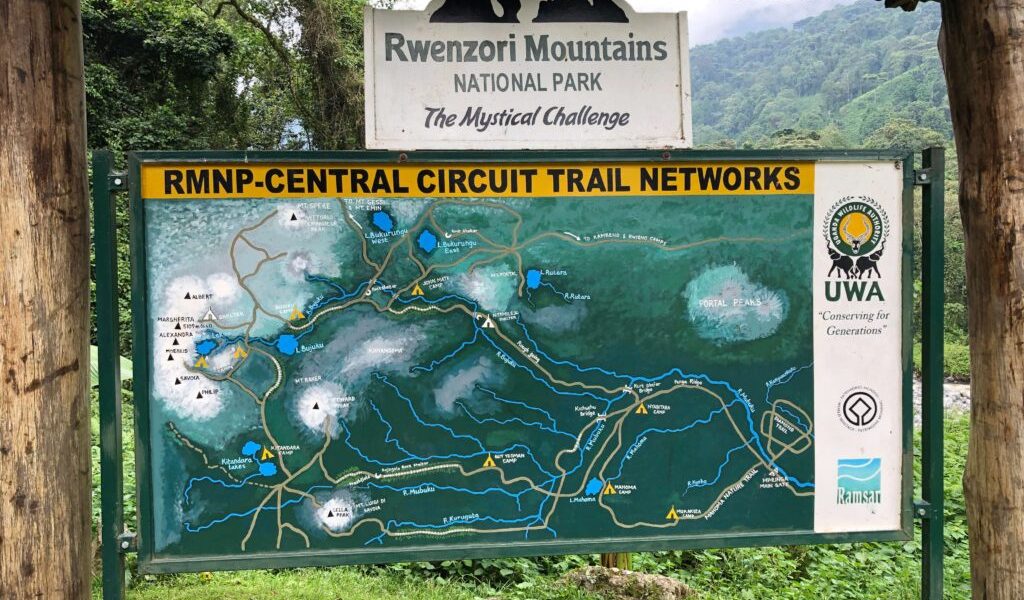
The Rwenzori Central Circuit Trail Route Guide
There are trails in this world that take you through the beautiful scenery of the Rwenzori Mountains. And then there is the Rwenzori Central Circuit route, a trail that takes you through 5 distinct vegetation zones of Rwenzori, stacked in vertical succession on the flanks of Africa’s most mysterious mountain range, each so different from the last that you will struggle to believe they share the same mountain. In a single expedition that typically lasts five to nine days, this 55-kilometer clockwise loop through the heart of Rwenzori Mountains National Park takes trekkers from equatorial forest filled with birdsong at 1,615 meters, through bamboo corridors and cathedral heather draped in lichen, past fields of giant lobelias and prehistoric groundsel trees, to the glaciated shoulders of Mount Stanley at over 5,000 meters, where crampons bite into ancient ice and the silence belongs to a place very close to the edge of the world.
The Central Circuit trail route is the oldest route on the Rwenzori, managed by the community-based Rwenzori Mountaineering Services (RMS) through the Mihunga gate near Nyakalengija, and it remains the most complete, most storied, and most rewarding trekking experience in Uganda, where Rwenzori Trekking Expeditions offers several Rwenzori trekking excursions. The central circuit trail is built for solo travelers who want the mountain to themselves; for couples chasing an experience that will define the years ahead; for families with teenagers ready to be challenged, and for groups who understand that the hardest things done together become the most treasured memories. Every version of this journey that departs with Rwenzori Trekking Expeditions is privately guided, seamlessly arranged, and shaped around the people walking it—because no two expeditions on the Mountains of the Moon should ever feel the same.
“The Central Circuit does not simply show you the Rwenzori. It takes you through it all, from the first bird call in the forest to the last step on the glacier. |
Central Circuit Trail: At a Glance
Route Type | Clockwise loop—same start and end point (Nyakalengija/Mihunga Gate) |
Total Distance | Approximately 55 kilometers round-trip |
Altitude Range | 1,615 m (Trailhead) to 5,109 m (Margherita Peak, Mount Stanley) |
Duration Options | 5 days (lower circuit) / 6 days (Weismann Peak) / 7 days (Margherita Peak) / 8–9 days (multi-summit) |
Difficulty | Moderate to strenuous—7-day Margherita summit requires glacier travel |
Managed By | Rwenzori Mountaineering Services (RMS)—community-based operator through Rwenzori Trekking Expeditions |
Entry Point | Mihunga Gate, Nyakalengija, near Kasese, western Uganda |
Vegetation Zones | 5 distinct zones: Montane Forest / Bamboo / Giant Heather / Afro-Alpine / Nival |
Camp Huts | 6 huts: Nyabitaba · John Matte · Bujuku · Elena · Kitandara · Guy Yeoman |
Best Months | January–February (summit clarity) and June–August (reliable dry season) |
Peaks Accessible | Mount Stanley (5,109m), Mount Speke (4,890m), Mount Baker (4,843m), Mount Luigi di Savoia (4,627m) |
Park Status | UNESCO World Heritage Site / Ramsar Wetland of International Importance |
How to Get to the Central Circuit Trail
The Central Circuit Trail begins at the Rwenzori Mountaineering Services compound near Nyakalengija, at the base of the mountains approximately 22 kilometers from Kasese town in western Uganda. Kasese is the gateway town for all Central Circuit expeditions, and every logistical thread, from airport transfer to permit collection to morning departure, is drawn together here before the mountain begins.
Overland from Entebbe or Kampala
Entebbe International Airport sits approximately 420 kilometres from Kasese, a drive of five to six hours by your dedicated private vehicle along Uganda’s western highway, passing through Fort Portal and the verdant foothills of the Rwenzori as you approach from the east. This overland journey is not merely transit: the western Uganda landscape has a beauty of its own, and many of Rwenzori Trekking Expeditions‘ clients request a break stop in Fort Portal for lunch, a stretch, and a first proper view of the mountains that now dominate the western skyline. Your vehicle and driver are arranged as part of your expedition package, with timing calibrated to your arrival flight so that every connection is seamless and unhurried.
By Charter Flight to Kasese
For travelers combining the Central Circuit trail with a broader Uganda itinerary, gorilla trekking in Bwindi Impenetrable Forest, wildlife game drives in Queen Elizabeth National Park, and chimpanzee tracking in Kibale Forest, a charter flight from Entebbe or Kajjansi Airfield to Kasese Airfield reduces travel time to under an hour and transforms the approach into an experience in its own right. The aerial view of the Rwenzori from a small charter aircraft, with the range’s glaciated summits visible on clear days, is one of those moments that arrives before the trek has even begun. We coordinate all aviation logistics on request. Explore our Rwenzori trekking safaris here.
Uganda Visa and Park Permits
All international visitors require a valid Uganda entry visa, applied for online through the Uganda Immigration Services portal at least three to four weeks before arrival. An East African Tourist Visa, covering Uganda, Kenya, and Rwanda under a single document, is available for multi-country travelers and is worth considering if the Rwenzori forms part of a wider East African journey. Uganda Wildlife Authority national park entry fees and Central Circuit Trail climbing permits are included in all Rwenzori Trekking Expeditions packages and arranged in advance by our team. You arrive at the Mihunga gate with everything confirmed and nothing left to sort out.
Trail Difficulty and Physical Preparation
The Central Circuit trail is neither a casual walk nor a technical mountaineering expedition, at least not for most of it. The honest answer to the question of difficulty is that it depends almost entirely on which version of the circuit you are undertaking.
Lower Circuit (Days 1–3): Moderate
The first three days of the Central Circuit, from Nyakalengija to Nyabitaba, John Matte, and Bujuku camps, fall into the moderate hiking category. The trails are well-maintained where they are not boggy, the altitude gain per day is manageable (approximately 850–1,300 meters net), and the extraordinary vegetation makes every kilometer genuinely engaging rather than merely effortful. A trekker who regularly walks or hikes on weekends and has no significant altitude experience can comfortably reach Bujuku Camp at 3,962 meters with adequate preparation.
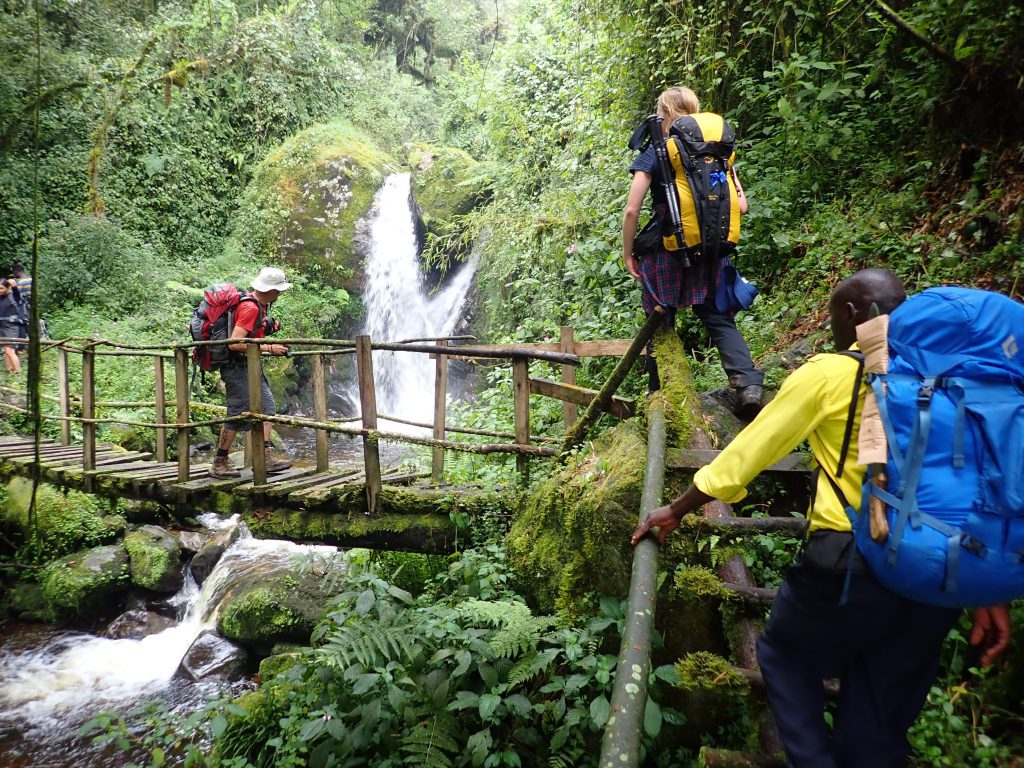
The bogs between John Matte and Bujuku are the one section where ‘comfortable’ gives way to ‘entertaining,’ rubber boots are provided, and your attitude in navigating the ankle-deep black mud significantly determines the quality of the experience.
Upper Circuit (Days 4–5): Strenuous
The ascent to Elena Camp at 4,541 meters and the summit day on Margherita Peak (5,109 m) are where the Central Circuit Trail earns its serious reputation. The altitude becomes a genuine presence above 4,000 meters; oxygen at Elena Camp is approximately 58% of sea-level concentration, and the body’s response to that reality varies considerably from person to person. Summit day begins at 2:00 a.m., involves twelve or more hours of cumulative effort, glacier travel on crampons with fixed ropes and ice axes, and the kind of relentless altitude that turns ordinary fatigue into something requiring active management. Prior experience at altitudes above 3,000 meters is strongly recommended. A fitness base that includes regular multi-day hikes with significant daily elevation is more valuable than any amount of gym work.
Physical Preparation Timeline
Six months before departure: establish a consistent aerobic base, running, cycling, swimming, or fast walking for a minimum of four hours per week. Four months before: introduce regular hiking with elevation gain, targeting at least 600–800 meters of ascent per outing. Two months before: complete at least two multi-day back-to-back hiking days to condition the body for consecutive effort. One month before: reduce intensity but maintain frequency. Arrive rested, not depleted. Our preparation guide, available on our Rwenzori fitness preparation page, outlines week-by-week training frameworks for all fitness starting points.
The Five Vegetation Zones: A Step-by-Step Trekking Story
The Rwenzori Central Circuit Trail is at its most fundamental level, a journey through five entirely different vegetation zones. Unlike any other trekking route in Africa, it compresses an ecological range equivalent to travelling from equatorial Uganda to the Arctic tundra into a single continuous trail. Each zone announces itself through changes in light, temperature, sound, and smell before a single plant species comes clearly into view. Walking them in sequence, ascending over days, with transitions that are gradual and then suddenly total, is the experience that Rwenzori trekkers describe most vividly years after returning home.
MONTANE FOREST ZONE 1,615m – 2,500m | The Montane Forest zone marks the start of the Central Circuit trail route. From the Mihunga gate at Nyakalengija, the trail moves through a patchwork of Bakonzo farmland, banana groves, tea plots, maize gardens neat in the morning light, before the national park boundary swallows the path in a transition that feels like stepping through a curtain. The forest closes overhead: ancient trees draped in moss, the canopy at least thirty metres above, the air suddenly cooler and richer with the smell of wet earth and decomposing leaves. Chimpanzees call from somewhere above and ahead; the sound bounces through the forest and disappears. Black-and-white colobus monkeys pass overhead in long, slow arcs. The Rwenzori turaco announces itself in a flash of crimson-and-green that no field guide quite prepares you for. The Mubuku River runs below the trail, audible rather than visible through the dense vegetation, and the sound of it becomes the rhythm of the first day. Nyabitaba Camp, on its commanding forested ridge at 2,651 meters, is a warm arrival after six hours in this cathedral. On clear evenings, the peaks above are briefly visible from the camp ridge, their glaciers catching the last light before cloud reclaims them. |
BAMBOO FOREST ZONE 2,500m – 3,000m | The Bamboo Forest zone begins after the Kurt Schafer Bridge crossing on Day 2, a wooden bridge over the Mubuku-Bujuku river confluence that marks both a geographical and psychological threshold. The forest character changes immediately: bamboo stems replace broad-leaved trees, creating a natural architecture of vertical green lines and filtered golden light. The path narrows. The sounds of the lower forest, including layered bird calls and primate movement, yield way to the softer percussion of bamboo stems shifting in the breeze and the constant presence of the Bujuku River below the trail. This Bamboo Forest zone is beautiful in a precise, geometric way; the forest feels designed rather than wild, though nothing human has shaped it. At the Nyamileju Rock Shelter, a natural overhang used as a waypoint for over a century of Rwenzori travel, lunch is taken and, on clear days, the first unobstructed views of the high peaks arrive. Mount Stanley’s glaciers are visible to the west. Mount Speke’s dark buttresses rise to the northeast. The mountain that has been behind clouds since Nyakalengija suddenly has a face, and the circuit becomes unmistakably, irrevocably real. |
GIANT HEATHER ZONE 3,000m – 3,800m | The Giant Heather zone is where the Rwenzori begins to reveal what makes it categorically different from any other mountain in Africa. Erica arborea, the heather that in Scotland reaches a shingled height, here grows into trees fifteen meters tall, their trunks twisted and dark, their branches draped with long curtains of old man’s beard lichen that swing in the mountain air like something from a fever dream. The forest is ancient and completely itself; it has not been shaped by human ideas of what woods should look like, and moving through it requires a readjustment of ordinary scale. The light is filtered and green-gold. Sound behaves differently here: voices carry less far, bird calls seem to come from directly above, and the drip of moisture from the lichen is constant and meditative. By late Day 2 and into the morning of Day 3, the heather yields way to the first giant lobelias, Lobelia wollastonii, which rise in silver spires from the increasingly saturated ground. The Bigo Bogs begin: the Central Circuit Trail’s most infamous terrain feature, a section of waterlogged moorland crossed by jumping between tussocks of grass, the black water gleaming between them. This section is where rubber boots earn their passage. The bogs are navigated on boardwalks where they exist and by reading the terrain carefully where they do not. They are messy, they are memorable, and every trekker who has crossed them mentions them alongside the summit. |
AFRO-ALPINE MOORLAND ZONE 3,800m – 4,500m | The Afro-Alpine Moorland is the Rwenzori at its most alien. Above the bogs, as the vegetation thins and the sky opens, Dendrosenecio adnivalis, the giant groundsel, stands in groups of six and ten and twenty, their bare trunks topped with enormous cabbage-like rosettes that can be two meters across. The effect is Jurassic: a landscape that looks designed by evolution in the specific absence of human observers, that has been doing exactly this work for millions of years, and that requires no audience. Lake Bujuku appears below the trail on Day 3, a glacial lake whose turquoise surface reflects Mount Stanley’s western flanks perfectly on calm mornings. Bujuku Camp, at 3,962 meters, is positioned in the center of the circuit’s most dramatic amphitheater: Mount Stanley to the west, Mount Speke to the northeast, and Mount Baker to the south. All three massifs are visible from camp simultaneously, one of the finest mountain viewpoints in East Africa that requires no climbing equipment to reach. The ascent from Bujuku to Elena Camp on Day 4 passes through the upper groundsel zone and Groundsel Gully, a steep, rocky climb that arrives at the highest hut on the circuit at 4,541 meters. Elena Camp is cold, austere, and magnificent. The glaciers of Mount Baker and Speke glow in the last light. The air has a quality of complete stillness that belongs only to places this far above the ordinary world. |
NIVAL ZONE 4,500m – 5,109m | The Nival Zone is where the Central Circuit trail becomes something apart from trekking. Above Elena Camp, the vegetation disappears entirely: rock, ice, and the occasional patch of hardy moss are all that remain of the biological world. At 2:00 a.m. on Day 5, headlamps move upward through a darkness of extraordinary density; the equatorial sky at 4,500 meters has a clarity that city-dwellers spend their entire lives never experiencing, and the stars are so numerous and brilliant that navigation by them alone is almost possible. The crampons go on within the first hour; the harnesses are checked; the rope connects the team. Three glaciers:the Elena, the Stanley Plateau, and the final summit approach—are crossed with your private guide on fixed ropes. The Stanley Plateau, at over 5,000 meters, is a broad field of ancient ice surrounded by a silence that has physical weight. The summit of Margherita Peak at 5,109 meters is reached at dawn on most summit days, the light arriving from the east across Uganda while the Congo Basin to the west is still in darkness, the last equatorial glaciers of Africa all around you, the glacial Lake Ireen visible far below on the western face. It is one of the most remarkable mountain moments on the African continent. And it is available to anyone who is willing to earn it, with the right preparation and the right team. |
The Rwenzori Mountain Ranges are visible from the Central Circuit.
The Central Circuit Trail passes beneath the flanks of four of the Rwenzori’s six major mountains. Understanding what you are looking at and from which camp or pass you can see it most clearly deepens your experience every day of the journey.
Mount Stanley 5,109 m — Highest | The dominant massif of the circuit, visible as an increasingly imposing presence from Day 2 onward. Mount Stanley carries eleven named summits, with Margherita Peak (5,109 m) and Alexandra Peak (5,091 m) the most prominent. Its Stanley Glacier forms the western wall of the Bujuku Valley and is best viewed from Bujuku Camp (Day 3) and Elena Camp (Day 4). The summit is reached on Day 5 via the Elena and Stanley glaciers. First climbed by the Duke of Abruzzi, June 18, 1906. Learn more on our Mount Stanley guide. |
4,890m — Second Highest | Positioned to the northeast of the Bujuku Valley, Mount Speke’s Vittorio Emanuele Peak is visible from Bujuku Camp in one of the circuit’s finest mountain compositions. Its dark rock buttresses catch the morning light in a way that makes them almost glow. Mount Speke’s summit is accessible on longer circuit variations of 8 or 9 days. From Elena Camp on Summit morning, Speke’s summit is already beneath you, offering a quietly astonishing perspective. |
Mount Baker 4,843m — Third Highest | Rising directly above the Kitandara Lakes to the south, Mount Baker’s Edward Peak creates the southern boundary of the upper circuit. The view of Baker’s western face reflected in the twin Kitandara Lakes on a calm evening (Day 5 camp) is one of the most photographed compositions in the Rwenzori. The approach to Freshfield Pass on Day 6 traverses the base of Baker’s southern flank; the panorama from the pass, with Kitandara below and Baker above, is the circuit’s finest non-glaciated viewpoint. |
Mount Luigi di Savoia 4,627 m—Weismann Peak 4,620 m | The southernmost massif visible on the Central Circuit, Mount Luigi di Savoia, carries the Sella and Weismann peaks. The 6-day Weismann Trek is a dedicated circuit variation that specifically targets Weismann Peak via the southern valley approach from Kitandara. This massif defines the skyline visible from Guy Yeoman Camp on Day 6 and provides a majestic southern gateway on the final descent. |
Mount Emin & Mount Gessi 4,798m / 4,715m | The northern massifs of the Rwenzori range, Mount Emin (Umberto Peak, 4,798 m) and Mount Gessi (Bottego Peak, 4,715 m), lie beyond the standard Central Circuit loop but are visible on clear days from the higher camps. They represent true wilderness mountaineering for those extending the circuit north—seldom climbed, rarely documented, and the genuine frontier of Rwenzori exploration. |
Where To Sleep/Stay: Accommodation Along the Central Circuit Trail
Six mountain huts, spaced at approximately one day’s hiking interval, provide the backbone of accommodation on the Central Circuit trail, including Nyabitaba Hut, John Matte Hut, Bujuku Hut, Elena Hut, Kitandara Hut and Guy Yeoman Hut. Rwenzori Mountaineering Services manages the accommodations along the Central Circuit Trail and has been built to withstand the range’s famously persistent weather. The huts provide solid, weatherproof shelter with sleeping platforms, foam mattresses, and communal cooking areas that your guide and cook team use. They are not luxury lodges. They are something better: authentic mountain shelters that have welcomed and dried out trekkers for decades and that carry the accumulated atmosphere of all those mountain days and hard-earned evenings.
Nyabitaba Hut Altitude: 2,651 m · Day 1 | Positioned on a forested ridge above the Mubuku River valley, Nyabitaba is the social gateway to the circuit, the hut where the mountain reveals its first real character. On clear evenings, the peaks above briefly emerge from clouds. Bird life in the surrounding forest is exceptional at dawn. A 15-minute walk from the hut leads to a viewpoint above the valley. This evening is the first night of the circuit, and the forest sounds that fill the dark, while insects, owls, and the occasional distant primate calls, are the introduction to a week of extraordinary sound. |
John Matte Hut Altitude: 3,505m · Day 2 | Named after a celebrated Ugandan mountaineer, John Matte sits above the Bujuku River on a rocky shelf with the first genuinely alpine character of the circuit. The heather zone begins just above camp, and on clear mornings, you can see the upper peaks over the ridgeline to the west. This is the hut where the altitude becomes a noticeable presence for the first time: a slight heaviness, a deepened quality of sleep. Your cook team prepares a warm dinner that earns its appreciation. |
Bujuku Hut Altitude: 3,962 m · Day 3 | The emotional heart of the Central Circuit. Positioned above Lake Bujuku in the most spectacular mountain amphitheatre on the route, Bujuku Camp offers simultaneous views of Mount Stanley to the west, Mount Speke to the northeast, and Mount Baker to the south, three of Africa’s most impressive mountain massifs visible from a single camp. Mornings here, when the lake below mirrors the surrounding peaks in perfect stillness before the wind arrives, are among the finest photographic moments in all of Uganda. Bujuku is also the acclimatisation camp before the push to Elena. Rest here is strategic as well as beautiful. |
Elena Hut Altitude: 4,541 m · Day 4 | The highest and most austere hut on the circuit, Elena sits on the rocky shoulder of Mount Stanley at 4,541 metres, exposed to the full character of the upper mountain weather. The hut provides critical shelter before and after summit day. On clear evenings, the glaciers of Mount Baker and Speke catch the last light from the door. Equipment briefings and crampon fittings take place here on the evening of Day 4. The cook rises before anyone else on Summit morning, ensuring breakfast inclyuding porridge, eggs, hot tea is waiting at 1:30 a.m. The 2:00 a.m. alarm will be the most important of the week. |
Kitandara Hut Altitude: 4,023 m · Day 5 (post-summit) | If Bujuku is the emotional heart, Kitandara is the circuit’s most beautiful camp. Set above the twin Kitandara Lakes in a valley ringed by the flanks of Stanley and Baker, it receives trekkers returning from summit day in a state of deep physical exhaustion and equally deep satisfaction. The lakes in the late afternoon, with the light changing by the minute and Mount Baker reflected in the still water, make this camp a place that rewards sitting quietly for twenty minutes before dinner. Sleep comes readily here. |
Guy Yeoman Hut Altitude: 3,261 m · Day 6 | Named after the botanist who contributed significantly to the documentation of Rwenzori flora, Guy Yeoman sits in a bamboo forest clearing on the descent from Freshfield Pass. Here, the descent from the pass arrives through high moss zones, past the Kichuchu cliff section, and alongside the Bujongolo Rock Shelter (the Duke of Abruzzi’s 1906 base camp), with the lower mountain already calling. The bamboo around the hut has a welcoming character that feels like the mountain beginning to release its hold. |
For accommodation before and after the circuit, Kasese offers several quality options suited to the gateway-town role it plays.
The Margherita Hotel, named for the very peak you will have climbed, provides comfortable rooms, hot water, and a restaurant that trekkers returning from the mountain speak of with genuine affection. The Ruboni Community Camp at the base of the mountains near Nyakalengija places you within earshot of the Mubuku River on the eve of departure, with the mountains rising immediately above, the nights extraordinarily quiet, and the morning start to the trailhead measured in minutes rather than kilometers. Our team coordinates both as part of your arrival and departure logistics. For all options in Kasese and the surrounding area, view our full accommodation guide.
Attractions and Highlights Along the Central Circuit
Lake Bujuku
At 3,977 meters in the upper valley, Lake Bujuku is a glacial lake of extraordinary clarity and stillness. Giant lobelias stand on its shoreline. On calm mornings, the lake’s surface reflects three of the Rwenzori’s greatest massifs. The approach from the north offers one of the most striking ‘reveal’ moments in African trekking, as the lake suddenly appears below when the trail crests the last ridge before Bujuku Camp.
The Twin Kitandara Lakes
Positioned at 4,023 meters in a valley between Mount Stanley and Mount Baker, the Kitandara Lakes have a quality of ceremonial stillness. They are best experienced in the late afternoon of Day 5, when the post-summit trekker arrives in a state of physical and emotional openness that makes the beauty of these lakes feel almost overwhelming. It is among the most photographed natural features in the Rwenzori.
Freshfield Pass
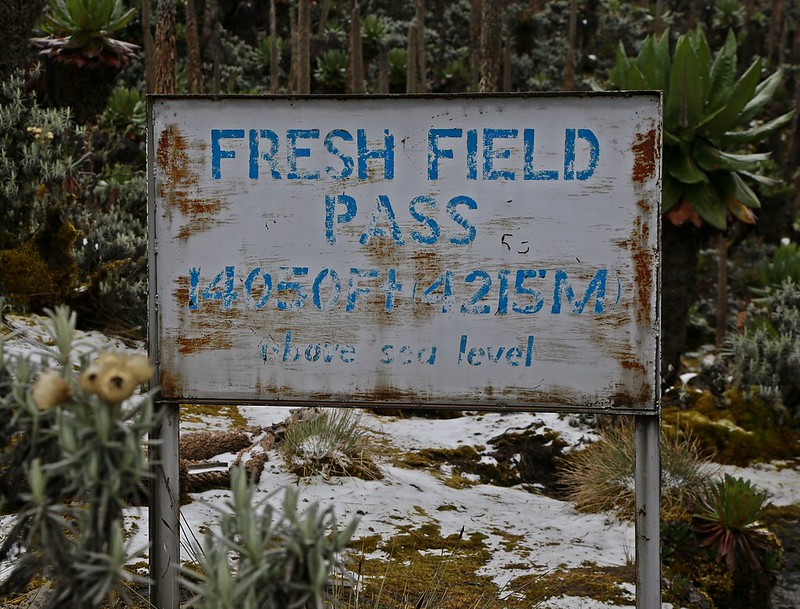
At 4,282 meters, Freshfield Pass is the highest non-glaciated viewpoint on the Central Circuit trail. On a clear day, the panorama south across the Kitandara Lakes and west into the Congo Basin offers one of the longest sightlines available to a trekker on foot in East Africa, rewarding those who complete the genuinely demanding ascent on Day 6. Your private guide will time the crossing for the clearest conditions of the morning.
Bujongolo Rock Shelter
A natural rock overhang on the descent from Freshfield Pass, Bujongolo served as the Duke of Abruzzi’s base camp during the 1906 expedition that produced the first recorded ascent of Margherita Peak. The shelter is unchanged. Standing here, with the same stone walls, the same mountain above, and the same sky, is a quietly historical moment that costs nothing and stays permanently.
The Bigo Bogs
The Upper and Lower Bigo Bogs, crossed on the approach to Bujuku Camp on Day 3, are the Central Circuit trails’s most characterful terrain feature. Navigating the saturated ground through fields of giant lobelias, jumping between grass tussocks with rubber boots and varying degrees of grace, is an experience that defines the Rwenzori in the memories of everyone who does it. Boardwalks help with the most difficult sections, while the right attitude and waterproof footwear cheerfully manage the rest.
Wildlife of the Forest Zones
The lower montane and bamboo forest zones of the circuit support chimpanzees, L’Hoest monkeys, black-and-white colobus monkeys, hyraxes, three-horned chameleons, and occasional forest elephants. The birdlife is among the finest in East Africa, with 217 species recorded in the Rwenzori Mountains National park, including the Rwenzori turaco (the mountain’s most celebrated endemic), handsome francolin, barred long-tailed cuckoo, Rwenzori double-collared sunbird, and strange weaver. Your private guide on the lower circuit is briefed to identify bird calls and locate wildlife in the canopy, a layer of experience that transforms the hiking days into something significantly richer. Read our dedicated Rwenzori birding and wildlife guide.

Best Time to Trek the Central Circuit Trail
The Rwenzori Mountains Range generates its own weather, a consequence of its equatorial position, its altitude, and its proximity to the moisture-laden Congo Basin. Rain falls in most months, to some degree, and any operator who tells you otherwise is not being entirely straight with you. What matters is understanding the seasonal rhythm and matching your objectives to it.
January and February — Optimal for Summit Attempts
These are the driest and clearest months of the year. Margherita Peak summit success rates are highest in this window, the glacier approaches are most stable, and the high-altitude light, sharp, cold, and crystalline, makes summit day photography extraordinary. This is the window chosen by trekkers for whom reaching Margherita Peak is a non-negotiable objective. Availability fills quickly: booking four to six months ahead is necessary for these dates.
June, July, and August: Peak Season, Reliable Conditions
The long dry season. The mountain is in full botanical bloom, the lobelias and groundsels at their most vivid, and the days long enough for comfortable afternoon arrivals at camp. The trail is busiest in these months, with the warmest atmosphere in the huts and the most experienced guides on the mountain. Families and groups consistently choose this window for its balance of reliable conditions and excellent company on the trail. Book three to four months ahead.
September to November and March to May, Wetter Windows
The transitional and wetter periods, with November and April representing the months of heaviest precipitation. The circuit is entirely walkable in these months, and experienced trekkers who choose them do so deliberately: the Rwenzori in mist and rain has an atmosphere unlike anything in the dry season, the solitude is complete, and the vegetation is impossibly lush. Summit day success rates drop significantly in these periods, and we are honest about that. For a forest and mid-mountain experience without a summit objective, these months carry a particular beauty that the drier seasons cannot quite replicate.
What to Wear and Carry (Gear) for the Central Circuit Trail
The Rwenzori’s reputation for wetness is deserved; it is one of the wettest mountain environments on earth. The gear you carry on the Central Circuit trail needs to be adequate for sustained rainfall at low altitude, mud of occasionally impressive depth, cold and wind at the upper camps, and genuine alpine conditions on summit day. The following outlines what matters most; a comprehensive packing list is provided to every confirmed client of Rwenzori Trekking Expeditions.
Footwear
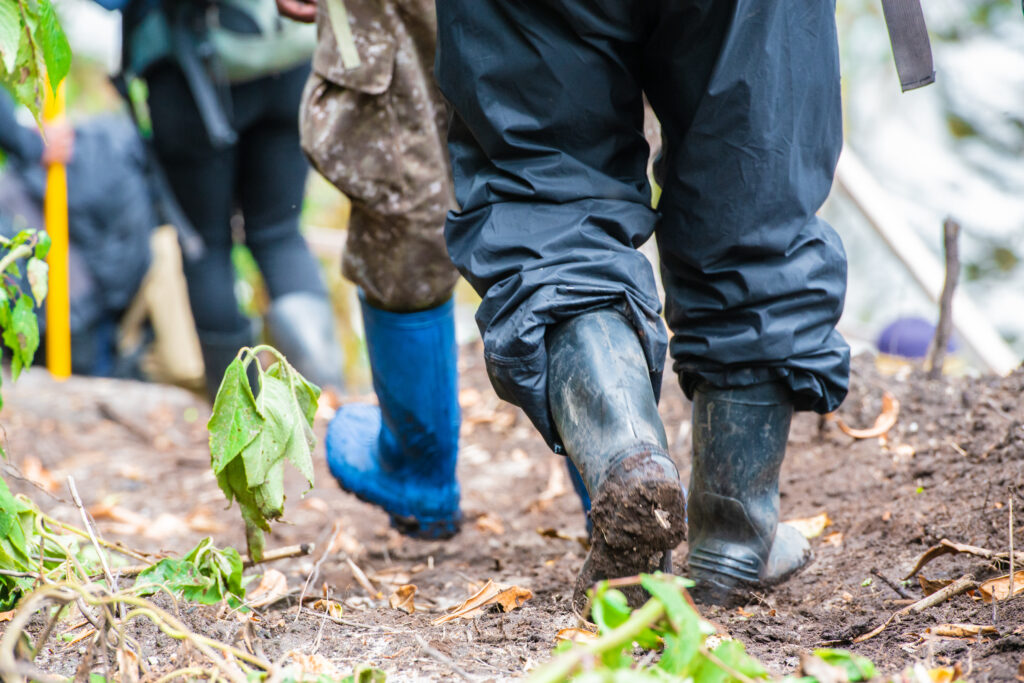
Rubber boots (gumboots) are not optional on the Central Circuit Trail; no waterproof hiking boot survives the Bigo Bogs with its contents dry. Complimentary rubber boots are provided to every client as part of all Rwenzori Trekking Expeditions packages; these are worn from Day 2 through the bog sections and lower mountain. Waterproof mountain hiking boots rated for rocky terrain are required from Day 4 upward and for the entirety of summit day. Crampons, provided by us, attach to your hiking boots for glacier travel on Day 5.
Sleeping Bag
A sleeping bag rated to a minimum of -10°C is required. Elena Camp, at 4,541 meters, is genuinely cold at night, and the difference between a -5°C bag and a -10°C bag on the night before a 2:00 a.m. Glacier departure is the difference between meaningful rest and shivering until the alarm. This region is not an area where the economy is rewarded.
Clothing System
Build a full layering system: moisture-wicking base layers (synthetic or merino wool, never cotton), a substantial insulating mid-layer (fleece or light down jacket), and a quality waterproof and windproof outer shell rated for sustained rain. Waterproof trousers are essential from Day 2 onward. A warm hat, liner gloves, and waterproof over-gloves complete the high-mountain kit. Gaiters reduce the amount of mud that reaches the inside of your boots on the bog sections.
Technical Summit Equipment: Fully Provided
All technical equipment for the glacier sections on Day 5 is provided by Rwenzori Trekking Expeditions as part of every Margherita Peak expedition: crampons, ice axes, harnesses, belay devices, fixed ropes, and helmets. A full equipment briefing and individual fitting take place at Elena Camp on the evening of Day 4. No prior familiarity with this equipment is required; your private guide has fitted and briefed hundreds of trekkers on this very kit on this very mountain.
Additional Essentials
Trekking poles reduce fatigue significantly on the descent days (Days 6 and 7 in particular, which are long and hard on the knees). A quality headlamp with spare batteries is essential for the summit start. High-factor sunscreen and UV-protective sunglasses are critical from Day 3 upward, where reflected light from snow and ice intensifies UV exposure. A personal first aid kit, blister treatment, rehydration salts, and any personal medications complete the kit. Three liters of water capacity per person per day is the minimum for the upper circuit. Our team coordinates gear rental in Kasese for any items you prefer not to source or travel with independently. You can view our full Rwenzori packing list and gear rental guide.
What Is Included in Your Expedition
Every Rwenzori Trekking Expeditions Central Circuit package is comprehensively provisioned. Your private, licensed mountain guide, a Bakonzo guide with deep personal knowledge of these mountains across all seasons, accompanies your team for every step of the trek, providing expert navigation, safety management, acclimatization monitoring, and the kind of contextual mountain storytelling that transforms terrain into memory. A Uganda Wildlife Authority ranger guide is embedded in your team throughout. Your dedicated porter team, typically consisting of six porters per trekker, carries specialist waterproof drums of up to 22 kg, ensuring that your daypack remains manageable even on the circuit’s most demanding days.
Three hot meals are prepared daily by your cook team from the morning of Day 1 to the evening of Day 7: substantial breakfasts calibrated for caloric demand, packed trail lunches, and warm evening dinners designed to restore energy and morale after a full mountain day. Your cook team serves hot drinks, including tea, coffee, cocoa, and hot chocolate, every morning and evening throughout your trek. We include and pre-arrange all Uganda Wildlife Authority national park entry fees and Central Circuit trail climbing permits. Complete technical summit equipment (crampons, ice axes, harnesses, ropes, and helmets) is provided for all glacier sections. Complimentary rubber boots are provided for bog sections. A Margherita Peak summit certificate is presented to all climbers completing the ascent. Emergency first aid equipment and supplemental oxygen are carried on every expedition. Private transfers from Kasese to Nyakalengija and return are included.
What Is Not Included
International flight and Uganda entry visa costs remain the responsibility of each traveler. Accommodation in Kasese or elsewhere before and after the trek is not included in the mountain package; our team provides recommendations and reservation assistance for all base-town lodging options. Personal trekking gear, a sleeping bag, hiking boots, a personal clothing system, and trekking poles is each trekker’s responsibility, with rental options coordinated locally in Kasese. All participants must have comprehensive travel insurance that covers high-altitude trekking to at least 5,200 meters and helicopter medical evacuation; specialist adventure policies from providers such as World Nomads, Battleface, or Allianz usually include this coverage. Personal snacks, alcoholic beverages, and personal purchases on the mountain are not included. Gratuities for guides and porters are entirely at each client’s discretion and warmly encouraged as meaningful contributions to the mountain communities whose livelihoods depend on responsible trekking tourism.
Related Itineraries Along the Central Circuit
The Central Circuit trail is not a single fixed itinerary but a framework that supports a range of expedition designs. Each variation below uses the same trail, the same huts, and the same privately guided format; the difference lies in summit objectives, number of days, and the pace at which the circuit is walked.
Lower circuit to Bujuku Camp and back. All five vegetation zones. No glacier travel. Ideal for confident hikers new to altitude. Best introduction to the Rwenzori without a summit commitment. | |
Dedicated ascent of Weismann Peak (4,620 m) on Mount Luigi di Savoia via the southern circuit approach. Moderate technical difficulty. Spectacular south-circuit views. | |
The classic full circuit to Margherita Peak (5,109m). The most popular and most comprehensively designed Central Circuit option. Recommended for fit trekkers with good hiking preparation. | |
Adds a deliberate acclimatization day at Bujuku Camp. Increases summit success probability significantly and allows a more measured, richer pace throughout the high-mountain section. | |
Designed for experienced mountaineers wishing to attempt Margherita Peak on Mount Stanley, Vittorio Emanuele on Mount Speke, and Edward Peak on Mount Baker within a single expedition. The most ambitious Central Circuit variation. | |
12 Days: Rwenzori Central Circuit + Gorilla Trekking | Combines the 7-day Central Circuit with gorilla trekking in Bwindi Impenetrable Forest, Uganda’s two most extraordinary wilderness experiences, in a single journey. 12–14 days total. |
View our full collection of Rwenzori treks and expeditions, or contact our team to design a bespoke itinerary around your specific experience level, time available, and summit objectives.
How to Plan Your Central Circuit Expedition
Step 1: Choose Your Duration and Summit Objective
Start with an honest assessment of your fitness, altitude experience, and available time. If Margherita Peak is the objective, the 7-day circuit is the minimum, and the 8-day is more reliable. If you are new to multi-day mountain trekking or to altitude, the 5-day lower circuit is the best starting point. Our team is available for a pre-booking consultation by email, phone, or video call to help you identify the right format for your specific situation.
Step 2: Book Early, Especially for January–February and June–August
The Central Circuit trail’s most popular dates, particularly in the primary dry seasons, fill months in advance. National park climbing permits, porter teams, and guide availability all require advance coordination. We recommend booking a minimum of three months ahead for dry-season dates and six months ahead for January and February. A deposit secures your dates and activates all permit and logistics arrangements.
Step 3: Build Your Fitness Base
Consult our Rwenzori fitness preparation guide and begin a consistent training program at least four to six months before departure. The mountain is forgiving of a great many things, but inadequate fitness is not among them. Your guide can provide extensive briefings in the field, but you must already have an aerobic base before you arrive.
Step 4: Arrange Travel Insurance
Secure a policy that explicitly covers high-altitude trekking to 5,200 meters and helicopter medical evacuation before confirming any other aspect of the expedition. This is non-negotiable. Evidence of adequate insurance may be requested at booking confirmation.
Step 5: Arrive in Kasese and rest.
If possible, include a rest day in Kasese in your Uganda itinerary. The overland drive from Entebbe is long, and beginning a mountain expedition the morning after an international flight and a five-hour road transfer is not ideal physiology. One night in Kasese, at the Margherita Hotel or Ruboni Community Camp, allows the body to arrive at the trailhead rested, acclimatized to the lower altitude, and properly oriented to what lies ahead.
Frequently Asked Questions
The following questions represent what real trekkers ask most before they book, while they plan, and when they are on the mountain thinking about the day ahead. We answer them here with the same honesty we bring to every conversation with a prospective client.