8-Day Rwenzori Trek to Margherita Peak Central Circuit Trail

The 8-day Rwenzori Trek to Margherita Peak via the Central Circuit Trail is widely regarded as the perfect itinerary for climbing Margherita, the highest peak in the Rwenzori Mountains and the third-highest mountain in Africa. This carefully paced expedition provides excellent acclimatization, increases summit success rates, and allows trekkers to fully experience the extraordinary landscapes of Uganda’s legendary Mountains of the Moon.

This unforgettable adventure traverses the UNESCO World Heritage-listed Rwenzori Mountains National Park, passing through tropical rainforests, bamboo forests, giant heather zones, alpine valleys, glacial lakes, permanent equatorial glaciers, and snow-covered peaks before reaching the summit of Margherita Peak (5,109m) on Mount Stanley.

“There are mountains that exist, and there are mountains that live. The Rwenzori, the fabled “Mountains of the Moon,” belong to the second world entirely.”

Somewhere in the green heart of East Africa, above the mists that have drifted across these peaks since Ptolemy first wrote of them in the 2nd century AD, Margherita Peak stands as Africa’s third-highest summit, at 5,109 meters. This is not a mountain you stumble upon. You earn it. You breathe it. You carry it with you long after you have descended. 

The 8-day Rwenzori Trek to Margherita Peak via the Central Circuit Trail is, quite simply, one of the most extraordinary wilderness journeys available anywhere within Rwenzori Mountains National Park along the central circuit trail, and Rwenzori Trekking Expeditions has been guiding climbers to its summit with expertise, care, and unrivalled local knowledge for years.

Over eight days on the Central Circuit Trail, you will cross from the equatorial rainforest alive with colobus monkeys and the percussion of waterfalls through a Tolkien-esque world of giant heather and lobelia draped in silver moss, past glacial lakes shimmering at altitude, and finally onto the permanent ice and rock that guards Margherita’s summit.

This 8-day Margherita Peak Rwenzori Central Circuit Trail itinerary is designed not merely to get you up a mountain, but to give you an encounter with one of Africa’s last great wild places at the pace it deserves.

Every aspect of this expedition, from your dedicated porter team and certified Rwenzori mountain guides to your permit logistics, mountain meals, and post-trek debrief, is handled seamlessly by the team at Rwenzori Trekking Expeditions. Your only task is to show up, look up, and let the Mountains of the Moon take care of everything else.

Quick Facts About the 8-Day Margherita Peak Rwenzori Trek Via central Circuit

Before the forest swallows you whole, here is everything you need to know at a glance.

Trek Name

8 Days Rwenzori Trek to Margherita Peak via Central Circuit Trail

Location

Rwenzori Mountains National Park, Western Uganda

Summit

Margherita Peak – 5,109 m (16,763 ft) – Africa’s 3rd highest point

Trail

Central Circuit Trail

Duration

8 Days / 7 Nights

Difficulty

Strenuous, prior high-altitude experience recommended

Max Altitude

5,109 m at Margherita Peak’s summit

Start / End Point

Nyakalengija Gate (1,646 m), Rwenzori Mountains NP

Group Size

2 to 12 trekkers (private expeditions available)

Best Season

June–August & December–February

Park Entry

Managed by Uganda Wildlife Authority (UWA)

Operator

Rwenzori Trekking Expeditions – Licensed UWA partner

Itinerary at a Glance

Day 1:  Entebbe / Kampala → Ibanda / Nyakalengija Gate (Drive & Overnight)

Day 2:  Nyakalengija Gate (1,646 m) → Nyabitaba Hut (2,650 m)

Day 3:  Nyabitaba Hut (2,650 m) → John Matte Hut (3,380 m)

Day 4:  John Matte Hut (3,380 m) → Bujuku Hut (3,962 m)

Day 5:  Bujuku Hut → Lake Bujuku → Elena Hut (4,541 m)

Day 6:  Summit Day — Margherita Peak (5,109 m) → Return to Elena Hut

Day 7:  Elena Hut → Nyabitaba Hut (Full Descent)

Day 8:  Nyabitaba Hut → Nyakalengija Gate → Drive to Kampala / Departure

Why Trek Margherita Peak via the Central Circuit Trail?

Among the handful of routes that thread through the Rwenzori Mountains National Park, the Central Circuit Trail is the gold standard, the route that delivers the full spectrum of what these mountains hold. It is not just a path to a summit; it is a complete Rwenzori experience, one that has earned UNESCO World Heritage status and remains one of the least-trafficked high-altitude treks on the African continent.

Unlike Kilimanjaro, where thousands of trekkers pass the same signposts each week, the Rwenzori receives only a fraction of that footfall. On the Central Circuit, days can pass with no other expedition in sight. The silence is its reward. The biodiversity is astonishing: over 70 species of endemic plants, giant groundsels (Dendrosenecio adnivalis) that look like something from the age of dinosaurs, neon-bright lobelias standing five meters tall, and giant heather trees draped so heavily in lichen they seem to breathe. This is Afro-alpine vegetation at its most theatrical.

Then there is the summit itself. Margherita Peak is the highest point of Mount Stanley, Africa’s third-highest mountain, and standing on its glaciated summit rewards trekkers with views across the Congo Basin to the west and the Ugandan Rift Valley to the east. On a clear morning, the world feels almost impossibly large from up there. The sense of achievement is absolute, and it is one that relatively few human beings have ever experienced.

The Central Circuit Trail is also the most logistically complete route, passing through all the major altitude zones and huts managed by Uganda Wildlife Authority in partnership with Rwenzori Trekking Expeditions. This means your guide team can prepare, support, and respond to your needs at every elevation, from the heather zone to the glacier’s edge.

Altitude Profile: Day-by-Day Elevation

Understanding the altitude progression on the Central Circuit Trail is essential for safe acclimatization. The itinerary is deliberately paced to allow your body to adapt gradually, with no single day demanding an extreme gain. The ascent to Elena Hut and then to Margherita Peak follows proven acclimatization principles used by experienced high-altitude guides.

Day

Camp / Destination

Altitude

Distance

Est. Duration

Day 1

Ibanda / Nyakalengija Gate

1,646 m

Drive

~6 hrs from Kampala

Day 2

Nyabitaba Hut

2,650 m

~9 km

5–6 hrs

Day 3

John Matte Hut

3,380 m

~9 km

6–7 hrs

Day 4

Bujuku Hut

3,962 m

~9 km

5–6 hrs

Day 5

Elena Hut (via Lake Bujuku)

4,541 m

~7 km

6–7 hrs

Day 6

Margherita Peak → Elena Hut

5,109 m summit

~4 km RT

7–9 hrs

Day 7

Nyabitaba Hut (descent)

2,650 m

~18 km

7–8 hrs

Day 8

Nyakalengija Gate → Kampala

1,646 m

~9 km + drive

Full day

Detailed 8-Day Margherita Peak Rwenzori Trek Central Circuit Trail

What follows is not a schedule. It is a story that unfolds across eight days in one of the world’s most remarkable Rwenzori Mountains. Your private guide has walked every meter of it, in every season, and knows every mood these mountains can wear.

Day 1: Arrival — The Journey to the Mountains Begins

Your Rwenzori expedition begins not in the mountains themselves but in motion, the long, rewarding drive from Entebbe or Kampala westward through the Ugandan heartland. Your dedicated driver-guide collects you from your hotel in a private, fully equipped 4WD vehicle and navigates the road that unfolds through tea plantations, crater lakes, and papyrus swamps before the unmistakable silhouette of the Rwenzori range emerges on the horizon, often half-veiled in cloud.

Rwenzori Trekking Expeditions Experts

The drive takes approximately five to six hours, arriving in the town of Ibanda near Nyakalengija Gate by early afternoon. This location is where the Rwenzori begins to reveal itself; the air changes, the light softens, and the distant sound of the Mubuku River reaches you before you can see it. The evening is spent at a guesthouse in Ibanda, where your guide team briefs you on the days ahead, checks your kit, distributes porter loads, and ensures every detail is in order for departure at first light. You enjoy a hearty dinner, have an early night, and carry the quiet knowledge that tomorrow, the mountains will welcome you.

Accommodation — Day 1

Guesthouse or lodge in Ibanda / near Nyakalengija — clean, comfortable, and locally owned. A fitting introduction to the warmth of western Uganda.

Day 2: Nyakalengija Gate (1,646 m) → Nyabitaba Hut (2,650 m)

The moment the Nyakalengija Gate registers your Uganda Wildlife Authority permit, the forest swallows you. A canopy of montane rainforest, enormous mahogany, podocarpus, and strangler figs closes overhead, and the path descends briefly to a suspension bridge over the roaring Mubuku River before beginning the day’s main ascent. Colobus monkeys announce themselves from the treetops. The trail is steep in places, roots and mud demanding concentration, and the humidity of the lower forest wraps around you like a warm cloth.

This is one of the most biologically rich environments in the world; every fallen log is colonized, every wet stone is furred with moss, and every branch is draped in epiphytes. Your guide points out the Rwenzori turaco and duiker tracks and reads the forest with the fluency of someone who has grown up in its shadow. The gradient eases as you climb, and after roughly five to six hours of walking, Nyabitaba Hut emerges above the treeline on a ridge with the first expansive views of the Mubuku Valley below and the heather zone above. The evening air has a chill that was absent at the gate. This is the Rwenzori finding its altitude.

Accommodation — Day 2

Nyabitaba Hut (2,650 m), a well-maintained mountain hut managed under UWA standards with sleeping bunks, a cook area, and a viewing ridge that frames the valley perfectly at dusk.

Day 3: Nyabitaba Hut (2,650 m) → John Matte Hut (3,380 m)

Day three of the 8-day Rwenzori trek to Margherita Peak is the day the Rwenzori’s famous strangeness begins to assert itself. The trail drops to the Bujuku River valley, crosses the Kurt Shafer Bridge, a moment of genuine drama over a gorge you feel as much as see, and then climbs into the heather zone. The trees here have become something else entirely: giant heathers (Erica arborea), eight to ten meters tall, their bark the color of old leather, their branches wound in pale beige lichen that catches the mist and glows in morning light.
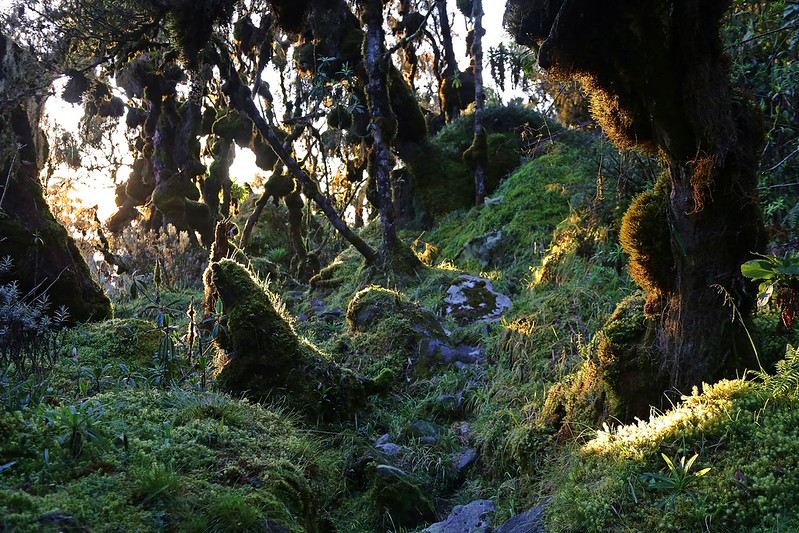
The path threads between bogs, classic Rwenzori peat bogs, crossed via wooden boardwalks and strategically placed stones, and the vegetation becomes increasingly surreal. Giant groundsels begin to appear, their palmate rosettes perched atop meter-high trunks, their yellow flowers brushed by clouds. This is high-altitude botany as a spectacle. John Matte Hut sits in a clearing ringed by heather and lobelia, the first night where the temperature genuinely drops below ten degrees. Your chef prepares a warming dinner, and the silence of the Rwenzori high country settles over everything.

Accommodation — Day 3

John Matte Hut (3,380 m): A landmark mountain shelter in the heart of the heather-lobelia zone, with stunning views toward the higher peaks on clear mornings.

Day 4: John Matte Hut (3,380 m) → Bujuku Hut (3,962 m)

The trail today earns its reputation. The ascent through the upper heather and into the Afro-alpine zone demands patience with terrain that is wet, sometimes ankle-deep in mud, and gloriously, absurdly beautiful. Giant lobelias (Lobelia wollastonii) stand like green sentinels on every slope, their silver-tipped rosettes catching the light. The groundsels grow taller and more imposing. This is the vegetation that causes experienced trekkers to stop, stare, and reach instinctively for a camera, the Rwenzori’s signature gift.
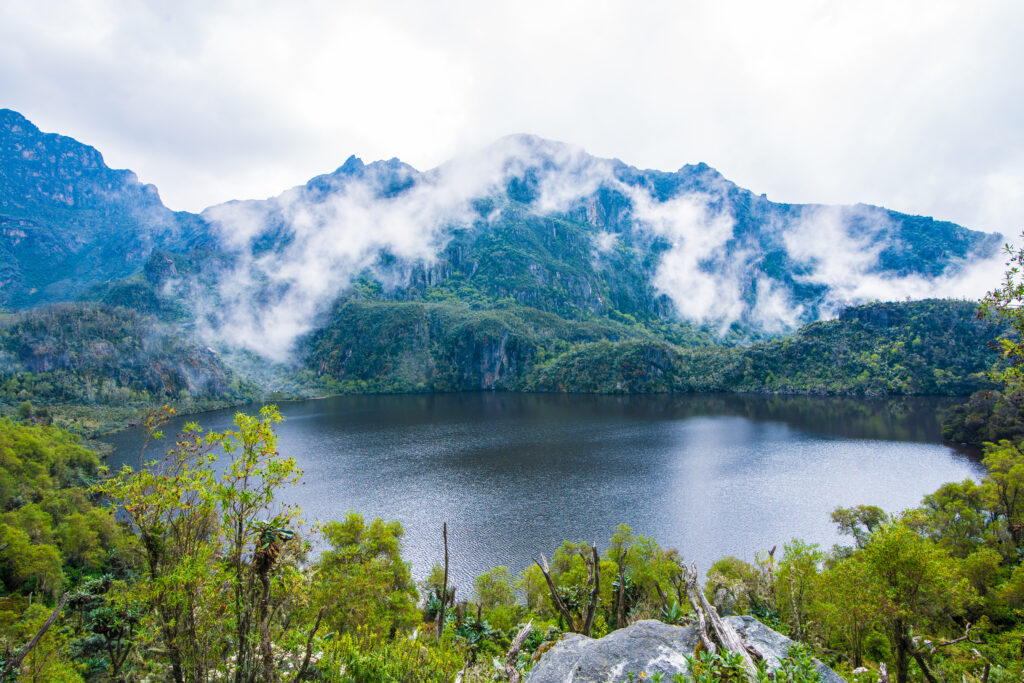
As the valley opens, the turquoise surface of Lake Bujuku appears below, framed by the rocky ridgelines of Mount Baker and Mount Stanley. The scale of the cirque becomes apparent: glacial, ancient, immense. Bujuku Hut sits at its upper end, close enough to the steep approach to Elena Hut to let you study tomorrow’s route. Acclimatization walks from the hut are recommended this afternoon: a short scramble above the hut rewards you with the clearest views yet of Margherita itself, now close enough to feel almost reachable.

Accommodation — Day 4

Bujuku Hut (3,962 m) — Perched above the glacial lake basin, this hut is one of the most scenically positioned shelters in the Rwenzori. Cloud permitting, sunsets here are extraordinary.

Day 5: Bujuku Hut → Lake Bujuku → Elena Hut (4,541 m)

Today, the mountain reveals its most severe and spectacular face simultaneously. The trail from Bujuku Hut skirts the northern shore of Lake Bujuku, a lake of extraordinary stillness and color, and then begins the long, steep climb through boulder fields and scree toward the Elena Glacier. The gradient is relentless. The air, noticeably thinner now, demands a deliberate pace, a rhythm your guide will help you find and hold.

Elena Hut, perched at 4,541 meters beside the lower edge of the Elena Glacier, is one of the highest permanent structures in East Africa. From its doorway, the glacier fills the upper horizon, a wall of ancient ice, fractured and blue-white, impossibly present. The summit pyramid of Margherita is visible above it, close now, as it gathers clouds in the late afternoon. Your guide runs through tomorrow’s summit plan in careful detail: the 2 a.m. start, the crampon fitting, the rope management on the glacier, and the summit push. The mountain is silent above the wind. Sleep, if you can. Tomorrow is summit day.

Accommodation — Day 5

Elena Hut (4,541 m): The highest hut on the trek, situated beside the Elena Glacier. Basic but functional, with sleeping platforms, kitchen facilities, and an atmosphere that is entirely, irreducibly alpine.

Day 6: Summit Day — Margherita Peak (5,109 m) → Elena Hut

There are mornings that exist outside ordinary time. This is one of them. The alarm sounds at two in the morning, the darkness outside Elena Hut is total, and the temperature has fallen sharply. Crampons are fitted using a headtorch. Harnesses checked. Ropes coiled. Your certified Rwenzori glacier guide, who has made this ascent dozens of times in every condition, leads you onto the Elena Glacier as the stars begin to pale above the Stanley Plateau.

The glacier crossing demands focus and a steady foot. Fixed ropes assist on the steeper ice sections, and your guide’s commands are clear and calm. The Stanley Plateau opens before you, a high, silent snowfield shared between Uganda and the Democratic Republic of Congo, one of the last equatorial glaciers in Africa. From here, the final rock scramble to Margherita’s narrow summit ridge is technical, exhilarating, and brief. And then, you are there. Africa’s third highest point. The equatorial glaciers of the Rwenzori are far below you. The Congo Basin stretches west into the morning haze. The Uganda Rift Valley is catching the first gold of dawn in the east.

The summit experience, on a clear morning, is one of the great moments of a trekking life. Most climbers need fifteen to thirty minutes on top, enough for photographs, for the full weight of the achievement to settle, and for the guides to begin the careful descent back across the glacier. By mid-morning, you are back at Elena Hut, recovering with hot tea and the particular, deep warmth that follows a summit.

Summit Note

Margherita Peak summit weather is highly variable. Your guide will make the final call on summit feasibility based on real-time conditions. Safety is never negotiated, but in our experience, careful preparation and a measured pace give the vast majority of our trekkers their summit.

Day 7: Elena Hut → Nyabitaba Hut (Full Descent)

The long descent begins with a kind of elegy. You pass back through everything the mountain showed you on the way up, but now it looks different, seen with the eyes of someone who has stood on top of it. The giant lobelias seem slightly more magnificent. The heather tunnels are more enchanted. The Bujuku Valley is more luminous. The descent is long; your legs will know it, but the pace is steady and the trail familiar now, almost friendly.

As you descend, the geological and botanical extravagance of the Rwenzori unfolds in reverse: the moorland gives way to heather forest, heather forest surrenders to giant ferns and moss-covered podocarpus, and by late afternoon, the roar of the Mubuku River announces the final descent to Nyabitaba Hut. The celebration, low-key and genuine, happens here, with hot food, warmed limbs, and the sound of stories from the guides who have shared these eight days with you.

Accommodation — Day 7

Nyabitaba Hut (2,650 m): Your first night’s camp, now a familiar and welcome sight. The team prepares the best dinner of the trek in recognition of the summit achieved.

Day 8: Nyabitaba Hut → Nyakalengija Gate → Kampala / Departure

The final morning on the mountain is unhurried. A last breakfast in the heather zone, a final look up at the ridgeline above, and then the descent through the lower montane forest, past the colobus territories, across the suspension bridge, and back through the noise and birdsong of the rainforest to Nyakalengija Gate. The UWA register is signed. The summit certificate is awarded. Your porter and guide team gathers for a final farewell that, after eight shared days in the mountains, carries genuine feeling.

Your private vehicle is waiting at the gate. The drive back to Kampala or Entebbe unfolds through the same western Uganda landscape, but you are no longer the same person who passed through it eight days ago. Something essential has shifted. The Mountains of the Moon have a way of doing that.

What Is Included in the Trek?

Rwenzori Trekking Expeditions operates fully inclusive expeditions; the price you pay covers the mountain from first to last, with no unexpected additions at the gate or on the trail. Here is precisely what your expedition includes and what falls outside it.

Included

  • Uganda Wildlife Authority park entrance fees and Rwenzori Mountains National Park permits for the full 8 days
  • Dedicated, certified mountain guide (English-speaking, first-aid trained, glacier-certified for summit day)
  • Experienced Rwenzori porter team for baggage carries (personal porter per trekker)
  • All mountain hut accommodation (Nyabitaba, John Matte, Bujuku, Elena Huts), 7 nights
  • All meals on the mountain — breakfast, packed lunch, dinner, and hot drinks (prepared by a dedicated mountain chef)
  • Technical equipment for summit day: crampons, ice axes, ropes, and harnesses
  • Ground transportation from Kampala / Entebbe to Nyakalengija Gate and return (private 4WD vehicle)
  • Pre-trek briefing and kit check in Ibanda
  • Rwenzori Trekking Expeditions summit certificate upon completion
  • Emergency evacuation plan and communication equipment carried throughout
  • All government taxes and levies

Not Included

  • International flights to and from Uganda
  • Uganda visa fees (approximately USD 50 per entry — check current requirements at ugandaevisa.go.ug)
  • Travel insurance (comprehensive coverage including emergency evacuation and repatriation is mandatory)
  • Pre- and post-trek hotel accommodation in Kampala, Entebbe, or Kasese (can be arranged on request)
  • Personal trekking equipment (boots, clothing, sleeping bag — see packing list below)
  • Alcoholic beverages
  • Tips and gratuities for guide and porter team (customary and warmly appreciated; guidance available on request)
  • Items of a personal nature

How Difficult Is the Margherita Peak Trek?

In the honest language of mountain guides: this is a challenging, high-altitude technical trek that rewards fit and well-prepared trekkers. However, it is not beyond the reach of any reasonably active adult who trains appropriately and has the right mindset. Rwenzori Trekking Expeditions has guided trekkers aged 22 to 62 to the summit of Margherita Peak, and the single most consistent factor in success is not youth or raw fitness but patience, pacing, and the ability to listen to your guide.

The technical element, glacier travel with crampons and fixed ropes on Day 6, is led entirely by certified glacier guides from our team. You don’t need any prior glacier experience; our team will give you full instruction at Elena Hut the evening before the summit push. What you do need is a solid base of cardiovascular fitness, some experience of multi-day hiking at altitude above 3,000 m, and a willingness to commit to the daily effort that the Rwenzori terrain demands.

The Rwenzori is famously wet. The trails are often muddy, the bogs are real, and the equatorial weather means you can experience four seasons in a single afternoon. Waterproof boots, trekking poles, and a properly fitted pack are non-negotiable. Our pre-trek briefing covers every element of physical preparation in detail.

Difficulty Rating

Strenuous | Technical Alpine Summit. Recommended prior experience: multi-day trekking, altitude above 3,500 m. No prior glacier experience needed — full guide instruction provided.

Central Circuit Trail vs Kilembe Trail: Which Route Is Right for You?

Two main routes access the Rwenzori high peaks, each offering a distinct character and logistical profile. The Central Circuit Trail, covered in this itinerary, is the established route for Margherita Peak summiteers and offers the greatest biodiversity and altitude range. The Kilembe Trail, entering from the south through Kasese, is a longer, more remote route suited to trekkers who prioritize absolute solitude and a less-technical summit objective.

Feature

Central Circuit Trail

Kilembe Trail

Duration

8 days (standard)

8–10 days (longer approach)

Difficulty

High, alpine technical finish

Moderate-High – less technical

Highest Point

5,109 m – Margherita Peak

4,996 m – Scott Elliot Pass

Scenery

Full Rwenzori panorama

Kilembe Valley, glacial lakes

Technical Gear

Crampons & ice axe required

Crampons occasionally needed

Crowds

Very low – pristine wilderness

Extremely low – remote route

Best For

Summiteers & serious trekkers

Adventurous & off-grid seekers

Rwenzori Trekking Expeditions operates guided expeditions on both routes. If you are uncertain which trail best matches your goals and experience level, our team is available to discuss your profile and recommend accordingly. Visit our Kilembe Trail page for full details on that route.

CTA Banner Widget — Rwenzori Trekking Expeditions

Experience Rwenzori Beyond Expectations

Spots Filling Fast — Schedule Your Trek Today

Best Time to Trek Margherita Peak

The Rwenzori Mountains receive rainfall in every month of the year; the region is not a destination with a true dry season in the conventional sense. The mountain creates its own weather, and experienced trekkers accept that cloud, mist, and rain are part of the Rwenzori experience rather than obstacles to it. That said, two seasonal windows offer the most reliable conditions for high-altitude trekking and summit attempts.

Peak Season: June to August

The long dry season brings the most stable weather windows on the mountain, with the greatest likelihood of clear skies on the Stanley Plateau and at the summit. Temperatures are cooler at altitude but manageable, and the trails, though always wet in the Rwenzori, are at their most navigable. June through August represents the peak season for Margherita Peak attempts and our busiest booking period.

Secondary Season: December to February

A shorter dry window between the two equatorial rainy seasons, December to February, offers similar summit conditions and the advantage of slightly lower trekker numbers on the mountain. The vegetation is often at its most lush in this period, and the light on the glaciers, angled from the southern summer sun, has a particular quality that photographers prize.

Shoulder Periods: March–May and September–November

Heavy rainfall characterizes both shoulder periods. The trails become more challenging, the vegetation more saturated, and summit windows less reliable. Experienced trekkers who are prepared for full wet-weather conditions and do not require a guaranteed summit can still find deep rewards in these months; the Rwenzori in full cloud is a place of haunting, almost mythological beauty. Pricing is often lower during these periods, and the mountain feels entirely private.

How to Get to the Rwenzori Mountains

The Rwenzori Mountains National Park is located in western Uganda, near the town of Kasese and the Congolese border. The primary trekking entry point is Nyakalengija Gate, approximately 15 kilometers north of Kasese town.

By Air

Most international visitors arrive at Entebbe International Airport (EBB), which receives direct flights from Nairobi, Addis Ababa, Amsterdam, London, Dubai, and other major hubs. A domestic flight from Entebbe to Kasese Airport is available and reduces the overland journey significantly — approximately 45 minutes by air versus five to six hours by road.

By Road

From Entebbe or Kampala, the road journey to Nyakalengija Gate takes approximately five to six hours via the Kampala–Mbarara highway, continuing through Fort Portal. Rwenzori Trekking Expeditions arranges all ground transportation in dedicated private 4WD vehicles with experienced drivers who know the western Uganda road network intimately. The drive itself is one of the most remarkable Uganda road journeys, passing the equator, Bwindi’s green ridges in the distance, the rolling hills of Ankole, and ultimately the unmistakable mass of the Rwenzori looming on the western horizon.

Nearest Town

Kasese town, 15 km from Nyakalengija Gate, serves as the last major supply point and is where trek supplies are finalized. Our team handles all logistics here — trekkers need only arrive.

What Should I Pack for Margherita Peak?

Packing correctly for a Rwenzori expedition is genuinely important. The mountain’s altitude range, from tropical rainforest at 1,646 meters to glaciated summit at 5,109 meters, demands a layering system that can handle heat, humidity, cold, rain, and wind, sometimes within the same afternoon. Below is the curated kit list our guides recommend, refined over years of Rwenzori expeditions.

Footwear

Waterproof, ankle-supporting trekking boots are non-negotiable. The Rwenzori trails are perennially wet and muddy, and boot failure on day three is a crisis you do not want. Lightweight camp shoes or sandals for hut use. Waterproof gaiters for bog crossings.

Clothing Layers

  • Moisture-wicking base layers (top and bottom) — at least 2 sets
  • Insulating mid-layer: fleece or down jacket — essential for evenings above 3,000 m
  • Waterproof, breathable shell jacket and trousers — the Rwenzori will test them
  • Warm hat, balaclava, and sun hat
  • Lightweight gloves and heavier summit gloves (glacier day)
  • Trekking trousers — avoid cotton
  • Several pairs of moisture-wicking trekking socks

Equipment

  • Trekking poles, highly recommended, both ascent and descent
  • Headtorch with spare batteries, essential for the 2 a.m. summit start
  • Sleeping bag rated to -10°C / 14°F — the Elena Hut nights are cold
  • Daypack (25–35 litres) for carrying daily essentials while porters handle main bags
  • Water bottles or hydration bladder (at least 2 litres capacity)
  • Sunglasses (UV-rated) and sunscreen; glacier glare is intense
  • Water purification tablets or filter as backup

Health & Personal

  • Personal first-aid kit and any prescription medications
  • Altitude sickness medication — discuss Diamox (acetazolamide) use with your doctor before departure
  • Insect repellent for lower-forest days
  • High-energy snacks for summit day
  • Camera or smartphone (keep batteries warm on summit day — cold drains them fast)

Frequently Asked Questions Day For the 8-day Margherita Peak Rwenzori Central Circuit Trek

How fit do I need to be to climb Margherita Peak?

Margherita Peak is a serious high-altitude objective that requires a good baseline of cardiovascular fitness. Trekkers who regularly hike for 5–7 hours with a daypack, maintain an active lifestyle, and have some experience above 3,000 meters are well-positioned for success. We recommend beginning a targeted training program at least three months before departure, focusing on cardiovascular endurance, leg strength, and, where possible, weekend hiking with a loaded pack. Our pre-trek briefing provides a full training guide upon booking.

Do I need glacier experience to summit Margherita Peak?

No prior glacier experience is required. The technical elements of the summit day, crampon technique, rope travel on ice, and route-finding on the Stanley Plateau are fully led by our certified glacier guides. The evening before the summit push, we hold a full equipment briefing and technique session at Elena Hut. Your guide carries responsibility for technical safety throughout the glacier crossing.

What is the Margherita Peak success rate?

With Rwenzori Trekking Expeditions, the majority of well-prepared trekkers who follow the 8-day Rwenzori Central Circuit Trekking itinerary reach the summit of Margherita Peak. The primary variables are individual acclimatization response and summit-day weather. Our guides make real-time decisions based on both factors, always prioritizing safety while maximizing every trekker’s chance of a successful summit. Choosing the right pace on days 4 and 5 is the single most important acclimatization strategy.

How much does the 8-day Rwenzori Trek to Margherita Peak cost?

Trek pricing varies based on group size, season, and any pre- or post-trek additions. Rwenzori Trekking Expeditions provides fully transparent pricing upon inquiry; there are no hidden gate fees, no porter surcharges, and no last-minute additions. For current pricing and availability, contact our team directly via the website inquiry form. Private expeditions (solo or small groups) are available year-round.

Can I do the Rwenzori trek without a guide?

No. Independent trekking in Rwenzori Mountains National Park is not permitted. Uganda Wildlife Authority regulations require all trekkers to be accompanied by a licensed guide at all times. Beyond regulatory compliance, the Rwenzori’s terrain, its maze of bog, dense heather, and glacier, makes guide expertise genuinely essential for safety and navigation. Rwenzori Trekking Expeditions provides fully certified, experienced guides who are among the most knowledgeable mountain professionals in East Africa.

Is altitude sickness a risk on the Margherita Peak trek?

Altitude sickness (AMS, Acute Mountain Sickness) is a genuine consideration on any trek above 3,000 meters. The 8-day Rwenzori trek to Margherita itinerary is structured to allow gradual acclimatization, with no single day exceeding 900 meters of altitude gain. Symptoms such as headache, nausea, and fatigue are common in the first day at each major altitude step and usually resolve with rest and hydration. Our guides monitor trekkers continuously and are trained to recognize when descent is the appropriate response. Discussing the use of prophylactic Diamox with your physician before departure is advisable.

What is the weather like in the Rwenzori Mountains?

The Rwenzori has a reputation for extreme wetness; it holds the title of one of the wettest mountain ranges in Africa, receiving upwards of 2,000 mm of annual precipitation on its upper slopes. Cloud, mist, and rain are daily companions on the mountain in any season. The best windows for summit attempts are June–August and December–February, when weather systems are most stable. That said, summit day weather is unpredictable even in peak season; our guides are experienced in reading the mountain’s signals and timing ascents accordingly.

What makes Rwenzori Trekking Expeditions different from other operators?

Rwenzori Trekking Expeditions is a specialist Rwenzori operator; the mountains are our only focus. Our guides are long-term Rwenzori veterans who have summited Margherita Peak hundreds of times. We carry comprehensive emergency equipment, maintain direct communication with Uganda Wildlife Authority, and operate with a commitment to responsible tourism that directly benefits the local Bakonzo communities who form the backbone of our guide and porter teams. We do not overpromise summits; we overdeliver on safety, experience quality, and genuine care for every trekker on our mountain.

Why Book Your Rwenzori Trek With Rwenzori Trekking Expeditions?

“The Rwenzori deserves specialists. We focus exclusively on Rwenzori treks.

There are generalist safari operators who will include a Rwenzori trek in a broader Uganda safari, offer it at a lower price, and provide guides with limited mountain experience. There are also operators who will promise you the summit on any weather day or tell you that an untested five-day circuit is adequate for Margherita Peak.

Rwenzori Trekking Expeditions is none of these things. We are a dedicated Rwenzori mountain company, born from decades of experience on these specific slopes, committed to the highest standards of safety, ecological responsibility, and trekker experience. Our guides grew up in the shadow of the Rwenzori and have dedicated their professional lives to mastering its terrain, weather, and altitude. When you trek with us, your safety briefing is not a legal formality; it is the accumulated wisdom of hundreds of expeditions. Your summit attempt is not a gamble — it is a carefully managed push by people who know exactly what the mountain requires.

Every expedition we operate directly supports the Bakonzo community through fair porter wages, guide employment, and investment in local infrastructure. A trek with us is also, in a quiet and meaningful way, a contribution to the conservation of one of Africa’s most extraordinary mountain ecosystems.

  • Uganda Wildlife Authority licensed and certified mountain operator
  • Glacier-certified summit guides with Margherita Peak specialization
  • Full emergency response protocols and satellite communication equipment
  • Transparent, fully inclusive pricing, no gate surprises
  • Fair porter wages and Bakonzo community investment programme
  • Private and small-group expeditions available year-round
  • Seamlessly arranged logistics from Kampala to summit and back
CTA Banner Widget — Rwenzori Trekking Expeditions

Experience Rwenzori Beyond Expectations

Spots Filling Fast — Schedule Your Trek Today

Book Your 8 Day Margherita Peak Adventure Today

Margherita Peak is not a bucket list item you should leave to chance. The Rwenzori Mountains are wild, complex, and entirely unforgiving of under-preparation, and they are also more rewarding, more beautiful, and more moving than almost anywhere else on Earth. This is a once-in-a-lifetime summit, on a once-in-a-lifetime mountain, and it deserves a guide team that has dedicated their lives to knowing it.

Begin your 8-day Rwenzori Trek to Margherita Peak with Rwenzori Trekking Expeditions. Send an inquiry through the form on this page, and a member of our expert team will respond within 24 hours with full pricing, availability, and a personalized expedition assessment. We will ask about your experience, your fitness baseline, your group size, and your preferred travel window, and we will build an expedition that fits you precisely.

The Mountains of the Moon are waiting. They have been waiting since Ptolemy named them. They will not wait indefinitely.

Enquire Now: trek@rwenzoritrekkingexpeditions.com

Private Expeditions | Small Groups | Year-Round Departures

CTA Banner Widget — Rwenzori Trekking Expeditions

Experience Rwenzori Beyond Expectations

Spots Filling Fast — Schedule Your Trek Today

Scroll to Top