Where Is Mount Luigi di Savoia?
Mount Luigi di Savoia sits at the southwestern edge of the Rwenzori’s central massif cluster, west of Mount Stanley and separated from it by the Kitandara Valley system, part of the network of glacially carved valleys that connects the range’s six great peaks. Its ridge runs along, and in part forms, the international boundary between Uganda and the Democratic Republic of the Congo, making it, like several of its neighboring massifs, a genuinely transboundary mountain rather than one confined to a single country’s territory.
Trekkers most commonly encounter Mount Luigi di Savoia from the Central Circuit Trail, particularly around the Kitandara Lakes and Freshfield Pass, from which the mountain’s northern aspect and the approach to Sella Peak become directly accessible.
Freshfield Pass connects the Kitandara valley to the Lac Gris area on the massif’s western flank and is the main access point for both the standard viewing route and the dedicated Weismann Tour, a shorter itinerary focused specifically on this massif rather than the range’s higher, more heavily trafficked peaks.
Why Mount Luigi di Savoia Is Important
Geologically, Mount Luigi di Savoia is an integral part of the same uplifted fault block that produced the entire Rwenzori range, and its rock record contributes directly to the broader scientific understanding of how the Albertine Rift raised this section of ancient African basement into a genuine alpine landscape, a detail covered fully in our dedicated geology guide. Ecologically, its slopes are part of the continuous Afro-alpine habitat that makes the Rwenzori one of the richest areas in the Albertine Rift biodiversity hotspot, supporting many of the same endemic plant and animal communities found in the range’s other massifs.
Scientifically, the mountain is particularly valuable because of its modest height and its comparatively early loss of permanent ice: as the first of the range’s six major massifs to lose its glaciers entirely, Mount Luigi di Savoia offers researchers a preview, already observable today, of the ecological and geomorphological changes that taller, still-glaciated massifs such as Mount Stanley are now beginning to undergo, a connection discussed further in our page on why the Rwenzori’s glaciers are disappearing. Within the UNESCO World Heritage Site, it forms an essential part of the property’s Outstanding Universal Value, contributing scenery and habitat rather than existing as some lesser appendage to the range’s higher peaks. Among experienced Rwenzori climbers, it is respected precisely for its quiet, less-crowded character and its direct historical association with the expedition that first opened the range to mountaineering.
The Peaks of Mount Luigi di Savoia
Mount Luigi di Savoia, like each of the Rwenzori’s major massifs, is a long ridge carrying several named summits rather than a single isolated peak. Its three principal points were mapped and named during the 1906 Duke of the Abruzzi expedition, the same campaign responsible for naming and climbing the summits of Mount Stanley, Mount Speke, and Mount Baker.
Summit | Elevation | Notes | Climbing Considerations |
Sella Peak | 4,627 m | The massif’s highest point, named for Vittorio Sella, the photographer on the 1906 expedition | Ascended via the northern approach near Freshfield Pass; a serious but non-technical scramble in good conditions |
Weismann Peak | 4,620 m | Slightly lower than Sella, but considerably more accessible | The standard objective for the shorter, dedicated Weismann Tour itinerary |
Stairs Peak | 4,545 m | The lowest of the massif’s three named summits | Typically viewed rather than climbed on standard itineraries |
Sella Peak deserves particular attention as the massif’s high point and its principal mountaineering objective. Named for Vittorio Sella, the Italian photographer whose large-format images of the 1906 expedition remain a scientific and historical treasure to this day, the peak is most commonly approached from its northern aspect near Freshfield Pass, where the ascent, while sustained and exposed in places, does not require the roped glacier travel demanded by Margherita Peak on Mount Stanley. Weismann Peak, though slightly lower, is the more frequently climbed of the massif’s summits in practice, largely because it forms the centerpiece of the dedicated six-day Weismann Tour itinerary, making it markedly more accessible to trekkers without the time or inclination for a full multi-peak expedition.
History of Mount Luigi di Savoia
As with every part of the Rwenzori, the mountain’s human history did not begin with European expeditions. The Bakonzo people, whose traditional territory extends across the range’s Ugandan slopes, possessed detailed practical and spiritual knowledge of this terrain long before any outside mapping took place, knowledge that continues to inform local guiding today, as discussed in our History of the Rwenzori Mountains and Cultural Heritage coverage. The historical record has relatively few documented indigenous accounts specific to Mount Luigi di Savoia, and this gap reflects the mountain’s relative remoteness rather than any lesser significance to the communities that have long lived in its shadow.
European mapping of the massif dates to the celebrated 1906 expedition led by Prince Luigi Amedeo of Savoy, the Duke of the Abruzzi, whose team of Italian Alpine guides, scientists, and the photographer Vittorio Sella spent several weeks systematically climbing and surveying the range’s principal peaks. It was this expedition that named the massif in honor of its leader, the House of Savoy being the Italian royal family to which the duke belonged. In a detail that adds a small but genuine note of historical texture to the mountain’s story, the Duke himself never stood on its summit, making Mount Luigi di Savoia the only one of the range’s six great massifs he did not personally climb during an expedition that otherwise achieved first ascents of every other principal peak. Instead, other members of his expedition team completed the first ascent of the massif.
Who Was Luigi di Savoia?
Prince Luigi Amedeo of Savoy, Duke of the Abruzzi, was one of the most accomplished mountaineers and polar explorers of the early twentieth century. Born into the Italian royal family in 1873, he built an international reputation for demanding, scientifically rigorous expeditions well before he ever set foot in Africa, including the first ascent of Mount Saint Elias in Alaska in 1897 and a celebrated high-altitude attempt on K2 in 1909, during which his expedition established a climbing route on the mountain’s southeastern ridge still known today as the Abruzzi Spur.
His 1906 Rwenzori expedition brought this same rigor to a range that had, until then, resisted sustained mountaineering attention despite being confirmed by Henry Morton Stanley nearly two decades earlier. Over several weeks, the Duke’s team achieved the first ascents of Margherita Peak on Mount Stanley and the principal summits of Mount Speke, Mount Baker, Mount Emin, and Mount Gessi. They also produced the first accurate topographic maps and geological surveys, along with the extraordinary photographic record for which Vittorio Sella is celebrated among mountaineering historians. The Duke went on to a distinguished later career that included military command during the First World War and extensive settlement and exploration work in the Horn of Africa, where he spent much of his later life. Within the history of the Rwenzori specifically, however, his legacy remains most visible in the names scattered across the range’s peaks, ridges, and glaciers, of which this mountain, fittingly, carries his own.
Geology Of Mount Luigi Di Savoia
Mount Luigi di Savoia shares the same fundamental geological story as the rest of the Rwenzori: it is not volcanic but a segment of ancient Precambrian metamorphic basement rock, with gneiss, quartzite, and amphibolite among the dominant types, uplifted along the Albertine Rift as part of the broader East African Rift System over the past several million years. As the lowest of the range’s six major massifs, its exposed rock and ridge profile offer a slightly gentler, though still genuinely alpine, expression of the same fault-block uplift and glacial sculpting described in full in our dedicated Rwenzori Geology guide.
Trekkers approaching the massif through the Kitandara Valley and over Freshfield Pass pass directly across visible evidence of this history: glacially smoothed rock surfaces, steep valley walls cut by both faulting and ice, and, near the Kitandara Lakes themselves, basins carved and subsequently dammed by past glaciation.
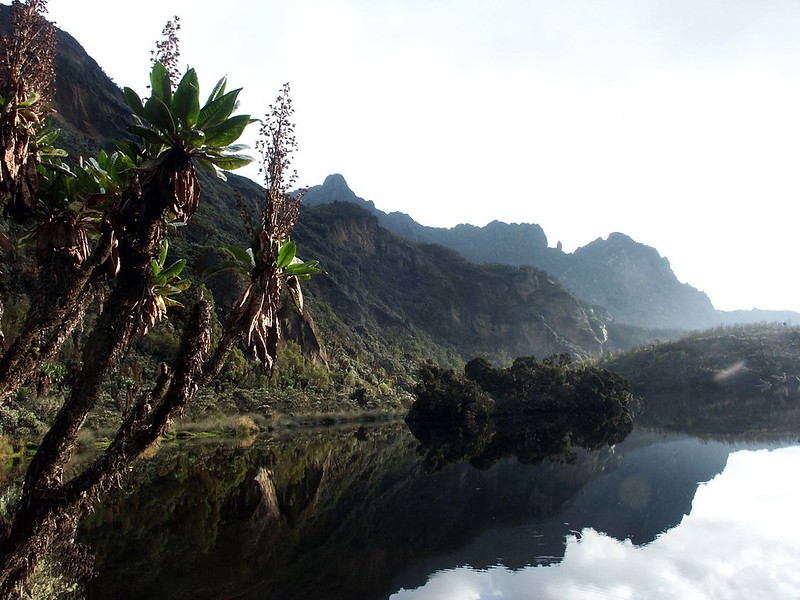
The massif’s comparatively lower elevation relative to Mount Stanley and Mount Speke also means that trekkers can observe, within a single day’s walk, the transition from clearly glacially sculpted terrain to landscape now shaped primarily by rivers and weathering, an instructive contrast for anyone interested in how altitude and ice history interact across the range.
Glacial History
Mount Luigi di Savoia carried glacial ice through the twentieth century, as photographic records from the 1906 expedition and subsequent surveys confirm, and its slopes retain clear geomorphological evidence of that history: cirques carved into the upper reaches of its ridge, moraine deposits marking the former limits of vanished ice, and the U-shaped valley profiles typical of glacially sculpted terrain throughout the range. As the lowest of the six principal massifs, Mount Luigi di Savoia was the first to completely lose its permanent ice cover, with its glaciers disappearing earlier in the twentieth century than those on the taller peaks of the range.
Current scientific surveys, consistent with the broader pattern of Rwenzori glacier retreat documented in our Climate Change and the Glaciers coverage, confirm that Mount Luigi di Savoia today retains no permanent ice, only seasonal snow patches that form and melt with the weather rather than persisting year-round. Trekkers should expect a genuinely alpine but ice-free summit environment here, a preview, in effect, of what researchers expect the range’s still-glaciated peaks, including Mount Stanley, to look like within coming decades.
Vegetation Zones
The approach to Mount Luigi di Savoia passes through the same broad sequence of vegetation zones found across the Rwenzori, but this is compressed into the few days that most itineraries allow for this massif. Lower elevations, roughly 1,800 to 2,500 meters, pass through dense montane forest rich in birdlife, giving way to a bamboo zone and then a heather belt as the trail climbs toward 3,000 to 3,800 meters, where gnarled, moss-draped heather trees create the fog-bound, otherworldly atmosphere for which the range’s middle elevations are known.
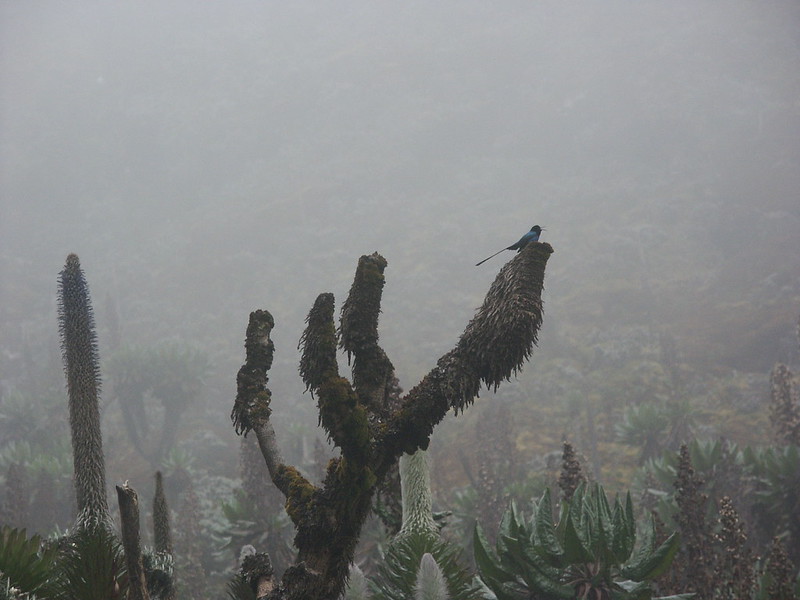
Above roughly 3,800 meters, trekkers enter the classic Afro-alpine moorland zone, dominated by giant lobelias and giant groundsels adapted to intense daytime sun and near-freezing nights, before the final alpine rock zone above approximately 4,300 meters, where vegetation thins to sparse cushion plants and lichens among exposed, weathered rock on the approach to Sella and Weismann Peaks. You can read a full description of this ecological transition in our dedicated Vegetation Zones guide.
Wildlife Around Mount Luigi di Savoia
In the lower montane forest surrounding the massif’s approach routes, trekkers may encounter blue monkeys and, less commonly, black-and-white colobus, alongside a strong diversity of forest birds. The Albertine Rift’s exceptional status as a center of avian endemism is well represented here, with species such as the Rwenzori turaco and several range-restricted sunbirds recorded along the trail’s middle elevations, detailed further in our Wildlife Guide.
Higher up, around the Kitandara Lakes and the heather and moorland zones, wildlife becomes sparser but remains distinctive: cold-adapted chameleons, high-altitude amphibians found only within the Albertine Rift’s mountain ranges, and specialized alpine insects that pollinate the region’s giant lobelias. Small forest mammals such as duikers may be glimpsed at lower elevations, though, as throughout the Rwenzori, dense vegetation and steep terrain mean sightings of larger mammals remain the exception rather than the rule.
Trekking Around Mount Luigi di Savoia
Most trekkers experience Mount Luigi di Savoia as a scenic and geographic waypoint on the Central Circuit Trail rather than as a dedicated summit objective, particularly around the Kitandara Lakes and Freshfield Pass, both of which offer outstanding views of the massif’s ridgeline without requiring a technical ascent. Compared to Margherita Peak, summit attempts on Sella or Weismann Peak are relatively rare but still possible, and they are usually organized either as an extension of the standard Central Circuit or through the dedicated Weismann Tour, which is a roughly 7-day Weismann Peak Rwenzori itinerary specifically designed for this massif.
Nearby camps, including those at Kitandara and Guy Yeoman, serve as natural bases for exploring the massif’s approaches, and the surrounding valley offers some of the Central Circuit’s most photogenic scenery, framed by the twin Kitandara Lakes and the ridgelines of both Mount Luigi di Savoia and Mount Baker. For trekkers assembling a longer, multi-peak Rwenzori expedition, the massif fits naturally alongside Mount Baker, given their shared proximity and the connecting trail infrastructure between the two, an option our guides plan regularly for experienced groups seeking to cover more than one summit in a single itinerary.
Difficulty and Accessibility
As the lowest of the range’s six major massifs, Mount Luigi di Savoia is, in relative terms, one of the more accessible Rwenzori summits, though this is a comparison worth keeping in perspective: any ascent here remains a serious high-altitude undertaking by ordinary hiking standards. Terrain includes steep ascents, boggy valley sections typical of the range’s lower elevations, rocky ridgelines near the summits, and occasional patches of old snow or ice depending on recent weather, though no sustained glacier travel is required on the standard routes to Sella or Weismann Peak.
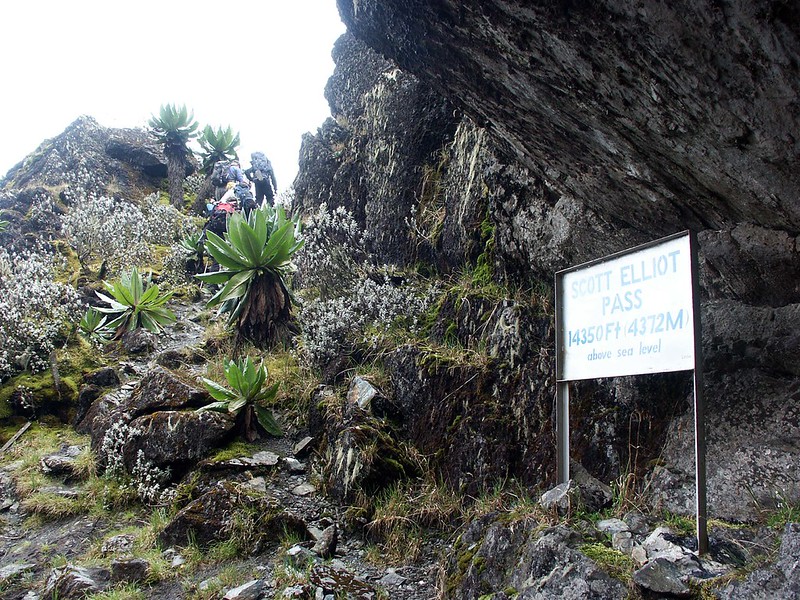
A reasonable level of trekking fitness, prior altitude experience or a conservative acclimatization schedule, and comfort with exposed scrambling near the summit ridge are all necessary. Weather remains a significant variable throughout, capable of turning a straightforward ridge walk into a genuinely testing day with little warning, which is why we plan every itinerary here with contingency time built in rather than a fixed, inflexible schedule.
Weather and Climate
Rainfall across the Rwenzori is frequent and heavy for most of the year, and Mount Luigi di Savoia, located at the southwestern edge of the range, is not exempt from this pattern. Cloud cover typically builds through the morning even on days that begin clear, making early starts important for both safety and visibility. Temperatures swing dramatically with elevation, from warm and humid in the lower montane forest to consistently below freezing overnight at the higher camps and on the exposed summit ridges of Sella and Weismann Peak, regardless of the calendar month.
Uganda’s comparatively drier windows, from roughly mid-December to mid-February and again from mid-June to August, tend to bring more stable conditions and better visibility across this part of the range, while the intervening wetter months bring correspondingly muddier trails and reduced summit visibility.
Best Time to Visit
For the clearest views of Sella Peak, the Kitandara Lakes, and the surrounding ridgelines, the drier windows of mid-December to mid-February and mid-June to August generally provide the best trail conditions and visibility, making them the preferred times for photographers hoping to capture the massif’s alpine scenery without persistent clouds. Wildlife viewing in the lower forest zones is possible throughout the year, and the wetter months, while muddier underfoot, bring lush, vivid vegetation to the montane and bamboo zones that some visitors find equally rewarding. As throughout the Rwenzori, no season offers a guarantee of clear weather, and a flexible itinerary with built-in contingency remains more valuable than choosing the calendar month with the best average odds.
Photography Guide
The twin Kitandara Lakes, framed by the ridgelines of Mount Luigi di Savoia and Mount Baker, are among the most photogenic locations on the entire Central Circuit, particularly in the still, clear light of early morning before cloud typically builds. Freshfield Pass offers sweeping panoramic views back across the valley and toward the massif’s northern approach, while the alpine rock zone near Sella and Weismann Peaks rewards photographers with dramatic ridge silhouettes and, in optimal conditions, distant views toward Mount Stanley’s glaciated summit.
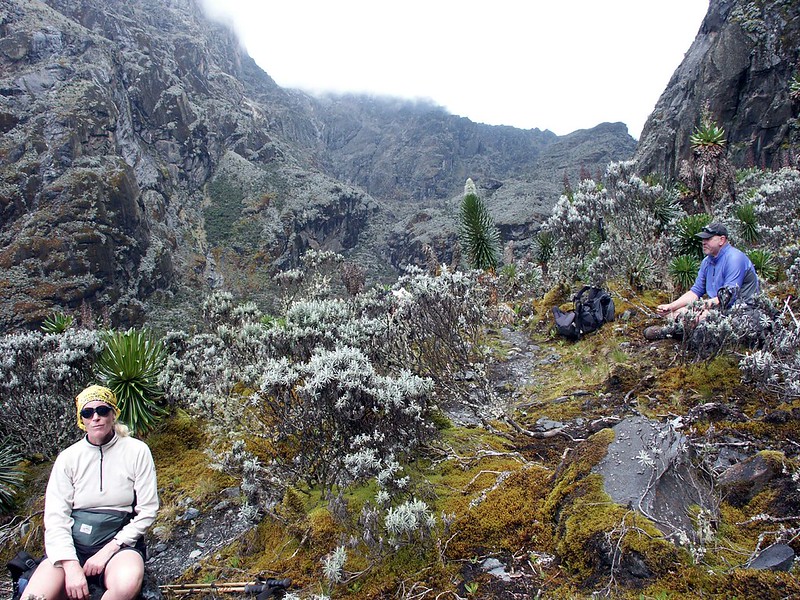
The Afro-alpine moorland surrounding the approach routes offers some of the range’s most striking vegetation photography, particularly stands of giant lobelias silhouetted against the ridge at sunrise or sunset, when low-angle light picks out the texture of both the plants and the weathered rock behind them.
Conservation
Mount Luigi di Savoia’s slopes fall entirely within Rwenzori Mountains National Park, managed by the Uganda Wildlife Authority under the framework of the park’s 1994 UNESCO World Heritage inscription, recognized for both outstanding natural beauty and outstanding biodiversity value. Conservation priorities here are the same as those across the wider range: protecting the massif’s distinct vegetation zones, managing visitor impact along the Central Circuit and Weismann Tour routes, and supporting the Bakonzo guide and porter communities whose livelihoods are increasingly tied to responsible, well-managed trekking tourism.
Mount Luigi di Savoia was the first of the six major massifs in the range to lose its permanent ice, making it a clear and serious example of the wider climate pressures affecting the entire Rwenzori, which we discuss further in our dedicated glacier retreat coverage. Responsible trekking practices, adherence to Leave No Trace principles, minimizing waste, staying on established trails, and supporting licensed local guiding and porter services remain among the most direct ways visitors can help protect this part of the park for the future.
Comparison with Other Major Rwenzori Massifs
Understanding where Mount Luigi di Savoia sits relative to the range’s other principal peaks helps trekkers choose the right objective for their interests and experience level.
Mountain | Approx. Height | Distinguishing Feature |
Mount Stanley | 5,109 m | Highest massif in the range; home to Margherita Peak and its largest surviving glaciers |
Mount Speke | ~4,890 m | Fourth-highest peak in Africa; dramatic alpine ridges around the Bujuku Valley |
Mount Baker | ~4,844 m | Named for Edward Peak; noted for scenic, classic ridge approaches |
Mount Emin | ~4,798 m | Remote western massif, seldom visited by standard itineraries |
Mount Gessi | ~4,715 m | Rugged massif with significant ecological value |
Mount Luigi di Savoia | ~4,627 m | The lowest of the six massifs, Sella Peak, has direct historic links to the Duke of the Abruzzi |
In practice, Mount Luigi di Savoia offers genuine Rwenzori alpine terrain and a direct historical connection to the range’s exploration story without the crowds, permitting complexity, or glacier logistics that come with an attempt on Margherita Peak, making it a rewarding standalone objective or a natural addition to a Mount Baker itinerary for trekkers building a longer, multi-peak expedition.