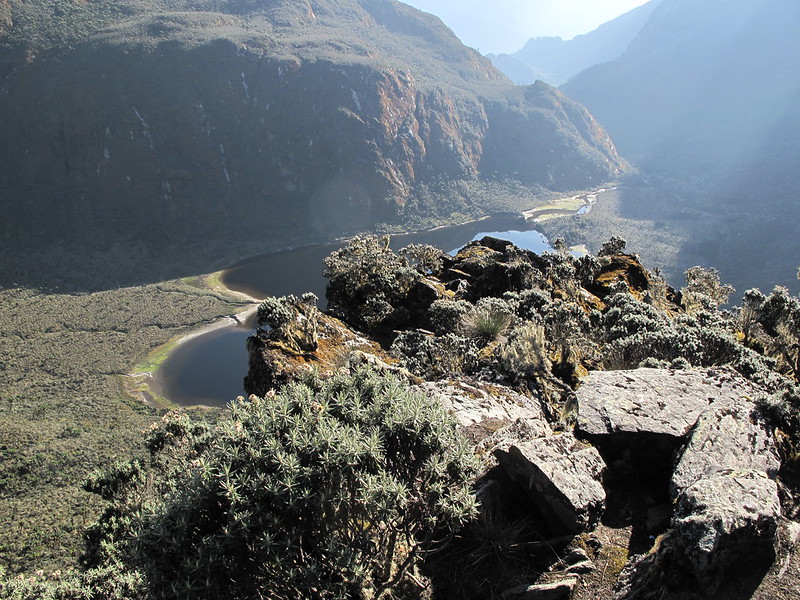

There is a summit in the heart of equatorial Africa that carries its mythology. The ancient Greek geographer Ptolemy mapped it two thousand years ago as the source of the Nile, the Mountains of the Moon, he called them, hidden behind a perpetual veil of cloud, impossibly glaciated for peaks that straddle the equator. He was right about both the mystique and the ice. The Rwenzori Mountains of western Uganda remain, today, one of the most extraordinary and least visited mountain destinations on Earth: glaciers clinging to equatorial peaks above 5,000 meters and botanical zones so distinct from one another that each day’s ascent feels like entering a different world entirely.
 The 7-Day Rwenzori Trekking to Margherita Peak via the Central Circuit Trail is the definitive Rwenzori trekking experience, the route that takes you through all five of the mountain’s vegetation ecological zones, from the Afro-montane forest at the Nyakalengija trailhead to the Stanley Glacier at 5,109 meters, in a beautifully paced seven-day arc that allows proper acclimatization, genuine immersion in the landscape, and the kind of summit attempt that is prepared rather than rushed. You begin at the Uganda Wildlife Authority gate with the smell of the equatorial forest and the sound of the Mubuku River below the trail. You end in the pre-dawn darkness of the Elena Hut, with crampons on your boots and the Stanley Glacier catching the first grey light of an equatorial morning above you. Between those two moments, the Rwenzori gives you everything it has.
Giant lobelias stand four meters tall in the Bigo Bog. The Kurt Schafer Bridge is suspended above the white water of the Bujuku River confluence. Lake Bujuku reflects the Stanley Massif in absolute stillness. The Scott-Elliot Pass panorama with six massifs simultaneously visible. And then the summit: Africa’s third-highest point, the highest in Uganda, the roof of the Rwenzori range, with the Congo Basin extending to the western horizon in a sweep of green immensity that no camera has ever captured without losing something essential.
Rwenzori Trekking Expeditions guides this journey with the knowledge that comes from guiding it hundreds of times and learning something new on every ascent. Your journey includes a private certified guide, a dedicated porter team, a mountain cook, a peak permit, and hut reservations. Every element is pre-arranged, confirmed, and managed so that you can focus fully on the mountain instead of its administration. The Central Circuit Trail begins at Nyakalengija. It is waiting for you.
The Rwenzori’s equatorial glaciers have retreated by over 80% in the last century. Scientists project complete disappearance before 2050. This seven-day journey crosses ice that has persisted at the equator since the last ice age. The window to climb the Rwenzori, as it has always been, is measured in years, not decades. The mountains are here now.
Day 1: Nyakalengija (1,646m) → Nyabitaba Hut (2,651m) | ~10 km | Approximately 5 hours | Zone 1
The Uganda Wildlife Authority registration at the Nyakalengija trailhead is a brief, businesslike formality; your private guide handles every element of the paperwork and permit verification while you absorb the starting point of this journey: the park gate, the sound of the Mubuku River below the trail’s first section, and the wall of Afro-montane forest that begins immediately and completely on the other side of it. The porter team assembles with practiced efficiency, loads distributed, weight checked, and equipment confirmed, and then the gate opens and the Rwenzori Mountains National Park receives you.
The first thing the trail gives you is forest. Dense, cathedral-dark, perpetually moist Afro-montane forest that closes above the path in a vault of Hagenia and Hypericum trees draped in epiphytic mosses, ferns, and the occasional orchid clinging to a branch at eye level. The Rwenzori turaco, the range’s avian emblem, its crimson wing patches unmistakable, announces itself from the canopy.
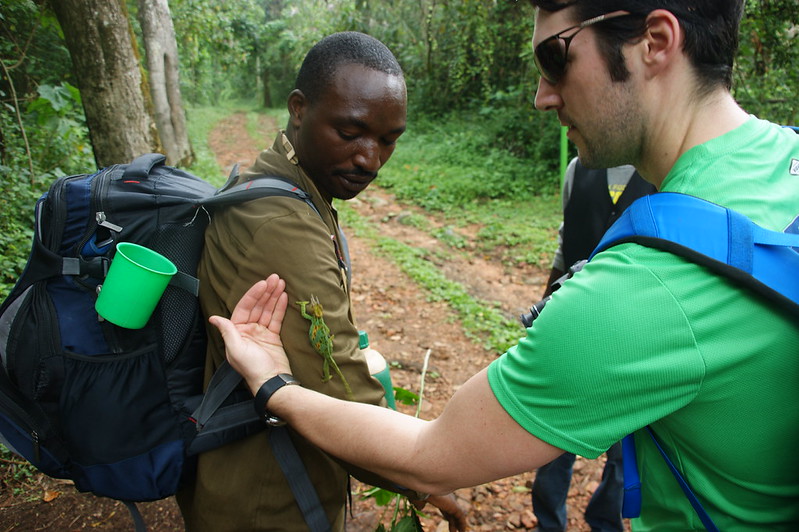
Three-horned chameleons occupy low branches with the philosophical stillness of animals that have long since concluded speed is unnecessary. The trail follows the Mubuku River’s upper drainage, crossing wooden bridges where the water is cold and clear and brisk, before beginning the sustained ascent that carries the path to the first ridge above the river valley.
The cultivated zone of the Bakonzo community, the indigenous people of the Rwenzori foothills, provides a transition between the world below and the world above, with their homesteads and banana gardens threading through the lower forest fringe. Children at doorways. Gardens tended with unhurried care. Your guide moves through this zone with the ease of long familiarity, pausing to exchange words with community members who know him by name. The relationship between the Bakonzo and these mountains runs to a depth that no amount of tourism development has altered.
Nyabitaba Hut, at 2,651 meters, arrives on a commanding ridge with views across the Mubuku River valley to the ridgelines beyond, the first clear indication that what the mountain has in store for you is genuinely vertical and truly worth it. The hut is well-maintained and welcoming; your mountain cook has arrived ahead of the main party and has the evening meal underway. Dinner at Nyabitaba is the first of six mountain meals prepared on your behalf, and its warmth and generosity set the standard that the following five will maintain.
Accommodation & Meals: Nyabitaba Hut (2,651m). Full-board mountain meals from your dedicated cook throughout the trek. First mountain night, acclimatization is gentle here.
Day 2: The Bridge, the Bamboo, and the Heather Giants
Nyabitaba Hut (2,651m) → John Matte Hut (3,505m) | ~8 km | Approximately 6–7 hours | Zones 1–2
The descent from Nyabitaba to the Kurt Schafer Bridge is one of the Central Circuit’s most reliable moments of concentrated attention: the trail drops steeply to the confluence of the Mubuku and Bujuku rivers, and the bridge, named for a pioneering Rwenzori trekker, is a narrow suspension crossing above white water that demands both physical focus and delivers a reliable, uncomplicated surge of aliveness. The briefest pause on the bridge, with the water rushing through the rock canyon below and the forest rising on both banks, is worth taking. This is the Central Circuit’s first striking sensory moment.

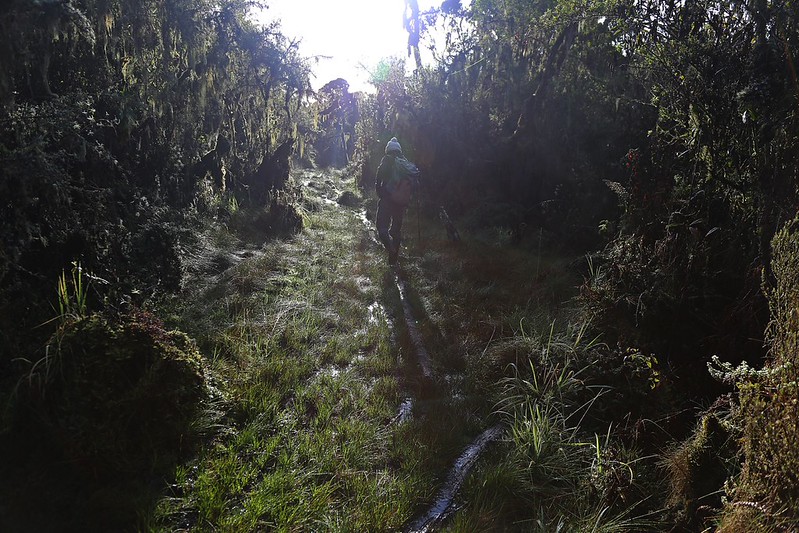
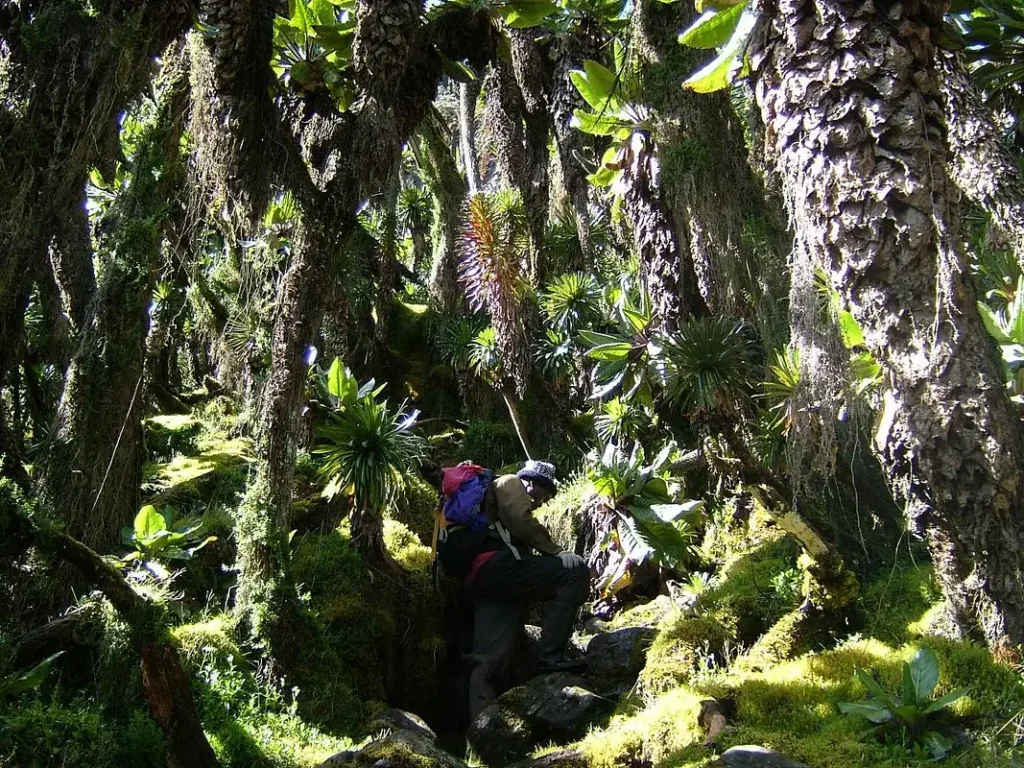
Above the bridge, the botanical character of the mountain changes register. The forest closes in bamboo — great columns of highland bamboo filtering the equatorial light into green diffuse shafts, the trail between them damp and root-crossed and requiring the slightly meditative attention of mountain footwork that, after a few hours, becomes its own form of concentration. The bamboo gives way above 2,900 meters to the first of the giant heather trees, Erica arborea, at altitudes and sizes it reaches nowhere else on Earth, its trunks so completely encased in pale Usnea lichen and saturated sphagnum moss that the underlying wood is entirely invisible. The effect is extraordinary: trees that appear to be made entirely of living matter, no bark, and no dry wood visible, only moss and moisture and the specific smell of a forest that has been continuously wet for longer than any human measurement.
The Nyamileju rock shelter provides a natural lunch stop, a cave formation used by generations of trekkers as a weather refuge and rest point. Your cook has prepared a packed lunch timed for this stop; the thirty minutes here allow feet to rest, the forest to be observed at leisure, and the conversation that always happens at a natural shelter in a mountain landscape, unhurried and genuine, the kind that does not happen at a café table.
John Matte Hut, at 3,505 meters, named for a revered early UWA guide, sits in a heather clearing with the first real views of the higher massifs, Mount Stanley’s ridgeline visible above the cloud on clear evenings, its upper extent suggesting a height that the lower forest has not permitted you to appreciate. The altitude registers clearly here for the first time: the body is making quiet adjustments, and the evening’s early rest and substantial dinner are precisely what is required.
Accommodation & Meals: John Matte Hut (3,505m). Full-board meals. Altitude effects begin tonight, hydrate well, eat everything, and sleep early.
Day 3: John Matte Hut (3,505m) → Bujuku Hut (3,962m) | ~7 km | Approximately 5–6 hours | Zone 3 (The Bigo Bog, Where the World Becomes Entirely New)
There is no adequate preparation for the Bigo Bog. The challenge needs to be stated plainly, because the photographs of the Rwenzori’s afro-alpine zone circulate widely enough that first-time visitors believe they have been prepared by seeing them. They have not. The photographs capture the visual component of the experience: the giant lobelias in silver congregation and the groundsel trees spreading their canopies above the boardwalk, but they cannot capture the scale, the smell, the sound, or the specific quality of spatial disorientation that arrives when you stand inside a landscape for which no reference point in your previous experience applies.
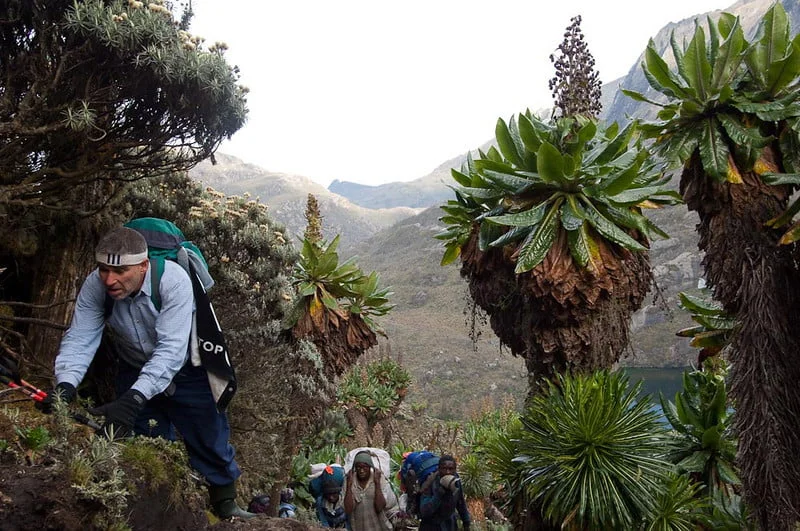
The descent from John Matte crosses the Bujuku River on a wooden bridge and arrives at the Inferior Bigo Swamp, where the giant lobelia population makes its first significant appearance. Lobelia wollastonii reaches three to four meters here, a plant that in temperate climates would be a knee-high perennial but is transformed here by altitude and moisture and a million years of evolutionary isolation into something that belongs in a Tolkien novel or a David Attenborough narration. The boardwalk across the swamp threads between lobelia stems wider than your waist, the vegetation closing above the path in configurations that the word ‘swamp’ does nothing to evoke. As the group moves through, your private guide identifies the species: the Senecio groundsel trees, the cushion Alchemilla, and the everlasting Helichrysum flowers, with the ease of genuine familiarity and the pleasure of showing visitors something that never ceases to produce the same response.
The Higher Bigo Bog above presents a second crossing of this extraordinary landscape before the trail rises toward Lake Bujuku. The lake appears as a revelation: a glacial tarn at 3,962 meters of extraordinary stillness, its dark surface reflecting the Stanley massif to the west with photographic precision on clear mornings. The Elena Glacier, visible on the Stanley’s southeastern face for the first time at this angle, is the ice you will cross in two days. From the lakeshore it looks permanent; your guide will tell you it has retreated by hundreds of meters in his lifetime. The knowledge adds something to the view that beauty alone does not.
Bujuku Hut, positioned above the lake with a direct view up to the Elena Glacier, is the expedition’s operational hub, the highest standard camp on the Central Circuit, with sleeping platforms, a communal area, and the satisfaction of being genuinely at altitude. The acclimatization is real by now, and the evening protocol matters: hydrate consistently, eat the full dinner your cook prepares, and let the body do its quiet, necessary work.
Accommodation & Meals: Bujuku Hut (3,962m). Full-board meals. Altitude acclimatization is now active; your guide monitors the group. Please report any symptoms immediately.
Day 4: Bujuku Hut (3,962m) → Elena Hut (4,541m) via Scott-Elliot Pass (4,372m) | ~5 km | 5–7 hours | Zones 3–5 (Scott-Elliot Pass and the Advance to Elena Hut)
Day Four of the 7-day Margherita Peak Rwenzori Trek carries the group from the familiar, the extraordinary is becoming familiar, which is one of the mountain’s finest gifts, into the genuinely alpine. The trail from Bujuku climbs through the upper groundsel zone, where the trees reach their maximum height of six meters and spread their silver-backed canopies above the path like plants that have been growing in this specific place for over a century. Above the groundsel line, the vegetation surrenders to bare rock, and the trail becomes a question of choosing the right footing on ancient crystalline gneiss that has been here since before the continent took its current shape.
Scott-Elliot Pass, at 4,372 meters, is one of the Central Circuit’s great moments of arrival. Named for the nineteenth-century Scottish naturalist whose expeditions helped document the Rwenzori’s botanical zone system, the pass is a narrow saddle between Mount Baker to the south and Mount Stanley to the north, and the panorama from it arrives with the completeness of a revelation that has been building since Nyakalengija: the Bujuku Valley falls away below you to the east, the Stanley Glacier fills the northern horizon, and in every direction, six massifs are simultaneously visible on a clear morning, the full Rwenzori range spread out in its spatial reality. Your guide names each massif, each peak, and each glacier. The geography of the next three days becomes comprehensible as a visual fact.
A fixed metal ladder assists the descent from the pass’s steepest rock section, a brief, focused passage that concentrates attention completely and delivers you onto the upper Stanley face where the Elena Hut trail traverses rightward across the mountain toward the glacier’s foot. Elena Hut, at 4,541 meters, is the highest accommodation on the Central Circuit trail and one of the most dramatically positioned mountain shelters in Africa: perched on a narrow rocky shelf with the glacier directly above and the cloud layer just below, exposed to the wind that moves almost continuously at this altitude, and, on clear evenings, open to a sky of stars so dense that the constellation shapes are harder to find than the individual stars. Crampons are fitted this evening. Ice axes are allocated. The summit briefing is delivered by your private lead guide with the direct, precise confidence of someone for whom these words are not performance but preparation. The alarm is set for midnight.
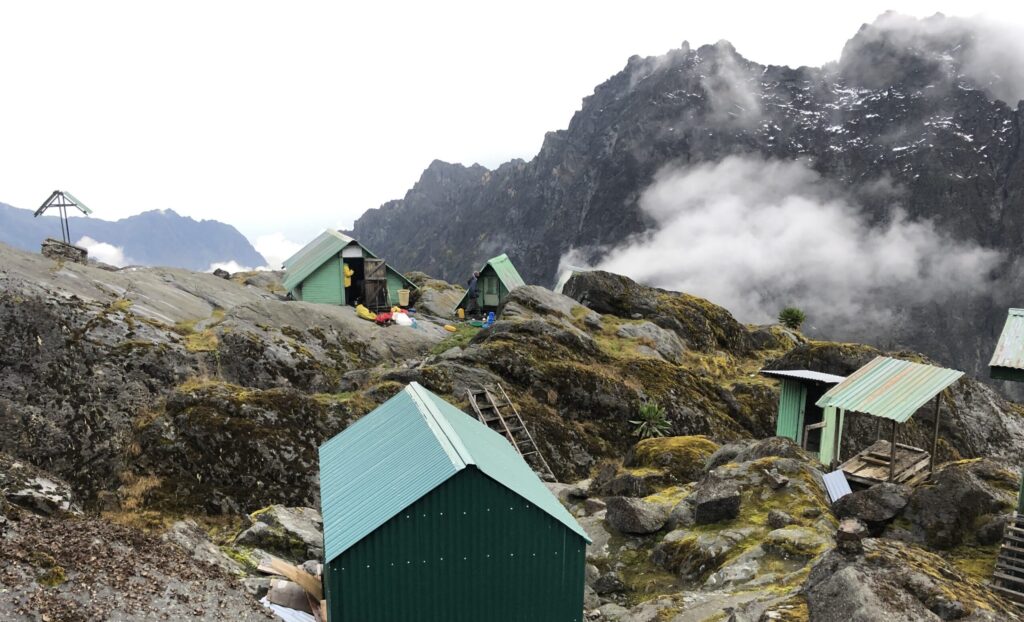
Accommodation & Meals: Elena Hut (4,541m). Full-board meals are provided, so eat everything; calories matter tonight. Crampons fitted and verified. Summit briefing complete. Alarm: midnight or 01:00 depending on conditions.
Day 5: Margherita Peak (5,109m) → Kitandara Hut (4,023m) | 10–14 hours (Summit Day and Kitandara Descent to Elena Hut (at 4,541 m)
The midnight alarm at Elena Hut sounds in absolute darkness and absolute cold, and the response to it: the layering, the crampon-fitting by headlamp, and the hot breakfast consumed, resolves the appetite—is executed with the quiet efficiency of a team that has been building toward this moment for four days. Your private lead guide makes the final conditions assessment and gives the go: the glacier is in appropriate condition. The summit team moves.
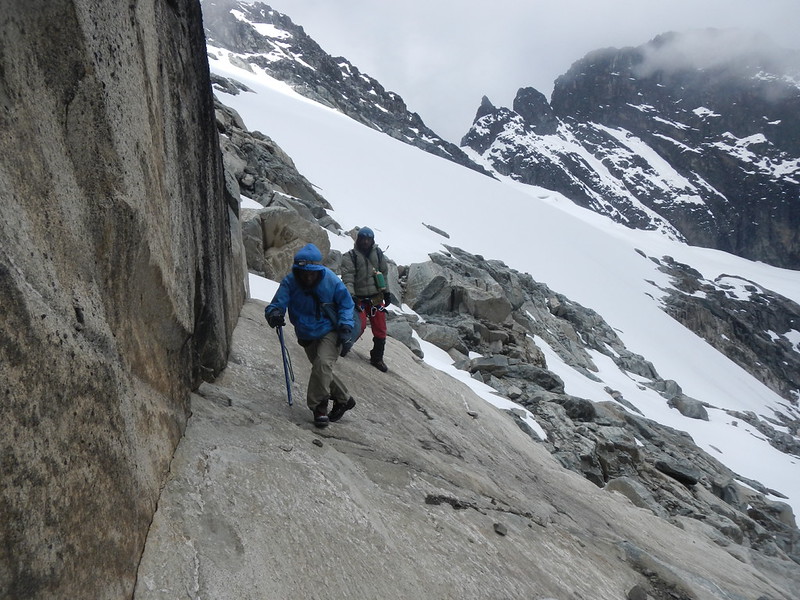
The ascent of the Stanley Glacier from Elena Hut begins on ancient equatorial ice. The crampon placements are precise and certain, a specific sound, and a specific sensation through the boot sole that communicates directly with the body’s understanding of commitment and trust. Your guide leads the rope team through the glacier’s upper section, reading the ice conditions in real time, navigating the crevasse zones that experience has mapped, and calling back directions in the quiet, functional shorthand of a guide who knows this glacier with the intimacy of daily familiarity and is managing its movement with professional authority. The darkness lifts in stages as the ascent progresses: grey first along the eastern horizon, then amber, then the first gold of an equatorial dawn that begins to reveal, below and behind you, the full scale of the terrain descended over the preceding four days.
The summit rock above the glacier’s upper lip requires hands-on scrambling, the guide close, the ropes present on the most exposed sections, and the exertion significant but entirely within the preparation the preceding days have provided. And then, with very little announcement, the summit arrives. Margherita Peak at 5,109 meters. Africa’s third-highest point: Uganda’s summit. This is the roof of the Rwenzori range. The view from here extends to the horizon in every direction: the Congo Basin filling the west in an immensity of green, the Rwenzori ridge curving north and south, Lake Imelda visible below the summit snowfield, and Mount Speke and Mount Baker spread across the northern and southern approaches. You have earned every meter of this view, and the mountain knows it and gives the summit moment exactly the gravity it deserves.
The descent from Margherita retraces the glacier route to Elena Hut, where lunch is taken before the afternoon continues. The southward trail drops via the Scott-Elliot junction to the Kitandara Lakes at 4,023 meters, twin glacial tarns of extraordinary beauty in the late afternoon light. The day has been very long by the time Kitandara Camp receives the team. Hot drinks. A proper dinner. The particular warmth that comes from achieving an objective.
Accommodation & Meals: Kitandara Hut (4,023m). Full-board meals. Summit certificate for Margherita Peak. Rest completely; the body has given generously today.
Day 6: Kitandara Hut (4,023m) → Freshfield Pass (4,282m) → Guy Yeoman Hut (3,261m) | ~9 km | 6–8 hours
The post-summit morning carries its own particular quality: a deep physical tiredness that coexists with the specific lightness of spirit that follows a genuinely achieved objective. The Kitandara Lakes in the early morning light, still water, Baker’s cliffs reflected, and the high moorland opening in every direction are one of the Rwenzori’s finest settings and one that deserves the unhurried breakfast your cook provides before the day’s movement begins.
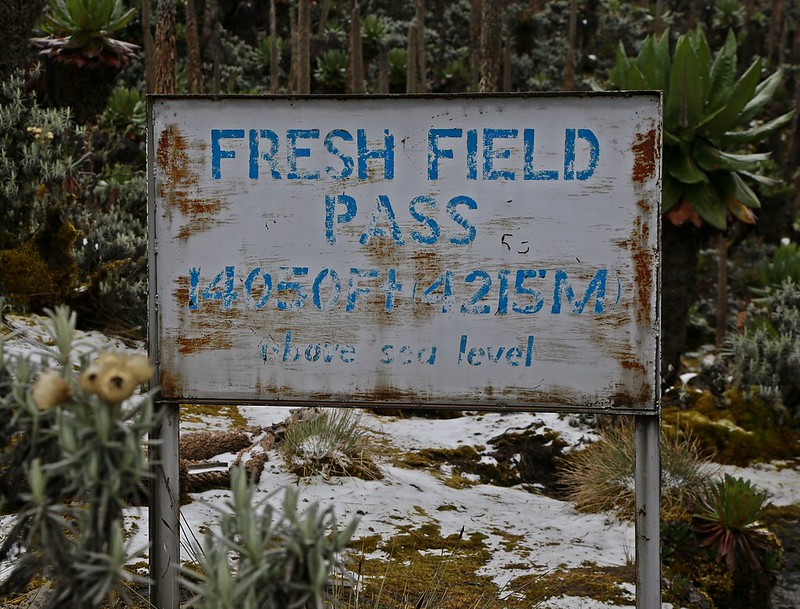
Freshfield Pass, at 4,282 meters, is the day’s high point and one of the circuit’s finest viewpoints. The ascent from Kitandara climbs through the final afro-alpine meadow zone, and from the pass itself, the view west across the Democratic Republic of Congo is among the expedition’s most striking geographical moments: the Congo Basin extending to the western horizon in an immensity that communicates the scale of the watershed system that the Rwenzori’s glaciers feed. To the north, the Stanley massif fills the skyline in the direction from which you descended yesterday. The route you traced over the preceding five days is now a visual reality rather than a plan.
The descent from Freshfield passes Bujangolo Cave, the rock shelter used as base camp by Luigi Amedeo di Savoia, Duke of Abruzzi, during the 1906 expedition that made the first recorded ascents of the Rwenzori’s major peaks. The plaque is modest; your guide’s account of what that expedition achieved with the equipment of its era gives the cave the weight of genuine history. Guy Yeoman Hut, at 3,261 meters, on the Mubuku River’s southern tributary, is the expedition’s last mountain night, a camp with the particular quality of all penultimate nights: the knowledge that the mountain’s gifts are nearly complete and the body’s gratitude for a flat sleeping surface and a proper cook’s dinner.
Accommodation & Meals: Guy Yeoman Hut (3,261m). Full-board meals. Last mountain night. The descent to Nyakalengija completes the circuit tomorrow.
Day 7: The Final Descent — Closing the Circle
Guy Yeoman Hut (3,261m) → Lake Mahoma → Nyabitaba → Nyakalengija (1,646m) | ~12 km | 6–8 hours
The last mountain morning has a different quality from all the others: the recognition that today the trail runs downward for the final time, through every vegetation zone traversed on the ascent but in reverse and in the space of a single sustained movement. The heather zone yields way to bamboo. The bamboo yields way to the montane forest. The forest opens gradually onto the cultivated fringe of the Bakonzo community above Nyakalengija. Each transition has a different texture on the descent than it did on the ascent, the familiar becoming familiar again, the body recognizing what the ascending version of itself encountered with the freshness of novelty.
The optional detour to Lake Mahoma, a beautiful crater lake at approximately 2,000 meters set in the forest with a particular reflective stillness, adds forty minutes to the descent and is worth every one of them. The lake is one of the Rwenzori’s least-visited day-hike objectives and among its most visually rewarding: the surrounding forest reflected in the dark water, colobus monkeys in the trees above the shore, and the particular quality of silence that a forest lake always provides and a mountain trail never quite does.
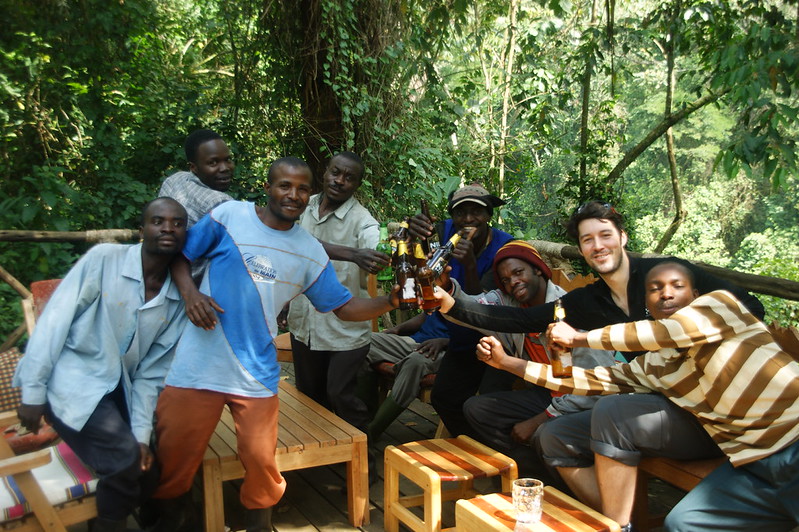
Nyakalengija arrives in the mid-afternoon. The porter tips are distributed, always a moment of genuine human warmth between people who have moved through extraordinary terrain together, a specific exchange of respect that crosses every language barrier between a first-world trekker and a Bakonzo mountain professional. The summit certificate is signed and dated. Your private vehicle is at the gate. The Central Circuit trail is complete. Seven days. Five vegetation zones. Africa’s third-highest summit. The Rwenzori Mountains have given you everything and carried something away in return: the particular mark that a genuinely transformative landscape always leaves on the people who walk through it.
Accommodation & Meals: Kasese hotel (post-trek, pre-arranged). Dinner included. Summit certificate presented. Your Rwenzori Trekking Expeditions team arranges your transfer to Kampala, Entebbe, or your onward destination.
The Rwenzori Trekking Expeditions 7-Day Central Circuit package is structured for complete logistical transparency. Your dedicated team confirms every element below before your departure date and manages it throughout. The exclusions list the few personal items outside this scope for complete clarity.
Included in Your Package
All Uganda Wildlife Authority (UWA) Rwenzori Mountains National Park entry fees for 7 days | ✓ |
Margherita Peak summit permit and glacier approach fees | ✓ |
One certified professional lead mountain guide, UWA-registered, private allocation for your group only | ✓ |
Assistant mountain guide for the Elena Hut and summit day sections | ✓ |
Dedicated porter team, one porter per trekker for personal kit up to 18 kg | ✓ |
Dedicated mountain cook, full-board catering for all 7 days on the mountain | ✓ |
All mountain hut accommodation: Nyabitaba, John Matte, Bujuku, Elena, Kitandara, Guy Yeoman | ✓ |
Crampons (strap-on, fitted to rubber boots), provided Day 4 onward | ✓ |
Ice axe, provided Day 4 onward | ✓ |
Climbing harness, safety helmet, and carabiners, provided Day 4 onward | ✓ |
Managed rope sections on Elena Glacier and summit approach | ✓ |
Rubber boots in all sizes, mandatory for Central Circuit bog sections, provided free | ✓ |
Emergency oxygen canisters are carried by guide team at all times above 4,000 m. | ✓ |
Comprehensive wilderness first-aid kit — carried at all times by lead guide | ✓ |
UWA-mandated mountain rescue fund contribution | ✓ |
Pre-trek equipment inspection and technical gear briefing | ✓ |
Daily altitude acclimatisation monitoring and health assessment by your certified guide | ✓ |
Margherita Peak summit certificate on successful ascent | ✓ |
Transfer from Kasese hotel to Nyakalengija trailhead (if booked with transfer package) | ✓ |
Post-trek transfer from Nyakalengija to Kasese accommodation | ✓ |
Not Included
International flights to and from Entebbe International Airport (EBB) | ✗ |
Uganda tourist visa ($50 USD for most nationalities — apply online at visas.immigration.go.ug) | ✗ |
Comprehensive travel and medical evacuation insurance — mandatory; must include mountaineering above 5,000m and emergency helicopter evacuation | ✗ |
Personal sleeping bag, minimum -5°C rating required; -10°C strongly recommended for Elena Hut | ✗ |
Personal trekking clothing: waterproof hardshell jacket and trousers, thermal base layers, down jacket, gaiters | ✗ |
Trekking poles, strongly recommended for descent; available for hire in Kasese with advance notice | ✗ |
Personal porterage above the 18 kg guideline | ✗ |
Alcoholic beverages | ✗ |
Personal medications, including altitude sickness prophylactics (Diamox/acetazolamide; consult your personal medical Doctor before departure) | ✗ |
Gratuities for mountain guides, porters, and cooks are entirely discretionary but warmly appreciated; your guide advises at the appropriate time | ✗ |
Kasese hotel accommodation before and after the trek (bookable through Rwenzori Trekking Expeditions at additional cost) | ✗ |
Transfer from Kampala or Entebbe to Kasese (bookable through RTE at additional cost) | ✗ |
Any optional activities or park extensions beyond the 7-day Central Circuit | ✗ |
What to Wear and Pack — The Rwenzori Gear Guide
The Rwenzori is the wettest mountain range in Africa. Assume rain every day at every altitude. The gear requirements for the Central Circuit trail route are more specific than a standard trekking itinerary because of the moisture baseline, the altitude range (1,646–5,109 m), and the technical glacier approach on Day Five.

What Rwenzori Trekking Expeditions Provides
All technical summit equipment is provided: crampons, ice axe, climbing harness, and safety helmet. Rubber boots are provided free of charge in all sizes and are mandatory for the Central Circuit’s bog sections; they protect your trekking boots and your footing through the waterlogged Bigo and Kitandara sections. Do not attempt the Central Circuit trail without rubber boots; your trekking boots will not survive the bog crossings, and nor will your feet. Neoprene socks (four pairs minimum) are essential for warmth inside the rubber boots.
What You Must Provide
- A sleeping bag rated to -10°C is required for Elena Hut, where overnight temperatures regularly drop below this threshold with wind chill.
- A fully waterproof hardshell jacket and trousers with a 20,000 mm hydrostatic head, fully seam-sealed, are non-negotiable.
- A waterproof jacket that leaks on the Rwenzori is not a waterproof jacket. You will need two sets of thermal base layers (synthetic or merino wool, never cotton) and a warm insulated down jacket with a hood for the upper camps and summit.
- Trekking poles (essential for the descent), a headlamp rated at 300+ lumens with spare batteries for the midnight summit start, and glacier sunglasses with UV400 protection and side shields for the Elena Glacier section.
Visit our complete Rwenzori packing list at www.rwenzoritrekkingexpeditions.com for the full, season-specific gear specification.
The Two-Boot System
The rubber boots provided by Rwenzori Trekking Expeditions are worn from the trailhead to the upper heather zone, through all bog sections, and for the approach to Elena Hut. Above Elena, crampons are fitted to the rubber boots for the glacier section. Your personal trekking boots can be carried by a porter and worn in the huts and on rock sections above the snow line. The two-boot system is the established Central Circuit trail approach and is managed by your guide throughout.