Understanding Each Mountain Before Comparing Them
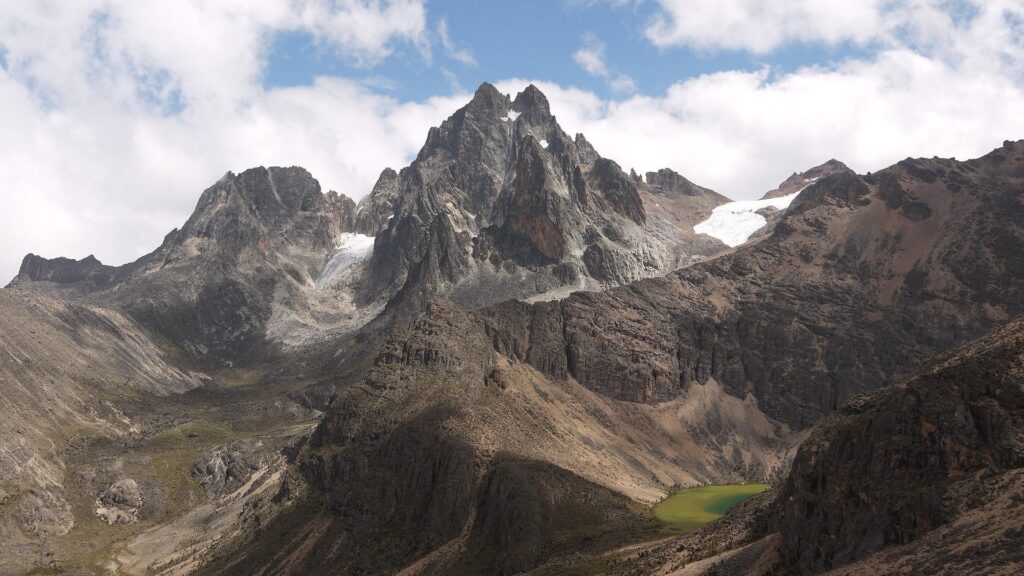
Mount Kilimanjaro: Africa’s Highest Summit
Kilimanjaro rises from the plains of northern Tanzania as a free-standing volcanic massif, its summit, Uhuru Peak, reaching 5,895 meters above sea level, the highest point on the African continent and one of the world’s celebrated Seven Summits. Several established trekking routes, including Machame, Lemosho, Marangu, and Rongai, pass through a series of distinct ecological zones: dense montane forest, open moorland, high-altitude desert, and finally the crater rim itself. The standard routes to Uhuru Peak are widely considered trekking objectives rather than technical mountaineering climbs; no ropes, crampons, or climbing experience are required on the normal ascent, and the principal challenge is altitude itself, compounded by cold, wind, and multiple consecutive days above 4,000 meters.
Who should choose Kilimanjaro?
- First-time high-altitude trekkers who prepare properly for the altitude challenge.
- Travellers whose specific dream is Africa’s highest summit.
- Those who value established trekking infrastructure and well-mapped routes.
- Travellers wanting to combine a summit trek with a classic Tanzania safari in the Serengeti or Ngorongoro Crater.
What makes Kilimanjaro special is the combination of extreme altitude, an iconic summit, dramatic volcanic scenery, and genuine accessibility, a serious mountain that does not require a technical climbing background to reach its top.
Mount Kenya: Trekking and Technical Mountaineering, Two Different Mountains in One
Mount Kenya is the eroded core of an extinct volcano rising from Kenya’s central highlands, and it is best understood as offering two genuinely different mountain experiences depending on the objective chosen. Point Lenana, at 4,985 metres, is the principal trekking objective and the summit reached by the vast majority of visitors; it involves no technical climbing and rewards trekkers with sweeping views across jagged rock spires and glacial valleys. Nelion, at 5,188 metres, is a serious technical mountaineering objective that requires rock climbing skills and proper alpine equipment. Batian, the true highest summit at 5,199 metres, is likewise a technical climb and the peak that most casual travellers never actually attempt.
Who should choose Mount Kenya?
- Trekkers seeking a high-altitude East African experience without committing to a technical climb, via Point Lenana.
- Climbers with genuine technical ambitions who want to attempt Nelion or Batian.
- Travellers who are drawn to rugged rock formations, alpine tarns, and dramatic mountain architecture.
The key sentence worth remembering: Mount Kenya should not be treated as one single type of climb, because the experience of trekking to Point Lenana is fundamentally different from climbing Batian or Nelion. Anyone comparing Mount Kenya to Kilimanjaro or the Rwenzori should be clear about which of these two mountains; the trekking peak or the technical peaks.
The Rwenzori Mountains: A True Wilderness Expedition
The Rwenzori Mountains rise along Uganda’s border with the Democratic Republic of Congo, protected within Rwenzori Mountains National Park, a UNESCO World Heritage Site known since antiquity as the Mountains of the Moon. Unlike Kilimanjaro and Mount Kenya, which are single volcanic massifs, the Rwenzori is a non-volcanic block-fault range comprising six major mountains, of which Mount Stanley is the highest, crowned by Margherita Peak at 5,109 meters, Africa’s third-highest summit. Expeditions here follow the Central Circuit Trail or the Kilembe Trail, moving through remote huts and tented camps, past giant groundsels and giant lobelias found almost nowhere else on Earth, across glacial terrain, and through weather that changes by the hour rather than the day.

This is the range our team knows most intimately, and it is worth stating plainly why it occupies a genuinely different category from the other two. The Rwenzori is a multi-day, multi-massif wilderness expedition rather than a single-summit trek: the journey through five distinct ecological zones, the remoteness of the camps, and the sheer unpredictability of equatorial mountain weather make this the most immersive and least conventional of the three experiences.
Who should choose the Rwenzori Mountains?
- Travellers seeking genuine wilderness rather than a well-trodden trekking corridor.
- Experienced trekkers who want more from a mountain than a single iconic summit photograph.
- Those wanting a less conventional African mountain experience, away from the largest crowds.
- Photographers drawn to giant Afro-alpine vegetation, mist, and dramatic changing light.
- Adventurers who value the journey itself as much as the summit at the end of it.
- Travellers interested in combining trekking with gorilla trekking and a wider Uganda safari.
Which Mountain Is Harder: Kilimanjaro, Mount Kenya, or Rwenzori?
Difficulty is not a single number, and any comparison that reduces it to one is a disservice to travelers. It is more useful to compare the specific factors that combine to create difficulty on each mountain.
Altitude
Kilimanjaro is the highest of the three (Kilimanjaro, Mount Kenya & Rwenzori Mountains), and its standard routes spend multiple consecutive days above 4,000 meters, creating significant physiological demands regardless of route choice. Mount Kenya’s Point Lenana and the Rwenzori’s Margherita Peak sit within a few hundred meters of each other in elevation, so altitude alone does not clearly separate those two.
Terrain
Kilimanjaro’s paths are generally well-graded and consistent. Mount Kenya’s higher terrain involves genuine rock scrambling on the approach to its technical peaks. The Rwenzori is frequently described by our guides as the most physically demanding underfoot: mud, steep and slippery sections, boggy ground in the heather zone, and river crossings are a normal part of most days on the trail.
Technical climbing
Mount Kenya’s highest summits, Nelion and Batian, require genuine technical rock climbing skill and equipment. Margherita Peak’s final ascent can involve snow, ice, rock, and glacier terrain depending on current conditions, placing it closer to a mountaineering objective than a trek. Kilimanjaro’s standard routes require neither.
Weather
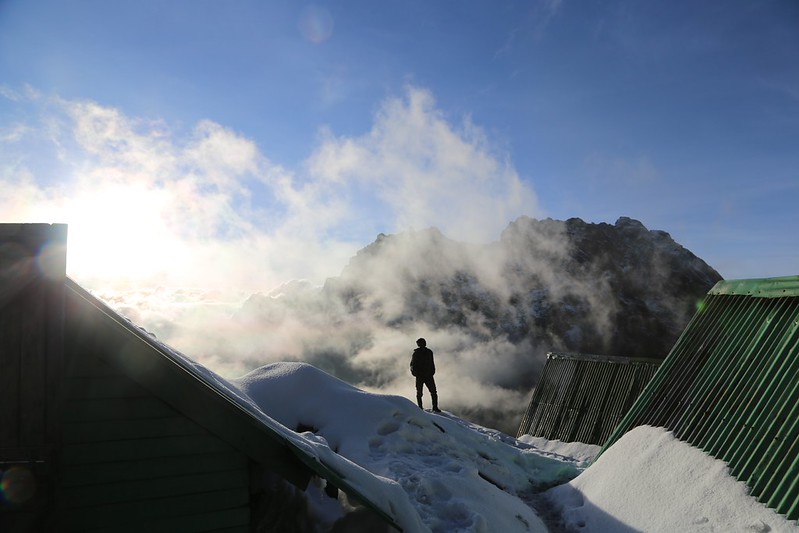
The Rwenzori Mountains is particularly known for wet and rapidly changing conditions, a consequence of its equatorial position and the moisture drawn up from the Congo Basin; rain, mist, and sudden temperature swings are a normal feature of most days, at almost any time of year. Kilimanjaro and Mount Kenya both have more clearly defined dry and wet seasons.
Duration
Longer expeditions create cumulative fatigue that a difficulty rating based on a single summit day cannot capture. Rwenzori itineraries extending to a week or more, or the multi-peak expeditions covering several summits, ask more of a trekker’s endurance over time than a five-day Kilimanjaro climb, even though no single day may be harder.
Remoteness
The Rwenzori experience can feel considerably more remote and logistically complex than either of the other two mountains, simply because of lower visitor numbers, more limited rescue infrastructure, and terrain that can make evacuation slower if it is ever required.
Difficulty, in short, cannot be measured by altitude alone. A trek to Uhuru Peak, a trek to Point Lenana, a technical ascent of Batian, and a Margherita Peak expedition involve different combinations of altitude, terrain, weather, technical skill, and endurance, and the honest answer to “which is hardest” depends on which of those factors matters most to you.
Which Mountain Requires Technical Climbing?
Kilimanjaro
A standard route to Uhuru Peak is generally considered a trekking objective rather than a technical mountaineering climb. No ropes or climbing hard gear are used on the normal ascent.
Mount Kenya
Point Lenana is a trekking objective reachable without technical climbing skill. Batian and Nelion are technical climbing objectives requiring rock climbing experience, a qualified mountain guide, and appropriate equipment.
Rwenzori
Margherita Peak is a mountaineering objective. Its final stages can involve fixed ropes, exposed rock, snow and glacier travel, and conditions and requirements can change with the state of the ice, snow, and route from season to season. Our team never publishes a static equipment requirement without reviewing current conditions directly with our guides; see our current Rwenzori packing list for the latest guidance before you travel.
Which Mountain Has the Best Scenery?
Choose Kilimanjaro for:
- Immense volcanic landscapes and a genuine sense of scale.
- High-altitude desert terrain unlike anywhere else on the trek.
- Dramatic, wide-open summit views at sunrise.
- The simple fact of standing on Africa’s highest mountain.
Choose Mount Kenya for:
- Jagged, spire-like rock peaks with real alpine character.
- Glacial valleys and high mountain tarns.
- Dramatic mountain architecture more reminiscent of the Alps than a volcano.
Choose Rwenzori for:
- Giant lobelias and giant groundsels are found almost nowhere else on Earth.
- Misty valleys and moss-draped, dripping forest.
- Dense, ancient vegetation across five distinct ecological zones.
- Alpine lakes tucked between rugged, multi-summit massifs.
- Genuine glacial scenery on the upper slopes of Mount Stanley.
The Rwenzori Mountains are arguably the most botanically unusual of the three, particularly because of their remarkable Afro-alpine vegetation, a landscape that regularly surprises even well-travelled trekkers who assumed they knew what an African mountain looks like.
Which Mountain Has the Most Unusual Vegetation? Kilimanjaro or Mount Kenya or Rwenzori
All three mountains (Rwenzori Mountains, Mount Kenya, and Kilimanjaro) climb through a sequence of ecological zones as elevation increases, but the character of those zones differs meaningfully.
Kilimanjaro
Forest, then heath and moorland, then alpine desert, then the bare summit zone, a progression toward increasing starkness as altitude rises.
Mount Kenya
Forest, then bamboo, then heathland, then moorland, then the alpine zone around the technical peaks, broadly similar in structure to Kilimanjaro, with more rock exposed at altitude.
Rwenzori
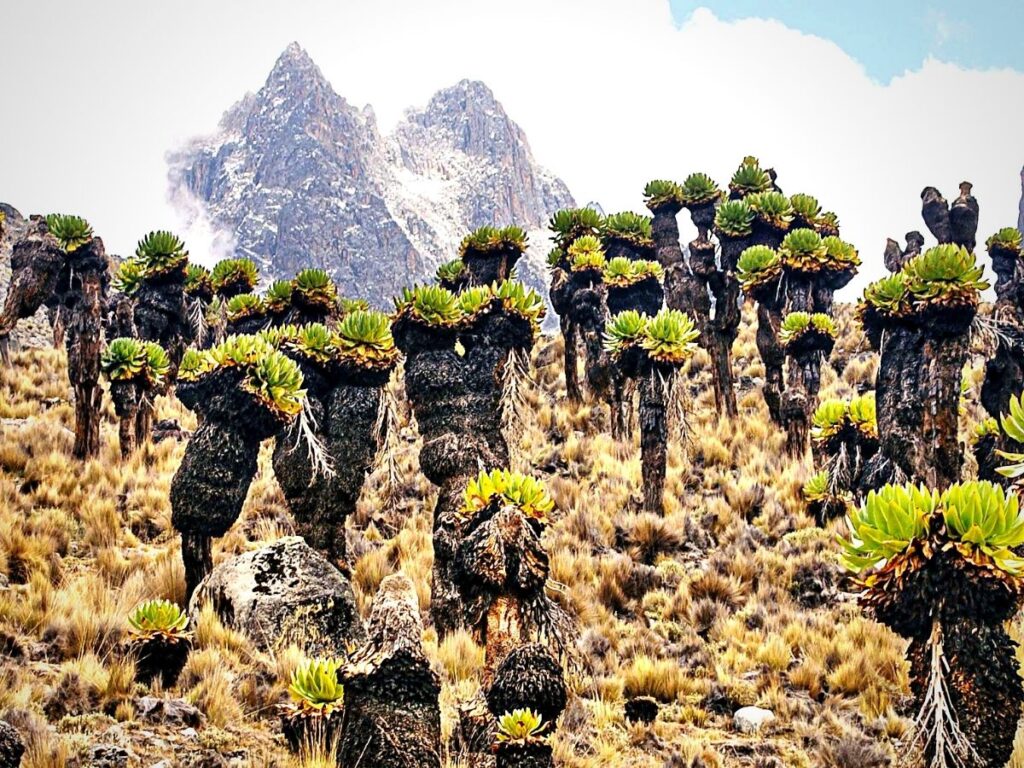
The sequence of vegetation in the Rwenzori includes montane forest, bamboo, heather, genuine Afro-alpine vegetation, and high alpine and glacial terrain near the summits, all covered in detail in our own Rwenzori vegetation zones guide.
It is the Afro-alpine zone that sets the Rwenzori mountains apart most clearly. Giant lobelias, rising in tall, sculptural spikes, and giant groundsels, with their tree-like trunks and rosettes of silver-green leaves, grow here in a form found in only a handful of East African mountain ranges. Combined with heather forests draped in old man’s beard lichen and moss-covered landscapes that seem to glow faintly green even in low light, this is a vegetation story that neither Kilimanjaro nor Mount Kenya can quite match in scale or strangeness. For travellers who care about botany and landscape as much as altitude, this is a major differentiator in the Rwenzori’s favour.
Which Mountain Offers the Best Wildlife Experience?
It is worth being clear from the outset: these are mountain expeditions, not conventional safaris, and wildlife sightings on any of the three should be treated as a bonus rather than the primary objective.

Kilimanjaro
Forest wildlife, including blue monkeys and forest birds, is present around the lower elevations of most routes, thinning out rapidly as the trail climbs into moorland and desert.
Mount Kenya
Forest wildlife and mountain biodiversity are present on the lower approach routes, with elephants and buffalo signs occasionally encountered near the park boundary.
Rwenzori Mountains
The Rwenzori Mountains offer biodiversity, birds, forest ecosystems, and, most importantly, opportunities to combine trekking with Uganda’s wider wildlife destinations. Travellers interested specifically in primates can add the Diamond Trail, a dedicated wildlife corridor within the same national park, to their itinerary. If wildlife is a major priority for your trip, the strongest safari combination available to you may matter more than the wildlife encountered during the mountain trek itself, and this aspect is precisely where the Rwenzori holds a genuine advantage: it sits within easy reach of Queen Elizabeth National Park, Kibale Forest’s chimpanzee trekking, and Bwindi’s gorilla trekking, none of which are within a comparable range of Kilimanjaro or Mount Kenya.
What Does It Actually Feel Like to Climb Each Mountain?
Kilimanjaro: The Iconic Summit Journey
The main story on Kilimanjaro is reaching Africa’s highest point. Every day of the climb builds toward that single, unmistakable objective, and the emotional arc of the trip is shaped around the final push to Uhuru Peak at sunrise, a shared achievement felt alongside hundreds of other trekkers making the same climb that week.
Mount Kenya: The Alpine Climbing Journey
The main story on Mount Kenya is that of a mountain with two identities held in tension: the accessible trekking summit of Point Lenana and the serious technical peaks of Nelion and Batian rising just beyond it. The feeling is one of alpine ambition, whichever version of the mountain you choose to attempt.
Rwenzori Mountains: The Wilderness Expedition
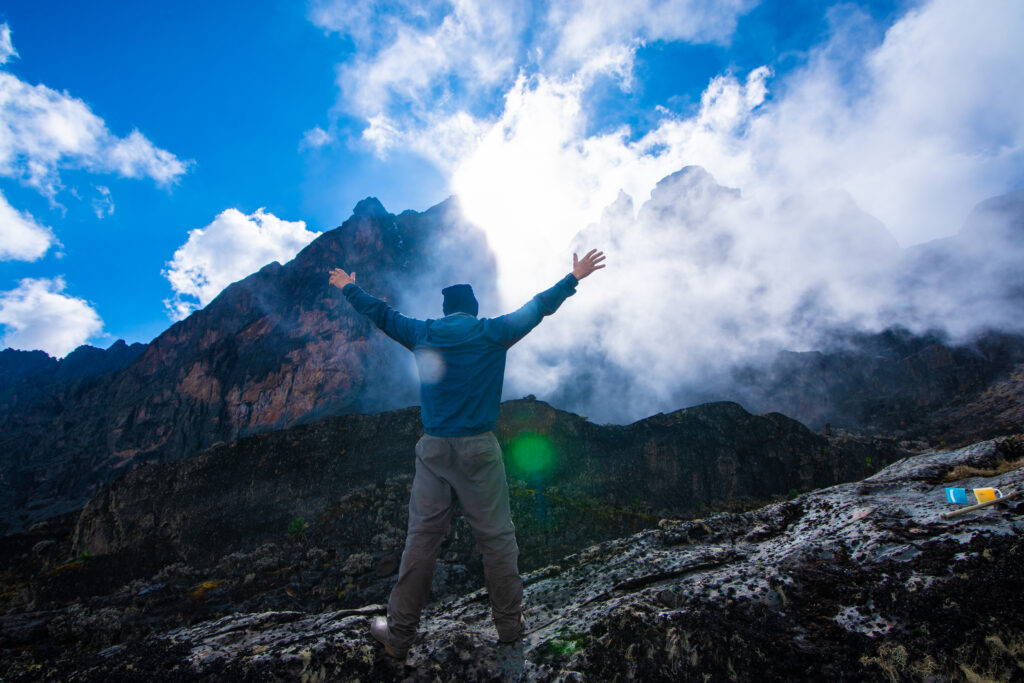
The main story of the Rwenzori Mountains is that the entire journey is the adventure, not just the summit. Days move through forest, bamboo, heather, and giant vegetation before the mountain ever shows you ice, and the changing weather, the remote camps, and the sheer strangeness of the Afro-alpine zone mean that by the time Margherita Peak comes into view, it feels earned in a different way, the culmination of an expedition rather than the sole point of it. This emotional distinction is, in our experience, the single most powerful reason why travellers choose the Rwenzori over its better-known neighbours.
Which Mountain Is Most Remote? (Kilimanjaro vs. Mount Kenya vs. Rwenzori
Kilimanjaro
Kilimanjaro is the most internationally famous of the three mountains (Mount Kenya, Kilimanjaro, and Rwenzori) and generally the most heavily visited, with well-developed infrastructure along every major route.
Mount Kenya
Mount Kenya can provide considerably more variation in remoteness depending on the route and objective chosen, from busier standard trekking paths to genuinely quiet approaches to the technical peaks.
Rwenzori
The Rwenzori Mountains generally provide the strongest sense of wilderness and remoteness of the three mountains (Kilimanjaro, Mount Kenya & Rwenzori Mountains), owing to lower overall visitor numbers and a trail network that sees a fraction of the foot traffic found on Kilimanjaro. We avoid quoting exact visitor statistics here, since reliable current figures vary by source and season, but the difference in atmosphere on the trail itself is immediately apparent to anyone who has climbed more than one of these mountains.
How Many Days Does Each Mountain (Mount Kenya, Kilimanjaro & Rwenzori) Take?
The honest answer, for all three mountains (Rwenzori, Mount Kenya & Kilimanjaro), is that duration depends entirely on the route and objective chosen; there is no single correct number of days.
Kilimanjaro
Several multi-day route options exist, typically ranging from five to nine days, with longer routes generally improving acclimatization and summit success rates.
Mount Kenya
Shorter trekking options to Point Lenana can be completed in three to five days, while technical expeditions to Nelion or Batian typically require additional days for climbing preparation and weather contingency.
Rwenzori Mountains
Short introductory treks through to extended, multi-peak, high-altitude expeditions are both available, ranging from four-day routes to summit attempts that stretch beyond thirteen days for trekkers pursuing several peaks. Our full range of Rwenzori trekking itineraries sets out the specific options by duration.
Which Mountain (Mount Kenya, Rwenzori, Kilimanjaro) Is More Expensive?
It is tempting to publish three simple price tags here, but doing so would be misleading. The real cost drivers are the same for the Mount Kenya, Kilimanjaro & Rwenzori Mountains, and they matter more than which mountain you choose:
- Route chosen
- Number of days on the mountain
- National park entry and conservation fees
- Guide-to-client ratio and guide experience
- Number of porters and their wages
- Accommodation standard, whether huts, tents, or lodges
- Transport and transfer arrangements
- Group size, since private treks cost more per person than large group departures
- Level of private, personalized service
- Technical equipment and specialist guiding for climbing objectives
The total cost should be compared using similar trip categories. A private, fully supported expedition should not be compared directly with a basic group trek simply because both visit the same mountain. Our own Rwenzori trek cost breakdown sets out exactly what drives pricing on our itineraries so that any comparison you make against Kilimanjaro or Mount Kenya operators is a genuinely fair one.
When Is the Best Time to Climb Each Mountain?

Best time for Kilimanjaro
The driest, most stable conditions for Kilimanjaro generally fall in the January to March and June to October windows, with clearer visibility and firmer trail conditions. The wetter months bring lusher lower-zone scenery but more challenging summit-day conditions.
Best time for Mount Kenya
The driest periods for Mount Kenya generally fall in January to February and again in August to September, offering the best rock conditions for technical climbing on Nelion and Batian as well as more comfortable trekking conditions to Point Lenana.
Best time for Rwenzori
December to early March and June to early September tend to offer the driest underfoot conditions and the best chance of clear summit views for the Rwenzori Mountains, yet Rwenzori’s equatorial position means rainfall, mist, and rapidly shifting weather are a possibility in any month. Our detailed Best Time to Visit the Rwenzori Mountains guide breaks conditions down month by month.
None of these windows guarantee good weather on any of the three mountains (Kilimanjaro, Mount Kenya & Rwenzori). High-altitude conditions in East Africa are genuinely variable, and the honest approach is to prepare thoroughly for changing weather rather than assume a particular month will deliver a clear summit day.
Which Mountain (Rwenzori, Kilimanjaro & Mount Kenya)? Is Best for Beginners?
The useful distinction here is that “beginner” does not mean “unfit.” All three mountains (Mount Kenya, Kilimanjaro & Rwenzori) reward genuine cardiovascular preparation, regardless of prior trekking experience.
Kilimanjaro
Kilimanjaro is potentially the most straightforward choice for a first major high-altitude summit trek, because standard routes to Uhuru Peak do not normally require technical climbing skill, though the altitude itself remains a serious physiological challenge that demands real preparation.
Mount Kenya
Mount Kenya’s Point Lenana may be approached as a trekking objective suitable for well-prepared beginners, while the higher technical summits of Nelion and Batian require genuine mountaineering skills and should not be attempted without a climbing background.
Rwenzori Mountains
The shorter routes in the Rwenzori Mountains, such as our short Rwenzori treks lasting one to four days, are well-suited for fit beginners, providing a genuine mountain experience without extreme demands. Longer summit expeditions toward Margherita Peak, however, demand considerably more preparation, considering the combined altitude, terrain, and mountaineering elements involved.
Which African Mountain Is Best for a Luxury Expedition?
Defining luxury correctly matters here. On any of these mountains above roughly 3,500 meters, luxury cannot mean hotel-style comfort; huts and tented camps are the reality everywhere. What luxury can and should mean is the quality of planning, service, and support around that reality.
Kilimanjaro
Kilimanjaro’s premium operators, who offer private guides, smaller group sizes, and luxury pre- and post-trek lodges, are well established and often combine these with luxury Tanzania safari extensions.
Mount Kenya
Mountain trekking combines premium Kenya safari lodges and private guiding for both trekking and technical climbing objectives.
Rwenzori Mountains
Rwenzori Mountains’ premium experiences here should focus on private expedition planning, fully personalized itineraries, premium pre- and post-trek lodges in Kasese and Fort Portal, private transfers throughout, dedicated guide and porter support, flexible pacing that lets the group move at its speed, and thoughtfully arranged safari and gorilla trekking extensions.
Luxury on a high-altitude mountain should be defined by the quality of planning and support rather than by unrealistic promises of hotel-style comfort at high altitude, a principle we apply to every Rwenzori itinerary we design.
Which Mountain Is Best for Photography?
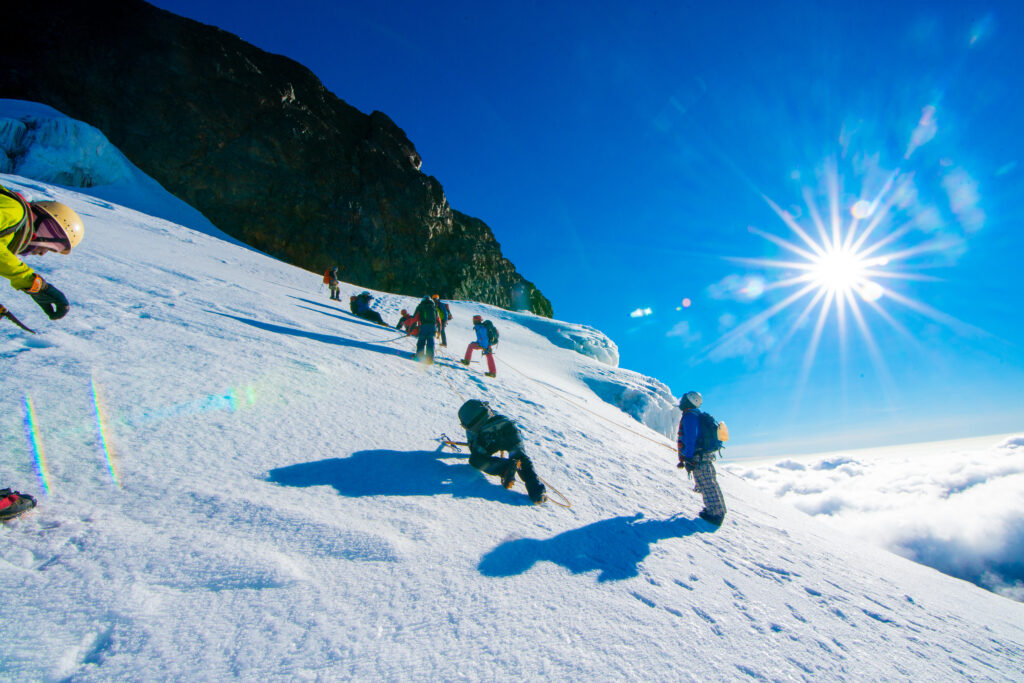
Kilimanjaro is best for:
- Huge volcanic landscapes and sweeping wide shots.
- Sunrise over the crater rim.
- Iconic summit sign photographs.
- Stark high-altitude desert textures.
Mount Kenya is best for:
- Rocky, spire-like summit silhouettes.
- Alpine lakes reflecting jagged peaks.
- Dramatic mountain forms with strong graphic lines.
The Rwenzori Mountains is best for:
- Giant lobelias and groundsels against misty backdrops.
- Fog, clouds, and shifting light through ancient forest.
- Moss-covered branches and glowing green undergrowth.
- Dramatic valleys and multi-summit mountain architecture.
- Alpine lakes and, on clear days, genuine glacial scenery.
- Constantly changing weather that rewards patient photographers.
This is another area where the Rwenzori Mountains stands apart: the sheer visual strangeness of its Afro-alpine zone offers compositions simply unavailable on Kilimanjaro or Mount Kenya.
Which Mountain (Kilimanjaro vs. Mount Kenya vs. Rwenzori)? Is Best for You?
Your Priority | Best Match |
Africa’s highest summit | Kilimanjaro |
Famous bucket-list climb | Kilimanjaro |
Non-technical major summit trek | Kilimanjaro |
Technical climbing | Mount Kenya |
Trekking + technical climbing options | Mount Kenya |
Dramatic rocky peaks | Mount Kenya |
Remote wilderness | Rwenzori Mountains |
Unique giant vegetation | Rwenzori Mountains |
Long expedition atmosphere | Rwenzori Mountains |
Margherita Peak | Rwenzori Mountains |
Gorilla trekking combination | Rwenzori Mountains / Uganda |
This table is a starting point, not an absolute rule. Many travellers hold more than one priority at once, and the honest next step is a conversation with an operator who can weigh your specific mix of goals rather than a single row on a chart.
Why the Highest Mountain Is Not Always the Best Choice
Kilimanjaro is the highest of the three (Mount Kenya, Rwenzori & Kilimanjaro), but height alone does not determine the quality of the experience. A traveller dreaming of a remote expedition may prefer the Rwenzori Mountains. For those seeking technical climbing, Mount Kenya may be the better choice. The best mountain is the one that matches your personal objective, not the one with the highest number on its summit.
Why Choose the Rwenzori Mountains?
- A genuine wilderness experience, with fewer trekkers sharing the trail.
- Extraordinary Afro-alpine vegetation found in only a handful of places on Earth.
- Multiple mountain massifs to explore, not a single volcanic cone.
- The chance to stand on Margherita Peak, Africa’s third-highest summit.
- Remote mountain camps that place you genuinely inside the landscape, not beside it.
- A less conventional African mountain expedition for travelers who have already done the obvious trip.
- The opportunity to combine trekking with chimpanzee tracking and wild primates.
- The opportunity to combine trekking with a full Uganda safari.
Choose the Rwenzori when you want the mountain journey itself to be the main adventure, not just a means of reaching a summit for a photograph.
Which Mountain (Rwenzori, Mount Kenya, Kilimanjaro) Offers the Best Combined African Adventure?
Kilimanjaro
Kiliamnajro pairs naturally with a Tanzania safari across the Serengeti and Ngorongoro Crater, one of the world’s classic wildlife circuits.
Mount Kenya
Mount Kenya pairs naturally with a Kenya safari, taking in the Maasai Mara and Amboseli’s elephant herds beneath Kilimanjaro’s silhouette.
Rwenzori Mountains
Rwenzori Mountains pairs with trekking, wild chimpanzees, savanna safari, and mountain gorilla trekking, arguably the richest and most varied combined adventure of the three. Our strongest itineraries build directly on this: Rwenzori + Queen Elizabeth National Park, Rwenzori + Kibale Forest chimpanzee trekking, Rwenzori + Bwindi gorilla trekking, and our dedicated Rwenzori and gorilla trekking combination page, alongside our full Uganda safari portfolio.