The 6-day Rwenzori Trek to Margherita Peak via the Central Circuit Trail is an accelerated summit expedition designed for experienced hikers seeking to conquer the highest peak in the Rwenzori Mountains and the third-highest mountain in Africa.
This 6-day Margherita Peak Rwenzori trek takes trekkers through the spectacular ecosystems of the UNESCO-listed Rwenzori Mountains National Park, from tropical rainforests and bamboo forests to giant heather zones, alpine valleys, glaciers, and snow-covered peaks.
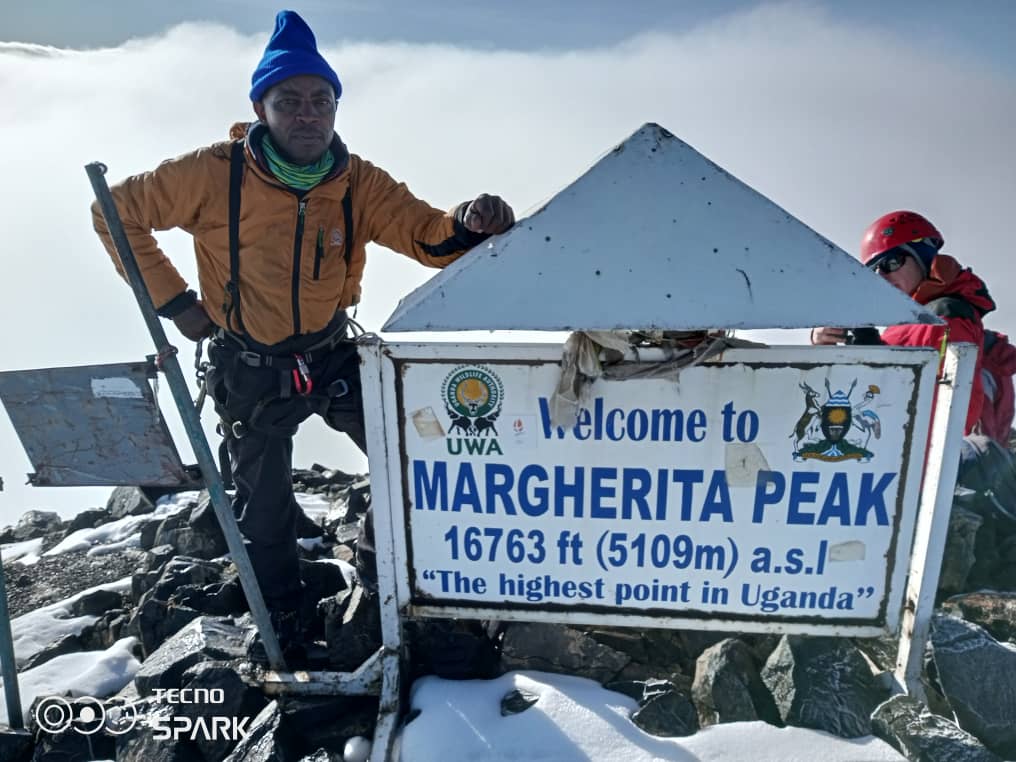 Standing at 5,109 meters (16,762 feet) above sea level, Margherita Peak, located on Mount Stanley, offers one of Africa’s most rewarding mountain experiences. This trek is ideal for experienced trekkers with excellent physical fitness and previous high-altitude hiking experience.
Six days. That is the measure of this 6-day Margherita Peak expedition: six days from the tropical forest of the Rwenzori’s lower slopes to the permanent snowfield of Margherita Peak at 5,109 meters, Africa’s third highest point. It is a compact and exacting timeline, and it is exactly right for the trekker who has earned the fitness and the commitment that this mountain demands and who wants to stand on the summit of the Rwenzori’s highest peak without the extended schedule of the 9-day Rwenzori trek to Margherita Peak full circuit. The 6-Day Rwenzori Trek to Margherita Peak via the Central Circuit Trail is the fastest credible route to Africa’s third-highest point, an ascent-focused expedition that carries you from the Nyakalengija Gate through the Rwenzori’s complete ecological sequence in six concentrated days, summiting on Day 5 via the Stanley Glacier and returning to Kasese on Day 6.
Over six days, your private guide leads you through every landscape the Rwenzori contains: the ancient Podocarpus forest of the lower Mubuku Valley, the giant heather and bamboo of the mid-mountain, the extraordinary Afro-alpine moorland of giant lobelias and groundsel trees, the glacially carved Bujuku Lake basin at 3,977 meters, and the permanent snowfield of the Stanley Plateau that stretches from Elena Hut at 4,541 meters to the corniced summit of Margherita Peak itself. The glacier section, crampons, ice axe, fixed ropes, and the particular focused silence of a rope team moving across blue ice before dawn are the technical heart of the expedition, and the summit, when it arrives in the hour after sunrise, is the reward for everything the six days have asked of you.
Every element of this expedition is managed by Rwenzori Trekking Expeditions: private transfers from Entebbe or Kampala; Uganda Wildlife Authority permits; a certified glacier-qualified guide and Bakonjo porter team; mountain hut accommodation; all meals; technical glacier equipment; and rescue insurance. What follows is a full, honest briefing from a team that has guided this route hundreds of times and knows the difference between a good summit day and an extraordinary one.
The 9-day Margherita Peak Rwenzori Central Circuit itinerary is the complete Rwenzori expedition, a full loop that visits every major landscape feature of the range, including the Kitandara Lakes and the Freshfield Pass descent. While the 6-day Rwenzori trek to Margherita Peak route is its focused counterpart: the same summit, the same glacier, and the same morning at 5,109 meters are achieved in a tighter timeline that serves the trekker who is fit, prepared, and ready to move with purpose through the mountain’s lower and middle zones to reach the summit and descend efficiently.
The trade-off involves acclimatization. The nine-day route builds altitude gain more gradually, with additional nights at intermediate elevations that allow the body more time to adjust to the rarefied air above 4,000 meters. The six-day route compensates for this compression with a carefully constructed altitude profile, strategic overnight positions, a rest morning at Bujuku Hut, and a full acclimatization afternoon at Elena Hut before the summit push, but it requires more from the trekker’s body and a higher baseline fitness level than the longer itinerary.
For the right trekker, genuinely fit, committed to preparation, and experienced with multi-day mountain trekking, the six-day Margherita Peak Rwenzori expedition delivers the full Rwenzori summit experience in a schedule that fits comfortably within a standard Uganda safari window. It is the route most frequently chosen by trekkers who have already completed the Lake Mahoma or John Matte Hut expeditions and are returning to the Rwenzori for the summit they have been building toward.
What Makes the 6-Day Margherita Peak Expedition Special?
The Ecological Sequence — A Vertical Continent
The ascent of Margherita Peak via the Central Circuit compresses, within six days of walking, the full biological sequence from equatorial Africa to the Arctic tundra. The lower forest of the Mubuku Valley, with its ancient Podocarpus trees, colobus monkeys, and Rwenzori turacos, gives way to giant heather and bamboo, which in turn gives way to the extraordinary Afro-alpine moorland of giant lobelias and groundsels, which then gives way to the moraine and snowfield of the Stanley Glacier. No other mountain experience in Africa delivers this complete ecological journey within a single expedition.
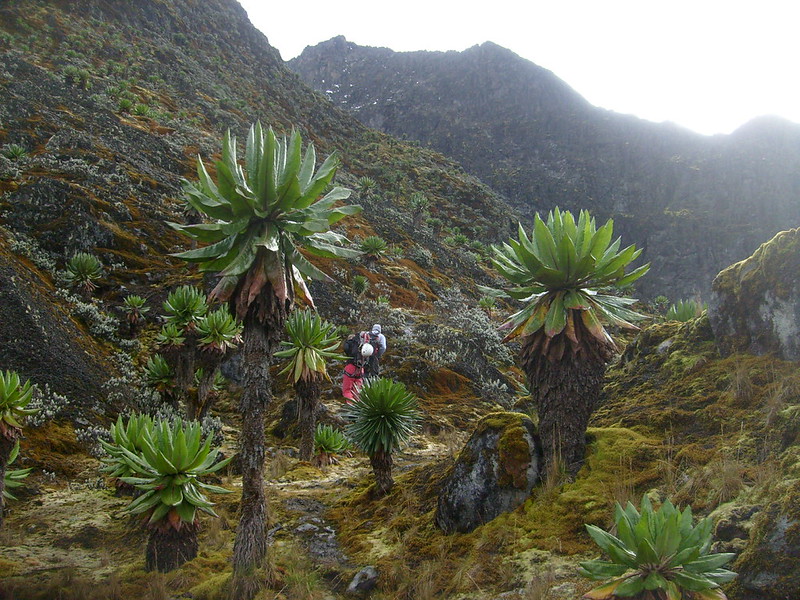
Each morning’s terrain is categorically different from the previous day’s, and the cumulative effect of this vertical progression, of genuinely arriving in a new world with each dawn, is one of the most distinctive qualities of the Rwenzori summit expedition.
Elena Hut and the Glacier Approach
Elena Hut, at 4,541 meters on the rocks above the Stanley Glacier, is the highest sleeping point of the expedition and one of the most extraordinary camping positions in Africa. From its doorway on a clear evening, the Stanley Plateau glacier is above, and the full sweep of the Rwenzori’s central massif is below. The glacier orientation session on the afternoon of Day 5, with crampons fitted and tested, ice axe technique practiced, and rope procedure established, takes place against this backdrop, in air that has a clarity and cold that is its own form of altitude. The location matches the seriousness of the briefing. By the time your guide calls for lights out, you have prepared as much as the mountain will allow.
The Summit — Africa’s Third Highest Point
The summit push begins before first light on Day 6, headlamps on the snowfield, the vast African darkness below, and the rope team moving in the particular, deliberate silence of people who understand that pace and steadiness are the only currency the glacier accepts.
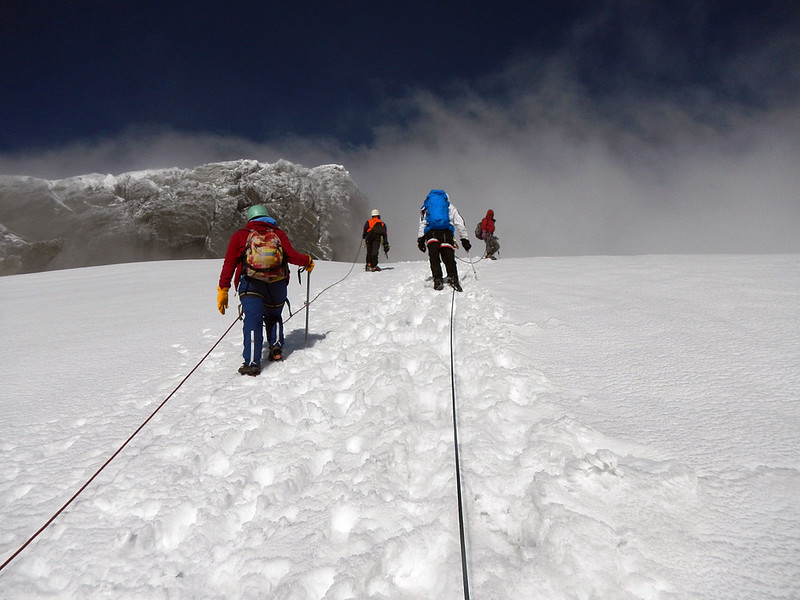
The Stanley Glacier crossing, the fixed ropes of the upper couloir, and the final approach to the corniced ridge that marks the summit of Margherita Peak—each section is guided, each technical moment managed by your certified lead guide with the calm authority of someone who has done this trek many times in many conditions. And then the summit: 5,109 meters, Africa’s third highest point, Uganda’s highest point, and the crown of the range that Ptolemy called the Mountains of the Moon. The sunrise here is not just a view; it spreads across the Congo Basin to the west while Uganda stretches east below the clouds. It is an event.
The Bakonjo Porter Team
No account of a Rwenzori summit expedition is complete without the Bakonjo porter community, the indigenous people of the Rwenzori slopes whose generational knowledge, physical capability, and mountain culture are as central to the summit experience as the glacier itself. Your Bakonjo porter team knows this mountain the way the mountain knows itself: in every season, in every weather condition, in the specific texture of the mud at each section of trail. The bond that forms between trekker and porter teams over six concentrated days on the Central Circuit is one of the expedition’s most consistently cited rewards in our post-trek client feedback.
Day | Summary |
Day 1 | Arrival at Entebbe / Kampala → Private transfer to Kasese (5–6 hrs) → Pre-trek briefing → Overnight Kasese |
Day 2 | Kasese → Nyakalengija Gate (1,646m) → Trek to Nyabitaba Hut (2,651m) → 5–6 hrs through montane forest |
Day 3 | Nyabitaba Hut → John Matte Hut (3,505m) → 6–7 hrs through bamboo, heather & Afro-alpine moorland |
Day 4 | John Matte Hut → Bujuku Hut (3,977m) → 4–5 hrs via Portal Peaks viewpoint → Rest afternoon |
Day 5 | Bujuku Hut → Elena Hut (4,541m) → 3–4 hrs → Glacier orientation & equipment fitting |
Day 6 | SUMMIT DAY: Pre-dawn departure → Stanley Glacier → Margherita Peak (5,109m) → Return to Nyabitaba Hut |
Day 7 | Nyabitaba Hut → Descent to Nyakalengija → Transfer to Kasese → Return transfer to Kampala / Entebbe |
Note: This trek is a 6-day trekking itinerary that requires a total of 8 days, including arrival and return transfer days. A 9-day Rwenzori trek to Margherita Peak, incorporating the Kitandara Lakes loop and Freshfield Pass descent, is also available, providing the complete central circuit experience. See our 9-Day Margherita Peak expedition for full details. |
Detailed 6-Day Margherita Peak Trek — Day-by-Day Narrative
Day 1: Arrival — Transfer to Kasese — Pre-Trek Briefing
Your Rwenzori Trekking Expeditions representative meets you at Entebbe International Airport or your Kampala hotel and settles you into a private 4WD vehicle for the journey west. The road to Kasese carries you through Uganda’s equatorial interior, the broad farmland of the central plateau, the papyrus wetlands of the Katonga, the western rift valley opening suddenly, and the Rwenzori appearing ahead: dark, massive, cloud-wrapped, generating its own weather system in full view of the road. The mountain looks exactly as formidable as it should.
Kasese’s guesthouse is comfortable and deliberately calm, the kind of rest that a serious expedition beginning the next morning requires. Over dinner, your lead guide conducts the pre-trek briefing with the thoroughness that a summit attempt demands: route profile, altitude management, glacier orientation schedule, equipment expectations, nutrition and hydration strategy, and the early symptom recognition protocol for altitude sickness above 4,000 meters. Gear is checked and confirmed tonight. Tomorrow the mountain begins, and the pace it sets from the first hour leaves no room for second thoughts at the trailhead.
Day 2: Nyakalengija Gate (1,646m) → Nyabitaba Hut (2,651m)
After breakfast and the short drive to Nyakalengija Gate, Uganda Wildlife Authority permits are completed while the Bakonjo porter team assembles loads with the efficient economy of professionals who have done this trek in every season. The forest at Nyakalengija is immediate and complete; within ten minutes, the trailhead disappears, and the Rwenzori has you entirely.
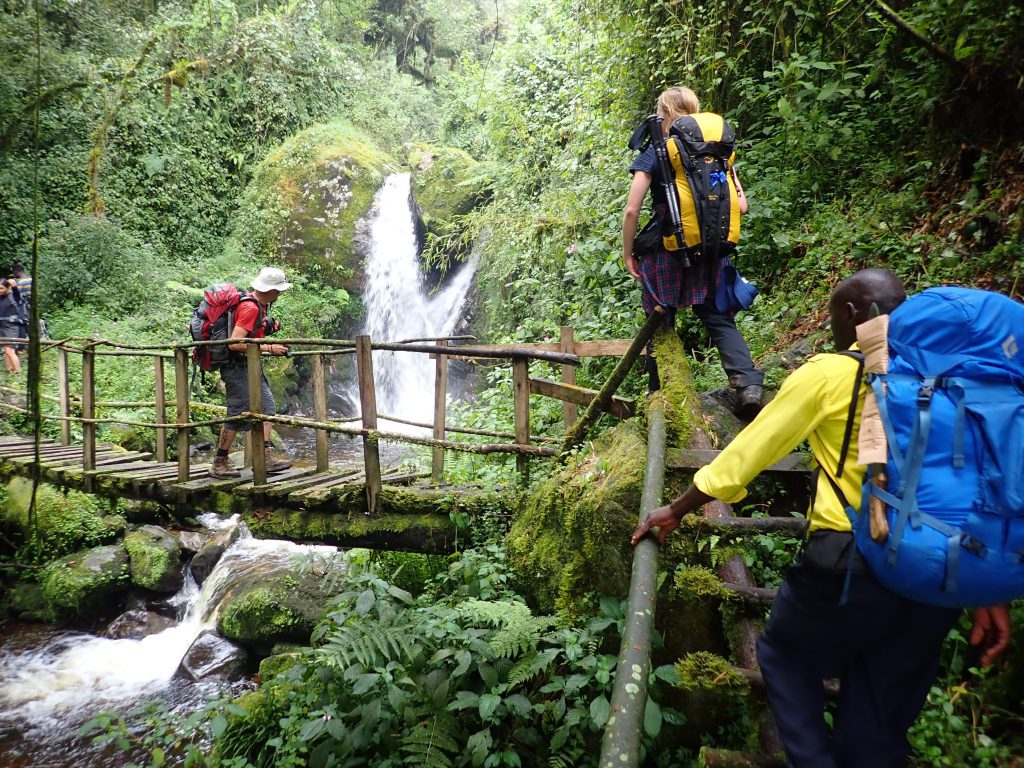
The Mubuku River valley’s lower forest is the Rwenzori at its most tropical. Podocarpus trees thirty meters tall, their roots forming a continuous kinetic puzzle underfoot, the river audible below and occasionally visible through the forest margin. Black-and-white colobus monkeys move overhead with effortless grace. Rwenzori turacos flash copper-red between the branches above. The birding here is exceptional, and your guide knows every call and every perch; this section of the Central Circuit is as rich in wildlife as any montane forest in the Albertine Rift.
As the trail climbs toward Nyabitaba, the forest character transitions, with giant heather replacing the Podocarpus canopy, the air cooling noticeably, and the ridge on which Nyabitaba Hut sits appearing through the heather in the mid-afternoon. The hut is solid and weatherproof, positioned at the confluence of the Mubuku and Bujuku valleys with views down the valley and, on clear evenings, the first glimpse of the central peaks above. The cook has dinner ready. The night at 2,651 meters is your first experience of genuine Rwenzori altitude: cool, quiet, and with a particular quality of air that sleep at sea level cannot replicate.
Day 3: Nyabitaba Hut (2,651m) → John Matte Hut (3,505m)
The crossing of the Mubuku River on the log bridge below Nyabitaba marks the transition from the lower forest world to the Rwenzori’s most celebrated ecological character, the Afro-alpine zone that has earned the range the title of Africa’s Galapagos. The trail climbs decisively through bamboo and then giant heather, its trunks at this elevation as thick as a person’s torso, before the moorland opens and the giant lobelias and groundsel trees appear in full.
The upper Bujuku Valley on this section of the Central Circuit is one of the most visually extraordinary landscapes in Africa, a vast, spongy moorland of sphagnum peat and tussock grass, punctuated by giant lobelia spires and groundsel rosette heads that look like something evolution abandoned mid-experiment, with the glaciated central peaks closing the valley’s head and cloud drifting through the heather in veils of grey-white mist. The scale here is humbling in the precise sense: walking through it, you understand that this mountain is genuinely large and that you are genuinely small within it.
John Matte Hut sits at the head of this valley at 3,505 meters, named for the Ugandan guide who became one of the Rwenzori’s towering mountain figures. On clear evenings, Speke and Baker peaks fill the skyline above the hut in alpenglow. Your guide’s evening briefing covers the following day’s shorter but critical ascent to Bujuku and the acclimatization rest that will follow. The expedition is now at an altitude where pace management and hydration are the primary determinants of summit outcome.
Day 4: John Matte Hut (3,505m) → Bujuku Hut (3,977m) — Rest & Acclimatisation
The ascent from John Matte to Bujuku is a relatively short day in distance, four to five hours, but it delivers the Central Circuit’s most dramatically scenic section before the glacier. The trail passes through the Portal Peaks approach, where the full Bujuku Valley cirque opens before you: the peaks of Speke, Baker, and Stanley encircling the valley’s head in a natural amphitheater of extraordinary scale. Bujuku Lake, at 3,977 meters, sits at the valley’s heart, its dark water reflecting sky and cloud in a surface that changes color and character with every shift of mountain weather.
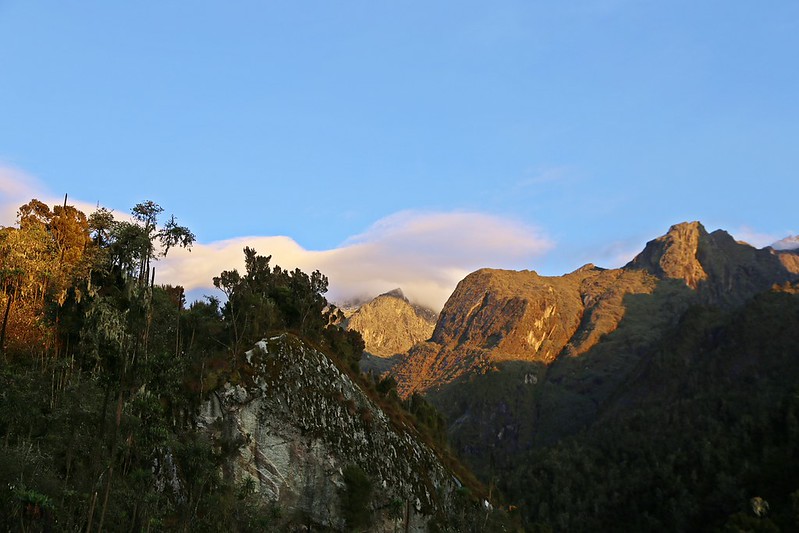
The famous Rwenzori mud is at its worst on the Bujuku Valley floor, where deep peat can swallow boots to the ankle with an unwary step, and the trail system of log-and-plank bridges requires attention and offers a kind of athletic engagement that flat terrain cannot provide. Your porters navigate it with the fluency of people who have never needed to think about it. You navigate it with gaiters and poles, increasingly sure that this terrain is simply what the Rwenzori is and that the summit above is worth every inch of mud required to get there.
The afternoon at Bujuku Hut is dedicated to rest and acclimatization, the most important investment of the expedition’s middle section. The most important investments of the expedition’s middle section are hydration, a light lunch, and the particular discipline of horizontal rest at altitude, while the body does its invisible work of hemoglobin production. Your guide checks in through the afternoon with the pulse oximeter, monitoring blood oxygen saturation and adjusting tomorrow’s plan as needed. The cold at Bujuku is serious and real, with nights dropping to near 0°C even in the dry season. The sleeping bag rated to -5°C is not a luxury here.
Day 5: Bujuku Hut (3,977m) → Elena Hut (4,541m) — Glacier Orientation
The final approach to Elena Hut, the expedition’s highest sleeping point and the launch position for the summit push, takes less than four hours and climbs 564 meters through terrain that changes from Afro-alpine moorland to rocky moraine and finally to the permanent snowfield at the glacier’s edge. Above 4,200 meters, the vegetation thins and disappears entirely, the air cools sharply, and the scale of the mountain asserts itself in a way that no previous section of the trail has prepared you for. The central peaks are enormous here. The glacier above is enormous. The summit, somewhere in the ice above Elena Hut, feels both terrifyingly close and respectfully distant.
Elena Hut, at 4,541 meters, is spartan, functional, and exactly right. From its doorway on a clear afternoon, the Stanley Glacier fills the slope above, and the Bujuku Valley falls away below in the full sequence of the landscape you have crossed over five days. The sunset, when clouds permit, turns the glacier a shade of copper and then deep amber that has no equivalent at lower altitudes.
The afternoon glacier orientation is conducted with the seriousness and precision that technical mountain terrain demands. Crampons are fitted and tested; the specific fit matters on ice, and your guide ensures every crampon is properly mounted before moving on. Ice axe technique for self-arrest is practiced. The rope procedure, how the rope team moves, how distance is maintained, and how falls are arrested are all explained until everyone understands. Your guide has led this briefing many times. The calm authority with which the guide conducts it reassures you. The 3:00 AM alarm call is set. Sleep is encouraged even when the altitude makes it difficult.
Day 6: Summit Day — Margherita Peak (5,109m) → Return to Nyabitaba Hut
The alarm sounds at 3:00 AM in the cold and dark of Elena Hut, and within forty-five minutes the rope team is moving across the Stanley Glacier by headlamp. The ice beneath the crampons is blue-grey in the torch beam. The sky above is dark and enormous and, on the best mornings, extravagantly starred. The Congo Basin below is invisible under a sea of cloud. The summit above is invisible against the pre-dawn sky. The team moves in the particular deliberate silence of a serious ascent, step, breathe, step, breathe: the rhythm settles into the body within the first twenty minutes and stays there.

The Stanley Glacier crossing takes the rope team across crevassed terrain on fixed lines assessed by your guide before dawn. Crampons bite into ice that was forming here during the last Ice Age and has been retreating with accelerating urgency ever since the industrial era began. The gradient steepens through the upper couloir, where the thin air makes itself felt even in well-prepared lungs. The pace is deliberate and sustainable. Your guide sets it and maintains it, knowing from experience exactly what the body can sustain at this altitude and at this hour.
“The summit of Margherita Peak is the closest thing in East Africa to a Himalayan climbing experience. The glacier, the altitude, the technical terrain, the darkness before dawn, and the sunrise all come together in that moment. Everything the mountain asks of you in six days is answered in the hour after you reach the top. ” Senior Guide, Rwenzori Trekking Expeditions |
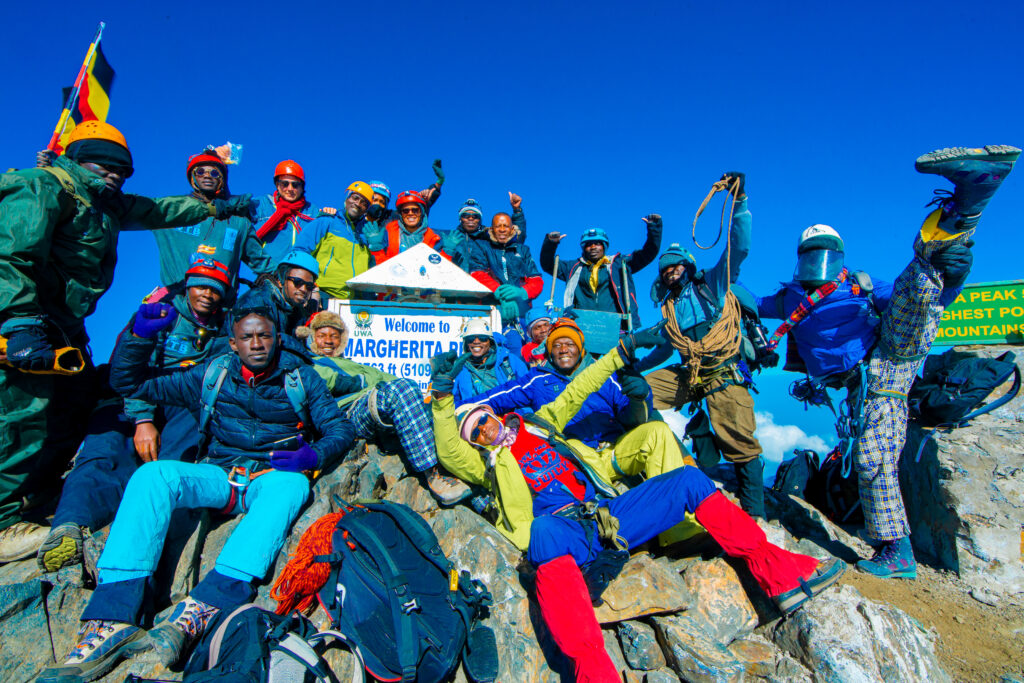
The summit arrives with the sunrise. The corniced snow ridge of Margherita Peak, which rises to 5,109 meters above sea level, is the highest point in Uganda and the third highest on the African continent, opening before the rope team in the first full light of a mountain morning. Uganda is east, invisible under clouds. The Congo Basin is west, a vast emerald darkness. The Stanley Plateau glacier is below, and the peaks of Speke and Baker are briefly, spectacularly, at eye level. The feeling at the summit is not simple triumph. It is something quieter and more complete, the specific satisfaction of a body fully used, a commitment entirely honored, and a mountain genuinely understood.
Your guide allows proper summit time: photographs, the summit register, and the particular stillness of a place that has no roads, no noise, and no audience except for the few who earn it. The descent follows carefully and methodically, crampons on ice, the rope team working back across the glacier as the sun rises and the ice begins its daily softening. By midday, you are back at Elena Hut. By mid-afternoon, on the long descending trail through the moorland and forest, the mountain is behind you, and the valley below is bright and warm. Nyabitaba Hut, the first night’s camp, arrives in the evening as a place thoroughly changed by context: the same hut, but seen now from the other side of a summit.
Day 7: Nyabitaba Hut → Descent → Nyakalengija → Kasese → Return Transfer
The final morning at Nyabitaba Hut begins with a breakfast that tastes different from all previous breakfasts on this expedition—the food of a person returning rather than ascending, with the particular flavor of completion. The forest descent to Nyakalengija re-traverses the lower Mubuku Valley in reverse: the giant heather giving way to Podocarpus, the canopy closing overhead, and the sound of the river reappearing. The forest looks different now, seen from the altitude of someone who has been above it, and the same birdsong that accompanied the ascent five days ago carries a different resonance on the return.
The trailhead arrival, the formal farewell to your porter team, the guide’s closing remarks on what the mountain offered over six days, and the cold drinks in the vehicle cooler have a weight that organized travel rarely achieves. These are not anonymous service providers. They are mountain professionals who shared six days of serious terrain with you and whose community, whose livelihoods, and whose mountain are the reason this expedition exists. The drive east to Kasese, and the longer return to Kampala or Entebbe, is quiet and full in the way that only a genuine physical and emotional investment, fully returned, can make it.
Day-by-Day Altitude Profile
Day | Location / Camp | Altitude |
Day 1 | Kasese (overnight guesthouse) | ~1,000m |
Day 2 | Nyakalengija Gate → Nyabitaba Hut | 1,646m → 2,651m |
Day 3 | Nyabitaba Hut → John Matte Hut | 2,651m → 3,505m |
Day 4 | John Matte Hut → Bujuku Hut (rest afternoon) | 3,505m → 3,977m |
Day 5 | Bujuku Hut → Elena Hut (glacier orientation) | 3,977m → 4,541m |
Day 6 | Elena Hut → Margherita Peak → Nyabitaba Hut | 4,541m → 5,109m → 2,651m |
Day 7 | Nyabitaba → Nyakalengija → Kasese → Kampala/Entebbe | 2,651m → 1,646m → ~1,000m |
Route Comparison — 6-Day vs 9-Day Margherita Peak Expedition
Feature | 6-Day Expedition (This Trek) | 9-Day Full Central Circuit |
Duration | 6 trekking days (7 days total) | 9 days total |
Summit | Margherita Peak (5,109m) | Margherita Peak (5,109m) |
Route Style | Ascent-focused; out and back via CCT | Full circuit, includes Kitandara Lakes |
Acclimatisation | Compressed: demands higher baseline fitness | Gradual: more altitude adjustment time |
Kitandara Lakes | Not included | Included major scenic highlight |
Freshfield Pass | Not included | Included on descent |
Best For | Fit, experienced trekkers; tighter schedules | Full Rwenzori experience; all fitness levels |
Summit Success Rate | High for well-prepared trekkers | Higher, more acclimatisation days |
Price Range | Moderate premium | Full expedition premium |
How Difficult Is the 6-Day Margherita Peak Trek?
The 6-day Margherita Peak expedition is classified as very challenging and is the most demanding itinerary we offer within a six-day timeframe. The combination of compressed altitude gain, technical glacier terrain on the summit day, sustained daily trekking distances, and the physical demands of a pre-dawn glacier ascent at 4,541 meters places this trek firmly in the category of serious mountain expeditions. It is not suitable for casual trekkers or those without a strong baseline of fitness, and no amount of motivation substitutes for the physical preparation it requires.
The technical elements of this expedition, crampons, ice axe, harness, and fixed-rope glacier crossing, are genuine mountaineering rather than simply high-altitude hiking. They are guided, and no prior glacier experience is required, but they require a steady head for heights, the ability to follow precise instructions on exposed terrain, and the physical and mental composure to perform under the specific stresses of altitude and cold. The compressed acclimatization profile of the six-day route means the body has less time to adjust to altitudes above 4,000 meters than on the nine-day itinerary, which places a premium on pre-trek fitness and on following your guide’s hydration and pace protocols precisely.
Our preparation recommendation for the six-day route is more demanding than for any other Rwenzori itinerary: four months of dedicated cardiovascular and strength training, including sustained uphill effort with a loaded pack, multiple overnight trekking expeditions, and ideally some experience at altitude above 3,000 meters before arrival. We share a detailed preparation program with all confirmed clients and encourage them to have an honest conversation about their fitness levels before we confirm departure dates.
Category | Assessment |
Overall Difficulty | Very Challenging, serious mountain expedition |
Daily Trekking | 5–8 hrs (Days 2–5); 12–14 hrs (Day 6 summit day) |
Max Elevation | 5,109m — Margherita Peak |
Total Altitude Gain | ~3,463m over 4 ascending trekking days |
Terrain | Forest, moorland, moraine, glacier — highly varied |
Altitude Risk | High above 4,000m,AMS protocols strictly applied |
Technical Sections | Yes, glacier travel: crampons, ice axe, fixed ropes |
Prior Experience | Multi-day trekking essential; glacier experience helpful |
Minimum Fitness | Excellent, 4 months structured prep strongly advised |
Age Recommendation | 18+ (mature teenagers considered case-by-case) |
The six-day Rwenzori Trek to Margherita Peak has a compressed acclimatization profile, making weather and trail conditions more consequential than on the longer route; there is less buffer against a poor summit day, and the glacier section is more demanding in wet or icy conditions outside the primary dry season. For this reason, the six-day Margherita Peak Rwenzori expedition is more strongly season-dependent than any other Rwenzori itinerary, and we schedule most departures for the primary and secondary dry season windows.
Primary Season: June to August
The East African long dry season is the optimal window for the six-day summit expedition. Trail conditions are at their most navigable, the glacier at its most stable and well-defined, and summit day success rates the highest. Cloud cover on summit mornings is reduced, though never eliminated, in this window, and the views from Margherita Peak in July or August, when the season is at its most settled, are among the finest available anywhere in Africa. This period sees the highest trekker demand, and places fill six to nine months in advance. Book early.
Secondary Season: December to February
The short dry season provides a strong second window with conditions approaching those of the primary season. January is particularly reliable for clear summit mornings, and the mountain in this period has a sharp, cold quality that experienced trekkers often prefer to the warmer months. The Christmas-to-New Year period is popular and fills quickly. January and February are the most underrated months on the Rwenzori — less busy than June–August, with excellent conditions and summit success rates that rival the primary season.
Shoulder Seasons: Not Recommended for the 6-Day Route
The wetter shoulder seasons, March through May and September through November, are the periods we least recommend for the six-day Rwenzori trek to the Margherita Peak summit route. In wet, cold, and unstable conditions, the compressed acclimatization and the technical glacier section are both less forgiving, and summit day cloud cover in these months makes it less likely that the Margherita experience will deliver the views that are central to the summit’s reward. We can guide the six-day route year-round, fully disclosing conditions; for clients whose schedules require a shoulder-season departure, we discuss options transparently and recommend the nine-day route where possible, as its extra days provide more flexibility around challenging weather windows.
How to Get to the Rwenzori Mountains
The Rwenzori Mountains National Park is located in western Uganda, near Kasese town, approximately 370 kilometers from Kampala and 420 kilometers from Entebbe. The Central Circuit Trail begins at Nyakalengija Gate, a short drive from Kasese on a laterite road through the Rwenzori foothills.
Entebbe International Airport (EBB) is the primary international gateway, served by Kenya Airways, Ethiopian Airlines, Turkish Airlines, Qatar Airways, RwandAir, and others via Nairobi, Addis Ababa, Kigali, Dubai, Istanbul, and other hubs. Aerolink Uganda operates domestic flights between Entebbe and Kasese Airport (approximately one hour), subject to schedule availability. Rwenzori Trekking Expeditions privately arranges all airport transfers and road logistics. The overland drive from Kampala or Entebbe to Kasese takes five to six hours in comfortable 4WD vehicles with experienced English-speaking drivers, passing through the equatorial landscapes of central and western Uganda.
What Is Included in the 6-Day Margherita Peak Trek?
The six-day Margherita Peak expedition is offered as a comprehensively inclusive package. Every element, from the moment your representative meets you at Entebbe to the moment you are returned to your onward destination, is arranged and managed by Rwenzori Trekking Expeditions. Rwenzori Trekking Expeditions includes all permit fees, equipment surcharges, and logistical support to ensure a seamless journey to the summit.
Category | What Is Covered |
Transfers | Private return transfers: Entebbe/Kampala ↔ Kasese ↔ Nyakalengija |
Park Fees & Permits | Uganda Wildlife Authority entry and trekking permits for all days |
Guide Services | Certified glacier-qualified lead guide; assistant guides per group size |
Porter Team | Full Bakonjo porter team for group and communal equipment |
Accommodation | Nyabitaba, John Matte, Bujuku & Elena Huts, + Kasese guesthouse (Nights 1 & 7) |
All Meals on Trek | Full board: breakfast, lunch, dinner, and hot drinks throughout |
Technical Equipment | Crampons, ice axe, climbing harness, helmet, fixed ropes are all provided |
Emergency Equipment | First aid kit, pulse oximeter, supplemental oxygen, stretcher, rescue coordination |
Pre-Trek Briefing | Full route brief, equipment check, altitude awareness session in Kasese |
Summit Certificate | Margherita Peak summit certificate, by Rwenzori Trekking Expeditions |
Rescue Insurance | Mountain rescue insurance included in expedition fee |
What Is Excluded?
Category | Notes |
International Flights | Arrange independently via your preferred carrier |
Uganda Visa | USD 50 on arrival or via evisa.go.ug in advance |
Travel Insurance | Required — must include medical evacuation cover |
Personal Porter | Available at additional cost — strongly recommended |
Gratuities | For guides and porters — voluntary but culturally significant |
Alcoholic Beverages | Not provided at mountain huts |
Personal Gear | Your personal trekking and summit equipment (see packing list) |
Pre/Post Accommodation | Kampala or Entebbe hotel nights before/after trek |
Safari Extensions | Gorilla trekking, game drives — arranged separately on request |