The 10-Day Rwenzori Trek to Mount Stanley and Mount Baker summits Mount Stanley’s Margherita Peak (5,109 m) and Mount Baker’s Edward Peak (4,844 m) via the Kilembe Trail of the Rwenzori Mountains in Rwenzori Mountains National Park, Uganda. Over 10 days (9 nights on the mountain) of a dual-summit mountaineering expedition to Mount Stanley and Mount Baker, experienced trekkers ascend through five vegetation zones to summit Mount Baker’s Edward Peak (4,844 m) and then Mount Stanley’s Margherita Peak (5,109 m) (Africa’s third-highest point) using guide-led rope teams, crampons, and fixed lines on the glaciated summit sections. It suits fit, mentally prepared trekkers rather than complete beginners, and no operator can guarantee a summit; weather, route conditions, and individual altitude response all play a role.
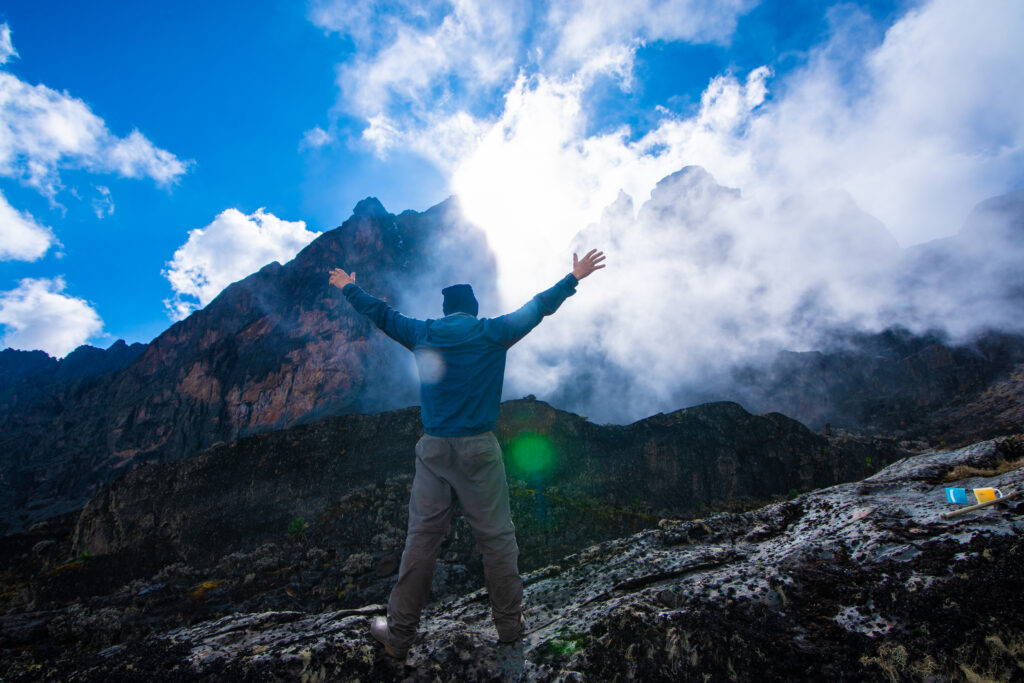 The 10-Day Rwenzori Trek to Mount Stanley & Mount Baker via the Kilembe Trail is not a checklist itinerary. It is a considered, professionally guided mountaineering expedition that gives serious trekkers, climbers, and small private parties the time, the altitude progression, and the technical support to stand on two of the six magnificent massifs of the Rwenzori Mountains, the legendary “Mountains of the Moon.”
If you have read about the Rwenzori Mountains and found yourself asking whether a shorter trek would be enough, whether Mount Baker and Mount Stanley can genuinely be combined, or what a summit day on an equatorial glacier actually feels like, this page was written for you. We have guided this route for years, and what follows is the honest, detailed briefing we would give you in person, at our office in Kasese, before you ever set foot on the trail.
10-Day Rwenzori Trek: Highlights
| Duration | 10 days / 9 nights on the mountain |
| Primary Summit | Margherita Peak, Mount Stanley at 5,109 m (highest point in Uganda; third-highest in Africa) |
| Secondary Summit | Edward Peak, Mount Baker: 4,844 m |
| Route | Kilembe Trail (“Southern Circuit”), Rwenzori Mountains National Park |
| Difficulty | Challenging to Very Challenging, two technical glacier/summit days, high-altitude passes, sustained multi-day effort |
| Start / End | Kilembe trailhead, near Kasese (1,450m) |
| Group Format | Private departures for solo trekkers, couples, families, and small groups (up to 8), not a fixed shared-group product |
| Accommodation | Wooden mountain huts at designated UWA-managed campsites throughout |
| Technical Gear | Crampons, ice axes, harnesses, helmets, and fixed ropes are provided for both summit days. |
| Best Season | Mid-December–Mid-March and June–August (the two drier windows) |
Picture the journey as a single, continuous ascent through the very atmosphere of the equator itself. You begin among the Kilembe foothills, where smallholder farms yield way to forest, and the Nyamwamba River runs loud and cold beside the trail. Within an hour the canopy closes overhead: the environment is tropical montane forest, dense and dripping, alive with the crimson flash of a Rwenzori turaco breaking cover and the crash of blue monkeys moving through the mid-storey. It smells of wet bark and leaf litter, and it does not let go easily; the climb here is real, the roots are slick, and the first sweat of the expedition is earned honestly.
Then the forest changes character. Hollow-stemmed bamboo closes in, dim and cathedral-still, and above it the giant heather begins, gnarled trunks draped in curtains of old man’s beard lichen, hanging motionless unless the wind moves through the ridge. This is the boundary of an ordinary mountain and the beginning of somewhere stranger. Beyond the heather, the Afro-alpine zone opens without warning: giant lobelias standing like grey-green sentinels, some reaching six metres, and groundsel trees with their black, peeling trunks and rosette crowns, silhouetted against valleys that fill and empty with mist in the space of ten minutes. Alpine lakes lie dark and still in glacially carved hollows, mirroring rock walls that were shaped by ice thousands of years before anyone thought to climb them.
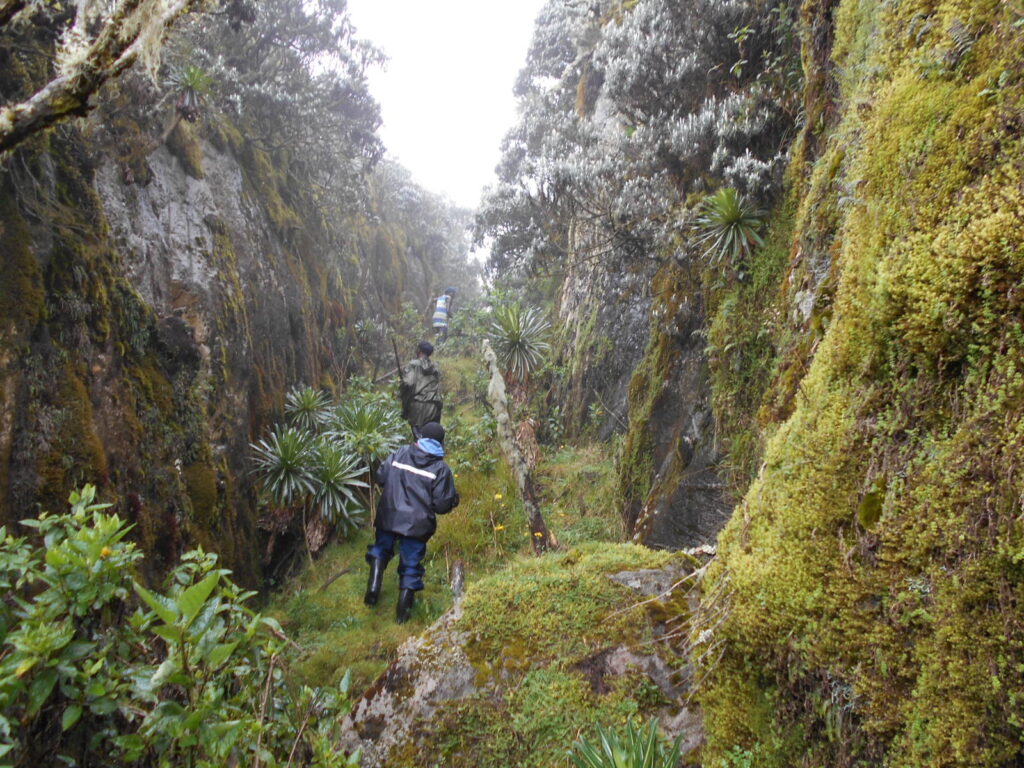
From here the terrain hardens. Moorland yields way to bare rock, scree, and moraine, the debris field of retreating glaciers still visible in the landscape’s bones. Ridgelines narrow. The wind carries less warmth and more intent. This stage is where trekking quietly becomes mountaineering: where your guide checks your harness, where crampons go on over rubber boots, and where the objective stops being a destination on a map and starts being a physical test.
Mount Baker comes first, a shorter, sharper summit day that introduces you to exposed scrambling, fixed ropes, and the particular focus that high-altitude terrain demands. Days later, having recovered and re-acclimatized, you face Mount Stanley: a pre-dawn departure in bitter cold, headlamps tracing a thin line up the glacier, and then, if the mountain allows it, the moment of standing on Margherita Peak as the sun finds the ice fields below and the whole shape of the Rwenzori reveals itself, with Mount Baker’s dark ridgeline visible to the south, exactly where you stood five days before.
A Note on Honesty We describe this progression because it is what the mountain genuinely offers on a typical day. We do not promise it. Cloud, rain, and wind are part of the Rwenzori’s character, and visibility, summit conditions, and individual outcomes vary from one expedition to the next. What we can promise is a route built with the time, the guiding, and the equipment to give you the best possible chance of experiencing it. |
Mount Stanley & Margherita Peak — The Principal Objective
Mount Stanley is the highest of Rwenzori’s six impressive massifs and the range’s undisputed centrepiece, straddling the border between Uganda and the Democratic Republic of the Congo at the head of the Bujuku Valley. It is a broad, glaciated massif with several named summits rather than a single peak, and the one that matters to trekkers is Margherita Peak, which crowns the Stanley Plateau at 5,109 meters above sea level. Margherita Peak is the highest point in Uganda and the third-highest summit in Africa, behind only Kilimanjaro (5,895m) in Tanzania and Mount Kenya (5,199m). It was named for Queen Margherita of Italy following the first ascent in 1906, led by Luigi Amedeo di Savoia, Duke of the Abruzzi, whose expedition first mapped and climbed the principal peaks of the range.
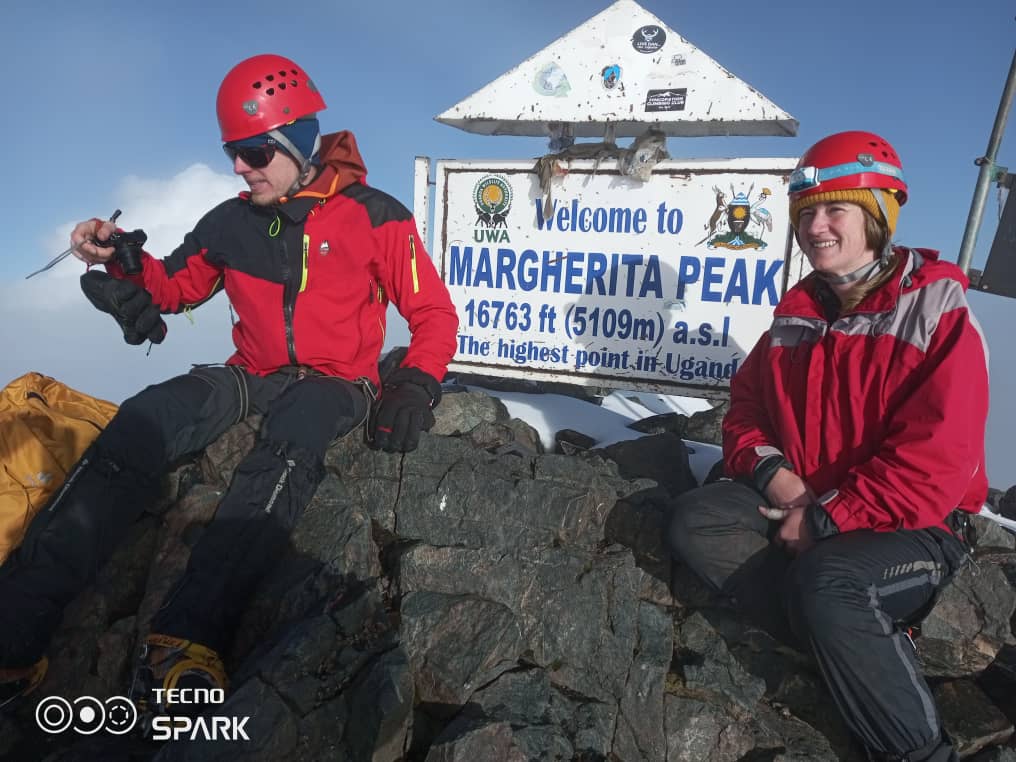
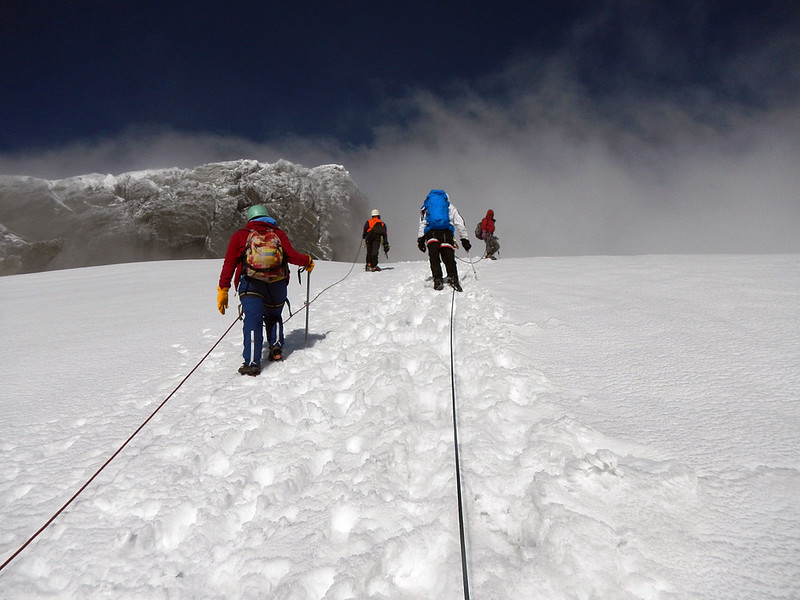
Margherita is why most serious mountaineers come to the Rwenzori, and it is the summit this expedition is built around. Unlike Kilimanjaro, where the summit is a long, non-technical walk, Margherita Peak requires you to cross a genuine equatorial glacier: a short but real ice field, crevassed in places, that demands a rope team, crampons, and a guide who knows the current state of the ice. This is not a walk-up. It is a mountaineering objective set inside a high-altitude trek, and it is treated that way at every stage of this itinerary.
What Summit Day on Margherita Involves
From Margherita Camp, the highest camp on the Kilembe Trail, the ascent begins in full darkness, typically between 3:00 and 4:00am, so that the rope team can cross the glacier and return before the afternoon cloud and softening ice increase risk. The route climbs rock and moraine to the glacier’s edge, where crampons go on and the group moves together, roped, under the guide’s direction across the ice to the summit ridge. The final meters to Margherita’s small summit cairn are exposed and require careful, unhurried footwork.
Current Technical & Safety Requirements Margherita’s summit route currently requires crampons, an ice axe, a climbing harness, a helmet, and roped travel across the glacier, with fixed lines used at the steeper or more exposed sections as conditions dictate. Rwenzori Trekking Expeditions provides all of this technical equipment, which your lead guide uses under direct supervision. Glacier conditions on the Rwenzori change from season to season and year to year as the ice continues to retreat, so the precise character of the crossing and whether a crevasse bridge or alternate line is in use is confirmed by our guide team in the days immediately before your summit attempt rather than fixed months in advance. |
For the full geological, historical, and route-specific detail on Uganda’s highest point, see our dedicated guide to Margherita Peak and our Mount Stanley mountain profile.
Mount Baker: The Preparatory Summit
Mount Baker sits in the southern half of the Rwenzori range, its ridgelines visible from the Kilembe Trail’s high camps well before you reach its base. Named for the British explorer Sir Samuel Baker, it is the third-highest massif in the range, culminating in Edward Peak at 4,844 meters (some published sources report 4,842 m; the discrepancy reflects differing historical survey data rather than any recent change to the mountain, and both figures appear across regional literature). Mount Baker, together with Mount Stanley and Mount Speke, forms the dramatic triangle of peaks that encloses the Bujuku Valley, the geographic and scenic heart of the Rwenzori.
Mount Baker’s character is distinct from Stanley’s: sharper, rockier ridgelines, a shorter approach from the high camps, and a summit day that is steep and exposed rather than glacier-crossing in the way Margherita is. In most seasons, the ascent is considered non-technical scrambling for those with a good head for heights, though the route can carry ice and snow during the wetter shoulder months (roughly April–May and September–October), when it becomes considerably more slippery and fixed ropes are used at key sections as standard practice, regardless of the season.
How Mount Baker Fits the Combined Expedition
This is precisely why the itinerary places Mount Baker before Mount Stanley. Its summit day is shorter and less technically demanding than Margherita’s glacier crossing, which makes it an excellent altitude and confidence test: your body registers the effects of climbing past 4,800m, your guide observes how you handle exposure and rope work, and you gain a full rest-and-recovery day afterward before the larger objective. Searching for how Mount Baker and Mount Stanley relate to one another on a single trip is one of the most common questions serious Rwenzori-bound trekkers ask, and the honest answer is that they complement each other logistically as much as scenically: Baker builds the readiness that Stanley then draws on.
Mount Baker vs. Mount Stanley, at a GlanceMount Baker (Edward Peak, 4,844 m): steep rock ridges and scrambling, shorter round-trip, generally non-technical outside the wet-season ice window, fixed ropes at exposed sections. Mount Stanley (Margherita Peak, 5,109 m): sustained glacier crossing, roped travel, crampons and ice axe throughout the final approach, greater altitude and greater exposure to cold, and higher overall technicality. |
What follows is the itinerary we currently operate on the ground, built around the camp network and route conditions our guide team knows firsthand. Distances, timings, and camp names reflect our current operations and the Uganda Wildlife Authority’s management of the Kilembe Trail; anything on the mountain is genuinely subject to change from season to season, and we say so plainly rather than leave you guessing.
Day 1: Kilembe Trailhead → Sine Camp1,450 m → 2,596 m · approx. 9.5 km · 5–6 hours |
The expedition begins quietly at the Kilembe trailhead, a short drive from Kasese, where your dedicated guide and porter team are already waiting. This first hour on the ground matters more than it might seem: your kit is checked piece by piece, your porter allocation is confirmed, park registration is completed with the Uganda Wildlife Authority, and your lead guide runs through the mountain’s rules, the days ahead, and what to expect underfoot. It is a perfect moment to ask every question you have been saving.
The trail itself opens with a short descent before settling into a long, sustained climb through Afro-montane rainforest. The transition from the populated foothills into genuine wilderness happens faster than most trekkers expect, within the first hour, farmland gives way to closed canopy, the light turns green and filtered, and the air thickens with the smell of wet bark. A suspension bridge carries you over the Nyamwamba River, and not long after, the trail passes Enock’s Falls, a wide, powerful cascade that offers a natural resting point and an early sense of just how much water this range moves. Watch the canopy for the crimson wing-flash of the Rwenzori turaco and listen for blue monkeys working the mid-storey.
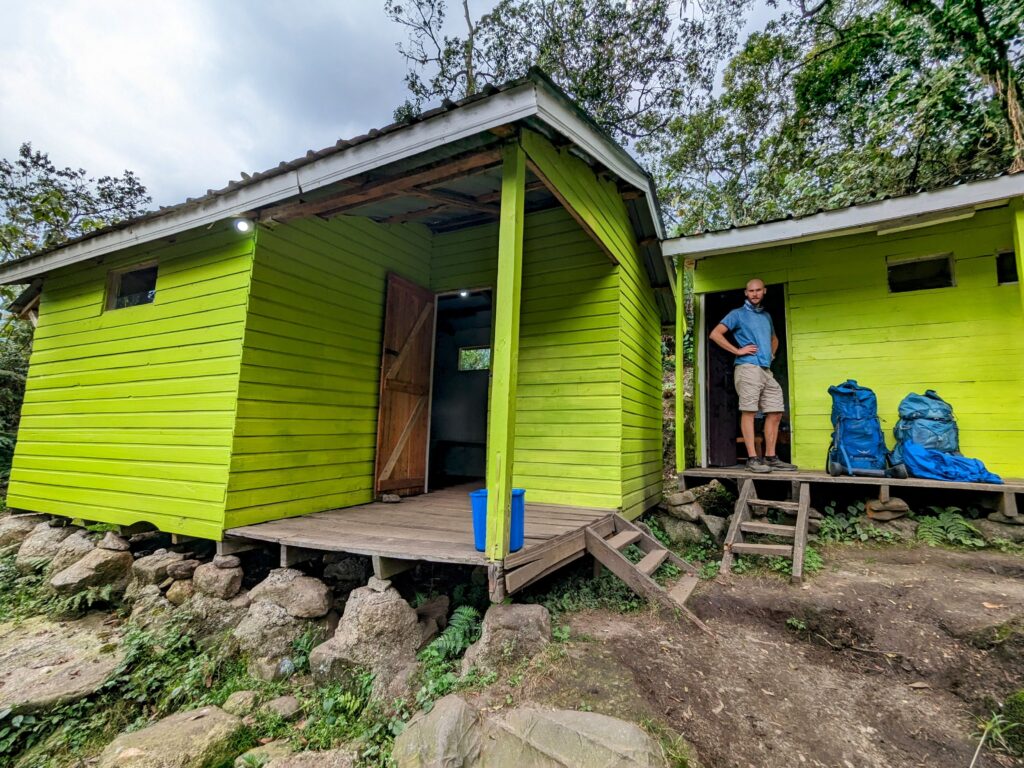
The final approach to Sine Camp climbs steeply through increasingly moss-laden forest. Sine sits at 2,596 m, its wooden huts set in a clearing at the upper edge of the true forest zone, still enclosed by trees but with the first hint of altitude in the evening air.
Overnight: Sine Camp (2,596 m), wooden mountain hut with bunk accommodation.
Meals: Packed lunch on the trail; three-course dinner and breakfast prepared by your mountain cook.
Day 2: Sine Camp → Mutinda Camp2,596 m → 3,582 m · approx. 6.1 km · 6–8 hours |
Day 2 is short in distance but demanding in gradient: you gain nearly a vertical kilometer over the course of the day. The forest transforms almost immediately into hollow-stemmed bamboo, dim and strangely quiet, the trail underfoot alternating between packed earth and slick root systems. As the bamboo thins, giant tree heather takes over, gnarled, ancient-looking, and draped in curtains of old man’s beard lichen that turn the trail into something closer to a twilight corridor than a footpath.
This is where the mountain’s weather starts to assert itself: clouds can move in and out within the hour, temperatures swing noticeably between sun and shade, and the trail begins showing the mud and bog sections the Kilembe Trail is known for at altitude. What makes today distinctive is the pace management it demands; this is the first day the itinerary asks you to consciously slow down, breathe deliberately, and let your body start adjusting to thinner air rather than push through it.
For groups electing the optional acclimatization detour, a short, steep side trip climbs to Mutinda Lookout at 3,975 m, rewarding the extra effort with a sweeping panorama east over the Kasese plains, Lake George, and Queen Elizabeth National Park, before returning to sleep at the lower elevation of Mutinda Camp. This brief high-then-low excursion is a textbook piece of altitude strategy and one of the clearest examples of why this itinerary’s extra days earn their place.
Overnight: Mutinda Camp (3,582 m), on an open ridge with the first clear views toward Mount Stanley’s glaciated flanks on fine evenings.
Meals: Hot breakfast at Sine Camp; packed lunch on the trail; hot dinner at Mutinda Camp.
Day 3: Mutinda Camp → Bugata Camp3,582 m → 4,100 m · approx. 8.6 km · 4–6 hours |
This is the day the expedition begins to feel distinctly alpine, and for many trekkers it is the single most visually overwhelming day of the entire trek. The route carries you through the Namusangi Valley, a corridor thick with botanical superlatives found almost nowhere else on the planet. Giant lobelias rise to six meters, their silvery flower spires standing above bogs and open ground; centuries-old groundsel trees punctuate the ridgelines with crowns that look more prehistoric than botanical; silver-and-gold everlasting flowers carpet the drier ground like a strange alpine meadow.
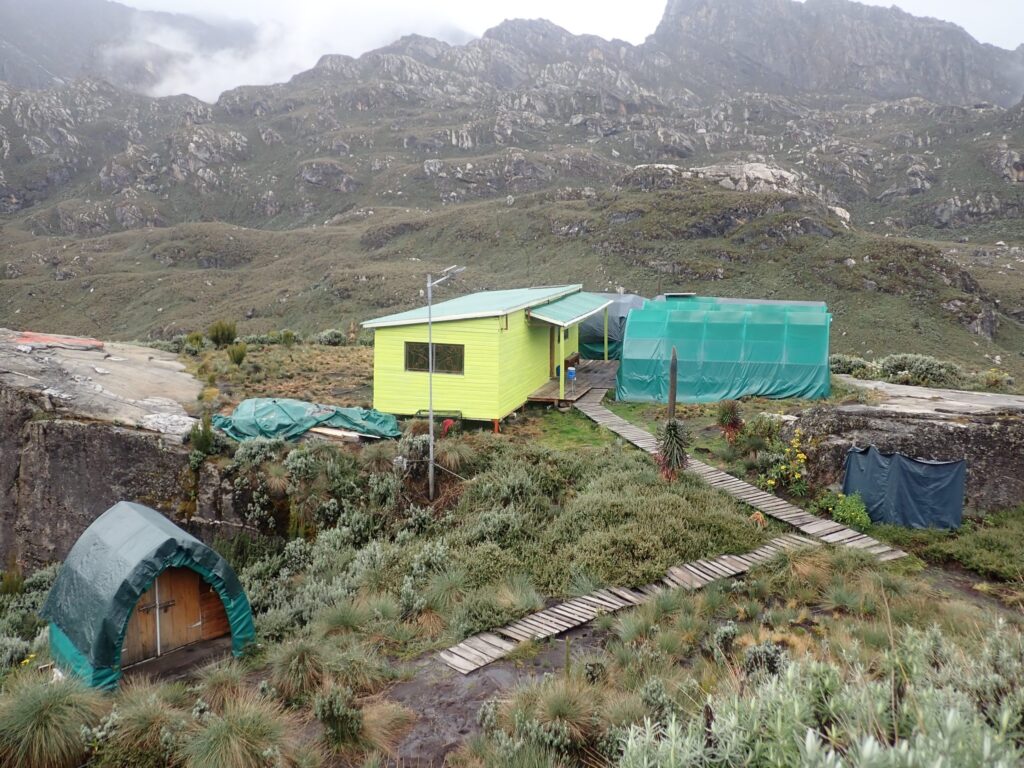
The valley floor is genuinely boggy in sections; this area is where your rubber boots prove their worth and where a controlled, unhurried pace matters more than speed. Rushing through mud at 3,800m invites twisted ankles and unnecessary fatigue; picking a deliberate line, testing your footing, and accepting a slower rhythm is the more experienced approach, and your guide will set exactly that tempo. As you climb toward Bugata Camp, the vegetation thins, the sky opens, and the first glacier views appear on the ridgeline ahead, thin white bands of ice that look almost impossibly high from this angle.
Overnight: Bugata Camp (4,100 m), on an open plateau with the first unobstructed views of the glacier-bearing peaks. Night temperatures drop below freezing from this point forward.
Meals: Hot breakfast at Mutinda; packed lunch on the trail; hot dinner at Bugata Camp.
Day 4: Bugata Camp → Hunwick’s Camp4,100 m → 4,450 m → 3,974 m · via Bamwanjara Pass · approx. 8.3 km · 6–8 hours |
Day 4 of the 10-day Rwenzori Trekking to Mount Stanley & Mount Baker: the mountain’s grand reveal. The route climbs to Bamwanjara Pass at 4,450 m, the highest ground crossed so far, and on a clear morning delivers one of the finest panoramas in the entire range: Mount Stanley’s glaciated summit, Mount Baker’s ice-draped ridgeline, and the flanks of Mount Speke are all visible together. It is the view that makes the previous three days of climbing make complete sense.
The terrain to the pass is exposed and rocky, and the air at 4,450 m is noticeably thin; the whole group’s pace slows here, deliberately. Your guide will be watching everyone closely for early signs of altitude sickness, headache, nausea, unusual breathlessness, and the mountain’s protocol on this route, as on every high-altitude trek we operate, is unambiguous: any trekker showing moderate or severe symptoms descends immediately, without negotiation. Hydrate consistently, keep your pace conversational, and resist any urge to outpace the group.
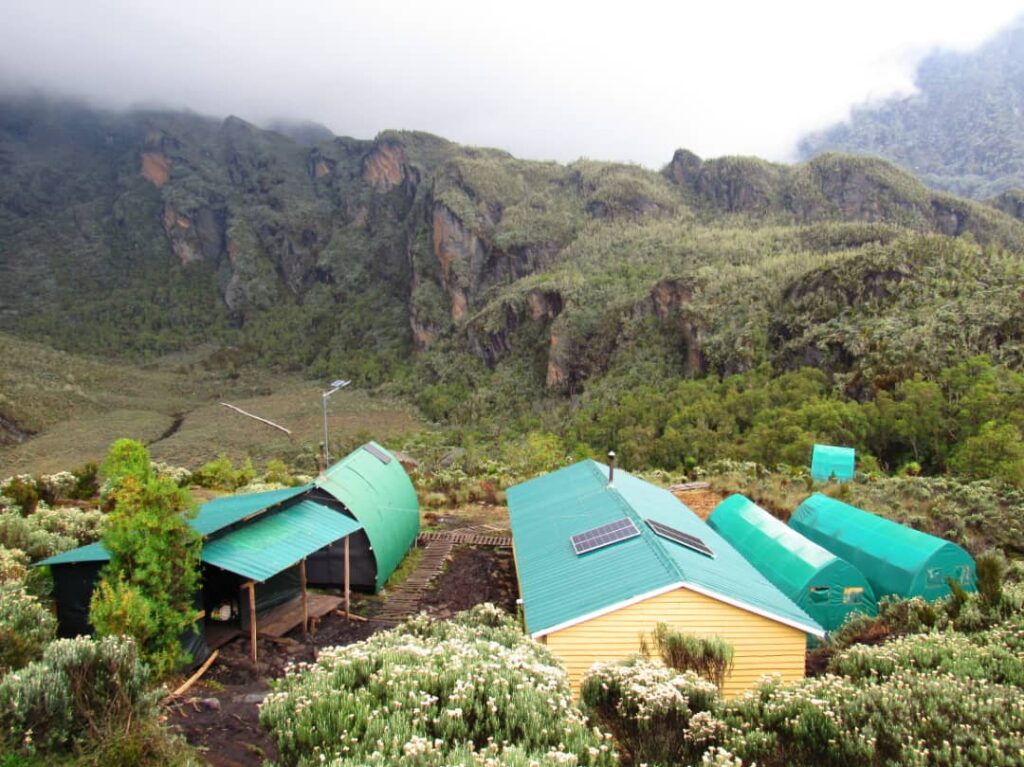
The descent from Bamwanjara Pass to Hunwick’s Camp goes through rock and moraine fields that were shaped by glaciers, clear signs of the much larger glaciers that covered these mountains thousands of years ago. Hunwick’s Camp itself, at 3,974 m, becomes the operational hub of your entire upper-mountain expedition: you will sleep here tonight, return here after the Mount Baker summit attempt, and again after Margherita, making it the most lived-in camp of the whole trek. Spend the afternoon resting, eating well, and reviewing tomorrow’s summit briefing in detail with your guide.
Overnight: Hunwick’s Camp (3,974 m), sheltered below the main ridge system, serving as a base for both summit attempts ahead.
Meals: Hot breakfast at Bugata; packed lunch at or near Bamwanjara Pass; hot dinner at Hunwick’s Camp.
Day 5: Summit Day—Mount Baker, Edward Peak (4,844 m)Round trip from Hunwick’s Camp: approx. 8–10 km · 6–9 hours total |
The alarm sounds early, typically between 4:00 and 5:00am, and the first summit attempt of the expedition begins in darkness. After a hot breakfast and a final equipment check, your guide leads the group up toward Mount Baker’s ridgeline. The climb is steep and rocky throughout and, depending on current conditions, includes a short section of glacial travel near the top; crampons, an ice axe, and a harness are issued and fitted before you leave camp, with your guide briefing the group on their use.

The pre-dawn hours are among the most memorable of the whole trek: headlamps picking out the route above, the only sounds your footsteps and the wind, and then, as the sky begins to lighten, the silhouette of Mount Stanley’s twin summits emerging to the north, the mountain you will be standing on in a matter of days. If the Rwenzori’s characteristic mist breaks at first light, as it often does, the early views across the range can be extraordinary.
The final approach to Edward Peak is a sustained, exposed scramble; your guide sets the pace and manages rope work at the more technical sections. From the summit, on a clear morning, the view sweeps across Margherita, Alexandra, and the Stanley Plateau to the north, with the ridgelines of the wider range falling away in every direction. The descent back to Hunwick’s Camp typically takes two to three hours. This is a genuine summit, at genuine altitude, and it should be treated with the same respect as the larger objective still ahead, not as a warm-up to be rushed.
Not a Guarantee As with every summit day on this itinerary, reaching Edward Peak depends on weather, current route conditions, and your guide’s real-time safety assessment. Some groups summit in clear morning light; others are turned back by wind, cloud, or ice conditions and still complete a genuinely rewarding high-altitude day on the mountain. |
Overnight: Hunwick’s Camp (3,974 m)—return.
Meals: Hot breakfast before the pre-dawn departure; packed summit rations; hot dinner at Hunwick’s Camp on return.
Technical gear: Crampons, ice axe, harness, helmet, and fixed ropes at key sections, all provided.
Day 6: Recovery & Preparation at Hunwick’s Camp3,974 m · no summit objective · full rest day |
This is the day that separates a genuinely well-designed dual-summit itinerary from a rushed one. After the physical and mental exertion of Mount Baker, your body needs deliberate recovery before it is asked to climb higher and further on Margherita. Today is built for exactly that: no summit objective, no long trekking distance, just structured rest.
Sleep late if your body wants it. Your guide will encourage aggressive rehydration and a nutrient-dense diet through the day and will watch each member of the group for lingering fatigue, unresolved altitude symptoms, or blisters and minor injuries that need attention before the next push. The afternoon is also when the Margherita summit briefing happens in earnest: your guide walks through the route from Margherita Camp, the current state of the glacier crossing, expected timings, and the specific technical sequence of tomorrow’s approach and the following day’s summit attempt. Short, easy walks around camp are welcome; anything more ambitious is discouraged. A short optional stroll toward the edge of camp for photography of the surrounding ridgelines is a pleasant way to spend an afternoon hour without taxing legs that need to recover.
Overnight: Hunwick’s Camp (3,974m).
Meals: Full hot breakfast, lunch, and dinner at camp, with an emphasis on rehydration and calorie-dense food ahead of the approach to Margherita.
Day 7: Hunwick’s Camp → Margherita Camp3,974 m → 4,485 m · via Lake Kitandara & Scott Elliot Pass · approx. 5.1 km · 4–6 hours |
Rested and re-briefed, you set out for the high camp beneath Mount Stanley. The route passes Lake Kitandara, one of the most beautiful high-alpine lakes in East Africa, its dark water lying still in a glacially carved hollow at roughly 4,023m and reflecting the rock walls above on calm mornings. It is a natural pause point and among the most photographed spots on the entire Kilembe Trail.
From the lake, the trail climbs steeply via Scott Elliot Pass, at approximately 4,372m, named for the explorer who first traced these valleys in 1895. The terrain above the pass turns increasingly rocky and exposed, vegetation thinning to almost nothing, wind becoming the dominant presence. Margherita Camp appears as a small cluster of huts on a narrow shelf below the glacier’s terminal moraine, the highest permanent camp on the Kilembe Trail, at 4,485m.
At this altitude, every movement wants a deliberate pace, and headaches or breathlessness are a normal part of the experience rather than a cause for alarm on their own. Confusion, an inability to walk a straight line, or coughing that produces blood are not normal and are the guide’s cue to descend without delay. Tonight’s priorities are simple: hydrate, eat a full hot meal, lay out your summit kit, and sleep as much as you can before an early alarm.
Overnight: Margherita Camp (4,485m), the highest camp on the route.
Meals: Hot breakfast at Hunwick’s, packed lunch on the trail, and early hot dinner at Margherita Camp.
Day 8: Summit Day—Margherita Peak, Mount Stanley (5,109m)Round trip from Margherita Camp: approx. 9 km · 9–12 hours total |
This is the day the entire expedition has been building toward. The alarm sounds around 4:00am, sometimes earlier depending on your guide’s assessment of the glacier and the weather window. You leave Margherita Camp in full darkness, your rope team moving up the initial rocky ground, led by headlamp. Expect a start temperature between -5°C and -10°C, colder still with wind chill, and every insulating layer you own in use: base layer, mid-layer fleece, hardshell jacket and trousers, insulated gloves, and a balaclava.
As you gain the glacier, crampons on and roped together, the sky begins to lighten behind you. This scene is the defining image most trekkers carry away from the Rwenzori: dawn breaking over the range’s eastern flank, the Rift Valley floor invisible far below in shadow, and the ice beneath your boots catching the day’s first cold blue light. The final approach across the glacier is unhurried and entirely guide-led, following whatever line current crevasse conditions require.
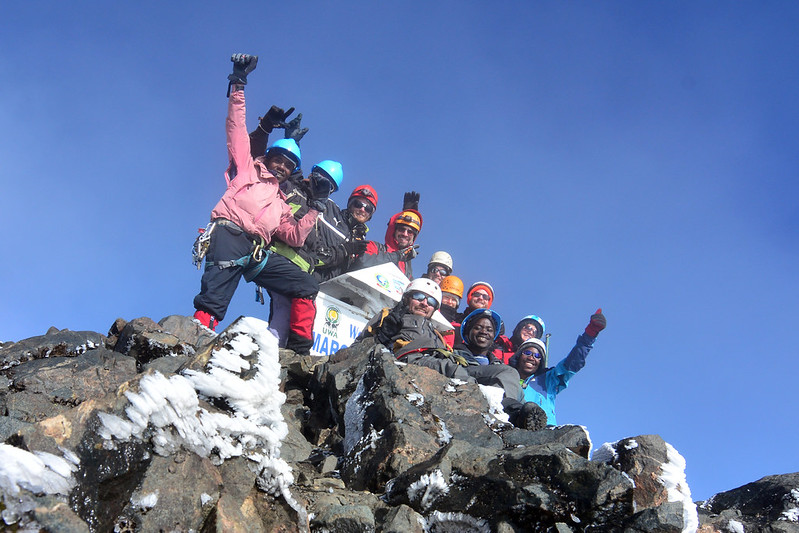
Reaching Margherita Peak’s small summit point at 5,109m places you at Africa’s third-highest point, with, on a clear morning, the volcanic profile of the DRC’s Virunga range visible to the south and the full sweep of western Uganda’s Rift Valley to the east. The descent, first across the glacier and then down the long rocky approach, is deliberately unhurried; fatigue and concentration lapses on the way down are a well-documented mountaineering risk, and your guide will manage the pace accordingly all the way back through Margherita Camp and onward to Hunwick’s Camp for the night.
The Sentence That Matters Most Reaching Margherita Peak depends on weather, route conditions, individual fitness, altitude response, and your guide’s safety decisions on the day. No itinerary of any length and no operator, however experienced, can guarantee a summit. What this expedition provides is the time, the equipment, and the guiding to give you the best realistic opportunity and a complete, honestly earned mountain experience regardless of how the summit attempt itself resolves. |
Overnight: Hunwick’s Camp (3,974m).
Meals: Very early hot breakfast (around 3:30–3:45am); packed summit rations; hot dinner at Hunwick’s Camp on return.
Technical gear: crampons, ice axe, harness, helmet, and ropes, all provided. Full thermal and waterproof layering required.
Day 9: Hunwick’s Camp → Kiharo Camp3,974 m → 3,430 m · via Oliver’s Pass · approx. 15.8 km · 9–10 hours |
With both summits behind you, Day 9 asks for one more genuinely long effort: it is among the longest days of the trek by distance, though the elevation trend is now firmly downward. The route crosses a stretch of glacially carved high plateau before reaching Oliver’s Pass, from where the ridgeline of Mount Luigi di Savoia, home to Weismann’s Peak, is visible to the south for trekkers who know they will return one day for that summit too.
The terrain alternates between rocky ridge walking, ancient glacial valleys, and the bog crossings characteristic of the Rwenzori at this elevation. It is not an easy day simply because the summits are complete; tired legs and a long bog crossing require the same patience and focus as anything earlier in the trek. Wind-sculpted groundsel trees along this stretch, twisted into extraordinary shapes by decades of exposure, offer some of the finest photography of the entire descent.
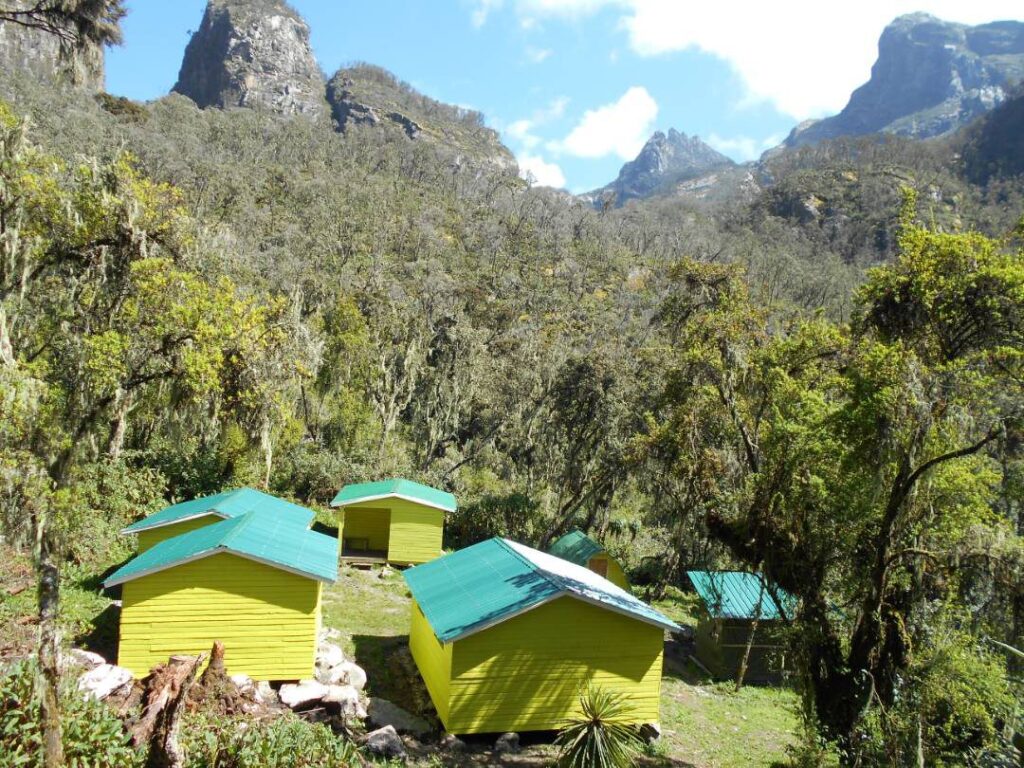
Kiharo Camp, at 3,430m, sits in a broader, more sheltered valley than the high camps of the past several nights. After the exposed cold of Hunwick’s and Margherita, the relative warmth here feels almost luxurious. This is your last night on the mountain, and it carries a particular satisfaction: boots off, blisters tended, summit stories exchanged over a hot meal that tastes better than it has any right to.
Overnight: Kiharo Camp (3,430m).
Meals: Hot breakfast at Hunwick’s; packed lunch on the trail; hot dinner at Kiharo Camp.
Day 10: Final Descent & Transfer3,430 m → 1,450 m · approx. 16 km · 6–8 hours · plus transfer to Kasese |
The final day retraces the full altitudinal sequence in reverse moorland into heather, heather into bamboo, and bamboo into the lower Afro-montane forest, and the Nyamwamba Valley carries you the whole way home. It is one of the most beautiful descent corridors on the mountain: the river grows steadily louder, the vegetation thickens hour by hour, and duikers occasionally dart across the lower trail while colobus monkeys move through the upper canopy.
As you drop below 2,000 m, the air thickens noticeably, and after nine nights of alpine cold, the warmth arrives almost as a physical shock. The Kilembe trailhead appears through the final stand of forest, and there is a particular quiet that tends to settle over every group in that last half hour, the quiet of two summits completed, or attempted, with everything a person had to give.
Back at the trailhead, porters are thanked and tipped, technical equipment is returned, and your private vehicle is waiting for the short transfer into Kasese. From here, celebration dinners, hot showers, and a soft bed take on a significance that only nine nights in a mountain hut can create.
Optional Premium Post-Trek Recovery Night
Rather than treating your last night as an afterthought, we can arrange a premium recovery night in Kasese or, for those with an extra day to spare, in the highland town of Fort Portal: a proper hot shower, a full night in a real bed, a curated dinner, and, where available, an in-room or spa massage to ease nine days of accumulated effort out of your legs. This service is entirely optional and arranged around your onward plans, whether that means a flight home, a Queen Elizabeth National Park boat safari on the Kazinga Channel, or a connection south toward a gorilla trekking permit in Bwindi.
Meals: Hot breakfast at Kiharo; packed lunch on the trail or at the trailhead; dinner in Kasese at your own arrangement, or included as part of an optional premium recovery package.
We would rather you arrive prepared than surprised. Both summit days on this 10-day Mount Stanley and Mount Baker Rwenzori Trekking itinerary—Mount Baker on Day 5 and Margherita Peak on Day 8—share the same underlying rhythm, and it is worth understanding honestly before you commit to the expedition.
How early do we wake up?
Wake-up time is between 3:00 and 5:00am, depending on the summit and the guide’s assessment of glacier and weather conditions. A hot breakfast is prepared before departure, even at that hour.
How cold is it?
Expect starting temperatures between -5°C and -10°C on Margherita’s summit morning, colder with wind chill, and only slightly milder on Mount Baker. This is why full thermal and waterproof layering is non-negotiable, not a suggestion.
How long shall we stay on the mountain?
Mount Baker’s round trip typically runs 6–9 hours; Margherita’s runs 9–12 hours, including the pre-dawn approach, the glacier crossing, summit time, and the full descent back to camp.
What happens if the weather deteriorates?
Your guide continuously reassesses conditions throughout the ascent. If wind, whiteout cloud, or deteriorating ice conditions cross a safety threshold, the group turns back; this decision is made by the guide, not negotiated with the client, and is treated as final.
What happens if someone becomes unwell?
Any trekker showing moderate or severe altitude symptoms, exhaustion, or injury descends immediately, accompanied by a guide or assistant guide. The rest of the group’s summit attempt is not automatically cancelled, but safety protocol for the affected individual always takes priority over the group’s schedule.
What happens if we don’t reach the summit?
It happens, and it is not treated as a failure of the 10-day Mount Stanley & Mount Baker Rwenzori trekking itinerary. A turned-back attempt still delivers a genuine high-altitude mountaineering experience, the pre-dawn glacier approach, the exposure, and the physical effort, and for many trekkers remains one of the most memorable days of their trip regardless of the outcome.
How much equipment do we carry?
A daypack with water, snacks, spare layers, and a camera; your guide and support team carry the shared technical equipment (ropes, spare crampons, first-aid kit, and emergency oxygen).
What does the guide decide, and what do you decide?
Route, pace, turn-back thresholds, and rope management are entirely the guide’s call; this decision is non-negotiable and exists for your safety. Your role is to communicate honestly and immediately about how you are feeling; withholding symptoms to avoid “ruining” a summit attempt is the single most common cause of serious incidents on high mountains worldwide.
Technical Requirements: Trekking vs. Mountaineering
Understanding the difference between the trekking days and the mountaineering days on this itinerary will help you prepare realistically.
Trekking (Days 1–4, 6–7, 9–10)
This is walking at altitude: long days on foot, sustained elevation gain and loss, uneven and often boggy terrain, and the cumulative physical demand of nine consecutive days on the mountain. It requires strong cardiovascular fitness and genuine multi-day hiking stamina, but no specialist climbing skill.
Mountaineering (Days 5 and 8)
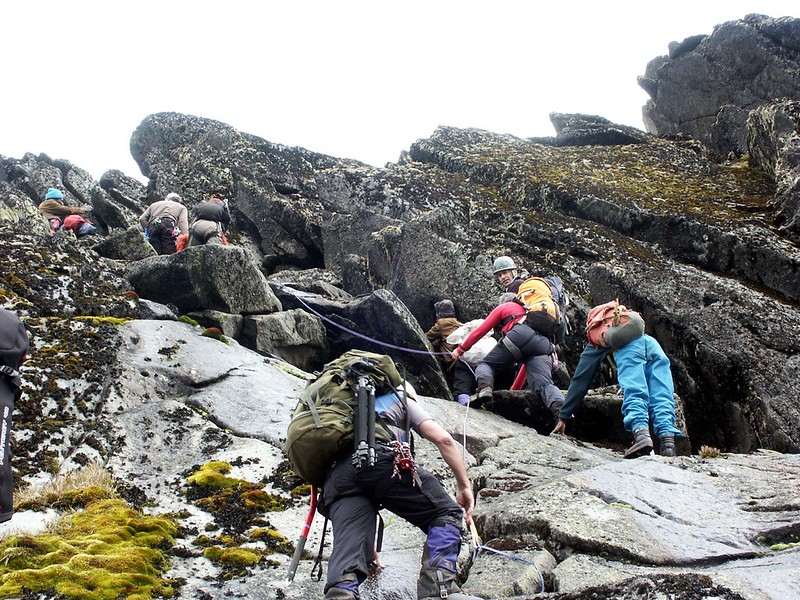
This section is technical terrain that requires specialized equipment and guide-managed procedures, including crampon use on ice, roped glacier travel, harness and fixed-rope work at exposed sections, and ice axe technique. No prior climbing certification is required; your guides provide full instruction before each summit attempt, but you should be comfortable with exposure, heights, and following precise instructions under physical stress.
What Determines the Exact Requirements
The specific technical demands of any given summit attempt depend on the current route, the season, the state of the glacier that year, your guide’s real-time assessment, and the Uganda Wildlife Authority/Rwenzori Trekking Services operating procedure at the time of your trek. We brief every group on current conditions in the days immediately before each summit attempt, not from a generic script written months in advance.
What We Provide vs. What You Bring Rwenzori Trekking Expeditions provides crampons, ice axes, climbing harnesses, helmets, all group climbing rope and fixed-line equipment, rubber boots for bog sections, emergency oxygen, and full technical instruction from certified guides before each summit day. You are responsible for bringing your own thermal and waterproof clothing layers, hiking boots or approved footwear for the trekking days, a sleeping bag rated to at least -10°C, personal first-aid items, and general trekking equipment as detailed in the packing list below. |
Who Is This Trek For?
Experienced Hikers
Trekkers are comfortable with multiple consecutive days of demanding mountain hiking, seven to ten hours on foot, uneven and often muddy terrain, and cumulative fatigue across a nine-day expedition. Previous multi-day trekking at altitude (2,000m and above) is strongly recommended, though not formally required, since our guides provide full technical instruction for the summit sections themselves.
Mountaineers
Trekkers with some prior exposure to roped travel, crampon use, or glacier terrain will find both summit days more intuitive and often more enjoyable than those encountering these techniques for the first time. That said, this trip is not an exclusively technical-climbers’ expedition; plenty of capable, well-prepared hikers without a mountaineering background complete it successfully each season.
Serious Adventure Travellers
Solo trekkers, couples, and small private groups who are physically prepared for a genuinely demanding expedition, comfortable with cold and wet conditions, and willing to follow professional mountain guidance without argument. This itinerary rewards patience, humility in the face of altitude, and a willingness to let the guide’s judgement override personal ambition on any given day.
Who Should Choose a Different Trek
If you are looking for a short, accessible introduction to the Rwenzori’s forest and lower vegetation zones, rather than a summit expedition, this is not the right itinerary. Our 4-day trek to Mutinda Lookout via the Kilembe Trail delivers extraordinary Afro-alpine scenery, including giant lobelia groves and sweeping views, without any technical glacier work or a multi-day summit push. Families with younger trekkers, first-time visitors to East African mountains, or anyone unsure whether high-altitude trekking suits them are generally better served starting there, or with one of our shorter Central Circuit trail itineraries, before returning for a summit attempt in the future.
Compare This Trek With Other Rwenzori Options
If you are weighing this expedition against a shorter or differently focused Rwenzori itinerary, this comparison should help you self-select the right trip.
Trek | Main Objective | Best For |
4-Day Mutinda Lookout | Afro-alpine scenery, no summit push | First-time Rwenzori visitors, families, photographers |
6-Day Margherita (Central Circuit) | Single summit-focused trek | Experienced trekkers on a tighter schedule |
7-Day Margherita (Central Circuit) | Single summit expedition, more time | Strong hikers wanting a fuller acclimatization arc |
8-Day Margherita (Kilembe Trail) | Single summit expedition via Kilembe | Trekkers who want the wilder Kilembe route to one summit |
9-Day Full Central Circuit | Summit plus extended circuit time | Trekkers prioritizing acclimatization and flexibility |
10-Day Stanley & Baker (this trek) | Two major summits: Margherita Peak & Edward Peak | Serious mountaineering adventurers wanting a complete dual-summit expedition |
What Does a Premium Rwenzori Expedition Look Like?
We will not pretend the Rwenzori offers five-star mountain camps; nobody who has genuinely climbed here would tell you that, and we would rather earn your trust with honesty than lose it with an exaggerated brochure claim. What premium means on this mountain is precision, privacy, and care applied at every stage that is within our control.
Before the Trek
- Private transfer: a dedicated vehicle and driver from Entebbe, Kampala, or Kasese, arranged around your own arrival schedule rather than a fixed group departure.
- Premium pre-trek lodge: comfortable accommodation in Kasese the night before departure, so you begin the trek rested rather than travel-worn.
- Personal expedition briefing: a one-on-one or small-group briefing with your lead guide, tailored to your fitness, prior altitude experience, and specific objectives.
- Equipment inspection: a full kit check well before departure day, with the chance to rent or replace anything missing in Kasese.
- Personalized itinerary: pacing, rest-day placement, and even camp sequencing can be adjusted for your party’s specific needs.
During the Trek
- Private expedition: your party treks as its own private group, not merged into a larger shared departure, from solo travellers up to groups of eight.
- Experienced, dedicated guide team: certified, first-aid-trained lead guides who know the Kilembe Trail and both summit routes intimately.
- Strong porter support: a full Bakonzo porter team carries your loads and ensures logistics never compromise your pace.
- Quality mountain meals: a dedicated mountain cook preparing hot, calorie-appropriate food at every camp, even at 4,485m.
- Carefully managed pacing and flexible decision-making: no rigid script; your guide adapts each day’s plan to weather, group fatigue, and conditions in real time.
After the Trek
- Premium recovery accommodation: a proper lodge in Kasese or Fort Portal, with a hot shower that will feel genuinely transformative.
- Optional massage or recovery treatment: where available, to ease nine days of cumulative effort.
- Private onward transfer: a dedicated vehicle to your next destination, whether that is Entebbe, Kampala, Queen Elizabeth National Park, or a gorilla trekking permit in Bwindi.
- Optional extensions: wildlife safari or gorilla trekking add-ons, curated to extend your Uganda journey without any logistics falling on you.
What’s Included & What’s Not Included
Included in Your Package
We handle every element of the mountain logistics on your behalf, from park administration to the equipment that gets you across the glacier. Specifically, your package includes:
- All Uganda Wildlife Authority (UWA) park entry fees and Kilembe Trail permits
- A certified, first-aid-trained, English-speaking lead mountain guide, with an assistant guide for larger private groups
- A full Bakonzo porter team (standard allocation of one porter per trekker, 20 kg limit per porter load)
- All meals on the mountain: hot breakfast, packed trail lunch, and a three-course dinner daily, prepared by your dedicated mountain cook
- Accommodation in designated wooden mountain huts at every camp on the route
- Full technical summit equipment for both Mount Baker and Margherita Peak: crampons, ice axes, harnesses, helmets, and fixed ropes
- Free use of rubber boots for the Kilembe Trail’s bog sections (all sizes available; essential kit for this route)
- Drinking water sourced and treated on the mountain throughout the trek
- Emergency oxygen carried by your guide team and a full first-aid kit with established emergency protocols
- Private trailhead transfer between Kasese and the Kilembe trailhead
- A contribution from trek proceeds directed to local Bakonzo community initiatives
Not Included
- International flights and Uganda visa fees
- Personal travel insurance and medical evacuation (medevac) cover, mandatory for this itinerary given the altitude and technical terrain involved
- Tips and gratuities for your guide and porter team
- Pre- and post-trek accommodation in Kasese, unless arranged as part of a premium package
- Personal trekking equipment: sleeping bag, thermal layers, waterproof clothing, and trekking poles (rental available locally in Kasese on request)
- Personal snacks, energy bars, and electrolyte supplements
- Alcoholic beverages
- International travel to and from Uganda
We do not believe a single headline number tells you anything useful about what you are actually paying for. The price of a genuine 10-day Mount Stanley & Mount Baker Rwenzori Trek is shaped by several real variables, and our full cost breakdown guide goes into far more detail than we can here. In broad terms, the factors that move the price are
- Private vs. shared departure: every itinerary we build is run as a private departure for your specific party, which costs more per person for a solo trekker than for a group of six or eight sharing guide and porter overheads.
- Number of travelers: park fees, guide fees, and portering are calculated per person, and larger private groups typically see a lower per-person rate.
- Route: the Kilembe Trail’s longer, more remote profile carries a somewhat different cost structure from the Central Circuit Trail.
- Guide-to-client ratio: solo trekkers or couples requesting an especially high level of individual guide attention on summit days may see their request reflected in the price.
- Porter requirements: additional porters for extra luggage, camera equipment, or personal comfort items add to the total.
- Pre- and post-trek accommodation: premium lodges in Kasese or Fort Portal, and private transfers, are priced as optional add-ons.
- Technical equipment condition and availability: our provided crampons, ropes, and harnesses are maintained and replaced on a regular cycle, which is factored into the base package cost rather than passed on as a surprise fee.
Current Indicative PricingContact us directly for current per-person pricing, which varies by group size, season, and the specific inclusions you select. As a private specialist operator, we quote every 10-day Stanley & Baker Rwenzori expedition individually rather than publish a single fixed rate that cannot reflect your actual party size and preferences. Request a tailored quote through our contact page, and we will respond with a transparent, itemized breakdown, not a vague estimate. |
Full Packing List for the 10-Day Stanley & Baker Expedition
This trek spans an extraordinary temperature range, from the warmth of Kasese to well below freezing on summit mornings, and the Kilembe Trail is a genuinely wet route for much of its length. Our full packing list guide covers every trek we operate in more depth; the categories below are specific to this expedition’s demands.
Clothing
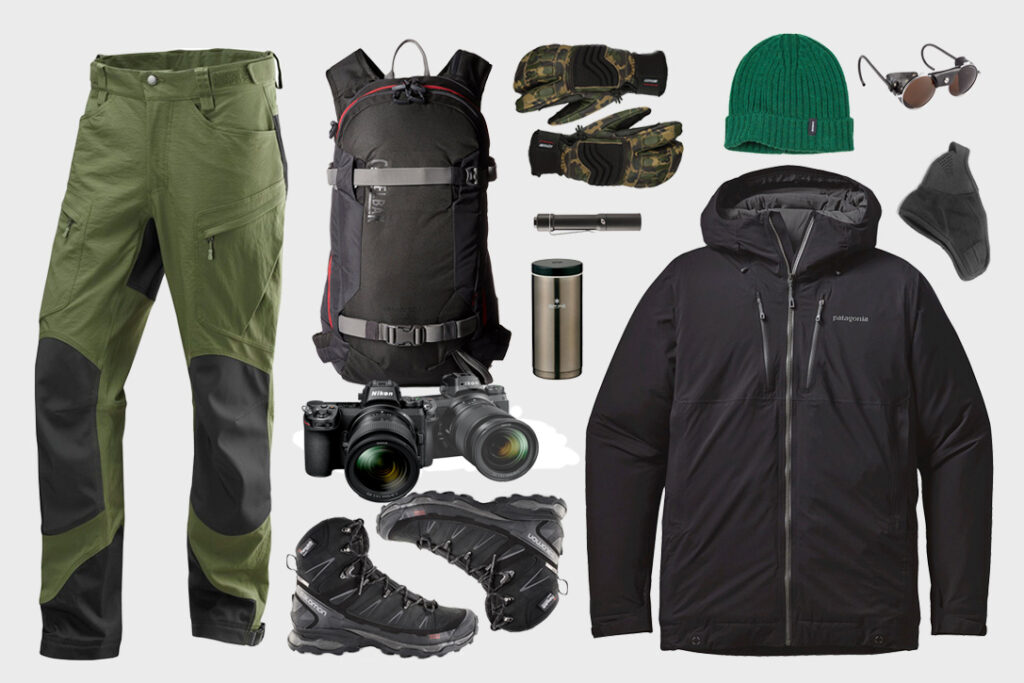
- Thermal base layers (at least two sets, top and bottom)
- Mid-layer fleece or lightweight insulated jacket
- Summit-grade insulated down jacket (600-fill minimum; 800-fill recommended)
- Waterproof, breathable hardshell jacket, non-negotiable for this route
- Waterproof trousers, ideally with full-length side zips to fit over rubber boots
- Insulated gloves for summit days, plus thin liner gloves for general trekking
- A warm hat and a separate balaclava, both, not either
Trekking
- Waterproof hiking boots for the trekking days, plus rubber boots (provided) for bog sections
- Gaiters, useful in heavy mud conditions
- Trekking poles, collapsible with rubber and spike tips
- A 25–35 liter daypack for daily essentials (porters carry your main luggage)
- Dry bags or heavy-duty liners to keep the sleeping bag and electronics dry
Summit-Specific
- Technical outer layers capable of handling -10°C to -15°C with wind chill
- Head protection: warm hat plus balaclava for pre-dawn starts
- Appropriate insulated, waterproof summit gloves or mitts
- Mountaineering equipment appropriate to current conditions is provided by us: crampons, ice axe, harness, and helmet; you do not need to own or bring these
Personal
- Headlamp with fresh batteries and spares essential for pre-dawn summit starts
- Reusable water bottles, minimum 2 liters combined capacity
- Sunscreen SPF 50+ and lip balm with UV protection (equatorial UV at altitude is intense)
- Sunglasses with strong UV protection, ideally glacier-rated
- Personal medication in full supply, plus a basic personal first-aid kit
- Camera, ideally weatherproofed or carried in a waterproof case
Fitness & Training: A Preparation
Framework
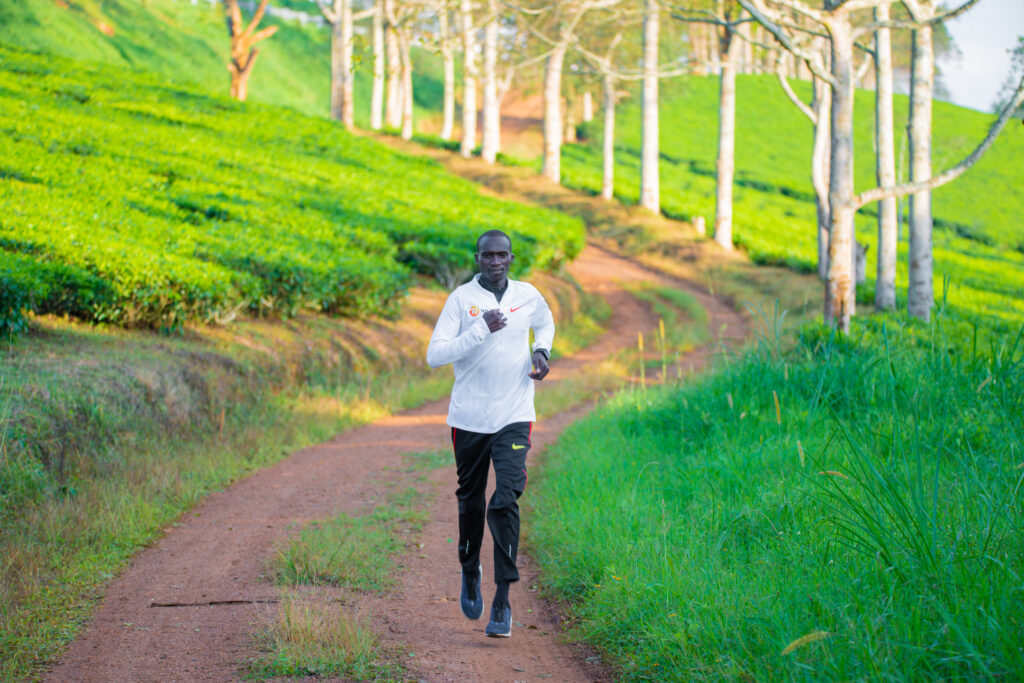
This trek is a serious expedition, and genuine preparation materially improves both your enjoyment and your realistic chance of reaching both summits. The framework below is a starting point; adjust the intensity to your current baseline fitness and discuss any health concerns with your doctor before beginning.
12–16 Weeks Before: Build Your Aerobic Base
Focus on sustained cardiovascular training, running, cycling, swimming, or brisk hiking, three to four times a week, building toward sessions of 60–90 minutes.
8–12 Weeks Before: Add Hills and Long Hikes
Introduce hill sessions and progressively longer weekend hikes, ideally on varied terrain with a loaded daypack, to build the specific leg strength and endurance this trek demands.
4–8 Weeks Before: Practice Consecutive Days
Simulate the trek’s cumulative demand with back-to-back hiking days where possible. Multi-day hikes, even at lower altitude, condition your body and mind for the fatigue management this expedition requires.
Final 2 Weeks: Reduce Volume, Prioritize Recovery
Taper your training significantly, prioritize sleep, and focus on nutrition and hydration rather than squeezing in a last demanding session that leaves you fatigued on arrival.
An Honest CaveatNo training program, however disciplined, can eliminate the effects of altitude. Fitness improves your baseline resilience and your enjoyment of the trekking days, but individual altitude response varies enormously and is not fully predictable from fitness level alone. This is precisely why the itinerary’s built-in acclimatization days matter as much as your gym schedule. |
The Rwenzori sits directly on the equator and receives rainfall throughout the year; it is, honestly, one of the wettest mountain environments on earth, and no season is genuinely dry. What exists instead are two comparatively drier windows. Our full guide to the best time to visit covers seasonal planning in more depth across all our itineraries.
December – March
Generally the most stable window of the year, with reduced rainfall, firmer trail conditions, and a higher likelihood of clear summit mornings on both Mount Baker and Margherita. January and February in particular tend to offer some of the best summit weather. Night temperatures at Margherita Camp still commonly fall between -5°C and -12°C.
June – August
A secondary dry window, historically wetter than December–March, remains entirely viable and popular with travellers working around Northern Hemisphere summer schedules. Lower sections of the Kilembe Trail can be particularly muddy in June, so rubber boots are essential.
April–May and September–November
The Rwenzori’s heaviest rains. The trek remains genuinely possible, and some experienced trekkers prefer this period for its vivid green vegetation, dramatic waterfalls, and near-total absence of other parties on the trail; however, trails are significantly muddier, clouds more often obscure summit views, and the technical glacier sections demand additional caution. With realistic expectations and the right gear, these months remain safe and, for some, deeply rewarding.
Safety on the 10-Day Stanley & Baker Rwenzori Trekking Expedition
A two-summit, glacier-crossing expedition carries real risks, and we would rather describe them plainly than gloss over them. Understanding the hazards and our protocols for managing them is part of making an informed decision to book this trek.
The Principal Hazards
- Altitude sickness is the most common serious risk on this route. It is managed through the itinerary’s built-in acclimatization profile, constant guide monitoring, and a clear protocol to descend immediately for moderate or severe symptoms.
- Hypothermia and cold injury pose a real risk on both summit mornings and are managed through mandatory layering standards, guide oversight of clothing before each summit departure, and turn-back decisions when wind chill crosses safe thresholds.
- Slippery and boggy terrain: particularly through the Namusangi Valley and other moorland sections, managed with provided rubber boots, a deliberately unhurried pace, and trekking poles.
- River crossings: several minor crossings occur on the lower trail; guides select safe crossing points and assist where currents run high after rain.
- Rockfall: possible on the steeper sections of the Mount Baker approach and the rocky ground above Scott Elliot Pass; guides manage the route to minimize exposure and brief on safe spacing.
- Glacier hazards: crevasses and variable ice conditions on the Margherita approach, managed through roped travel, current-condition assessment before every summit attempt, and fixed lines at known hazard points.
- Weather: rapid changes in wind, cloud, and precipitation are normal at this altitude; these are managed through conservative turn-back protocols rather than a fixed determination to summit regardless of conditions.
- Cumulative fatigue: nine consecutive days on the mountain add up; managed through the itinerary’s dedicated recovery day and realistic daily distances.
- Emergency communication and evacuation: our guide team carries communication equipment appropriate to the route and maintains established evacuation protocols coordinated with UWA and local emergency services; this is precisely why mandatory medical evacuation insurance is a condition of booking.
Guide Authority on Safety Matters
Your lead guide’s decision is final on every question of pace, route, turn-back timing, and descent. This is not a bureaucratic formality; it is the single most important safety mechanism on the mountain, and it is the reason our guides are certified, first-aid trained, and deeply experienced on both the Mount Baker and Margherita Peak routes specifically.
Is This the Right Rwenzori Trek for Me?
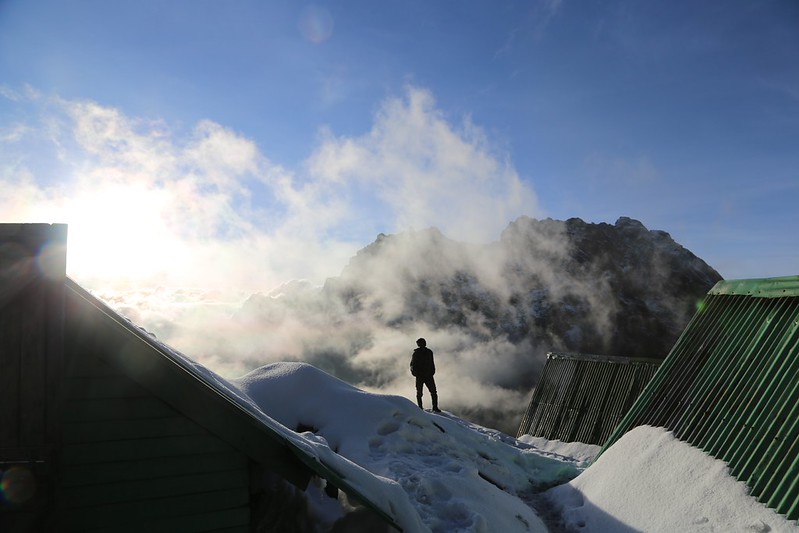
Choose the 10-Day Stanley & Baker Expedition If:
- You want two major summit objectives, Margherita Peak and Edward Peak, in a single, well-paced expedition.
- You have strong, genuinely tested trekking fitness and can commit to nine consecutive days on the mountain.
- You want a longer expedition with real acclimatization time, rather than the shortest possible itinerary.
- You value flexibility and conservative, safety-first summit planning over a rigid schedule.
- You are comfortable with cold, wet, high-altitude mountain conditions and technical glacier terrain under guide supervision.
Choose a Shorter Trek If:
- You have limited time and cannot commit to a full 10-day mountain schedule.
- You are not seeking a high-altitude summit objective and would prefer to focus purely on scenery and nature.
- You are newer to multi-day trekking and would benefit from a shorter, non-technical introduction to the Rwenzori first.
For that shorter introduction, our 4-day trek to Mutinda Lookout remains one of the finest low-commitment ways to experience the Rwenzori’s Afro-alpine character. For a single-summit Margherita objective without Mount Baker, our 7- day Margherita Peak and 8-day Margherita Peak itineraries via the Central Circuit Trail and Kilembe Trail are both well-established alternatives — speak to our team and we will help you choose honestly, even if that means recommending a different trek than the one you came here to read about.