The 8-day Rwenzori trek to Margherita Peak via the Kilembe Trail summits Margherita Peak (5,109 m) on Mount Stanley in the Rwenzori range of Rwenzori Mountains National Park. Rwenzori Trekking Expeditions offers this 8-day trek to Margherita Peak via the Kilembe Trail route, which is famous for picturesque waterfalls, Bugata Lake, glacier summit valleys, diverse wildlife, and a gradual, safe climb. This 8-day Margherita Peak Rwenzori trek via the Kilembe trail costs $1,450, including a $35 park entry fee each day, adding up to $1,695 per person for the 7-night Rwenzori trek to Margherita Peak.
Most people who climb Margherita Peak arrive from the North, through the Nyakalengija Gate, along the Central Circuit Trail that the Duke of Abruzzi’s 1906 expedition made famous. But there is another way to the roof of Uganda, and it is, in many respects, the finer approach: the Kilembe Trail, rising from the historic copper-mining town of Kilembe on the Rwenzori’s southern flank, through a forest ecosystem of extraordinary biological richness, past waterfalls of spectacular volume and height, up through bamboo and giant heather and the full Afro-alpine sequence to the Weismann’s Peak saddle and then, for those equipped and guided for the glacier, across the Elena Glacier to the summit of Margherita Peak at 5,109 meters.

The 8-day Rwenzori Trek to Margherita Peak via the Kilembe Trail is the definitive southern approach to Africa’s third highest summit: longer, more remote, and richer in landscape variety than the northern routes, with a summit day of equal drama and a return journey that completes one of the most comprehensive mountain loop expeditions available anywhere in East Africa.
Over 8 days, your private guide leads you from Kilembe Village through the full southern ecological sequence of the Rwenzori, dense montane forest, bamboo, giant heather, Afro-alpine moorland, Bugata Lake at 3,430 meters, and the high camps below Weismann’s Peak at 4,620 meters, and then across the glacier to Margherita Peak and back, descending via the upper Kilembe Valley to complete a loop of extraordinary topographic and ecological variety.
The Kilembe Trail’s remoteness is one of its defining qualities: fewer trekkers, wilder wildlife encounters, a porter community with a deep and distinct relationship to their particular section of mountain, and a sense of genuine expedition that the more established northern routes, for all their magnificence, cannot quite replicate.
Rwenzori Trekking Expeditions provides an all-inclusive 8-day Rwenzori trek to Margherita Peak (5,109 m), including private transfers, Uganda Wildlife Authority permits, a certified glacier-qualified guide, a Bakonjo porter team, mountain camp accommodation, all meals, technical glacier equipment, and rescue insurance, among others. What follows is a complete briefing from a team that guides this trail year-round and knows its waterfalls, its moorland, its glacier approach, and its summit in every condition the mountain produces.
Day 1: Kilembe Gate to Kalalama Camp
The trek begins quietly, at a gate barely wide enough for a Land Cruiser, where your private guide checks permits with the rangers while porters redistribute loads for the climb ahead. From Kilembe Gate, at 1,450 meters, the trail climbs almost immediately into hardwood forest, with mahogany and podocarpus overhead, the calls of blue monkeys somewhere in the canopy, and the ground underfoot damp with the previous night’s rain. This is the longest single ascent of the trip in terms of vegetation change, a five-hour climb that carries you from cultivated foothills into genuine wilderness. Kalalama Camp, at 3,140 meters, sits in a clearing ringed by giant heather, and on clear evenings the Kasese plains stretch out below like a map.
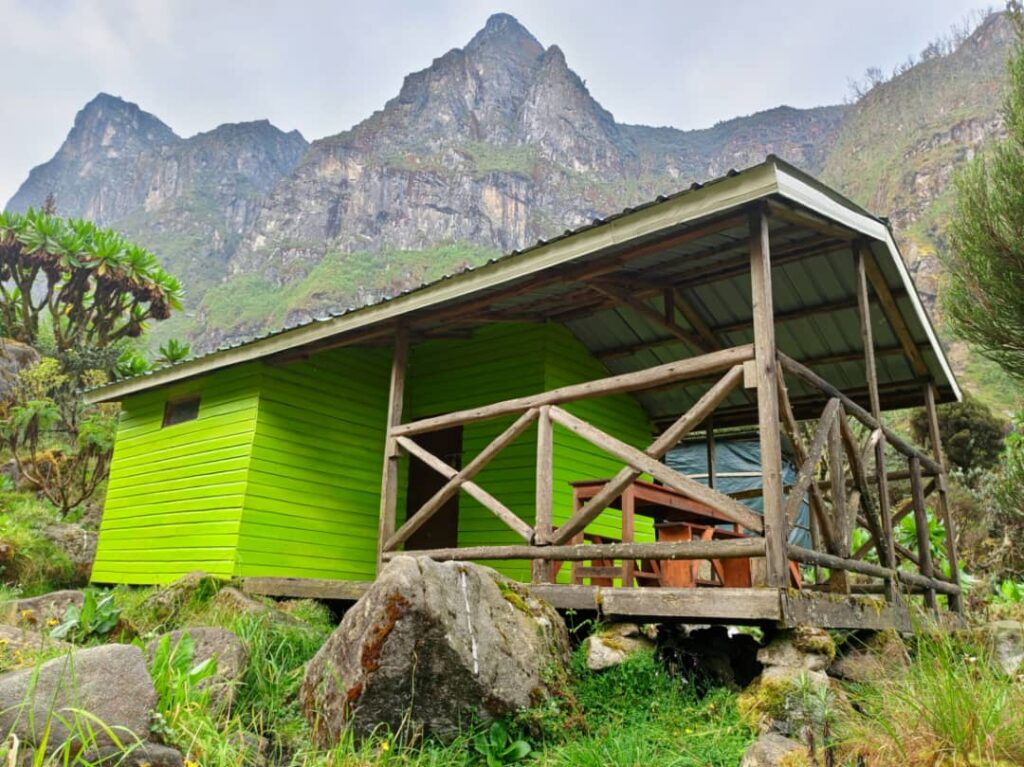
Dinner here: hot soup, rice, stewed beans, and the first of many nights around a paraffin lamp, where the mountain first begins to feel real. Trekkers often ask whether the first day is the hardest; it is the longest but rarely the toughest, which comes later.
Day 2: Kalalama Camp to Mutinda Camp
Morning at Kalalama arrives in mist, the forest exhaling before the sun burns through. The trail climbs out of hardwood into a bamboo zone so dense that your guide’s machete work becomes part of the day’s rhythm before the bamboo thins into Rwenzori heather draped in old man’s beard lichen, a landscape that feels prehistoric, half submerged in cloud. By early afternoon the Mutinda towers, a cluster of jagged volcanic plugs, appear through the mist, and Mutinda Camp, at 3,688 meters, sits directly beneath them. The site site is widely considered one of the most dramatic campsites on the entire route, and a short acclimatization walk toward the towers before dinner is offered on request. Ask your guide about the towers’ local name, and you will hear a story that has nothing to do with the mountaineering guidebooks.
Day 3: Mutinda Camp to Bugata Camp
The character of the trek changes here. Bamboo and heather give way to open Afro-alpine moorland, with tussock grass and giant lobelia standing like sentinels against a sky that shifts by the minute. The trail undulates rather than simply climbs, crossing streams fed directly by glacial melt, and for the first time the higher peaks of the range, Mount Baker and Mount Speke, appear on the horizon. Bugata Camp, at 3,962 meters, sits beside a lake of the same name, its surface often glass-still at dusk, reflecting whatever cloud or clear sky the mountain has decided to offer that evening. This is one of the quieter and coldest camps on the route; down jackets come out for good from here on.
Day 4: Bugata Camp to Hunwick’s Camp
Today’s crossing includes the Bigo bog, a stretch of boardwalk and mud that has tested the patience of every Rwenzori trekker since the early expeditions, followed by a ridge walk with views into the Kitandara Valley below. The trail then climbs to Hunwick’s Camp, at 3,874 meters, a rock-shelter site named for the early European explorer who used it as a base, a detail your guide will happily expand on over dinner. The vegetation here is sparse and wind-shaped, and the first sense of true high-mountain exposure sets in. Acclimatization is deliberate at this stage; the pace is unhurried by design, because the days ahead demand reserves you cannot afford to spend early.
Day 5: Hunwick’s Camp to Margherita Camp
This is the day the glaciers stop being a photograph on someone else’s itinerary and become the view outside your tent. The trail climbs steeply from Hunwick’s, past the Scott Elliot Pass, with the ice fields of Mount Stanley visible for hours before you reach them. Margherita Camp, at 4,485 meters, sits at the very edge of permanent snow and ice, a place where the air is thin enough that conversation slows and appetite fades, both entirely normal and closely monitored by your guide. Equipment is checked here, including crampons, harnesses, and ropes, and an early, quiet dinner precedes an early night because the alarm tomorrow will sound well before midnight.
Day 6: Margherita Camp to the Summit and back to Margherita Camp
Summit day begins in darkness, with headlamps tracing a line up onto the Stanley Glacier itself. This is the technical heart of the entire trek: crampon travel across ice, fixed ropes on the exposed rock sections, and ladders bridging crevasses that no photograph quite prepares you for. The final approach to Margherita Peak is a scramble along an exposed rock ridge, and the summit itself, at 5,109 meters, offers what is arguably the single most improbable view in East Africa: equatorial glaciers, the Congo basin’s haze to the west, and on the clearest mornings, the distant outline of Lake Edward. The descent to Margherita Camp retraces the same technical ground in daylight, which is, if anything, more demanding on weary legs than the climb itself. Trekkers ask whether the summit push is dangerous; it is serious, not reckless.
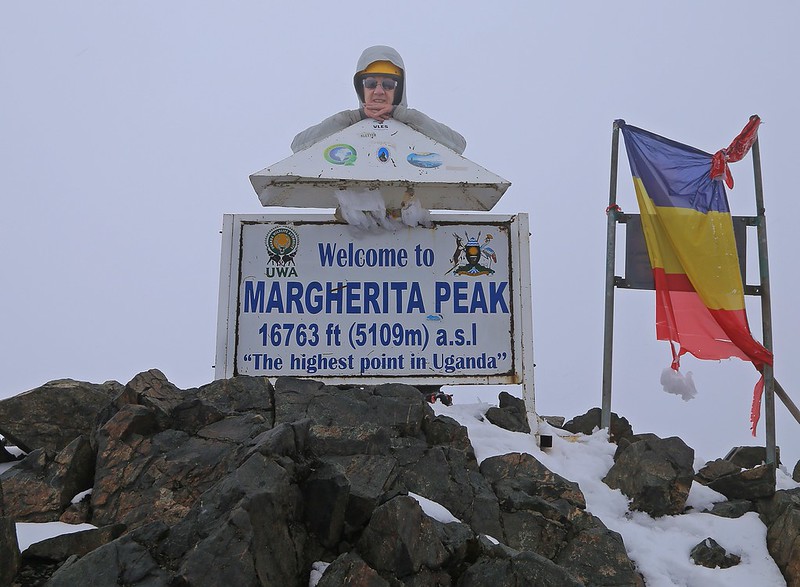
Every rope and ladder on this route is inspected each season, and your guide has led climbers to the summit of this exact peak hundreds of times.
Day 7: Margherita Camp to Kiharo Camp
The descent begins in earnest today, retracing the approach past Scott Elliot Pass before dropping toward Kiharo Camp, at approximately 3,460 meters. Legs that spent yesterday climbing ice now spend today negotiating loose rock and root-bound trail, and the change in vegetation happens in reverse and in fast-forward, with moorland giving way to heather and heather to the first true forest in days. Kiharo Camp sits low enough that the air feels noticeably richer, and dinner tonight carries a different mood entirely: the summit is behind you, and only the walk out remains.
Day 8: Kiharo Camp to Kilembe Gate
The final day is a long, satisfying descent back through the the forest to Kilembe Gate, where your dedicated vehicle waits to take you back to Kasese. Porters who have carried your camp for a week receive their tips and their thanks here, at the gate, in the manner the local porters’ association recommends. It is a quiet ending to a loud achievement; most trekkers say the scale of what they have done only sinks in once they are back on tarmac, looking up at the range they have just walked across.
What Is Included in the 8-Day Kilembe Trail Summit Expedition?
The eight-day Kilembe Trail summit expedition is offered as a fully inclusive expedition. Every element of the journey is arranged and managed by Rwenzori Trekking Expeditions — from the private airport transfer to the return delivery to your Entebbe or Kampala destination. There are no hidden permit charges, no unexpected equipment fees, and no logistical gaps between you and the summit.
Category | What Is Covered |
Transfers | Private return transfers: Entebbe/Kampala ↔ Kasese ↔ Kilembe Trailhead |
Park Fees & Permits | Uganda Wildlife Authority entry and trekking permits for all days |
Guide Services | Certified glacier-qualified lead guide; assistant guides per group size |
Porter Team | Full Bakonjo porter team for group and communal equipment |
Accommodation | Tent camps throughout (Sine, Bugata x2, High Camp x2, Sine) + Kasese guesthouse (Nights 1 & 8) |
All Meals on Trek | Full board: breakfast, lunch, dinner, and hot drinks throughout |
Technical Equipment | Crampons, ice axe, climbing harness, helmet, fixed ropes are all provided |
Emergency Equipment | First aid kit, pulse oximeter, supplemental oxygen, rescue coordination |
Pre-Trek Briefing | Full route brief, equipment check, altitude awareness session in Kasese |
Summit Certificate | Margherita Peak summit certificate — Rwenzori Trekking Expeditions |
Rescue Insurance | Mountain rescue insurance included in expedition fee |
What Is Excluded?
Category | Notes |
International Flights | Arrange independently via your preferred carrier |
Uganda Visa | USD 50 on arrival or via evisa.go.ug in advance |
Travel Insurance | Required — must include medical evacuation cover |
Personal Porter | Available at additional cost — strongly recommended |
Gratuities | For guides and porters — voluntary but culturally significant |
Alcoholic Beverages | Not provided at mountain camps |
Personal Gear | Your personal trekking and summit equipment (see packing list) |
Pre/Post Accommodation | Kampala or Entebbe hotel nights before/after trek |
Safari Extensions | Gorilla trekking, game drives — arranged separately on request |
Altitude Profile: Kilembe Trail Day by Day
Altitude is the quiet variable that decides whether a Rwenzori trek succeeds. The gain below is spread deliberately, with no single day exceeding roughly 700 vertical meters of net camp-to-camp ascent until the summit day itself.
Day | Camp | Altitude | Net Gain |
1 | Kilembe Gate – Kalalama Camp | 1,450m – 3,140m | +1,690m |
2 | Kalalama Camp – Mutinda Camp | 3,140m – 3,688m | +548m |
3 | Mutinda Camp – Bugata Camp | 3,688m – 3,962m | +274m |
4 | Bugata Camp – Hunwick’s Camp | 3,962m – 3,874m | -88m |
5 | Hunwick’s Camp – Margherita Camp | 3,874m – 4,485m | +611m |
6 | Margherita Camp – Summit – Margherita Camp | 4,485m – 5,109m – 4,485m | +624m / -624m |
7 | Margherita Camp – Kiharo Camp | 4,485 m – 3,460m | -1,025m |
8 | Kiharo Camp – Kilembe Gate | 3,460m – 1,450m | -2,010m |
Central Circuit Trail vs Kilembe Trail: Which Route Is Right for You?
Both routes lead to the same glaciers, but they offer meaningfully different experiences, and travelers researching a Rwenzori climb deserve an honest comparison rather than a sales pitch.
Feature | Kilembe Trail | Central Circuit (Nyakalengija) |
Entry point | Kilembe Gate, near Kasese | Nyakalengija, Nyabitaba side |
Typical duration | 8 days to Margherita Peak | 7–9 days, various loop options |
Crowd levels | Quieter, fewer parties on trail | Busier, more established traffic |
Scenery emphasis | Forest, bamboo, moorland, direct glacier approach | Classic circuit lakes and passes |
Technical summit day | Yes, via Stanley Glacier | Yes, via same summit approach |
Best suited to | Trekkers wanting a quieter, direct line to Margherita | Trekkers prioritising the full historic circuit |
How to Get to the Rwenzori Mountains
Most international travelers arrive at Entebbe International Airport, near Kampala, and from there reach Kasese, the gateway town for the Kilembe Trail, either by a scheduled domestic flight to Kasese airstrip, which takes roughly an hour in the air, or by road, a scenic but long drive of around seven to eight hours via Mbarara or Fort Portal. Rwenzori Trekking Expeditions arranges private road transfers and can coordinate domestic flight bookings on request, meeting every client at Entebbe or Kasese and handling the final short transfer to Kilembe Gate. Travellers combining this trek with Uganda’s national parks often route through Fort Portal, which sits conveniently between Kibale Forest and the Rwenzori foothills.
What is the 8-day Rwenzori trek to Margherita Peak via the Kilembe Trail?
In plain terms, this is a supported, multi-day mountaineering trek that climbs from the eastern base of the Rwenzori range to the summit of Margherita Peak on Mount Stanley, Uganda’s highest point and Africa’s third-highest summit. It combines standard high-altitude trekking on days one through five and seven through eight with a single technical mountaineering day, 6, that involves crampons, fixed ropes, and glacier travel. It is not a walk-up peak in the way Kilimanjaro’s standard routes can be; it is a genuine climb, and this itinerary is built to prepare the body and the nerves for that day, well in advance.
How Difficult Is the 8-Day Rwenzori Trek to Margherita Peak via the Kilembe Trail?
Honestly assessed: this trip is a strenuous trek with one genuinely technical day. The daily trekking on the approach and descent is comparable to demanding multi-day hikes elsewhere in East Africa, made harder by mud, root systems, and, in the upper reaches, loose rock. Summit day is in a different category altogether: sustained glacier travel, exposed scrambling, and several hours above 4,800 meters, all before dawn. Altitude, not distance, is the main obstacle; the itinerary’s gradual camp spacing exists specifically to manage it. Trekkers with prior high-altitude experience, reasonable cardiovascular fitness, and comfort on exposed rock and ice will find this trek demanding but achievable; those without any high-altitude background should treat the acclimatization days as non-negotiable and consider a pre-trek conditioning program in the months beforehand.
Best Time to Trek: The 8-Day Rwenzori Trek to Margherita Peak via Kilembe Trail
The Rwenzori has two reliable dry windows: mid-December through mid-February and June through August, with early September often still favorable. Outside these months, the upper moorland and the approach to Margherita Camp can turn to deep mud, and the technical sections on summit day become considerably more hazardous when wet. December to February tends to bring the clearest summit mornings and the best long-range views from the peak itself, while the June to August window offers slightly cooler days and equally reliable conditions on the glacier. We advise against attempting the summit push during the heavier rains of March–May and October–November, when visibility and rockfall risk both increase.
June to August: Summit Priority
The East African long dry season is the best time for the Kilembe summit expedition. Glacier conditions on the Elena Glacier are most stable in this period, success rates on summit day are highest, trail mud is most manageable above the bamboo zone, and the views from Weismann’s Saddle and Margherita Peak are most likely to deliver the panoramic clarity that makes this route’s summit views exceptional. Book 6 to 9 months in advance for this window; it fills with the global mountaineering community.
December to February: Strong Alternative
Uganda’s short dry season provides an excellent second window with conditions approaching those of the June through August season. The lower forest after the short rains is particularly rich in birding opportunity, and January delivers some of the sharpest summit-day clarity of any month. The Christmas and New Year period is popular and requires equally early booking. January on the Kilembe Trail, with clear summit mornings, active bird life, and the Nyamwamba Falls at post-rain volume, is one of the mountain’s finest and most underrated months.
March–May and September–November
Waterfalls Priority)
The wet-season shoulder months of March to May & September to November deliver the Kilembe Trail’s waterfalls at their most spectacular: the Nyamwamba Falls in April or October at full, thundering volume, the lower cascades carrying the full south-slope rainfall. Summit success rates are lower in these months due to increased glacier cloud cover, and the upper moorland terrain is more challenging. For trekkers whose major motivation is the waterfall experience with a summit attempt as a secondary goal, the shoulder seasons are worth considering with clear expectations about summit conditions.
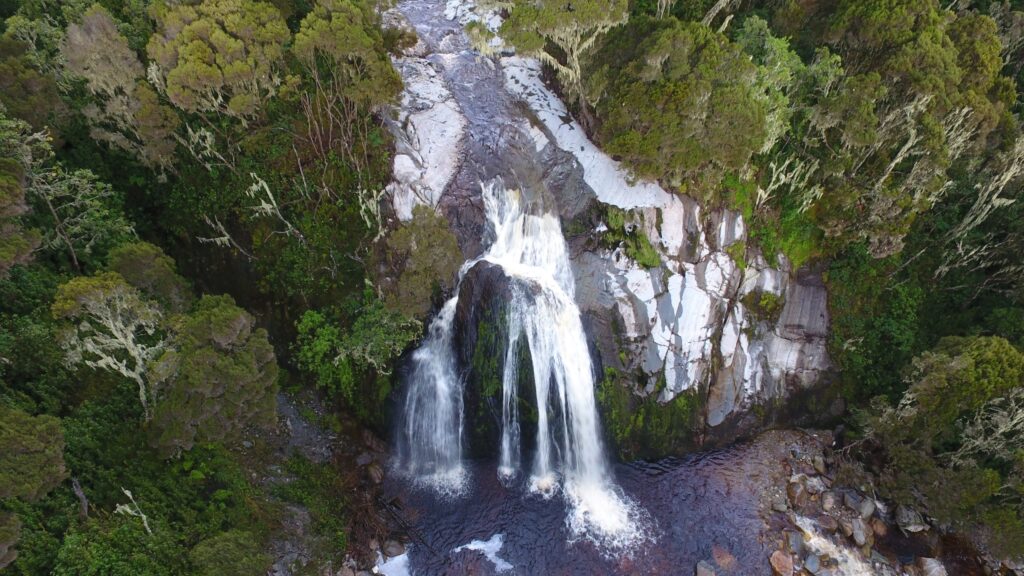
We guide year-round with full transparency about what each month typically offers.
How Safe Is the 8-Day Rwenzori Trek to Margherita Peak via the Kilembe Trail?
Safety on this trek rests on three pillars: experienced local guiding, well-maintained technical equipment, and conservative decision-making around weather and altitude. Every lead guide on our Kilembe departures is trained in altitude sickness recognition and carries a portable altitude chamber and satellite communication for emergencies; ropes, ladders, and anchors on the summit route are inspected each season by our mountain crew; and porters are registered through the Rwenzori Porters’ Association, with enforced weight limits for their own protection as much as anyone’s. Rangers from Rwenzori Mountains National Park are present at trailhead checkpoints, and evacuation protocols on foot, by stretcher, or by emergency helicopter, where conditions allow, are briefed to every client before departure. We ask, in turn, that every trekker carries comprehensive travel insurance with high-altitude rescue cover; it is a condition of joining any of our departures, not a suggestion.
Safety Element | Provision |
Guide Certification | UWA accredited; wilderness first aid; glacier guiding trained |
Glacier Safety | Fixed ropes, crampon fitting, rope team protocol, pre-summit briefing |
Medical Equipment | First aid kit, pulse oximeter, supplemental oxygen per group |
Altitude Monitoring | Blood oxygen was tracked from Day 3 with an oximeter. |
Acclimatisation | Dedicated rest day at Bugata Lake (3,430m) built into itinerary |
Rescue Coordination | Emergency communication; mountain rescue insurance included |
Remote Trail Protocol | Extended conservative decision-making given Kilembe remoteness |
Summit Turn Authority | The guide is authorised to turn around at any point for safety |
Porter Welfare | Proper equipment, living wages, formal welfare policy |
Pre-Trek Health Screen | All clients complete health disclosure before departure |
What Should I Pack/Wear for the 8-Day Kilembe Trail Summit Expedition?
Packing for the Kilembe Trail summit expedition requires covering the full range of the Rwenzori’s southern climate: the warm, humid lower forest of Days 2–3; the cold moorland camp at Bugata Lake; the exposed high camp at 4,200 meters; and the summit day at 5,109 meters with its pre-dawn glacier temperatures. Technical glacier equipment, crampons, an ice axe, a harness, and a helmet are provided. The waterfall sections of Days 2–3 add an additional waterproofing requirement: camera equipment and sleeping kits must be sealed against spray zone exposure.
Item | Notes |
Waterproof Boots | Ankle-support, fully waterproof, crampon-compatible, broken-in |
Gaiters | Knee-length is essential throughout; Kilembe mud is serious |
Waterproof Jacket | Full outer shell—spray zones and mountain rain require Gore-Tex quality |
Waterproof Trousers | Essential from Bugata Lake upward; useful throughout |
Base Layer | Moisture-wicking thermal top — merino wool preferred |
Mid Layer | Fleece or down vest |
Heavy Down Jacket | Mandatory for High Camp and summit, minimum 700-fill |
Summit Mittens | Waterproof outer mitts over warm liner gloves |
Balaclava | For summit morning, glacier wind chill is severe |
Glacier Sunglasses | UV400 rated sunglasses are insufficient on a snowfield. |
Trekking Poles | Adjustable—required throughout; stowed on glacier section |
Sleeping Bag | -10°C rated minimum — High Camp temperatures are extreme |
Sleeping Liner | Adds warmth and hygiene in tent camps |
Headlamp | With spare batteries—a 3:00 AM summit start is non-negotiable |
Dry Bags | Multiple waterfall zones will wet unprotected kit |
Waterproof Camera Case | Essential for Days 2–3 waterfall sections |
Water Bottles | 2–3 litres; purification tablets as backup |
Sunscreen | SPF 50+ — glacier UV is extreme at altitude |
Personal First Aid | Blister care, personal medications, Diamox (consult physician) |
Summit Snacks | High-energy food for summit day — altitude suppresses appetite |
What Makes the 8-Day Kilembe Trail Expedition Special?
The Southern Forest: Wildlife at Its Most Raw
The Kilembe Trail’s lower forest is among the most biodiverse montane forests in the Albertine Rift, a UNESCO-designated biodiversity hotspot that the WWF consistently ranks among the most important conservation zones in Africa.
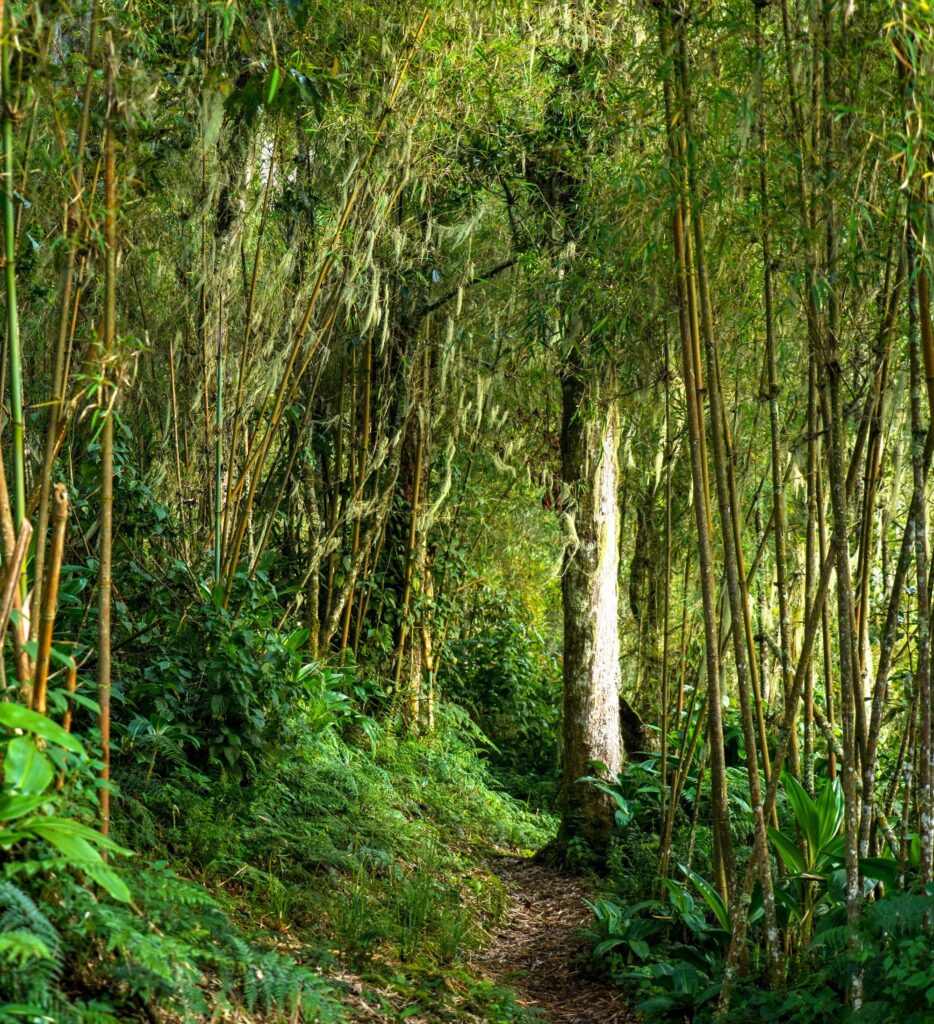
The forest entered from Kilembe is bamboo-rich and dense, less trafficked than the northern approaches, and, consequently, more alive with wildlife encounters that feel genuinely wild rather than managed. Black-and-white colobus and red colobus monkeys in groups of twenty or more; the African green broadbill at close range in the bamboo; L’Hoest’s monkey in the denser mid-forest; the three-horned Rwenzori chameleon on vegetation in the upper bamboo zone. The lower Kilembe forest delivers more wildlife intensity in fewer hours of trekking than almost any comparable trail in the range.
The Waterfall Sequence: Three Days of Cascades
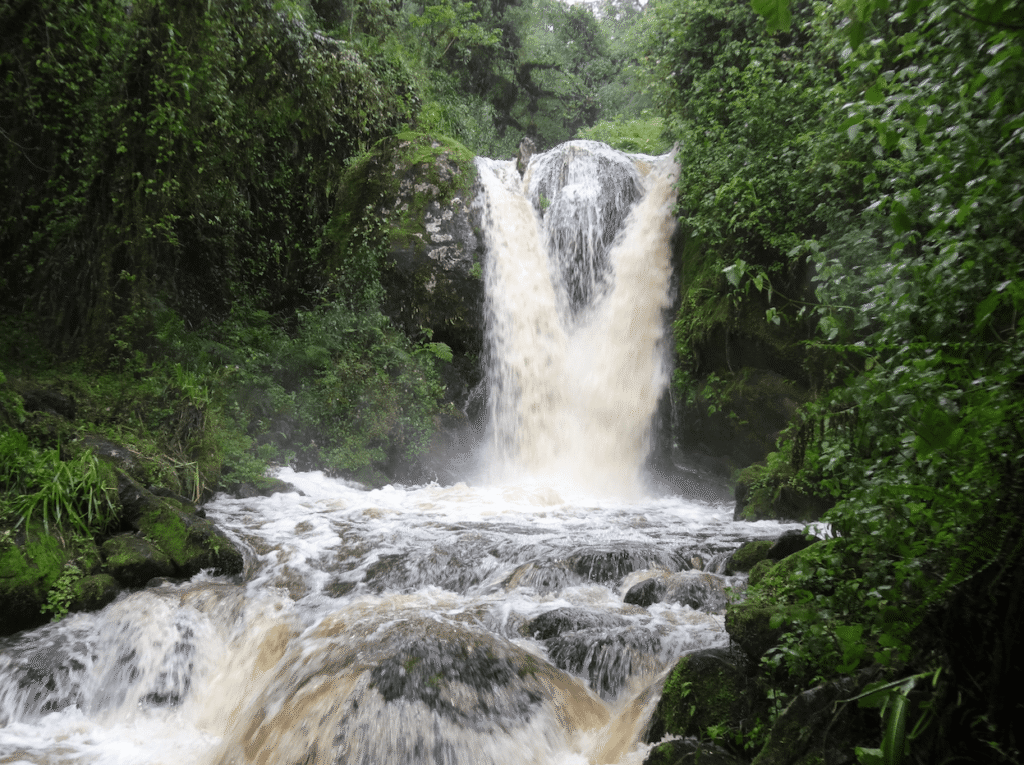
The approach to altitude via the Kilembe Trail crosses more active waterfall systems than any other Rwenzori summit route. The lower valley has the Kilembe River cascading, the mid-mountain zone has the Nyamwamba Falls, the Mubuku hanging falls are above the bamboo line, and a continuous network of seasonal and permanent waterfalls is fed by the southern drainage of the central peaks. These form a three-day waterfall sequence that is the Kilembe Trail’s defining lower-mountain character and that no other Rwenzori summit expedition includes in its approach. For trekkers who want the summit and the waterfalls, this trail is the only route that provides both.
Bugata Lake: The High Camp Jewel
Bugata Lake, located at about 3,430 meters on the upper Kilembe Trail, is one of the Rwenzori’s most important high-altitude features. It is a glacially carved tarn in a bowl of rock and moorland, surrounded by giant heather and lobelia, with the central peaks providing a backdrop of extraordinary scale on clear evenings. The expedition camps at Bugata for two nights, using it as an acclimatization base before the push to the high camps above Weismann’s Peak. Two nights at Bugata, with a full exploration day in the surrounding moorland and lake basin, allow the body to acclimatize at 3,430 meters, a critical investment in summit-day success, while delivering a remote lake camp experience that is, in its own right, one of the finest wilderness nights the Rwenzori offers.
Weismann’s Peak Saddle: Africa’s High Corridor
The approach to Margherita Peak via the Kilembe Trail passes through the Weismann’s Peak saddle at approximately 4,620 meters, the highest point on the Rwenzori accessible without glacier travel and one of the most dramatically positioned high-altitude passes in Africa. The view from the saddle, when clouds permit, encompasses the southern Rwenzori landscape in full: the Kilembe valley below, the moorland of the upper southern slopes, and the permanent snowfield of the Elena Glacier immediately above. For trekkers who have never stood at over 4,500 meters before, the saddle is where the Rwenzori’s scale and the seriousness of the summit above it become simultaneously and unmistakably real.
Pricing depends on group size, season, and any additional services such as flights or extra acclimatization days. Rwenzori Trekking Expeditions provides a detailed, no-obligation quote for every inquiry through our website, broken down by inclusion so travelers can see exactly what they are paying for.
Yes. All trekking in Rwenzori Mountains National Park requires a permit issued through the Uganda Wildlife Authority, which we arrange as part of every booking, along with conservation and camping fees for each night on the mountain.
You should be comfortable hiking five to eight hours a day, several days in a row, at altitude, ideally with some prior high-altitude or multi-day trekking experience. A structured cardio and leg-strength conditioning program in the two to three months before departure makes a meaningful difference on summit day.
It is the single biggest risk factor on any Rwenzori climb, which is why this itinerary spreads elevation gain across multiple days rather than rushing to Margherita Camp. Guides monitor every client daily and will adjust pace, or in rare cases recommend descent, if symptoms progress beyond mild headache or fatigue.
Permits, camping and hut fees, guiding, porterage, full-board catering, technical summit equipment, and transfers between Kasese and Kilembe Gate are all included, as detailed in the inclusions section above.
Our Kilembe departures are kept small by design, typically between two and eight climbers, with fully private departures available for solo trekkers, couples, or families who prefer their own dedicated guide and crew.
A dedicated mountain cook prepares hot breakfasts, packed trail lunches, and three-course dinners each night, drawing on Ugandan staples alongside familiar international dishes, with dietary requirements accommodated when flagged in advance.
Yes, streams and glacial melt provide ample water at most camps, which our crew filters and boils before serving; trekkers are not required to carry more than a day’s supply at any point.
Each established camp along the Kilembe Trail has basic long-drop toilet facilities maintained by the park authority and our ground crew, with privacy screening at every site.
Coverage is limited and unreliable above Kalalama Camp, which is precisely why our guides carry satellite communication devices for emergency contact regardless of local signal.
Tipping is customary and appreciated, though never obligatory. As a general guide, climbers typically allocate the equivalent of 15 to 20 US dollars per day for the lead guide and slightly less per porter, distributed at the end of the trek at Kilembe Gate.
A sturdy, waterproof leather or synthetic boot with ankle support and a stiff sole for crampon compatibility is ideal; the trail’s mud, bog boardwalks, and glacier travel all punish lightweight trail runners.
A sturdy, waterproof leather or synthetic boot with ankle support and a stiff sole for crampon compatibility is ideal; the trail’s mud, bog boardwalks, and glacier travel all punish lightweight trail runners.
The best preparation comes from a combination of cardiovascular endurance work, leg-strength training, and, if possible, back-to-back long hikes carrying a daypack in the months before travel, along with any acclimatization hikes at altitude you can arrange locally.
On the other hand, four months of dedicated preparation is our minimum recommendation for the 8-day Kilembe Trail summit expedition. The training should combine sustained cardiovascular training (running, cycling, or stair climbing five days per week at moderate to high intensity); progressive loaded-pack hill walks (increasing both load and duration over the preparation period); and at minimum three full-day hikes of eight or more hours in the final six weeks. Specific attention to knee and ankle strength is important given the long descent days on the return journey. If possible, one or two nights camping at an altitude above 3,000 meters in the preparation period will be the most valuable single investment in summit readiness.
In technical terms, yes. Kilimanjaro’s standard routes are non-technical walk-ups, while Margherita Peak’s summit day involves genuine glacier travel, fixed ropes, and exposed scrambling, making it a more demanding climb despite its lower altitude.
Crampons, a climbing harness, a helmet, and fixed-rope technique are all required for the glacier and rock sections; all of this equipment is provided and fitted by our team during the pre-trek briefing, and no personal mountaineering gear is necessary beyond appropriate clothing.
Yes, in line with Rwenzori porter welfare standards, personal duffel weight is capped per porter allowance; trekkers exceeding the limit can arrange an additional porter in advance.
Most nationalities require a Uganda visa, obtainable online in advance through the official e-visa portal; we recommend applying at least a few weeks before travel.
Yellow fever vaccination is generally required for entry into Uganda, and malaria prophylaxis is strongly recommended for the lower-altitude portions of any trip, though the risk drops sharply at the higher camps on this trek. We recommend consulting a travel health clinic before departure.
The Kilembe Trail is the eastern approach that joins the historic Central Circuit route near Bugata Camp, offering a quieter, more direct path to Margherita Peak, while the Central Circuit is more commonly entered from Nyakalengija on the range’s northern side, as detailed in the comparison table above.
Your guide’s first priority is always safety, not summit statistics. If weather, fitness, or altitude symptoms make the final push unsafe, the itinerary’s built-in flexibility allows a supported descent from Margherita Camp with no judgment attached. Reaching 4,485 meters beneath the glaciers is itself a rare achievement.
Rwenzori Trekking Expeditions maintains a summit success rate above 80% for the 8-day Kilembe Trail expedition to Margherita Peak for well-prepared clients. The acclimatization day at Bugata Lake contributes meaningfully to this rate compared to shorter routes without a dedicated rest day. The primary factors affecting summit outcomes are inadequate pre-trek physical preparation, altitude sickness above 4,000 meters, and adverse summit-day weather. Clients who follow our preparation program, arrive in genuine summit fitness, and trust their guide’s pace and acclimatization management achieve summit success at a consistently high rate.
The Kilembe Trail delivers more wildlife variety over its eight days than any other Rwenzori summit route. The lower forest of Days 2–3 is a particularly rewarding place to see black-and-white colobus, red colobus, and L’Hoest’s monkey; the African green broadbill, Rwenzori turaco, and several Albertine Rift endemic birds; and the three-horned Rwenzori chameleon in the bamboo zone.
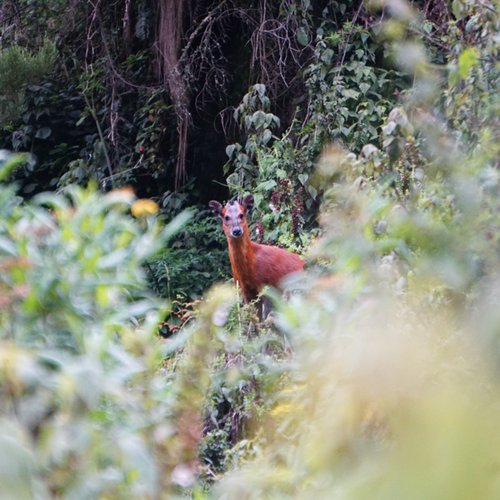
The Bugata Lake basin and upper moorland of Days 3–5 are home to clawless otters at the lake shore, Rwenzori duikers in the heather margins, and the extraordinary Afro-alpine plant communities that make the Rwenzori a top botanical destination. Above the glacier, the mountain is effectively lifeless, but the views of the ecosystems below from summit height have their wildlife dimension.
Yes! Weismann’s Peak, at 4,620 meters, is visible from Margherita Peak, standing below and to the south along the ridgeline that the Kilembe Trail ascends. From the summit, the full southern approach, Weismann’s Saddle, the upper moorland, Bugata Lake at 3,430 meters, and the Kilembe valley below are visible on a clear summit morning, providing a complete aerial perspective on the route you have ascended over eight days. This southward summit view is one of the Kilembe approach’s most distinctive features and one that no trekker approaching from the north experiences.
Yes, the 8-day trek to the Margherita Peak via Kilembe Trail summit expedition can be extended into a full Rwenzori traverse by descending via the Central Circuit Trail to Nyakalengija rather than returning to Kilembe. This creates a north-to-south (or south-to-north) traverse of the Rwenzori, combining the Kilembe Trail’s southern approach with the Central Circuit’s northern descent through the Bujuku valley, John Matte Hut, and the Mubuku River forest. The traverse adds two to three days to the total expedition and is the most comprehensive Rwenzori mountain experience available. Contact us to discuss the full traverse option and how it fits within your Uganda travel schedule.
Mixed-fitness groups are common in mountain expeditions, and the 8-day Kilembe Trail Margherita Peak Rwenzori trek itinerary accommodates them through pace management and the acclimatization day at Bugata Lake. Our guides are skilled at maintaining group cohesion at a pace that keeps the less fit members comfortable without frustrating the more fit. In groups where fitness disparity is significant, we may recommend a personal porter for less fit members to reduce their load and improve their pace. If the fitness gap is such that summit success for the full group is at serious risk, we have the option of separating the party, sending the fitter members to Margherita Peak with one guide while the other guide remains with the less fit members with whom they will reach the summit. We discuss all options openly at the pre-trek briefing and on the mountain as conditions develop.
High Camp, at approximately 4,200 meters, experiences night temperatures between -8°C and -15°C in the dry season, with wind chill adding significantly to the felt temperature on exposed nights. Summit day begins at 3:00 AM in these conditions, and the Weismann’s saddle at 4,620 meters can be colder still with westerly winds. The glacier itself at 5,109 meters routinely reaches -15°C to -20°C before sunrise. A sleeping bag rated to a minimum of -10°C and a heavy down jacket for the pre-dawn glacier departure are non-negotiable. Trekkers who have not experienced temperatures in this range should take the cold specification of their sleeping bag and jacket seriously rather than assuming they can supplement with layers.
The Kilembe Trail uses tent camp accommodation throughout, with weatherproof, properly positioned tent setups managed by our porter team, as well as communal cooking and dining shelters and basic long-drop toilet facilities at each camp. Trekkers bring their own sleeping bags, while the porter team carries the tent, sleeping mat, and camp infrastructure. The camps are deliberately simple in keeping with the remote mountain wilderness character of the Kilembe route. Kasese guesthouse accommodation on Nights 1 and 8 provides en-suite rooms and hot showers. The simplicity of the mountain camps is not a limitation; it is integral to the experience of a genuine remote expedition.
Yes, Bwindi Impenetrable National Park is approximately three to four hours south of Kasese by road, and gorilla trekking in Bwindi combines naturally with a Kilembe summit expedition as a pre- or post-trek extension. Rwenzori Trekking Expeditions curates seamless combined Uganda safari itineraries covering the Rwenzori summit, Bwindi gorillas, Queen Elizabeth National Park game drives, and Kibale Forest chimpanzee tracking. Contact us to design your complete Uganda mountain and wildlife expedition.