A complete Rwenzori Mountains wildlife guide: mammals, birds, endemics & where to spot them on every trekking route. The wildlife of the Rwenzori Mountains comprises 70 species of mammals, more than 217 species of birds, and distinctive reptiles found over five separate altitudinal vegetation zones. Prominent species include the African forest elephant , the Rwenzori turaco, and the three-horned chameleon in Rwenzori Mountains National Park.
The Rwenzori Mountains have a wildlife community found nowhere else in quite the same combination: forest elephants moving unseen through cloud forest, chimpanzees calling across misted valleys, and, found on no other mountain range on Earth outside a handful of East African peaks, a suite of birds and mammals that exist only within the Albertine Rift. This guide answers, in depth, the question every trekker, birder, photographer, and researcher eventually asks about this range: what actually lives here, and what can I realistically expect to see?
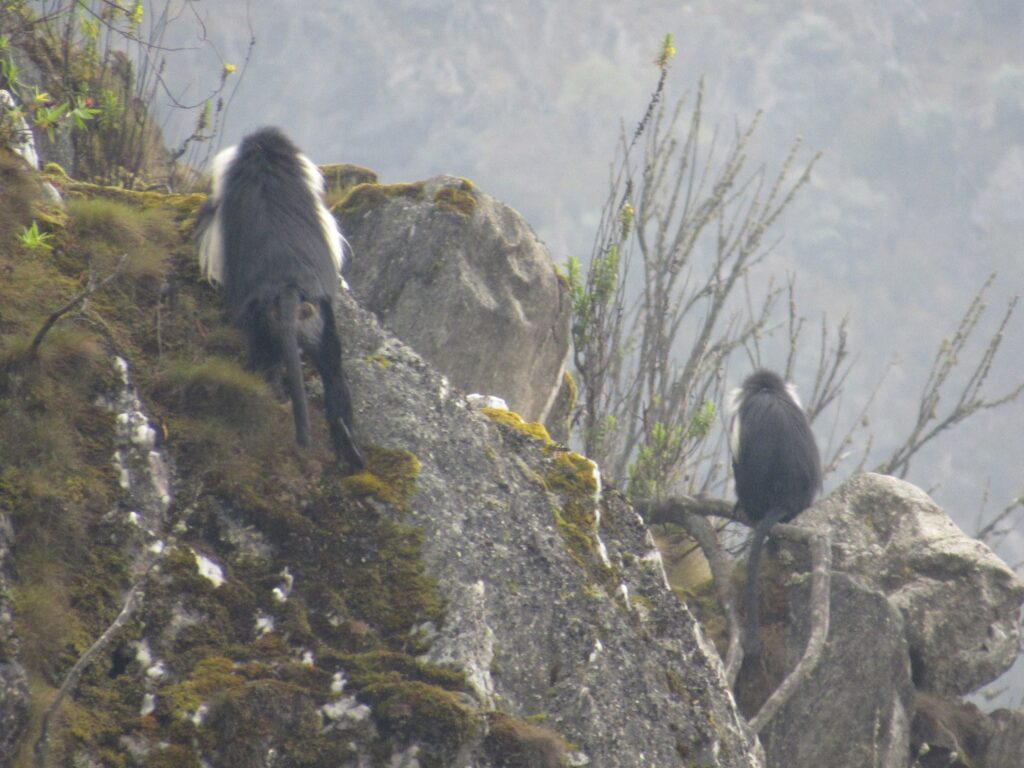
The short answer is that the Rwenzori is important for biodiversity not because of the sheer volume of sightings, but because of what the range protects. The environment is a dense equatorial forest and moorland, not an open savannah, but because of what the range protects. As part of the Albertine Rift, one of Africa’s richest biodiversity hotspots, Rwenzori Mountains National Park supports roughly 70 recorded mammal species, more than 217 bird species (19 to 24 of them Albertine Rift endemics found in this narrow band of mountains and nowhere else on the planet), around 9 reptile species, 6 amphibian species, and a wealth of butterflies and other invertebrates, all distributed across five altitudinal Rwenzori Vegetation zones that shift from tropical rainforest to Afroalpine moorland within a single trek.
Realistically, most visitors will see primates, forest birds, and small mammals in the lower montane forest during the first two days of any Rwenzori treks, will hear far more than they see once above the bamboo zone, and should treat a leopard, elephant, or buffalo sighting as a rare privilege rather than an expectation. What makes the Rwenzori Mountains genuinely unique as a mountain ecosystem is that this modest visibility sits on top of extraordinary biological importance; several species found here exist in no other country, and some in no other mountain range at all.
Mammals of the Rwenzori Mountains
Roughly 70 mammal species have been recorded within Rwenzori Mountains National Park, though the range’s dense, tangled terrain means sightings are generally quieter and more opportunistic than in Uganda’s savannah parks. Mammals here fall broadly into three categories: primates, which are the mammals trekkers see most consistently; smaller forest mammals, seen regularly but not guaranteed; and larger mammals, present within the wider park ecosystem but rarely encountered on the established trekking routes.
Primates
Five or more primate species are recorded in the Rwenzori, concentrated almost entirely in the Afro-Montane Forest and Bamboo zones below roughly 3,000 meters.
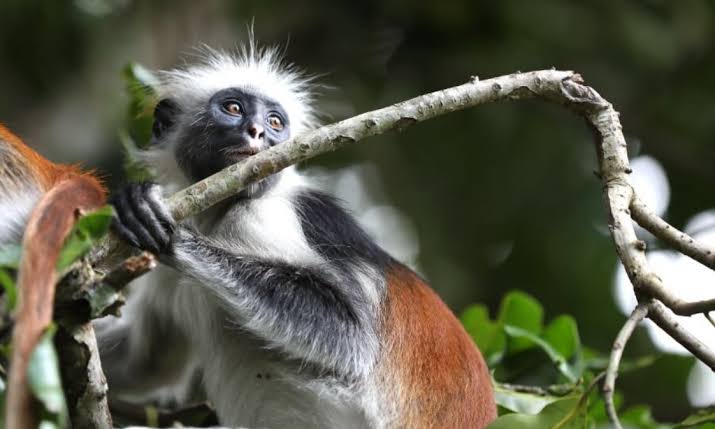
Blue Monkey
Cercopithecus mitis
Identification | Medium-sized guenon with slate-blue-grey fur, a dark face, and a long tail; often seen in small troops moving through the mid-canopy |
Habitat | Montane and bamboo forest, typically in the canopy and mid-storey |
Elevation range | Roughly 1,450–3,000 meters |
Behavior | Diurnal and highly vocal, moving in troops of 10–30; forages on fruit, leaves, and insects |
Best places to spot it | Nyabitaba to John Matte sections on the Central Circuit; lower Kilembe Trail forest |
Conservation status | IUCN Least Concern |
Photography tip | Shoot from below at a wide aperture to isolate the animal against the bright canopy; a 300 mm+ lens helps given the height of typical sightings. |
Black-and-White Colobus (incl. Rwenzori / Angola Colobus)
Colobus guereza / Colobus angolensis ruwenzorii
Identification | The Rwenzori race of the Angolan colobus is a regional specialty, characterized by a striking black body, a white facial fringe, a white shoulder mantle, and a long white tail plume. |
Habitat | Tall montane forest canopy |
Elevation range | Roughly 1,450–2,600 meters |
Behavior | Highly arboreal, rarely descending to the ground; travels in family troops and is known for dramatic leaps between canopy gaps |
Best places to spot it | First day’s forest walk on both the Central Circuit and Kilembe Trail; this is the only Ugandan park where the Angola colobus has been confirmed in the wild. |
Conservation status | IUCN Least Concern (Colobus guereza); the Angola colobus region is notable for its restricted range |
Photography tip | Early morning light filtering through canopy gaps gives the best exposure on the white mantle without blowing out highlights. |
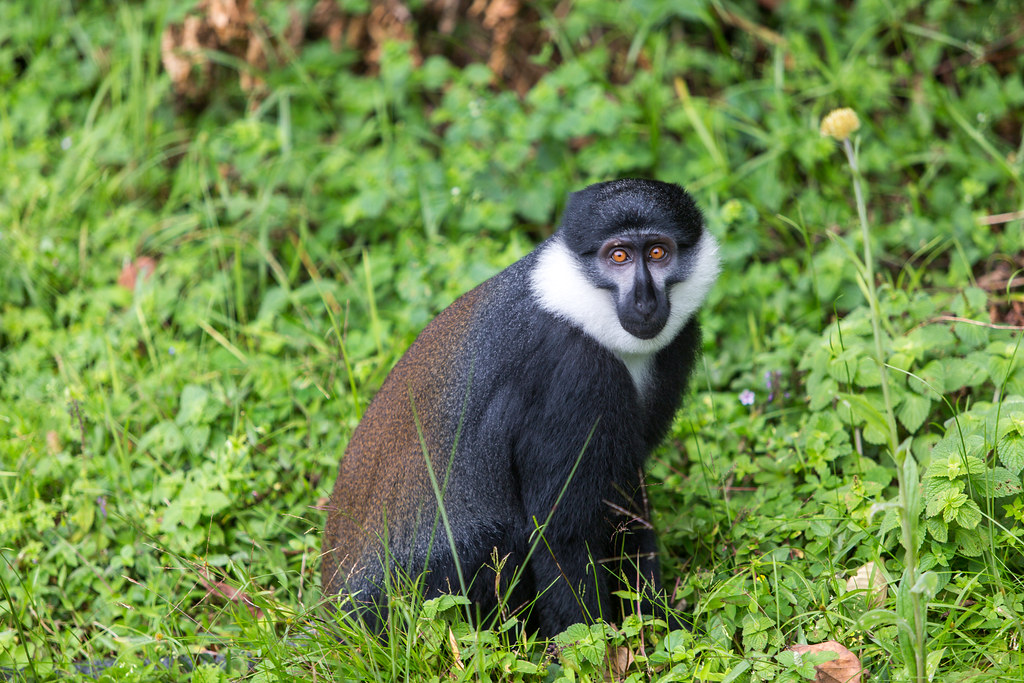
L’Hoest’s Monkey
Allochrocebus lhoesti
Identification | Dark-coated guenon with a distinctive white throat patch, backward-arching tail, and a shy, ground-associated habit unusual among African monkeys |
Habitat | Dense forest understory and forest floor near streams |
Elevation range | Roughly 1,450–2,500 meters |
Behavior | More terrestrial and considerably shyer than blue monkeys or colobus; often first detected by alarm calls rather than sight |
Best places to spot it | Quiet stretches of forest near Nyakalengija and lower Kilembe, ideally in early morning with a patient approach |
Conservation status | IUCN Vulnerable |
Photography tip | A silent approach and long lens are essential; this species flees readily and rewards patience over pursuit. |
Chimpanzee
Pan troglodytes schweinfurthii
Identification | Uganda’s eastern chimpanzee subspecies: black-coated, highly intelligent, and unmistakable when encountered |
Habitat | Lower montane forest with large fruiting trees |
Elevation range | Below approximately 2,200 meters |
Behavior | Lives in fluid, dispersed communities; far more often heard, its distinctive pant-hoot calls carry long distances through the forest than are seen on standard trekking routes. |
Best places to spot it | Lower forest sections near the park boundary: a genuine sighting on a standard trek is uncommon, though calls are frequently heard |
Conservation status | IUCN Endangered |
Photography tip | If encountered, keep a minimum safe distance, use a long lens, and never attempt to approach: this is both a safety and an ethical requirement |
Forest Mammals
Beyond the primates, a cast of smaller forest mammals is encountered regularly enough that most trekkers see at least one or two of the following over a multi-day trek.
Bushbuck
Tragelaphus scriptus
Identification | Medium antelope with a reddish-brown coat marked with white spots and stripes; males carry short, spiralled horns |
Habitat | Forest edges and clearings |
Elevation range | Below roughly 2,600 meters |
Behavior | Solitary or in pairs, most active at dawn and dusk, quick to freeze and vanish into cover when disturbed |
Best places to spot it | Forest-edge clearings near Nyakalengija and Kilembe trailheads |
Conservation status | IUCN Least Concern |
Photography tip | Best photographed at first light when bushbuck feed more openly at forest margins. |
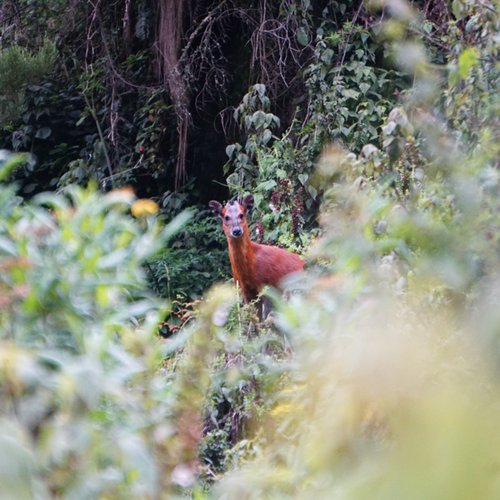
Rwenzori Duiker (and Bush Duiker)
Cephalophus rubidus / Sylvicapra grimmia
Identification | Small, hunch-backed antelope; the Rwenzori (Rwenzori red) duiker is a range-restricted, high-altitude specialist rarely seen outside this massif. |
Habitat | Bamboo and heather zone thickets for the Rwenzori duiker; forest edge for the common bush duiker |
Elevation range | Roughly 3,000–4,000 meters (Rwenzori duiker) |
Behavior | Extremely shy and largely nocturnal or crepuscular; usually detected by rustling in undergrowth rather than direct sighting |
Best places to spot it | Heather zone sections of both main routes, most often at dusk near camp |
Conservation status | IUCN Data Deficient / Near Threatened, depending on assessment |
Photography tip | A sighting is typically brief; keep a camera set to a quick shutter speed and higher ISO ready during dusk camp hours. |
Southern Tree Hyrax
Dendrohyrax arboreus
Identification | The small, guinea-pig-like mammal has a stocky body and short legs, and is more often heard than seen; its shrieking nocturnal call is one of the mountain’s signature night sounds. |
Habitat | Rocky outcrops and forest through to the heather zone |
Elevation range | Roughly 2,000–4,000 meters |
Behavior | Nocturnal and highly vocal, sheltering in rock crevices and tree hollows by day |
Best places to spot it | Around Bujuku and Elena’s huts on the Central Circuit trail, frequently heard rather than seen at any camp above 3,000 metres |
Conservation status | IUCN Least Concern |
Photography tip | A torch-assisted spotlight approach after dark, with your guide’s guidance, offers the best chance of a photographable sighting |
Giant Forest Hog
Hylochoerus meinertzhageni
Identification | Africa’s largest wild pig species, a heavily built, dark-coated animal with pronounced facial ridges |
Habitat | Dense montane forest and forest-bamboo margins |
Elevation range | Below roughly 2,800 meters |
Behavior | Lives in small family groups, mainly active at dawn, dusk, and occasionally at night; wary of humans and quick to retreat |
Best places to spot it | Forest zone on both main routes; signs (wallows, tracks) are more commonly encountered than the animal itself. |
Conservation status | IUCN Least Concern |
Photography tip | Look for fresh wallows and rooted-up ground as an indicator of recent presence, and stay alert during early morning walking hours. |
Other forest mammals recorded in the Rwenzori include forest squirrels, giant pouched rats, several genet and mongoose species, and the elusive, semi-aquatic Rwenzori otter shrew (Micropotamogale ruwenzorii) — a genuinely rare, range-restricted species tied to fast-flowing mountain streams and one of the park’s most significant small-mammal endemics, though a live sighting is exceptional even for experienced researchers.
Larger Mammals: Present but Rarely Encountered
The Rwenzori’s forest ecosystem also supports genuinely large mammals, but honesty matters here: these are forest-adapted, low-density populations in extremely dense terrain, and sightings on a standard multi-day trek are uncommon to rare. We would rather set that expectation clearly than oversell a photograph you are unlikely to get.
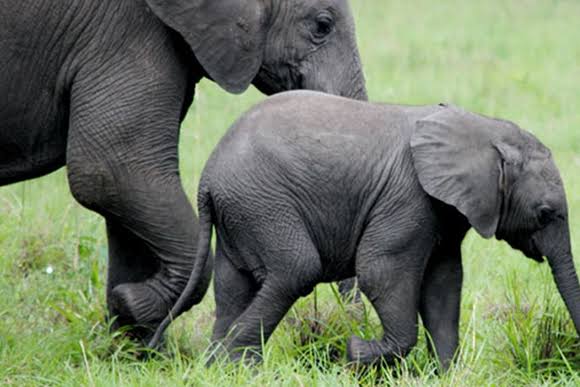
African Forest Elephant
Loxodonta cyclotis
Identification | Smaller, straighter-tusked, and more rounded-eared than savannah elephants, adapted for moving through dense forest |
Habitat | Lower montane forest, particularly less-disturbed valleys and the Congolese slopes |
Elevation range | Below roughly 2,000 meters |
Behavior | Highly elusive in forest habitat; more often detected through dung, footprints, or browsed vegetation than direct sighting |
Best places to spot it | Signs are occasionally found in lower forest sections; a 2019 UWA census recorded only around 13 individuals within the park, with later surveys suggesting further decline. A direct sighting is genuinely rare |
Conservation status | IUCN Critically Endangered |
Photography tip | If a fresh sign is found, your guide will assess safety before any approach; elephant safety protocol always takes priority over a photograph. |
African (Forest/Montane) Buffalo
Syncerus caffer
Identification | Smaller and more reddish-coated than the classic savannah buffalo, often in smaller, more secretive groups |
Habitat | Lower forest zone |
Elevation range | Below roughly 2,200 meters |
Behavior | Secretive in forest terrain, groups are small and quick to retreat, though buffalo remain among Africa’s most unpredictable large mammals when surprised at close range. |
Best places to spot it | Occasional encounters in lower forest sections; guides remain alert for fresh signs throughout the first trekking day. |
Conservation status | IUCN Near Threatened |
Photography tip | Never approach on foot; any sighting should be photographed from a safe distance behind your guide’s positioning |
Leopard
Panthera pardus
Identification | Uganda’s apex forest predator, solitary and largely nocturnal, identified by its rosette-marked coat |
Habitat | Occurs across nearly every vegetation zone in the park, remarkably including the Afroalpine moorland. |
Elevation range | Recorded up to roughly 4,000 meters, among the highest-altitude leopard records in East Africa |
Behavior | Almost entirely nocturnal and extremely elusive, the sign (tracks, scat, occasional kills) is far more commonly encountered than the animal itself. |
Best places to spot it | No reliable sighting location exists; the jaguar is an animal you are fortunate to glimpse rather than one you can plan to see. |
Conservation status | IUCN Vulnerable |
Photography tip | Camera traps aside, most visitor sightings are fleeting glimpses at dusk; keep a camera set to a brisk shutter speed as a standing habit throughout any trek. |
Birds of the Rwenzori Mountains
This is, without question, the strongest reason serious birders travel to the Rwenzori. Recognized by BirdLife International as an Important Bird Area, the Rwenzori Mountains National Park holds more than 217 recorded species, including, by various counts, between 19 and 24 Albertine Rift endemics— birds found nowhere on Earth outside this narrow chain of East and Central African mountains. Uganda’s birding community regards the Rwenzori as one of only a handful of sites in the country where a determined birder can realistically tick the majority of the region’s endemic specialities in a single, focused trip.
Rwenzori Turaco
Gallirex johnstoni (syn. Tauraco johnstoni)
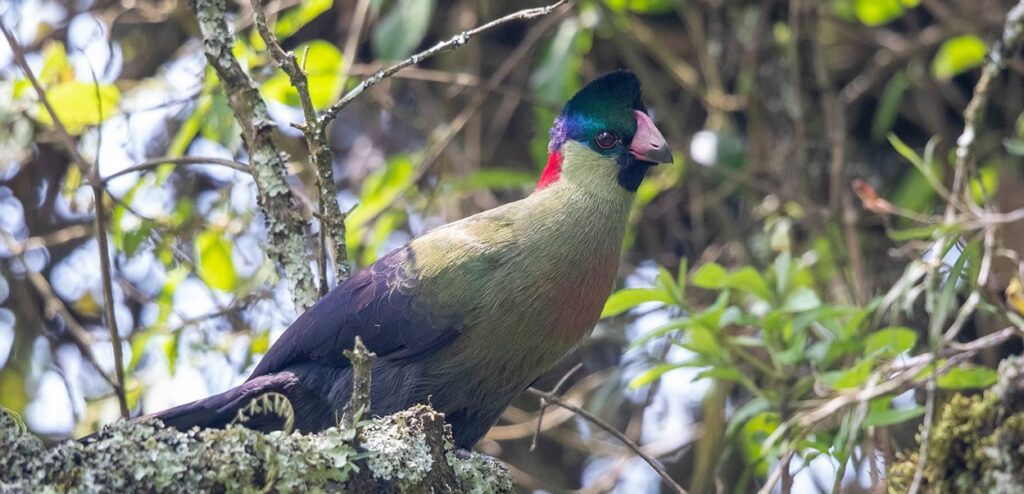
Identification | A large, glossy bluish-purple turaco with vivid crimson flight feathers that flash brilliantly in flight; one of the most visually striking birds on the mountain |
Habitat | Montane and bamboo forest canopy |
Best altitude | Roughly 2,600–3,600 metres |
Best season | Year-round resident; slightly easier to detect during drier months when forest activity peaks at dawn |
Conservation significance | Albertine Rift endemic and a Key Biodiversity Area trigger species for the park |
Chances of seeing it | Good with a dedicated birding guide and patience; more often heard first via its loud, guttural call |
Scarlet-tufted Sunbird (Malachite Sunbird)
Nectarinia johnstoni
Identification | A large sunbird with iridescent green-black plumage, elongated tail feathers, and scarlet pectoral tufts visible in flight |
Habitat | Afroalpine moorland, closely associated with giant lobelia flower spikes |
Best altitude | Roughly 3,000–4,500 metres |
Best season | Year-round; most active and visible on clear mornings |
Conservation significance | A signature species of East Africa’s Afroalpine sky-island moorlands |
Chances of seeing it | High for trekkers who reach the Afroalpine zone — this bird is closely tied to the giant lobelia stands that define the moorland landscape |
Handsome Francolin
Pternistis nobilis
Identification | A striking, dark-plumaged forest francolin with a bright red facial patch and legs |
Habitat | Dense montane forest understory and bamboo |
Best altitude | Roughly 2,200–3,400 metres |
Best season | Year-round; calls most actively at dawn |
Conservation significance | Albertine Rift endemic and a Key Biodiversity Area trigger species |
Chances of seeing it | Moderate; more frequently heard calling from dense cover than seen in the open |
Strange Weaver
Ploceus alienus
Identification | An understated, dark olive-and-black weaver, less colourful than most weaver species but prized by birders for its rarity |
Habitat | Montane forest edge and bamboo |
Best altitude | Roughly 2,300–3,200 metres |
Best season | Year-round resident |
Conservation significance | Albertine Rift endemic with a genuinely restricted global range |
Chances of seeing it | Moderate to low; a genuine target species that rewards a specialist birding guide |
Dusky Crimsonwing
Cryptospiza jacksoni
Identification | A small, dark estrildid finch with a subtly rich, dusky-red wash to the plumage |
Habitat | Forest understory and bamboo-forest margins |
Best altitude | Roughly 2,000–3,200 metres |
Best season | Year-round |
Conservation significance | Albertine Rift endemic; IUCN Least Concern but with a naturally restricted range |
Chances of seeing it | Moderate; found in mixed understory flocks, best located by call |
Beyond these headline species, the Rwenzori’s endemic and near-endemic checklist includes the Rwenzori batis, Rwenzori nightjar, stripe-breasted tit, Rwenzori double-collared sunbird, blue-headed sunbird, purple-breasted sunbird, regal sunbird, Shelley’s crimsonwing, dwarf honeyguide, red-throated alethe, Archer’s robin-chat, Rwenzori apalis, and Grauer’s rush warbler, among others.
Why does one mountain hold so many range-restricted birds? The Albertine Rift’s isolated, high-altitude “sky islands” have functioned as evolutionary laboratories for millions of years, populations separated from their lowland relatives by unbroken forest and rift-valley terrain have speciated independently on each mountain massif, producing the extraordinary concentration of endemics found here and on neighbouring Albertine Rift ranges such as Bwindi Impenetrable National Park, Mgahinga Gorilla National Park, and the Virunga volcanoes
Reptiles of the Rwenzori Mountains
Approximately nine reptile species have been recorded in the park, a modest number by tropical standards but notable for its endemism, roughly 14 percent of Africa’s reptile species occur within the wider Albertine Rift, including around 15 endemics, several of which are chameleons found on this specific range.
Rwenzori Three-Horned Chameleon (Johnston’s Chameleon)
Trioceros johnstoni (syn. Chamaeleo johnstoni)

Identification | Mature male chameleons have three distinct brown horns: one rostral horn on the nose and two above the eyes, while females lack horns and are smaller. |
Habitat | Montane forest vegetation, particularly at higher elevations within the forest and bamboo zones |
Elevation range | Roughly 1,000–2,500 metres, though local guides most reliably observe it above 2,000 metres. |
Behavior | Slow-moving and color-changing for camouflage and thermoregulation rather than active concealment; feeds on insects using a specialized projectile tongue |
Best places to spot it | Forest sections of both the Central Circuit Trail and Kilembe Trail, most easily located by an experienced guide scanning low branches and shrubs |
Conservation status | Endemic to the Albertine Rift (Uganda, DRC, Rwanda, Burundi); not currently IUCN-assessed at species level but considered range-restricted |
Photography tip | Use a macro or close-focus lens with a diffused flash or reflector, chameleons hold still once located, making them one of the most reliably photographable species on the mountain |
Other notable reptiles include the montane side-striped chameleon and several other chameleon species found in the forest zone, the range-restricted Ruwenzori four-toed skink (a Key Biodiversity Area trigger species), forest-floor skinks and lizards, and a small number of non-venomous and venomous forest snake species that are rarely seen due to typical trail conditions and guide vigilance. Reptile sightings are concentrated almost entirely in the lower Afro-Montane Forest Zone, where warmer, more stable temperatures support ectothermic species; reptile diversity drops sharply above the bamboo zone as temperatures fall.
Amphibians of the Rwenzori Mountains
Around six amphibian species have been documented within the park, a modest figure that reflects the challenges of surveying this densely forested, high-rainfall terrain rather than genuinely low diversity; herpetological research on the Rwenzori remains comparatively limited, and further species are likely to be found as surveys continue.
The Rwenzori’s cool, near-constantly wet climate is precisely the condition amphibians require: permanent moisture, abundant invertebrate prey, and a dense, sheltering understory across the forest, bamboo, and heather zones. Like the range’s birds and chameleons, many montane frog species recorded here are either endemic to the Albertine Rift or have very limited ranges that are restricted to a small group of neighbouring high-altitude forests, due to the same isolation-driven speciation that shapes the mountain’s bird and reptile life. Amphibians are most active and most audible after rain, particularly around dusk in the lower forest zone, where their calls form one of the most memorable ambient sounds of a first night on the mountain.
Butterflies and Insects
Easily overlooked in favor of the mountain’s larger, more charismatic wildlife, the Rwenzori’s invertebrate life is genuinely rich and forms the base of the park’s entire food web. Forest clearings and sunlit trail sections through the montane forest and bamboo zones host a striking diversity of butterflies, including large swallowtails and numerous forest-specialist species, most visible on warm, sunny mornings after overnight rain. Dragonflies and damselflies are common around the park’s streams, bogs, and glacial lakes, particularly the Kitandara Lakes and the margins of the Bigo Bog boardwalks.
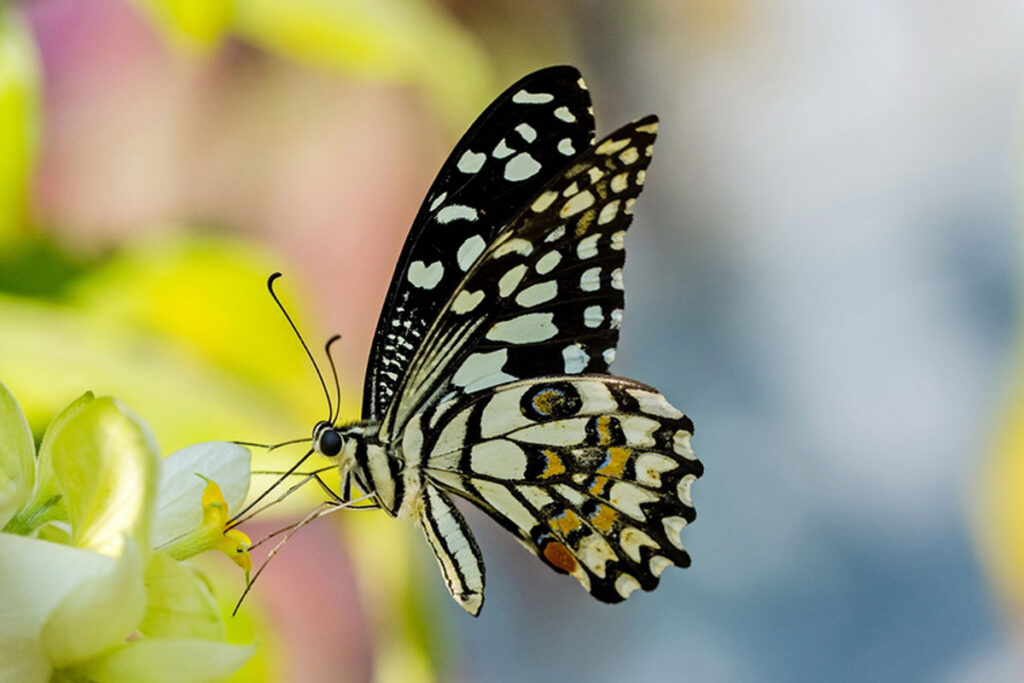
Beyond their visual appeal, these insects play an outsized ecological role: butterflies and a wide range of other pollinating insects are essential to the reproduction of the giant lobelias, groundsels, and heathers that define the mountain’s higher vegetation zones, while the sheer biomass of forest insects sustains the birds, bats, reptiles, and small mammals further up the food chain. A slower pace through sunlit forest clearings, with a few minutes spent simply watching rather than walking, consistently rewards visitors with sightings that most trekkers moving at pace will miss entirely.
Wildlife by Vegetation Zone
Rather than a single wildlife list, the most useful way to understand Rwenzori fauna is zone by zone, because what you are likely to see changes completely as you climb.
Montane Forest (roughly 1,450–2,500 meters)
This is the zone of maximum wildlife activity on any Rwenzori trek. Expect L’Hoest’s monkeys, blue monkeys, black-and-white and Angola colobus, the Rwenzori turaco, handsome francolin, three-horned chameleons, bushbuck, and far more often heard than seen: chimpanzees, forest elephants, and buffalo. This is the single best zone for wildlife photography, given both density of sightings and better light penetration than the zones above.
Bamboo Zone (roughly 2,400–3,000 meters)
A transitional belt dominated by dense Arundinaria alpina bamboo. Blue monkeys and occasional chimpanzees persist here, alongside a strong concentration of forest birds including the strange weaver, dusky crimsonwing, and stripe-breasted tit. Visibility drops considerably in the dense bamboo stands, so most sightings here are auditory.
Heather Zone (roughly 3,000–3,500 meters)
A hushed, moss-draped forest of giant heathers. Wildlife thins noticeably here, but hyrax, duiker, and a range of montane forest birds, including the Rwenzori double-collared sunbird, remain present, along with small mammals adapted to the cooler, wetter conditions.
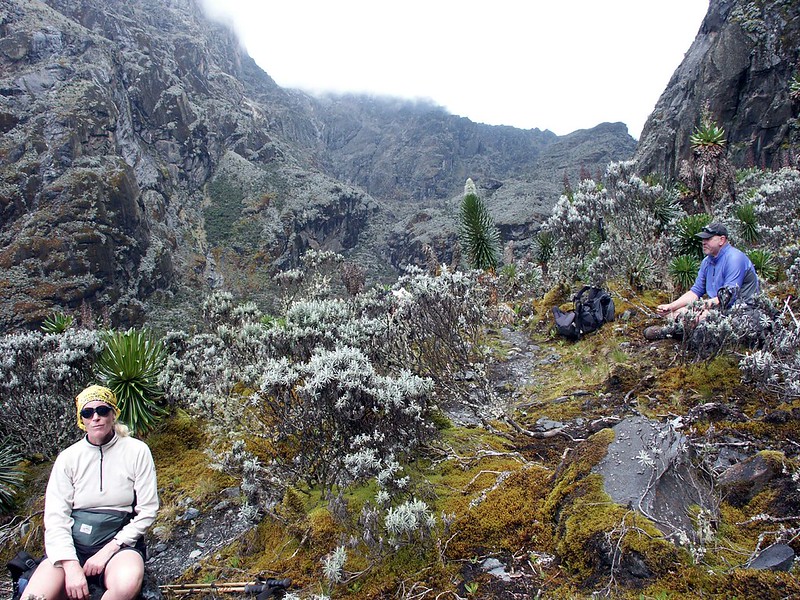
Afroalpine Moorland (roughly 3,500–4,500 meters)
A landscape of giant lobelias and groundsels supports a specialised birdlife community, most famously the scarlet-tufted (malachite) sunbird, which is closely tied to lobelia flower spikes for both food and song-posts. The Rwenzori red duiker and, occasionally, leopard are recorded at this altitude, among the highest-elevation leopard records anywhere in East Africa.
Glacial and Nival Zone (above roughly 4,500 meters)
Vegetation and wildlife both become genuinely scarce here. The combination of peraltitude—amonge rock, and snow supports almost no resident fauna beyond the very occasional transient bird or insect; this zone is crossed for its glaciology and views rather than its wildlife.
Wildlife Along the Trekking Routes
What you are likely to see also depends meaningfully on which route you choose — set realistic expectations for each rather than assuming sightings are guaranteed on either.
Central Circuit Trail
The Central Circuit Trail’s opening day from Nyakalengija to Nyabitaba passes through some of the richest forests on the mountain, giving strong odds of primate and forest bird sightings, including the Rwenzori turaco. The Bigo Bog crossing on days two to three is the best section on this route for the scarlet-tufted sunbird among the giant lobelias, while hyrax calls are a nightly feature around Bujuku and Elena huts.
Kilembe Trail
 Kilembe’s lower waterfall-lined forest sections are excellent for birding, particularly in the first two days, and the route’s longer bamboo-zone stretch offers a strong chance at strange weaver and dusky crimsonwing for patient birders. The Afroalpine sections around Bugata and Hunwick’s Camp offer comparable moorland birding to the Central Circuit’s Bigo Bog, with the advantage of noticeably fewer other trekkers on the trail.
On both routes, realistic expectations matter: primates and forest birds are seen on most treks, moorland specialists are seen by most trekkers who reach the Afroalpine zone, and large mammals such as elephant, buffalo, and leopard are a rare bonus rather than something any operator can promise.
Best Wildlife Viewing Times
The Rwenzori’s two dry seasons, June through August and mid-December through February, offer the best overall wildlife viewing conditions for a combination of reasons rather than any single factor. Drier trails mean quieter, less squelching footsteps and a better chance of primates and forest antelope not being alerted to your approach well in advance. Clearer skies improve visibility for both photography and general viewing in the upper zones, and bird activity, particularly territorial calling, peaks during these drier windows.
Time of day matters as much as season. Early morning, in the first two to three hours after dawn, is consistently the best window for both primate and bird activity across every vegetation zone. During this time, animals are actively foraging, and birds are most vocal, while the forest light is softer and more even for photography. Activity drops noticeably through the heat of midday, picking up again in the late afternoon as temperatures cool. Rain, common even in the dry seasons, tends to suppress activity while falling but can trigger a burst of amphibian calling and insect activity immediately afterward, particularly at dusk in the lower forest zone.
Conservation of Rwenzori Wildlife
Rwenzori Mountains National Park is managed by the Uganda Wildlife Authority (UWA), which oversees resource protection, ranger-based ecological monitoring, community conservation education, and research across the property, working in transboundary partnership with conservation authorities across the border in the Democratic Republic of Congo. The park was inscribed as a UNESCO World Heritage Site in 1994, and, a fact worth being transparent about rather than glossing over, was listed as a World Heritage Site in Danger between 1999 and 2004 due to armed insurgency and associated poaching in the region; that listing was lifted once security and management conditions improved, and the site’s conservation outlook is currently assessed by IUCN as “good, with some concerns.”
Those remaining concerns are real and specific. A 2019 UWA elephant census recorded only around 13 individual forest elephants remaining within the park, and subsequent survey data point to further decline, a population size that raises genuine concern about long-term viability and has prompted calls for stronger ecological corridors connecting the Rwenzori to neighbouring protected areas.
Climate change poses an even more visible threat: the Rwenzori’s glaciers have been retreating steadily for decades, with scientific monitoring projecting their disappearance as soon as 2030, a change expected to reduce river flow, shift vegetation zones upward, and place pressure on the range’s rarest Afroalpine specialist species. Illegal logging, encroachment from a dense and growing human population along the park’s boundary, and occasional poaching, particularly affecting species such as the Rwenzori duiker and chimpanzee, remain active management challenges.
Community conservation is central to the park’s long-term protection. Licensed trail operators, like those managing the Central Circuit trail, Kilembe trail, and Bukurungu routes, employ local guides, porters, and rangers, sending tourism revenue directly into communities that might otherwise rely more on forest resource extraction. Responsible tourism, staying on designated trails, employing licensed operators, respecting UWA’s wildlife guidelines, and supporting community-based conservation initiatives, is one of the most direct, practical contributions a visitor can make to the park’s future, and it is a core part of how we structure every trek we run.
Wildlife Photography Tips,
Recommended Lenses
A telephoto zoom in the 100–400mm range covers the majority of primate and bird photography needs without becoming too heavy to carry on multi-day trekking days. A dedicated macro or close-focus lens is worth the extra weight for chameleons, butterflies, and the moorland’s smaller plant-associated insects, while a wide-angle lens remains essential for the giant lobelia and groundsel landscapes themselves.
Camera Settings for Forest Conditions
Montane forest light is low and contrasty. Favour a wider aperture (f/4–f/5.6) to maintain shutter speed in shaded understory, and do not hesitate to raise ISO — a slightly noisier but sharp image beats a clean but blurred one when a monkey moves unexpectedly. Back-button focus and continuous autofocus modes help track primates moving through cluttered branches.
Protecting Equipment in Wet Conditions
The Rwenzori’s near-daily rain and pervasive humidity are genuinely hard on camera gear. Pack equipment in a dedicated dry bag or waterproof case inside your daypack, carry silica gel packets in your camera bag to manage condensation, and dry lenses and bodies thoroughly each evening in camp before the next day’s ascent.
Ethical Wildlife Photography
Never bait, call in, or otherwise attempt to alter an animal’s natural behaviour for a photograph. Keep to the distances your guide sets, avoid flash photography with primates and other mammals at close range, and prioritise the animal’s welfare over any single image — a principle that every reputable Rwenzori operator, including ours, treats as non-negotiable.
Safety Around Wildlife
Trekking in genuine wildlife habitat calls for a few consistent, simple practices, and every reputable guide will reinforce these throughout your trek.
- Keep a respectful distance from all wildlife, particularly buffalo, elephant, and any primate with young — these are the encounters most likely to turn unpredictable at close range.
- Never feed or attempt to attract wildlife, for the animal’s health and behavior as much as your own safety.
- Follow your guide’s instructions immediately and without argument during any wildlife encounter; guides read animal behavior cues that visitors often cannot.
- Stay on designated trails at all times, both to protect fragile Afroalpine vegetation and to avoid surprise encounters in dense, low-visibility terrain.
- Minimize noise on the trail, particularly in the early morning forest sections—a quieter approach dramatically improves both your safety margin and your chances of a genuine sighting.
This is why every standard Rwenzori itinerary includes an armed UWA ranger with your guide and porter team in areas where larger mammals are more likely to be seen, which is a standard, sensible precaution rather than a sign of frequent danger.