Rwenzori Trekking Expeditions‘ 2-day Rwenzori Trek to Lake Mahoma via the Mahoma Loop Trail offers the perfect introduction to the spectacular landscapes, wildlife, and biodiversity of the famous Mountains of the Moon.
This 2-day Rwenzori trek to Mahoma Lake follows the popular Mahoma Loop Trail through lush tropical rainforest, bamboo forests, mountain ridges, and pristine wilderness before reaching the beautiful Lake Mahoma, a tranquil crater-like mountain lake nestled within the lower slopes of the Rwenzori Mountains.
The 2-day Rwenzori Trek to Lake Mahoma is perfect for beginners, nature lovers, birdwatchers, photographers, families, and travelers with limited time; this trek provides an authentic Rwenzori hiking experience without the physical demands of higher-altitude expeditions.
2-Day Rwenzori Trek to Lake Mahoma: Complete Guide For Beginners
Somewhere in the misty lower reaches of the Rwenzori Mountains, Africa’s legendary Mountains of the Moon, a crater lake sits in undisturbed silence, ringed by Afro-montane forest so dense and so alive that it seems to breathe. Lake Mahoma is not a destination you find on mainstream hiking maps. It requires effort, intention, and a guide who knows the forest.

The 2-day Rwenzori Trek to Lake Mahoma via the Mahoma Loop is one of East Africa’s finest short wilderness experiences: an immersive, expertly guided 2-day trek through equatorial montane forest, past thundering waterfalls and ancient heather trees, to a lake of extraordinary stillness at 2,196 meters. It is the perfect introduction to Rwenzori Mountains trekking excursions, demanding enough to feel earned and beautiful enough to be unforgettable, and Rwenzori Trekking Expeditions handles every detail from the moment your private vehicle departs Kampala to the moment you return, summit certificate in hand and forest still in your senses.
This itinerary is designed for hikers who want to experience the true spirit of the Rwenzori without the commitment of a full multi-day summit expedition. Whether you are a seasoned trekker on a tight schedule, a first-time Rwenzori visitor, or a family seeking an extraordinary weekend escape, the Lake Mahoma trek delivers the Rwenzori in its most accessible and most intimate form. Two days. One night beside a crater lake. A lifetime of memory.
Everything you need to know before the forest receives you.
Trek Name | 2-Day Rwenzori Trek to Lake Mahoma via the Mahoma Loop / Central Circuit Trail |
Location | Rwenzori Mountains National Park, Western Uganda |
Lake Altitude | 2,196 m (7,205 ft), pristine crater lake in montane forest |
Trail | Mahoma Loop Trail (Central Circuit approach) |
Duration | 2 Days / 1 Night |
Difficulty | Moderate, suitable for fit beginners and casual hikers |
Start / End | Nyakalengija Gate (1,646 m), Rwenzori Mountains NP |
Group Size | 2 to 12 trekkers (private expeditions available) |
Best Season | June–August & December–February |
Managed By | Uganda Wildlife Authority (UWA) |
Operator | Rwenzori Trekking Expeditions, Licensed UWA Partner |
Why Trek via the Central Circuit Trail?
The Mahoma Loop is one of the most rewarding short trails in the entire Rwenzori mountain system, and it approaches Lake Mahoma via the same storied lower corridor used by the Central Circuit Trail, the flagship route for Margherita Peak expeditions. This matters, because it means trekkers on the 2-day Rwenzori trek to Lake Mahoma itinerary experience the authentic Rwenzori: the same botanical richness, the same quality of forest, and the same birdlife and biodiversity that make the Rwenzori Mountains National Park a UNESCO World Heritage site.
Many short Rwenzori hikes keep you on peripheral trails with limited immersion. The Mahoma Loop takes you deep into the park’s protected interior, crossing rivers on wooden bridges, climbing through bands of montane forest that few non-trekking visitors ever reach, and delivering you to a lake that sits in a geological and ecological context of rare significance. For trekkers who wonder what the Rwenzori feels like but are not yet ready for an eight-day summit expedition, the Mahoma Loop is the honest, unhurried answer.
There is also a practical elegance to the two-day format. Day One ascends at a measured pace, allowing full immersion in the forest environment. The overnight camp beside Lake Mahoma, set up seamlessly by your porter and chef team, means you experience the lake at its most quiet: at dusk, when the forest calls change register, and at dawn, when mist hangs on the water and the stillness is absolute. A single-day hike to the lake and back misses precisely this, the lake’s true character, revealed only when you stay the night beside it.
About Lake Mahoma: The Jewel of the Lower Rwenzori
Lake Mahoma occupies a volcanic crater at an altitude of 2,196 meters, surrounded on all sides by montane forest that has never been cleared, never been logged, and never been altered by human industry. The lake itself is dark, the color of deep jade or old pewter depending on the quality of the light, and its surface is rarely disturbed by wind at this altitude. On still mornings, it mirrors the forest canopy perfectly, creating a doubled world of green and water that photographers rarely want to leave.
The lake was formed by ancient volcanic activity in the Rwenzori’s lower geological history, and it retains a quality of geological antiquity that larger, more accessible lakes rarely possess. There are no roads within an hour’s walk of it. No motorboats. No guesthouses on its shore. The only way to reach Lake Mahoma is on foot, through the forest, with a guide, and this is entirely by design. The Uganda Wildlife Authority manages access carefully to preserve the ecological integrity of the crater basin and its surrounding forest.
For ornithologists and naturalists, the lake represents one of the most accessible entry points into the Rwenzori’s extraordinary endemic wildlife. For everyone else, it is simply one of Uganda’s most beautiful places — and, once seen, one of the hardest to leave.
Itinerary at a Glance
Day 1: Kampala / Entebbe → Nyakalengija Gate → Lake Mahoma Camp (2,196 m)
Day 2: Lake Mahoma Camp → Nyakalengija Gate → Drive to Kampala / Departure
Altitude Profile: Day-by-Day Elevation
The Lake Mahoma trek covers a focused altitude range, making acclimatization straightforward for fit trekkers. The gain from the gate to the lake is approximately 550 meters over eight kilometers of forested trail, achievable in a comfortable four to five hours for most fitness levels.
Day | Camp / Destination | Altitude | Distance | Est. Duration |
Day 1 | Nyakalengija Gate → Lake Mahoma Camp | 1,646 m → 2,196 m | ~8 km | 4–5 hrs |
Day 2 | Lake Mahoma Camp → Nyakalengija Gate | 2,196 m → 1,646 m | ~8 km | 3–4 hrs |
2-Day Mahoma Loop Trek vs 1-Day Mahoma Day Hike
Rwenzori Trekking Expeditions offers both a two-day overnight trek and a one-day return hike to Lake Mahoma. The comparison below will help you decide which format best fits your time, fitness, and depth of experience sought.
Feature | 2-Day Mahoma Loop Trek | 1-Day Mahoma Day Hike |
Duration | 2 Days / 1 Night | 1 Day (day hike option) |
Difficulty | Moderate — beginner-friendly | Easy-Moderate |
Highest Point | 2,196 m, Lake Mahoma | 2,196 m, Lake Mahoma |
Route | Mahoma Loop / Central Circuit | Direct out-and-back |
Scenery | Forest, waterfalls, crater lake | Forest, crater lake |
Overnight | Tented camp at the lakeshore | No day hike only |
Best For | Weekend trekkers, first Rwenzori | Very time-limited visitors |
For trekkers with the flexibility of two days, the overnight format is almost always the more rewarding choice. The lake’s atmosphere at dusk and dawn is the defining Rwenzori experience, and it simply cannot be replicated on a return hike.
Detailed 2-Day Lake Mahoma Trek Itinerary
What follows is not a schedule. It is a story written by guides who have walked every step of it, in every season, in every mood that the Rwenzori wears.
Day 1: Kampala / Entebbe → Nyakalengija Gate → Lake Mahoma Camp
The journey begins before the forest does. Your dedicated driver-guide collects you from your Kampala or Entebbe hotel in a private, fully equipped 4WD vehicle, and the road west unfolds across the Ugandan heartland through tea country, past crater lake ridgelines, and through the gentle green hills of western Uganda until the unmistakable silhouette of the Rwenzori range rises on the horizon, its upper reaches lost, as always, in cloud. The drive takes approximately five to six hours. It is not merely a transfer. It is a slow approach, a gradual shift of register, and by the time Nyakalengija Gate appears through the eucalyptus stands at the park boundary, you are already somewhere different.
At the gate, Uganda Wildlife Authority formalities are handled swiftly by your guide, permits verified, porter loads allocated, and briefing delivered with the calm authority of someone who has done this hundreds of times and still means every word of it. Then the forest closes around you, and the world outside vanishes.
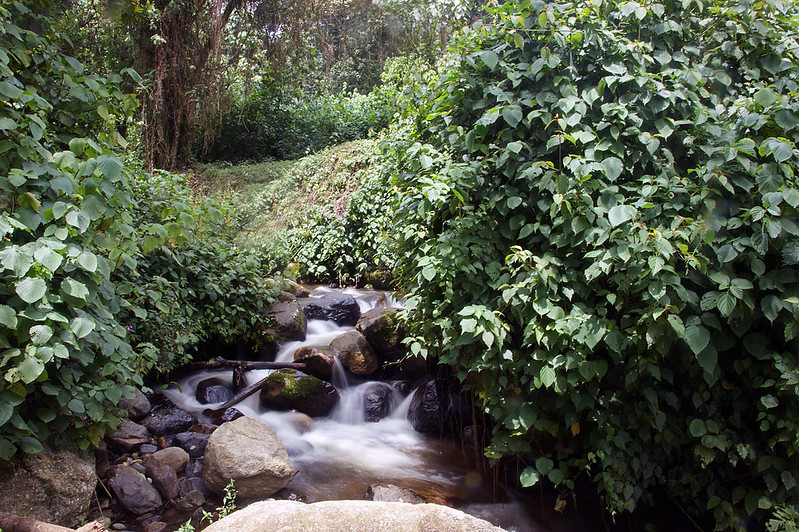
The trail from Nyakalengija Gate to Lake Mahoma follows the initial section of the Central Circuit Trail before branching west onto the Mahoma Loop. The gradient is steady rather than severe, climbing through dense montane forest where enormous Podocarpus trees rise cathedral-tall overhead and their roots thread across the path like exposed tendons. The Mubuku River is audible before it is visible, and the first river crossing, a wooden bridge over fast, cold water the color of strong tea, is one of the day’s defining moments. Below the bridge, the river runs through a gorge carved over millennia. Above it, the forest continues upward without interruption.
As the trail gains altitude, the character of the vegetation shifts. Giant ferns crowd the trail edges. Mosses cover every surface in a deep, unbroken green. Epiphytes drape from branches in long, trailing curtains. The air is cool, damp, and richly scented with the particular fragrance of wet tropical forest, something between earth and green and rain. The birdlife is constant: Rwenzori turaco, sunbirds, and the distant percussion of a Rwenzori hornbill somewhere in the canopy.
After four to five hours of walking, with a lunch stop beside a waterfall that your chef has prepared from the morning’s fresh supplies, the forest opens fractionally and Lake Mahoma appears. It is one of those moments that rewards patience. The lake is dark and still and perfectly silent. The forest rises on all sides. The camp, tents already pitched by your porter team, who took an alternative route to arrive ahead of you, sits on a level clearing at the lake’s edge, a small, immaculate base camp in an immense, wild setting.
The evening at Lake Mahoma belongs entirely to the senses. A hot dinner prepared by your mountain chef. The sound of the forest adjusting to darkness, the calls shifting, the volume rising, and the texture of the Rwenzori night becoming vivid and layered. The lake surface, reflecting whatever stars break through the equatorial cloud. There is nowhere else on Earth quite like this place.
Accommodation — Night 1 A tented camp at Lake Mahoma’s shore (2,196 m). Quality dome tents with sleeping mats, warm sleeping bags, and a dedicated cook tent. Your porter team sets up and dismantles the camp entirely, so you arrive to find it ready. |
Day 2: Lake Mahoma Camp → Nyakalengija Gate → Kampala
The morning at Lake Mahoma is, for most trekkers, the moment the entire journey earns its purpose. The forest wakes before the light fully arrives, first sound, then silhouette, then the slow revelation of color as the cloud overhead thins and the lake surface catches the first grey-green light of dawn. Your chef has tea and coffee ready before the camp stirs. No alarm is needed. The Rwenzori provides its own.
A guided walk around part of the lakeshore before breakfast is one of the highlights your guide will offer, an opportunity to observe the crater basin’s geology, to spot the endemic birds that feed at the water’s edge in the early morning, and to experience the lake at its most composed and revealing. The crater walls rise steeply on the far side, draped in an uninterrupted forest. At this hour, the silence feels almost architectural in its completeness.

After breakfast, the porter team efficiently strikes camp while you take a final walk along the shore. The descent back to Nyakalengija Gate follows the return section of the Mahoma Loop, a different aspect of the forest, a new trail, and new perspectives on the same magnificent ecosystem. The descent is faster and gentler on the cardiovascular system than the ascent, though the trail demands continued attention on root-crossed and occasionally muddy ground.
The gate is reached by late morning or midday. UWA exit paperwork is signed. The trekking certificate, presented by your guide with appropriate ceremony, is awarded. The porter and guide team gathers for a farewell that, even after only two days, carries genuine warmth. Eight kilometres of shared forest has that effect on people.
Your private vehicle is waiting. The road back east through western Uganda unfolds in reverse, carrying you away from the Mountains of the Moon with the lake still present in your body, in the ache of well-used muscles, in the forest smell that clings to good gear, and in something quieter that the Rwenzori leaves in everyone who enters it properly.
Logistics — Day 2 Drive time from Nyakalengija Gate to Kampala: approximately 5–6 hours. Evening arrival in Kampala / Entebbe. Hotel drop-off seamlessly arranged by your dedicated vehicle and driver. |
How Difficult Is the Lake Mahoma Trek?
The 2-day Lake Mahoma trek is rated moderate, the most accessible entry point into the Rwenzori mountain system. The daily walking distances of approximately eight kilometers each way are well within the capability of any fit adult who engages in regular physical activity. The altitude gain of 550 meters on Day One is gradual and well-managed, and the lake’s elevation of 2,196 meters presents no significant altitude challenge for most trekkers.
That said, the Rwenzori is not a groomed mountain trail. The path is natural, sometimes root-crossed and muddy, and the forest terrain demands attentiveness throughout the day. Waterproof footwear is not optional — it is the single most important piece of kit on this trek, and trekkers who arrive with inadequate boots consistently report the most discomfort. Trekking poles are recommended and significantly reduce fatigue on both the ascent and descent.
Rwenzori Trekking Expeditions tailors the pace of every trek to the fitness level and comfort of the group. Your guide will never rush you; will always position themselves where they are most useful, whether that is leading on an open trail or providing a hand on a slippery root crossing; and carry comprehensive first-aid equipment for any eventuality. The Lake Mahoma trek is an excellent first mountain experience for children over the age of ten who are accustomed to hiking, subject to individual assessment.
Difficulty Rating Moderate | No altitude challenge | Suitable for fit beginners. Waterproof boots and trekking poles strongly recommended. Not technically demanding but physically engaging, expect genuine forest-trekking conditions. |
Wildlife and Birdlife Along the Mahoma Trail
The Rwenzori Mountains National Park is one of Africa’s most biodiverse mountain ecosystems, and the lower forest corridor between Nyakalengija Gate and Lake Mahoma represents some of its richest accessible habitat. Trekkers on the 2-day Mahoma Loop should arrive expecting wildlife encounters, not as highlights to be sought, but as the natural texture of a forest that is deeply and demonstrably alive.
Primates
Black-and-white colobus monkeys (Colobus guereza) are among the most dramatic forest residents, large, impossibly photogenic, and often encountered in canopy groups above the trail. Olive baboons and red-tailed monkeys are also present in the lower forest. L’Hoest’s monkey, a rarer endemic of Afromontane forests has been recorded regularly along the Mahoma trail by Rwenzori Trekking Expeditions guides.
Birds
The Rwenzori Mountains are a recognized birding destination of continental significance, hosting numerous Albertine Rift endemics found nowhere else on Earth. The Mahoma trail is particularly rewarding for the Rwenzori turaco, a stunning bird, vivid green with crimson wing patches, as well as the handsome francolin, Rwenzori nightjar, Stuhlmann’s starling, and the African green broadbill. Rwenzori Trekking Expeditions guides are trained naturalists as well as mountain specialists and will identify bird calls throughout the trek without interrupting the rhythm of the walk.
Other Wildlife
Elephants, giant forest hogs, and leopards are all present within the national park boundary, though sightings on the Mahoma trail are uncommon. The forest herpetofauna, chameleons, forest geckos, and the occasional forest cobra at lower elevations are a source of quiet fascination for naturalist trekkers. Butterflies in the lower forest are spectacular: the Rwenzori hosts over 230 species, many of them Albertine Rift endemics.
Best Time to Hike Lake Mahoma
The Rwenzori receives rainfall throughout the year; such precipitation is a fact of equatorial mountain geography that all trekkers accept as part of the experience. The forest trails around Lake Mahoma are navigable in all seasons, and the lake’s beauty is, if anything, enhanced by the dramatic, cloud-heavy skies of the wetter months. That said, two seasonal windows offer the most reliable conditions for trekking.
Peak Season: June to August
The long dry season delivers the most stable weather on the lower Rwenzori trails. Morning starts are frequently clear, afternoon clouds are manageable, and the trails, while always involving some mud, are at their driest. June to August represents the most popular period for the Lake Mahoma trek and the best time for first-time visitors to the Rwenzori.
Secondary Season: December to February
A shorter window of relative dryness between the equatorial rainy seasons, December to February, offers similar conditions to the peak season and the additional advantage of fewer trekkers on the mountain. The forest vegetation is at its most lush and photogenic in this period, and the light has a particular quality that suits photography.
Shoulder Periods: March–May and September–November
Heavy rainfall characterizes both shoulder periods. The Mahoma Trail becomes muddier, and stream crossings may run higher. Experienced trekkers who are comfortable in wet conditions and who are prepared with appropriate waterproof gear will find these months offer a profoundly private and atmospherically beautiful Rwenzori experience. Rates are often lower during shoulder season, and the forest carries a particular intensity after sustained rain that rewards those willing to embrace it.
How to Get to the Rwenzori Mountains
Rwenzori Mountains National Park is located in western Uganda, approximately 400 kilometers from Kampala. The primary trekking entry point for the Mahoma Loop is Nyakalengija Gate, situated 15 kilometers north of Kasese town.
By Air
International visitors arrive at Entebbe International Airport (EBB), which receives direct flights from Nairobi, Addis Ababa, Amsterdam, London, Dubai, and other regional hubs. A domestic flight from Entebbe to Kasese Airport reduces the overland journey to approximately 45 minutes. Rwenzori Trekking Expeditions arranges airport collection and domestic flight logistics upon request.
By Road
The overland drive from Kampala to Nyakalengija Gate takes five to six hours via the Mbarara Highway through Fort Portal, one of Uganda’s most scenic western road journeys, passing the equator, tea country, and the volcanic crater lakes of western Uganda. Rwenzori Trekking Expeditions provides all ground transportation in private 4WD vehicles with experienced drivers who know this road in every season.
What Should I Pack for the Lake Mahoma Trek?
Packing correctly for a two-day Rwenzori forest trek is simpler than packing for a high-altitude expedition, but no less important. The forest environment demands specific kit, particularly for footwear and waterproofing, and the overnight element requires a sleeping system appropriate for temperatures that can drop to 8–12°C at lake altitude. Below is the curated packing list our guides recommend for the Lake Mahoma trek.
Footwear
Waterproof, ankle-supporting trekking boots are the single most critical item on this trek. The Rwenzori forest floor is perennially wet, and boot failure at any point in the two days creates real discomfort. Lightweight camp shoes or sandals for use at the lake camp in the evening. Gaiters for bog crossings are recommended.
Clothing
Moisture-wicking base layers that dry quickly. A fleece or light down mid-layer for the lake camp evening; temperatures drop noticeably after dark at 2,196 meters. A waterproof, breathable shell jacket and trousers, essential in any season. A sun hat for any open sections and a warm hat for the lake camp morning. Trekking trousers: avoid cotton in wet forest conditions.
Equipment
Trekking poles are highly recommended for both ascent and descent on root-crossed forest trails. A daypack of 20–25 liters is recommended for carrying daily essentials, while your porter carries the main load. A headtorch with spare batteries for the lake camp evening and early morning. A water bottle or hydration bladder of at least one liter capacity. Sunscreen and sunglasses for any exposed sections. A small personal first-aid kit.
Photography
The Lake Mahoma trek rewards photographers at every level of expertise. The forest light in the late afternoon on Day One and at dawn on Day Two is extraordinary, soft, diffused, and deeply atmospheric. A waterproof camera bag or dry bag is strongly recommended. Keep equipment accessible throughout the day; the most memorable wildlife encounters on the Rwenzori happen without announcement.
What Is Included in the 2-Day Lake Mahoma Trek?
Rwenzori Trekking Expeditions operates fully inclusive expeditions. The following covers precisely what your trek package includes and what falls outside it — no surprises at the gate, no hidden additions on the trail.
Included
- Uganda Wildlife Authority park entrance fees and Rwenzori Mountains National Park trekking permits for the full 2 days.
- A dedicated, certified mountain guide who is English-speaking, first-aid trained, and an experienced Rwenzori naturalist.
- An experienced Rwenzori porter team for baggage carries, one personal porter per trekker.
- All meals on the mountain: breakfast, packed trail lunch, dinner, and hot drinks prepared by a dedicated mountain chef.
- Tented camp accommodation at Lake Mahoma shore, dome tents with sleeping mats and warm sleeping bags.
- Ground transportation from Kampala or Entebbe to Nyakalengija Gate and return in a private 4WD vehicle.
- Pre-trek briefing and kit inspection
- A Rwenzori Trekking Exped certificate is provided upon completion. An emergency response plan and first-aid equipment will be carried throughout the trek.
- All government taxes and levies.
Not Included
- International flights to and from Uganda. Uganda visa fees (approximately USD 50 per entry, verify current requirements at ugandaevisa.go.ug).
- Comprehensive travel insurance, including emergency evacuation coverage, is mandatory for all trekkers.
- Pre- and post-trek hotel accommodation in Kampala, Entebbe, or Kasese is available on request through Rwenzori Trekking Expeditions.
- Personal trekking equipment including boots, clothing, and sleeping bag liner. Alcoholic beverages.
- Tips and gratuities for the guide and porter team are customary and warmly appreciated, and guidance on appropriate amounts is available on request.