The 18-day Rwenzori 8 Peaks’ Trek allows you to hike all 8 Rwenzori peaks in 18 days: Margherita (5,109 m), Cheptegei, Alexandra, Baker, Speke, Gessi, Emin & Weismann with Rwenzori Trekking Expeditions.
Margherita · Cheptegei · Albert · Alexandra · Vittorio Emanuele · Edward · Umberto · Weismann
| 18 Days · 8 Summits | Kilembe Trail | All 6 Massifs | Extreme / Elite Level | Fully Private & Bespoke |
On this 18-day Rwenzori 8 Peaks trekking expedition, all eight major summits fall within eighteen days: Weismann Peak on Mount Luigi di Savoia (4,620m) as the first summit, a perfect physiological primer for what follows; Edward Peak on Mount Baker (4,844m) via the technical glacier approach; then Margherita Peak (5,109 m), Africa’s third highest summit, the roof of the Rwenzori, crossed on ancient equatorial ice with crampons and rope in the pre-dawn darkness; Alexandra Peak (5,083m) the following day, on the most technically demanding ridge traverse of the entire expedition; Cheptegei Peak (4,907 m) on the Stanley massif, one of the least-visited major Rwenzori summits; Vittorio Emanuele Peak on Mount Speke (4,890 m) via the Elena approach; Bottego Peak on Mount Gessi (4,715 m) in the remote northern wilderness; and Umberto Peak on Mount Emin (4,798 m), the penultimate summit, standing on ancient crystalline rock above an immensity of equatorial forest, with the knowledge that the complete Rwenzori crown is within reach.
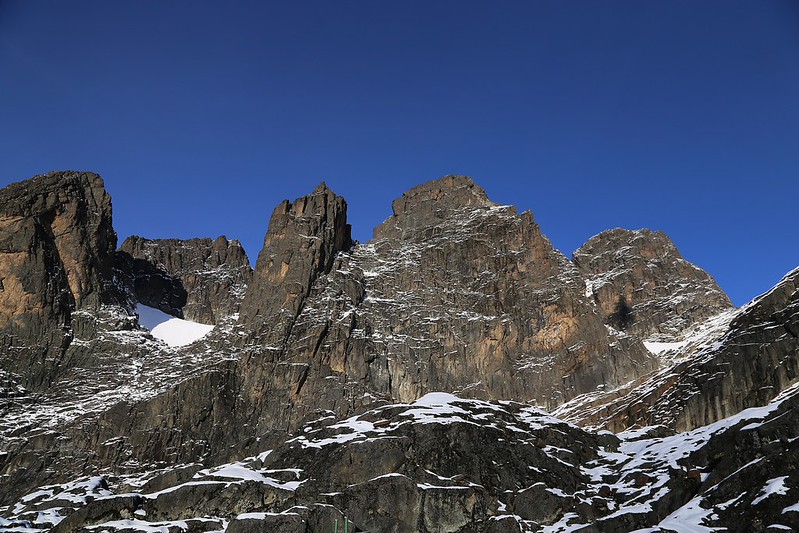 The Rwenzori’s equatorial glaciers have retreated by over 80% in a century. The window to cross ice at the equator, to stand on Margherita and Alexandra with genuine glaciers beneath your boots, is measured in decades, not centuries. The eight-peak experience that this expedition delivers is one of the rarest, most time-sensitive, and most extraordinary mountain achievements available to any mountaineer alive today.
Rwenzori Trekking Expeditions manages every logistical element of this journey, including your certified private guide team, your dedicated porter allocation, all UWA park permits and individual peak fees, eighteen days of full-board mountain catering, all hut and camp accommodation, crampons and technical equipment for every glacier approach, and seamless private vehicle transfers throughout. The mountain is your only concern. We carry everything else.
18-Day Rwenzori Trek: Summit All 8 Peaks
Each of the eight peaks on this expedition represents a distinct massif character, a distinct approach, and a distinct summit moment. Mount Stanley alone delivers three separate summits (Margherita, Alexandra, and Cheptegei), each requiring its own summit day. The table below captures the essential facts of what you will climb; the day-by-day narrative below delivers the experience of each.
# | Summit Peak | Mountain Massif | Altitude | Character & Notes |
1 | Weismann Peak | Mt Luigi di Savoia | 4,620m | Non-glaciated; first summit; physiological primer; southern moorland |
2 | Edward Peak | Mount Baker | 4,844m | Technical glacier section; pre-dawn start; crampons required |
3 | 5,109 m | Africa’s 3rd highest; full glacier crossing; expedition centrepiece | ||
4 | Alexandra Peak | 5,083 m | Icy arête traverse from Margherita; most technical section of expedition | |
5 | 4,907 m | Least-visited Stanley summit; rocky approach; exceptional views | ||
6 | Vittorio Emanuele | 4,890m | Rocky scrambling approach; Bujuku Valley panorama; atmospheric | |
7 | Bottego Peak | 4,715m | Most remote, sharp Precambrian rock, fewest visitors of any Rwenzori peak | |
8 | Umberto Peak | 4,798 m | Exposed ridgeline; Congo Basin views; penultimate crown summit |
The 18-Day Rwenzori 8-Peak Grand Expedition is emphatically the latter, the most ambitious mountain trekking expedition available anywhere on the African continent, a single, continuous traverse of all six Rwenzori mountains. Summiting 8 Rwenzori peaks across eighteen days of sustained, technical, profoundly beautiful high-altitude effort via the celebrated Kilembe Trail through one of the world’s most extraordinary mountain ecosystems.
 Fewer than a few dozen mountaineers complete this expedition in any given year. Not because it is restricted or exclusive in any administrative sense, but because it is genuinely hard, hard in the way that the finest things in life tend to be, and because reaching it requires years of building the fitness, experience, and mountain knowledge that the Rwenzori demands before it yields all eight of its crown jewels. If you are reading this with recognition rather than reservation, this expedition was written for you.
The Rwenzori Mountains, or the Mountains of the Moon, were named by Ptolemy’s cartographers two thousand years ago for their impossible, cloud-wrapped remoteness, and they rise from Uganda’s Western Rift Valley to glaciated heights above 5,100 meters, straddling the equator with a geological and ecological defiance that continues to astonish everyone who stands on their peaks. Five distinct vegetation zones rise in vertical succession from the dense Afro-montane forest at the trailhead to the ancient equatorial glaciers above Elena Hut. The giant lobelias and Senecio groundsel trees of the Afro-alpine moorland are unique in the world. The glaciers themselves (retreating irreversibly), projected to be gone within three decades, are among the last equatorial ice fields on Earth.
Expedition Highlights
Duration | 18 Days / 17 Nights on the mountain + 1 arrival day in Kasese |
Total Distance | ~140–160 km (Kilembe Trail full traverse + all summit excursions) |
Maximum Elevation | 5,109m: Margherita Peak, Mount Stanley |
Total Summits | 8 peaks across all 6 Rwenzori Mountains |
Difficulty Rating | EXTREME: Elite multi-peak mountaineering expedition |
Trail | Kilembe Trail (primary) with high-mountain traverses between massifs |
Start & End Point | Kilembe Trailhead, Kasese (1,450m) → Kilembe Trailhead |
Best Season | December–March (primary) | June–August (secondary) |
Group Size | 1–8 trekkers, private departures only |
Technical Gear Provided | Crampons, ice axes, harnesses, helmets, ropes, rubber boots |
Prerequisite Fitness | Prior high-altitude multi-day trekking at 4,000m+ is mandatory |
Cumulative Elevation Gain | ~9,500–10,500m across 17 hiking days |
Day 1: Kasese (914m) | Preparation Day | Overnight: Kasese Hotel
The quality of an 18-day Rwenzori 8-peak trek/hike expedition depends, in no small part, on the quality of its first day. Kasese receives you with the warm, purposeful efficiency of a town that has learned to take mountaineers seriously: your Rwenzori Trekking Expeditions representative is waiting at your hotel or arrival point, and the day’s program is already set in motion before you have fully unpacked.
This 8-day Rwenzori 8 Peaks trekking expedition truly begins in the briefing room. Your certified lead guide, an UWA-registered professional whose summit count on these peaks runs into the hundreds, walks through every element of the eighteen days ahead with the unhurried precision of someone who understands that the difference between a successful and an unsuccessful 8-peak expedition often comes down to the quality of its preparation. The route, the camps, the summit sequence, the acclimatization strategy, the altitude sickness protocol, and the contingency plans for weather and fitness variations across eight summit days—all of it is laid out clearly, confidently, and with room for every question you have.
Equipment is inspected with forensic thoroughness. Every layer, every boot, and every sleeping bag rating is checked against the temperature ranges you will encounter: from Kasese’s 30°C heat to Margherita Camp’s potential -15°C at night. The porter team is introduced, and their allocations are confirmed. Medical baselines, blood oxygen saturation, and heart rate at rest are taken by your guide as the first data points of the acclimatization monitoring that will continue for the entire expedition. Dinner tonight is substantial and early. Tomorrow, the Kilembe Trail begins.
Accommodation & Meals: Kasese hotel (your selection, pre-trek). A full dinner will be arranged at the hotel. All expedition logistics are confirmed this evening.
Day 2: Kilembe Trailhead (1,450 m) – Sine Camp (2,596 m) | ~9.5 km | 5–6 hours
The private vehicle from Kasese to the Kilembe Trailhead takes twenty minutes, a brief, charged transit that feels like a threshold crossing. At the Uganda Wildlife Authority registration point, your guides complete all permit formalities while you absorb the scene: the dark wall of Afro-montane forest above the trailhead, the porter team checking loads with practiced authority, and behind it all, the first sense of the mountain’s scale as the forest canopy rises into cloud above the path.
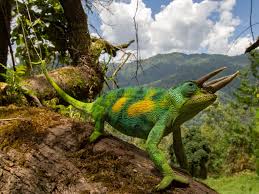
The Kilembe Trail enters the Rwenzori Mountains National Park through a forest that is immediately, extravagantly alive. The canopy reaches thirty to forty meters, filtering equatorial sunlight into cathedral shafts of green and gold. Rwenzori turacos flash crimson through the middle canopy, the range’s avian emblem, unmistakable and reliably startling. Three-horned chameleons occupy the mossy trunks with the slow authority of animals that have never needed speed.
Blue monkeys and black-and-white colobus move through the upper branches in organized, noisy troops. The trail crosses the suspension bridge above the Nyamwamba River, pausing here for a moment to listen to the river’s roar below, which is its reward, before climbing steadily through increasingly moss-draped forest to the drama of Enock’s Falls.
Sine Camp, at 2,596 meters, sits at the transition between the montane forest and the first giant heather, the upper boundary of the forest zone and the beginning of the botanical journey that will define the next sixteen days. Your mountain cook has arrived ahead of the main party; dinner is hot, generous, and entirely welcome after the first day’s climb. The forest settles into darkness with sounds that have nothing to do with the human world: tree hyrax calling across the ridges, water threading through the undergrowth, and the particular quality of night that only arrives when you are genuinely far from electricity.
Accommodation & Meals: Sine Camp hut (2,596 m). Full-board meals begin. Mountain rhythm established tonight.
Day 3: Sine Camp (2,596 m) – Mutinda Camp (3,688 m) | ~6.5 km | 6–8 hours
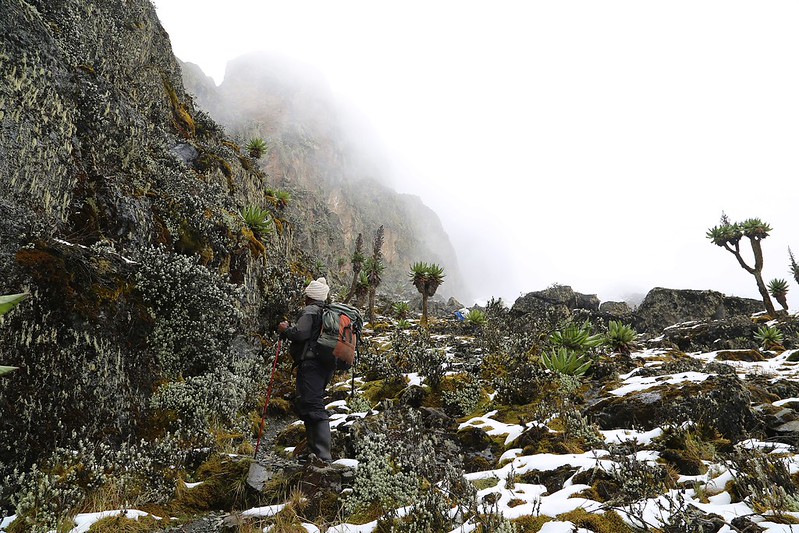
Day Three carries you through the single most spectacular botanical transition on the Kilembe Trail: the transformation from montane forest into the giant heather zone. The bamboo appears first, in dense, hollow-echoing groves that filter sound and light equally, before giving way to Erica arborea trees of extraordinary size, their trunks so completely covered in old man’s beard lichen and sphagnum moss that the wood beneath has effectively been replaced by living matter. These are heather trees of the kind that exist nowhere else on earth, shaped over decades by the Rwenzori’s unique combination of altitude, moisture, and equatorial light.
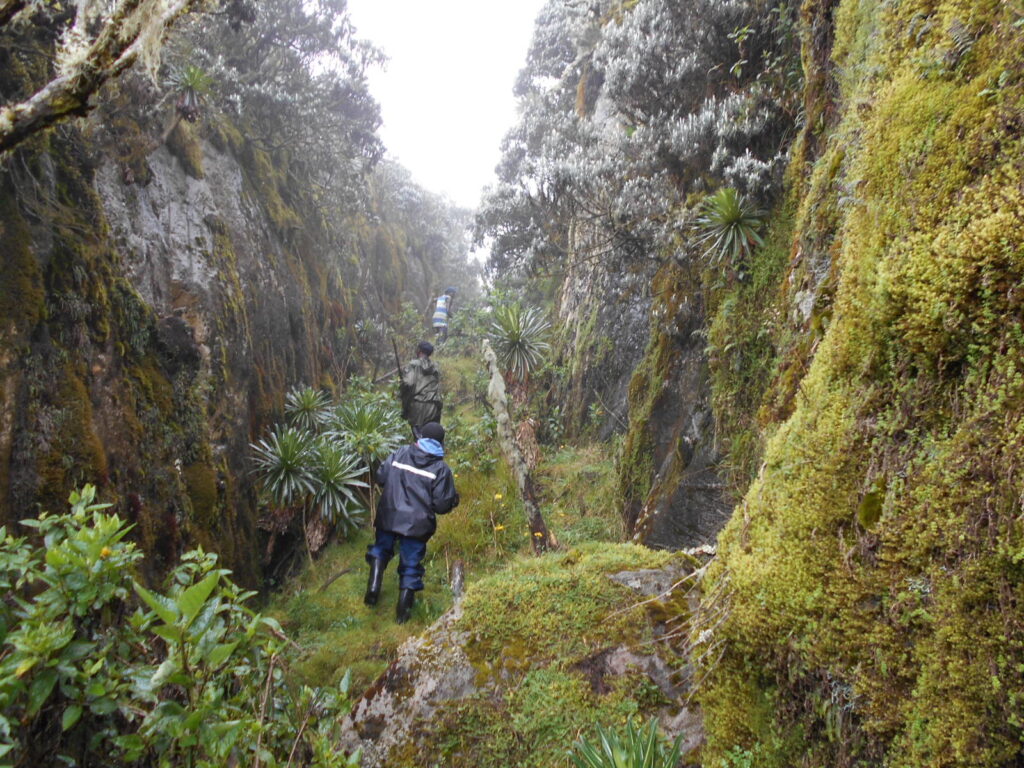
The giant lobelias make their first significant appearance today. Lobelia wollastonii, the Rwenzori’s signature plant, stands two to five meters above the heather floor in silver-grey magnificence, each plant a rosette of velvet leaves protecting a central column of flower structure that has been described by everyone who encounters it for the first time as belonging to another planet. The Dendrosenecio groundsel trees punctuate the ridgelines with their umbrella canopies, some of them a century old, their silver-backed leaves catching the diffused Rwenzori light with photographic precision.
Mutinda Camp, at 3,688 meters, sits on an open ridge with genuine east-facing views across the Rift Valley plains far below, a perspective that makes the altitude suddenly tangible. The optional acclimatization excursion to the 3,925-meter viewpoint above camp is a worthwhile investment of an hour: the first panoramic view of the higher massifs and a valuable physiological step-up before tomorrow’s move to Bugata. Your guide assesses altitude responses quietly and consistently throughout the day. Dinner at Mutinda is hot, caloric, and served in the particular warmth of a mountain hut with the cold pressing in on every side.
Accommodation & Meals: Mutinda Camp Hut (3,688 m). Full-board meals. Optional acclimatization ascent to the 3,925m viewpoint after arrival.
Day 4: Mutinda Camp (3,688m) – Bugata Camp (4,062m) | ~8.6 km | 5–7 hours
Day four of the 18-day Rwenzori trek to eight peaks showcases the Rwenzori in its full Afro-alpine expression. The Namusangi Valley corridor, traversed today, is the botanical heart of the range, a landscape of giant lobelias standing six meters tall in silver congregation, century-old groundsel trees spreading their canopies above the bog, everlasting flowers covering the open moorland in silver and white, and cushion plants filling the spaces between rock outcrops with a density that suggests a vast, slow garden tended by forces not entirely natural. This landscape exists nowhere else on earth. It is a product of millions of years of evolutionary isolation at equatorial altitude, and the effect on every first-time visitor is the same: a deep, speechless recognition that the world contains more than the mind had previously made room for.
The waterfalls that punctuate the valley floor are fed by meltwater from the glaciers above—water that has traveled from ice to stream to waterfall in a single day, connecting the expedition’s highest objective to its lowest terrain in one continuous system. As the valley broadens, Weismann Peak comes into clear view above the ridgeline to the south: tomorrow’s first summit, its summit plateau visible and accessible from this distance. Your guide identifies the approach lines with the quiet authority of someone who has made that ascent many times.
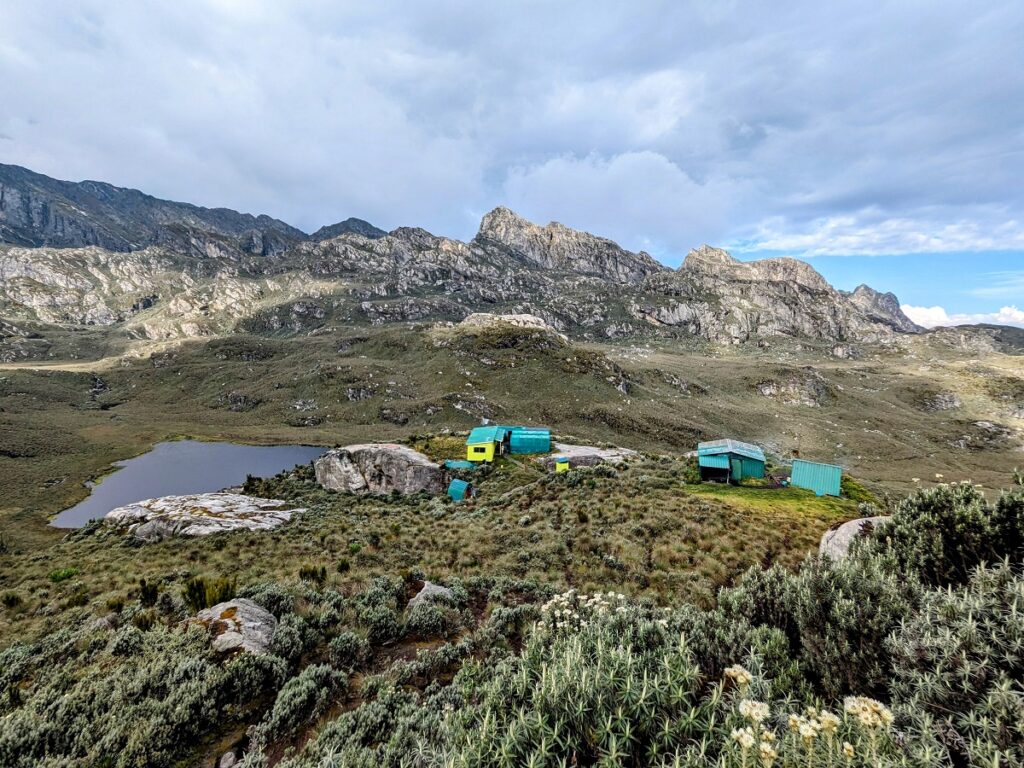
Bugata Camp, at 4,062 meters, is the last camp before the summit sequence begins. Temperatures drop sharply after sunset, all thermal layers emerge tonight, and the sleeping bag rating is no longer theoretical. The Weismann summit briefing takes place after dinner: departure time, approach route, expected conditions, and the physical signs your guide will be monitoring throughout.
Accommodation & Meals: Bugata Camp hut (4,062 m). Full-board meals. First summit briefing this evening. All thermal kits are out and ready.
Day 5: Summit One: Weismann Peak, Mount Luigi di Savoia (4,620 m)
Bugata Camp (4,062 m) – Weismann Peak (4,620 m) – Return to Bugata | ~8 km | 6–8 hours
The first summit morning arrives before the sun. The alarm at five o’clock brings a cold that is clarifying rather than unwelcome, the body recognizing that something purposeful is about to happen and responding accordingly. Weismann Peak, at 4,620 meters on Mount Luigi di Savoia, is a non-glaciated summit approached on rocky terrain above the alpine bog, and its character as the expedition’s opening summit is deliberately chosen: physically demanding, genuinely rewarding, and technically accessible enough to allow the body’s first high-altitude summit experience without the added complexity of glacier travel.
The ascent gains the ridge system that leads to Weismann’s summit plateau, the views expanding southward with every hundred meters of altitude gained. From the summit on a clear morning, the full Rwenzori spine reveals itself for the first time in its complete ambition: Mount Baker to the north, Mount Stanley’s glaciated crown beyond it, and the rolling moorlands below threading between the massifs in ancient, water-carved valleys. To stand here and understand, not abstractly but visually, spatially, and physically, the scale of what the next seventeen days will traverse is one of the expedition’s most important single moments.
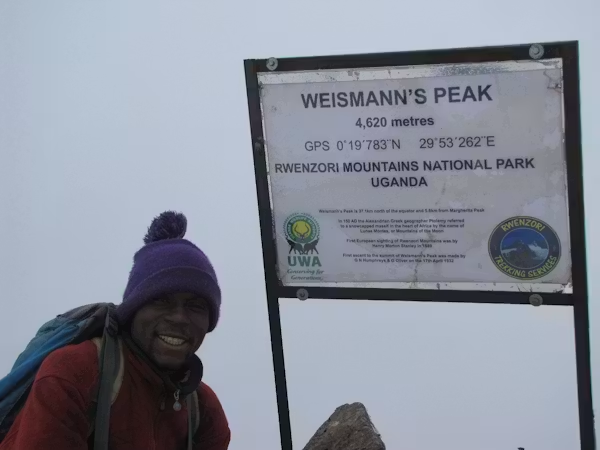
The return to Bugata Camp by mid-afternoon allows for proper rest, hydration, and the quiet pride of an opening summit achieved. Your cook produces a substantial dinner. The expedition has begun in earnest; seven summits remain.
Accommodation & Meals: Bugata Camp hut (4,062 m). Full-board meals. Summit certificate for Weismann Peak. Rest and recovery this afternoon.
Day 6: Bugata Camp (4,062m) – Bamwanjara Pass (4,450 m) – Butawu/Hunwick’s Camp (3,974 m) | ~8.3 km | 6–8 hours
Bamwanjara Pass, at 4,450 meters, is the expedition’s first great ridge crossing, the geographic boundary between the southern massifs and the central zone of the range, and a viewpoint of extraordinary power. The ascent from Bugata climbs through the last lobelia and groundsel zones onto bare rock and open alpine terrain, where the sky suddenly dominates the view and the panorama stretches in every direction with an excessive expansiveness, as if the landscape is trying to show something about scale that no lesser geography can communicate.
From the pass itself, three glaciated massifs are visible at once: Mount Stanley to the northwest, its ice-bearing summits precisely identified by your guide; Mount Baker immediately to the north, tomorrow’s objective; and Mount Speke to the northeast, its rocky faces catching the morning light. This is the expedition’s first multi-peak panorama, and the visual inventory it delivers, with all three of the next summit targets visible from a single standing point, is one of the defining moments of the traverse.
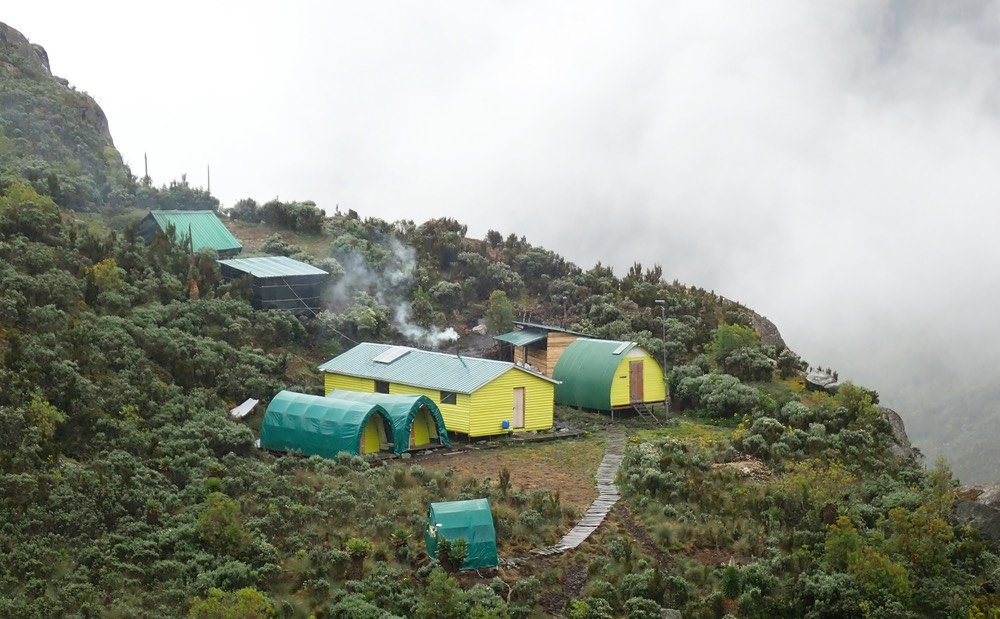
The descent from Bamwanjara crosses glacially scoured Precambrian rock and ancient moraine deposits, which are geological evidence of the much larger glaciers that once dominated these mountains. Butawu Camp, at 3,974 meters, positioned in a sheltered valley with direct sight lines to the Baker massif above, receives the expedition with a particular functional importance: this camp is the Baker staging point, and the briefing tonight covers the summit approach in tactical detail. Crampons are inspected. Departure time is confirmed at four o’clock.
Accommodation & Meals: Butawu/Hunwick’s Camp Hut (3,974 m). Full-board meals. Summit briefing for Edward Peak. Crampons inspected and fitted.
Day 7: Summit Two: Edward Peak, Mount Baker (4,844m)
Butawu Camp (3,974 m) – Edward Peak (4,844 m) – Return to Butawu | ~9 km | 7–10 hours
The four o’clock alarm at Butawu Camp has a different quality from yesterday’s: colder, darker, and carrying the specific charge of a technical summit morning. Crampons are fitted by headlamp. The rope is clipped. Your lead guide assembles the summit team in the pre-dawn darkness with the calm efficiency of someone for whom this preparation is both ritual and profession, and the ascent begins.
The approach to Edward Peak on Mount Baker at 4,844 meters climbs through rocky terrain above the camp by headlamp, the trail rising steeply before the Baker Glacier comes into view, smaller than the Stanley ice but genuine, ancient, and demanding of proper technical respect. The glacier crossing requires crampons and roped travel; your guide manages the ice assessment, the line selection, and the group’s movement across the surface with the unhurried confidence of deep familiarity. Above the glacier, the final rocky approach to the summit requires scrambling and full-body engagement with the rock.
Dawn arrives during the upper ascent. The eastern sky ignites amber and gold as Edward Peak’s summit comes into reach, and from the top at 4,844 meters, in the full light of an equatorial sunrise, the silhouette of Mount Stanley’s twin glaciated peaks emerges to the northwest with a clarity that stops everyone mid-breath. This is the first moment the Stanley summits are seen from a vantage that communicates exactly what they require: the glacier, the height, and the route. Two of those peaks are four days away. The knowledge settles into something that is simultaneously anticipatory and quietly solemn.
Accommodation & Meals: Butawu/Hunwick’s Camp Hut (3,974 m). Full-board meals. Summit certificate for Edward Peak. Complete rest this afternoon.
Day 8: Butawu Camp (3,974m) – Kitandara Lakes (4,023m) – Margherita Camp (4,485 m) | ~5.5 km | 4–6 hours
Day 8 of the 18-day Rwenzori trek to 8 peaks is a transitional day whose apparent brevity conceals its strategic importance. Moving from Butawu Camp to Margherita Camp at 4,485 meters, positioned directly at the foot of the Stanley Glacier, is the single most critical altitude step of the expedition. Everything about today is designed to maximize the physiological preparation for what the next two days will demand.
The route passes through Lake Kitandara at 4,023 meters, one of the most beautiful high-alpine lakes in East Africa, a twin glacial tarn set in a broad, serene hollow where the dark water mirrors the rock walls above with reflective precision. The stillness here, on mornings when the wind has not yet arrived, is total and rare. Your guide identifies the Scott-Elliot Pass trail above the lake’s northern shore, the historic crossing named for the 1895 explorer, one of the Rwenzori’s classic high traverses, and the ascent from the lake begins.
Margherita Camp, at 4,485 meters, is the highest permanent camp on the Kilembe Trail. Perched on a narrow rocky shelf with the Stanley Glacier visible and enormous directly above, it is one of the most dramatically positioned mountain camps in Africa and one of the coldest. Temperatures here regularly drop to -10°C or below overnight. Eat everything your cook prepares. Drink more water than seems necessary. Sleep as early as the altitude and the anticipation permit. The alarm is set for three-thirty. Tomorrow is the day.
Accommodation & Meals: Margherita Camp (4,485m). Full-board meals, caloric priority tonight. Glacier briefing and final equipment check after dinner.
Day 9: Summit Three: Margherita Peak (5,109 m), Africa’s Third Highest
Margherita Camp (4,485 m) – Margherita Peak (5,109 m) – Return to Margherita Camp | 7–10 hours
At three-thirty in the morning, the dark inside Margherita Camp is absolute, and the cold is immediate and serious. The first act of the day, pulling on every thermal layer before the sleeping bag is surrendered, requires the discipline of someone who knows that the next several hours will demand everything the body has built over eight days of progressive acclimatization. Breakfast is brief and caloric. Your guide speaks in the quiet, focused shorthand of a summit morning. Crampons are fitted. The rope team assembles in headlamp light. The glacier is above.
The ascent of the Stanley Glacier from Margherita Camp is the most technically demanding and most emotionally significant undertaking of the entire eighteen-day expedition. The ice is ancient, formed over thousands of years at the equator through a climatic improbability that is now also in irreversible retreat. Crampon placements on the glacier surface are deliberate and certain. Fixed ropes protect the steepest sections. Your guide reads the glacier’s condition in real time, surface texture, crevasse locations, and the subtle signs that distinguish a safe line from an inadvisable one with the expertise that only comes from having crossed this ice hundreds of times.
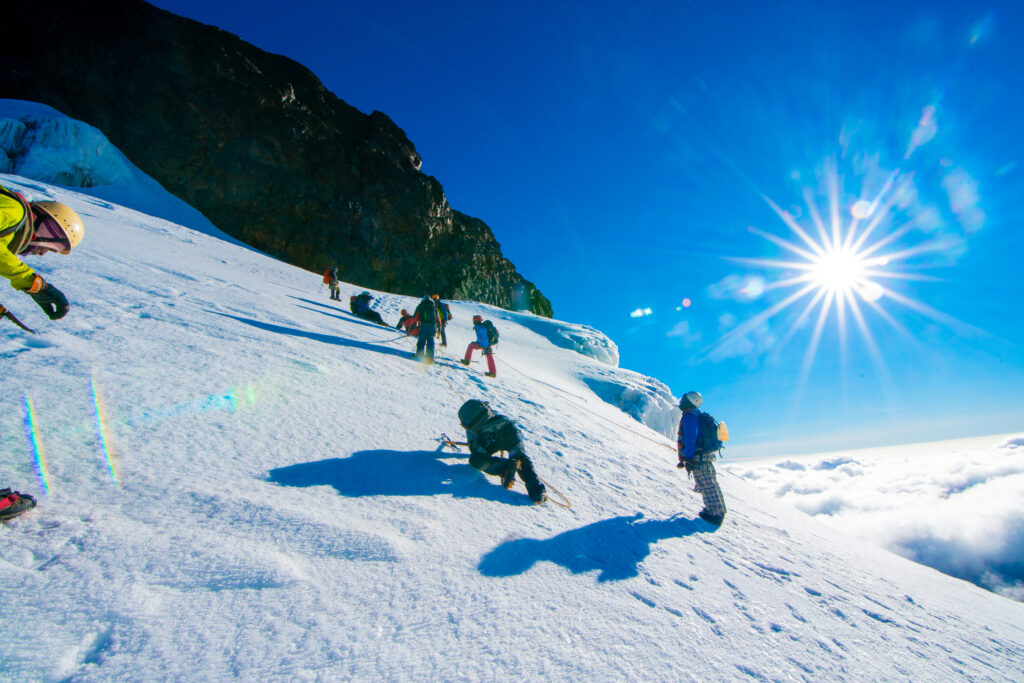
Dawn comes during the upper ascent, arriving in the slow, layered way of equatorial mornings at altitude: grey first, then amber along the eastern horizon, then gold, then the full spectrum of a sunrise that lights up the Congo Basin to the west in colors that have no adequate names. The summit of Margherita Peak at 5,109 meters, Africa’s third-highest point, the roof of Uganda, and the apex of the Rwenzori Mountains arrive without ceremony. Just a moment when the ice beneath your feet levels off, and the horizon appears in every direction, and the body understands before the mind does what has just been accomplished.
The descent returns to Margherita Camp by late morning. The remainder of the day belongs entirely to rest, nutrition, and the particular internal processing that follows a summit of this significance. Tomorrow brings Alexandra Peak. The mountain is not finished with you yet.
Accommodation & Meals: Margherita Camp (4,485m). Full-board meals. Summit certificate for Margherita Peak, Africa’s third-highest summit. Rest completely.
Day 10: Summit Four: Alexandra Peak (5,083m),
Margherita Camp (4,485 m) – Alexandra Peak (5,083 m) – Return | 6–9 hours
Alexandra Peak, at 5,083 meters, is Mount Stanley’s second summit, and reaching it from Margherita requires crossing the icy arête between the two peaks, the single most technically demanding traverse section of the entire eighteen-day expedition. The two summits are separated by approximately 500 meters of horizontal distance across a glaciated ridge where the exposure is significant, the footing requires absolute precision, and the rope discipline between guide and trekker is at its most purposeful. This is the moment in the expedition when mountaineering becomes the focus rather than trekking.
Many experienced mountaineers report that Alexandra carries a greater psychological intensity than Margherita despite sitting 26 meters lower. The cumulative physical state, two nights at 4,485 meters, and the Stanley Glacier behind you from yesterday combine with the technical demands of the arête to create a summit day that is simultaneously the expedition’s hardest and most memorable single experience. The guide is in front on the arête, setting the pace and managing the rope, and your trust in that expertise is the thing that makes the crossing possible and safe.
From the summit of Alexandra Peak, looking back across the arête to Margherita, the route of yesterday’s climb is visible in complete detail. The Elena Glacier below is one of the Rwenzori’s largest remaining ice bodies, and from Alexandra’s height its retreat is dramatically visible, the dark rock scars where ice formerly pressed against the mountain telling the story of the last century of warming in a single glance. The descent to Margherita Camp is measured and careful. Four summits are in the body’s permanent record. Four remain.
Accommodation & Meals: Margherita Camp (4,485m). Full-board meals. Summit certificate for Alexandra Peak. Extended rest—tomorrow begins the traverse toward Cheptegei.
Day 11: Summit Five: Cheptegei Peak (4,907m) and the Traverse to Speke
Margherita Camp—Cheptegei Peak (4,907 m)—Elena/Speke Base Camp (~4,300–4,500 m) | Full day
Cheptegei Peak, at 4,907 meters, is the third summit on the Mount Stanley massif and one of the least visited major Rwenzori peaks by any expedition. Its inclusion in the 18-day Rwenzori 8-peak trekking itinerary is one of the program’s distinguishing features: a commitment to completeness that shorter itineraries cannot deliver. The approach from Margherita Camp involves descending and contouring around the Stanley massif before ascending to the Cheptegei summit via a rocky approach that is less technically demanding than the Alexandra arête but requires sustained physical output from a body now carrying three consecutive summit days’ worth of effort.
From Cheptegei’s summit at 4,907 meters, the complete eight-peak itinerary reveals itself as a spatial reality for the first time: to the south, the Baker massif and Weismann Peak are already behind you; to the east, the Rwenzori’s Bujuku Valley is far below; to the north, the Speke massif is immediately adjacent, and tomorrow’s objective is visible in clear conditions. The geography resolves into personal history as you stand on each summit: not a map, but a landscape you have moved through with your own legs.
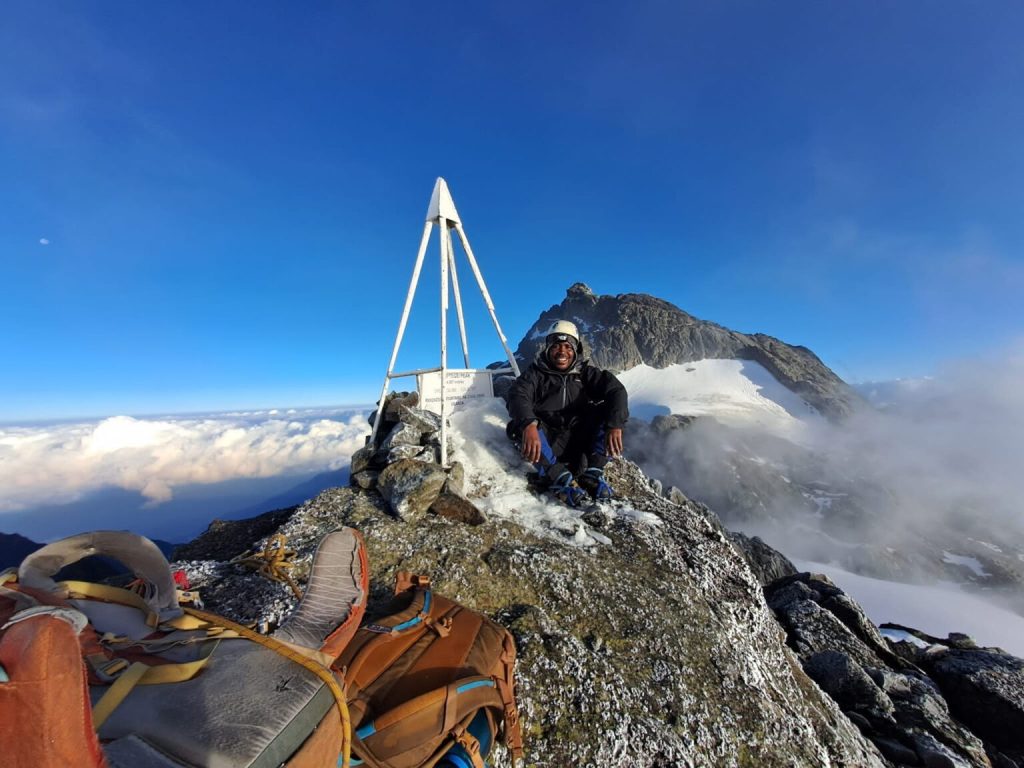
The traverse from Cheptegei toward Elena Camp begins the movement into the Speke zone, a descent and re-approach through high rocky terrain that your guide navigates with the intimate route knowledge that makes this section possible. Elena Camp, positioned between the Stanley and Speke massifs on an exposed rocky shelf, is one of the most remote overnight points on the entire expedition. You will likely have it entirely to yourself. The silence at this elevation, on a clear night, is complete.
Accommodation & Meals: Elena/Speke Base Camp (~4,300–4,500m). Full-board meals. Five summits achieved. Tomorrow: Mount Speke.
Day 12: Summit Six: Vittorio Emanuele Peak, Mount Speke (4,890m)
Elena/Speke Base (~4,300 m) – Vittorio Emanuele Peak (4,890m) – Return to camp | 6–8 hours
Mount Speke’s Vittorio Emanuele Peak at 4,890 meters has a personality distinctly its own among the Rwenzori’s major summits. Less glaciated than Stanley and more rocky and scrambling in character, the approach from Elena Camp climbs through the Speke massif’s lower faces before gaining the upper ridge, a sustained, demanding ascent that requires confident footwork on exposed rock, with some sections that require both hands and serious attention.
By Day Twelve, the expedition’s body is operating in a register unlike anything in ordinary life. The accumulated altitude, the consecutive days of effort, and the disrupted sleep at high camps—all of these combine to create a physical state that, paradoxically, can deliver some of the clearest and most focused mental experiences of the entire journey. The summit of Vittorio Emanuele Peak frequently arrives through Rwenzori mist, an atmospheric condition that, rather than diminishing the achievement, concentrates it. The mountain encloses you, and the summit moment is entirely interior, entirely personal, entirely yours.
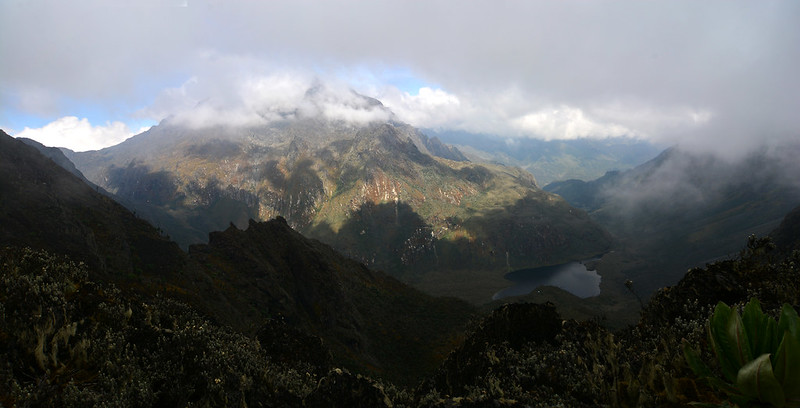
On clear mornings, the view from Speke is the expedition’s most comprehensive panorama: the full arc of the Rwenzori spine from north to south, the Stanley summits behind you, and the Gessi and Emin massifs ahead. Six summits. Two remain in the northern wilderness.
Accommodation & Meals: Elena/Speke Base Camp or the first northern traverse camp. Full-board meals. Summit certificate for Vittorio Emanuele Peak. Begin the northern arc tomorrow.
Day 13: Elena Camp – Long northern traverse – Northern Base Camp (~3,800–4,200 m) | 7–9 hours
Day thirteen of the 18-day Rwenzori trek to eight peaks is the expedition’s great connecting movement: a long, demanding traverse from the Speke zone northward into the territory of the Rwenzori’s most remote massifs. The descent from Elena takes the group through rocky alpine terrain, then through the upper groundsel forest, and finally into the broader Afro-alpine moorlands of the northern range, where the landscape opens dramatically and the sense of remoteness becomes genuinely absolute for the first time on this expedition.
The northern zone of the Rwenzori receives fewer visitors than any other section of the range. The ancient Dendrosenecio groundsel trees here are among the largest and oldest in the park, specimens that have been growing since before any living person was born; their umbrella canopies spread above the path with the authority of the permanent and the irreplaceable. Your guide moves through this terrain with the intimate knowledge of someone who has walked it many times and never ceased to find something new in it.
The northern base camp, positioned to access both Gessi and Emin on consecutive summit days, is one of the most rarely visited overnight points in the entire park. The evening here, with the two remaining summit massifs visible above camp and the full weight of twelve days’ achievement behind you, carries a quality of anticipation that is different from every previous summit eve. Two peaks remain. The crown is within reach.
Accommodation & Meals: Northern Base Camp (~3,800–4,200m). Wild camping with tents erected by your team. Full-board meals. Final summit sequence briefing.
Day 14: Summit Seven: Bottego Peak, Mount Gessi (4,715m)
Northern Base → Bottego Peak (4,715 m) → Return to camp | 6–9 hours
Mount Gessi’s Bottego Peak, at 4,715 meters, is Rwenzori’s most rarely climbed major summit, a distinction that reflects its remote position and the demanding nature of its approach, not its magnificence. Named for Vittorio Bottego, the Italian explorer who passed through this region in the 1890s, the peak rises from the Gessi massif with an aloof independence that belongs entirely to its position at the far northern arc of the range.
The approach from the northern base camp carries you across terrain where no marked trail exists; your guide’s knowledge is the route, and the rock faces of the Gessi massif rise above an approach zone of ancient bog and heather that requires both physical effort and navigational trust. The scramble to Bottego Peak’s summit is the most vertically exposed ascent of the expedition’s northern section: sharp Precambrian gneiss and granite sculpted by glacial action into arêtes and faces with significant drop-offs that demand steady concentration and complete trust in your footing.
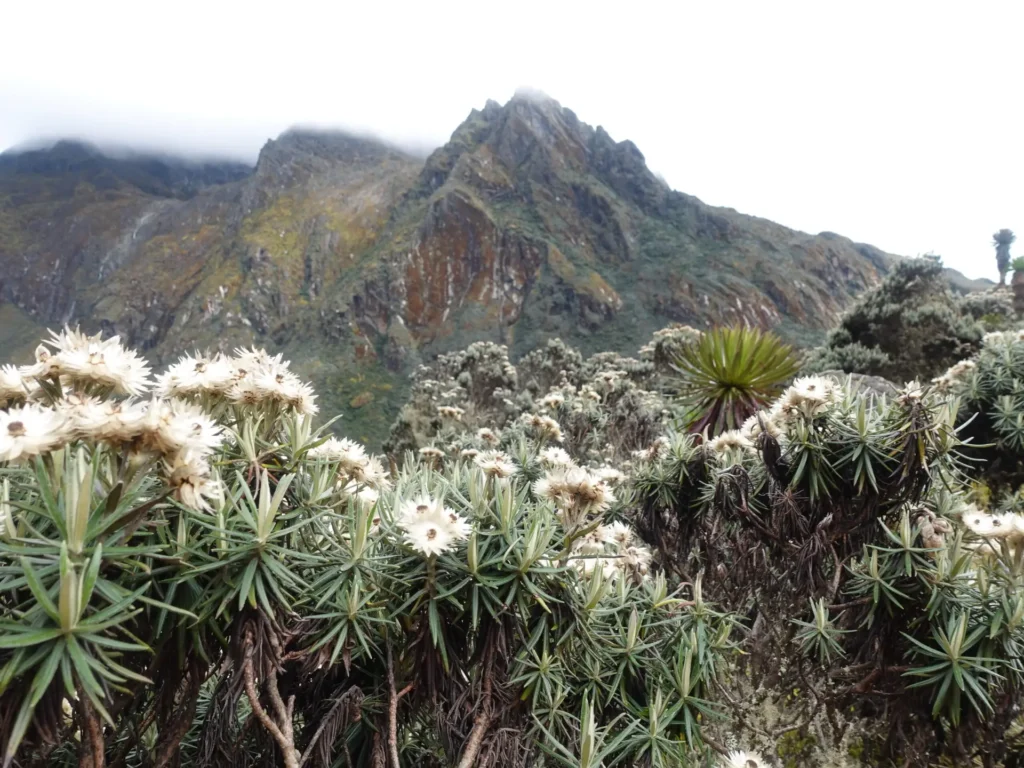
From the summit at 4,715 meters, the full panorama of the eight-peak traverse is visible to the north: Mount Emin is immediately adjacent to the east, yesterday’s Speke summit is visible to the south, and the enormous green immensity of the Congo basin fills the western horizon from ridge-top to sky. You are, at this moment, standing on one of the least visited major summits in Africa, having reached it through seventeen days of continuous effort. One peak remains.
Accommodation & Meals: Northern Base Camp. Full-board meals. Summit certificate for Bottego Peak. Tomorrow: Mount Emin and the complete crown.
Day 15: Summit Eight: Umberto Peak, Mount Emin (4,798m)
Northern Base – Umberto Peak (4,798 m) – Return to camp | 7–10 hours
The eighth and final summit morning of the 18-day Rwenzori trek to the 8-peaks grand expedition has a quality that no other morning on this mountain has. The alarm sounds in the pre-dawn darkness as it has on every summit day; the cold is familiar and no longer surprising, and the preparation ritual (layers, boots, pack, and poles) is executed with the efficiency of deeply established habit. But everything feels different this morning, because today is the day the expedition is complete.
Mount Emin’s Umberto Peak, at 4,798 meters, is reached via exposed ridgeline terrain with sections of genuine scrambling on rock that is sharp and loose in places, demanding concentration throughout. The upper approach carries you along a ridge with significant exposure on both sides, your guide managing the route with familiar calm authority, and the rope discipline as precise as it was on Day Seven, because the mountain does not reduce its requirements simply because you have been on it for two weeks.

The summit arrives. Eight summits. Six massifs. Eighteen days on the Mountains of the Moon. Africa’s complete Rwenzori crown, in a single continuous expedition. The view from Umberto Peak at 4,798 meters encompasses the entire range you have traversed, every massif, every camp, and every summit now part of a single lived geography rather than a route on a map. The Congo Basin extends westward without limit. Uganda’s Rift Valley falls away to the east. The sky at this altitude is a color that exists nowhere else. You have done something that very few people alive have done, and that number is not growing quickly.
The descent to camp is measured, careful, and accompanied by a quality of inner quiet that does not require explanation to anyone who has ever finished something genuinely difficult.
Accommodation & Meals: Northern Base Camp. Full-board dinner. Full set of eight summit certificates presented this evening. The mountain crown is yours.
Day 16: Northern Base: Long southern traverse | Bugata Camp (4,062 m) | ~12–15 km | 8–10 hours
Day 16 of the 18-day Rwenzori trek to 8 peaks closes the northern loop and begins the long arc of return. The traverse southward from the Emin and Gessi zone carries the expedition back through the moorland valleys and reascends to Bugata Camp, a camp departed eleven days ago at the start of the summit sequence, now returned to with eight peaks behind you and a body that has given more than it knew it had.
The botanical transitions on this traverse carry a different quality on the return journey. The giant lobelias and groundsels, seen for the first time on Day Four with the freshness of the entirely new, are now familiar presences, each specific plant remembered, it seems, from the outward journey, and the landscape is less strange and more intimate. This familiarity with the Rwenzori’s most extraordinary terrain is one of the gifts that an eighteen-day expedition delivers that no shorter journey can: the difference between encountering a landscape and knowing it.
Bugata Camp receives the expedition with the warmth of a familiar camp. Dinner here, eleven days after the first night, tastes different, the cook’s same preparations elevated by the accumulated experience of everything that has happened in between. Eight summits. The descent begins tomorrow.
Accommodation & Meals: Bugata Camp hut (4,062 m). Full-board meals. Long day; rest is essential tonight.
Day 17: Bugata Camp (4,062 m) – Sine Camp (2,596 m) | ~13 km | 5–7 hours
The descent from the alpine zone takes you through every vegetation zone you climbed on the outward journey, but in reverse and within a single day, creating a rapid altitudinal compression that makes the ecological transitions feel almost cinematic. The sparse rockscape of the Bugata zone gives way to the first groundsels and lobelias, then to the dense heather forest, then to the bamboo groves, and finally to the rich montane forest of the lower slopes, where the air thickens and warms with every hundred meters of descent.
Bird calls return: turacos, sunbirds, flycatchers, and the complex avian orchestra of the Afro-montane forest that has been absent above the heather line for over a week. The sound is both a return and a revelation, the forest’s acoustic richness appreciable only after the relative silence of the high alpine zone. The smell of the lower forest, damp earth, and decomposing vegetation and the sweetness of flowering trees in the canopy arrive as a physical sensation after the mineral-clean air of the high camps.
Sine Camp, at 2,596 meters, reached in the mid-afternoon, feels almost tropical after seventeen days at altitude. The forest presses close on every side. The night sounds are entirely different from anything heard above the heather line. Tonight’s dinner carries the quiet dignity of an expedition that is complete in everything but its final descent.
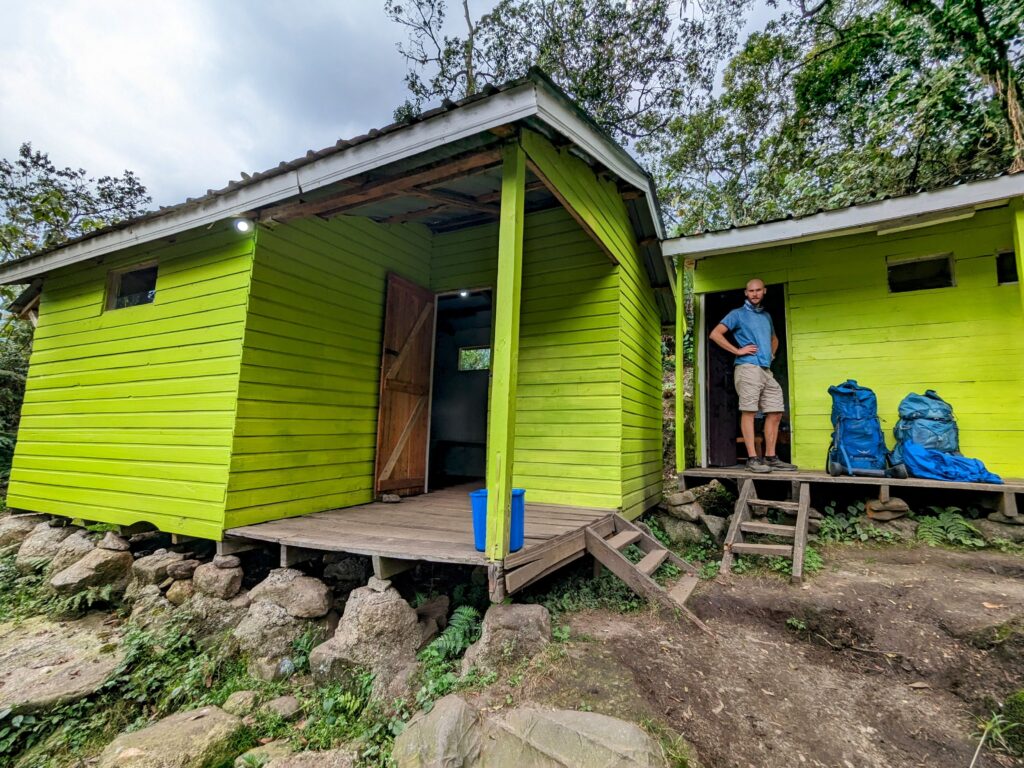
Accommodation & Meals: Sine Camp hut (2,596 m). Full-board meals. The final mountain night.
Day 18: Sine Camp (2,596 m) – Kilembe Trailhead (1,450 m) – Kasese | ~9.5 km | 4–5 hours
The final morning on the mountain. The forest below Sine Camp receives you with the full complexity of Afro-montane life: duiker in the undergrowth, colobus monkeys in the upper canopy, and the sound of the Nyamwamba River growing steadily louder as the trail descends toward the valley floor. Every footstep of this last morning is a recalibration, the body finding its lower-altitude register, the mind releasing the compressed focus of eighteen summit-pursuing days and beginning the slow, rich process of integrating what has happened into the permanent record of a life.
The suspension bridge above the Nyamwamba River, crossed at the beginning of Day Two in the charged anticipation of a mountain still entirely ahead, crosses again at the end of Day Eighteen with eight summits behind you. The specific quality of that contrast, experienced in the same body on the same bridge seventeen days apart, is one of the expedition’s final and finest gifts.
At the Kilembe Trailhead, boots come off. The porter team gathers for the distribution of tips, a moment of genuine human exchange, with warmth flowing in both directions between people who have moved through an extraordinary landscape together and know, in the specific way of mountain partnerships, that something was shared that cannot be fully translated into ordinary social language. Your private vehicle returns you to Kasese in twenty minutes. The hotel has been notified. A hot shower and a proper meal await. You have completed the 18-Day Rwenzori Eight-Peak Grand Expedition, one of the rarest mountaineering achievements available to any trekker alive today.
Accommodation & Meals: Kasese hotel (post-trek night). Celebration dinner. Complete set of eight summit certificates presented as a framed collection. Return transfer to Entebbe arranged for the following morning.
What Your 18-Day Rwenzori Trek to 8 Peaks Expedition Covers
The Rwenzori Trekking Expeditions’ 18-day, eight-peak hike package covers every logistical element of the journey, from your arrival transfer to your post-trek hotel and departure logistics. The package is comprehensive, transparent, and designed to ensure that your sole responsibility throughout is the mountain itself. Everything else is ours.
Included in Your Expedition Package
Private vehicle transfers: Entebbe or Kampala to Kasese (arrival) and return | ✓ |
Pre-trek overnight accommodation in Kasese (dinner included) | ✓ |
Post-trek overnight accommodation in Kasese (dinner included) | ✓ |
All UWA national park entry fees for 17 nights on the mountain | ✓ |
All 8 individual peak summit permits across all 6 massifs | ✓ |
One certified professional lead mountain guide (private for your group only) | ✓ |
Assistant mountain guides (scaled to group size; enhanced ratio for technical summit days) | ✓ |
Dedicated porter team for personal kit portage up to 15 kg per trekker | ✓ |
Dedicated mountain cook for full-board, hot breakfast, packed lunch, and three-course dinner daily | ✓ |
All mountain hut accommodation across established camps (17 nights) | ✓ |
Wild camping tents, groundsheets, and sleeping mats for northern zone nights (Emin/Gessi base) | ✓ |
Rubber boots in all available sizes (mandatory for Kilembe Trail bog sections) | ✓ |
Crampons and ice axes for glacier approaches (Baker, Margherita, Alexandra, Cheptegei) | ✓ |
Harnesses, helmets, and carabiners for technical sections | ✓ |
Fixed-line ropes on all glaciated and exposed summit sections | ✓ |
Emergency oxygen canister carried by the guide team throughout | ✓ |
Comprehensive wilderness first-aid kit and medical monitoring equipment | ✓ |
UWA-mandated rescue fund levy | ✓ |
Pre-trek full equipment inspection and technical gear briefing | ✓ |
Daily altitude acclimatisation monitoring throughout by a certified guide | ✓ |
Complete set of all eight summit certificates, framed and presented on expedition completion | ✓ |
10% of expedition proceeds are directed to Bakonzo community programs and local schools. | ✓ |
Not Included
International flights to and from Entebbe International Airport | ✗ |
Uganda tourist visa (obtainable online at visas.immigration.go.ug or on arrival) | ✗ |
Comprehensive travel and medical insurance with mountaineering cover above 5,000 m and helicopter medical evacuation are MANDATORY for this expedition. | ✗ |
Personal sleeping bag (minimum -15°C rating for Margherita Camp, which regularly reaches -12°C or below with wind chill) | ✗ |
Personal trekking equipment: thermal layers, waterproof hardshell jacket and trousers, gaiters, trekking poles | ✗ |
Personal porterage above the 15 kg per-trekker guideline | ✗ |
Alcoholic beverages and personal expenditure | ✗ |
Personal medications and altitude sickness prophylactics (Diamox/acetazolamide; consult your physician) | ✗ |
Personal snacks, energy gels, and electrolyte supplements for 18 days | ✗ |
Gratuities for guides and porters, entirely discretionary but warmly appreciated and genuinely life-changing | ✗ |
Optional Uganda extensions: gorilla trekking in Bwindi, wildlife in Queen Elizabeth, chimpanzee trekking in Kibale | ✗ |
Physical Preparation: Who Is This 18-Day Rwenzori 8-Peak Expedition For?
The 18-Day Rwenzori Eight-Peak Grand Expedition is the hardest Rwenzori program available, and it demands an honest assessment of physical capability and experiential background before a booking is confirmed. This is not a Rwenzori expedition for the unprepared, and it is not appropriate for trekkers without genuine prior high-altitude multi-day experience. The following assessment is direct, not discouraging; its purpose is to ensure that those who commit to this expedition arrive genuinely capable of completing it safely and fully.
What are the mandatory prerequisites for hiking all 8 peaks of the Rwenzori Mountains?
- Prior high-altitude trekking experience above 4,000 meters is non-negotiable, not as a tick-box but as genuine physiological and psychological preparation for what the Rwenzori, at 5,109 meters, over eighteen days, actually requires.
- Kilimanjaro via a non-technical route provides a useful baseline but is insufficient preparation on its own.
- The 18-Day Rwenzori expedition to 6 peaks is significantly harder than a standard Kilimanjaro climb in duration, technical complexity, and cumulative summit demands.
- Trekkers who have completed the Rwenzori’s own 13-daytrek, 6 peaks Rwenzori trekking expedition, or a technical alpine route in the Alps, Andes, Himalayas, or Atlas Mountains are substantially better positioned.
- Experience with crampons and roped glacier travel, or the genuine willingness to follow precise guide instruction in these techniques, is required for all glacier summit days.
- The expedition also requires a completed minimum six-month structured training program before departure. Cardiovascular output, trail running, stair climbing, and cycling with weighted daypacks on consecutive long hikes build the aerobic base the mountain demands. Leg strength (squats, lunges, step-ups, deadlifts) protects the knees and quads during long descents.
- Mental endurance training, the ability to maintain sustained effort and positive decision-making under fatigue, cold, and altitude, is as important as physical preparation, and the multi-day-long hike training sessions with back-to-back consecutive days are the single best simulator for what the expedition asks.
Acclimatisation Design Within the Itinerary
The 18-Day Rwenzori trek to 8 peaks has the best acclimatization structure of any Rwenzori itinerary: a four-day base-building phase before the first summit, graduated altitude progression, repeated high-sleep / low-sleep patterns on summit days, and rest days integrated after the three consecutive highest-altitude nights. This design significantly reduces acute mountain sickness risk relative to compressed itineraries. Even so, altitude sickness can affect anyone regardless of fitness level; your guide’s daily monitoring, honest communication from every group member, and the absolute commitment to descend immediately when symptoms indicate it are the three protocols that keep this expedition safe.
Are porters required for the Rwenzori Mountains trekking (18-day expedition)?
An eighteen-day, eight-peak Rwenzori expedition requires a substantial and entirely professional support team. For a group of two to four trekkers, the total mountain team typically includes a certified senior lead guide, one or two assistant guides on technical summit days, a dedicated mountain cook, and a porter team scaled at one porter per trekker plus additional shared equipment porters for wild camp nights and technical equipment. The entire team on this expedition can exceed twelve people, all of them UWA-registered, professionally equipped, and drawing wages at or above the Rwenzori Trekking Expeditions‘ mandated minimum.
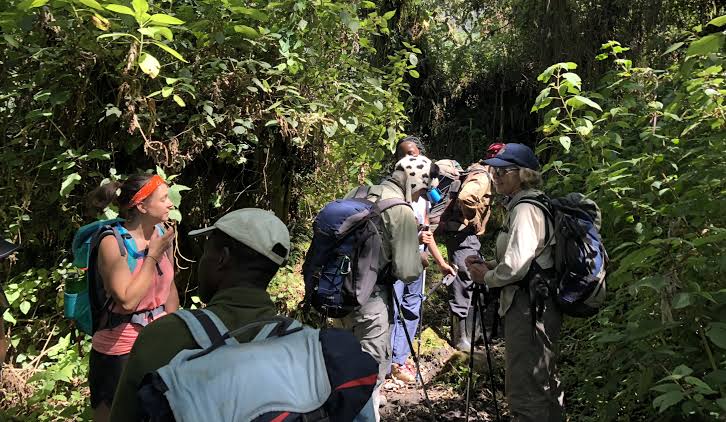
The Bakonzo porters of the Rwenzori are not a logistical convenience. They are the mountain’s memory, having grown up in the shadow of these peaks, knowing the trails in every weather and season, and possessing a physical capability on terrain that would exhaust an unloaded trekker that must be witnessed to be believed. Their expertise, their warmth, and their pride in the mountain they were born beside make up some of the expedition’s most genuinely irreplaceable elements. Tipping generously at the expedition’s close is not a required gesture but a meaningful one; your guide will advise on appropriate amounts at the appropriate time.