A 5-day Rwenzori trek to Weismann Peak allows you to hike to Weismann’s Peak (4,620 m) via the Kilembe Trail, a non-technical Rwenzori summit with breathtaking views of Mount Baker, Mount Stanley, Mount Speke, and Kitandara Lakes. This 5-day trek to Weismann’s Peak via the Kilembe trail costs $870 per person, including $35 per day for national park entrance fees.
Kilembe Trail · Sine Hut · Mutinda Camp · Bugata Camp · Kiharo Camp · Rwenzori Mountains National Park, Uganda
This 5-day Rwenzori trekking itinerary climbs the Kilembe Trail from Kilembe’s Trekkers Hostel to the summit of Weismann’s Peak (4,620m) on Mount Luigi di Savoia, a shorter, more accessible alternative to a full Margherita Peak expedition that still delivers a genuine high-altitude summit, sweeping views of Mount Stanley, Mount Baker, and Mount Speke together, and five full days inside one of the least-visited corners of the Rwenzori Mountains National Park. The 5-day Weismann’s Peak Rwenzori Trek route climbs through Sine Hut, Mutinda Camp, and Bugata Camp before the summit push on Weismann’s Peak and a dramatic descent through the remote Nyamwamba Valley via Kiharo Camp back to the trailhead of the Kilembe trail.
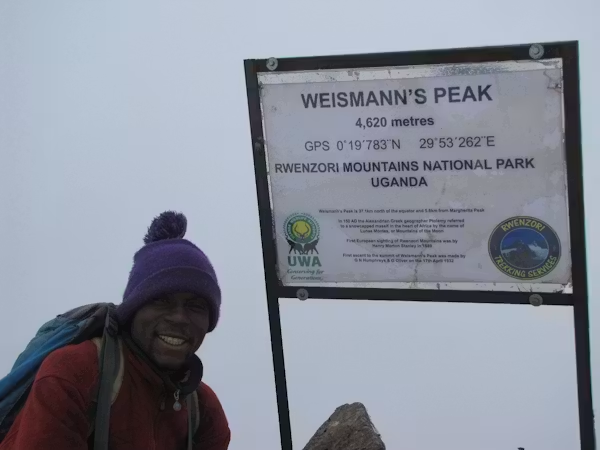 The 5-day Weismann’s Peak trek via the Kilembe Trail is one of East Africa’s best non-technical high-altitude treks: a remote, immersive, expertly guided journey through bamboo forest, moss-draped valleys, and the twin Kitandara Lakes to the summit of Weismann’s Peak at 4,620 meters on Mount Luigi di Savoia, with panoramic views of Mount Stanley, Mount Baker, and Mount Speke that are among the most extraordinary highland perspectives in Africa. Rwenzori Trekking Expeditions guides this route with specialist Kilembe Trail knowledge, the same comprehensive mountain safety protocols they maintain on the flagship Central Circuit trail expeditions, and a commitment to delivering the Rwenzori’s most remote trail at the standard its wilderness demands.
Weismann’s Peak, at 4,620 meters, is the highest point of Mount Luigi di Savoia, one of the Rwenzori’s six major massifs and, on the Kilembe Trail, the natural summit objective for a 5-day Rwenzori trekking itinerary that begins in the copper-mining town of Kilembe and ascends through a series of environments so dramatically different from one another that the five days feel like five distinct journeys. The Kilembe Trail sees a fraction of the foot traffic of the Central Circuit; some weeks, trekkers encounter no other expedition groups from trailhead to summit. This is the Rwenzori in its most private, most unhurried, and most completely wild expression. It is available in every detail, seamlessly arranged, through Rwenzori Trekking Expeditions.
Day 1: Kilembe to Sine Hut | 2,596m · 4–5 hours · height gain: 1,146 m
Your private guide meets you at Trekkers Hostel in Kyanjuki, Kilembe, a short twelve kilometers from Kasese, for a relaxed morning briefing before the walk to the Uganda Wildlife Authority ranger’s post, roughly an hour away, where park fees are settled and the rules of the national park explained in full. From there the trail climbs steadily up the valley floor through Afro-montane forest, with tall hardwoods overhead and a genuine chance of spotting blue monkeys moving through the branches, troops of black-and-white colobus swinging between the canopies, and, on a fortunate day, the rare L’Hoest’s monkey, a species of particular cultural significance to the Bakonjo people.
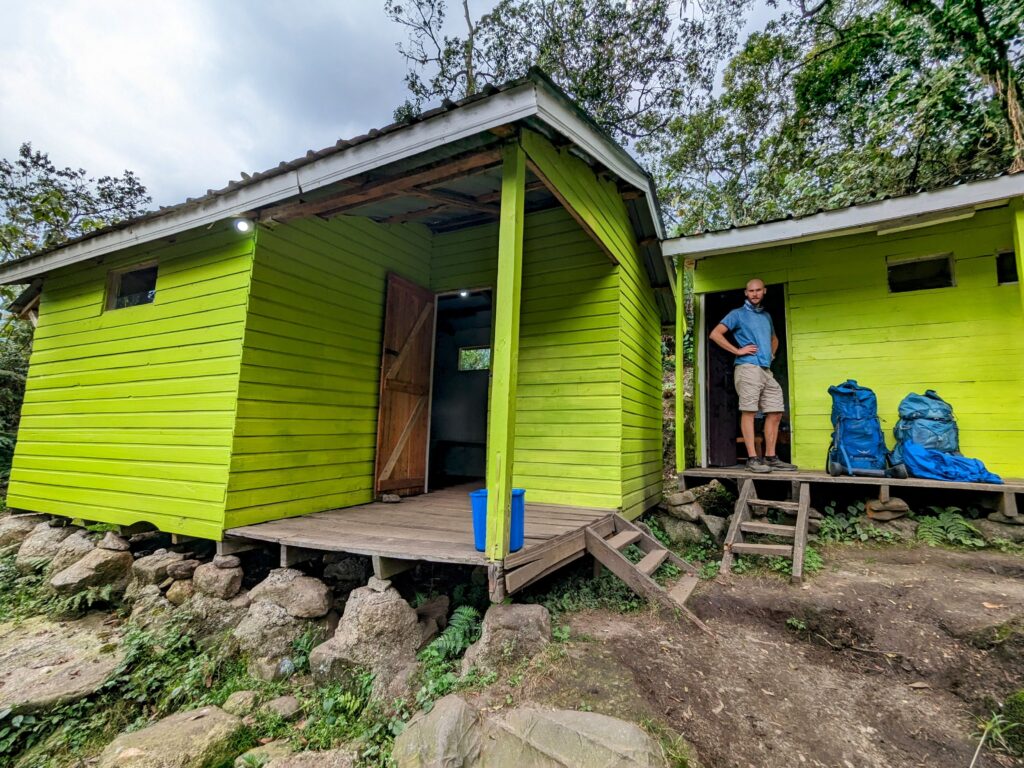
Sine Hut sits on a narrow forested ridge, with wooden huts set among tall trees with a view down onto a dramatic waterfall crashing through the rocks below. Enock’s Falls, just two hundred meters from camp, is worth the short detour before dinner, and many evenings end around a campfire with your guides, trading stories about the mountain and community life in the villages below. Overnight at Sine Hut.
Day 2: Sine Hut to Mutinda Camp | 3,688 m · via Kalalama Camp (3,147m) · with optional lookout hike
The day opens directly into the bamboo-mimulopsis zone, tall, arrow-straight stems climbing steeply with high, uneven steps that can turn genuinely slippery after rain. The reward for the effort is Kalalama Camp at 3,147 m, in the heather-Rapanea zone, a natural spot to pause for tea before continuing. Beyond Kalalama the trail meanders over a series of small knolls along a ridge, crossing streams and passing close to moss-draped waterfalls, climbing steadily beside a river tumbling under giant heather trees hung with old man’s beard lichen.
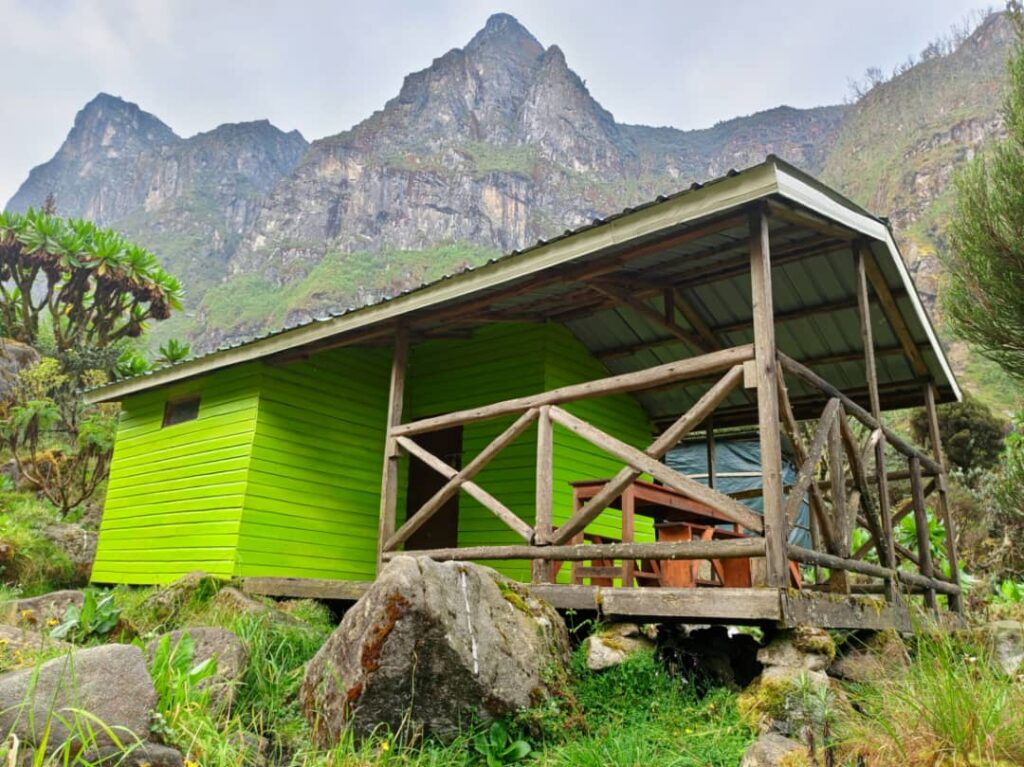
Mutinda Camp is reached by mid-afternoon, leaving time for the optional climb to Mutinda Lookout at 3,925m, a genuinely worthwhile ninety-minute ascent for the acclimatization benefit alone. From moss-covered boulders at the top, views stretch across the Rwenzori range and down to Kasese town and Lake George, a clear preview of the scale of the landscape you are moving through. Overnight at Mutinda Camp.
Day 3: Mutanda Camp to Bugata Camp | 4,062m · 4.9km
Boardwalks now ease what remains a genuinely boggy crossing of the Mutinda Valley, though a little tussock-hopping skill still helps. Giant lobelias, tussock grass, and everlasting flowers crowd the trail before a steep climb up to the Namusangi Valley at 3,840m, which ends abruptly at a set of sheer waterfalls and a fine backward view of the Mutinda Peaks. The valley then widens, undulating across several more bogs on the steady climb to Bugata Camp.
Bugata sits high above Bugata Lake, with views across Lake Kopello toward Weismann’s Peak itself, often dusted with snow, and further down the valley toward Lake Africa and Lake Kanganyika. The area is prime Red Forest Duiker territory, a Rwenzori-endemic subspecies found nowhere else. The camp is well equipped with solar lighting and proper toilets and bathrooms, a welcome comfort ahead of tomorrow’s summit day. Overnight at Bugata Camp.
Day 4: Summit Day: Weismann’s Peak, Down to Kiharo Camp | 4,620m summit · descend to 3,460m · 9 km · 4–6 hours to summit
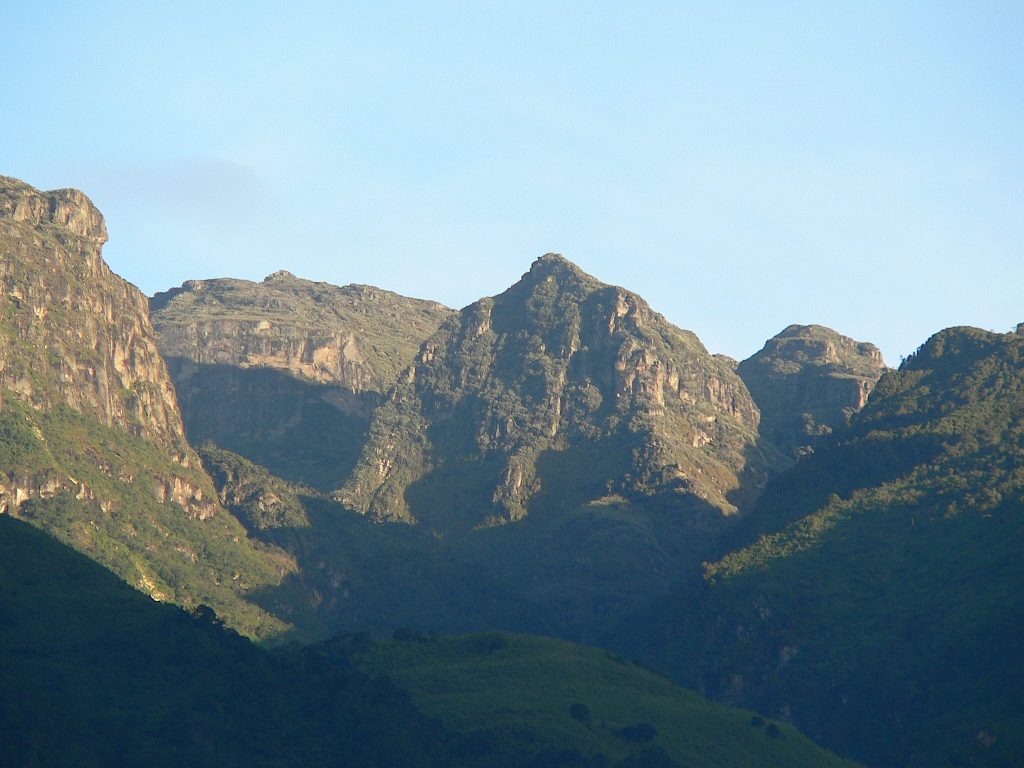
The push to Weismann’s Peak begins with a walk across the hillside below high cliffs above Bugata Lake, rounding a ridge point to reach the edge of Lake Kopello, whose water hovers at a startling two degrees Celsius year-round. Climbing beside the lake delivers expanding views over four glacial lakes strung along the valley below. The final approach steepens onto solid rock, occasionally requiring a fixed rope for safety if conditions are icy, before opening onto Weismann’s broad, gently domed summit, deep moss underfoot and, on a clear day, an unobstructed view of Mount Stanley, Mount Speke, and Mount Baker together. Stella Peak (4,626m), a short distance further along the ridge, is visible from here but is a genuinely technical scramble that our guides do not recommend attempting.
From the summit, the descent drops directly into the Nyamwamba Valley toward Kiharo Camp, passing through a dense stand of giant groundsel and evergreen undergrowth beneath towering rock walls, a landscape shaped by glaciers that melted away millennia ago and left their boulder fields behind. Kiharo Camp, set among evergreen vegetation with a stream running close by, is one of the more atmospheric overnight stops on the entire trail; in the drier months, the calls of rock hyrax echo off the cliffs above camp well after dark. Overnight at Kiharo Camp.
Day 5: Kiharo Camp to Kilembe (The Long Descent) | 1,450m · 16km to the gate, plus 2.8km to Trekkers Hostel · 5–8 hours
Your final day follows the Nyamwamba Valley almost entirely downhill, and by most accounts it is among the most beautiful stretches of trail anywhere in the Rwenzori: moss-covered boulders lining the river, cascading waterfalls at regular intervals, and dense forest closing in as altitude falls away. A short distance from camp the trail turns to follow the river directly, and this stretch holds what is likely the highest concentration of Rwenzori red duikers in the entire national park, so a quiet pace and a careful eye are often rewarded.
Further down, the trail steepens around a series of waterfalls, climbing briefly over a high ridge before dropping back through dense forest with fine views over the valley below. A lunch stop at Forest View Camp marks the final rest before the last stretch back to Trekkers Hostel in Kilembe, where your dedicated vehicle is waiting to return you to Kasese. Those connecting to onward flights or activities from Kampala should plan an early departure from Kiharo, given the distance still to cover.
What Is Included in the 5-Day Weismann’s Peak Trek?
Every logistical detail is arranged before you set off, so the only thing left for you to manage on the mountain is the walking itself.
- Your package includes all Rwenzori Mountains National Park entry and hiking permits.
- The services of your professional English-speaking guide and porter team.
- Full board meal plan throughout the trek, prepared by your dedicated trekking cook.
- Accommodation at Sine Hut, Mutinda Camp, Bugata Camp, and Kiharo Camp.
- Drinking water is provided throughout, and a fixed rope is carried for the final rock section below Weismann’s summit should conditions require it.
Not included are:
- International and domestic flights
- Uganda visa fees;
- Travel insurance (mandatory, and it should cover trekking above 4,500 meters)
- Personal hiking gear such as your boots and sleeping bag.
- Tips for your guide and porter team.
- Accommodation in Kasese or Kilembe before and after the trek, which we are happy to arrange on request.
- A full cost breakdown is available on our Rwenzori Trekking Cost page.
- How Difficult Is the 5-Day Weismann’s Peak Trek?
Rated honestly, this is a moderate to strenuous trek with a genuinely non-technical summit, which makes it considerably more accessible than a Margherita Peak expedition while still demanding real fitness. The daily walking is sustained, four to seven hours most days, over ground that is frequently boggy, occasionally steep, and always uneven, and the final approach to Weismann’s summit involves a proper scramble over solid rock that can turn treacherous if snow or ice is present, which is why a fixed rope is carried as standard.
No glacier travel, crampons, or roped ice climbing are required on this route, which puts a genuine 4,620m summit within reach of fit, determined hikers who may not have prior mountaineering experience. A solid baseline of multi-day hiking fitness, comfort on wet and uneven terrain, and the ability to sustain four to eight hours of movement on back-to-back days remain essential. Altitude sickness is a real consideration above 3,500m, and the itinerary’s steady daily elevation gain helps manage that risk.
Best Time to Trek to Weismann’s Peak
As with the rest of the Rwenzori, “best time” here means most reliably stable rather than guaranteed dry, since the range sits almost exactly on the equator and receives rain across most of the calendar. The two dry windows, mid-December through February and June through September, offer the firmest underfoot conditions and the clearest summit-day visibility for that all-important three-peak panorama, with July, August, and January standing out as particularly strong individual months.
Outside these windows, March to May and September into November bring noticeably heavier rainfall and muddier trail conditions, especially through the Mutinda and Namusangi bogs, though the trek remains achievable year-round for well-prepared hikers. Because this route involves no glacier travel, seasonal timing matters slightly less for technical safety than it does on a Margherita Peak attempt, though the summit views you are here for are considerably more likely on a dry-season departure. Full month-by-month detail is available on our Best Time to Visit Rwenzori guide.
What Should I Pack for the Weismann’s Peak Trek?
Packing for this trek means preparing for genuinely changeable weather across a single day, every day.
Sturdy, well broken-in waterproof hiking boots are essential, and many guides recommend rubber boots for the boggiest lower sections given how frequently the Mutinda and Namusangi valleys turn to mud.
Layering remains the core principle: a moisture-wicking base layer, a warm mid-layer such as fleece, and a genuinely waterproof outer shell for both jacket and trousers, since rain is possible in any month.
For summit day, an extra warm layer, gloves, and a hat make a real difference at 4,620m, particularly given the early start and the cold rock scramble near the top.
Trekking poles help considerably on the boggy, uneven lower sections, and a daypack with its rain cover, headlamp with spare batteries, sun protection, and any personal medication round out the core kit. Our complete, itemized Rwenzori packing list covers every layer in more detail.
How to Get to the Kilembe Trailhead
Trekkers Hostel in Kyanjuki, Kilembe, sits roughly twelve kilometers from Kasese town in western Uganda, which is itself around six to seven hours by road from Kampala via Fort Portal or Mbarara or reachable by a short charter flight from Entebbe to Kasese Airstrip, followed by a brief transfer by road. Most trekkers spend the night before departure in Kasese or Kilembe to allow time for a relaxed morning start, since the trek can comfortably begin any time between 9am and 11am on Day 1. Full transport options are detailed on our Getting to Rwenzori page.
Weismann’s Peak Trek Altitude Profile
Location | Altitude | Role in this itinerary |
Trekkers Hostel, Kilembe | 1,450m | Trailhead — start and finish |
UWA Ranger’s Post | 1,727 m | Park entry, Day 1 |
Sine Hut | 2,596 m | Night 1 |
Kalalama Camp | 3,147 m | Rest stop, Day 2 |
Mutinda Camp | 3,688 m | Night 2 |
Mutinda Lookout | 3,925m | Optional side-hike, Day 2 |
Namusangi Valley | 3,840m | Crossed Day 3 |
Bugata Camp | 4,062m | Night 3 |
Weismann’s Peak | 4,620m | Day 4 summit — highest point of the trek |
Stella Peak | 4,626 m | Visible from summit; technical, not recommended |
Kiharo Camp | 3,460m | Night 4 |
How Safe Is the 5-Day Weismann’s Peak Trek?
This trek is safe when properly guided, and Rwenzori Trekking Services’ registered guides must accompany every trekker on the Kilembe Trail. A fixed rope is carried for the final rock scramble below Weismann’s summit and used whenever conditions call for it, and Bugata Camp is equipped with a helicopter landing pad for genuine emergencies, though travelers should note that helicopter rescue in Uganda is expensive and comprehensive travel insurance covering high-altitude trekking is essential before departure.
The major risks on this route are altitude sickness above 3,500m, slippery footing on wet rock and muddy bog crossings, and exposure on the steep, sometimes icy final approach to the summit, all of which are managed through the pacing, acclimatization stops, and guide-led rope work already built into this itinerary.
Political and personal safety in the park itself is not a significant concern; the region is stable, and the Kilembe Trail’s guiding community has a strong, long-standing safety record.
5 days Rwenzori trek to Weismann Peak at 4620m via Kilembe trail leads to Weismann Peak with views Mount Baker, Mount Stanley, Mount Speke. The 5-day Weismann’s Peak Rwenzori trekking Expedition via the Kilembe Route is an engaging, non-technical ascent reaching an elevation of 4,620 meters. This 5 days trek to Weismann peak(4620m) often commence at approximately $880 to $1,160 per person excluding the daily park charge.
The 5-day trek to Weismann’s Peak in the Rwenzori Mountains of Uganda is a breathtaking, high-altitude alpine expedition. The Kilembe Trail route entails trekking through Afro-montane forests and marshy moorlands to attain the peak, requiring 5–7 hours of daily trek.
This elevated path in the Rwenzori Mountains crosses various unique ecological zones, commencing with the steep, root-laden, and potentially muddy Afro-Montane and bamboo woods. Above 3,000 meters, the landscape transitions to swampy afro-alpine moorland, characterized by sphagnum moss and treacherous footing that necessitates hikers to navigate gently between grass tussocks and damp ground. The area is characterized by distinctive endemic vegetation, such as Giant Lobelia and Giant Groundsel.
The ultimate ascent to Weismann’s Peak (4,620m) is predominantly over bare, firm rock. The uppermost section is prone to ice and snow accumulation year-round, rendering traction gear (microspikes or crampons) advantageous for stable footing near the peak, particularly in bad weather. The entire region is susceptible to heavy downpours, thick fog, and quick alteration in the weather. This is generally conducted as a five-day Rwenzori expedition with guides, facilitated by the Rwenzori Trekking Expeditions.
The 5-Days Rwenzori Trekking to Weismanns Peak at 4620m, via Kilembe trail route begins at Trekkers Hostel in Kyanjuki, Kilembe, situated 1,450 meters above sea level and 12 kilometers from Kasese town. The ideal time to begin the walk is at 9 AM, although departure is allowed until 11 AM. It takes around an hour to travel 2.2 km to the UWA ranger’s post at an elevation of 1,727 meters. Following the payment of the admission fee, the rangers deliver a briefing on the regulations of the Rwenzori Mountains National Park.
This five-day Rwenzori Trekking expedition to Weismann Peak (4,620m) is not simply a climb; it is an enthralling exploration of the distinctive beauty of this remarkable site. Imagine traversing lush bamboo forests, ascending moss-covered boulders, and navigating clear lakes, while observing playful colobus monkeys and the vibrant Rwenzori Turaco birds. Each step unveils a new chapter in this natural odyssey, culminating in the exhilarating ascent of Weismans Peak at 4,620 meters. As the sun descends behind the mountain
Day 1: Trekkers To Sine Hut(2596m)
Begin from Trekkers at an altitude of 1,450 meters and ascend to Sine Hut at 2,596 meters, yielding a vertical increase of 1,146 meters.
We begin our rise through the valley floor, maneuvering around the tall trees of the Afro Montane Forest Zone. This is a steady climb with several species of birds and the potential to observe blue monkeys traversing the forest.
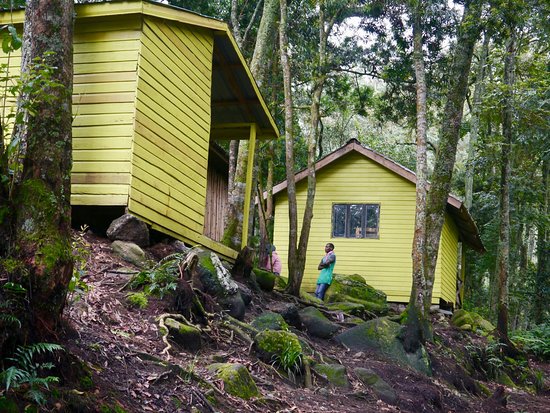
Visitors may occasionally witness groups of 15 to 20 black and white Colobus monkeys navigating the treetops. Infrequent observations of the L’Hoest monkey, a cultural emblem of the Bukonzo, are protected by the authority of the King or Omusinga, and one may also hear wild chimpanzees nearby.
A vast assortment of plant species is present, encompassing forest trees, bamboo thickets, low shrubs, flowers, mushrooms, and various moss- and lichen-adorned vines descending from the towering trees, creating a remarkable visual appeal. Enock’s Falls are situated within 200 meters of Sine Hut, offering an exceptional opportunity to capture a fantastic screensaver for your memories.
Sine Camp, located at an altitude of 2,596 meters, offers wooden huts between towering forest trees on a small ridge, enabling you to see the beauty of the Afro Montane forest while overlooking a stunning waterfall tumbling over the rocks below. Some clients prefer to sit outdoors, enjoying the warmth of the campfire while discussing the mountains and their communal life with the guides. Sine is situated just below the bamboo zone, and the vicinity is home to a vast variety of bird types. Enock Falls, situated 150 meters from the camp, is enveloped by lush green vegetation and cascading vines. Truly magnificent. Individuals may repose at Sine, however those in optimal physical condition may proceed to Kalama Camp at an altitude of 3,134 meters. This alternative provides breathtaking vistas and affords more time at Mutinda Camp, enabling an ascent to Mutinda Lookout at 3,975 meters for magnificent views.
Day 2: Kalalama Camp
After a hearty breakfast, hiking begins at 8:30 AM as you approach the Bamboo-Mimulopsis Zone, marked by a steep slope with many high steps. In the rainy season, the bamboo area becomes exceedingly muddy and treacherous, leading to hindered advancement. The atmosphere and the forest are remarkable as you climb 551 meters over 1.8 kilometers to Kalalama Camp at 3,147 meters, located in the Heather-Rapanea Zone, where you may take a short break and savor a cup of tea or coffee before continuing to Mutinda Camp. The path meanders over numerous minor hills along a ridge, drops into the valley, ascends again, crosses multiple small streams, and nears moss-laden waterfalls. You ascend gently beside a scenic moss-laden river that tumbles over rocks beneath the imposing Giant Heather trees, whose trunks are embellished with green moss and adorned with Usnea lichen.
The trail meanders as you climb the deep valley, which features a diverse assortment of vegetation and flowers. This valley is unique, featuring several Giant Heather plants that provide a scenic atmosphere often shrouded in mist.
In the afternoon, you may like to ascend to the summit of Mutinda Lookout, which takes one to two hours to ascend and one hour to descend. The views are magnificent as you stand on moss-laden rocks at 3,925 meters, gazing across the Rwenzori Mountains and down towards Kasese town and Lake George. Hikers ascending to Margherita Peak or any of the key peaks will discover that climbing Mutinda, at 3,975 meters, is an efficient means of acclimatization and reducing the risk of high altitude sickness.
Day 3: Bugata Camp
4.9 kilometers starting at 3,688 meters and rising to 4,062 meters
The route is boggy, particularly in the wet season; nevertheless, with little skill, one can navigate from tussock to tussock to aid mobility. We have created many boardwalks over the most arduous bogs and are continuing to build more to enable passage. You navigate the Mutinda Valley, maneuvering through tussock grass and everlasting flowers interspersed with Giant Lobelias, before ascending a sharp slope to the Namusangi Valley (3,840 meters), which concludes suddenly with towering waterfalls and breathtaking views of the Mutinda Peaks. The Namusangi Valley is vast, including various elevations and depressions, while crossing several wetlands as the route steadily ascends to Bugata Camp at 4,062 meters. Bugata Camp is situated at a high altitude on Bamwanjara Pass, with views of Bugata Lake, extending to Lake Kopello and Weismann’s Peak, often capped with snow, as well as down the valley towards Lake Africa and Lake Kanganyika, across many minor peaks going to Mutinda Camp. The area is inhabited by tussock grass, everlasting flowers (Helichrysum), St John’s Wort (Hypericum becquaeritii), gigantic groundsel (Senecio adnivalis), and giant lobelia (Lobelia gibberoa). A substantial population of Red Forest Duikers (Cephalophus nigrifrons rubidus), a subspecies exclusive to the Rwenzori Mountains, is present.
Bugata Camp has noteworthy amenities, including solar illumination, well-maintained toilets, and bathrooms where guides may supply warm water in a basin for washing. Bugata features a helicopter pad (GPS coordinates N 18.312 E 29 53.457) for future rescue operations; nevertheless, it is crucial to acknowledge that helicopter services in Uganda reach $10,000 per hour, far surpassing costs in other countries, hence requiring insurance for rescue situations.
Day 4 : Weismann Peak at 4620m
Climb Weismann’s Peak at 4,620 meters and Stella Peak at 4,626 meters.
3.7 kilometers to Weismanns Peak, followed by a further 800 meters to Stella Peak and return.
Total distance: 9 kilometers; duration: 4 to 6 hours.
The trip begins by navigating the hillside beneath the imposing cliffs that overlook Bugata Lake, continuing over a ridge to Lake Kopello, where we walk along the lake’s edge, which research indicates has an average water temperature of 2˚C. During the ascent, one acquires stunning views of the four lakes located in the valley below. The final hike to the top is steep on firm rock and may be difficult during snowfall or ice conditions, requiring the use of ropes for safety.
On a clear day, one can witness stunning views of the prominent peaks: Mt. Stanley, Mt. Speke, and Mt. Baker. The top of Weismann’s Peak is comparatively level or dome-like, embellished with thick moss on the rocks, which fosters a scenic atmosphere. Stella Peak, standing at 4,626 meters, is situated near Weismann’s and demands considerable technical proficiency owing to its hazardous characteristics, requiring both experience and a robust tolerance for altitude. We advise against proceeding to Stella Peak.
We promptly descend from the summit to Kiharo Camp, situated at an altitude of 3,460 meters in the Nyamwamba Valley. At the summit of the valley, a significant area of dense Giant Groundsel coexists with verdant evergreen undergrowth and moss, while the towering rocky peaks above create a unique habitat. As you descend the valley, you will see the scenery features some flat, marshy areas, relics of glaciers from millions of years past, which melted and deposited a barrier of big boulders at their original site. The valley contains multiple Red Forest Duikers (Cephalophus nigrifrons rubidus). At night, you may stay at Kiharo Camp, located at an altitude of 3,460 meters, an area rich in evergreen flora and flowing streams. Particularly in the dry months, the nocturnal atmosphere reverberates with the calls of the rock hyrax, situated on the lofty granite escarpments.
Day 5: Trekker’s Hostel
The distance from Kiharo Camp to the park gate is 16 km, and a further 2.8 km to Trekkers Hostel. Individuals needing to connect to planes returning to Kampala or attending other commitments must leave Kiharo early, as the trek requires 5 to 8 hours of trekking.
The descent through the Nyamwamba Valley is primarily downhill and remarkably scenic, showcasing stunning views, moss-covered rocks by the river, cascading waterfalls, and deep gorges and forests that may be unmatched in the Rwenzori Mountains. It took six years to construct a traveler-friendly, passable route along this portion of the trail. In 1937, the explorer and geologist McConnell endeavored to traverse this valley but was unsuccessful and had to withdraw in pursuit of an alternative route up the mountain; however, this exceptionally gorgeous valley can now be explored.
The trail veers to the right, along the riverbed, a short distance from Kiharo Camp. In the open areas, one may witness a Duiker subtly foraging in small forests while navigating the riverside. This site probably contains the largest population of Rwenzori Red Duikers in the National Park. A few kilometers downstream, the river becomes steeper and showcases several stunning waterfalls. After the waterfalls, we climb a steep incline and drop into the dense forest, providing stunning views of the valley below. We halt at Forest View Camp for lunch before returning to Base Camp. A remarkable event and culmination of an unbelievable adventure.
Conclusion of the 5-Day Rwenzori Trekking Itinerary to Weismann’s Peak