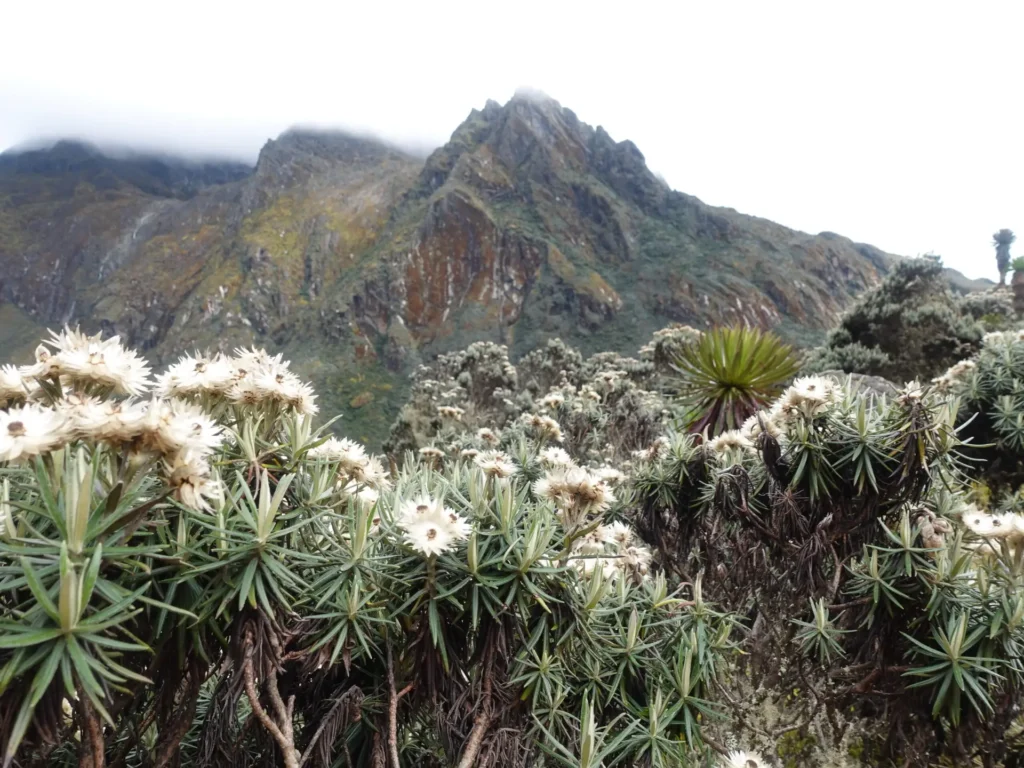
Starting at Kyanjuki Village (Kilembe Trailhead) and ending at the Nyamwamba Valley Exit, Kasese, Uganda
Day 1: Kyanjuki Trailhead to Sine Camp (1,450 m → 2,596 m)
Distance: ~9.5 km | Elevation Gain: +1,146 m | Trekking Time: 5–7 hours | Overnight: Sine Camp (2,596 m)
The expedition begins at the Rwenzori Backpackers Hostel in Kyanjuki village, the Kilembe Trail’s dedicated trailhead facility, set against the backdrop of the historic Kilembe Copper Mine’s industrial architecture slowly being reclaimed by the forest above it. Arrival the previous evening is mandatory for this itinerary: seven days on the mountain begin with a 7:00 AM departure, and the guide introductions, porter load allocation, equipment checks, and pre-trek briefing that happen at Kyanjuki require an unhurried morning to run well. Your dedicated Rwenzori Trekking Expeditions guide opens the briefing with a full overview of the two-summit structure, the specific demands of Baker versus Weismann’s, the safety rope deployment on Baker’s upper sections, the acclimatization schedule, and the point-to-point logistics that mean your exit vehicle must be pre-arranged for Day 7.
The trail enters the Nyamwamba Valley immediately and without ceremony. There is no flat warm-up section on the Kilembe trail; the forest begins and the ascent begins simultaneously, and the two hundred meters of altitude gain in the first two kilometers establish the character of the day: steep, rooted, atmospheric, demanding. The lower Afro-montane forest of the Nyamwamba Valley is among the richest in the Rwenzori Mountains National Park, with ancient hardwoods twenty to thirty meters tall, their canopy interlocked overhead, and every surface below the treetops carpeted in moss, liverwort, and a botanical density that feels almost pressurized. The guide pauses at a section of mixed mid-canopy activity: black-and-white colobus monkeys, blue monkeys, and, on an exceptional morning, the sacred L’Hoest’s monkeys in the understory.
At approximately 2,000 meters, a short side detour from the main trail leads to Enock’s Falls, a multi-tiered cascade of extraordinary beauty through the hanging vegetation of the valley gorge. The ten- to fifteen-minute return is entirely worth every step. The bamboo zone begins above the falls, and the trail steepens progressively through increasingly dense forest for the final two kilometers before Sine Camp appears through the trees at 2,596 meters. A narrow ridge camp with views over the Nyamwamba Valley gorge, the sound of waterfalls rising from below, and your mountain cook already at work with hot food, after five to seven hours on the trail, Sine Camp is a genuinely welcome arrival. Night temperatures of 10–14°C make Sine Camp the warmest and most comfortable camp of the entire expedition.
Meals: Lunch (trail), Dinner (Sine Camp) | Wildlife: Colobus, blue & L’Hoest’s monkeys, Rwenzori Turaco | Highlight: Enock’s Falls | Accommodation: Sine Camp wooden huts, 2,596 m
Day 2: Sine Camp (2,596 m)
to Mutinda Camp → 3,582 m)
Distance: ~6.1 km | Elevation Gain: +986 m | Trekking Time: 6–8 hours | Overnight: Mutinda Camp (3,582 m)
Breakfast at Sine Camp by 7:00 AM and departure by 7:30. The bamboo zone begins within two hundred meters of camp and immediately imposes its character on the day: giant mountain bamboo, Arundinaria alpina, growing eight to twelve meters, creates a green tunnel overhead, the pale stems clicking in the morning wind, and the light filtering through the canopy in shifting patterns that change with every step. The ground is always wet and rooted, and three-horned Rwenzori chameleons, which are only found in this range, are often seen on bamboo stems at eye level, their slow, deliberate movements and turret-mounted eyes showing they belong to a different evolutionary timeline than everything around them. Your guide slows the pace at the bamboo level because the chameleons are there to see if you are looking carefully.
Above the bamboo, the transition into the heather zone at approximately 2,900 meters is one of the trail’s most visually memorable moments. Giant tree heather (Erica arborea and Erica trimera) grows to fifteen meters, its ancient trunks wrapped in Usnea lichen, and the whole area has the sculptural, otherworldly quality of a forest from a different epoch. Ridge crossings through the upper heather offer the first backward views down the Nyamwamba Valley and, on clear mornings, across the lower Albertine Rift. Kalalama Camp, at 3,147 meters, is a welcome midday rest shelter with waterfalls nearby, and the 435-meter push from Kalalama to Mutinda Camp involves the day’s hardest climbing, a sustained steep section through thinning heather that rewards with increasingly open views.
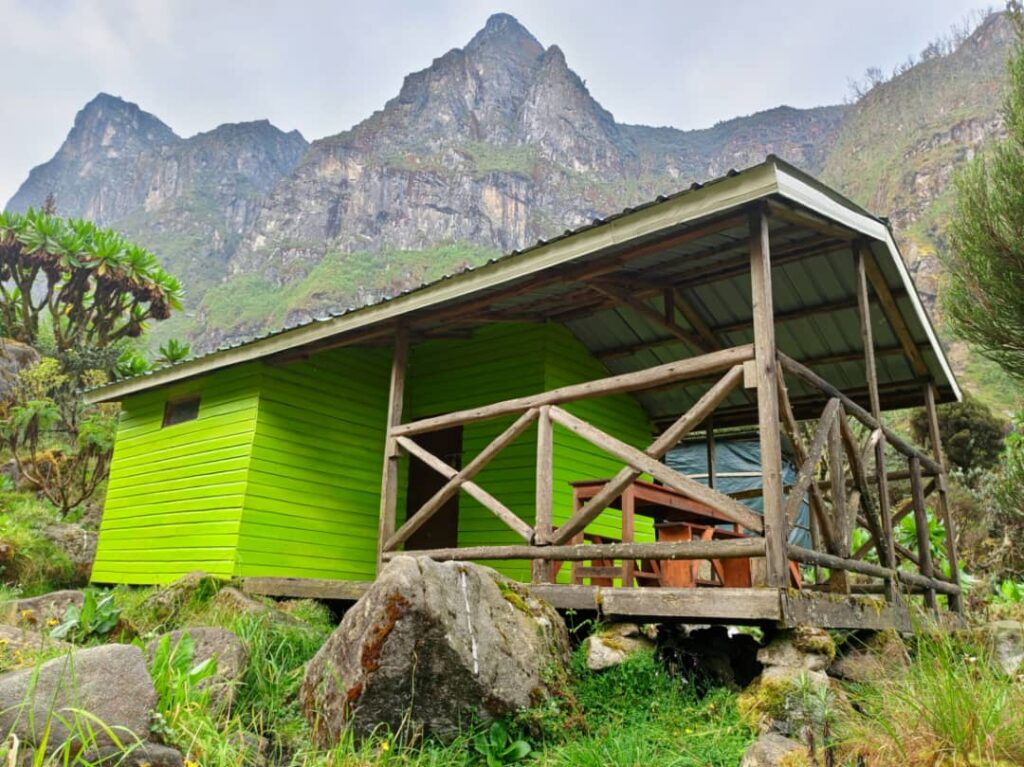
Mutinda Camp at 3,582 meters sits beside a mountain stream in a wide alpine bowl, and the afternoon here is the expedition’s critical acclimatization window. The optional hike to Mutinda Lookout at 3,975 meters, 393 meters above camp, takes two to three hours and is described as optional on some itineraries but treated as essential on this one. The climb-high-sleep-low principle is the most effective single strategy for AMS prevention, and the Mutinda Lookout hike is the primary built-in altitude buffer before the 4,100-meter camp on Day 3 and the 4,843-meter summit on Day 5. From the Lookout on a clear afternoon, you see both target summits for the first time: Baker to the northeast and Weismann’s beyond it. The expedition’s full geometry is visible from a single vantage point. Sleep early at Mutinda.
Meals: Breakfast, Lunch, Dinner | Wildlife: 3-horned chameleons in bamboo, sunbirds in heather | Highlight: Mutinda Lookout, first views of Baker & Weismann | Accommodation: Mutinda Camp, 3,582 m
Day 3: Mutinda Camp (3,582 m) to Bugata Camp (4,100m)
Distance: ~8.6 km | Elevation Gain: +518 m | Trekking Time: 4–6 hours | Overnight: Bugata Camp (4,100 m)
Day 3 is the day the Rwenzori becomes something genuinely unlike anywhere else on Earth. Above the heather zone, the trail enters the Afro-alpine moorland, the ecological zone that defines the Rwenzori’s worldwide reputation and that no amount of prior landscape knowledge fully prepares you for. Giant Lobelia wollastonii stands three to six meters tall, its silver rosettes arranged in architectural perfection around a central spike inflorescence. Giant Senecio adnivalis, groundsel trees with thick trunks and cabbage-like crowns, stand in clusters across the open moorland. Everlasting flowers carpet the ground between them in pale yellow clusters. The scale and strangeness of this landscape, combined with the thinning air above 3,500 meters and the complete absence of any reference point connecting it to the lower world, produces a quality of atmosphere that trekkers consistently describe as the most arresting of the entire expedition.
The route crosses the open Mutinda Valley in the morning, where Malachite Sunbirds, iridescent green with brilliant red chest patches and endemic to the Rwenzori and Virunga highlands, work systematically across the giant lobelia spikes in the early feeding activity. Approaching slowly and watching a Malachite Sunbird hover at the base of a lobelia spike, probing the flower, and moving to the next, three meters from where you stand at 3,700 meters above sea level, is one of the finest wildlife moments available on any Rwenzori trek at any duration or price point.
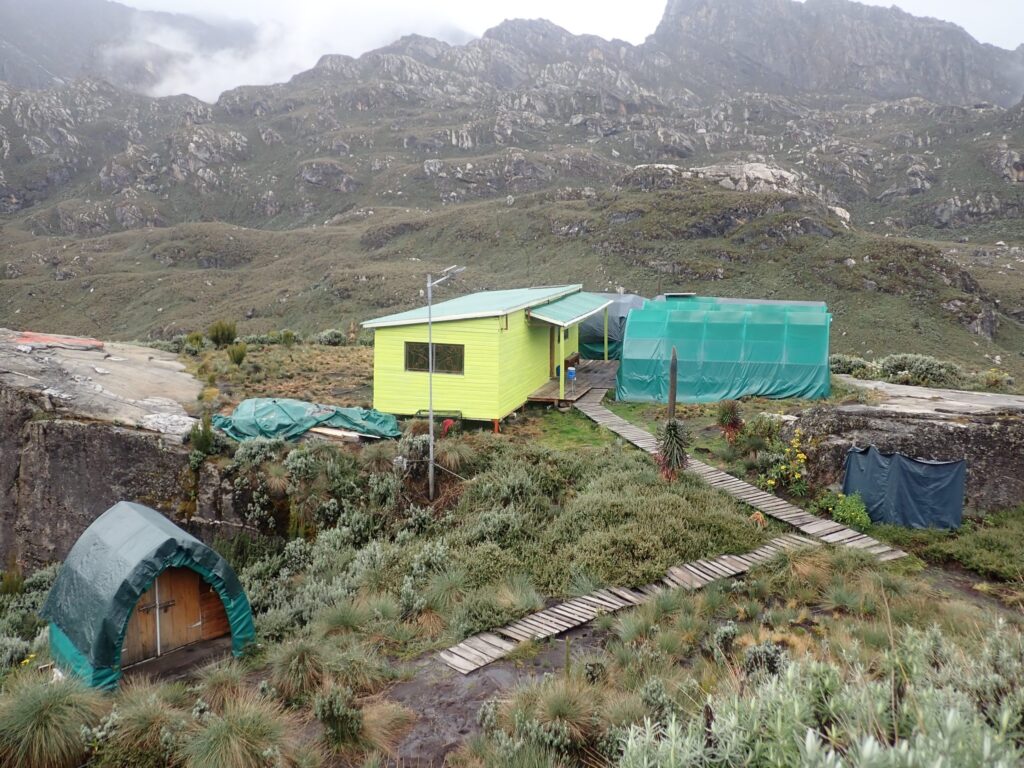
The Namusangi Valley section is the visual climax of the ascent. Vertical waterfalls drop thirty to fifty meters down sheer dark rock faces on both sides of the valley, and the scale of the surrounding terrain, the high ridges, the open sky, and the silence punctuated only by the distant sound of falling water create a landscape of genuine grandeur. Bugata Camp, at 4,100 meters, is the finest equipped high camp on the Kilembe Trail: solar-lit sleeping huts, warm shower facilities, a kitchen and dining shelter, composting toilets, and emergency helicopter landing access. At 4,100 meters with two summit days ahead, this location is also where your travel insurance document becomes practically relevant. Confirm your emergency evacuation coverage is active. Night temperatures are 0–4°C.
Meals: Breakfast, Lunch, Dinner | Wildlife: Malachite Sunbird on giant lobelias, Rwenzori Red Forest Duiker at camp margins Highlight: Namusangi Valley waterfalls, first close views of Baker & Weismann’s | Accommodation: Bugata Camp, 4,100 m (solar lighting, warm showers)
Day 4: Bugata Camp (4,100 m) to Hunwick’s Camp (4,450 m) via Bamwanjara Pass (3,974 m)
Distance: ~8.3 km | Elevation: +350 m to pass, then −476 m to camp | Trekking Time: 7–9 hours | Overnight: Hunwick’s Camp (3,974 m)
Day 4 is the passage, the crossing that separates the approach from the destination and the Kilembe side of the range from the inner mountain world where both summits wait. Breakfast at 6:30 AM, departure by 7:00. The trail climbs from Bugata Camp along a long ridge toward Bamwanjara Pass at 4,450 meters, the highest point of the approach section and one of the finest mountain viewpoints in the Rwenzori range. A small emergency shelter hut marks the pass, serving as a windbreak on this day while you absorb the panorama.
On clear mornings at Bamwanjara Pass, you can see all four of the inner Rwenzori massifs at once. Mount Stanley, at 5,109 meters, dominates the northwest, its Stanley Glacier catching the morning light as a bright horizontal band on the upper mountain. Mount Baker stands immediately to the northeast; the rock walls and the summit ridge of Edward Peak are now close enough to study the Day 5 approach line. Mount Speke, at 4,890 meters, appears to the north. Weismann’s Peak rises to the east, its blade-like profile now familiar from yesterday’s Mutinda Lookout view but dramatically closer. Both summits lie before you in a single glance, separated by twenty-four hours. The guide takes time here for a summit briefing: the Baker approach line, the weather indicators that matter, and the departure time tomorrow morning.
The descent from Bamwanjara Pass into the inner Rwenzori valleys crosses high-altitude alpine bogs where the ground is carpeted in sphagnum moss and the trail requires careful selection of firm ground. Augur buzzards soar above the open ridge; common ravens work the ground below the pass.
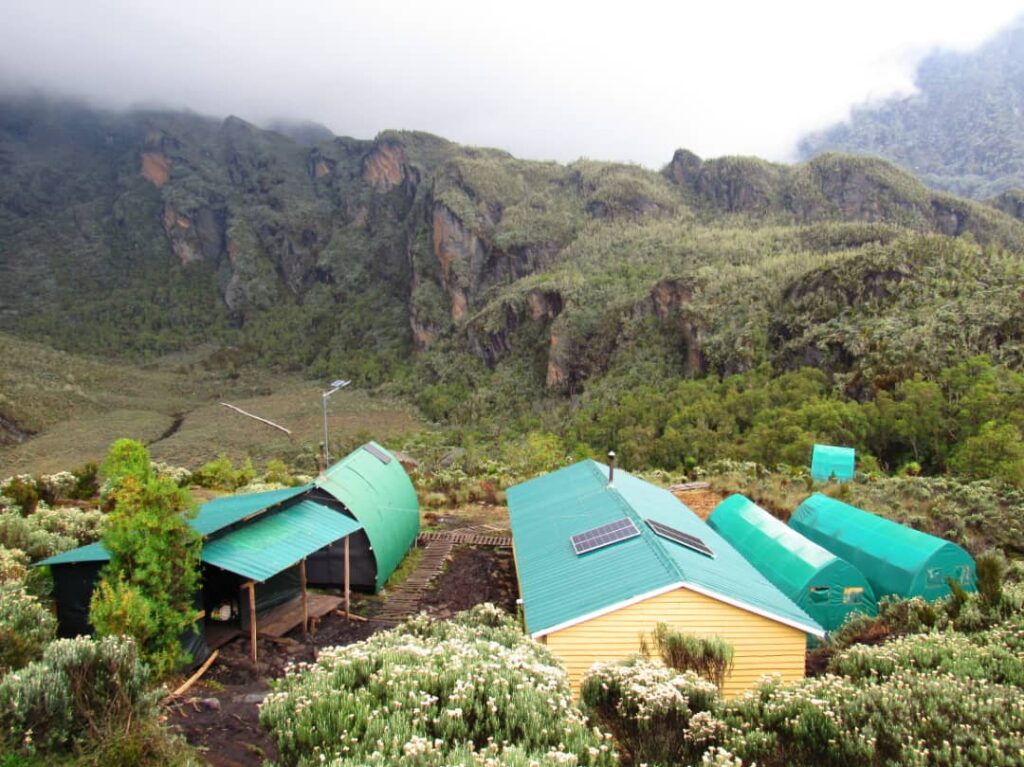
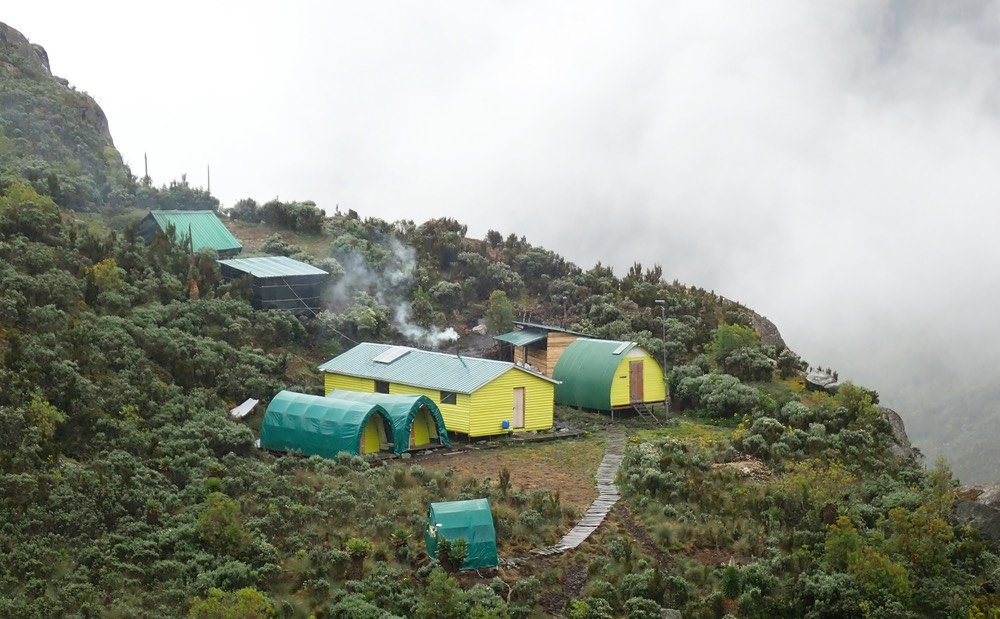
Hunwick’s Camp, at 3,974 meters, occupies the rim of a deep valley with a 270-degree panorama of the surrounding massifs, the most exposed and most spectacular camp position on the entire Kilembe Trail. The first night here anticipates Baker’s arrival. Night temperatures consistently drop below 0°C. Every insulating layer matters at Hunwick’s.
Meals: Breakfast, Lunch, Dinner | Wildlife: Augur Buzzard soaring at Bamwanjara, alpine bog birds | Highlight: Bamwanjara Pass panorama, four Rwenzori massifs visible simultaneously | Accommodation: Hunwick’s Camp, 3,974 m (Night 4)
Day 5: Summit Edward Peak On Mount Baker (4,843 m) and Return to Hunwick’s Camp
Summit Gain: +869 m from camp | Distance: ~10 km round trip | Trekking Time: 6–8 hours | Overnight: Hunwick’s Camp (3,974 m, 2nd night)
The alarm wakes the team at 5:00 AM, when temperatures range from -3°C to -6°C and the complete darkness of a pre-dawn mountain morning prevails. Hot drinks and biscuits are provided before departure. By 5:30–6:00 AM, head torches are on, and the Baker summit attempt begins. Mount Baker’s Edward Peak, at 4,843 meters, is Africa’s tenth highest summit and the most technically demanding section of this entire 7-day Mount Baker & Weismann’s Peak trek expedition.

The approach from Hunwick’s involves a steep climb on rocky, exposed ground, where the valley drops away on both sides and the summit crest appears as a dark line against the sky above. In dry-season conditions, the rock is firm and the traction manageable with sturdy waterproof hiking boots. In the wet season, exposed sections can carry ice, and your guide carries safety ropes on every Baker summit attempt, deploying them on the steep and most exposed faces without hesitation or prompting. This is standard procedure at Rwenzori Trekking Expeditions, not a response to exceptional conditions.
The final meters to the summit involve a short scramble through a cleft in the granite before the crest opens onto Edward Peak. The view from 4,843 meters is among the finest in the Rwenzori range: Margherita Peak and Alexandra Peak on Mount Stanley are visible to the northwest, with the Stanley Glacier catching the early light; the DRC border is 2.8 kilometers to the south; on exceptionally clear mornings, the Ruwenzori foothills extend westward into the Congo basin. To the east, Weismann’s Peak is clearly visible, tomorrow’s summit, seen today from a perspective that provides it an entirely different meaning than it had from the pass yesterday. The summit allows twenty to forty minutes: photographs, a moment of genuine acknowledgement, and then the descent.
The down-climb demands equal focus to the ascent; weary legs on steep, rocky terrain on a cold pre-summit morning require a deliberate, methodical pace. Safety ropes remain deployed on the steep upper sections during descent. Most teams are back at Hunwick’s Camp for hot lunch by midday. The afternoon is yours: rest, rehydration, full meals, and the psychological preparation for tomorrow’s second summit. The afternoon at Hunwick’s offers a structural advantage of the 7-day Mount Baker & Weismann’s Peak itinerary; you summit Baker rested and have a full day to recover before Weismann’s pre-dawn departure.
Meals: Breakfast (pre-dawn), hot lunch at camp on return, Dinner | Wildlife: Common Ravens at summit, augur buzzard soaring | Highlight: Edward Peak summit (4,843 m) — Africa’s 10th highest summit; views of Stanley Glacier & DRC border | Accommodation: Hunwick’s Camp, 3,974 m (Night 5)
Day 6: Weismann’s Peak Summit (4,620 m) via Oliver’s Pass, then Descent to Kiharo Camp (3,460 m)
Summit Gain: +646 m from camp via Oliver’s Pass | Full Day Distance: ~15.8 km | Trekking Time: 9–12 hours | Overnight: Kiharo Camp (3,460 m)
Day 6 is the longest and most complex day of the expedition. Unlike the Baker out-and-back on Day 5, today combines a summit attempt with the beginning of the long traverse descent; the team carries full packs and does not return to Hunwick’s. Departure is again at 5:30 AM in headlamps and cold. The route initially moves across the inner mountain terrain in a different direction from yesterday’s Baker approach, traversing toward Oliver’s Pass at approximately 4,200 meters, a narrow saddle between ridges that offers the first clear view of Weismann’s Peak’s upper ridge and the McConnell’s Prong approach line.
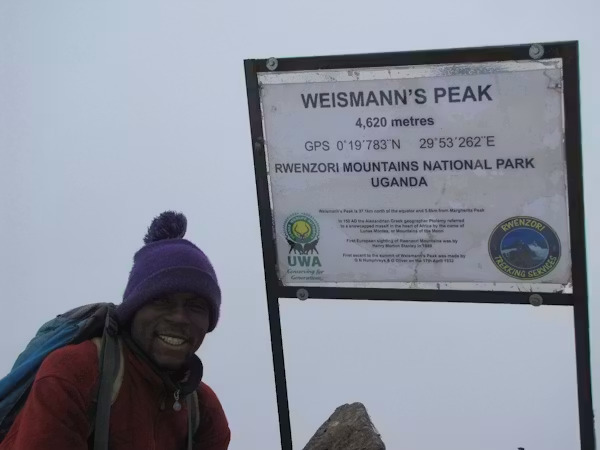
The ascent to Weismann’s Peak at 4,620 meters via McConnell’s Prong is steep and exposed but has a different technical character from Baker. The rock is less icy in wet conditions, the approach line is more direct, and safety ropes are deployed in wet-season conditions on the guide’s assessment rather than as standard procedure. The summit of Weismann’s Peak is a narrow rocky crest with exposure on all sides, and the view from here is the one that completes the dual-summit experience. Looking southwest from Weismann’s, the dark summit mass of Mount Baker stands exactly where you stood yesterday morning. The defining experiential signature of this 7-day Mount Baker & Weismann’s Peak trek itinerary is the geometric relationship between the two peaks, seen from opposite sides on consecutive summit mornings, something that exists nowhere else in the Rwenzori Mountains and cannot be replicated on any other route.
Weismann’s Peak, at 4,620 meters, is Uganda’s eleventh highest summit. Standing here the day after Edward Peak, Uganda’s tenth highest, means both of Uganda’s top eleven summits are now available without glacier equipment and belong to the same 48-hour window of this expedition. The descent from Weismann’s enters the extraordinary Kitandara basin at approximately 4,023 meters, with glacially carved alpine lakes perfectly still in the morning air, giant lobelias and groundsels crowding the lake margins, and rock hyraxes calling from surrounding boulder fields. The descent continues through the upper Nyamwamba Valley as altitude drops and the vegetation gradually rebuilds: heather reappearing, then scrub, then the first trees of the lower montane zone. Kiharo Camp, at 3,460 meters, is reached in the late afternoon and is sheltered, forested, and beside a rushing stream, with the deepest and most welcome sleep of the expedition waiting on the other side of dinner.
Meals: Breakfast (pre-dawn), Lunch (trail), Dinner (Kiharo) | Wildlife: Rock hyraxes at Kitandara, Rwenzori Red Forest Duiker in descent vegetation | Highlight: Weismann’s Peak summit (4,620 m), Kitandara Lakes basin | Accommodation: Kiharo Camp, 3,460 m
Day 7: Kiharo Camp to Nyamwamba Valley Exit (~1,480 m)
Distance: ~16 km
Elevation Loss: −1,980 m
Trekking Time: 7–8 hours
End of expedition
The last morning of the expedition has the quality that belongs to any genuine conclusion: a mixture of relief, pride, and the particular clarity that comes from having done something that actually cost something. Two summits above 4,600 meters in 48 hours, a full mountain traverse on one of Africa’s most demanding trekking trails, seven days and six nights in the Rwenzori. The forest around Kiharo Camp is quiet in the early morning, the stream audible, the first birds beginning in the trees above. Breakfast is unhurried. The day ahead is long but all downhill.
The Nyamwamba Valley gorge, the Day 7 descent route, is the geological culmination of the expedition: a canyon carved by glacial meltwater over millions of years into the ancient crystalline bedrock of the Rwenzori range, its walls moss-covered and vertical in places, the river running white over boulders far below the trail. Waterfalls appear at intervals throughout the descent, some of them fifty meters of continuous white water against dark rock. The trail alternates between the valley floor, where the river is close and the sound is everything, and high traverses on rocky ledges above the gorge, where the exposure and the views remind you how far above sea level yesterday’s summits actually were.
Wildlife activity multiplies with every hundred meters of lost altitude. Rwenzori red forest duikers push through the undergrowth of the subalpine zone. Rock hyraxes colonize every boulder field. At 2,500 meters, the forest canopy closes overhead again, and primate activity returns, with colobus and blue monkeys re-entering the canopy above the path and the Rwenzori turaco calling from the forest edge. The Riverside Rock Shelter provides the traditional Day 7 lunch stop: a natural overhang beside the river where the cool rock and the water sound create a restorative pause before the final forest section to the park boundary.
The Nyamwamba Valley exit point, at approximately 1,480 meters, is where your pre-arranged private vehicle waits. Trek completion certificates are issued. You exchange farewells with the porter and guide team, warmed by the seven shared days in the mountains. Gratuities are distributed. The cold drink that has been a background thought since Bamwanjara Pass is finally available. The transfer to Kasese or Fort Portal takes twenty to forty minutes. Two summits, seven days, and a traverse of one of Africa’s last true mountain wildernesses are now behind you.
Meals: Breakfast (Kiharo), Lunch (Riverside Rock Shelter) | Wildlife: Increasing primates and birds with altitude loss, duiker, hyrax | Highlight: Nyamwamba Valley gorge, waterfalls, expedition completion
The 7-Day Baker & Weismann’s Peak Campsite Profile (Where to Sleep)
Sine Camp (2,596 m)
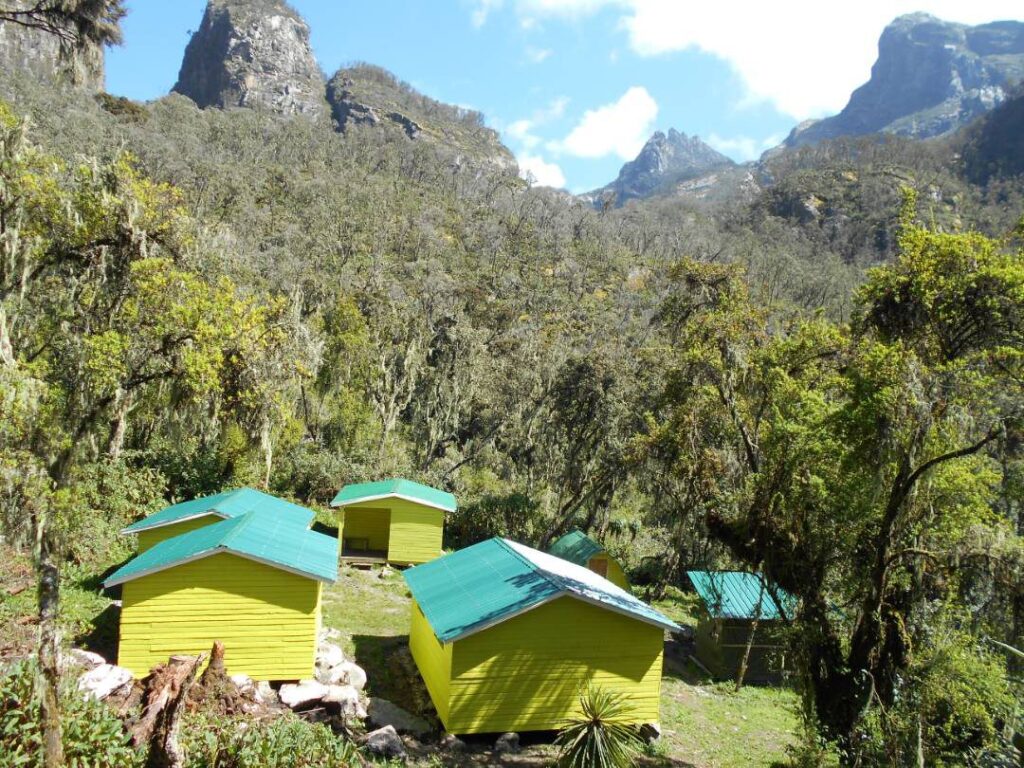
Sine Camp occupies a narrow forested ridge above the Nyamwamba Valley at the ecological transition between the upper bamboo and lower heather zones. Wooden sleeping huts with mattresses and blankets, a kitchen shelter, and basic toilet facilities. Night temperatures of 10–14°C make this the most comfortable camp of the expedition.
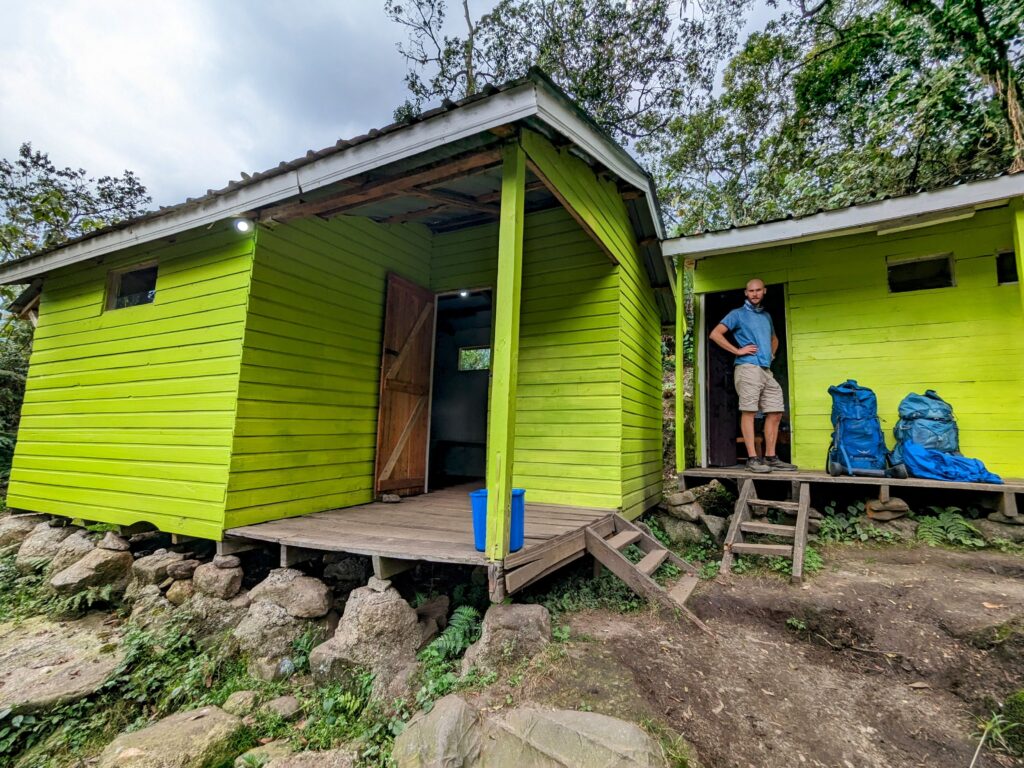
Enock’s Falls, accessible via a two-hundred-metre side trail, is the essential evening excursion. The constant ambient sound of rapids in the valley below provides the auditory backdrop to the first mountain night.
Mutinda Camp (3,582 m)
A sheltered alpine bowl beside a mountain stream, framed by heather and the first alpine plants. Sleeping huts with mattresses and blankets, a kitchen and dining shelter, and basic toilet facilities. Night temperatures of 4–8°C require a proper sleeping bag from this camp onward.
The optional Mutinda Lookout acclimatization hike departs from here and is the single most important altitude-management action available in the entire itinerary; treat it as mandatory.
Bugata Camp (4,100 m)
The finest equipped high camp on the Kilembe Trail has solar-lit sleeping huts, warm shower facilities, a kitchen and dining shelter, composting toilets, and emergency helicopter landing access. Views directly up at Mount Baker and Weismann’s Peak from the camp area.
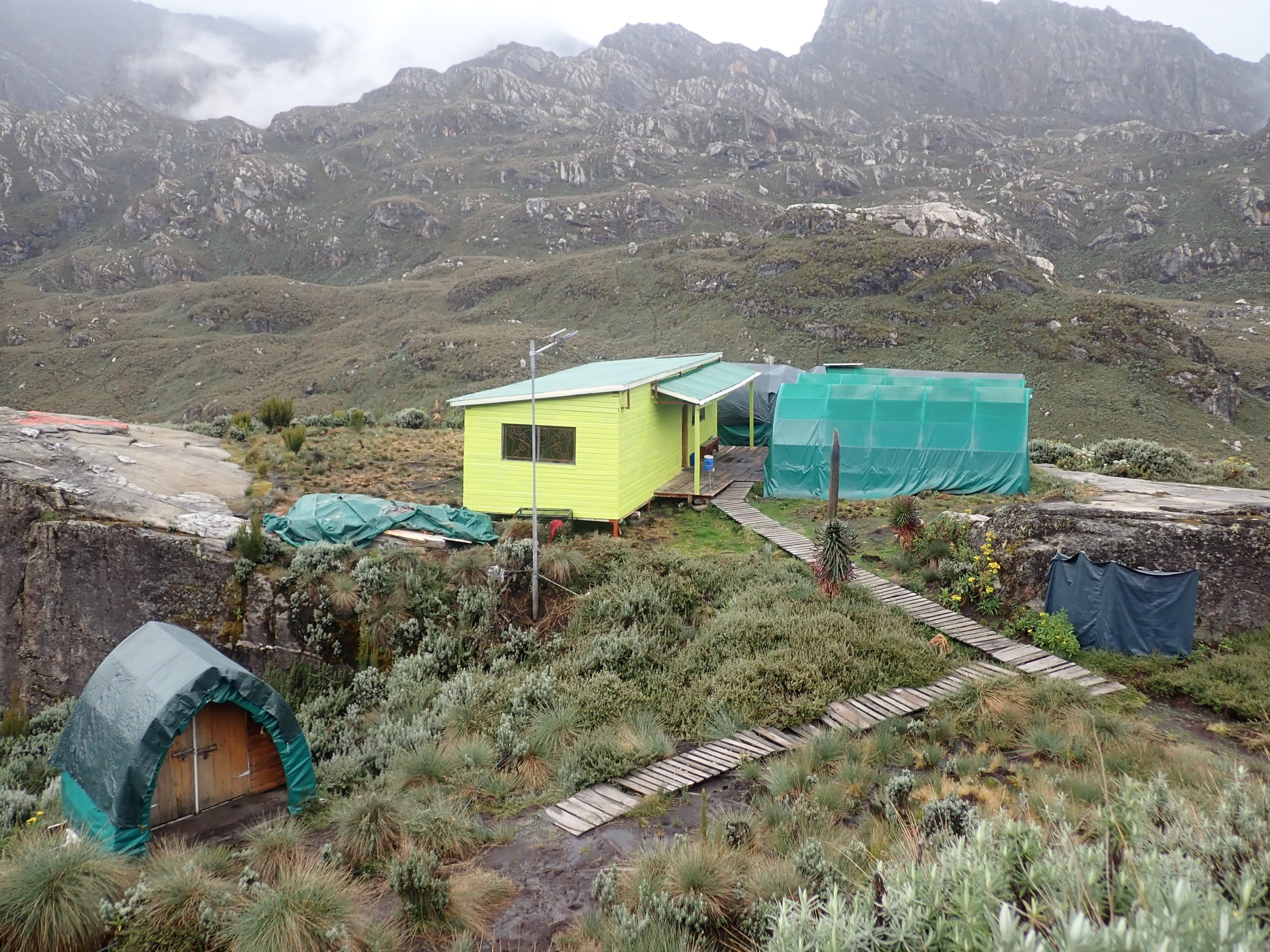
Night temperatures of 0–4°C. The helicopter access makes this camp the critical insurance checkpoint; confirm your emergency evacuation coverage is active before ascending above 4,000 meters.
Hunwick’s Camp (3,974 m): days 4 & 5 staging nights for both Summits
Hunwick’s Camp is the expedition’s strategic heart: the base from which both Baker and Weismann summited on consecutive mornings. Hunwick’s Camp, positioned on the rim of a deep inner valley, offers a 270-degree panorama of the surrounding massifs and is the most exposed and spectacular camp on the entire route. Sleeping platforms for twelve to sixteen, a kitchen shelter, and basic facilities.
Night temperatures consistently drop below 0°C, so we recommend sleeping bags rated to -5°C. The two-night stay here is a structural advantage of the 7-day itinerary: Mount Baker is summited from a rested body, and Weismann’s Peak is approached twenty-four hours later with a full recovery day between them.
Kiharo Camp (3,460 m)
A forested, sheltered camp beside a rushing stream at 3,460 meters, the most protected and vegetated of the high camps, with rock hyraxes calling from surrounding boulders at dusk. Sleeping hut platforms, kitchen shelter, and basic facilities. Night temperatures of 4–8°C. After two nights above 3,900 meters and two summit mornings, the lower altitude and enclosed forest environment at Kiharo produce the deepest and most restorative sleep of the entire expedition. Most trekkers sleep eleven to twelve hours.
What Is Included in the 7-Day Baker & Weismann’s Peak Package?
Rwenzori Trekking Expeditions operates this expedition on a fully inclusive mountain basis. Every element required for your seven days on the Kilembe Trail is arranged, managed, and delivered so that from the moment you arrive at Kyanjuki, your focus is entirely on the mountains ahead of you and nothing else.
What Is Included
All Uganda Wildlife Authority national park entry fees and Kilembe Trail trekking permits for seven days are fully covered.
Your certified, English-speaking, Baker-Summit-experienced mountain guide accompanies the team throughout all seven days. An assistant guide is provided for groups of four or more.
Your dedicated mountain chef provides full catering from Day 1 lunch through Day 7 lunch, three meals per day, and hot drinks throughout.
One porter per trekker carries communal equipment and personal kit within the standard fifteen-kilogram load allocation.
We book and secure accommodation in wooden mountain huts at all six camps, Sine, Mutinda, Bugata, Hunwick’s (two nights), and Kiharo, in advance.
The guide team carries and deploys safety ropes for Baker’s summit and Weismann’s exposed sections as standard practice.
Free rubber gumboots are available at the Kyanjuki trailhead. Sleeping mats are provided in all huts.
A comprehensive first aid kit and emergency communication equipment are carried at all times.
Exit vehicle transfer from the Nyamwamba Valley trailhead back to Kasese or Fort Portal is seamlessly arranged.
What Is Not Included
International and domestic flights to Uganda are not included.
You must arrange Ugandan tourist visas independently, either on arrival at Entebbe or through the e-Visa portal.
Travel insurance, which must include altitude coverage to 5,000 meters and emergency medical evacuation, is a mandatory requirement and is not provided. This is a non-negotiable requirement for all Rwenzori Trekking Expeditions departures on this route:
Bugata Camp has helicopter access, and Hunwick’s Camp emergency evacuation requires air access in most scenarios. No insurance means no departure.
Personal trekking clothing, a sleeping bag rated to -5°C, and hiking boots are the trekker’s own responsibility.
Guide and porter gratuities are not included in the package price.
Pre- and post-trek accommodation in Kasese or Fort Portal is not included unless specifically added to a combined itinerary.
⚠️ Travel insurance with altitude cover to 5,000 m and emergency medical evacuation is mandatory for this expedition. Confirmation of active insurance coverage is required before departure from Kyanjuki. No insurance = no departure.
The core difference is the addition of Mount Baker’s Edward Peak at 4,843 meters as a second summit. The 6-day Weismann’s Peak expedition ascends only Weismann’s Peak at 4,620 meters via Oliver’s Pass. The 7-day Mount Baker & Weismann’s Peak trekking route adds a full Mount Baker summit day from Hunwick’s Camp, requiring one additional day on the mountain and a second overnight at Hunwick’s at 3,974 meters. This means the cumulative ascent is approximately 1,200 meters greater; both pre-dawn summit departures happen from the same camp on consecutive mornings, and the expedition reaches a higher maximum elevation at 4,843 meters versus 4,620 meters. This is the only Rwenzori itinerary that takes trekkers to both Edwards Peak and Weismann’s Peak in a single expedition.
Edward Peak’s summit approach is more technically demanding than Weismann’s Peak. The route involves steep rocky terrain with sections of genuine exposure requiring sure-footedness and mental composure at altitude. Rwenzori Trekking Expeditions uses safety ropes on the most exposed sections of every Baker summit attempt as standard operational practice, not because the route is classified as a technical mountaineering climb, but because appropriate caution on steep exposed rock at 4,800 meters is non-negotiable. No crampons, ice axe, or harness are required in dry-season conditions. In the wet season of April–May and September–October, ice-coated rock on Baker’s upper sections significantly increases the technical demands, and additional rope deployment should be expected.
The two-night staging at Hunwick’s Camp at 3,974 meters is the structural feature that makes the dual-summit objective achievable rather than exhausting. On Night 4, you sleep at Hunwick’s before Baker’s summit day. After returning from Baker, you rest the full afternoon and sleep there again on Night 5 before Weismann’s summit day. This structure means Baker is summiting from a rested body, not from the same day’s approach, and Weismann’s is attempted with twenty-four hours of genuine recovery between the two pre-dawn departures.
Both summits from a single overnight staging would produce diminishing returns in both performance and safety margin. The two-night stay is a deliberate design feature, not padding.
Edward Peak on Mount Baker stands at 4,843 meters above sea level. It is Uganda’s fourth-highest summit overall, behind Margherita Peak at 5,109 meters, Alexandra Peak at 5,091 meters, and Albert Peak at 5,087 meters on Mount Stanley. Within the Rwenzori range, Mount Baker is the third-highest massif after Mount Stanley and Mount Speke at 4,890 meters. The peak is located approximately 2.8 kilometers from the DRC border inside Rwenzori Mountains National Park. It ranks as Africa’s tenth-highest summit overall. The mountain was named after British explorer Samuel Baker, the first European to reach Lake Albert in 1864, and its summit was first climbed by the Duke of Abruzzi’s expedition in 1906.
Yes! Both Edward Peak on Mount Baker and Weismann’s Peak offer clear views of Mount Stanley’s glacier system on clear mornings. From Edward Peak at 4,843 meters, the Stanley Glacier is visible to the northwest as a distinct band of ice on the mountain’s upper flanks, with Margherita Peak and Alexandra Peak rising above it. From Weismann’s Peak, the perspective shifts, but Mount Stanley remains the dominant northwestern feature. The Rwenzori glaciers have retreated over 80 percent in the past century and are projected to disappear entirely by 2050 under current climate trajectories. Witnessing them from two different summits on consecutive mornings is one of the most compelling reasons to complete this specific dual-summit itinerary while the glaciers remain.
The maximum altitude is 4,843 meters at Edward Peak on Mount Baker, with two nights at Hunwick’s Camp at 3,974 meters. This represents significant cumulative high-altitude exposure. From 3,800 meters upward, mild AMS symptoms, headache, reduced appetite, and disturbed sleep should be anticipated as normal physiological responses. Serious AMS, high altitude cerebral edema, and high altitude pulmonary edema can occur at these altitudes. The Mutinda Lookout acclimatization hike on the afternoon of Day 2 is the primary altitude buffer in this itinerary and is treated as mandatory by Rwenzori Trekking Expeditions guides. The guide team is trained in AMS recognition, carries emergency communication equipment, and will make unilateral descent decisions when trekker safety requires it. Discuss Diamox prophylaxis with your physician before departure.
This 7-day Mount Baker & Weismann’s Peak Rwenzori trek is not recommended for first-time high-altitude trekkers. The front-loaded ascent profile, the two-night staging above 3,900 meters, and the technical demands of Baker’s summit approach are all better managed by trekkers with prior high-altitude experience. The minimum recommendation is at least one completed multi-day trek above 3,500 meters with no significant AMS symptoms. First-time high-altitude trekkers wanting a Rwenzori summit experience are better served by the 6-day Weismann’s Peak expedition or the 7-day Central Circuit to Margherita Peak, which has a more gradual acclimatization profile.
The 8-day Kilembe Trail to Margherita Peak, Rwenzori, adds Africa’s third-highest summit at 5,109 meters and, critically, the Elena Glacier crossing that comes with it. Margherita Peak requires crampons, a harness, and rope work on a real equatorial glacier, making it a technical mountaineering objective, unlike the 7-day Mount Baker & Weismann’s peak route. The 8-day Rwenzori trek route to Margherita Peak via the Kilembe trail is the right choice for trekkers whose primary objective is the Rwenzori’s highest summit and who are comfortable with glacier equipment. If the goal is two named Rwenzori summits above 4,600 meters without glacier travel, the 7-day Baker and Weismann’s trek is the correct itinerary.
The 7-day Mount Baker & Weismann’s Peak expedition has the longest combined time in both the lower Afro-montane forest zone and the high Afro-alpine zone of any standard Kilembe Trail itinerary. The critical wildlife addition is time in the high moorland between Bamwanjara Pass and both summits, where the Malachite Sunbird feeds on giant lobelia spikes, the Rwenzori Red Forest Duiker is reliably seen at camp margins, and the endemic Rwenzori flora is at its most spectacular. The Day 6 descent through the Kitandara Lakes basin, traversed only on this itinerary and the 8-day Margherita route, adds one of the most visually exceptional alpine ecosystems in the Rwenzori to the wildlife and landscape experience of the expedition.
Yes, the natural extension becomes the 10-day 4-Peaks Trek covering Margherita, Mount Speke, Weismann’s Peak, and Edward Peak on Mount Baker. Adding Margherita Peak requires continuing past Weismann’s into the inner Rwenzori circuit to Elena Hut at 4,563 metres, then the Margherita summit via the Elena Glacier, plus the necessary glacier equipment days. It adds three days to the total itinerary. If a Margherita summit is on your longer-term Rwenzori horizon, the 10-day 4-Peaks Trek is the most logical framework for combining it with Baker and Weismann’s in a single expedition.
The Rwenzori Backpackers Hostel at Kilembe is the most convenient pre-trek option, directly at the trailhead with guide briefings on-site. Kasese town, thirty-five to forty-five minutes away, has several hotels suitable for trekkers. After the trek, the Nyamwamba Valley exit requires a vehicle transfer back to Kasese, Rwenzori Trekking Expeditions pre-arranges this as part of every expedition package. Fort Portal, forty kilometers north of Kasese, is the recommended post-expedition recovery base: quality lodges, excellent restaurants, and proximity to Kibale Forest National Park for an optional chimpanzee trekking day before onward travel.
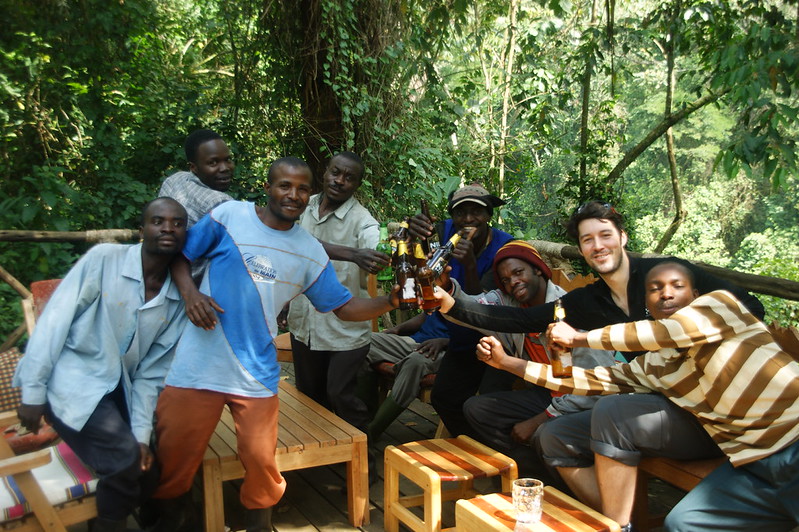
Gratuities for guides and porters are not included in the expedition package but are a meaningful and valued component of their total income. For a 7-day Mount Baker & Weismann’s Peak Rwenzori expedition, the recommended guideline is USD $15–$20 per day for your lead guide, USD $10–$15 per day for an assistant guide if present, and USD $7–$10 per day for each porter. For a solo trekker with one guide and two porters over seven days, a total tipping budget of USD $200–$290 is a reasonable starting point. Gratuities are distributed at the Nyamwamba Valley exit point at the end of Day 7.
Your Rwenzori Trekking Expeditions coordinator provides full guidance on appropriate tipping amounts and distribution protocol upon booking confirmation.
Yes! The exit vehicle transfer from the Nyamwamba Valley trailhead back to Kasese or onward to Fort Portal is coordinated by Rwenzori Trekking Expeditions as part of the expedition logistics. The driver meets the team at the exit point, and the vehicle is confirmed in advance of the Day 7 departure date. This trek is a point-to-point traverse requiring a different exit point from the start point, and the transfer coordination is handled entirely by the operations team so that no logistical uncertainty exists at the end of seven demanding days on the mountain.
Yes, Rwenzori Trekking Expeditions operates private departures for the 7-day Baker and Weismann’s Peak expedition on any requested date throughout the year, subject to guide and permit availability. Private departures let the group set the pace, focus, and logistics of the expedition, including the option to extend specific camp stays, adjust the Day 2 acclimatization schedule, or add more wildlife observation time in the high moorland zones. Minimum private departure group size is two trekkers. Contact us, the team, at www.rwenzoritrekkingexpeditions.com to confirm availability for your specific dates.
Rwenzori Trekking Expeditions maintains a combined dual-summit success rate above 80 percent for trekkers on the 7-day Baker and Weismann’s Peak itinerary who arrive adequately prepared. The primary factors affecting success are weather conditions on Days 5 and 6, individual acclimatization, and physical fitness matching the route’s demands. Baker’s summit, being the more technically demanding of the two, sees a slightly lower success rate than Weismann’s in wet-season months due to ice conditions. The Mutinda Lookout acclimatization hike and the two-night Hunwick’s Camp staging are the two structural features that most significantly improve summit success rates on this specific itinerary.