Trekking the Rwenzori Mountains can range from moderately challenging to extremely demanding, depending on the route, duration, altitude, and summit objective. Shorter treks to lower camps or viewpoints can be suitable for fit beginners, while multi-day expeditions to high-altitude objectives such as Margherita Peak require strong endurance, good acclimatization, mental resilience, and the ability to cope with steep, wet, and sometimes muddy terrain. The Rwenzori Mountains are often considered particularly demanding not simply because of altitude, but because of the combination of difficult terrain, rapidly changing weather, prolonged trekking days, and remote mountain conditions.
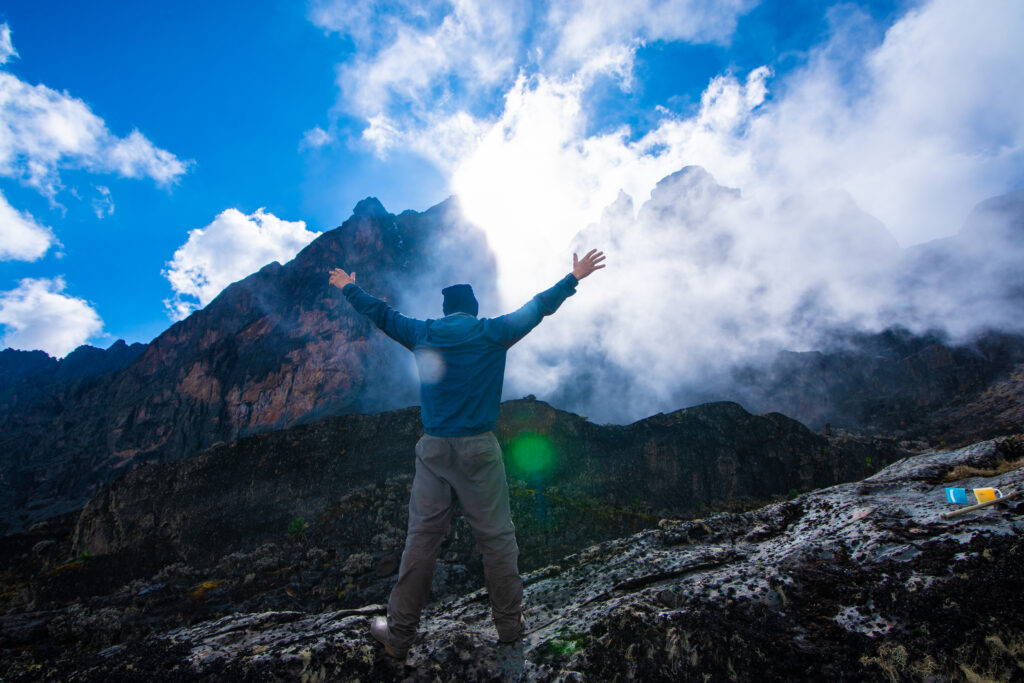
Before dawn, the Rwenzori remain silent. Cloud moves through the Bigo bog like breath. Somewhere above the treeline, ice that has waited since the last ice age catches the first light on the shoulder of Margherita Peak, and for a moment the whole range seems to hold still, as if deciding whether to let you in.
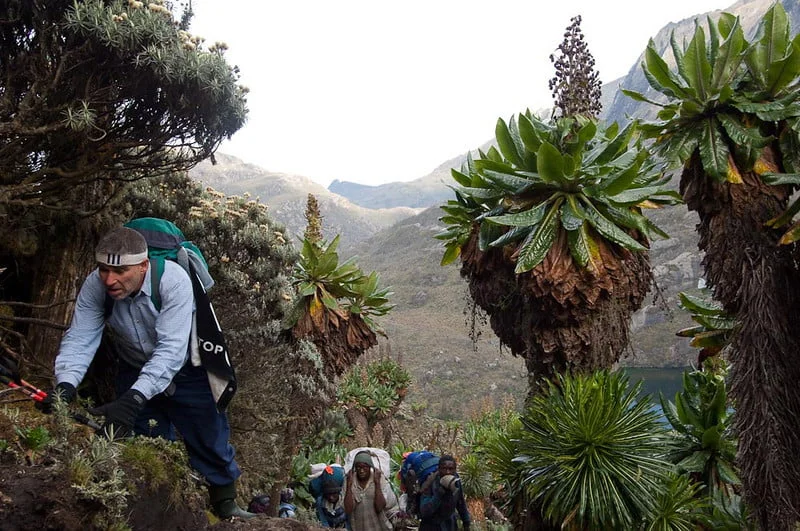
This area is the range the ancient world called the Mountains of the Moon, the mythical, cloud-veiled source of the Nile that geographers argued over for two thousand years before anyone from outside East Africa ever set eyes on it. It is not a mountain you walk up, but rather a world you walk into: giant lobelias standing sentinel in the mist, groundsel forests dripping with old man’s beard, glacial tarns the color of steel, and silence broken only by the suck of a boot pulling free of black mud.
So the traveller standing at the edge of this decision, with bags half-packed and the itinerary open in another tab, asks the only honest question worth asking: how hard is it, really? Not the marketing answer. The true one.
This guide gives you that answer in full so that when you step onto the Kilembe or Central Circuit trail, you know exactly what the mountain will ask of you and that you have chosen the right route, at the right pace, with the right team beside you.
Trekking the Rwenzori Mountains is genuinely challenging, more so, in day-to-day physical terms, than many trekkers expect. The difficulty comes less from any single obstacle and more from the combination of altitude, near-constant mud, steep and uneven terrain, unpredictable weather, and several consecutive days on the trail. It is not a walk reserved for elite athletes, but it is not a casual stroll either. The right question is not “Is it hard?” but “Which Rwenzori trek matches my fitness?, my time?, and my experience?” and that is precisely what this guide will help you answer.
What Makes Trekking the Rwenzori Mountains Difficult?
The Rwenzori has earned its reputation for difficulty, but this difficulty is specific and learnable, not a mystery. Understanding each factor in advance is the single best thing you can do to prepare for it.
1. The Altitude
Altitude becomes an increasingly real factor as trekkers climb higher into the range, particularly above 3,500 meters. The air holds less oxygen with every step upward, and the body must work harder to do what it did easily at sea level.
- Reduced oxygen availability, which makes exertion feel disproportionately hard.
- Headache and fatigue often arrive before any other symptoms.
- Sleep difficulties at higher camps, even for experienced trekkers.
- Reduced performance, slower pace, shorter breath, and heavier legs are common symptoms.
- Altitude sickness, ranging from mild discomfort to a serious medical concern that requires descent.
Being physically fit does not make a person immune to altitude sickness.
This single fact surprises many strong, well-trained trekkers. Altitude is a physiological response, not a fitness test, and it must be respected with a slow pace, proper acclimatisation days, and honest communication with your guides.
2. Muddy and Wet Terrain
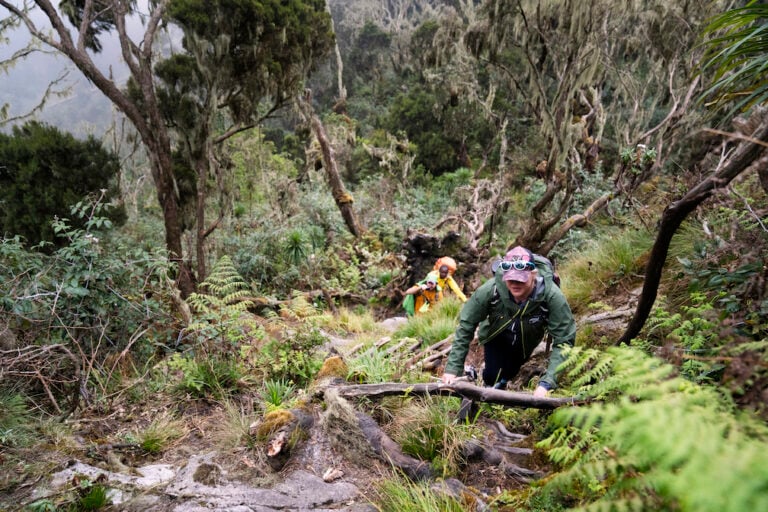
If there is one condition that defines Rwenzori trekking more than any other, it is mud. The range sits in one of the wettest mountain environments in Africa, and its trails carry the evidence of that at almost every altitude.
- Frequent rainfall, even outside the official rainy seasons.
- Muddy trails that can turn a straightforward path into a slow, deliberate exercise in balance.
- Boggy areas, particularly through the Bigo and Bujuku basins, where duckboards and stepping logs are part of the route.
- Wet vegetation that soaks trousers and gaiters within the first hour of most days.
- Slippery rocks on steeper pitches, especially descending.
- Waterlogged sections that demand careful foot placement rather than speed.
We will say this plainly, because honesty builds trust: a trek can feel considerably harder after several hours of rain or when the trail is muddy and slippery. This situation is normal on the Rwenzori Mountains, not a sign that something has gone wrong. The trekkers who enjoy themselves most are the ones who expect it.
3. Steep Ascents and Descents
The Rwenzori rewards patience over speed. Trails alternate between sustained climbing and equally demanding descents, often on uneven, root-covered ground.
- Sustained climbing over long stretches, with few flat sections to recover on.
- Uneven terrain that keeps ankles and attention constantly engaged.
- Root-covered trails through the forest zones, hidden beneath leaf litter and mud.
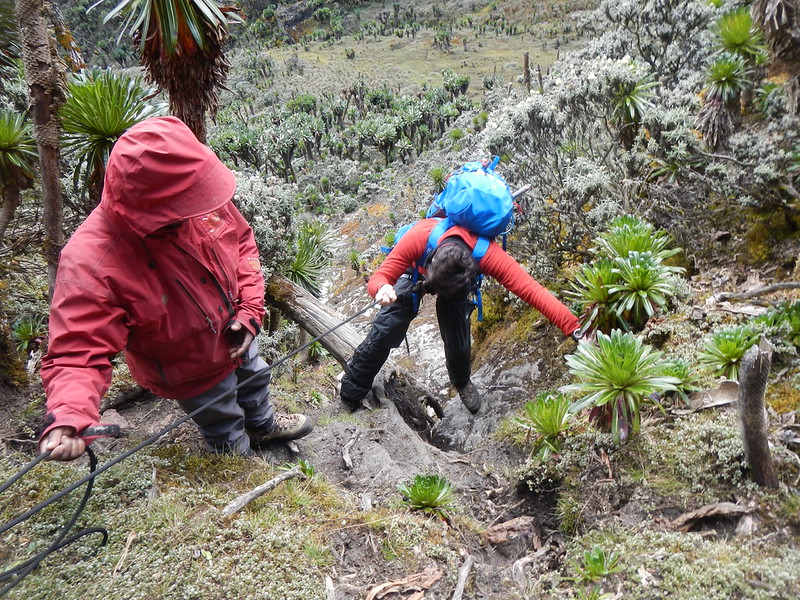
- Rocky sections that require hands-on scrambling in places.
- Descents that challenge knees and balance more than most trekkers anticipate, often the hardest part of the day, not the climb.
4. Consecutive Days of Trekking
A single six- or seven-hour trekking day is manageable for most reasonably fit travellers. The real test of the Rwenzori is what happens when that day repeats itself, again and again, without a rest day to reset.
- Accumulated fatigue that builds gradually rather than announcing itself on day one.
- Muscle soreness that deepens through the middle days of longer treks.
- Reduced recovery overnight, particularly at higher, colder camps.
- Mental fatigue, which can affect motivation as much as the legs do.
This is precisely why trek duration matters so much when choosing a route and why the right itinerary length is as important as the destination itself.
5. The Weather
The Rwenzori generate their own weather, and it changes quickly. Understanding these conditions in advance is part of preparing properly.
- Rain, which can arrive with little warning at any altitude.
- Mist that closes in and reduces visibility within minutes.
- Cold, especially overnight and above the treeline.
- Wind on exposed ridges and higher camps.
- Rapid weather changes, from clear skies to driving rain within the hour.
The Rwenzori Mountains can be wet at any time of year. We will not promise you perfect weather, because no honest operator can. What we can promise is a team, route, and pace built around that reality, so the weather becomes part of the adventure rather than a threat to it.
6. Remote Mountain Conditions
Once you leave the trailhead, you are genuinely in a remote wilderness, and that remoteness is part of what makes the range so extraordinary and part of what makes it demanding.
- The distance from towns and any form of quick outside assistance is significant.
- Basic mountain accommodation in huts or camps, simple by design.
- Limited facilities compared to lower-altitude, more accessible treks.
- Long response times should any issue arise on the trail.
- A need for self-reliance, patience, and a cooperative mindset among the group.
7. Technical Summit Terrain
Not every Rwenzori trek requires technical mountaineering. However, high summit objectives may involve specialized terrain and conditions that require additional skills, equipment, and professional guidance.
This distinction matters enormously, because visitors often confuse a Rwenzori trek with a Margherita Peak climb. They are not the same undertaking. A multi-day trek through the Bigo bog to Bujuku or Mutinda is a serious but non-technical wilderness experience. A summit bid for Margherita Peak involves glacier travel, fixed ropes, via ferrata sections, and the use of crampons and ice axes under professional guidance. Knowing which one you are signing up for is the first step in preparing correctly.
How Hard Are Different Rwenzori Treks?
Difficulty in the Rwenzori is not one fixed number; it depends entirely on the route, duration, and objective you choose. Here is how the main categories compare.
Short Rwenzori Treks
Suitable for travellers with limited time, fit beginners, and anyone wanting a genuine introduction to Rwenzori landscapes without committing to a full expedition.
- Sine Camp
- Mahoma Loop
- Nyabitaba
Difficulty: Generally moderate to challenging, a real trekking day, but achievable for prepared beginners.
Mid-Length Treks
- Mutinda Lookout
- Bujuku area
- Weismann Peak
Difficulty: Generally challenging. The exact difficulty depends on duration, elevation gained, and the specific route taken.
High-Altitude Summit Treks
- Margherita Peak
- Other major Rwenzori summit objectives
Difficulty: Very challenging.
These expeditions require:
- Good fitness.
- Multi-day endurance.
- Altitude preparation.
- Appropriate equipment.
- You should also be able to cope with difficult weather.
Can a Beginner Trek the Rwenzori Mountains?
Yes, a beginner can experience the Rwenzori Mountains, but those new to trekking should choose an itinerary appropriate to their fitness and experience. A short trek does not require the same preparation as a high-altitude expedition to Margherita Peak.
Good choices for beginners
- Shorter routes with fewer consecutive trekking days.
- Lower altitude objectives that avoid the more serious effects of thin air.
- Well-paced itineraries built with rest and acclimatization in mind, not rushed for time.
Not ideal as a first challenge
- Major high-altitude summit expeditions attempted without prior preparation or mountain experience.
Start with the mountain experience that matches your current ability, not the most difficult itinerary simply because it is famous.
How Fit Do You Need to Be?
Fitness for the Rwenzori is practical, not theoretical. Before you commit to a date, be honest with yourself about the following:
- Walk for several hours: most trekking days run five to seven hours or more, so comfort on your feet for extended periods is essential.
- Manage uphill terrain: sustained climbing is a daily feature, not an occasional challenge.
- Walk on uneven ground: roots, rocks, mud, and duckboards demand constant, low-level balance and attention.
- Carry a daypack: you will typically carry water, layers, snacks, and personal items yourself each day.
- Continue for several consecutive days: recovery matters as much as raw strength, since fatigue is cumulative.
Recommended preparation
- Walking, the simplest, most transferable preparation there is.
- Hiking, ideally on varied and hilly terrain.
- Stair climbing builds the specific muscles used in steep ascent and descent.
- Running or cycling for baseline cardiovascular endurance.
- Leg-strength training, particularly for the descents, which punish untrained knees and quads.
- Core exercises, which support balance on uneven terrain.
General gym fitness alone is a good foundation, but it is not the same as being trail-ready. Mountain-specific training, time spent walking uphill and downhill, ideally with a loaded pack, prepares your body for the exact movement patterns the Rwenzori will demand, in a way a treadmill or a weights session cannot fully replicate.
How to Train for a Rwenzori Trek
A structured training window gives your body time to adapt gradually, which is the safest and most effective way to prepare.
8–12 Weeks Before Your Trek
Build your foundation.
- Cardiovascular fitness: regular sessions that raise your heart rate and build base endurance.
- Hill training: Seek inclines wherever you can find them.
- Long walks, gradually extending distance and time on your feet.
- Stair climbing is a simple and highly effective substitute when hills are not available.
4–8 Weeks Before
Increase the specificity and load of your training.
- Hiking duration: Extend your longest sessions toward a full trekking day.
- Elevation gain: Seek routes with more up and down, not just distance.
- Backpack training: Start carrying weight similar to your daypack load.
- Strength training: Continue building the leg and core strength that protects your joints on descent.
Final Weeks
Shift from building fitness to protecting it.
- Long consecutive hiking days: Simulate back-to-back trekking days if possible.
- Recovery: Prioritize sleep, stretching, and rest between sessions.
- Equipment testing: wear your actual boots and gear on real terrain before you fly.
- Avoiding injury: ease off intensity in the final week rather than cramming.
For a full week-by-week breakdown with sample sessions, see our dedicated guide: How to Train for a Rwenzori Trek.
Is Rwenzori Harder Than Kilimanjaro?
This is a common comparison, and the honest answer is that the two mountains are difficult in different ways. Kilimanjaro is significantly higher, reaching 5,895 meters, and the majority of its challenge comes from sustained high-altitude trekking on comparatively well-established, drier trails. The Rwenzori tops out lower at Margherita Peak, but it is layered on mud, dense vegetation, steep and technical terrain, near-constant moisture, and genuine remoteness.
Kilimanjaro’s greater altitude creates a significant physiological challenge, while the Rwenzori can feel more physically demanding because of terrain, mud, weather, and remoteness. Which is harder depends on the specific routes and summit objectives you compare.
Trekkers who have done both often describe Kilimanjaro as the tougher test of the lungs and the Rwenzori as the tougher test of the legs, feet, and patience.
Is Rwenzori Harder Than Mount Kenya?
Mount Kenya is not just one single climb; it consists of several completely unique objectives on the same mountain, and to compare them fairly, you need to separate them out.
Point Lenana
The trekking summit of Mount Kenya, reached via well-trodden non-technical trails. It is a serious high-altitude trek, broadly comparable in demand to a mid-length Rwenzori trek, though generally on drier ground.
Batian and Nelion
The true technical summits of Mount Kenya require rock-climbing skill, ropes, and a mountaineering background. These sit in an entirely different category from any standard Rwenzori trekking itinerary.
Margherita Peak
The Rwenzori’s own technical summit, involving glacier travel and via ferrata sections. It compares more fairly with Batian and Nelion than with Point Lenana.
A trekking expedition to Point Lenana should not be compared directly with a technical climb of Batian, just as a short Rwenzori trek should not be compared with a Margherita Peak expedition.
Is the Rwenzori Trek Mentally Difficult?
Ask any trekker who has completed a multi-day Rwenzori itinerary what they remember most, and as often as not, it is not a single view or summit; it is a feeling of having been tested and having held steady.
- Rain for several days in a row, with no option to simply wait it out.
- Cold that settles into camp each evening and lingers into the morning.
- Mud underfoot for hour after hour, wearing patience long before it wears at the legs.
- Tiredness that accumulates quietly across the days.
- Remote camps, far from any comfort beyond what your team carries in.
- Early starts, often in darkness and cold.
- Long summit or high-point days that test resolve as much as fitness.
Physical fitness gets you through the trail, but patience and mental resilience often determine how well you adapt to the Rwenzori experience.
This phase is, in many ways, the quiet heart of the Rwenzori experience: the discovery that you can sit with discomfort and still find wonder in the mist and moss more than you expected.
How Can I Make Trekking the Rwenzori Mountains Easier?
- Choose the right itinerary: match the route to your current fitness and experience rather than to reputation alone.
- Give yourself enough time: a longer itinerary with built-in acclimatisation is consistently easier, day to day, than a compressed one.
- Train before your trek: even modest, consistent preparation changes how the days feel underfoot.
- Use appropriate waterproof equipment: quality rain gear and gaiters are not optional extras in this environment; they are essential.
- Wear comfortable, broken-in boots: never trek in Rwenzori mud in boots you have not already worn extensively.
- Pace yourself: a slow, steady rhythm consistently outperforms bursts of speed followed by exhaustion.
- Stay hydrated: dehydration compounds both fatigue and altitude symptoms.
- Listen to your guides: they read the trail, the weather, and your condition based on their daily experience of this exact terrain.
- Do not ignore altitude symptoms: early, honest communication about how you feel is what keeps minor symptoms from becoming serious ones.
- Accept that weather is part of the experience: trekkers who arrive expecting mud and mist enjoy themselves far more than those expecting a dry, easy path.
Difficulty by Trek Duration
Trek Duration | Typical Experience | General Challenge |
1–2 Days | Forest trails, an introduction to the lower Rwenzori landscape, day walks, or a single night on the mountain. | Moderate |
3–4 Days | Short-to-mid routes such as Sine Camp or Mahoma Loop, with steeper ground and changeable weather. | Moderate to Challenging |
5–7 Days | Mid-length treks toward Mutinda or Bujuku, with sustained climbing, mud, and consecutive trekking days. | Challenging |
8–9+ Days | High-altitude summit expeditions, including Margherita Peak, with technical terrain near the summit. | Very Challenging |
What Is the Hardest Part of Trekking the Rwenzori?
For many trekkers, the hardest part is not one single section of the trail. It is the combination of mud, wet conditions, altitude, steep terrain, and several consecutive days of walking. The challenge is cumulative; no individual hour is unbearable, but the sum of many demanding hours, day after day, is what tests you. Trekkers who understand the challenge in advance and pace themselves accordingly consistently find the experience more manageable and far more rewarding than those expecting one dramatic obstacle to overcome.
Frequently Asked Questions
How hard is trekking the Rwenzori Mountains?
It is genuinely challenging, driven mainly by mud, steep and uneven terrain, altitude, and several consecutive trekking days. Difficulty varies significantly by route, from moderate short treks to very challenging summit expeditions.
Are the Rwenzori Mountains harder than Kilimanjaro?
Kilimanjaro’s greater altitude creates a significant physiological challenge, while the Rwenzori can feel more physically demanding because of terrain, mud, weather, and remoteness. Which is harder depends on the specific routes being compared.
Is Rwenzori harder than Mount Kenya?
It depends on which Mount Kenya objective you mean. A trekking summit like Point Lenana compares reasonably with a mid-length Rwenzori trek, while a technical climb of Batian or Nelion sits closer to a Margherita Peak expedition.
Can beginners trek the Rwenzori?
Yes, provided the itinerary matches their fitness, shorter, lower-altitude, well-paced routes provide a suitable and rewarding introduction for beginners.
How fit do I need to be?
You should be able to walk for several hours on uneven, uphill terrain, carry a daypack, and manage several consecutive trekking days without significant strain.
How long should I train?
A structured 8–12 week training window, building progressively toward your final weeks, is a realistic and effective standard for most trekkers.
Do I need hiking experience?
Prior hiking experience helps, particularly for mid-length and summit treks, but is not strictly required for well-chosen shorter itineraries.
Can I prepare in a gym?
A gym provides a useful fitness foundation, but mountain-specific training, hill walking, stair climbing, and loaded hiking, better prepare your body for actual trail conditions.
Do I need to carry my luggage?
You typically carry a daypack with your daily essentials; main baggage is carried by porters, in line with your chosen itinerary.
Are porters available?
Yes, porter support is a standard and important part of Rwenzori trekking logistics.
Is the Rwenzori trek muddy?
Yes, mud is one of the defining features of the range, present at various levels across nearly every route.
Does it rain often?
Rain is common and can occur at any time of year, so waterproof preparation is essential rather than optional.
How cold does it get?
Temperatures drop noticeably at higher camps, particularly overnight, so warm layers are essential even though the region sits on the equator.
Are there steep sections?
Yes, sustained ascents and descents are a regular feature of most Rwenzori routes.
Can I get altitude sickness?
Yes, anyone ascending to sufficient altitude can be affected, regardless of fitness level.
How can I acclimatize?
Choosing an itinerary with adequate time, ascending gradually, staying hydrated, and communicating symptoms early are the most effective approaches.
Can fit people get altitude sickness in Rwenzori?
Yes. Being physically fit does not make a person immune to altitude sickness; it is a physiological response, not a measure of fitness.
What happens if I cannot continue with Rwenzori Trek?
Experienced guides assess your condition and arrange an appropriate response, which may include a slower pace, rest, or descent, depending on the situation.
Is there emergency support?
Established operators maintain protocols for emergencies, though the Rwenzori’s remoteness means response times are longer than in more accessible destinations.
Is travel insurance required?
Comprehensive travel insurance covering high-altitude trekking and emergency evacuation is strongly recommended for any Rwenzori expedition.
So, How Hard Is Trekking the Rwenzori Mountains?
Trekking the Rwenzori Mountains is challenging, but it is not just for elite athletes. The right level of difficulty depends on the trek you choose. Shorter Rwenzori hikes can introduce fit beginners to the mountain environment, while longer high-altitude expeditions demand greater endurance, preparation, and resilience. The most important step is choosing an itinerary that matches your current ability, giving yourself enough time to prepare, and approaching the mountains with realistic expectations.
There is a particular kind of quiet that settles over the Bujuku valley in late afternoon, when the mist lifts just long enough to reveal the glaciers above, and every step that brought you there suddenly feels worth it. That moment is what the difficulty is all about.
Plan Your Rwenzori Trek With the Team Who Knows Every Step of It
You don’t have to figure out the right route, season, or level of preparation alone. Rwenzori Trekking Expeditions helps travelers choose the right Rwenzori route based on their available time, fitness, trekking experience, and mountain goals. Whether you are looking for a brief introduction or a major summit expedition, careful planning can make the experience safer, more enjoyable, and more rewarding.
From your first inquiry to the final descent, we handle every detail—permits, guides, porters, camps, and contingency planning—with the same care the mountain itself demands. Nothing is left to chance, because on the Rwenzori, nothing should be.
Tell us where you are starting from, and let us help you find the trek that matches it. Enquire with Rwenzori Trekking Expeditions today and begin planning the mountain experience that has been waiting for you.