Rwenzori Mountains National Park is a 995-square-kilometer protected area in Kasese District, western Uganda, established as a national park in 1991 and designated a UNESCO World Heritage Site in 1994 and designated a Ramsar Wetland of International Importance in 2008. Rwenzori Mountains National Park protects Uganda’s Rwenzori Mountains range, a fault-block massif, not volcanic, whose ancient crystalline peaks rise from the floor of the Albertine Rift Valley to the summit of Margherita Peak at 5,109 meters.
It shelters over 70 mammal species, 217 bird species including 19 Albertine Rift endemics, and a botanical community, particularly its Afro-alpine vegetation, that is unique in the world. Margherita Peak at 5,109 meters on Mount Stanley is Africa’s third-highest summit.
 But the facts, important as they are, don’t capture what the park actually feels like from inside it. The Rwenzori feels like a mountain range that exists on terms other than the ones human beings typically set for mountains. The giant lobelias in the Bigo Bog stand in silver congregation at four meters, watching the boardwalk below with the authority of plants that have been growing in this specific place longer than any nearby human settlement. The Elena Glacier at midnight approached on crampons before the summit push, the headlamp beam making white circles on ancient equatorial ice, carrying a quality of silence and improbability that no amount of preparation adequately anticipates. The view from Margherita Peak at dawn, with the Congo Basin igniting in amber to the west and the entire Rwenzori ridge coming into view below you, is the kind of view that people try to describe for the rest of their lives without quite succeeding.
This guide, written from years of on-the-ground guide experience in Rwenzori Mountains National Park, exists to give you the honest, specific, expert understanding of what the park is, what it offers, and how to experience it at the standard it deserves, whether your Rwenzori journey is a 2-day forest walk to Lake Mahoma or an eighteen-day eight-peak traverse of the range’s complete crown.
The Rwenzori Mountains received fewer than 2,000 trekkers in 2024. By contrast, Kilimanjaro receives 50,000 per year. The mountains that Ptolemy placed on the ancient maps are still, today, a place most of the world has never heard of. That is both the mountain’s greatest challenge and its most irreplaceable gift.
 It is managed by Uganda Wildlife Authority (UWA) in partnership with Rwenzori Mountain Services (RMS) & Rwenzori Trekking Services (RTS), which maintains the mountain trail and hut infrastructure.
Geographically, Rwenzori Mountains National Park sits on Uganda’s international border with the Democratic Republic of the Congo; the summit of Margherita Peak is the highest point in both countries simultaneously. Kasese town, the nearest urban center, lies approximately 22 kilometers from the main northern trailhead at Nyakalengija and approximately 35 kilometers from the South by Road to Kyanjuki village.
Rwenzori Mountains National Park is approximately 390 to 420 kilometers from Kampala and 430 to 460 kilometers from Entebbe International Airport, making it a six- to seven-and-a-half-hour road journey from the country’s main international gateway. It is bordered by Queen Elizabeth National Park to the east, Fort Portal and Kibale Forest to the north, and Bwindi Impenetrable National Park to the south, positioning it at the heart of Uganda’s extraordinary western conservation corridor.
Rwenzori Mountains vs. Rwenzori Mountains National Park
The Rwenzori Mountains refers to the entire mountain range, portions of which extend across the international border into the DRC. The Rwenzori Mountains National Park is the specific, legally protected area within Uganda’s borders. Every guided trek, every summit attempt, and every wildlife observation described in this guide takes place within the national park’s boundaries. Uganda Wildlife Authority manages trekking permits, guide certification, and conservation fees within this framework.
Rwenzori Mountains National Park
| Feature | Detail |
| Country | Uganda (East Africa) |
| Distance from Kampala | ~380 km (5–6 hours by private vehicle) |
| Distance from Entebbe | ~420 km (6–7 hours by private vehicle) |
| Bird Species | 217, including 19 Albertine Rift endemics |
| Region | Western Uganda — Kasese District |
| Mammal Species | 70+, including colobus, L’Hoest’s monkey, buffalo, forest elephant |
| Annual Rainfall | 1,500–3,000mm (one of Africa’s wettest mountain ranges) |
| Park Area | 995 km² / 384 sq miles |
| Established | 1991 (national park) | UNESCO World Heritage Site 1994 |
| Management | Uganda Wildlife Authority (UWA) + Rwenzori Mountain Services (RMS) + Rwenzori Trekking Services |
| Highest Peak | Margherita Peak, Mount Stanley—5,109 m / 16,762 ft |
| Africa Rank | 3rd highest mountain range in Africa |
| Major Massifs | 6 Rwenzori Mountains: Stanley (5,109 m), Speke (4,890 m), Baker (4,843 m), Emin (4,798 m), Gessi (4,715 m), Luigi di Savoia (4,627 m) |
| Vegetation Zones | 5 Rwenzori Vegetation Zones: Afro-montane forest, bamboo, heather, Afro-alpine moorland, nival/glacier |
| Main Trails | Central Circuit Trail (Nyakalengija) | Kilembe Trail (Kyanjuki) |
| Nearest Town | Kasese: 22 km from Nyakalengija trailhead |
| Equatorial Glaciers | Yes: among the last equatorial ice fields on Earth (retreating) |
| Trek Difficulty | Moderate to very strenuous depending on the itinerary |
| Year-Round Access | Yes: park open all 12 months |
The Rwenzori Mountains are not a single peak. They are a complex of six major massifs, each a distinct mountain in its own right, each with its character, its summit peaks, its approach terrain, and its place in the range’s extraordinary geography. Understanding all six massifs is the foundation for understanding the park’s fullest offerings. For the complete detailed guide to each peak and approach route, visit the Rwenzori Mountains section of Rwenzori Trekking Expeditions.
Rank | Massif | Highest Peak | Elevation | Key Characteristic |
1st | Mount Stanley | Margherita Peak | 5,109 m / 16,762 ft | Uganda’s & DRC’s highest; last equatorial glaciers; glacier crossing on summit day |
2nd | Mount Speke | Vittorio Emanuele Peak | 4,890 m / 16,043 ft | Second highest; dramatic rocky approach; part of the 9-day Central Circuit |
3rd | Mount Baker | Edward Peak | 4,843 m / 15,889 ft | Africa’s 10th highest; steep technical approach; safety ropes standard |
4th | Mount Emin | Umberto Peak | 4,798 m / 15,741 ft | Twin summits; extended multi-peak expedition objective |
5th | Mount Gessi | Bottego Peak | 4,715 m / 15,469 ft | Twin summits, named for Italian explorer Romolo Gessi |
6th | Mount Luigi di Savoia | Weismann’s Peak | 4,627 m / 15,180 ft | Accessible via 7-day Kilembe Trail expedition; outstanding summit panorama |
Sub-peak | Portal Peaks | Kuhuma Peak | 4,134 m / 13,563 ft | Best beginner 4,000 m+ summit; no glacier; 6-day itinerary |
1. Mount Stanley: The Roof of Africa’s Third Highest Mountain
Mount Stanley, at 5,109 metres, is the Rwenzori’s crown, the highest point of the range, Africa’s third-highest summit, and the park’s most celebrated mountaineering objective. The massif is named for Henry Morton Stanley, whose 1889 expedition became the first European to document the range. Stanley carries multiple summit peaks on its broad glaciated plateau: Margherita (5,109m) is the highest, followed by Alexandra (5,083m), Savoia (4,977m), Elena (4,968m), Moebius (4,949m), Philip (4,920m), Elizabeth (4,929m), and Albert (5,087m). The Duke of Abruzzi’s 1906 expedition made the first recorded ascents of these peaks.
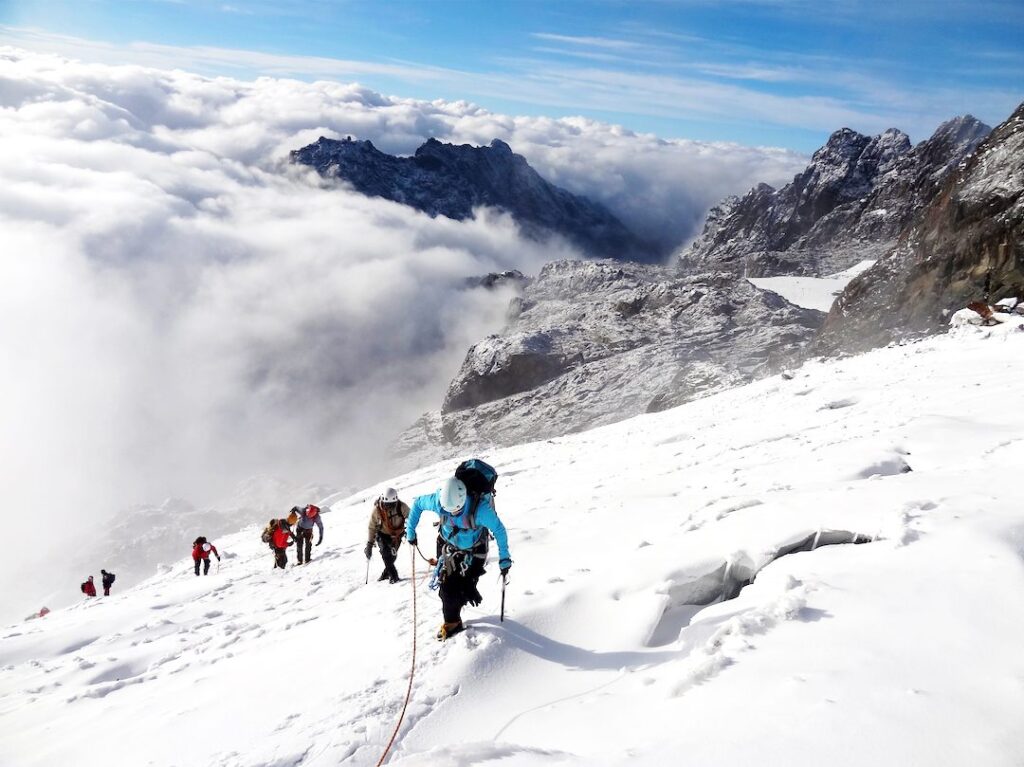
The Margherita summit approach from the Ugandan side crosses the Elena Glacier, one of the range’s largest remaining ice bodies, under crampons and rope from Elena Hut at 4,541 meters in a pre-dawn push that typically reaches the summit between 06:00 and 08:00.
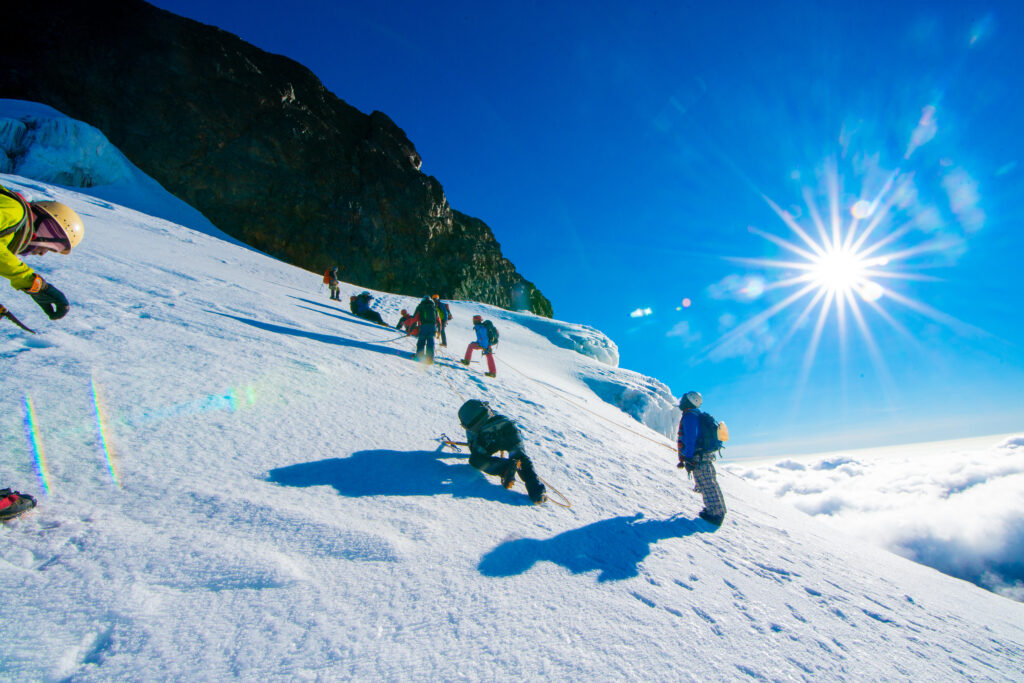
The glacier retreat is documented and measurable: photographs from 1906 show ice extending to altitudes now covered only by dark rock, and scientists project complete glacier loss by approximately 2050. To cross the Stanley Glacier today is to walk on ice that has existed at the equator since before human civilization and whose remaining years are numbered.
2. Mount Speke: The Rocky Neighbor
Mount Speke, at 4,890 meters, rises northeast of the Bujuku Valley, its dark rock faces visible from the Bujuku Camp, which serves as the Central Circuit Trail’s operational hub. Named for John Hanning Speke, whose 1862 expedition identified Lake Victoria as the Nile’s source, the Speke massif carries Vittorio Emanuele Peak (4,890 m) as its highest point, named for the Italian king in whose era the Rwenzori’s peaks were first systematically explored. The approach from Bujuku is a sustained rock scramble without glacier travel, making Vittorio Emanuele the most technically accessible of the range’s major summits above 4,800 meters.
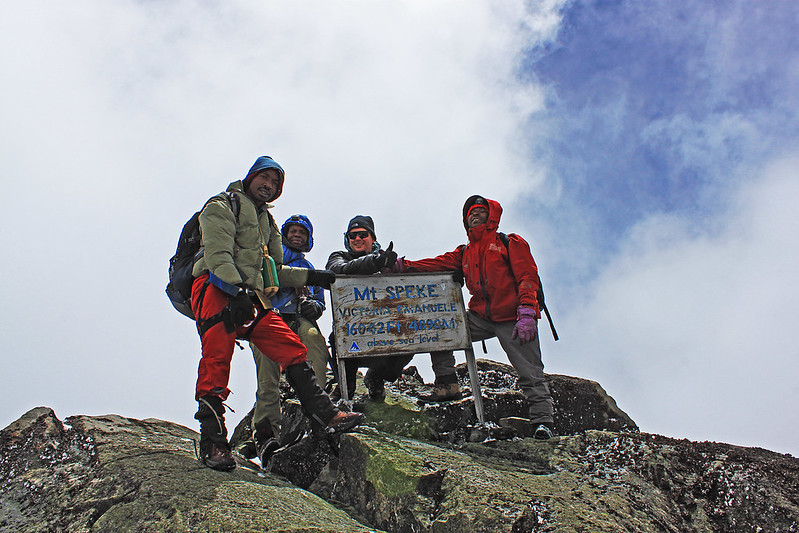
The view from the Speke summit encompasses the full Stanley massif directly across the Bujuku Valley, providing the most complete view of the Margherita glacier from any adjacent peak.
3. Mount Baker: The Guardian of the Kitandara Lakes
Mount Baker, at 4,843 metres, rises directly above the Kitandara Lakes basin, at 4,023 metres, in a relationship of mountain and water that photographers consistently identify as the Rwenzori’s most striking single composition. Edward Peak (4,843 m) is the Baker Massif’s highest point, approached by sustained scrambling on rock that becomes increasingly technical on the upper faces. The Kitandara Lakes, twin glacial tarns positioned below Baker’s south face, are among East Africa’s most beautiful high-altitude lake settings: dark water, still on windless mornings, reflecting Baker’s cliff faces with the precision of a geological mirror. Baker is included in the ten-day, thirteen-day, and longer multi-peak programs.

4. Mount Emin: The Remote Northern Wilderness
Mount Emin, at 4,798 meters, is Rwanda’s most northerly major massif and one of its least visited. Umberto Peak (4,798 m) is the highest point, requiring navigation through terrain that lies beyond the standard trail system, including the Skull Cave and Lac de Laluna approach that serves the six-peak and eight-peak programs. Named for Emin Pasha, the German governor of Uganda’s Equatoria Province in the 1880s, Mount Emin provides views of the Congo Basin from its summit ridge that are available at no other vantage point on the range. Fewer than a few hundred people summit Umberto Peak in any given year.
5. Mount Gessi: Africa’s Most Rarely Climbed Major Summit
Mount Gessi at 4,715 metres stands at the far northern end of the Rwenzori range, its Bottego Peak (4,715 m) representing, according to the consistent assessment of guides who know these mountains, the most rarely climbed major summit in Africa. Named for Romolo Gessi, the Italian explorer who first circumnavigated Lake Albert in 1876, the Gessi massif’s sharp Precambrian gneiss and the navigational demands of the approach terrain make it accessible only to those undertaking the full six or eight-peak traverse. The summit is included in the thirteen-day and eighteen-day programs.
6. Mount Luigi di Savoia, the Southern Crown
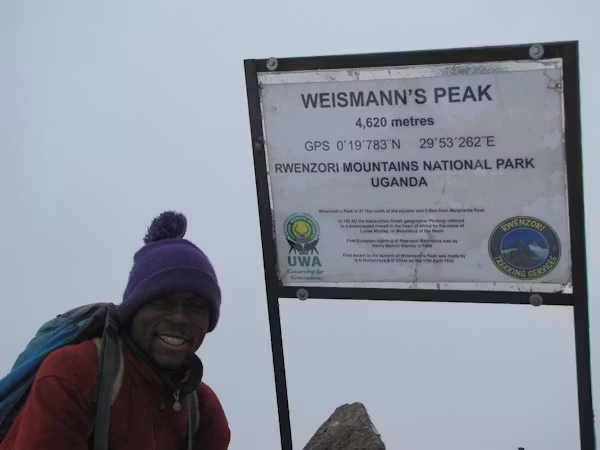
Mount Luigi di Savoia at 4,627 meters is the southernmost of the six massifs, carrying Weismann Peak (4,627 m) and Sella Peak (4,627 m) as its twin summits. Named for Luigi Amedeo di Savoia, Duke of Abruzzi, whose 1906 expedition made the first recorded ascents of the Rwenzori’s major peaks, the massif is approached from Freshfield Pass (4,282 m) by a non-glaciated rocky scramble above the afro-alpine moorland. The ten-day four-peaks program and the six-peak and eight-peak traverses all include the summits of Luigi di Savoia. Weismann Peak at 4,627 m is the most accessible major Rwenzori summit for trekkers without glacier experience.
The Portal Peaks: The Rwenzori’s Quartzite Sentinels
The Portal Peaks are twin quartzite pillars rising to 4,059 metres on the Rwenzori’s eastern ridge that, while not among the six major massifs, deserve specific mention as one of the range’s most distinctive and photographed features. Visible from the lower sections of the Central Circuit Trail, the Portal Peaks frame the approach to John Matte Hut with a dramatic silhouette that has made them the visual emblem of the Rwenzori’s mountain profile. They are named for their gatekeeping position on the approach to the range’s central massifs, and their quartzite composition, which is different from the gneiss and schist that dominate the range’s higher terrain, reflects the geological complexity of a mountain shaped by tectonic forces over millions of years.
What to See and Do in Rwenzori Mountains National Park
Trekking and Mountaineering
The Rwenzori’s premier activities are its trekking and mountaineering programs, which range from a two-day forest walk to Lake Mahoma at 2,988 meters, through the range’s most celebrated short excursion, to the eighteen-day eight-peak grand traverse, which represents the most comprehensive mountain expedition available on the African continent. Three established trails serve the park: the Central Circuit Trail (entering from Nyakalengija on the north), the Kilembe Trail (entering from Kilembe Village on the south), and the Bukurungu Wilderness Camping Trail (a tented wilderness route accessing four high-altitude lakes).

For the complete trekking program guide, including day-by-day itineraries, pricing, and availability, visit the Trekking Safaris section of Rwenzori Trekking Expeditions
Birding: An Albertine Rift Endemic Showcase
Rwenzori Mountains National Park is one of Uganda’s premier birding destinations, with 217 recorded bird species, of which 19 are Albertine Rift endemics found nowhere outside this specific biogeographic zone. The Rwenzori turaco, with its crimson wing patches and distinctive loud call, is the park’s avian emblem and reliably encountered in the forest zone from the first meters of the Central Circuit trail. The handsome francolin, Archer’s robin-chat, African green broadbill, Rwenzori batis, stripe-breasted tit, and Rwenzori double-collared sunbird are among the endemics that make this mountain one of the finest single birding destinations in the Albertine Rift. The forest zone between the Nyakalengija trailhead and Nyabitaba Hut and the Lake Mahoma crater’s edge are the two most productive birding sections. Visit our Rwenzori Birding Guide at rwenzoritrekkingexpeditions.com for the complete species checklist and seasonal guidance.
Wildlife Viewing: Primates, Buffalo, and the Rwenzori Leopard
The park’s lower forest zones support populations of black-and-white colobus monkeys, L’Hoest’s monkeys, red-tailed monkeys, and the three-horned chameleon, a Rwenzori endemic. African buffalo use the forest-savannah fringe areas and are occasionally crossed on the lower trail sections. The forest elephant, though rarely observed, leaves evidence of its passage in the form of trail crossings and feeding signs throughout the lower montane forest. The Rwenzori leopard, a melanistic or normally pigmented subspecies adapted to the mountain’s forest conditions, is present but extremely rarely seen; its tracks and territorial markings are found more reliably than the animal itself. For the complete Rwenzori wildlife guide, visit www.rwenzoritrekkingexpeditions.com.
Cultural Visits: The Bakonzo People and Mountain Heritage
The Bakonzo people of the Rwenzori foothills have lived in relationship with these mountains for centuries, and their culture is inseparable from the mountain’s identity. Your private guide and porter team are almost entirely Bakonzo community members whose knowledge of the mountain extends beyond professional training to the layered, specific understanding of home. Cultural experiences available in the Rwenzori foothills include visits to traditional Bakonzo homesteads, demonstrations of traditional farming practices on the mountain’s terraced lower slopes, and the opportunity to attend traditional music and dance performances arranged through community tourism initiatives. The Ruboni Community Camp in the foothills offers an organized cultural program that has become one of the region’s most appreciated community tourism experiences. For Bakonzo cultural visit arrangements, contact your Rwenzori Trekking Expeditions consultant.
Photography: One of Africa’s Most Photogenic Mountain Environments
The Rwenzori Mountains offer photography opportunities that no other mountain range in Africa can match: the giant lobelias and groundsel trees of the Afro-alpine zone, the twin Kitandara Lakes reflecting Baker’s cliffs in the late afternoon, the pre-dawn glacier approach with headlamps and ancient ice, and the summit view from Margherita Peak with the Congo Basin glowing amber in the first equatorial light. The forest zone’s Rwenzori turacos offer avian photography of exceptional quality; the three-horned chameleons on the lower trail deliver the kind of close-range wildlife portrait photography that national parks with vehicles and telephoto requirements cannot produce. The entire park is a continuous photography opportunity for those who bring quality equipment and the patience to use it.
Waterfall Experiences: The Kilembe Trail’s Signature Features
The Kilembe Trail’s lower sections pass through a series of significant waterfalls that are among the most dramatic in western Uganda. Samalira Falls, Kinyakahori Falls, and the multiple waterfall cascades visible from the trail’s first two days make the Kilembe approach the most waterfall-rich trekking experience in the Rwenzori Mountains National Park.
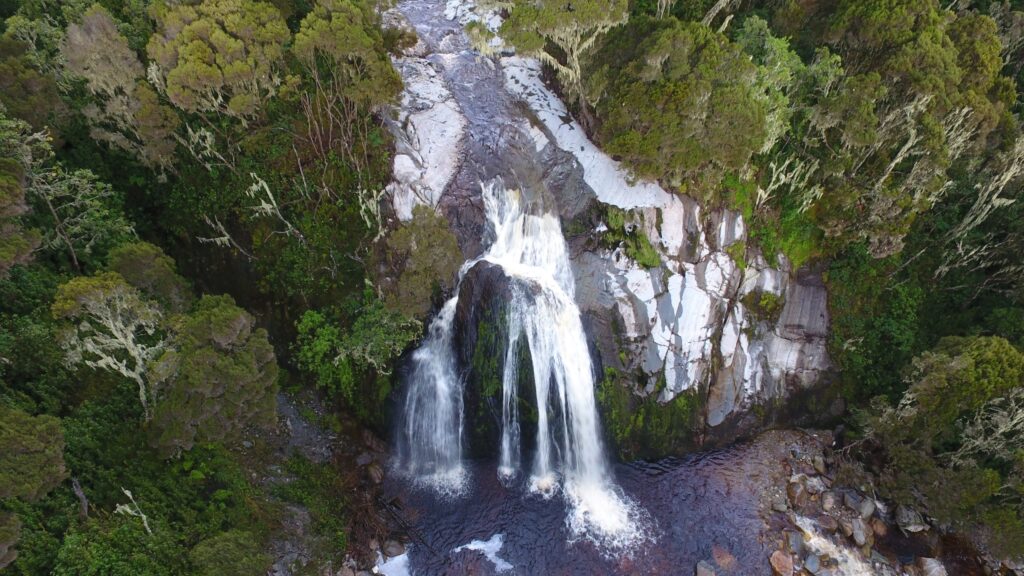
The waterfalls are at their most powerful in the wet season months when the mountain’s characteristic high rainfall is at its peak, though they are impressive in any season. The 4-day Kilembe waterfalls hike, designed as an accessible introduction to this trail’s character, is available as a standalone program through Rwenzori Trekking Expeditions.
The Five Ecological Zones: A Vertical World Like No Other
The Rwenzori Mountains National Park’s most remarkable characteristic (the feature that sets it apart from every other mountain national park in Africa) is the succession of five radically distinct ecological zones encountered on the ascent from the park’s lower boundary to its glaciated summits. Each zone transition is abrupt, unmistakable, and botanically unlike anything in the zone immediately below or above it. This vertical ecological sequence, compressed into a relatively short horizontal distance, is one of the reasons the park was awarded UNESCO World Heritage status.
Zone 1: Afro-Montane Forest (1,646–2,500m)
The park’s entry zone is an Afro-montane forest of extraordinary richness: Hagenia abyssinica and Hypericum trees forming the primary canopy, draped with epiphytic mosses, ferns, and orchids at every level from ground to crown. This zone supports the highest wildlife diversity of any in the park: primates, forest birds including the Rwenzori turaco, reptiles including the three-horned chameleon, and the botanical community that underpins the entire forest ecosystem above it. The Nyabitaba Hut at 2,651 metres marks the approximate upper boundary of this zone’s densest expression.
Zone 2: Bamboo and Giant Heather (2,500–3,500m)
Above the montane forest, highland bamboo appears first, thirty-metre columns filtering the light into green diffuse shafts, before giving way to the giant heather zone that defines the Rwenzori’s mid-altitude landscape. Erica arborea at six to eight meters, its trunks so completely encased in Usnea lichen and sphagnum moss that the underlying wood is invisible, creates a landscape of extraordinary biological strangeness. The Kurt Schafer Bridge crossing between Nyabitaba and John Matte Huts marks the transition into this zone.

Zone 3: Afro-Alpine Bog (3,500–4,200m)
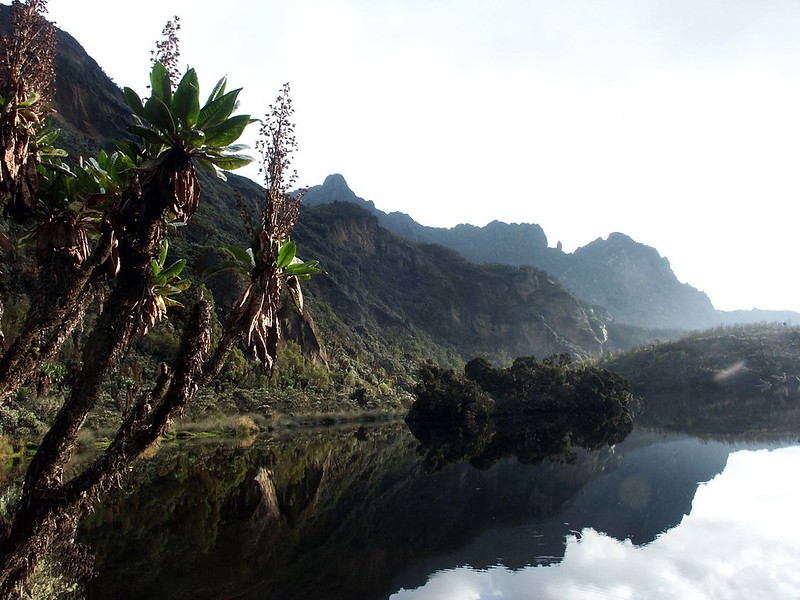
The Rwenzori’s most celebrated and most botanically unique zone, the Afro-alpine moorland of giant lobelias and Senecio groundsel trees that produces the images most associated with the range internationally. Lobelia wollastonii, at three to four meters, stands in silver congregation across the waterlogged tussock grass. Dendrosenecio adnivalis spreads its silver-backed canopies above the boardwalk at intervals, with some individual specimens over a century old. The Bigo Bog on the Central Circuit and the Bugata Camp area on the Kilembe Trail are the most expansive and spectacular expressions of this zone.
Zone 4: Upper Rocky Zone (4,200–4,800m)
Above the giant lobelia moorland, the vegetation surrenders progressively to bare Precambrian rock. Cushion Alchemilla, mosses, and lichens cling to the rock surface at the zone’s lower reaches; higher, the outcrops are entirely bare, shaped by the same daily freeze-thaw cycle that has been working on this terrain since the last ice age. Scott-Elliot Pass at 4,372 meters sits in this zone, offering the most comprehensive panorama of the range’s peak system from any point accessible to non-technical trekkers.
Zone 5: Glacial Zone (4,800–5,109m)
The park’s highest zone is defined by the remaining equatorial glaciers: the Elena, Coronation, Albert, Alexandra, and Margherita ice bodies on Mount Stanley and remnant ice on some of the adjacent massifs. These are among the last equatorial glaciers in Africa; their retreat over the past century is documented in the photographs taken by the Duke of Abruzzi’s 1906 expedition, and scientific projections suggest complete disappearance by approximately 2050. To walk on the Rwenzori glaciers today is to experience one of the rarest and most time-sensitive natural phenomena available to any mountain trekker on Earth.
Wildlife of the Rwenzori Mountains
Rwenzori Mountains National Park sits within the Albertine Rift Biodiversity Hotspot, identified by Conservation International as the world’s most concentrated repository of endemic vertebrate species in Africa. Over 70 mammal species, 217 bird species (37 Albertine Rift endemics), and hundreds of plant species found nowhere else make every trail day a naturalist expedition as well as a mountain trek.
Primates
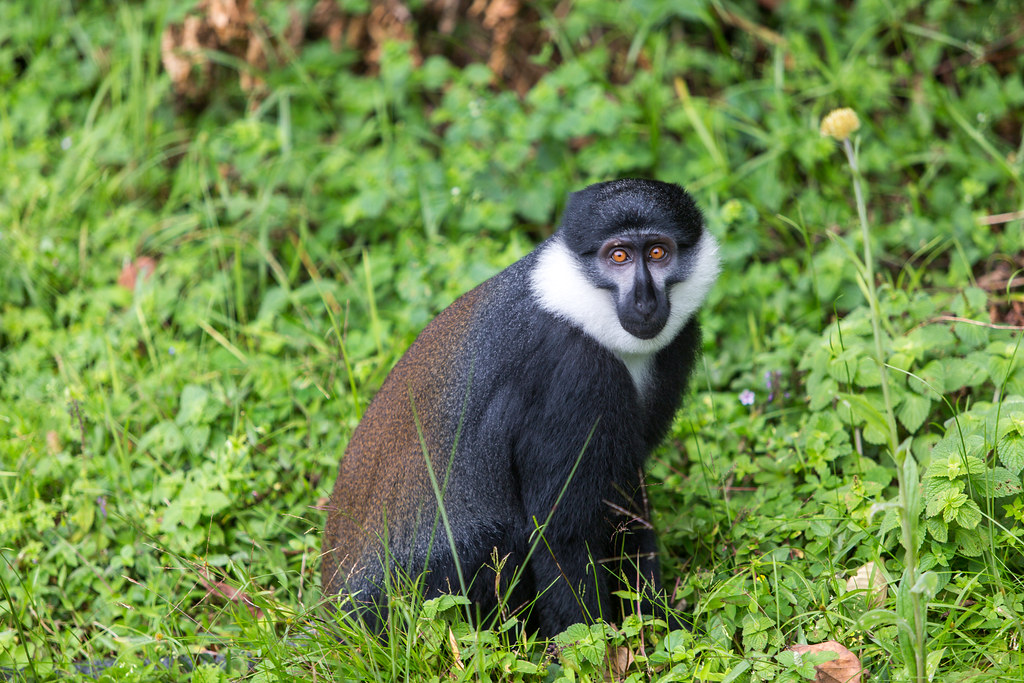
Blue Monkeys, Black-and-White Colobus, and the rare L’Hoest’s Monkey inhabit the lower Afro-montane forest of both trail systems. They are encountered on virtually every guided departure, typically in the lower forest on Days 1 and 2 of longer itineraries and during the descent. Chimpanzees are present in the park’s forest zones but are unhabituated, and sightings are wild and opportunistic.
The Albertine Rift Bird Community
The Rwenzori Turaco (Ruwenzorornis johnstoni), with its electric crimson wing flash and liquid descending call, is the range’s signature bird and is encountered on almost every guided departure from either trailhead. The African Green Broadbill, Handsome Francolin, Rwenzori Batis, Yellow-Eyed Black Flycatcher, and Malachite Sunbird are all Albertine Rift endemics that trekkers regularly see when guided at an observation-focused pace through the appropriate zones. The Malachite Sunbird feeding on giant lobelia spikes at 3,800 meters is among the finest wildlife moments in the park.
High Mountain Specialists
Rock hyraxes colonize boulder fields from the heather zone upward and are consistently vocal and visible around the high mountain camps. The Rwenzori Red Forest Duiker, an endemic subspecies, appears at vegetation margins in the heather and alpine zones.

The Rwenzori Three-Horned Chameleon (Trioceros johnstoni), endemic to the range, is found in the bamboo zone and is one of the most rewarding slow-pace wildlife finds on the trail.
How to Get to Rwenzori Mountains National Park

From Entebbe International Airport
Entebbe International Airport (IATA: EBB) is Uganda’s primary international gateway, located 40 kilometers south of Kampala on Lake Victoria’s northern shore. From Entebbe, the Rwenzori Mountains National Park’s main access town of Kasese is approximately 420 kilometers west, a journey of six to seven hours by private vehicle via the Fort Portal highland route. International connections to Entebbe include direct or single-connection services from London Heathrow (British Airways), Amsterdam (KLM), Dubai (Emirates), Nairobi (multiple carriers), and Addis Ababa (Ethiopian Airlines). Rwenzori Trekking Expeditions provides fully private transfer from Entebbe to Kasese for all confirmed bookings; your dedicated driver meets you at arrivals and manages the entire journey, including a curated mid-route lunch stop.
From Kampala to Kasese
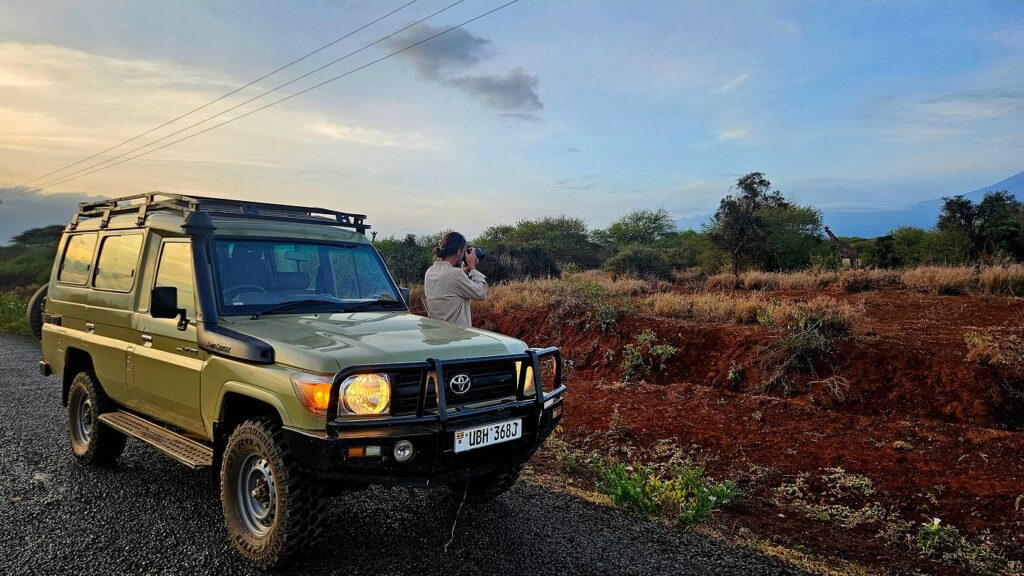
From Kampala, Kasese is approximately 380 kilometers west, a journey of five to six hours by private vehicle via the Kampala-Fort Portal highway. The road passes through the rolling tea-growing highlands of central Uganda before descending into the western Rift Valley, with the Rwenzori Mountains visible above the western horizon from certain elevated sections in the final hour of the drive. Scheduled public coach services run daily from Kampala to Kasese; the journey takes seven to nine hours. For premium trekking programs, private vehicle transfer is strongly recommended; arriving rested makes a material difference to Day One on the mountain.
Domestic Flight to Kasese Airstrip
A domestic airstrip at Kasese serves light aircraft from Entebbe and Kampala, reducing travel time to approximately one hour. Aerolink Uganda and other regional operators provide scheduled and charter service. This option is worth considering for trekkers with tight schedules or those combining the Rwenzori with other western Uganda destinations (Queen Elizabeth National Park, Bwindi) who need efficient inter-park transfers. Contact your Rwenzori Trekking Expeditions consultant for current domestic flight schedules and charter pricing.
Rwenzori Trekking Routes: The Two Principal Trails
The Central Circuit Trail: Northern Approach
The Central Circuit Trail departs from Nyakalengija on the mountain’s northern flank, 22 kilometers from Kasese, and follows the Mubuku and Bujuku river systems into the range’s interior. It is the original, most established, and most ecologically diverse trekking route in the park, ascending through all five vegetation zones, traversing the Bujuku Valley with its extraordinary giant lobelia moorland, passing the Kitandara Lakes at 4,023 metres, and reaching the Elena Glacier Margherita summit approach from Elena Hut at 4,541 metres. The Central Circuit serves as the framework for the 2-day Lake Mahoma Trek, the 6-day Portal Peaks Trek, and the full 9-day 3-Peaks Margherita Peak expedition. Its out-and-back and loop configurations give it the flexibility to support itineraries of almost any duration.
The Kilembe Trail: Southern Valley Approach
The Kilembe Trail enters the park from the south through the glacially carved Nyamwamba Valley, starting at Kyanjuki village near the historic Kilembe Copper Mines. It is a point-to-point traverse, entering from Kyanjuki and exiting at the Nyamwamba Valley exit on the far side of the inner mountain, giving it a momentum and narrative arc that the Central Circuit’s more circular structure does not share. The Kilembe Trail’s signature features are the extraordinary waterfall drama of Enock’s Falls at Sine Hut, the atmospheric bamboo corridor on Day 2, the solar-equipped Bugata Camp at 4,100 metres with warm showers, and the stunning Bamwanjara Pass panorama at 4,450 metres. It serves the 2-day Sine Camp Trek, the 7-day Baker and Weismann’s Peak dual-summit expedition, and the 7-day Kilembe Trail Margherita Peak expedition.
Central Circuit vs. Kilembe Trail: Which Is Right for You?
Feature | Central Circuit Trail | Kilembe Trail |
Trailhead | Nyakalengija—22 km from Kasese | Kyanjuki—35 km from Kasese |
Route Type | Out-and-back / loop options | Point-to-point traverse |
Signature Feature | Bujuku Valley lobelias, Kitandara Lakes | Enock’s Falls, Nyamwamba Valley gorge |
Bamboo Zone | Present; less prominent | Outstanding and atmospheric—Day 2 highlight |
High Camp Facilities | Elena Hut 4,541 m (basic) | Bugata Camp 4,100 m (solar, warm showers) |
Margherita Approach | Via Elena Hut (4,541 m) | Via Margherita High Camp (~4,800m) |
Short Trek Options | Lake Mahoma (2 days), Portal Peaks (6 days) | Sine Camp (2 days), Sine & Samalira (3 days) |
Multi-Peak Options | Speke, Baker, Margherita | Baker, Weismann’s, Margherita |
Best For | Loop circuit, broadest ecology, 9-day expedition | Point-to-point, waterfalls, focused summit |
From the Trailheads
From Kasese town, the two main trailheads are within forty minutes by vehicle: the Nyakalengija trailhead (Central Circuit Trail) is 22 kilometers from Kasese, approximately forty minutes by private vehicle. The Kilembe trailhead (Kilembe Trail) is 14 kilometers from Kasese, approximately thirty minutes. Both trailhead transfers are included in all Rwenzori Trekking Expedition programs. For Uganda visa information, $50 USD for most nationalities, available at visas.immigration.go.ug or on arrival at Entebbe, visit the Getting to the Rwenzori section at www.rwenzoritrekkingexpeditions.com.
Park Entrance Fees and Permit Costs
All trekking in Rwenzori Mountains National Park requires Uganda Wildlife Authority permits. Rwenzori Trekking Expeditions manages and pays for these on your behalf as part of your package. The following fee schedule represents current 2024–2026 UWA Conservation Tariff rates.
Fee Category | Rate | Notes |
Park Entry—Foreign Non-Resident | USD $45/person/day | Applies to all international visitors |
Park Entry — Foreign Resident | USD $25/person/day | Valid residency documentation is required. |
Park Entry — East African Citizen | UGX 15,000/person/day | Citizens of Uganda, Kenya, Tanzania, Rwanda, Burundi |
Hut/Camp Fee (per night) | USD $35/person | Applies at all RMS-managed huts on Central Circuit |
Guide Fee — Lead Guide | USD $30/day | UWA-registered, mandatory for all treks |
Guide Fee — Assistant Guide | USD $20/day | Required on technical summit days |
Porter Fee | USD $15/day | Per porter, max load 18 kg including own kit |
Cook Fee | USD $15/day | Full-board mountain catering |
Peak Summit Permit | USD $50–100/peak | Per peak; varies by massif and summit elevation |
Rescue Fund Levy | USD $30/trek | Mandatory UWA rescue fund contribution |
Rubber Boot Hire | Included by RTE | All sizes; mandatory for bog sections |
All UWA fees for programs booked through Rwenzori Trekking Expeditions are incorporated into the package price and managed entirely by your guide team. No separate payment is required at the park gate. For the complete fee schedule, including group discounts and East African Community visa information, visit the Park Fees section at www.rwenzoritrekkingexpeditions.com.
Best Time to Visit Rwenzori Mountains National Park
The Rwenzori Mountains receive rainfall on approximately 300 days each year, making it one of the highest precipitation rates of any mountain range in Africa. This is not a mountain where weather uncertainty is an edge case; it is a mountain where moisture is a fundamental character. Planning around the seasonal patterns, however, significantly affects the quality of the summit experience and the comfort of the trek.
Primary Season: December through February
January and February are the finest months to visit Rwenzori Mountains National Park for summit-focused programs. The primary dry season brings the clearest skies, the most stable glacier conditions on the Elena and Stanley approaches, the firmest going through the high bog sections, and the highest probability of a clear summit morning at Margherita Peak. Beryl Park, who became the oldest person to summit Margherita at 78 in 2010, made her ascent in the dry season, the conditions she encountered were the best the mountain offers. Bird activity in the forest zone is excellent throughout, and the cultural programs in the Bakonzo communities are available year-round. Book six to twelve months ahead for primary season availability.
Secondary Season: June through August
June and July offer the second reliable window for all summit programs. Both months provide adequate conditions for the glacier approach and favorable trail conditions on the Central Circuit trail and Kilembe Trail. August marks the transition toward the shorter wet season in some years. This window aligns with European and North American summer schedules and is the most popular booking period. The combination of the Rwenzori with gorilla trekking in Bwindi, which is also excellent in the June–August window, makes this a particularly attractive period for travellers planning the combined safari and mountain experiences available through Rwenzori Trekking Expeditions.
Wet Seasons: March–May and September–November
The wet season months bring heavier precipitation and lower summit success rates. The trails are muddier, the glacier approach carries greater uncertainty, and the bog sections require more careful navigation. That said, the wet season in Rwenzori has genuine appeal: the forest is at its most lush, the waterfalls on both trails run at full volume, the bird activity in the forest zone is excellent (many species are more vocal in and after rain), and the mountain has an atmospheric quality—mist, cloud, and the particular sound of a saturated forest, that the dry season cannot replicate. For short, non-summit programs (the two-day Lake Mahoma Trek and the four-day Mutinda Lookout Hike), the wet season is a valid and attractive option with appropriate gear and expectations.
Best and Worst Time For Rwenzori
The best time to climb is January–February (primary) and June–July (secondary). The best time for birding in the Rwenzori is year-round, with early morning activity peaking in any month between 06:30 and 09:00. The best time for photography is January–February for summit clarity and June–August for the combination of optimal light and lush vegetation. The wettest months of April, May, and October have the lowest summit success probability and the most demanding trail conditions. For the complete month-by-month guide to visiting Rwenzori Mountains National Park, visit the Best Time to Visit section at www.rwenzoritrekkingexpeditions.com.
What to Wear and Pack: The Rwenzori Gear Guide
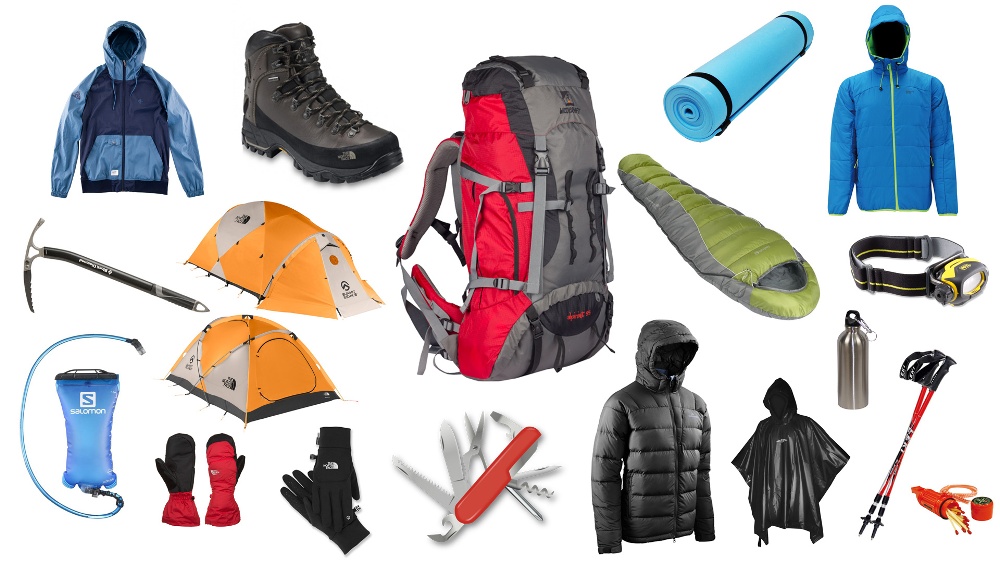
The Rwenzori Mountains National Park demands more specific and more carefully considered gear than any other national park in Uganda. The temperature range encountered across a summit trek spans from 30°C at the Kasese lowland to -15°C at Elena Hut overnight. The moisture level is near-constant. The bog terrain requires specific footwear that standard trekking boot guidance does not cover. Getting the gear right is not a preference; it is a safety and comfort requirement.
Footwear: The Critical Decision
Rubber boots (Wellington-style waterproof boots) are mandatory for all trekking in Rwenzori Mountains National Park and are provided free of charge in all sizes by Rwenzori Trekking Expeditions at the trailhead. The Central Circuit and Kilembe Trail bog sections remain waterlogged throughout the year and will ruin standard trekking boots in a single crossing. Neoprene socks (four to five pairs minimum) provide essential insulation inside the rubber boots at altitude. For the glacier sections on summit programs, crampons are fitted directly to the rubber boots by your guide.
Waterproof System Non-Negotiable
A fully waterproof hardshell jacket and trousers rated to a minimum of 20,000 mm hydrostatic head, with all seams sealed, are the single most important items in your personal kit. A water-resistant jacket, one that manages light rain but is not fully waterproof, is not a waterproof jacket on the Rwenzori. The mountain will expose any waterproof rating below the full specification within hours. Hardshell trousers must be full zip-side to fit over rubber boots.
Thermal Layers
Two sets of thermal base layers (synthetic or merino wool, never cotton), a heavyweight fleece mid-layer, and a down jacket with hood (600-fill minimum) for the upper camps and summit day. The down jacket goes on at the approach to Elena Hut and comes off when you are safely below 4,500 metres on the descent. At Margherita Camp or Elena Hut overnight, the sleeping bag (minimum -10°C rating) is what stands between you and a freezing night.
Technical Equipment: Provided by Rwenzori Trekking Expeditions
Crampons, ice axes, climbing harnesses, and safety helmets are all provided by Rwenzori Trekking Expeditions for all summit programs from Elena Hut or Margherita Camp onward. These are inspected, maintained, and fitted to your boots by your guide. No prior ownership or experience with this equipment is required; your guide provides full instruction.
Head, Hands, and Eyes
Balaclava and warm beanie (both required). Warm gloves with waterproof outer shells. Glacier sunglasses with UV400 protection and side shields are mandatory for all glacier sections; UV reflected off equatorial ice at 5,000 meters is severe, and unprotected eyes will be damaged. A headlamp of 300+ lumens with spare batteries for the midnight or pre-dawn summit departure.
For the complete, detailed, season-specific Rwenzori packing list, including brand recommendations, budget alternatives, and specific notes for the Central Circuit trail versus Kilembe Trail, visit the What to Pack section at www.rwenzoritrekkingexpeditions.com.
Where (Accommodation) to Stay: Before, During, and After the Trek—Rwenzori Mountains National Park
Pre-Trek: Kasese and Fort Portal
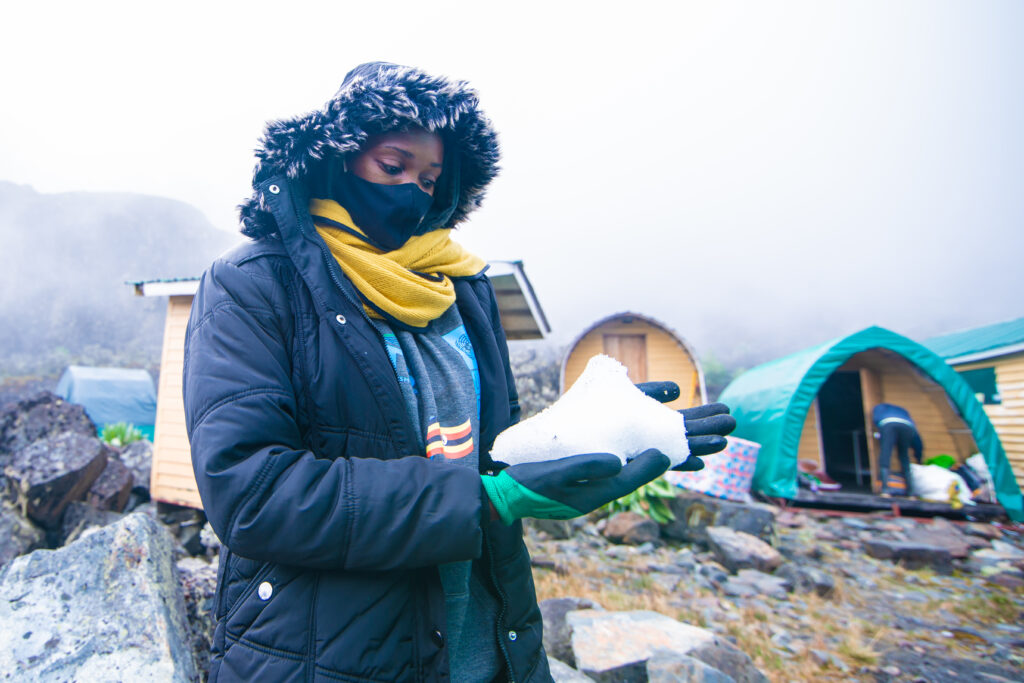
Kasese town offers comfortable midrange accommodation for pre-trek nights. The Mountains of the Moon Hotel, Rwenzori Travellers Inn, and Margherita Hotel are the most frequently used options among expedition trekkers, offering clean rooms, hot water, good meals, and proximity to gear shops and transport links. For trekkers combining the Rwenzori with Kibale Forest chimpanzee trekking, Fort Portal—75 kilometers north—offers a wider accommodation range, including the Rwenzori View Guesthouse, Chimpanzee Forest Guesthouse, and the luxury Kyaninga Lodge on the Kyaninga Crater Lake. Rwenzori Trekking Expeditions can recommend and book Kasese and Fort Portal accommodation for confirmed expedition guests upon request.
On the Mountain—Huts and Camps
The Central Circuit Trail is served by Uganda Wildlife Authority wooden mountain huts: Nyabitaba Hut (2,651 m), John Matte Camp (3,505 m), Bujuku Hut (3,962 m), Elena Hut (4,541 m), Kitandara Camp (4,023 m), and Guy Yeoman Hut (3,261 m). Each hut provides bunk sleeping with foam mattresses, a basic kitchen and dining shelter, and pit latrines. The Kilembe Trail camps, Sine Hut (2,596 m), Mutinda Camp (3,582 m), Bugata Camp (4,100 m), Hunwick’s Camp (3,974 m), and Kiharo Camp (3,460 m), are maintained to the same standard, with Bugata Camp standing apart for its solar-lit sleeping huts and warm shower facilities at 4,100 metres. All accommodation is pre-booked and secured by Rwenzori Trekking Expeditions for each expedition.
Lodge / Camp | Category | Location | Notes | Est. Rate |
Rwenzori Backpackers | Budget | Kasese Town | Backpacker hostel; dormitories and private rooms; popular trekker base | $20–40 |
Sandton Hotel Kasese | Mid-range | Kasese Town | Comfortable rooms, restaurant, reliable WiFi, pre/post-trek standard | $60–120 |
Margherita Hotel | Mid-range | Kasese Town | Historic hotel; mountain views; been hosting trekkers for decades | $80–150 |
Ruboni Community Camp | Eco/Mid-range | Rwenzori Foothills | Community-owned cultural programs; forest setting; Bakonzo hosts | $80–180 |
Rwenzori View Guesthouse | Budget-Mid | Kasese Foothills | Simple rooms; mountain views; close to trailhead; trekker-friendly | $40–80 |
Toro Semiliki Wildlife Reserve | Luxury | Fort Portal (~90km) | Exclusive tented camp; Rift Valley views; wildlife; for pre-trek luxury | $350–600 |
Mountains of the Moon Hotel | Mid-range | Fort Portal | Historic Fort Portal hotel; reliable; good restaurant; 90 min from park | $100–200 |
Nyabitaba Hut | Mountain | 2,651m | RMS CC | First Central Circuit hut; sleeping platforms; basic facilities | $35/night |
John Matte Hut | Mountain | 3,505m | RMS CC | Second Central Circuit hut; heather clearing; valley views | $35/night |
Bujuku Hut | Mountain | 3,962m | RMS CC | Expedition hub; Lake Bujuku; three massifs visible | $35/night |
Elena Hut | Mountain | 4,541m | RMS CC | Glacier-foot position; highest CC hut; coldest nights | $35/night |
Kitandara Hut | Mountain | 4,023m | RMS CC | Twin lakes setting; post-summit; serene atmosphere | $35/night |
Guy Yeoman Hut | Mountain | 3,261m | RMS CC | Final CC mountain hut; Mubuku River; last mountain night | $35/night |
Bugata Camp (Kilembe Trail) | Mountain | 4,062 m | RTS KT | Best-equipped Kilembe camp; solar lighting; eco-toilet | $35/night |
Margherita Camp (KT) | Mountain | 4,485 m | RTS KT | Kilembe Trail summit base; glacier directly above | $35/night |
For the complete, current accommodation guide, including seasonal pricing, availability, and how to combine mountain and foothills accommodation within your trek itinerary, visit the Where to Stay section at www.rwenzoritrekkingexpeditions.com.
Sample Itineraries—Four Curated Rwenzori Mountain Park Experiences
Itinerary 1: The Forest Introduction—2 Days, Lake Mahoma
Best for: Families · First-time visitors · Couples · Weekend adventurers
The finest short introduction to Rwenzori Mountains National Park is the 2-Day Lake Mahoma Trek, a privately guided overnight excursion from the Nyakalengija trailhead through the Afro-montane forest to the overnight camp at Nyabitaba Hut at 2,651 metres, followed by the Mahoma Loop Trail to Lake Mahoma crater at 2,988 metres. This is the park at its most accessible without any compromise on the quality of the experience: the birding in the Mahoma forest is exceptional, the crater lake is genuinely rare and beautiful, and the overnight at Nyabitaba Hut provides a mountain experience that no day walk can replicate.
Day | Activity & Location | |
Day 1 | 🌳 | Kasese → Nyakalengija Trailhead (1,646 m) → Nyabitaba Hut (2,651 m) | ~10 km | 5 hrs | Forest ascent |
Day 2 | 🏞️ | Nyabitaba → Mahoma Loop Trail → Lake Mahoma (2,988m) → Return to Nyakalengija | ~14 km | 5–7 hrs |
Day One: Your private guide from Rwenzori Trekking Expeditions meets you at your Kasese hotel after breakfast for the seamlessly arranged transfer to the Nyakalengija trailhead. The park gate registration is handled entirely by your guide while you watch the porter team assemble, loads distributed with practiced authority, and the mountain already beginning beyond the gate. The forest closes around you within the first hundred meters: Hagenia trees draped in orchids, the Rwenzori turaco calling from the canopy, and three-horned chameleons occupying low branches with meditative slowness. Nyabitaba Hut at 2,651 metres welcomes the team in the mid-afternoon, the valley below filling with mist as the cook prepares a hot dinner that anticipates exactly what the body needs after five hours on the mountain trail.
Day Two: An early breakfast, a light day pack, and the Mahoma Loop Trail diverges from the Central Circuit Trail into a quieter, narrower forest. The giant heather trees appear in increasing density above 2,700 meters. The lake announces itself through a change in the forest’s acoustic quality before it becomes visible, and then the crater opens, Lake Mahoma filling its floor in perfect volcanic circularity, the forest closing above it on every side, the surface so still that the trees appear to grow both upward and downward simultaneously. The hour at the lake is yours entirely.
Accommodation & Meals: Night 1: Nyabitaba Hut (2,651 m): full-board mountain meals. From USD $280 per person.
Itinerary 2: The Summit: 7 Days, Margherita Peak via Central Circuit
Best for: Solo trekkers · Experienced hikers · Couples · Summit seekers
The 7-Day Central Circuit Trek to Margherita Peak is the defining Rwenzori Mountains National Park experience; the route and duration have established the mountain’s reputation in the international trekking community and continue to deliver the full range of what the park offers in the most efficient structured format. All five ecological zones, following the Bujuku Valley, the Kitandara Lakes, the Elena Glacier, and Africa’s third highest summit, this itinerary contains them all.
Day | Activity & Location | |
Day 1 | 🌳 | Nyakalengija (1,646m) → Nyabitaba Hut (2,651m) | ~10 km | 5 hrs |
Day 2 | 🌿 | Nyabitaba → John Matte Hut (3,505m) | ~8 km | 6–7 hrs | Bamboo · Heather · Kurt Schafer Bridge |
Day 3 | 🌺 | John Matte → Bujuku Hut (3,962m) | ~7 km | 5–6 hrs | Bigo Bog · Giant Lobelias · Lake Bujuku |
Day 4 | ❄️ | Bujuku → Elena Hut (4,541m) via Scott-Elliot Pass | ~5 km | 5–7 hrs | Crampons fitted |
Day 5 | 🏆 | SUMMIT: Elena (4,541m) → Margherita Peak (5,109m) → Kitandara (4,023m) | 10–14 hrs total |
Day 6 | ⛰️ | Kitandara → Freshfield Pass (4,282m) → Guy Yeoman Hut (3,261m) | ~9 km | 6–8 hrs |
Day 7 | ⬇️ | Guy Yeoman → Lake Mahoma (optional) → Nyakalengija (1,646m) | ~12 km | 6–8 hrs |
This route is the itinerary narrated in full in the 7-Day Rwenzori Central Circuit guide on our website. The five-day ascent, the pre-dawn summit push across the Elena Glacier with crampons and rope in the care of your dedicated certified guide, and the equatorial sunrise from Africa’s third highest point—these are not experiences that summary prose does adequate justice to. For the complete day-by-day narrative, accommodation details, inclusions, and pricing, visit the 7-Day Central Circuit page at www.rwenzoritrekkingexpeditions.com.
Accommodation & Meals: Six mountain hut nights, Nyabitaba, John Matte, Bujuku, Elena, Kitandara, and Guy Yeoman. From USD $1,400 per person.
Itinerary 3: Mountains and Gorillas — 12 Days, Rwenzori + Bwindi
Best for: Couples · Groups · Wildlife + mountain enthusiasts · First-time Uganda visitors
The 12-Day Rwenzori and Gorilla Safari is Uganda’s most sought-after combination itinerary: seven days on the Central Circuit Trail with the Margherita summit objective, followed by gorilla trekking in Bwindi Impenetrable National Park, an itinerary that places Africa’s third highest summit and the world’s most intimate gorilla encounter within the same twelve days of dedicated travel. The two experiences occupy entirely different registers of the possible, and their combination produces a journey whose range cannot be replicated by any other single-country African safari.
Day | Activity & Location | |
Day 1 | ✈️ | Arrival Kampala/Entebbe | Transfer to Kasese foothills | Mountain briefing |
Day 2 | 🏔️ | Central Circuit Day 1: Nyakalengija → Nyabitaba Hut (2,651m) |
Day 3 | 🌿 | Central Circuit Day 2: Nyabitaba → John Matte Hut (3,505m) |
Day 4 | 🌺 | Central Circuit Day 3: John Matte → Bujuku Hut (3,962m) | Bigo Bog |
Day 5 | ❄️ | Central Circuit Day 4: Bujuku → Elena Hut (4,541 m) | Summit briefing |
Day 6 | 🏆 | SUMMIT DAY: Margherita Peak (5,109m) → Kitandara Hut (4,023m) |
Day 7 | ⛰️ | Central Circuit Day 6: Kitandara → Guy Yeoman Hut (3,261m) |
Day 8 | ⬇️ | Central Circuit Day 7: Full descent to Nyakalengija | Transfer to Kasese |
Day 9 | 🚗 | Kasese → Queen Elizabeth NP | Afternoon game drive | Kazinga Channel |
Day 10 | 🌳 | Queen Elizabeth → Bwindi Impenetrable Forest | Gorilla trek briefing |
Day 11 | 🦍 | GORILLA TREKKING — Bwindi | $800 permit included | 1 hour with gorillas |
Day 12 | ✈️ | Bwindi → Kampala/Entebbe | Departure |
For the complete 12-day Rwenzori and Gorilla Safari narrative, including the day-by-day immersive story, accommodation at every stop, full inclusions and exclusions, and pricing, visit the 12-Day Rwenzori Gorilla Trek page at rwenzoritrekkingexpeditions.com. Your Rwenzori Trekking Expeditions team secures the gorilla permit ($800 per person) and includes it in the package price from the time of booking.
Accommodation & Meals: Kasese pre-trek lodge + 6 mountain huts + Queen Elizabeth NP lodge + Bwindi forest lodge. From USD $5,800 per person.
Itinerary 4: The Complete Uganda Adventure — 19 Days
Best for: Groups · Multi-destination adventurers · Complete Uganda experience seekers
The 19-Day Uganda Ultimate Adventure combines every major western Uganda experience in a single seamlessly managed private journey: the full Rwenzori Mountains Central Circuit trail with the Margherita summit, gorilla trekking in Bwindi, chimpanzee tracking in Kibale, wildlife in Queen Elizabeth (including the tree-climbing lions of Ishasha and the Kazinga Channel boat safari), walking with white rhinos at Ziwa Rhino Sanctuary, the Murchison Falls Nile boat cruise at the world’s most powerful waterfall, the Batwa cultural trail at Bwindi, and white-water rafting on the Grade Five Nile rapids at Jinja. This is Uganda in its complete form across nineteen extraordinary days.
Day | Activity & Location | |
Day 1 | ✈️ | Arrival Entebbe | Kampala city tour | Overnight Kampala |
Day 2 | 🦏 | Kampala → Ziwa Rhino Sanctuary (rhino walk) → Murchison Falls NP |
Day 3 | 🦁 | Murchison Falls: Game drive + Nile boat cruise to Murchison Falls base |
Day 4 | 🚗 | Murchison → Kibale Forest NP | Evening birding |
Day 5 | 🐒 | Chimpanzee Tracking, Kibale Forest | Optional Bigodi Wetland Walk |
Day 6 | 🌿 | Kibale → Queen Elizabeth NP | Kasenyi Plains game drive |
Day 7 | ⛰️ | QENP → Kasese | Mountain briefing and gear check |
Day 8 | 🏔️ | Rwenzori Day 1: Nyakalengija → Nyabitaba Hut (2,651m) |
Day 9 | 🌺 | Rwenzori Day 2: Nyabitaba → John Matte Hut (3,505m) |
Day 10 | 🌺 | Rwenzori Day 3: John Matte → Bujuku Hut (3,962m) | Bigo Bog |
Day 11 | ❄️ | Rwenzori Day 4: Bujuku → Elena Hut (4,541m) | Crampons fitted |
Day 12 | 🏆 | SUMMIT: Margherita Peak (5,109m) → Kitandara Hut (4,023m) |
Day 13 | ⛰️ | Rwenzori Day 6: Kitandara → Guy Yeoman Hut (3,261m) |
Day 14 | ⬇️ | Full descent → Nyakalengija | Transfer to Kasese/Bwindi |
Day 15 | 🌳 | Kasese → Bwindi Impenetrable Forest | Forest arrival |
Day 16 | 🦍 | Gorilla Trekking, Bwindi | $800 permit included |
Day 17 | 🎭 | Batwa Trail cultural experience | Ssezibwa Falls | Transfer Jinja |
Day 18 | 🚣 | White-Water Rafting: Nile, Jinja | Grade 5 rapids |
Day 19 | ✈️ | Return Kampala/Entebbe | Departure |
For the complete 19-Day Ultimate Uganda Adventure, including a full day-by-day narrative, all accommodation details, permit inclusions, pricing, and customization options, visit the 19-Day Uganda Ultimate Adventure page at www.rwenzoritrekkingexpeditions.com. All permits (gorilla $800, chimpanzee $200–250) are included.
Accommodation & Meals: 18 nights across Kampala, Murchison Falls NP, Kibale Forest, Kasese, 6 mountain huts, Bwindi, and Jinja. From USD $6,770 per person.
Popular Rwenzori Trekking Safaris, Itineraries & Packages
Every itinerary below is operated by Rwenzori Trekking Expeditions as a fully guided, all-inclusive expedition. Private departures are available year-round on any requested date. The table below provides an overview; each itinerary has a dedicated full-length page on the website.
Trek | Duration | Trail | Max Altitude | Summit / Destination | Difficulty | Best For |
Lake Mahoma Trek | 2 days | Central Circuit | ~2,500 m | Lake Mahoma crater lake | Moderate | Beginners, families, short-trippers |
Sine Camp Trek | 2 days | Kilembe Trail | 2,596 m | Sine Hut, Enock’s Falls | Moderate–Challenging | Waterfall lovers, forest immersion |
Sine & Samalira Camp | 3 days | Kilembe Trail | 3,170 m | Samalira heather camp | Moderate–Challenging | Bamboo & heather seekers |
Portal Peaks Trek | 6 days | Central Circuit | 4,134 m | Kuhuma & Rutara Peaks | Moderate–Challenging | First high-summit trekkers |
Baker & Weismann’s Peak | 7 days | Kilembe Trail | 4,843 m | Edward Peak + Weismann | Hard | Dual-summit seekers |
Margherita Peak (Kilembe) | 7 days | Kilembe Trail | 5,109 m | Margherita Peak | Very Strenuous | Focused summit climbers |
Margherita Peak (Central) | 9 days | Central Circuit | 5,109 m | Speke, Baker, Margherita | Strenuous–Very Strenuous | Complete circuit experience |
4-Peak Expedition | 10 days | Both trails | 5,109 m | Margherita+3 peaks | Expedition | Elite mountain trekkers |
6-Peak Grand Expedition | 13 days | Central Circuit | 5,109 m | All 6 major massifs | Expedition | Full Rwenzori mastery |
What the Mountain Feels Like: A Day on the Rwenzori Central Circuit
No description of Rwenzori Mountains National Park is complete without the felt quality of the experience: the sensory reality of what a day on the Central Circuit trail actually delivers. What follows is a narrated account of Day 3 of the 9-day 3-Peaks Expedition, the day the trek enters the Afro-alpine moorland and the Rwenzori reveals its most singular face.
Day 3: From John Matte Camp to Bujuku Hut: The Day the Rwenzori Changes Everything
The morning mist at John Matte Camp at 3,505 metres breaks in the way that mountain mists break, suddenly, without apology, replaced by the particular luminosity of high-altitude air. Your private guide is already at the camp table with tea by the time you emerge, and the first thing visible above the camp through the departing cloud is the white smear of the Stanley Glacier on Mount Stanley, impossibly high and impossibly close at once. Breakfast is served by your dedicated mountain cook, porridge, eggs, toast, and hot tea, in the mountain-camp warmth that thirty minutes of altitude morning makes feel luxurious.
The trail from John Matte leaves the last Podocarpus forest behind within the first kilometer and enters the transition zone between heather and the lower Afro-alpine vegetation, and the landscape shifts with a theatricality that feels almost deliberate. The giant lobelias appear first as isolated towers at the trail margin, then in clusters, then in what can only be described as communities, dozens of six-meter silver-grey architectural columns standing in the open valley below the moraine ridges, each one the product of decades of slow equatorial growth. Giant Senecio groundsel trees punctuate the spaces between them with their thick trunks and cabbage-crown canopies. The visual grammar of the world has entirely changed from the forest below, and there is no precedent in any other East African landscape for what you are looking at.
Your guide pauses at a cluster of giant lobelias and speaks quietly about the Malachite Sunbird, iridescent green, the crimson chest-patch vivid in the clear mountain light, that is working the lobelia towers with focused, hovering precision. It hovers at each floret, probing with a curved bill and moving to the next with the efficiency of an animal that has evolved alongside this specific plant over thousands of years at this specific altitude. Three meters from where you stand. At 3,700 meters above sea level, in the equatorial heart of Africa. The trail continues through the Bujuku Valley in this atmosphere, the sound of running water below the boardwalk sections, the occasional call of an Augur Buzzard above, and the silence between those sounds deeper than any silence in the lower forest, until Bujuku Hut appears above Lake Bujuku at 3,962 meters, the Elena Glacier visible on the Stanley massif directly ahead, the day’s destination reached, and the day’s full significance arriving with it.
Dinner at Bujuku Hut is served hot by the mountain cook as the afternoon cloud moves through the valley below, a creeping, visible tide of mist that fills the Bujuku Valley from the east. The temperature drops quickly after the cloud arrives. Every layer comes out. The evening briefing from your guide covers tomorrow’s approach to Elena Hut and the summit day logistics two days ahead. Sleep at 3,962 metres is deep and specific, the altitude and the day’s physical expenditure producing a stillness that no flat-land fatigue quite replicates.
What Every Rwenzori Trekking Expeditions Package Covers
Every package from Rwenzori Trekking Expeditions is designed around a standard of comprehensive inclusion that removes the logistical burden from your experience, regardless of the duration or complexity of your Rwenzori Mountains National Park program, and places it where it belongs: with your dedicated team. The following applies to all summit trekking programs: the 2-day and shorter programs have adjusted inclusions appropriate to their scope.
Included in All Summit Programmes
All Uganda Wildlife Authority (UWA) Rwenzori Mountains National Park entry fees | ✓ |
All peak summit permits are applicable to the program. | ✓ |
One certified professional lead guide, UWA-registered, private allocation for your group only | ✓ |
Dedicated porter team, one porter per trekker, personal kit to 18 kg | ✓ |
Dedicated mountain cook, full-board catering on the mountain throughout | ✓ |
All mountain hut or camp accommodation as applicable | ✓ |
Rubber boots in all sizes, provided free from the trailhead (mandatory) | ✓ |
Crampons, ice axes, climbing harnesses, and safety helmets, all provided for glacier sections | ✓ |
Managed rope sections on glacier and technical terrain | ✓ |
Emergency oxygen canister carried by guide team above 4,000 m | ✓ |
Comprehensive wilderness first-aid kit at all times | ✓ |
UWA-mandated mountain rescue fund contribution | ✓ |
Pre-trek equipment inspection and comprehensive guide briefing | ✓ |
Daily altitude acclimatisation monitoring and health assessment | ✓ |
Margherita Peak summit certificate on successful ascent | ✓ |
Trailhead transfer from Kasese to Nyakalengija or Kilembe | ✓ |
Not Included in Standard Packages
International flights to Entebbe International Airport | ✗ |
Uganda tourist visa ($50 USD—apply at visas.immigration.go.ug before travel) | ✗ |
Travel and medical evacuation insurance: mandatory; must cover mountaineering above 5,000m | ✗ |
Personal sleeping bag: minimum -10°C for Elena Hut/Margherita Camp nights | ✗ |
Personal waterproof clothing: hardshell jacket and trousers, down jacket, thermal layers | ✗ |
Trekking poles: recommended; available for hire in Kasese | ✗ |
Personal porterage above the 18 kg guideline | ✗ |
Alcoholic beverages | ✗ |
Personal medications, including altitude sickness prophylactics | ✗ |
Gratuities for guides, porters, and cooks | ✗ |
Kasese hotel accommodation before and after the trek | ✗ |
Kampala or Entebbe to Kasese transfer (bookable as an addition) | ✗ |
How Difficult Is Rwenzori Trekking? — Honest Assessment
The phrase ‘Rwenzori trek’ covers a wider range of difficulty than almost any other single destination in East Africa. Matching the right itinerary to the right fitness level and preparation is the single most important planning decision, and the experience of a knowledgeable guide team matters most.
Difficulty Level | Itinerary Examples | Preparation Required | Technical Skills Needed |
Moderate | 2-day Lake Mahoma | 2-day Sine Camp | Regular hiking fitness; no special prep | None—waterproof boots and gaiters are essential. |
Moderate–Challenging | 6-day Portal Peaks | 3-day Sine & Samalira | Solid fitness; 6–8 week prep program | No technical climbing; some rocky summit terrain |
Hard | 7-day Baker & Weismann’s Peak | Strong fitness; altitude experience recommended | Safety ropes on Baker’s steep sections; no glacier |
Very Strenuous | 7–9 day Margherita Peak expeditions | Excellent fitness; 12-week specific training | Elena Glacier crossing with crampons, ice axe, and rope |
Expedition Level | 10–13 day multi-peak grand expeditions | Elite endurance; prior multi-day altitude experience | All of the above across multiple summit days |
Why Visit Rwenzori Mountains National Park?
The question is less ‘why visit’ and more ‘why now.’ The Rwenzori Mountains National Park offers a combination of mountain, ecological, and cultural experiences that exist nowhere else in Africa and in hardly any places on Earth, and some of those experiences are time-limited in the most literal sense. The equatorial glaciers on the upper flanks of Mount Stanley are disappearing at a measurable, documented rate. The Rwenzori Turaco and the African Green Broadbill are Albertine Rift endemics whose global range is restricted to this mountain corridor. The giant lobelias and groundsels of the Afro-alpine moorland are evolutionary marvels that developed their extraordinary forms right here, at this altitude, in this specific mountain climate. None of these things can be reproduced, replicated, or found elsewhere. They are here, and the choice of when to experience them is yours.
Beyond the biological and geological superlatives, the Rwenzori offers something rarer in modern mountain tourism: genuine remoteness. The trails are not the well-trodden highways of Kilimanjaro’s Marangu route or the busy circuits of the Simien Mountains. The forest above Nyakalengija in the early morning, before the cloud arrives and while the primates are still moving, is genuinely wild. The camps in the heather zone are genuinely quiet. The summit of Margherita Peak at 5,109 meters, crossed on a glacier before dawn by a rope team led by a guide who has made this approach dozens of times, is an experience with no crowd, no infrastructure, and no queue. It is a mountain that asks something real and offers something real in return.
Why Are They Called the Mountains of the Moon?
In approximately 150 AD, the Greek-Egyptian mathematician and geographer Claudius Ptolemy published his work Geographia, in which he described a range of snow-capped mountains deep in equatorial Africa, the Lunae Montes, the Mountains of the Moon, from whose glacial meltwater the Nile drew its source. For nearly eighteen centuries, European scholarship dismissed this reference as fantasy: snow at the equator was considered a geographical impossibility, and Ptolemy’s Mountains of the Moon were filed alongside Atlantis in the catalogue of ancient myths.

Then, in 1888, Henry Morton Stanley, on his Emin Pasha Relief Expedition, sighted the snow-capped peaks from the Semliki Valley and confirmed that Ptolemy’s description was not myth but an accurate geographical record transmitted through centuries of trade route accounts before reaching the Alexandrian geographer’s desk. The mountains that Stanley saw were the Rwenzori, and the name that the indigenous Bakonzo people had always used for them — Rwenzururu, meaning ‘place where it snows’ — had been in the local vocabulary for as long as the mountains had been inhabited. The Mountains of the Moon were real. They had simply been waiting for the rest of the world to catch up.