12 Days Rwenzori Trek & Gorilla Trekking Safari
12 Days Uganda Gorilla & Rwenzori trekking Complete Guide
12 Days / 11 Nights | Kilembe Trail | 5,109m | 1 gorilla permit included. | From $5,800 p/p |
The 12-day Rwenzori trek/hike and gorilla trekking safari combines trekking to Margherita Peak in the Rwenzori Mountains, gorilla trekking in Bwindi Impenetrable National Park, and wildlife viewing in Queen Elizabeth National Park. This 12-day Uganda gorilla trek & Rwenzori trekking safari explores the legendary Rwenzori Mountains, also known as the Mountains of the Moon, with a once-in-a-lifetime chance to see mountain gorillas in Uganda’s famous gorilla forests of Bwindi National Park & the open savannahs of Queen Elizabeth National Park.
Gorilla Trekking, Wildlife Safari & Rwenzori Mountaineering via Kilembe Trail
The 12-day Rwenzori & gorilla trekking safari starts with gorilla trekking in Bwindi Impenetrable National Park, which is home to nearly 50% of the mountain gorillas that are left in the world. After this trek, you’ll have the opportunity to experience a classic African wildlife (Big Five) safari, boat cruises, and breathtaking views of the Rift Valley plains at Queen Elizabeth National Park. Your journey will culminate with a 7-day trek through the Rwenzori Mountains via the Kilembe Trail, which is renowned for its verdant vegetation zones, impressive glaciers, expansive valleys, and the exhilarating climb to Margherita Peak on Mount Stanley. The 12-day Rwenzori hike & gorilla trekking itinerary combines rainforest, alpine trekking, wildlife viewing, and cultural landscapes, making it one of the most diverse in East Africa.
Margherita Peak 5,109mย ยทย Mountain Gorillasย ยทย Tree-Climbing Lionsย ยทย Kazinga Channel
12 DaysUganda Gorilla & Rwenzori Trekking Complete Guide
Uganda is the only country in the world where a single itinerary can take you from the forest floor of a 25,000-year-old rainforest situated three meters from a silverback mountain gorilla whose calm, dark eyes conduct an assessment of you that is disconcertingly mutual to the edge of an equatorial glacier at 5,109 meters fourย days later, with crampons on your boots and the pre-dawn darkness of Africa’s Mountains of the Moon pressing in from every direction.
This 12-Day Uganda gorilla trekking, wildlife safari, and Rwenzori mountaineering adventure does not waste a single day. It begins in Bwindi Impenetrable Forest, one of Africa’s oldest and most biodiverse rainforests, where the gorilla trekking permit you hold grants you one hour with a habituated gorilla family in the kind of proximity that no zoo, no nature film, and no previous wildlife experience will have adequately prepared you for. It moves through Queen Elizabeth National Park, Uganda’s most species-rich savannah park, with its famous tree-climbing lions and the incomparable Kazinga Channel boat cruise and then turns its face toward the west and the Rwenzori Mountains, where seven days on the Kilembe Trail carry you through five distinct vegetation zones to the summit of Margherita Peak.
The Kilembe Trail is the Rwenzori’s newer and arguably more spectacular mountain route: a path that enters the national park through the Nyamwamba Valley above the historic copper mines of Kilembe, ascending through a waterfall-draped montane forest and bamboo tunnels to the giant lobelia and Senecio groundsel moorlands of the Afro-alpine zone, crossing Bamwanjara Pass at 4,450 meters with panoramic views of all six Rwenzori massifs simultaneously, and approaching the Margherita summit via the historic campsite used by Luigi Amedeo di Savoia, Duke of Abruzzi, during the first recorded ascent of these peaks in 1906. The Kilembe Trail is a mountain route of genuine distinction, and the seven-day version of it used here is designed with the acclimatization profile that responsible summit attempts require.
Rwenzori Trekking Expeditions manages this journey as a single, seamlessly orchestrated itinerary, one point of contact, and one unbroken standard of excellence across all twelve days. Your private safari vehicle and driver-guide for the first four days. Your certified mountain guide, porters, mountain cook, and all technical summit equipment for the seven mountain days. Your gorilla permit, park fees, lodge bookings, and transfer logistics are all included throughout your trip. The only decision you need to make is the first one: when to go.
The Rwenzori’s equatorial glaciers have retreated by over 80% in the last century. The silverback mountain gorilla population has grown but remains critically small. These two encounters, on the same twelve-day Uganda safari itinerary, represent a living world that is finite, fragile, and extraordinary. The window is open. The mountain is waiting.
Safari & Expedition Overview
The 12-day Uganda Safari begins with a private vehicle departure from Kampala, heading southwest on Day One for the seven- to nine-hour drive to Bwindi Impenetrable Forest. Day Two is the gorilla trekking day: an early morning assembly at the UWA park headquarters for the pre-trek briefing, followed by the forest trek to the assigned gorilla family and one hour of direct encounter. Day three moves north from Bwindi to Queen Elizabeth National Park, a three- to four-hour drive by private vehicle, arriving in time for the afternoon Kazinga Channel boat safari. Day Four opens with a Kasenyi Plains dawn game drive before the transfer north to Kasese and the Kilembe Trailhead, where the mountain briefing, porter introduction, and gear inspection prepare the team for Day Five.
Days Five through Eleven unfold as seven consecutive days on the Kilembe Trail: Kilembe Trailhead (1,450m) to Kalalama Camp (3,147m) on Day Five; Kalalama to Mutinda Camp (3,688m) with the optional Mutinda Lookout ascent on Day Six; Mutinda to Bugata Camp (4,062m) through the Namusangi Valley giant lobelia fields on Day Seven; the dramatic Bamwanjara Pass crossing and descent to Hunwick’s Camp (3,974m) on Day Eight; the traverse to Margherita Camp (4,485m) with the pre-summit glacier briefing on Day Nine; the pre-dawn summit push to Margherita Peak (5,109m) and the long return to Hunwick’s Camp on Day Ten; and the full descent from Hunwick’s through all five vegetation zones back to the Kilembe Trailhead and transfer to Kasese on Day Eleven. Day Twelve is the five-to-six-hour return drive to Kampala, with equator and lunch stops en route.
Every element is pre-confirmed and managed by your Rwenzori Trekking Expeditions team. The gorilla permit is secured at booking. The Kilembe Trail hut bookings are confirmed. The guide, porter, and cook are allocated. The technical summit equipment is ready. The lodge at each stop is waiting. All you need is your personal kit, your curiosity, and an appetite for an experience that will be hard to equal.
Kampala โ Bwindi Impenetrable Forest โ Queen Elizabeth NP โ Kasese โ Kilembe Trail (7 Days) โ Kampala
The 12-day Uganda Gorilla & Rwenzori Trekking Safari itinerary begins with a private vehicle departure from Kampala, heading southwest on Day One for the seven-to-nine-hour drive to Bwindi Impenetrable National Park.
Day Two is the gorilla trekking day: an early morning assembly at the UWA park headquarters for the pre-trek briefing, followed by the forest trek to the assigned gorilla family and one hour of direct encounter.
Day Three moves north from Bwindi Impenetrable National Park to Queen Elizabeth National Park, a three-to-four-hour driveย by private vehicle, arriving in time for the afternoon Kazinga Channel boat safari.
Day Four opens with a Kasenyi Plains dawn game drive before the transfer north to Kasese and the Kilembe Trailhead, where the Rwenzori Mountains briefing, porter introduction, and gear inspection prepare the team for Day Five.
Days five through eleven are a 7-day Rwenzori trek to Margherita Peak via the Kilembe Trail: Kilembe Trailhead (1,450 m) to Kalalama Camp (3,147 m) on day five; Kalalama to Mutinda Camp (3,688 m) with the optional Mutinda Lookout ascent on day six; Mutinda to Bugata Camp (4,062 m) through the Namusangi Valley giant lobelia fields on day seven; the dramatic Bamwanjara Pass crossing and descent to Hunwick’s Camp (3,974 m) on day eight; the traverse to Margherita Camp (4,485 m) with the pre-summit glacier briefing on day nine; the pre-dawn summit push to Margherita Peak (5,109 m) and the long return to Hunwick’s Camp on day ten; and the full descent from Hunwick’s through all five vegetation zones back to the Kilembe Trailhead and transfer to Kasese on day eleven. Day twelve is a 5 to 6-hour return drive to Kampala with Equator and lunch stops en route.
Every element is pre-confirmed and managed by your Rwenzori Trekking Expeditions team. The gorilla permit is secured at booking. The Kilembe Trail hut bookings are confirmed. The guide, porter, and cook are allocated. The technical summit equipment is ready. The lodge at each stop is waiting. All you need is your personal kit, your curiosity, and an appetite for an experience that will be hard to equal.
Itinerary At A Glance: 12 days Rwenzori & Gorilla Safari
Duration | 12 Days / 11 Nights |
Mountain Route | Kilembe Trail โ Rwenzori Mountains National Park |
Mountain Days | 7 days (Days 5โ11): Kilembe (1,450m) โ Margherita Peak (5,109m) |
Max Elevation | 5,109 m โ Margherita Peak, Mount Stanley (Africa’s 3rd highest) |
Safari Parks | Bwindi Impenetrable Forest NP + Queen Elizabeth NP |
Gorilla Permit | 1 ร $800 USD per person โ included in package price |
Mountain Difficulty | Challenging to strenuous glacier summit with crampons included |
Technical Equipment | Crampons, ice axe, harness, helmet, ropes, all provided |
Minimum Fitness | Multi-day hiking fitness essential; prior mountain experience useful |
Group Size | 1โ10 trekkers, private departures only |
Best Season | DecemberโFebruary (primary) | JuneโAugust (secondary) |
Starting Price | From $5,800 per person (group of 2) |
Start & End Point | Kampala (Entebbe International Airport connections) |
Community Benefit | 10% of proceeds support Bakonzo community schools and homes |
Safari at a Glance
Day | ย | Location & Activity |
Day 1 | ๐ | Kampala โ Bwindi Impenetrable Forest NP | ~490 km | 7โ9 hrs private drive |
Day 2 | ๐ฆ | Gorilla Trekking โ Bwindi Impenetrable Forest | $800 permit | 1 hour with gorillas |
Day 3 | ๐ | Bwindi โ Queen Elizabeth NP | ~155 km | Kazinga Channel afternoon boat cruise |
Day 4 | ๐ฆ | Kasenyi Plains dawn game drive | Transfer to Kasese | Mountain briefing |
Day 5 | ๐๏ธ | Kilembe Trailhead (1,450m) โ Kalalama Camp (3,147m) | Forest & waterfalls | 5โ7 hrs |
Day 6 | ๐ฟ | Kalalama Camp โ Mutinda Camp (3,688m) | Bamboo & heather | Optional Mutinda Lookout |
Day 7 | ๐ธ | Mutinda Camp โ Bugata Camp (4,062m) | Giant lobelias | Namusangi Valley |
Day 8 | โฐ๏ธ | Bugata Camp โ Bamwanjara Pass (4,450m) โ Hunwick’s Camp (3,974m) | Kachope Lakes |
Day 9 | โ๏ธ | Hunwick’s Camp โ Margherita Camp (4,485m) | Scott-Elliot Pass | Summit briefing |
Day 10 | ๐ | SUMMIT DAY: Margherita Peak (5,109m) | Glacier crossing 03:00 start | Descent to Hunwick’s |
Day 11 | โฌ๏ธ | Full descent: Hunwick’s โ Kilembe Trailhead | Summit certificate | Transfer Kasese |
Day 12 | โ๏ธ | Kasese โ Kampala | Equator stop | Lunch Mbarara | Safari complete |
Experience Rwenzori Beyond Expectations
Spots Filling Fast — Schedule Your Trek Today
12 Days Rwenzori & Gorilla trekking Detailed Itinerary
Day 1: Kampala to Bwindi Impenetrable Forest NP | ~490 km | 7โ9 hours | Overnight: Bwindi Forest Lodge
The departure from Kampala happens in the early morning, before the city has fully committed to its momentum. Your dedicated driver-guide is at the hotel by seven o’clock, luggage stowed, vehicle briefed, cold water in the cooler, and the road southwest unfolds with the particular clarity of a Ugandan morning: banana groves catching the low-angle light, red-soil farm roads threading between hills, and the gradual thickening of the highland air as the vehicle climbs toward Mbarara.
The Masaka-Mbarara Highway is one of Uganda’s main arterial routes, and its passage through the rolling hills and tea-growing highlands of the southwestern plateau is genuinely beautiful, not the spectacular, high-drama beauty of the mountain country ahead, but a quieter, agricultural beauty of worked landscapes and human-scale community life. Your driver-guide knows the exact restaurant in Mbarara where lunch is worth stopping, making the journey feel both managed and unhurried.
The final section from Kabale into the Bwindi highlands is where the landscape makes its most powerful statement. The road climbs into mist-draped hills, terraced farmland rising on either side in geometric precision, before the dark wall of Bwindi Impenetrable National Park appears. A forest appears on the southern horizon, a mass of ancient trees so dense and so continuous that it looks from a distance like something solid rather than something growing. The lodge at the forest edge receives you in the late afternoon. The forest sounds begin before the sun has fully set: insects, nightjars, and somewhere in the canopy above, the movement of something large.
Accommodation & Meals: Bwindi forest-edge lodge. Full-board dinner. Gorilla family assignment and pre-trek briefing conducted over dinner by your guide.
Day 2: The Gorilla Encounter โ One Hour That Resets Your Understanding of the World
Gorilla Trekking, Bwindi Impenetrable Forest NP | $800 Permit Included | Overnight: Bwindi
The Uganda Wildlife Authority briefing at 7:30 am is conducted with the quiet authority of rangers who have been doing this every morning for years and understand, precisely, what the next few hours are going to mean to the group standing in front of them. The rules are delivered as information rather than restrictions: Maintain 7 meters from the gorillas when possible, use no flash photography, keep voices low, and wear face masks at all times. Mountain gorillas share enough human DNA to be vulnerable to our respiratory diseases, and if a silverback charges, stand firm, look down, and do not run. Then the forest opens, and the trek begins.
Bwindi Impenetrable National Park is 25,000 years old. That number is not an abstraction; it is the depth of time visible in the forest itself. The trees here are enormous and covered in orchids, ferns, and mosses that have accumulated over centuries. The root systems are vast. The forest floor is layered with decomposed organic matter accumulated over millennia. L’Hoest’s monkeys watch from the middle canopy. Bwindi’s endemic turacos call across the canopy. The trackers ahead on the radio are already in contact with the gorilla family. Everything is moving toward a moment.
The gorillas appear without announcement. There is no fanfare, no dramatic reveal, just a section of forest where the vegetation is slightly more disturbed than the rest and then a shape that resolves into a silverback male, perhaps 180 kilograms, browsing vegetation three meters from where you stand. He is aware of you. He is not alarmed by you. His assessment of your group takes perhaps two seconds, a calm, intelligent evaluation from an animal that has been habituated to human presence over the years and has concluded that these particular primates are harmless. Then he returns to his breakfast.
Around him: a mother nursing an infant whose small fingers grip her fur with the absolute trust of complete dependence. Juveniles chasing each other through the undergrowth with an energy and apparent joy that requires no translation across species. An older female watching your group with the specific, evaluative attention of someone who has made up her mind but is keeping the decision private. The one hour allowed by UWA regulation is measured in its own time, which is not clock time. It ends too early. It always ends too early.
The conservation context is not separate from the experience โ it is the experience. The $800 gorilla permit funds the anti-poaching patrols that keep these animals alive, the ranger salaries, and the community programs that make local people invested in the forest’s survival rather than in its destruction. Bwindi’s mountain gorilla population is the only one in the world that is growing. Your permit is a direct contribution to that growth.
Accommodation & Meals: Bwindi forest-edge lodge. Full-board meals. Afternoon at leisure, photographs reviewed, and the encounter processed. This day deserves unhurried reflection.
Day 3: Bwindi to Queen Elizabeth National Park
Bwindi โ Queen Elizabeth NP | ~155 km | 3โ4 hours | Kazinga Channel Boat Cruise | Overnight: QENP Lodge
Breakfast at the Bwindi lodge with the forest still pressing close on every side, the last morning in gorilla country, and then the departure north, the landscape transforming in the space of three hours from ancient rainforest to open rift valley savanna. The road climbs briefly over the Kigezi highlands before dropping through the escarpment, and Queen Elizabeth National Park announces itself with the particular flatness and openness of East African savannah: sky above, grass below, and in the distance the blue-grey line of the Rwenzori Mountains that will occupy the next seven days.
The Kazinga Channel boat safari is the afternoon’s centerpiece and one of the finest wildlife experiences in East Africa by any measure. The thirty-two kilometer waterway connecting Lake George and Lake Edward is host to one of the highest hippo concentrations on the continent, several thousand individuals in the channel at any given time, and the flat-bottomed boat moves through them at distances that are simply not achievable from a vehicle on land. Hippos submerge and resurface around the hull with the unconcerned authority of animals that own this water. Enormous Nile crocodiles occupy every sandbank in arrangements that look deliberately geometric. Elephants come to drink in family groups at the bank’s edge within meters of the boat. African fish eagles hunt from dead trees along the bank. Great white pelicans drift in silent flotillas. The light in the late afternoon on the channel is the kind of light that makes photographers quiet, almost involuntarily.
The lodge at Queen Elizabeth, positioned on the Mweya Peninsula above the channel, receives you for dinner with the sounds of hippos calling from the water below. The mountain is visible on the western horizon in the last of the day’s light: a dark ridgeline above the cloud, growing incrementally closer.
Accommodation & Meals: Lodge at Queen Elizabeth National Park, Mweya Peninsula. Full-board dinner. The mountains are visible on the western skyline. Tomorrow: game drives and the transfer to Kasese.
Day 4: Lions on the Kasenyi Plains โ Then to the Mountain Gateway
Kasenyi Plains Game Drive | Transfer to Kasese / Kilembe | Overnight: Kasese Lodge
The Kasenyi Plains before 0600 hrs have a quality of light and silence that belong exclusively to the East African savannah at first light: the sun is not yet above the horizon, the grass is silver with dew, and the Uganda kobs are moving in herds of hundreds across the open ground with the unhurried confidence of animals that have earned their place. Your driver-guide positions the vehicle along the drainage lines and woodland edges where you are most likely to encounter Queen Elizabeth’s lion population. The prides here are well-documented and individually recognizable, and your guide knows which family uses which territory at which time of day. Lions in the early morning golden light, observed from a private vehicle with no other vehicles nearby, are one of those safari experiences that require no embellishment after the fact.
By 0900 hrs, the game drive has delivered its morning inventory, including lions, buffalo, warthogs, Uganda kobs, and elephants, at the woodland edge, and the safari vehicle turns north toward Kasese. The drive from Queen Elizabeth to Kasese takes approximately two hours, and the Rwenzori Mountains grow from a distant horizon feature to an overwhelming vertical presence with every kilometer. By the time Kasese appears in the valley below the western escarpment, the mountains above the town are enormous and immediate, their lower slopes dark green and cloud-draped, their upper reaches hidden in the mist that keeps them wet enough to sustain the glaciers above.
The afternoon in Kasese belongs entirely to the mountain preparation. Your Rwenzori Trekking Expeditions mountain guide introduces the porter team and oversees the weighing and distribution of equipment loads. Every item of personal kit is checked: sleeping bag rating, waterproof performance, boot condition, and layer system. Crampons are fitted to boots to confirm sizing. The Kilembe Trail’s seven-day arc is walked through in detail, including camps, distances, altitude profiles, the summit day protocol, the acclimatization strategy, and the conditions under which the guide will adjust the day’s plans. The guide’s briefing is direct, comprehensive, and deeply reassuring in the specific way that expert knowledge always is.
Accommodation & Meals: Kasese lodge (pre-trek selection, full-board dinner). Mountain gear inspection and team introduction this evening. Early sleep; the Kilembe Trailhead calls at 08:00 tomorrow.
Day 5:ย Kilembe Trailhead (1,450m) โ Kalalama Camp (3,147m) | ~10 km | 5โ7 hours
The Rwenzori Mountains’ ranger post at Kilembe sits above the old copper mines, a historically significant site where one of Uganda’s most important 20th-century industrial operations carved deep shafts into the mountain, the remnants still visible in the infrastructure of the valley below. The porter team assembles at the trailhead with the precise, unhurried efficiency of people who have done this hundreds of times, loads distributed and checked by your lead guide before the registration formalities are completed. Then the gate opens, and you enter the Rwenzori Mountains National Park.
The Kilembe Trail is celebrated among experienced Rwenzori guides for two things that the Central Circuit trail cannot match: the waterfall scenery and the relative wildness of the lower approach. Multiple waterfalls of genuine size are visible and audible throughout the first day’s ascent; the largest, visible from a natural viewpoint an hour above the trailhead, drops a hundred meters through a rock face draped in mist-fed vegetation. The mountain cook stops here for the packed lunch preparation, and the twenty minutes spent at this viewpoint with the waterfall below and the forest rising above establishes, definitively, what kind of mountain you have entered.
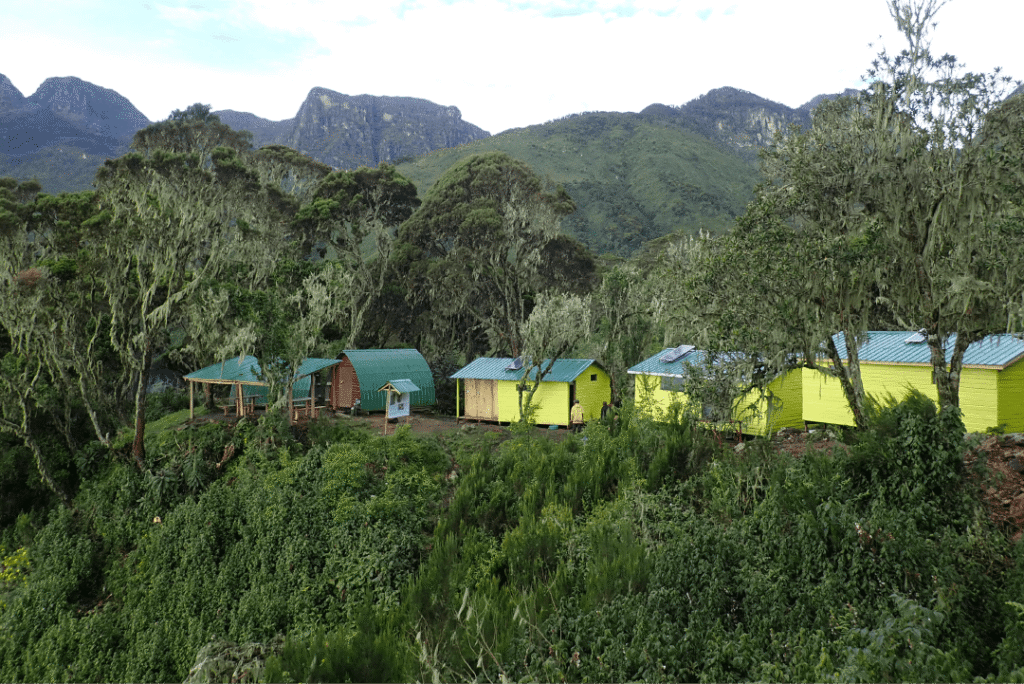
The forest deepens as altitude increases. Podocarpus trees, or African yellowwood, some of them centuries old, support a community of epiphytes that covers every available surface in a layering of moss, lichen, fern, and orchids. Rwenzori turacos announce themselves from the canopy; three-horned chameleons occupy low branches with the philosophical stillness of animals that have never needed speed. By the time the trail delivers you to Kalalama Camp at 3,147 meters, a solid hut in a sheltered valley at the montane-heather transition, the forest has done its introductory work, and the body has begun the quiet physiological adjustments that acclimatization always requires.
Accommodation & Meals: Kalalama Camp hut (3,147m). Full-board meals from your dedicated mountain cook. First altitude effects may appear tonight; rest and hydration are the response.
Day 6:ย Kalalama Camp (3,147m) โ Mutinda Camp (3,688m) | ~6 km | 5โ7 hours | Optional Mutinda Lookout
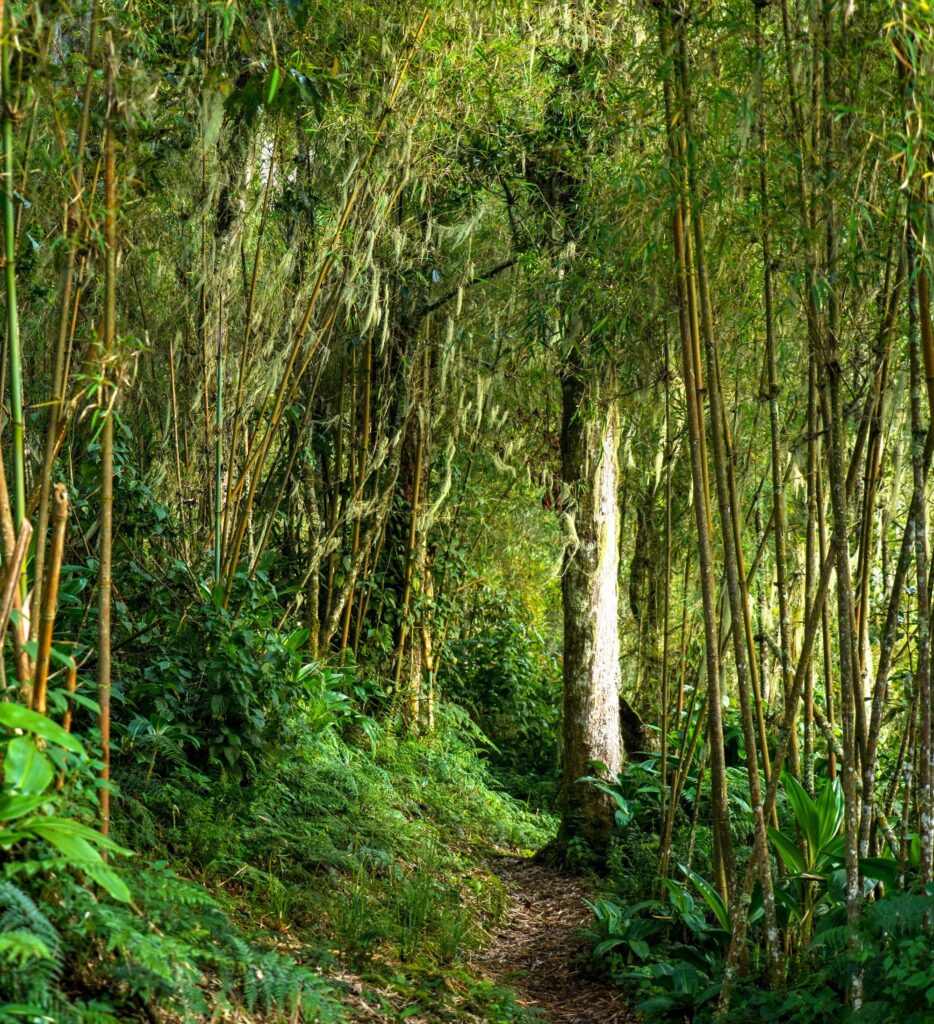
The transition from the forest zone to the bamboo-heather corridor is as abrupt as ecological boundaries on the Rwenzori always are: one vegetation community gives way to another with a clarity that would seem dramatic if you were not already fully occupied with the act of moving upward through it. Highland bamboo, Sinarundinaria alpina, closes above the trail in dense groves that filter the morning light and muffle the sounds of the forest below. The path between the bamboo columns is mud-slick and root-crossed, requiring the specific, slightly meditative attention of mountain footwork that, after a few hours, becomes its form of concentration.
Above the bamboo, the giant heathers begin. Erica arborea at this altitude reaches six to eight meters, its trunks so completely encased in pale Usnea lichen and green sphagnum moss that the underlying wood is entirely invisible. The effect is of trees that have been converted entirely into living matter: no bark, no dry wood, only moss and moisture and the faint smell of a forest that has been continuously wet for longer than any human civilization has existed. The Rwenzori’s legendary mystique is built, in significant part, from the experience of walking through this specific zone, and it is a mystique that no photograph adequately communicates.
Mutinda Camp, at 3,688 meters, offers an optional ascent that experienced Rwenzori guides recommend without reservation: the ninety-minute climb to the Mutinda Lookout at 3,925 meters, where the Kilembe Trail reveals its full ambition for the first time, with all the higher massifs arranged across the northern skyline; Kasese town and Lake George are visible far below to the south and east, and the Congo escarpment is on the western horizon. This is the Rwenzori as a geographer would want to see it, and the investment of ninety minutes earns a perspective that is not available at any other point on the trail.
Accommodation & Meals: Mutinda Camp hut (3,688m). Full-board meals. Optional Mutinda Lookout ascent post-arrival for those with energy reserves.
Day 7:ย Mutinda Camp (3,688m) โ Bugata Camp (4,062m) | ~7 km | 5โ7 hours | Giant Lobelias
The Namusangi Valley opens up above Mutinda Camp in the first hour of Day Seven’s ascent, forming a broad alpine bowl that is one of the Rwenzori’s most important spatial experiences, where the giant lobelia population reaches its peak density and the groundsel trees spread their silver-backed canopies across the moorland floor in patterns that seem designed rather than grown. The giant lobelias, Lobelia gibberoa here, reach three to five meters, standing in the waterlogged tussock grass with the gravity of something permanent, their flower spikes pointing skyward in a silence that the Rwenzori’s near-constant drizzle only deepens.
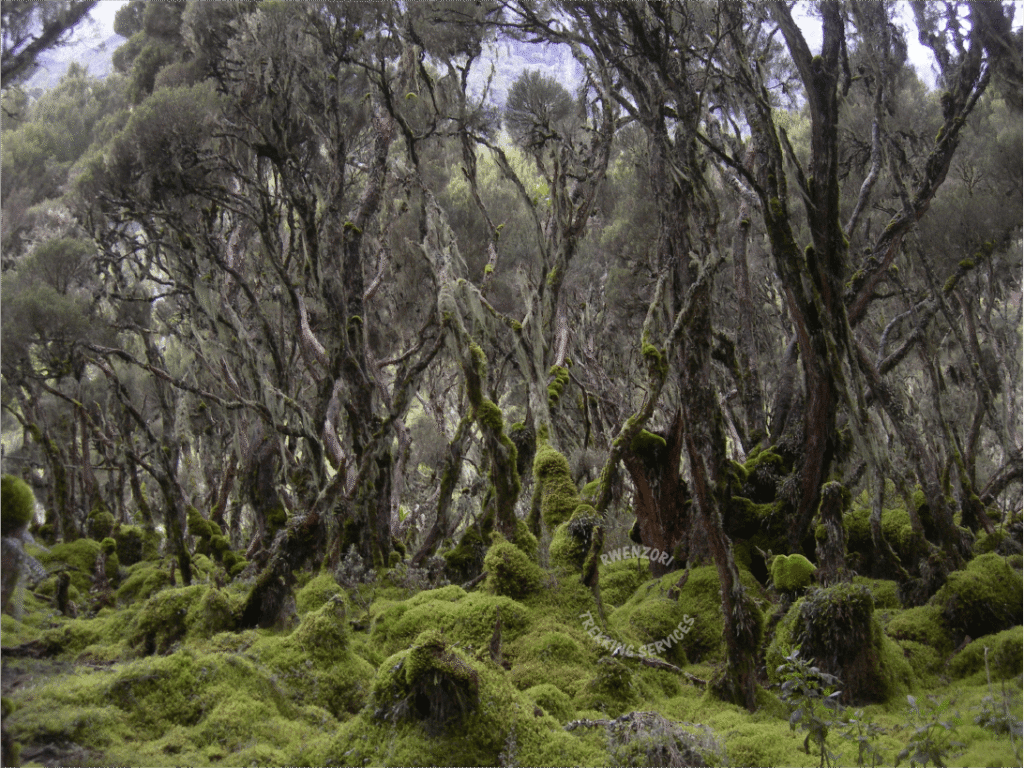
Nothing in the temperate mountain world prepares you for the Afro-alpine zone of the Rwenzori. The reference points simply do not exist. The plants are too large, the landscape is too damp, the fog is too present, and the combination of botanical extravagance and high-altitude severity is too specific to this latitude and this mountain to have any analogue. First-time visitors to this zone consistently report the same response: a kind of disorientation that is entirely pleasurable and the sense of having arrived somewhere genuinely new, somewhere the eye has never had to make sense of before.
Bugata Camp, at 4,062 meters, is the Kilembe Trail’s most comfortable high camp: solar-powered lighting, eco-flush toilets, and washing facilities that feel genuinely luxurious at this altitude. From camp, the optional short walk to the edge of the Nusuranja Valley reveals nine glacial lakes spread across the valley below, a view that your mountain cook, who has watched countless groups experience the scenery for the first time, notes is among the most reliable moments of silence on the entire trail. Dinner at Bugata is the halfway point of the mountain section. Tomorrow, the high pass.
Accommodation & Meals: Bugata Camp hut (4,062m). Full-board meals. Solar lighting, an eco-toilet, a bathroom, and Thelembe Trail’s finest camp. Nine-lakes optional walk post-arrival.
Day 8: Bugata Camp (4,062m) โ Bamwanjara Pass (4,450m) โ Hunwick’s Camp (3,974m) | ~8 km | 6โ8 hours
Bamwanjara and the Kachope Lakes)
Bamwanjara Pass, at 4,450 meters, is the Kilembe Trail’s signature geographical moment and one of the finest high-altitude viewpoints in the entire Rwenzori range. The ascent from Bugata is gradual but sustained, with long, flat bog sections requiring the rubber-boot shuffling confidence that the lower trail has already taught you before the final climb to the ridge where the pass opens and, on a clear morning, stops everyone mid-stride. All six Rwenzori massifs spread across the horizon simultaneously: Stanley, Speke, Baker, Emin, Gessi, and Luigi di Savoia. A single panorama makes the geography of Africa’s Mountains of the Moon comprehensible.
A small emergency shelter at the pass provides a windbreak; the ridge is exposed and cold, and full thermal and windproof layers are appropriate from this point forward. The guide pauses here for a rest and a briefing on what is visible: identifying the summit you will stand on in two days, tracing the glacier line, and pointing out the Scott-Elliot Pass approach that Day Nine will use. From this altitude, the summit feels both genuinely close and truly serious. Both assessments are accurate.
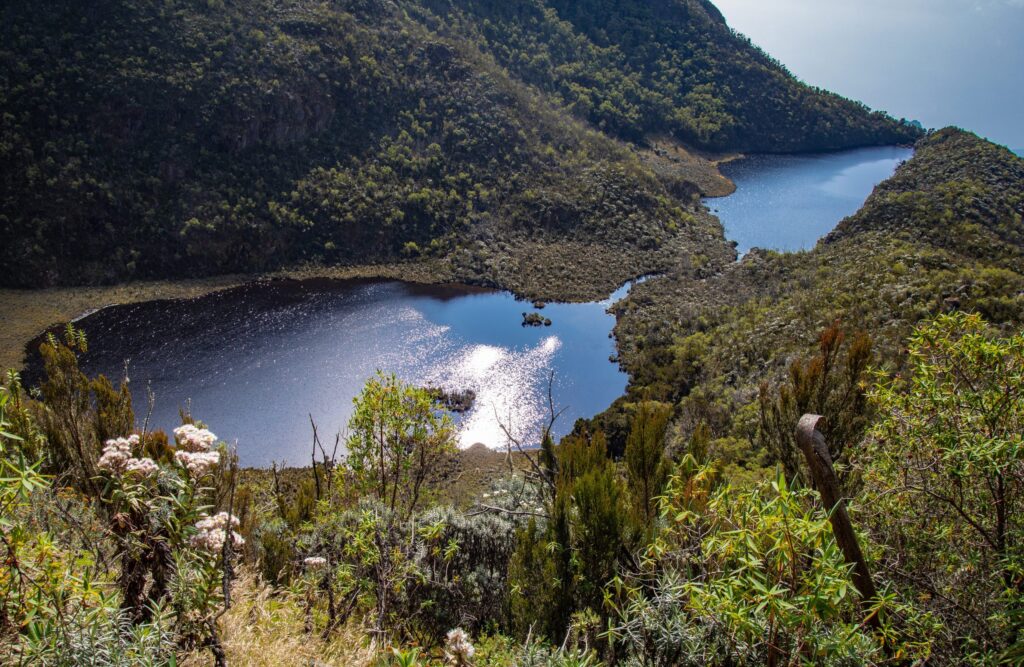
The descent from Bamwanjara drops past the Kachope Lakes, a pair of glacially-fed alpine tarns of extraordinary clarity, set in a rock basin between the pass and the valley below, their surfaces catching the cloud-filtered light in a blue that has no adequate description. Hunwick’s Camp, at 3,974 meters, positioned on a ridge with a direct sight line to the Baker massif’s south face, receives the expedition with the efficiency of a team whose timing is built from experience. Your first clear sight of the glaciated world you will cross in two days comes from the cook tent at Hunwick’s, where you look directly at the ice-dusted peaks above the camp.
Accommodation & Meals: Hunwick’s Camp hut (3,974m). Full-board meals. The summit briefing begins this evening: tomorrow’s approach, Day Ten’s glacier protocol, and equipment requirements.
Day 9: Hunwick’s to Margherita Camp (Hunwick’s Camp (3,974m) โ Scott-Elliot Pass โ Margherita Camp (4,485m) | ~6 km | 5โ7 hours)
The approach from Hunwick’s Camp to Margherita Camp is the most technically demanding transit day of the Kilembe Trail and the most historically weighted. The route traverses a complex ridge system above Hunwick’s, navigating snowmelt stream crossings and exposed rock sections in the company of a guide whose route knowledge is built from years of crossing this specific terrain in every conceivable weather condition. Scott-Elliot Pass, named for the Scottish professor whose 1895 expedition first documented this high route, places you at the intersection of the Stanley and Baker massifs with the ice fields of Mount Stanley directly above.
Margherita Camp, at 4,485 meters, occupies the same rocky shelf used by Luigi Amedeo di Savoia and his Italian alpine team during the 1906 expedition that made the first recorded ascents of the Rwenzori’s major peaks. The Duke of Abruzzi’s party spent multiple nights here in conditions that would have been substantially more arduous than yours: no established huts, no fixed ropes, and no modern technical equipment before making ascents that remain among the most significant achievements in African mountaineering history. To stand on this campsite looking directly up at the glacier is to inhabit a specific moment of continuity with that history.
The summit briefing tonight is the most important conversation of the expedition. Your guide covers the pre-dawn departure protocol, the glacier approach and crampon technique, the rope sequence, the summit turnaround conditions, and the descent plan. Every question is answered. Equipment is laid out and ready. Sleep, whose altitude and anticipation conspire to make it shallow, comes when it does. The alarm is set for two o’clock. Tomorrow is the day.

Accommodation & Meals: Margherita Camp (4,485m). Full-board dinner โ caloric priority. Crampons adjusted, harness fitted, ice axe briefing complete. Alarm set: 02:00.
Day 10: Margherita Peak (5,109m) and the Return to Hunwick’s (Margheritaย Camp (4,485m) โ Margherita Peak (5,109m) โ Hunwick’s Camp (3,974m) | 10โ14 hours total)
At two in the morning, the darkness at Margherita Camp is absolute, and the cold is immediate and serious. The first act of the day โ abandoning the sleeping bag’s warmth for the temperature outside the hut โ requires a specific quality of resolve that the preceding nine days have been building. Every layer goes on. The packed breakfast is consumed without ceremony. Crampons are clicked into rubber boots with the methodical efficiency of people who have been briefed precisely and are executing that brief. The guide checks each crampon binding and each harness clip with the focused thoroughness of someone for whom these checks have never been a mere formality. The headlamps go on. The summit team moves.
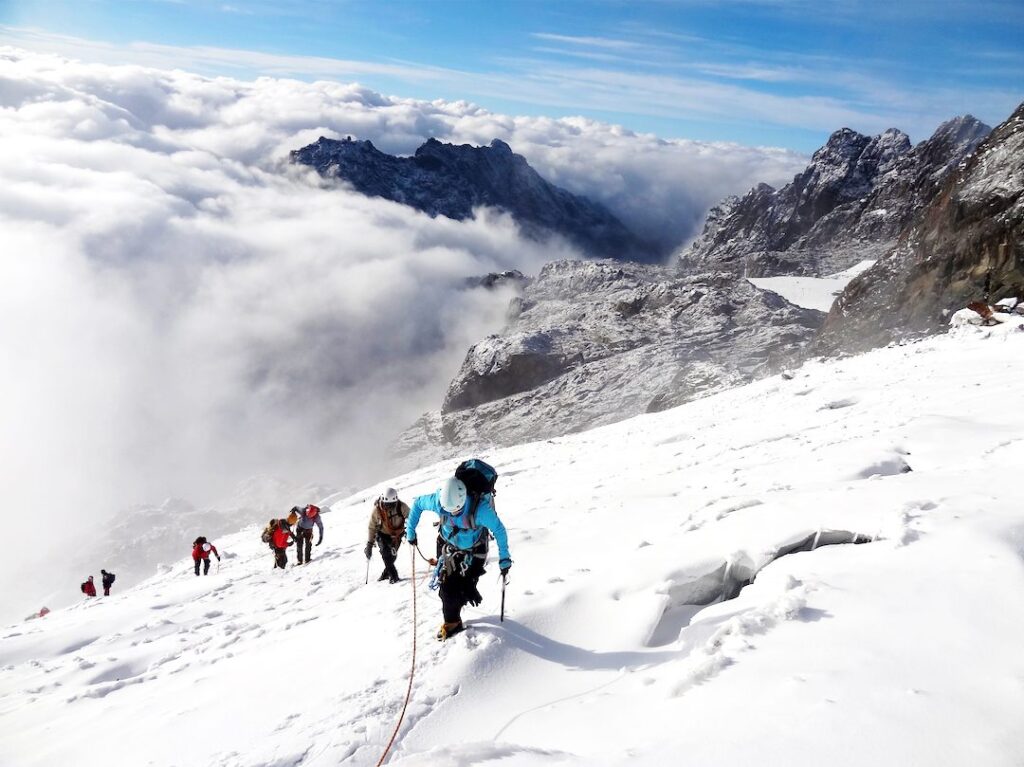
The route above Margherita Camp crosses a boulder field before reaching the Stanley Plateau approach, an undulating snowfield that leads to the glacier proper. The Margherita Glacier, one of the last equatorial glaciers on Earth, has retreated by several meters annually over recent decades and is predicted to disappear entirely before mid-century. In the pre-dawn darkness on the glacier’s surface, the beams from headlamps create white circles on the ancient ice, and the sharp, certain sounds of crampon placements with each step heighten awareness of the glacier’s retreat.
The guide manages the glacier crossing with the fixed ropes installed by the Uganda Wildlife Authority, directing the rope team through the crevasse zones he knows by memory and reading the surface conditions in real time. The darkness lifts in stages during the upper approach: grey first along the eastern horizon, then amber, then the first gold of an equatorial sunrise that ignites the Congo Basin to the west in a spectrum of orange and red that has no adequate language. By the time the summit rock appears above the glacier’s upper lip, the world is fully light, and the physical effort of the preceding four hours has produced a clarity of attention that summit days always generate.
Margherita Peak at 5,109 meters. Africa’s third highest point. The highest in Uganda. It is the apex of the Rwenzori Mountains. The summit register has names from the past century of ascents. The view extends from the DRC’s forest immensity to the west, to the plains of Uganda to the east, and to the glaciated crowns of Speke and Baker to the north. You stand on equatorial ice at five thousand meters above sea level, on a mountain that most people in the world have never heard of, and the glacier beneath your boots is the same ice that feeds the rivers that feed Lake Albert. The descent begins. Hunwick’s Camp by late afternoon. Hot food. Deep sleep. Summit achieved.
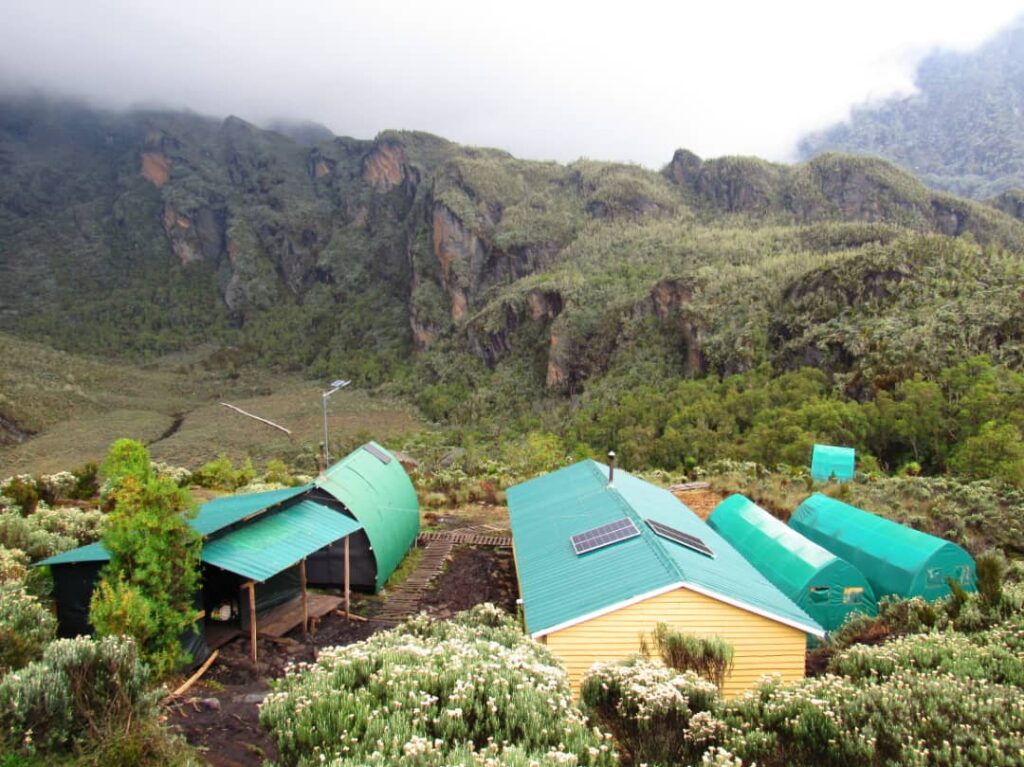
Accommodation & Meals: Hunwick’s Camp (3,974m). Full-board dinner. A summit certificate for Margherita Peak was presented. The body deserves everything it asks for tonight.
Day 11: The Long DescentโAll Five Zones in a Single Day (Hunwick’sย Camp (3,974m) โ Kilembe Trailhead (1,450m) | ~17 km | 7โ9 hours | Transfer to Kasese)
The final mountain day is physically demanding in a different way from everything that has preceded it, as gravity’s accumulated pull on weary legs is felt over a sustained descent that covers more than 2,500 meters of altitude in a single movement. The body must act like a brake instead of an engine, and the specific demands of descent are real: quadriceps working eccentrically, knees absorbing repeated impact, and the tendency for concentration to lapse as the danger of the higher terrain recedes. Trekking poles are essential here. The guide sets a pace that is efficient without being reckless.
The descent goes back through the five zones we climbed: the high alpine zone gives way to the Afro-alpine moorland, the moorland to the heather forest, the heather to the bamboo, and the bamboo finally to the Podocarpus montane forest of the lower Kilembe Trail. Each transition announces itself with the same abruptness as the ascent, but with a different emotional texture: the familiar becoming familiar again, the warmth returning to the air, the sounds of the lower forest reassembling around the path as altitude is lost.
At the Kilembe Ranger Post, the summit certificate is waiting, an official Rwenzori Trekking Services document confirming the ascent of Margherita Peak, signed by the guide and stamped by the ranger station. The porter tips are distributed in the particular warmth of a mountain partnership conclusion: people who have shared exceptional terrain together and the exchange of respect that crosses every other kind of language barrier. Your private vehicle is at the trailhead. Kasese in twenty minutes. Hotel by evening. Hot shower. Proper dinner. Seven mountain days complete.
Accommodation & Meals: Kasese Lodge (post-trek). Full-board dinner. The mountain is behind you. The road home begins tomorrow.
Day 12:ย Kasese โ Mbarara โ Uganda Equator โ Kampala | ~390 km | 5โ6 hours
The final morning is a different kind of morning from every mountain morning that preceded it: unhurried, warm, at low altitude, with no pack to weigh and no trail to assess. Breakfast at the Kasese lodge has a quality of arrival, the body registering the return to normal temperature and oxygen levels with a deep, grateful relaxation that makes ordinary pleasures feel heightened. Scrambled eggs at 914 meters above sea level taste better than scrambled eggs should.
The road east to Kampala follows the main Kasese highway through the Rwenzori foothills, past the outer boundary of Queen Elizabeth National Park, and into the Ugandan midlands. Your driver-guide uses the Mbarara lunch stop with the judgment of long familiarity, the right restaurant, the right timing, and a table with a view of the hills. After Mbarara, the Uganda Equator monument at Kayabwe arrives at the latitude line where Uganda crosses zero degrees: the concrete ring straddling the zero-degrees-latitude marker, the small market of crafts and souvenirs, and the optional photograph confirming that you have crossed the equator in both directions within twelve days.
Kampala arrives in the late afternoon. Your driver-guide delivers you to the hotel or departure point with the same quiet, unhurried competence that has characterized the entire journey. The twelve days are over. The Bwindi gorilla is three days and five thousand vertical meters behind you in the same memory. The Margherita Glacier is behind you in the same body. Uganda has delivered everything it promised, and in the specific, irreversible way that genuine experience always does, it has left something in you that was not there before.
Accommodation & Meals: Delivery to the Kampala hotel or Entebbe International Airport as required. Safari complete. Transfers are pre-arranged for any evening flight departures.
Elevation Profile โ The Kilembe Trail Arc
| Day | Location | Elevation | Movement Note |
| 1 | Kampala / Bwindi Impenetrable Forest | ~1,160m | Drive day โ forest arrival |
| 2 | Bwindi Forest (gorilla trek) | ~1,160โ2,000m | Trek 2โ8 km in forest, return to lodge |
| 3 | Queen Elizabeth NP | ~914m | Drive + Kazinga Channel cruise |
| 4 | Kasese town | ~914m | Game drive + mountain transfer |
| 5 | Kalalama Camp | 3,147 m | โ +1,697m Day 1 on mountain |
| 6 | Mutinda Camp | 3,688 m | โ +541m bamboo & heather |
| 7 | Bugata Camp | 4,062m | โ +374m Afro-alpine entry |
| 8 | Bamwanjara Pass โ Hunwick’s | 4,450m / 3,974m | โ pass, then โ to camp |
| 9 | Margherita Camp | 4,485 m | โ via Scott-Elliot Pass |
| 10 | Margherita Peak โ Hunwick’s | 5,109m โ 3,974m | โ SUMMIT at dawn then full descent |
| 11 | Kilembe Trailhead | 1,450m | โ Full descent โ all 5 zones |
| 12 | Kampala | 1,190 m | Drive eastโsafari complete |
What Your 12-Day Rwenzori & Gorilla trekking Safari Covers
The Rwenzori Trekking Expeditions 12-day Rwenzori & Gorilla Trekking package covers every significant logistical element of the journey, from your departure transfer from Kampala to your return. The investment is structured for complete transparency; no significant surprise costs arise mid-journey for a prepared traveler.
Included in Your Package
All ground transport is in private 4WD safari vehicle with experienced driver-guide | โ |
All accommodation: Bwindi forest-edge lodge (1 night), Queen Elizabeth NP lodge (1 night), Kasese pre-trek lodge (1 night), 7 nights Kilembe Trail mountain huts / bandas, Kasese post-trek lodge (1 night) โ 12 nights total | โ |
All meals as specified throughout the 12 days (full-board on mountain; B+L+D at all lodges) | โ |
Uganda Wildlife Authority (UWA) gorilla trekking permit โ $800 USD value, fully included | โ |
All UWA Rwenzori Mountains National Park entry and trekking fees โ 7 days | โ |
Certified senior mountain guide and assistant guide โ private allocation for your group only | โ |
One dedicated porter per trekker on the Kilembe Trail (personal kit up to 18 kg) | โ |
Dedicated mountain cook and all cooking equipment throughout the mountain section | โ |
All technical summit equipment: crampons, ice axe, harness, safety helmet, ropes | โ |
Rubber boot hire in all sizes, mandatory for Kilembe Trail bog sections, provided free | โ |
Kazinga Channel afternoon boat cruise (Queen Elizabeth NP โ Day 3) | โ |
Morning game drive at Queen Elizabeth National Park Kasenyi Plains (Day 4) | โ |
Rwenzori Mountains summit certificate on completion of Margherita Peak descent | โ |
Emergency oxygen cylinder and wilderness first-aid kit throughout the mountain section | โ |
Queen Elizabeth NP vehicle entrance fee | โ |
Equator stop and Mbarara lunch stop on return drive (Day 12) | โ |
10% of safari proceeds are directed to Bakonzo community schools and family support programs. | โ |
Not Included
International flights to and from Entebbe International Airport (EBB) | โ |
Uganda tourist visa ($50 USD for most nationalities, apply at visas. immigration.go.ug before travel) | โ |
Comprehensive travel and medical evacuation insurance: mandatory; must include trekking above 5,000m and emergency helicopter evacuation | โ |
Personal sleeping bag (minimum -10ยฐC rating required for Margherita Camp) | โ |
Personal mountain clothing: thermal layers, waterproof hardshell jacket and trousers, down jacket, gaiters | โ |
Trekking poles (strongly recommended, available for hire in Kasese with advance notice) | โ |
Personal porterage above the 18 kg guideline on the mountain | โ |
Alcoholic beverages and personal expenditure throughout | โ |
Personal medications, including altitude sickness prophylactics (Diamox, consult your GP before departure) | โ |
Tips and gratuities for mountain guide, porters, safari driver-guide, and lodge staff (discretionary but meaningful) | โ |
Pre-safari accommodation in Kampala or Entebbe (arrival evening before Day 1) | โ |
Bwindi Impenetrable Forest NP entrance fee (included in permit administration costs โ confirm at booking) | โ |
Any optional gorilla habituation experience upgrade (available at additional cost on request) | โ |
Best/worst Time To Visit/trek Gorillas & Rwenzori Mountains
ย This 12-day Rwenzori & Gorilla Trekking Safari combines gorilla trekking in Bwindi, wildlife viewing in Queen Elizabeth, and Rwenzori mountain trekking on the Kilembe Trail. Each experience has its own seasonal character, but the good news for planning purposes is that Uganda’s two dry season/month windows broadly benefit all three simultaneously.
Primary Season: December through February
January and February are, according to the consistent assessment of experienced Rwenzori guides, the finest months for this itinerary. The primary dry season brings the clearest skies and most stable conditions for the Kilembe Trail summit push; the glacier approach on Day Ten has the best probability of clear morning conditions in these months, maximizing both the summit experience and the safety margin. Queen Elizabeth National Park‘s wildlife viewing peaks as animals concentrate around water sources with reduced vegetation cover. Gorilla trekking in Bwindi is enjoyable year-round, but drier conditions on the forest floor make the terrain slightly easier and the gorilla families slightly more predictable in their movement. December is operationally similar to January and February. Book six to twelve months ahead for permits and lodge availability in this window.
Secondary Season: June through July
June and July offer the second strong window for the full twelve-day package. Both months provide sufficiently reliable dry conditions for the Kilembe Trail summit attempt and good game viewing in Queen Elizabeth. Gorilla permit availability in Bwindi is slightly more accessible in June than in the December-January peak. August begins the short rainy season transition and is less reliable for the mountain section. This window aligns well with Northern Hemisphere summer travel and is the most popular booking period; gorilla permits for June and July should be secured six to eight months in advance.
Wet Seasons: MarchโMay and AugustโNovember
The 12-day safari operates year-round, and the gorilla trekking and wildlife sections are genuinely enjoyable in any season. The Kilembe Trail is much muddier and more technically demanding in the wet season, and the summit success rate on Margherita drops during sustained rainfall because the glacier approach and upper rock sections become much more hazardous. The itinerary does not include a dedicated weather buffer day, unlike some longer Rwenzori programs, meaning that a weather-forced summit cancellation on Day Ten cannot be recovered within this itinerary’s structure. Trekkers who are flexible about summit success probability and prioritize quieter parks, lower prices, and lush scenery will find the wet season a viable option. Trekkers whose major objective is Margherita Peak should plan their trip for December to February or June to July.
Gorilla Permit Booking โ Act Early
Gorilla trekking permits for Bwindi, priced at $800 per person, are issued by the Uganda Wildlife Authority in strictly limited quantities, with only one permit available per gorilla family per day. In peak season windows of December, January, June, and July,ย the Uganda Wildlife Authority regularly allocates available dates four to six months in advance. We recommend that you contact Rwenzori Trekking Expeditions as soon as you establish your intended travel dates to confirm permit availability before making any other booking commitment.
Getting There โ Arrival and Logistics
The safari begins in Kampala, and all ground transport is provided in your private safari vehicle throughout the twelve days. Most international travelers arrive at Entebbe International Airport (IATA: EBB), located 40 kilometers south of Kampala on Lake Victoria’s northern shore, with direct or single-connection services from London Heathrow (British Airways), Amsterdam (KLM), Dubai (Emirates), Nairobi (multiple carriers), and Addis Ababa (Ethiopian Airlines). We strongly recommend an overnight stay in Kampala or Entebbe on the evening before Day One’s departure; the drive to Bwindi is seven to nine hours, and arriving rested rather than jetlagged makes a material difference to the Day Two gorilla experience.
Rwenzori Trekking Expeditions arranges airport pickup from Entebbe on request for the evening before Day One. The Kasese section of the itinerary (Days 4โ11) uses a curated selection of Kasese lodges with Rwenzori Mountain trekking experiences. For detailed getting-there information covering all transport options, including private vehicle, scheduled bus, and domestic flight to the Kasese airstrip, visit the Getting to Rwenzori section at www.rwenzoritrekkingexpeditions.com.
What to Wear and Pack โ The Two-Environment Gear Strategy
This 12-day Rwenzori & gorilla trekking safariย spans two radically different environments: the wet, warm rainforest of Bwindi and the cold, wet Rwenzori alpine zone reaching 5,109 meters. The smart packing approach is a two-bag system: a safari bag for the lodge-based days (Days 1โ4) that stays in the vehicle during the mountain section, and a dedicated mountain pack for the seven Kilembe Trail days. This keeps mountain loads manageable and prevents you from carrying unnecessary kit to altitude.
For the Safari Days โ Bwindi and Queen Elizabeth
- Bwindi gorilla trekking requires neutral-colored clothing, green, brown, or khaki, as bright colors are discouraged near gorillas.
- Long-sleeved shirts and long trousers protect against nettles and insects on the forest floor.
- A lightweight waterproof jacket is essential: Bwindi is reliably wet.
- Sturdy closed-toe walking shoes or trail runners are appropriate for the gorilla trek.
- Gardening gloves are recommended for gripping vegetation on steeper sections.
- A small day pack carries water, a packed lunch, your camera, and the mask required for gorilla proximity.
- For Queen Elizabeth game drives, the same neutral clothing applies, plus a sun hat, SPF 50 sunscreen, and binoculars (8×42 or 10×42 for wildlife viewing).
- DEET insect repellent is essential for evening hours at Bwindi Impenetrable National Park & Queen Elizabeth National Park.
What to Wear & Park For the Kilembe Trail โ Mountain Essentials
Rwenzori Trekking Expeditions provides all technical summit equipment: crampons, climbing harness, safety helmet, ice axe, and managed rope sections on the glacier. Rubber boots are provided free of charge and are mandatory โ the Kilembe Trail’s bog sections make standard trekking boots impractical and quickly destroyed. Bring neoprene socks (three to four pairs) for warmth inside the rubber boots.
What you must provide:
- A sleeping bag rated to a minimum of -10ยฐC is essential for Margherita Camp nights.
- A fully waterproof hardshell jacket and trousers (20,000 mm hydrostatic head, seam-sealed; the Rwenzori is the wettest mountain range in Africa); thermal base layers in two sets; a warm insulated down jacket (minimum 600-fill with hood) for the upper camps and summit; trekking poles (essential for the descent);
- A headlamp rated at 300+ lumens with spare batteries (the 02:00 summit departure requires reliable light); glacier glasses with side shields (UV at 5,000 m on equatorial ice is extreme);
- Warm summit gloves with waterproof outers; a balaclava; and a 20,000 mAh power bank kept in your sleeping bag overnight to maintain charge at altitude.
- For the full, season-specific Kilembe Trail gear list, visit our complete packing guide on the website at Packing List For Rwenzori.
- For footwear guidance, our rubber boot and waterproof sock guide is available in the Plan Your Trek section.
Experience Rwenzori Beyond Expectations
Spots Filling Fast — Schedule Your Trek Today
Frequently Asked Questions โ 12-Day Uganda Gorilla Trek, Wildlife & Rwenzori Trekking Safari
The questions below address the most important considerations for travelers planning this 12-day Rwenzori trek & gorilla trekking safari. Your Rwenzori Trekking Expeditions consultant responds to all inquiries within a few minutes.
For Gorilla Trekking Session
Gorilla trekking in Bwindi Impenetrable National Park involves hiking 2 to 8 kilometers on steep, densely vegetated forest terrain at altitudes of 1,160 to 2,000 meters. It is moderate exercise, broadly accessible to reasonably mobile adults without specialist training. The forest floor is often muddy and root-crossed, requiring solid walking shoes or trail runners, and the steep sections ask for a reasonable base level of cardiovascular fitness. It is substantially less physically demanding than the Kilembe Trail mountain section. The main physical challenge is the variable duration; your group treks until the gorilla family is found, which can take anywhere from thirty minutes to six or more hours depending on family movement overnight.
Uganda Wildlife Authority regulations set the minimum age for gorilla trekking at 15 years for all permits. Children under 15 cannot participate in the gorilla trek and must remain at the lodge on that day. Trekkers aged 15 and above who are in excellent health and reasonably fit can participate regardless of prior trekking experience. There is no upper age limit; gorilla trekking has been completed by travelers in their seventies. If you are traveling with family members near the age threshold, please contact your consultant, and we will advise you on the most appropriate itinerary configuration.
No! The one-hour maximum viewing time per habituated gorilla family is a strict Uganda Wildlife Authority regulation, enforced without exception. This limit is in place for real conservation reasons, such as reducing stress on the gorilla families, lowering the risk of disease transmission, and ensuring the long-term success of the habituation program that makes these encounters possible. If you wish to spend a full day with a gorilla family, the Gorilla Habituation Experience , available in specific Bwindi sectors, provides a full day with a family currently in the process of habituation. This option is available as an upgrade to this itinerary at an additional permit cost; ask your consultant about availability.
The itinerary is primarily planned through the Buhoma sector in the north of Bwindi, which is the original and most established gorilla trekking sector with the longest history of habituation and the most developed lodge infrastructure. Specific sector and gorilla family assignments depend on permit availability at booking and on UWA allocation at the time of the trek. If Buhoma permits are unavailable for your dates, Rushaga in the south, which has the largest number of habituated families, provides an excellent alternative. Your consultant discusses sector specifics at booking.
Rwenzori Trekking Expeditions operates on a clear, transparent booking and cancellation policy. A deposit of 30% of the expedition fee secures your dates, with the balance due 60 days before departure. Cancellations made more than 60 days before departure receive a full deposit refund, less a modest processing fee; cancellations made within 60 days are subject to a sliding scale as outlined in our booking terms. We strongly recommend travel insurance that includes cancellation cover, as well as the mandatory medical evacuation cover. Full policy details are provided at the time of booking confirmation.
The Rwenzori Mountain Section
The Kilembe Trail is used for this 12-day Rwenzori hike and gorilla trekking combination itinerary rather than the Central Circuit trail for several reasons. The Kilembe Trail is less crowded, offers arguably superior waterfall and botanical scenery in its lower and middle sections, passes through Bugata Camp’s well-equipped facilities, and crosses Bamwanjara Pass, the finest all-massif panorama viewpoint on any Rwenzori trail route. The 7-day Rwenzori trek, Margherita Kilembe trail version, also provides a slightly more generous acclimatization profile than the standard seven-day Central Circuit trail. The Central Circuit trail is the alternative for travelers who specifically prefer the Bujuku Valley approach or the Nyakalengija trailhead; ask your consultant about switching if you have a specific preference.
The 12-day Uganda Gorilla & Rwenzori trekking safari itinerary does not include a dedicated weather buffer day, unlike some of our longer Rwenzori programs. This is the primary limitation of this duration for the summit objective: if summit day is forced back entirely by severe weather, the descent on Day Eleven proceeds as scheduled and the summit cannot be reattempted within this itinerary. Trekkers for whom the Margherita summit is the highest priority should consider the 16-Day Uganda Gorilla & Rwenzori trekking itinerary, which uses the Central Circuit with more mountain days and a built-in contingency. For trekkers who want the combination of gorilla trekking, Queen Elizabeth, and the mountain experience and are prepared to accept weather risk on the summit, the 12-day Rwenzori & Gorilla Trekking Safari delivers outstanding value and an extraordinary journey even in a weather-cancelled summit scenario
No prior glacial or technical climbing experience is required. The summit approach uses crampons and ice axes on fixed ropes managed throughout by your certified guide. What you need is confidence on steep, variable terrain; comfort with sustained physical effort after six consecutive mountain days; and the willingness to follow precise guide instruction in the dark on the glacier surface. Your guide provides a comprehensive crampon and ice axe briefing on Day 9 at Margherita Camp; Day Ten begins with the guide leading the rope team and managing every technical decision. Rwenzori Trekking Expeditions provides all technical equipment: crampons, harness, helmet, and ice axe.
Porters on the Kilembe Trail are allocated one per trekker as a personal kit porter (load limit 18 kg including the porter’s own food and equipment). The porter team is drawn from the Bakonzo communities of the Rwenzori foothills, professional mountain workers whose physical capability on this terrain is extraordinary. UWA regulations mandate minimum wages, maximum loads, appropriate shelter, and hot meals at all camps; Rwenzori Trekking Expeditions exceeds these requirements as standard. Tipping at the expedition’s close is entirely discretionary but is genuinely meaningful to Bakonzo families whose income depends heavily on trekking work. Your guide will advise you on appropriate tip amounts at the appropriate moment. Visit the porter and tipping guide on our website for a full breakdown.
Altitude sickness is a genuine consideration on the Kilembe Trail above 3,500 meters, and the only reliable treatment is descent. Your certified mountain guide monitors every member of the group daily for symptoms like headache, nausea, dizziness, disturbed sleep, and reduced appetite and maintains the authority to initiate descent immediately if symptoms indicate it is necessary. No summit, no schedule, and no itinerary cost consideration can override this authority. Acute mountain sickness can affect anyone regardless of fitness level; carrying acetazolamide (Diamox) prescribed by your doctor before departure significantly reduces risk. Consult your GP at least four weeks before departure. Our medical guide for Rwenzori trekkers is available on the website.
Your expedition fee includes the Bakonjo porter team for group and communal equipment, tents (if applicable), communal cooking equipment, and shared supplies. Personal porters, who carry your individual pack, are available at an additional daily cost and are strongly recommended for trekkers who want to move at a comfortable pace and preserve their energy for the environment rather than for the load. Many clients find that the relationship with a personal porter is one of the most memorable aspects of the Rwenzori experience. We are happy to discuss personal porter options when confirming your booking.
Rwenzori Trekking Expeditions operates on a clear, transparent booking and cancellation policy. A deposit of 30% of the expedition fee secures your dates, with the balance due 60 days before departure. Cancellations made more than 60 days before departure receive a full deposit refund, less a modest processing fee; cancellations made within 60 days are subject to a sliding scale as outlined in our booking terms. We strongly recommend travel insurance that includes cancellation cover, as well as the mandatory medical evacuation cover. Full policy details are provided at the time of booking confirmation.
Wildlife Safaris In Queen Elizabeth National Park
Queen Elizabeth National Park supports over 95 mammal species and more than 600 bird species. On the Kasenyi Plains game drive, visitors reliably encounter elephants, Cape buffalo, Uganda kob, warthog, and spotted hyena. Lions are present and regularly sighted; the Kasenyi drainage lines in early morning are the most productive zone. The Kazinga Channel boat cruise delivers hippos (one of the continent’s highest concentrations), Nile crocodiles, and excellent waterside birding, including African fish eagles, pied kingfishers, Goliath herons, and African skimmers. The itinerary’s standard game drive does not include the Ishasha sector’s tree-climbing lions, but you can add them with advance notice if timing permits.
For a first Uganda visit, the Kazinga Channel boat safari on Day Three afternoon and the Kasenyi Plains dawn game drive on Day Four morning provide a concentrated but genuinely excellent Queen Elizabeth experience. These two activities target the park’s best wildlife experiences: the boat cruise for hippos and waterbirds and the morning game drive for lions and elephants and deliver the highlights within the itinerary’s time constraints. Travellers who want more time in QENP can extend the itinerary by adding a second night, which your consultant can arrange as a bespoke adjustment.
Logistics and Practical Questions
Solo travelers are warmly accommodated on this itinerary. The private vehicle, mountain guide, and porter services are provided regardless of group size, which means that per-person costs for solo travelers are typically higher than for groups of two or more who share those fixed costs. Rwenzori Trekking Expeditions maintains a list of scheduled small-group departures where solo travellers can join existing groups at reduced per-person cost. Contact your consultant for solo pricing and the current small-group departure calendar.
Comprehensive travel and medical evacuation insurance is mandatory for the Rwenzori mountain section and strongly recommended for the entire safari. The policy must explicitly include high-altitude trekking above 5,000 meters (many standard policies exclude above 3,000 m, so read the terms carefully); emergency helicopter or mountain rescue evacuation; medical expenses of at least USD 100,000; and trip cancellation and curtailment. Standard travel insurance without these specific inclusions is insufficient. Visit our Rwenzori insurance guide for travelers at rwenzoritrekkingexpeditions.com for recommended providers and the specific policy language to look for.
Yes. The 12-day Rwenzori & gorilla trekking itinerary is a designed starting point, not a fixed program. Common customizations include adding the Ishasha sector game drive for tree-climbing lions (which requires either an earlier QENP arrival or a third QENP night); upgrading the gorilla section to two trekking days with two different gorilla families (which adds one Bwindi night and one additional permit at $800); extending the mountain section to the 8-day Kilembe Trail version for better acclimatization and a summit buffer day; or adding chimpanzee trekking in Kibale Forest as a day three activity before the QENP transfer. Contact your Rwenzori Trekking Expeditions consultant to discuss any customization.
The 12-Day Rwenzori & Gorilla Trek itinerary delivers the three core Uganda experiences: Bwindi gorilla trekking, Queen Elizabeth wildlife, and the Rwenzori Margherita summit via Kilembe in the most efficient twelve-day structure. The 16-day Rwenzori & Gorilla itinerary adds chimpanzee tracking in Kibale Forest, uses the Central Circuit trail rather than the Kilembe Trail for the mountain section, and includes a dedicated summit contingency day. The 16-day Rwenzori & Gorilla trekking version suits travelers who want to add the chimpanzee experience, prefer the Central Circuit, or want the additional security of a summit buffer. The 12-day version suits those with limited time who want the definitive Uganda highlights in a single seamlessly managed journey. Both are excellent. The choice depends on your available time and specific priorities.
Begin Planning Your 12-Day Uganda Safari
Twelve days. Three national parks. Youโll see mountain gorillas, tree-climbing lions, and an equatorial glacier at 5,109 meters. Uganda’s greatest journey, perfectly sequenced, from $5,800 per person.
The 12-day Uganda Gorilla Trekking, Wildlife Safari, and Rwenzori Mountaineering safari is the itinerary we recommend most consistently to travelers who want the full range of what Uganda offers and have two weeks to dedicate to it. It does not waste a day. It does not pad the schedule. It delivers the three experiences that define Uganda’s natural world, the gorilla, the savannah, and the glacier, in a sequence that builds from the intimate to the epic and leaves you with a body full of mountains and a mind full of gorillas.
Rwenzori Trekking Expeditions has managed this journey many times and knows every element that determines its quality: the guide who has summited Margherita Peak in every weather condition and knows the glacier by feel as much as by sight; the driver-guide who can position a vehicle on the Kasenyi Plains for the best lion light before sunrise; and the mountain cook who adjusts the evening meal based on how much the group has given during the day. This knowledge does not happen by accident. It is built from years of doing this work, caring about the quality, and refusing to compromise on either.
From the moment you share your travel dates, everything is in our hands. The gorilla permit is secured. The lodge bookings are confirmed. The mountain team is allocated. The technical gear is ready. Every transfer is private and in a private vehicle. Every meal is managed. The mountain is your only responsibility for seven days. The gorilla encounter is your only responsibility for one morning. Everything else belongs to us.
Reach out today. Tell us your dates, your group size, your fitness level, and any requirements, dietary, accommodation preference, or pace preference on the mountain. We will respond with a fully personalized safari proposal within 1 hour.
Gorillas. Glaciers. Lions. Twelve Days. Uganda. ๐งย trek@rwenzoritrekkingexpeditions.com ๐ย www.rwenzoritrekkingexpeditions.com ๐ย +256 785331024ย |ย WhatsApp available From $5,800 per person (group of 2) ยท Gorilla permit included ยท Private departures |
Experience Rwenzori Beyond Expectations