Day 1: Kilembe Ranger Post (1,450m)
to Kalalama Camp (3,147m)
The morning begins gently, with a full briefing at the Kilembe Ranger Post from your dedicated mountain guide, a final gear check, and the quiet logistics of porters and rangers assembling for the week ahead, all handled entirely out of your sight. Then the valley floor rises to meet you, and the trail climbs steadily under a canopy of tall Afro-montane forest trees, their trunks strung with old man’s beard lichen and hanging vines.
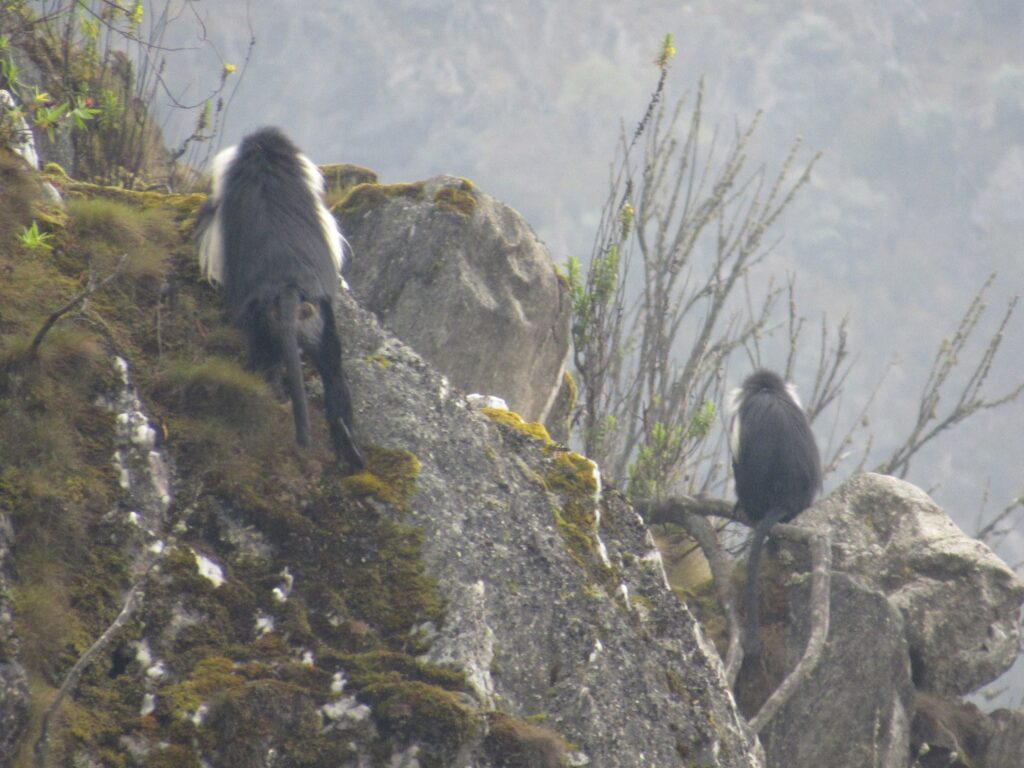
Black-and-white colobus troupes move through the upper branches in groups of fifteen or twenty; blue monkeys scatter at the sound of footsteps, and if fortune allows, the shy, russet-coated L’Hoest’s monkey, a creature protected under Bakonzo cultural tradition as an emblem of the Omusinga, watches silently from the undergrowth. Somewhere below, unseen, wild chimpanzees call across the valley, and the electric-green flash of a Rwenzori turaco occasionally cuts through the canopy. A trailside break near Enock’s Falls, where the forest opens onto a curtain of falling water, marks the transition from lowland to montane forest before a final push through thinning trees delivers you to Kalalama Camp at 3,147 meters, set within the heather-rapanea zone, for a hot dinner, tomorrow’s briefing, and your first night at altitude.
Day 2: Kalalama Camp (3,147m) to Mutinda Camp (3,688m)
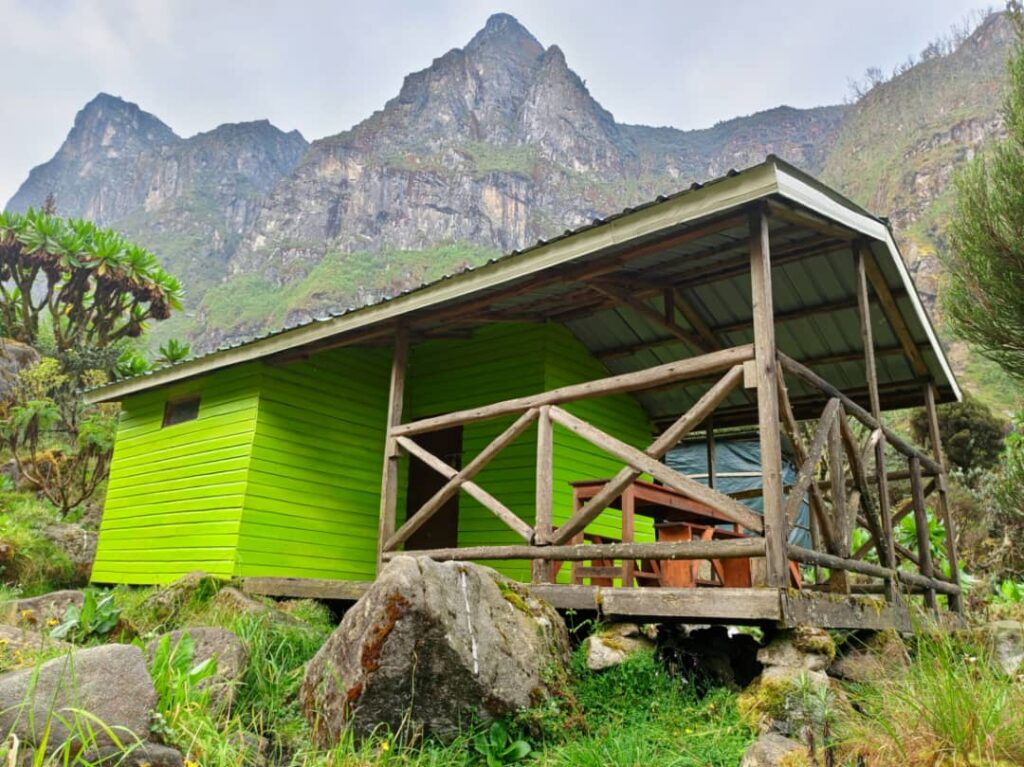
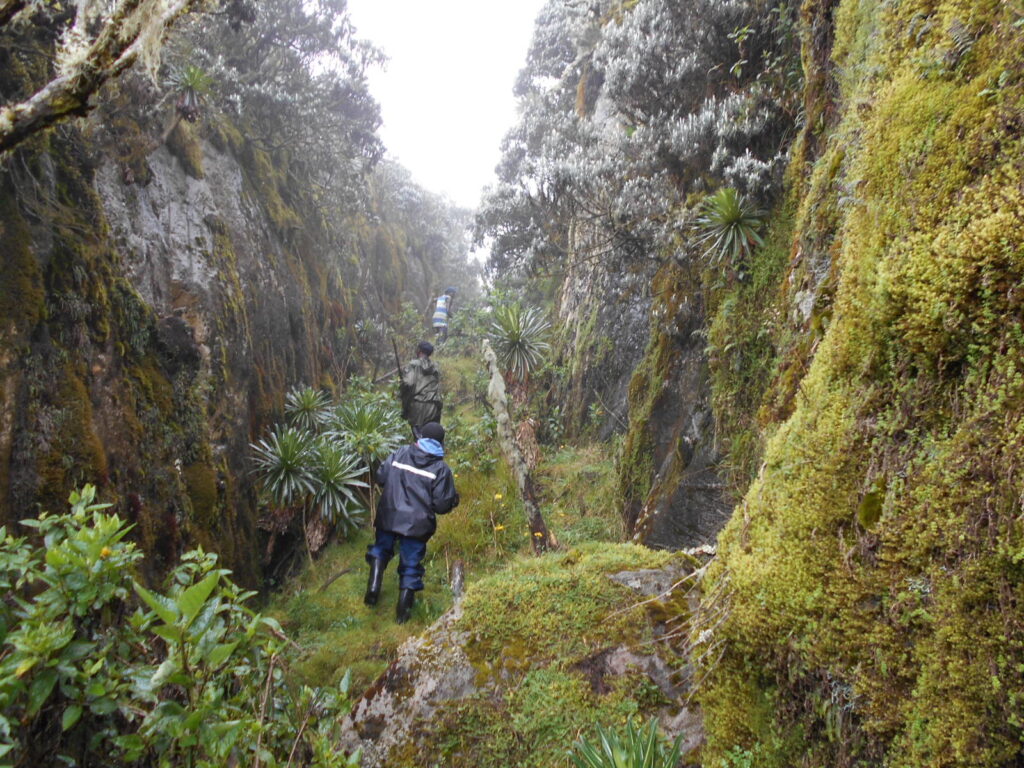
Breakfast is unhurried, because today’s climb, while short in distance, is steep from the first step. The trail enters the Bamboo-Mimulopsis Zone almost immediately, a dense, cathedral-like corridor of tall bamboo where the path climbs via a long run of natural steps; in wetter months the ground here turns slick, and the pace slows to something more deliberate and grounded. A rest point offers time for tea and a packed lunch before the trail crosses into the heather zone, twisting alongside a mossy river that tumbles over rock beneath giant heather trees, their branches draped in pale Usnea lichen and shrouded, more often than not, in drifting mist. The atmosphere here is genuinely otherworldly, less African rainforest than something out of a fable. Mutinda Camp, at 3,688 meters, is named for the jagged Mutinda Peaks that rise directly above it. For those with energy in reserve, the afternoon offers an optional ninety-minute climb to Mutinda Lookout at roughly 3,925 meters. This climb is a superb piece of active acclimatization, with sweeping views down to Kasese town and Lake George, and it provides controlled altitude exposure that meaningfully reduces the risk of summit-day sickness five days from now.
Day 3: Mutinda Camp (3,688m) to Bugata Camp (4,062m)
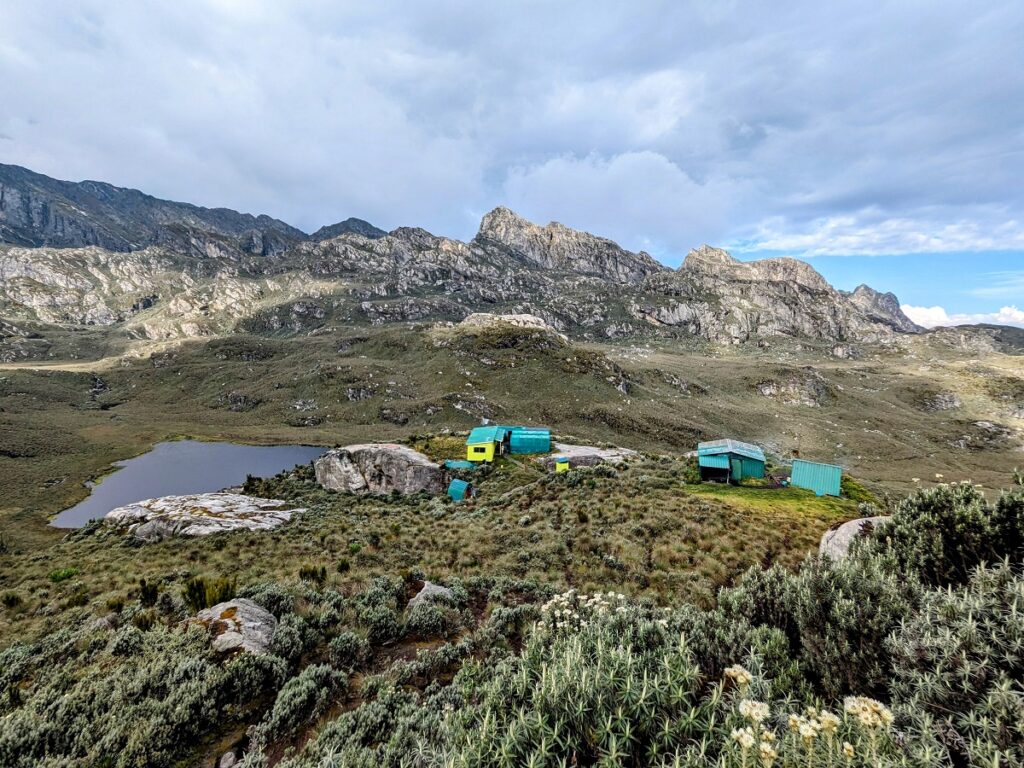
The character of the mountain changes again today. Beyond Mutinda Camp, the trail drops into boggy tussock-grass terrain thick with everlasting flowers and the extraordinary silhouettes of giant lobelia, a landscape that feels closer to a high Andean páramo than to anything typically associated with equatorial Africa. Crossing the Mutinda Valley requires a light-footed rhythm of stepping tussock to tussock before a steep pull up into the wide, dramatic Namusangi Valley, where sheer waterfalls drop from the cliffs and, looking back, the full jagged profile of the Mutinda Peaks comes into view. As the trail gains height toward Bugata Camp, the icy, permanently snow-dusted summit of Weismann’s Peak on Mount Luigi di Savoia appears in the distance, and on a clear afternoon the valley opens toward Lake Kitandara and the string of glacial lakes that give this stretch of the range its quiet, mirror-like beauty. Bugata Camp, at 4,062 meters, is one of the best-equipped stops on the entire route; its solar lighting and eco-toilets are a welcome comfort after a demanding day, and dinner here is taken with views few travelers on any continent will ever see from a dining tent.
Day 4: Bugata Camp (4,062m) Via Bamwanjara Pass to Hunwick’s Camp (3,974m)
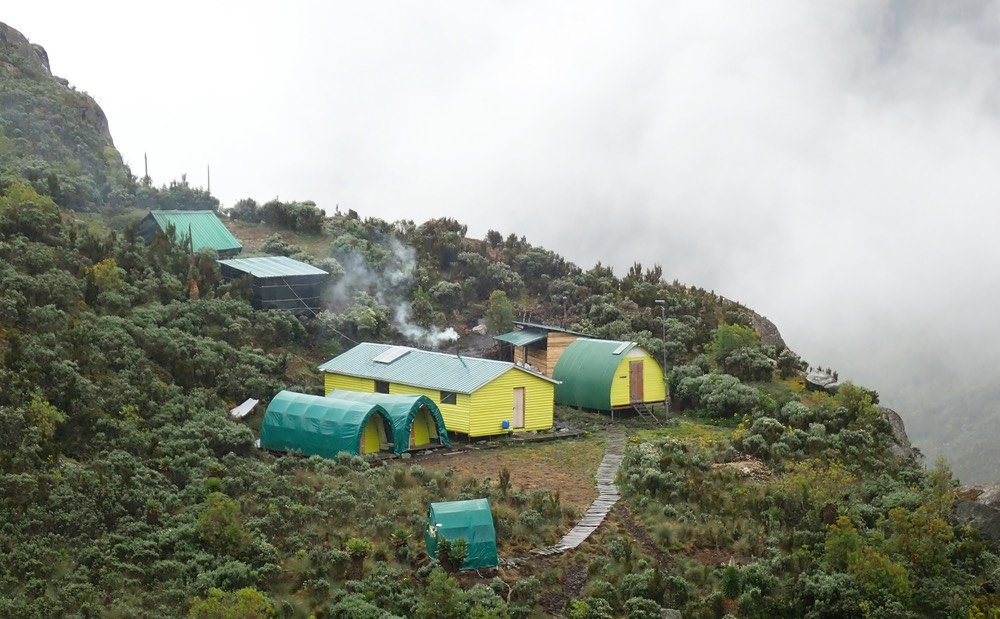
Today’s crossing of Bamwanjara Pass, at around 4,450 meters, is the structural high point of the trail before Margherita itself, and on a clear morning it delivers the single best panorama of the Rwenzori’s three principal massifs before the clouds close in, as they typically do by early afternoon. The route out of Bugata climbs a ridge before dropping and rising again to the pass, where a small emergency shelter stands should the weather turn, a reminder that the Rwenzori is, at every stage, a mountain to be respected rather than merely admired. Beyond the pass, the trail descends along the edge of thick, waterlogged bogs and dense evergreen groundsel and lobelia, a stretch regarded by guides as one of the finest places in the entire range to watch the iridescent malachite sunbird feeding among the lobelia flowers. A final steady climb over a last ridge brings you to Hunwick’s Camp at 3,974 meters, perched above a deep valley with clear views across to Mount Stanley, Mount Baker, Weismann’s Peak, and McConnell’s Prong, your first uninterrupted look at tomorrow’s destination.
Day 5: Hunwick’s Camp (3,974m)
to Margherita Camp (4,485m) Through Scott Elliot Pass
Though shorter in distance than the days before it, at a little over four kilometers, Day 5 is when the mountain begins to feel more like an expedition than a trek. The trail drops down across the valley floor to Lake Kitandara, a still, glacier-fed lake framed by dramatic vegetation, before climbing steadily up Scott Elliot Pass, crossing small streams fed directly by the glaciers of Mount Baker and by Freshfield Pass, and finally following the exposed ridge to Margherita Camp itself. At 4,485 meters, the camp sits sheltered between giant boulders that blunt the worst of the wind, positioned directly below Elena Hut, the stone refuge maintained by Rwenzori Mountaineering Services that has served generations of Margherita summit attempts. This is almost exactly the spot where the Italian nobleman Prince Luigi Amedeo, Duke of the Abruzzi, made his camp before the first confirmed ascent of Margherita Peak in 1906, a piece of mountaineering history that lends real weight to the night ahead. From camp, the darkening light plays across the glaciers of Mount Baker and the upper reaches of Mount Stanley, and dinner tonight is eaten with tomorrow’s summit bid the only subject of conversation.
Day 6: Summit Day: Margherita Camp (4,485 m) to Margherita Peak (5,109m) and Back to Hunwick’s Camp (3,974m)
This is the day the entire itinerary has been built around, and it begins in darkness. A hearty breakfast is served at 2:00am, and by 2:30am your private guide leads the way out of camp by headlamp; the early start is built entirely around the mountain’s own weather pattern: clear skies through the small hours give way, with striking reliability, to heavy cloud and snow squalls from early afternoon as moisture rises off the Congo Basin rainforest below. Crampons, ice axe, harness, and rope go on for the glacier crossing itself, guided by rangers and mountaineering staff who read this ice every day of their working lives and know exactly where the crevasse risk and thinning ice caves are as the glacier continues its slow retreat. Less experienced climbers are given the option of stopping short of the technical ice on a rocky vantage point near Alexandra Peak, with views across to the Congo and the lower ridgelines that are, in their own right, worth the entire week.
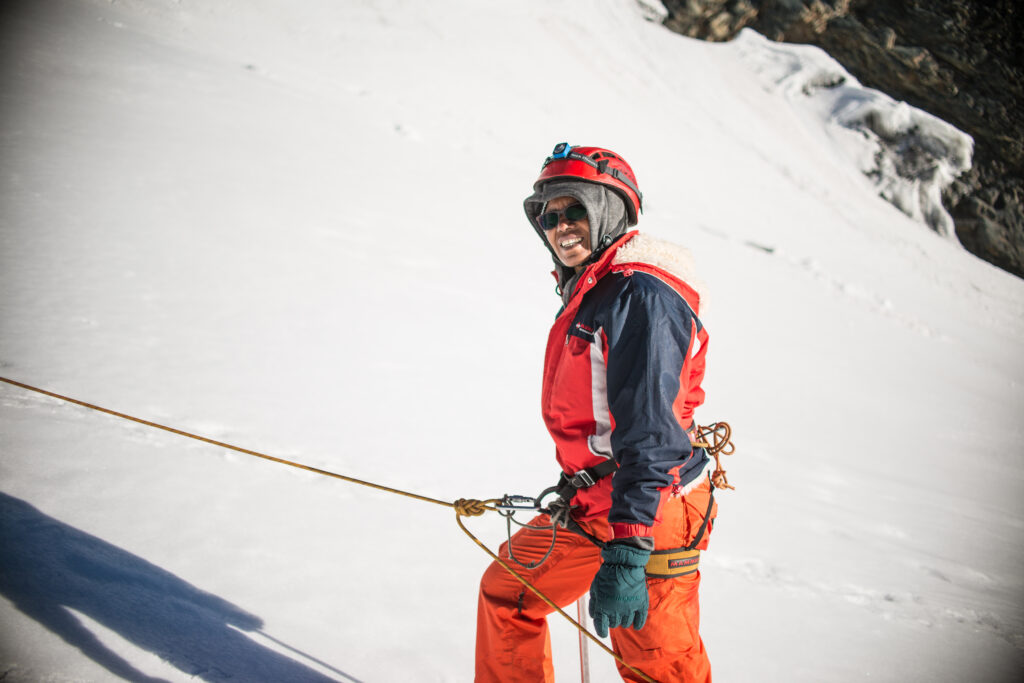
For those continuing, the final approach to Margherita’s summit at 5,109 meters is a genuine scramble over rock and ice rather than a walk, and a strict, non-negotiable turnaround time, enforced by your guide in the interests of safety regardless of how close the summit feels, governs the whole ascent. Standing on the roof of Uganda, with Africa’s third-highest point beneath your boots and the glaciers of Mount Stanley falling away on every side, is a moment few trekkers ever forget. The descent retraces the route back to Hunwick’s Camp at 3,974 meters, with a trailside lunch en route and a well-earned dinner and rest waiting at the end of a long, unforgettable day.
Day 7: Hunwick’s Camp to Kilembe Ranger Post — The Long Descent
The final day belongs to the valley rather than the peaks. After breakfast, the trail slopes down through terrain alive with birdlife flitting in and out of the pack, then follows a narrow ridge with sweeping views back over the ground you have covered before crossing a series of small valleys and streams toward Kyalavula and the descent to the Ranger Post. It is a day for reflection as much as walking, for watching the vegetation zones you climbed through in reverse, thicker and greener with every kilometer lost in altitude, and for quiet conversation with the guides and porters who have shared the week with you. At the base camp, certificates are presented to every trekker who reached Margherita Peak, a private vehicle waits for the transfer back to Kasese, and a hot shower, a proper bed, and a celebratory dinner bring the expedition to a close in comfort.
What’s Included / What’s Excluded
Every Rwenzori Trekking Expeditions itinerary is quoted with full transparency, so there are no surprise costs once you are on the mountain and no hidden extras buried in the fine print. The table below sets out exactly what your trek fee covers and what is left for you to arrange or budget separately.
Included | Excluded |
All park entrance and Kilembe Trail concession fees | International flights and Uganda visa fees |
Professional, government-licensed mountain guide throughout | Private transfer between Kampala/Entebbe and Kasese (available as an add-on) |
Porters and armed park rangers as required by the Uganda Wildlife Authority | Personal hiking gear (boots, crampons for hire on request, sleeping bag) |
Accommodation at all mountain campsites and huts | Pre- and post-trek hotel nights in Kasese or Kampala |
All meals on the mountain, prepared fresh by your trek cook | Tips and gratuities for guides, porters and cooks |
Purified drinking water throughout the trek | Personal travel insurance with high-altitude trekking and evacuation cover |
Rescue and evacuation arrangements via Rwenzori Mountaineering Services | Alcoholic and premium bottled drinks |
Technical mountaineering equipment for the summit bid (ropes, harnesses) | Optional side-summits such as Weismann’s Peak |
Summit certificate on successful completion |
The Five Vegetation Zones of the Kilembe Trail
Few treks on the planet compress so much ecological change into such a short distance. From the Kilembe trailhead to the summit of Margherita, the vegetation shifts through five recognized zones, each with its own character, climate, and challenges.
Afro-Montane Forest Zone (1,450m – 2,500m)
A tall hardwood forest, dense with primates, birdlife, and waterfalls, forms the first day’s climb out of the ranger post.
Bamboo–Mimulopsis Zone (2,500m – 3,000m)
A steep, step-laden corridor of dense bamboo, muddy and atmospheric in the wet season, forming the opening stretch of Day 2.
Heather–Rapanea Zone (3,000m – 3,800m)
Giant heather trees draped in Usnea lichen, mossy streams, and frequent mist span Kalalama and Mutinda camps.
Afro-Alpine Moorland (3,800m – 4,500m)
Boggy, tussock terrain populated by giant lobelia, giant groundsel, and everlasting flowers, the surreal, otherworldly landscape crossed on Days 3 and 4.
Rock, Glacier and Nival Zone (4,500m and above)
On summit day, climbers crossed bare rock, permanent snowfields, and the retreating glaciers of Mount Stanley using crampons, an ice axe, and a rope.
Accommodation Guide
On the mountain itself, accommodation is in simple but sturdy timber and stone huts and platform tents maintained by Rwenzori Trekking Services, upgraded significantly along the Kilembe corridor recently. Kalalama, Mutinda, and Hunwick’s camps offer solid wooden sleeping huts with communal dining shelters, while Bugata Camp is currently the best-equipped stop on the route, with solar lighting and eco-toilets that feel like a genuine luxury after a long day above 4,000 meters. Margherita Camp itself is the most exposed and basic of the seven nights, tucked among boulders below Elena Hut purely for shelter from the wind ahead of the pre-dawn summit push; comfort here gives way entirely to position and safety.
Before and after the trek, we place you in comfortable, well-run lodges in Kilembe town and Kasese, ranging from boutique guesthouses to higher-end options for travelers who want a proper bed, hot water, and a restaurant meal to bookend the mountain days. Please tell us your comfort expectations when inquiring, and we will match the pre- and post-trek stays accordingly.
Attractions and Things to Do in Rwenzori
Beyond the summit trek itself, the wider Rwenzori region rewards travelers who build in extra time. Shorter nature walks around the park boundary offer excellent birding and primate viewing without the commitment of a multi-day summit attempt, while cultural visits to Bakonzo communities around Kilembe and Kasese offer genuine insight into the mountain-worshipping traditions that have shaped life here for centuries. Queen Elizabeth National Park, with its tree-climbing lions and Kazinga Channel boat cruise, sits within easy reach for travelers extending their stay, and the glacial lakes and waterfalls scattered throughout the park reward even a short detour with some of the most photogenic scenery in western Uganda.
Wildlife on the Kilembe Trail
The lower forest belt of the Kilembe Trail is one of the most rewarding wildlife stretches of any trek in the Rwenzori. Troupes of black-and-white colobus monkeys move noisily through the canopy in the first hours of Day 1; blue monkeys are almost guaranteed; and patient, quiet walkers occasionally spot the rare, culturally protected L’Hoest’s monkey. Wild chimpanzees inhabit these forests too, more often heard than seen, their calls carrying across the valley at dawn and dusk.
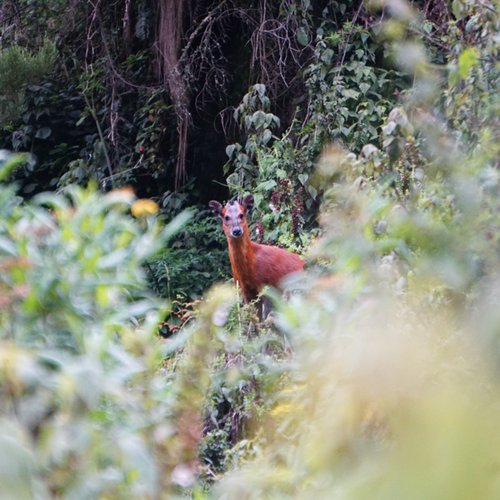
Birdlife is exceptional throughout, with the endemic Rwenzori turaco, the iridescent malachite sunbird feeding among the alpine lobelias near Hunwick’s Camp, and well over two hundred recorded species across the park’s elevation gradient rewarding anyone who treks with binoculars. The shy, chestnut-coated Rwenzori red duiker, one of the park’s least-seen mammals, favors the dense forest lower down the mountain, while the giant forest hog and several duiker species round out a wildlife list that few visitors expect from a range better known for glaciers than game.
Cost Factors: What Determines Your Trek Price
Rwenzori trekking prices vary more than most travelers expect, and understanding what drives that variation helps you compare quotes fairly. Group size is the single biggest factor, since park fees, guide costs, and rescue-fund contributions are largely fixed per trek and are shared across fewer people on a private departure than on a scheduled group trip. Season also plays a role, with peak dry-season dates commanding a premium compared to the shoulder months. The level of comfort you choose before and after the mountain, whether a simple guesthouse in Kasese or a higher-end lodge, noticeably shifts the land package cost, as does any technical gear you need to hire instead of bringing yourself. Porter numbers, which you can increase for a more supported, lighter daypack experience, and optional add-ons such as the Weismann’s Peak side summit or extra acclimatization nights are the final variables. We quote every trek with a full, itemized breakdown so you can see exactly where your money goes, with no undisclosed surcharges once you are on the trail.
Level of Difficulty: Is This Trek Right for You
We won’t say this 7-day Margherita Peak Rwenzori trek via the Kilembe trail is easy, because it isn’t, and any operator who says otherwise isn’t being straight with you. The 7-day Kilembe route to Margherita Peak is a serious high-altitude mountaineering expedition rather than a casual hike, and by most experienced trekkers’ accounts it is a harder physical undertaking, day for day, than Kilimanjaro. You will walk between five and eight hours most days across steep, often muddy, and root-strewn terrain; sleep at altitudes exceeding 4,000 meters for three consecutive nights; and on summit day, undertake genuine technical glacier travel on rope and crampons and, in places, exposed bolted rock. A strong baseline of cardiovascular fitness, prior experience of multi-day trekking with a loaded pack, and mental resilience for long, cold, uncertain days matter more here than any specific technical climbing background. Rwenzori Trekking Expeditions‘ guides teach you everything you need to know about crampon and rope work the evening before summit day. Successful summits each season are achieved by families trekking with older, fit teenagers, couples in good general fitness, and solo trekkers who have realistic self-awareness about their conditioning; the honest limiting factor is almost always preparation, not age or experience level. We are always glad to have a candid conversation about your current fitness and help you decide whether this itinerary, our shorter Mutinda Lookout trek, or a longer nine-day acclimatization schedule is the right fit.
Safety on the Mountain
Every guide on this itinerary is licensed, mountain trained, and works within the established network of Rwenzori Trekking Services huts and rescue posts that has operated on this range for decades. The seven-day pacing of this 7-day Kilembe trail trek to Margherita Peak is a safety decision: the gradual ascent profile, the optional acclimatization walk to Mutinda Lookout on Day 2, and the built-in rest at Hunwick’s Camp are all designed to reduce the risk of acute mountain sickness before the summit push. On Margherita itself, a strict, guide-enforced turnaround time protects every climber from the mountain’s well-documented pattern of clear mornings giving way to fast-moving afternoon snow and cloud, and technical glacier sections are led on rope by staff who reassess crevasse and ice-cave risk daily as the glacier continues to retreat. Comprehensive travel insurance that explicitly covers high-altitude trekking and mountain evacuation up to at least 5,500 meters is a firm requirement for every booking, and we are glad to recommend appropriate policies at the time of inquiry.
Fitness and Training Guide
This is a strenuous trek, not a gentle nature walk, and honest preparation makes an enormous difference to how much you enjoy it. Aim to build a base of regular cardiovascular training, hiking, running, cycling, or stair climbing for at least eight to twelve weeks before departure, ideally three to four sessions a week building toward back-to-back long days on your feet. Hiking with a loaded daypack on hilly or stepped terrain is the single best preparation for the Bamboo Zone and Bamwanjara Pass, and any prior experience with scrambling, via ferrata, or basic rope work will make summit day feel considerably less foreign. Strength work for the legs and core pays real dividends on the steep, often muddy descents, and mental preparation matters just as much as physical fitness: the 2:00am wake-up call, the cold, and the discipline of turning around before the summit if the weather or the clock demands it are as much a part of this trek as the walking itself. Trekkers of good general fitness in their sixties and beyond complete this route successfully every season, provided training has been consistent and expectations are realistic.
Food on the Mountain
A dedicated trek cook and support team carry fresh provisions up the mountain daily, so meals on this itinerary are hot, generous, and far removed from the freeze-dried rations common on other African peaks.
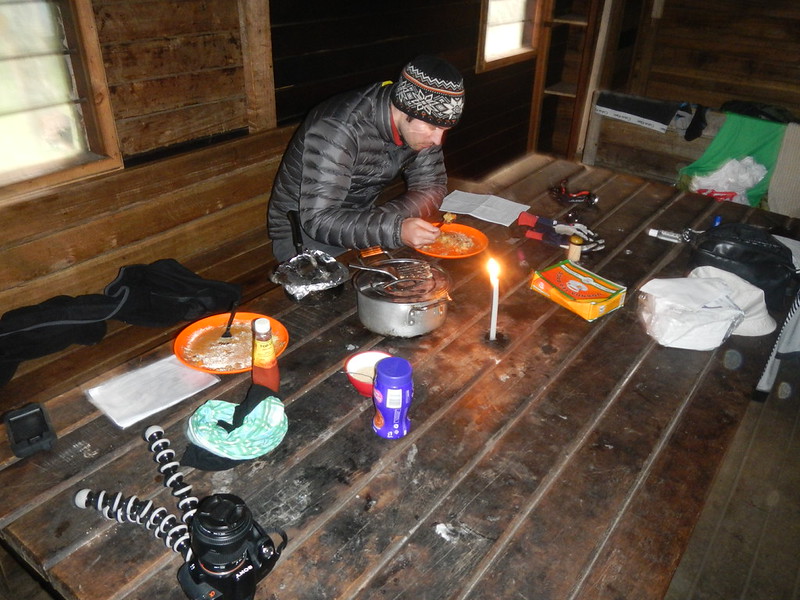
Expect a cooked breakfast of porridge, eggs, and fresh fruit before each day’s climb; a packed or trailside lunch of sandwiches, energy bars, and hot soup; and a substantial evening meal of rice, potatoes, pasta, stewed meat or vegetables, and fresh vegetables carried up in stages by the porter team. Hot tea, coffee, and hot chocolate are available at every stop, and purified drinking water is provided throughout so you never need to treat your own. With advance notice at the time of booking, we can easily accommodate dietary requirements, whether vegetarian, vegan, gluten-free, or otherwise.
Packing Guide
Layering is the single most important packing principle for this trek, because a single day can move you from humid rainforest heat to sub-zero glacier wind. A solid pair of worn-in waterproof hiking boots with ankle support is non-negotiable, paired with gaiters for the boggy Afro-alpine sections on Days 3 and 4. Base layers should be moisture-wicking rather than cotton, with a warm mid-layer fleece or down jacket and a fully waterproof, windproof outer shell for the exposed passes and the pre-dawn summit push, where temperatures regularly fall well below freezing. For summit day, you need warm gloves, an insulated hat, a headlamp with spare batteries, and UV-rated sunglasses or glacier goggles, as the glare off the snow and ice is intense. A four-season sleeping bag rated to at least minus ten degrees Celsius, trekking poles for the steep, often muddy trail sections, and a comfortable daypack for personal items round out the core kit list; technical mountaineering equipment such as crampons, an ice axe, a harness, and a rope for the summit glacier crossing is provided as part of your package, though trekkers with their own well-fitted gear are welcome to bring it. We send every confirmed booking a detailed, personalized packing checklist so you don’t have to guess what to bring.
Why Choose This 7-Day Kilembe Trail Trek to Margherita Peak
Kilimanjaro is climbed by more people in a single peak season than the Rwenzori sees in several years combined, and that scarcity is precisely the point. The Rwenzori is a range where you can walk for a full day and meet no one outside your own party and its guides, where the trail still feels like exploration rather than a queue, and where the summit you eventually stand on is genuinely earned through scrambling, fixed ropes, and real glacier travel rather than a long, gentle walk-up. The Rwenzori’s ice is retreating fast; climatologists expect the last remnants to disappear within a generation, so a Margherita summit today is also a chance to stand on something the next generation of trekkers may only read about.
Few multi-day treks anywhere in Africa compress this much ecological range into one route. In seven days you pass from steaming lowland rainforest thick with primates and birdsong through cathedral-like bamboo groves and moss-drenched heather forest into the surreal Afro-alpine world of giant lobelias and groundsel and finally onto bare rock, permanent snowfields, and glacier ice, a vertical journey through nearly every major Rwenzori vegetation zone without ever leaving a single national park.
Why Choose the Kilembe Trail Of Rwenzori
Uganda’s Rwenzori has two principal climbing routes: the older, longer Central Circuit on the northern side and the Kilembe Trail on the south, developed in 2009 and now the preferred route for operators who prioritize camp comfort and trekker safety. Kilembe’s huts are newer and better equipped, with solar lighting and eco-toilets at camps such as Bugata, and the trail was engineered with a gentler overall daily gradient even though individual sections, particularly the Bamboo-Mimulopsis zone on Day 2 and Bamwanjara Pass on Day 4, are genuinely steep. The lower forest is also noticeably richer in wildlife than the Central Circuit approach, with far better odds of colobus and blue monkey sightings, and the trailhead sits closer to Kasese town, cutting driving time and giving you an extra hour of daylight on your first morning.