8-Day Rwenzori Trek To Mount Speke, Mount Stanley (Margherita Peak), & Mount Baker (3 Peaks)

The 8-day Rwenzori trek to 3 peaks (Mount Stanley, Mount Speke, and Mount Baker Safari) via the central circuit trail is a challenging, high-altitude trek in the Rwenzori Mountains to Vittorio Emanuele Peak (4,520 m), Margherita Peak (5,109 m), and Edward Peak (4,844 m). The route traverses all Rwenzori vegetation zones via the Central Circuit Trail.

This 8-day Rwenzori trek to Mount Speke, Mount Stanley (Margherita Peak), and Mount Baker via the central circuit trail is the definitive experience for climbers who want more than a single summit. On this journey, you will stand on three separate mountains in one unbroken trek: Mount Speke, Mount Stanley’s Margherita Peak at 5,109 meters (Africa’s third-highest point), and Mount Baker. You will traverse six of the range’s famous high-altitude huts, cross the notorious Bamwanjara Pass, and descend through the same emerald forest of giant lobelias and groundsels that first stopped the range’s Victorian-era explorers in their tracks. Every transfer, permit, hut booking, and mountain meal is arranged before you arrive; every day is guided by the Bakonzo mountain crew, who were born within sight of these peaks and have spent their lives reading their weather, their rock, and their ice. What follows is a day-by-day itinerary of the 8-day Rwenzori trek to Mount Speke, Mount Baker & Mount Stanley exactly as our guides walk it, along with everything you need to know before deciding if this is the trek you want to take.

Mount Speke
Rwenzori Trekking to Mount Speke-Central circuit hike

Quick Facts About the Triple-Peak (Mount Speke, Mount Stanley & Mount Baker Central Circuit Trek)

Before the story of the mountain, the essentials any serious climber wants settled first. This table gives you the shape of the trek at a glance, its length, its highest point, its trail, and its cost, so you can weigh it against any other Rwenzori trekking itinerary before reading further.

Detail

Information

Duration

8 days / 7 nights on the mountain (10 days total with Kampala/Kasese transfers)

Trail Used

Central Circuit Trail (Nyakalengija start and finish)

Peaks Attempted

Mount Speke (Vittorio Emanuele Peak, 4,890m), Mount Stanley (Margherita Peak, 5,109m), Mount Baker (Edward Peak, 4,844m)

Highest Point

Margherita Peak, 5,109m — Africa’s 3rd highest summit

Trek Grade

Strenuous to Challenging, for fit, experienced hikers; technical glacier travel on summit day

Group Size

Private and small-group departures, maximum 8 climbers

Start / End Point

Nyakalengija Trailhead, Kasese District, Rwenzori Mountains National Park

Accommodation

Central Circuit high-altitude huts (Kiharo, Nyabitaba, John Matte, Bujuku, Elena, Kitandara)

Best Season

Mid-December to mid-February and June to August (dry seasons)

Starting Cost

From USD 2,650 per person (fully inclusive of park fees, permits, hut fees, meals, and mountain crew)

Nearest Town

Kasese, western Uganda (approx. 6-7 hours by road from Kampala or Entebbe)

Why trek Mount Speke, Mount Stanley & Margherita via the Central Circuit Trail?

Most visitors to Uganda hear of gorillas first and mountains second, if at all. But the Rwenzori, the true ‘Mountains of the Moon’ named by Ptolemy nearly two thousand years ago, offer something East Africa’s volcanic giants cannot: a jagged, glaciated, block-faulted range of ancient crystalline rock, thick with Afro-alpine vegetation found nowhere else on the continent in such density. Where Kilimanjaro is a long walk to a single summit, the Rwenzori Central Circuit trail is a genuine mountaineering traverse, six huts, five major valleys, and three distinct peaks, each with its character and its own reward.

Mount Speke rewards you with sweeping views back across the Mubuku Valley and a real sense of the range’s scale. Mount Baker offers a shorter, sharper scramble across ridge and rock. And Margherita Peak, the crown of Mount Stanley, is the objective every serious Rwenzori climber ultimately measures themselves against: a pre-dawn ascent across the Stanley Plateau’s ice fields, up the Elena Glacier’s remaining ice and exposed rock, to a summit ridge shared only by the mountain, the sky, and whoever has trained hard enough to stand there. Climbing all three in a single eight-day circuit, rather than choosing just one, is what separates a serious Rwenzori expedition from a single-peak holiday and why serious mountaineers increasingly request this exact itinerary from us by name.

The Central Circuit Trail is also, in our long experience guiding this range, simply the most complete way to see the Rwenzori. Where the newer Kilembe Trail approaches from the south and suits climbers focused purely on Margherita, the Central Circuit’s classic route through Nyabitaba, the Bigo Bog boardwalks, Lake Bujuku, and the John Matte and Kitandara valleys remains the original and, for many, the more atmospheric way to experience the range’s full botanical and glacial drama, a point we return to in the trail comparison table further down this page.

Central Circuit Trail vs Kilembe Trail: Which Should You Choose for a Multi-Peak Trek?

Trekkers occasionally ask whether the newer Kilembe Trail, managed separately by Rwenzori Trekking Services, might be a better option for a multi-peak trip. For a three-peak itinerary specifically targeting Speke, Stanley, and Baker, the honest answer is no: the Kilembe Trail approaches the range from the south and gives excellent access to Margherita Peak and to Mount Luigi di Savoia, Mount Emin, and Mount Gessi, but it does not run through the Bujuku Valley hub where Speke, Stanley, and Baker converge. The two trails are operated by entirely separate organizations, with separate huts, guide teams, and permits, and cannot be mixed mid-route. The comparison below summarizes how the two routes differ for travelers weighing their options.

Feature

Central Circuit Trail

Kilembe Trail

Managed by

Rwenzori Mountaineering Services (RMS)

Rwenzori Trekking Services (RTS)

Access to Speke, Stanley & Baker together

Yes, direct, via Bujuku Valley

No,  Stanley only, via a different approach

Typical duration

7–9 days

8–10 days

Standout scenery

Lake Bujuku, Bigo Bogs boardwalks, Scott-Elliot Pass

Kalalama Camp views, Samalira waterfalls, Mount Luigi di Savoia access

Best suited to

Multi-peak itineraries, first-time Rwenzori trekkers, classic route seekers

Trekkers prioritising solitude or the southern peaks

Crowd levels

Busier in peak season, still far quieter than Kilimanjaro

Consistently quieter year-round

8 Days Rwenzori Trekking Itinerary at a Glance

  • Day 1: Nyakalengija (1,615m) to Nyabitaba Hut (2,651m)
  • Day 2: Nyabitaba Hut to John Matte Hut (3,505m)
  • Day 3: John Matte Hut to Bujuku Hut (3,962m) — first close views of Speke, Baker & Stanley
  • Day 4: Bujuku Hut — summit attempt on Mount Speke’s Vittorio Emanuele Peak (4,890m), return to Bujuku Hut
  • Day 5: Bujuku Hut to Elena Hut (4,541m) via the Scott-Elliot Pass (4,372m)
  • Day 6: Elena Hut — summit Margherita Peak (5,109m) on Mount Stanley, descend to Kitandara Hut (4,023m)
  • Day 7: Kitandara Hut — summit attempt on Mount Baker’s Edward Peak (4,844m) via Fresh Field Pass, descend to Guy Yeoman Hut (3,450m)
  • Day 8: Guy Yeoman Hut via Nyabitaba Hut back to Nyakalengija — trek ends
8 days Rwenzori Mountains trekking Expeditions/hiking/climbing

Detailed 8-Day Rwenzori Trek (3 Peaks): Mount Speke, Mount Stanley & Mount Baker via the Central Circuit

 Day 1: Nyakalengija to Nyabitaba Hut | 2,651 m · 6–7 hours · 10km

Your private guide meets you at the Rwenzori Mountaineering Services offices in Nyakalengija in the early morning for registration, a full safety briefing from the park authority, and a final gear check before your porter team is assembled. From the park gate the trail eases you in through Bakonjo farmland and banana plantations before the forest closes in properly: tropical hardwoods, tangled vines, and the calls of black-and-white colobus and blue monkeys somewhere overhead. The path follows the Mubuku River, crosses its Mahoma tributary, and then climbs steadily up a long forested ridge. Chimpanzee calls occasionally drift down from higher in the canopy, and the Rwenzori turaco, unmistakable in flight, is often the first of the range’s striking endemic birds you will see.

Nyabitaba Hut sits on a ridge with a clean, open view back down the valley you have just climbed and, on a clear evening, a first distant look at the peaks still ahead. Dinner is taken communally in the hut’s dining space, prepared by your trekking cook, with the first genuinely cool mountain air settling in after dark. Overnight at Nyabitaba Hut.

Day 2: Nyabitaba to John Matte Hut | 3,505 m · 6–7 hours · 10km

Leaving Nyabitaba after breakfast, the trail drops to the Kurt Schafer Bridge at the confluence of the Mubuku and Bujuku Rivers, a crossing point that has greeted Rwenzori trekkers for decades.

Best Attractions in Rwenzori Mountains National Park


Beyond it, dense bamboo forest gives way to a long, often slippery stretch of moss-draped rock, the mountain’s way of reminding you that this trek is a genuine wilderness trail rather than a manicured path. From the Nyamuleju rock shelter, weather permitting, you get your first real look at the summits of Mount Stanley and Mount Speke rising ahead, an early glimpse of exactly where the next several days will take you.

John Matte Hut is set in heather-zone terrain, cooler and more open than the forest below, with giant lobelias beginning to appear along the trailside, one of the botanical signatures that makes the Rwenzori’s alpine zone feel genuinely otherworldly. Overnight at John Matte Hut.

John Matte to Bujuku Hut | 3,962 m · 5–6 hours · 7 km

This trek is the day the Rwenzori’s central amphitheater opens up around you. The trail descends to cross the Bujuku River before leading you through the Lower and then Upper Bigo Bog, where boardwalks now ease a crossing that once required leaping between grass tussocks. Giant groundsels stand across the bog like something out of an illustrated fable, and if the cloud lifts even briefly, Lake Bujuku appears ahead, framed by the ridgelines of Mount Stanley, Mount Speke, and Mount Baker simultaneously—the exact panorama this itinerary is designed around.
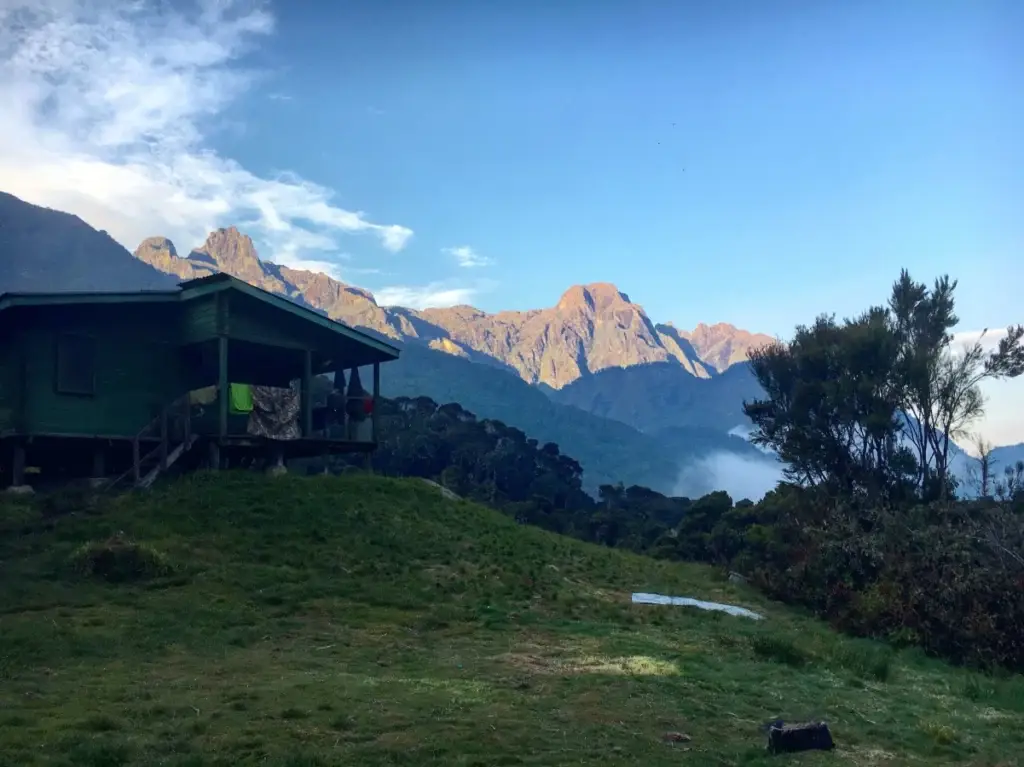
4 days Rwenzori Trek to John Matte Central Circut Trail with Rwenzori Trekking Expeditions


Bujuku Hut sits directly beneath all three mountains, and it will be your base for tomorrow’s Speke summit attempt. This location is also a natural point to rest, hydrate deliberately, and let your body continue adjusting to altitude before the technical days ahead. Overnight at Bujuku Hut.

GUIDE’S NOTE: Lake Bujuku at dusk, with three glaciated peaks arranged around a single body of still water, is a scene few climbers anywhere in Africa will ever otherwise see. We schedule extra rest time here specifically so you don’t rush through it.

  Day 4: Mount Speke Ascent, Vittorio Emanuele Peak (4,890m, 8–10 hours round trip)

Today’s objective is Mount Speke, the second of your three summits, climbed as an acclimatization day from Bujuku Hut with a lighter daypack and your climbing guide alone. The route climbs steeply out of the Bujuku basin onto Speke’s western flank, crossing rock and increasingly frequent patches of old snow as height is gained, before a final scramble delivers you to Vittorio Emanuele Peak, Speke’s true summit, with the whole Central Circuit trail spread beneath you and Margherita’s ice cap rising directly opposite.
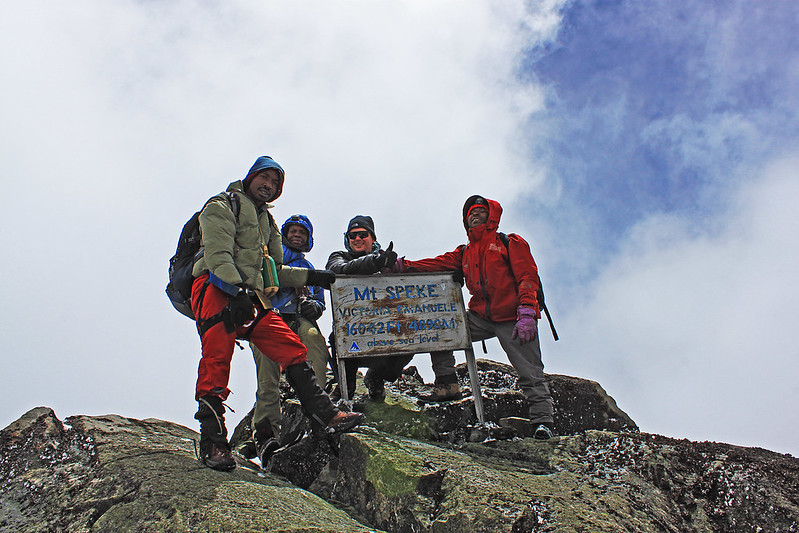
Mount Speke-Mountains Of The Moon

For climbers with limited time, Speke is sometimes skipped in favor of extra acclimatization; for those pursuing the full triple-peak objective, today is both a summit in its own right and the most valuable acclimatization day of the trip, pushing your body to altitudes close to Margherita’s Peak day in a lower-consequence setting. The descent returns you to Bujuku Hut by mid-afternoon, with the remainder of the day given to rest, hydration, and equipment checks ahead of the Elena Hut push tomorrow.

Day 5: Scott Elliot Pass: Bujuku Hut to Elena Hut (4,541m, 5–6 hours)

The trail out of Bujuku climbs immediately and does not relent at the infamous ‘Bamwanjara Pass‘ approach, a steep scramble up wet rock and roots known locally, with characteristic Rwenzori understatement, as the section where climbers ‘discover their legs.” The vegetation here thins to Afro-alpine moorland and finally to bare rock and scree as you gain the final meters to Elena Hut, which is perched directly beneath the Stanley Plateau.

Elena Hut is small, basic, and utterly unforgettable, a simple stone shelter with Margherita Peak’s summit ridge visible directly above and the Elena Glacier’s remaining ice glinting in the afternoon light. Here your climbing guide fits crampons and harnesses for the following morning, checks ropes, and walks you through the summit day’s technical sections in detail. Dinner is early and light; sleep, for most climbers, is short, nerves and altitude both playing their part before the earliest start of the trip.

  Day 6: Margherita Peak (5,109m) and Descent to Kitandara Hut (4,023m, 10-11 hours)

You leave Elena Hut in full darkness, headlamps picking out the first icy pitches of the Stanley Plateau as your guide leads the rope team across crevasse-scarred ice that has, over decades of documented retreat, become the range’s most fragile and closely monitored terrain. The route crosses the plateau to the base of the Margherita Glacier, climbs a short but genuinely technical ice and rock pitch fixed with ropes, and finally gains the exposed summit ridge, narrow, wind-scoured, and shared, at that hour, with no one but your own small team.
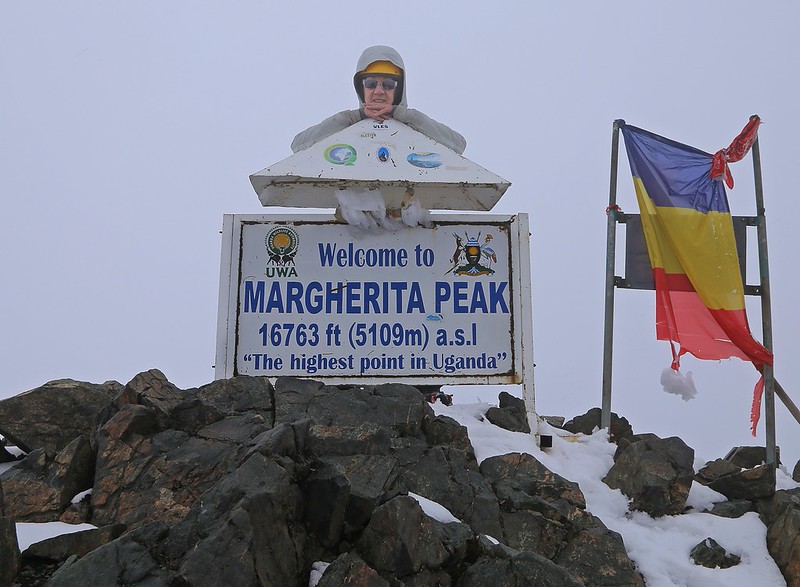
Summit Margherita Peak at 5109m

Standing on Margherita Peak as the sun clears the horizon, with the Congo Basin’s cloud sea to the west and Uganda’s plains to the east, is the reason climbers travel from every continent to attempt this exact ascent. The summit itself allows only brief minutes before the descent begins, down the same technical ground, back across the plateau, and down to Elena Hut for a late breakfast before the day continues onward, dropping through changing vegetation zones to Kitandara Hut beside its twin glacial lakes, where the day’s achievement is properly toasted over dinner.

GUIDE’S NOTE  ·  Summit day is long; twelve to fourteen hours is typical and weather-dependent. We build one contingency day into every triple-peak booking specifically to protect this summit attempt, a buffer that many other operators omit to shorten their brochures.

  Day 7: Mount Baker Ascent (Edward Peak, 4,844m) Via Fresh Field Pass To Guy Yeoman; descend to 3,450m · 7–9 hours

With Margherita achieved, today’s objective is Mount Baker, the third and final peak of the circuit, climbed directly from Kitandara Hut’s twin lakes. The approach is shorter and less technical than Margherita’s summit day but no less spectacular: a steep scramble up Baker’s northern ridge, with views back across Kitandara’s lakes to the peaks you climbed only a day earlier, before a final rock pitch delivers you to Edward Peak’s small, wind-battered summit.

Rwenzori Mount Baker Trekking

The descent from Baker rejoins the Central Circuit’s return route, dropping steadily through the Kitandara Valley and back into forest, with Guy Yeoman Hut or Nyabitaba Hut serving as the night’s camp depending on the day’s pace and how each climber’s legs are holding up after the trek’s two summit days. Dinner tonight carries a different energy from the rest of the trip: three peaks completed and only the walk out remaining.

  Day 8: Descent to Nyakalengija (1,615m · 6–7 hours, 12 km)

Trailhead and Transfer to Kasese

The final morning descends through the same forest you climbed on Day 1, but it feels entirely different when walked in reverse, with three summits now behind you and the noise of the Mubuku River growing steadily louder as you near the valley floor. At Nyakalengija, certificates are presented, your mountain crew is thanked and tipped according to the guidance we provide before departure, and a last look is taken back up the valley toward peaks that, for the rest of your life, you will now recognize by name.

Your dedicated vehicle and driver are waiting at the trailhead for the transfer back to Kasese, where you can enjoy a hot shower and a proper bed, and for those continuing on with us to Queen Elizabeth National Park for gorilla trekking or an onward safari, we would be glad to help you plan the next chapter of your Uganda itinerary.

Is climbing/hiking the Rwenzori Mountains (Stanley, Baker, and Speke) safe?

Trekking to Mount Speke, Mount Stanley, and Mount Baker is safe when guided properly, but genuinely hazardous when not, which is precisely why the Rwenzori’s permit system requires every trekker to be accompanied by Uganda Wildlife Authority-registered guides. The park authority has, recently, also invested directly in route safety, including a bridge across a crevasse section of the Margherita Glacier and additional fixed climbing ropes on the most exposed stretches, both of which have measurably improved the safety of the final summit approach.

The genuine risks on this trek are altitude sickness above 4,000 meters, slips on wet rock and bog crossings, and exposure during the glacier sections, all of which are managed through the pacing, acclimatization days, and technical equipment already built into this itinerary. Political and personal safety in the park itself is not a significant concern; the Rwenzori region is stable and well-regulated, and the Bakonjo guiding community has an excellent, decades-long safety record. As with any high-altitude expedition, comprehensive travel insurance covering trekking above 5,000 meters is required.

How difficult is the 8-day Rwenzori trek to Mount Stanley, Mount Speke, and Mount Baker via the Central Circuit Trail?

This trek is, without qualification, one of the most demanding trekking itineraries we operate in Uganda, and it is not the right first mountain for a first-time hiker. Over the course of eight days, you repeatedly gain and lose altitude on a steep, often wet and muddy trail, culminating in two technical summit days: Margherita Peak‘s glacier crossing and Mount Baker‘s rock scramble, both of which require real fitness, sound footing, and comfort with exposure. Altitude is the other defining challenge: Bujuku, Elena, and the summits themselves sit well above 4,000 and 5,000 meters, and altitude sickness remains the most common reason climbers fail to summit on any Rwenzori itinerary, this one included.

We ask every climber booking this itinerary to arrive with a genuine base of hiking or mountaineering fitness; multi-day trekking experience elsewhere, ideally at altitude, is strongly preferred, and to budget honestly for the physical and mental demands of back-to-back summit days. In exchange, our guides bring decades of combined experience reading Rwenzori weather and glacier conditions, and we build the itinerary’s pacing, rest days, and contingency time specifically around protecting your best chance of standing on all three summits rather than rushing toward a single one.

Difficulty Breakdown by Day

Day

Terrain

Altitude Gain

Difficulty

Day 1

Forest trail, river crossings

~950m

Moderate

Day 2

Forest to heather zone

~530m

Moderate

Day 3

Bog boardwalk, moorland

~470m

Moderate to Strenuous

Day 4

Rock scramble, snow patches

~910m (round trip)

Strenuous

Day 5

Steep scree and rock (Bamwanjara)

~560m

Strenuous

Day 6

Glacier, technical rock, ropes

~570m (round trip) + descent

Very Strenuous / Technical

Day 7

Rock scramble and long descent

~820m (round trip)

Strenuous

Day 8

Forest descent

-1,530m

Moderate

Rwenzori Altitude Profile: Central Circuit Huts & Summit Elevations

Location

Altitude

Role in this itinerary

Nyakalengija

1,615m

Trailhead — start and finish

Nyabitaba Hut

2,651 m

Night 1 & Night 7

John Matte Hut

3,505 m

Night 2

Bujuku Hut

3,962 m

Night 3 & Night 4 (Speke summit base)

Vittorio Emanuele Peak (Mt Speke)

4,890m

Day 4 summit

Scott-Elliot Pass

4,372m

Crossed Day 5

Elena Hut

4,541 m

Night 5 (Margherita summit base)

Margherita Peak (Mt Stanley)

5,109 m

Day 6 summit — highest point of the trek

Kitandara Hut

4,023 m

Night 6 (Baker summit base)

Fresh Field Pass

4,282m

Crossed Day 7

Edward Peak (Mt Baker)

4,844m

Day 7 summit

Guy Yeoman Hut

3,450m

Night 7

For climbers weighing this decision directly against a Margherita-only ascent, our 8-Day Margherita Peak via Kilembe Trail itinerary and our

The 9-day full Central Circuit Margherita Peak itinerary lays out the single-summit versions of this same trail system in detail.

What’s included in the 8-Day Triple-Peak Trek?

Every element of this expedition, permits, huts, mountain crew, and meals, is arranged before you set foot on the trail so that your only task once walking begins is to walk. The sections below set out exactly what that means in practice.

Included

  • Rwenzori Mountains National Park entry fees and trekking permits (Central Circuit)
  • All hut accommodation along the route (Kiharo, John Matte, Bujuku, Elena, Kitandara, Guy Yeoman/Nyabitaba)
  • Professional mountain guide, assistant guide, and porters for the full duration
  • All meals on the mountain (breakfast, packed lunch, and dinner), prepared by your dedicated mountain cook
  • Technical mountaineering support for Margherita Peak: ropes, harnesses, crampons, and ice axe use with your climbing guide
  • Private road transfers between Kasese and the Nyakalengija Trailhead
  • Rescue and evacuation coordination fees payable to the Rwenzori Mountaineering Services
  • Purified drinking water throughout the trek
  • Pre-trek briefing and equipment check in Kasese or Nyakalengija
  • A full porter team will carry your gear and camp equipment, as well as all technical mountaineering equipment needed for the glacier sections of Speke, Stanley, and Baker, including ropes, harnesses, and crampons.
  • A 10% share of every Rwenzori Trekking Expeditions booking also goes directly toward supporting local Bakonjo community projects, including schools and orphan support programs.

Excluded

  • International and domestic flights
  • Uganda entry visa
  • Accommodation in Kampala, Entebbe, or Kasese before and after the trek
  • Personal mountaineering gear (boots, technical clothing see packing list below)
  • Personal travel insurance with high-altitude trekking and evacuation cover (mandatory and it must specifically cover high-altitude trekking above 5,000 metres)
  • Tips and gratuities for guides, porters, and cooks
  • Alcoholic and bottled beverages
  • Any activities before or after the trek itself (gorilla trekking, game drives, etc.)

Best Time to Trek Mount Speke, Mount Stanley & Mount Baker

The Rwenzori Mountains sit directly on the equator and receive rainfall in every month of the year, which makes trail and glacier conditions, rather than a simple wet-versus-dry calendar, the real deciding factor for this itinerary. Two windows stand out clearly from our years of running this exact circuit: mid-December through mid-February and June through August. Both periods have noticeably firmer trail conditions on the Bigo Bog boardwalks and Bamwanjara Pass scramble, and, critically for summit day, more stable, predictable weather on the Stanley Plateau and Elena Glacier, where visibility and ice conditions determine whether Margherita Peak is safely climbable on any given morning.

Outside these windows, the March-to-May and September-to-November rains make the lower forest trail much muddier and increase the chance of clouds obscuring the Stanley Plateau on summit morning, sometimes forcing a contingency-day summit attempt instead of the planned one. We still guide climbers through these shoulder seasons by request, particularly those with flexible schedules, but for anyone with a single fixed window to attempt all three peaks, we recommend booking within the two dry seasons above and confirming departure dates as early as possible, since our small-group and private slots for this itinerary fill months ahead during peak months.

What Should I Pack for the Speke, Stanley & Baker Trek?

Packing for the Rwenzori means preparing for four seasons in a single day, every day. Layering is the governing principle: moisture-wicking base layers, a warm mid-layer such as fleece or light down, and a genuinely waterproof outer shell for both jacket and trousers, since rain is possible in any month and mud is a near-certainty on several days regardless of season. Sturdy, well broken-in waterproof hiking boots with solid ankle support are non-negotiable, along with gaiters to keep bog water and mud out and a separate pair of camp shoes for evenings at the huts.

For the summit days on Speke, Stanley, and Baker, warmer insulated layers become essential, along with a warm hat or balaclava, insulated gloves worn over thin liner gloves, and sunglasses or glacier goggles for the glare off the ice. A four-season sleeping bag, a headlamp with spare batteries, trekking poles, and a daypack with its own rain cover round out the core kit, alongside personal items such as sun protection, blister care, and any prescribed altitude medication discussed with your doctor beforehand. Technical mountaineering equipment (ropes, harnesses, crampons) is provided as part of your package. Our complete, itemized Rwenzori packing list covers every layer in detail.

Category

Items

Footwear

Waterproof, broken-in mountaineering or trekking boots; gaiters; camp shoes; 3-4 pairs of hiking socks

Technical Clothing

Thermal base layers, fleece mid-layer, waterproof hard-shell jacket and trousers, insulated down jacket for summit night

Summit-Specific Gear

Warm gloves and liner gloves, balaclava or buff, and a headlamp with spare batteries

Technical Equipment

Mountaineering crampons (compatible with your boots), climbing harness, ice axe can all be hired locally if arranged in advance

Sleeping

4-season sleeping bag (huts provide mattresses but not bedding), sleeping bag liner

Bags

Waterproof duffel for porter-carried gear, daypack (30-35L) for daily essentials

Health & Hygiene

Personal first-aid kit, blister care, sun protection (glacier UV is intense), personal medication, hand sanitiser

Trekking Aids

Trekking poles (strongly recommended for the bog crossings and steep descents)

Documents

Passport, travel insurance documents with evacuation cover, printed permit confirmation

Are Rwenzori Mountains treks/hikes safe?

Uganda is a stable, welcoming country for travelers, and the Rwenzori Mountains National Park is well managed by the Uganda Wildlife Authority in partnership with experienced local trekking operators. The genuine risks on this itinerary are mountain risks rather than security risks: altitude sickness, exposure, slippery trail in wet conditions, and the technical demands of glacier travel on summit day. We manage each of these directly, through a pacing schedule designed for acclimatization, daily health checks by your guide, mandatory rope and crampon use on the Stanley Plateau, and a firm policy of turning climbers back before conditions or symptoms become dangerous, regardless of how close to a summit they may be.

We require every climber to carry travel insurance that explicitly covers high-altitude trekking and helicopter or ground evacuation, and we coordinate directly with the Rwenzori Mountaineering Services rescue team, whose fee is included in your trek cost. Our guides carry oxygen, a comprehensive first-aid kit, and satellite communication for the full duration of the trek, and our decades of combined experience on this exact route inform every safety call we make on the mountain.

CTA Banner Widget — Rwenzori Trekking Expeditions

Experience Rwenzori Beyond Expectations

Spots Filling Fast — Schedule Your Trek Today

Frequently Asked Questions About Mount Speke, Mount Stanley & Mount Baker

Technically and physically, this trek is more demanding than the standard Kilimanjaro trekking routes. While Kilimanjaro is mostly a long, high-altitude walk, the Rwenzori Central Circuit trail has genuinely technical terrain, glacier crossings, roped travel, and rock scrambling on both Margherita Peak and Mount Baker, along with the same significant altitude challenges. It is best suited to hikers with prior multi-day trekking experience, ideally at altitude.

Prior technical mountaineering experience is not strictly mandatory, since your climbing guide leads the roped sections of the Stanley Plateau and Elena Glacier and fits your crampons and harness personally, but a genuine base of hiking fitness and comfort with steep, exposed terrain is essential. Climbers with prior glacier, via ferrata, or scrambling experience typically find summit day considerably more comfortable.

Eight days is the minimum sensible duration for a three-peak Rwenzori itinerary via the Central Circuit Trail. Shorter itineraries can reach Margherita Peak alone, but combining all three summits safely requires the extra acclimatization margin this 8-day schedule builds in.

Our 8-day Mount Speke, Mount Stanley (Margherita Peak), and Mount Baker Central Circuit trek starts from USD 2,650 per person for small-group departures, fully inclusive of park fees, permits, hut accommodation, mountain crew, and meals on the mountain. Private departures and custom group sizes are quoted individually based on group size and dates.

Yes. This exact itinerary is built specifically to summit all three: Mount Speke on Day 4 as an acclimatization ascent, Margherita Peak (Mount Stanley) on Day 6 as the expedition’s main technical objective, and Mount Baker on Day 7 before the descent begins. Climbing all three Rwenzori Mountains is the defining feature of this itinerary, setting it apart from Rwenzori treks that only include 6-peak expeditions.

Summit success depends heavily on fitness, acclimatization, and weather conditions on the Stanley Plateau, but climbers who follow our recommended pre-trek conditioning and complete the full acclimatization schedule (including the Mount Speke ascent on Day 4) achieve a high summit success rate. We build a contingency day into every triple-peak booking specifically to protect against a single weather-affected attempt.

Neither trail is objectively better; they suit different goals. The Central Circuit trail is the classic route and the only practical way to also summit Mount Speke and Mount Baker in one trip, while the Kilembe Trail offers a slightly faster, quieter approach for climbers focused purely on Margherita Peak. Our full comparison table above sets out the specific differences.

Yellow fever vaccination is a Ugandan entry requirement, and we recommend consulting a travel health clinic regarding malaria prophylaxis for the lower altitudes, alongside routine travel vaccinations. Preventing altitude sickness is also crucial for this trek, and this can be done by gradually going up and, if your doctor says so, taking medication like acetazolamide.

Most climbers fly into Entebbe International Airport, then travel by road (approximately 6-7 hours) or by domestic flight to Kasese, the closest town to the Rwenzori Mountains National Park. We arrange private road transfers directly from Entebbe or Kampala to Kasese and on to the Nyakalengija Trailhead as part of every booking.

Nyakalengija sits near Kasese in western Uganda, roughly six to seven hours by road from Kampala via Fort Portal or Mbarara or a short charter flight from Entebbe to Kasese Airstrip followed by a brief drive. Full transport options are detailed on our Getting to Rwenzori page.

The two recommended windows are mid-December to mid-February and June to August, both dry seasons that offer firmer trail conditions and more stable summit-day weather on the Stanley Plateau. Full seasonal details are set out in the Best Time to Trek Rwenzori.

All lead guides employed by Rwenzori Trekking Expeditions speak fluent English and Rutooro (the regional language of western Uganda). Most also speak Lhukonjo, the language of the Bakonjo porter community. Several of our senior guides speak French and basic Swahili. If your group includes non-English speakers, please advise us at the time of booking, and we will do our best to accommodate them with guide assignment or supplementary translation.

The lower forest zones are home to black-and-white colobus monkeys, blue monkeys, occasional chimpanzees, and forest elephants, alongside striking endemic birds such as the Rwenzori turaco and handsome francolin. Sightings become rarer as you climb into the heather and alpine zones, where giant lobelias and groundsels become the standout feature instead.

Above 4,000 meters, altitude sickness is a genuine and constant consideration, which is why this itinerary includes deliberate acclimatization days and gradual elevation gain rather than a compressed schedule. Trekkers with any relevant medical history should consult a doctor before booking and should discuss preventive medication options in advance.

The Central Circuit Trail, used for this itinerary, approaches from Nyakalengija in the east and runs directly through the Bujuku Valley, providing access to Speke, Stanley, and Baker together. The Kilembe Trail approaches from the south and is the better choice for trekkers focused on Mount Luigi di Savoia, Mount Emin, or Mount Gessi rather than a Speke-Stanley-Baker combination. See our full route comparison table above for more detail

Yes. This itinerary can be adapted to focus solely on Margherita Peak in 7 days or extended to include additional Rwenzori summits such as Mount Emin or Mount Gessi. Every Rwenzori Trekking Expeditions itinerary is fully customizable to your goals and timeline.

Pricing for multi-peak Rwenzori Expeditions depends on group size, season, and the specific inclusions selected and is usually higher than for a single-summit Margherita Peak trek because of the extra guiding and technical equipment needed for Speke and Baker. Contact our team for a personalized quote, or see our Rwenzori Trekking Cost page for a full breakdown.

Why book your 8-day Rwenzori trek to Mount Speke, Mount Baker & Mount Stanley with Rwenzori Trekking Expeditions?

We are a Ugandan-owned specialist operator working exclusively within the Rwenzori Mountains National Park, and this itinerary, three summits, one circuit, eight days, represents the fullest expression of what our guiding team knows about this range. Our lead mountain guides have summited Margherita Peak more times than they can easily count, hold the technical qualifications required for glacier travel on the Stanley Plateau, and are drawn from Bakonzo communities who have lived beside these mountains for generations. That is not a marketing claim; it is the difference between a guide reading a route description and a guide who knows, from memory, which section of the Elena Glacier has changed since last season.

Every triple-peak booking with us is planned individually, group sizes are capped intentionally, contingency time is built into the schedule to protect your summit chances, and every permit, hut booking, and transfer is confirmed before you arrive so that nothing about your eight days on the mountain is left to chance. We would be glad to help you plan the rest of a Uganda journey around this trek as well, whether that means gorilla trekking in Bwindi, game drives in Queen Elizabeth National Park, or the extended Uganda safari itineraries we also operate.

Explore our full range of Rwenzori trekking options, including the 3-Day Lake Mahoma Trek for a shorter introduction to the range, or our comprehensive

16-Day Uganda Grand Safari, which combines Rwenzori trekking with gorilla trekking, chimpanzee tracking, and Uganda’s premier wildlife parks.

CTA Banner Widget — Rwenzori Trekking Expeditions

Experience Rwenzori Beyond Expectations

Spots Filling Fast — Schedule Your Trek Today

Book Your 8-Day Mount Baker, Mount Speke, Mount Stanley Rwenzori Trek

If you have read this far, some part of you has likely already decided. The Rwenzori do not need to be sold to the kind of climber who reads an entire day-by-day itinerary before breakfast is even finished; they need only to be reached. We handle the permits, huts, crew, and logistics; we ask only for your fitness, will, and eight days.

Reach out to our team directly to check departure dates; discuss your fitness and experience honestly with us; and begin planning the exact triple-peak expedition described on this page, privately guided, fully supported, and built around giving you the best possible chance of standing on all three summits. We look forward to walking this trail with you.

Scroll to Top