Trek Detail | Information |
Duration | 3 Days / 2 Nights |
Route | Mahoma Loop Trail |
Destination | Lake Mahoma — 2,068m |
Trek Distance | Approx. 22 km (full loop) |
Difficulty | Moderate — suitable for beginners |
Max Altitude | 2,068m (Lake Mahoma) |
Best Season | June–August & December–February |
Starting Point | Nyakalengija Gate, near Kasese, Uganda |
Group Size | 2–12 trekkers (private options available) |
Accommodation | Mountain forest huts (Sine & Mahoma) |
Meals | Full board throughout the trek |
Permit Required | Yes — Uganda Wildlife Authority |
Operator | Rwenzori Trekking Expeditions |
Ideal For | Beginners, families, wildlife lovers, safari add-ons |
Discover Lake Mahoma — The Perfect Short Rwenzori Trekking Adventure
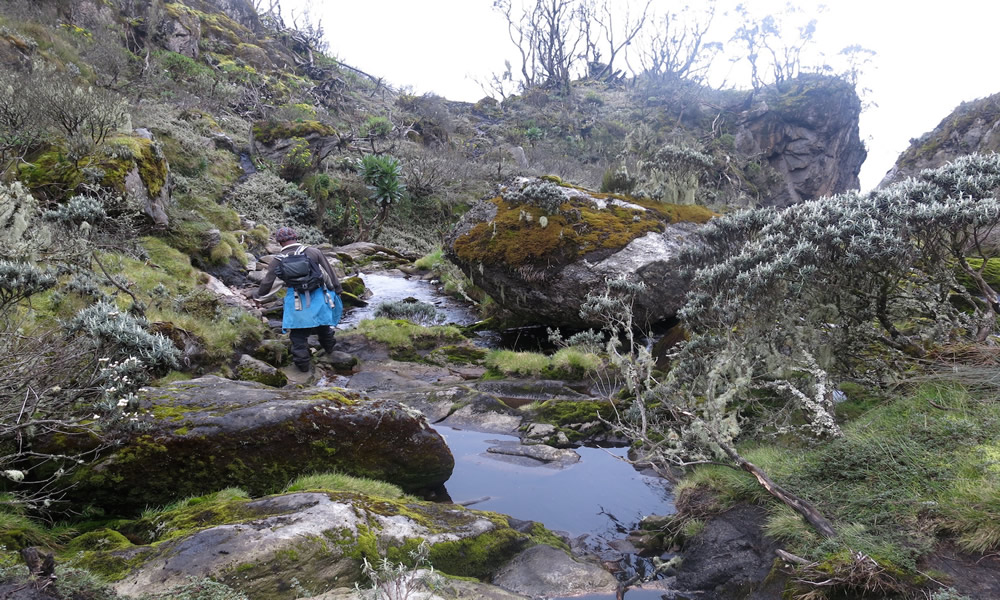
Lake Mahoma does not announce itself. It reveals itself, gradually, through two days of forest walking so rich in sensory detail that the destination almost feels secondary to the journey. The Mahoma Loop Trail enters the Rwenzori through its most accessible and most biologically abundant zone: the montane forest belt, where giant Podocarpus trees rise thirty meters above the trail, where the sound of the Mahoma River accompanies you for hours, and where the forest canopy hosts one of the most extraordinary bird communities in Africa.
Then, on the second morning, the forest opens. A rim of rock and heather appears above. And below it, perfectly still, catching the equatorial sky in its surface, lies Lake Mahoma, a volcanic crater lake of deep, clear water at 2,068 meters, fringed with giant heather and montane forest, home to otters, waterbirds, and the particular stillness that only very remote water bodies possess. This is one of Uganda’s least visited and most beautiful high-altitude lakes, and for the trekkers who reach it, it represents something that the word “destination” barely captures. It is a moment of arrival in the fullest sense.
Lake Mahoma is one of only three crater lakes inside the Rwenzori Mountains National Park. Formed by ancient volcanic activity and sustained by the mountain’s extraordinary rainfall, it sits within a UNESCO World Heritage Site that contains more endemic plant species per square kilometer than almost anywhere else on earth. |
Why Choose the Lake Mahoma Trek?
The Rwenzori Mountains are most commonly associated with their high-altitude crown, the glaciated peaks around Margherita at 5,109 meters, and there is no question that the Central Circuit Trek to the summit is one of Africa’s most remarkable expedition experiences. But not every traveler has the time, fitness, or inclination for a 9-day technical mountain expedition. The Lake Mahoma Trek exists for everyone else, and it delivers a Rwenzori experience that is, in many respects, richer in wildlife and forest immersion than its higher-altitude counterpart.
This trek is the ideal entry point for first-time Rwenzori visitors: long enough to genuinely penetrate the mountain’s forest ecosystem, short enough to fit within a three-day Uganda safari window. It is the right choice for travelers combining the Rwenzori with gorilla trekking in Bwindi Impenetrable National Park, chimpanzee tracking in Kibale Forest, or a game drive in Queen Elizabeth National Park. It is also the trek our guides recommend most often to families with older children, birders seeking the Rwenzori’s extraordinary endemic avifauna, and photographers for whom forest light and wildlife are the primary motivation.
Below, a route comparison between the two main Rwenzori options so you can make the choice that fits your journey.
Mahoma Loop Trail vs Central Circuit Trail, Route Comparison
Feature | Mahoma Loop (This Trek) | Central Circuit / Margherita |
Duration | 3 Days | 9 Days |
Summit / Goal | Lake Mahoma (2,068m) | Margherita Peak (5,109m) |
Difficulty | Moderate — beginner-friendly | Very Challenging, technical |
Glacier Travel | No | Yes, crampons required |
Wildlife Focus | Exceptional- forest & birds | Good, mainly lower forest |
Accommodation | Forest huts | UWA mountain huts |
Best For | Beginners, birders, families | Serious trekkers & climbers |
Price Range | Accessible | Premium expedition |
Combines Well With | Queen Elizabeth, Bwindi, Kibale | Bwindi, Kibale |
Itinerary at a Glance
Day | Summary |
Day 1 | Arrival at Entebbe / Kampala → Private transfer to Kasese (5–6 hrs) → Evening briefing → Overnight Kasese |
Day 2 | Kasese → Nyakalengija Gate (1,646m) → Trek to Sine Hut (1,890m) → 3–4 hrs through montane forest |
Day 3 | Sine Hut → Lake Mahoma (2,068m) → Swim / explore → Return descent to Nyakalengija → Transfer to Kasese |
Day 4 | Kasese → Private transfer to Kampala / Entebbe → End of trek |
Note: This itinerary is also available as a 2-day option (overnight at Sine Hut, Lake Mahoma day visit, and return) for trekkers with tighter schedules. Contact us to discuss the version that fits your Uganda itinerary. |
Detailed 3-Day Rwenzori Trek To Lake Mahoma Trail Itinerary
Day 1: Arrival — Transfer to Kasese — Pre-Trek Briefing
The expedition begins with a private pick-up from Entebbe International Airport or your Kampala hotel, where a Rwenzori Trekking Expeditions representative greets you and settles you into your dedicated 4WD vehicle for the journey west. The road to Kasese, approximately 370 kilometers from Kampala, is a quiet pleasure in itself: equatorial farmland, the expansive wetland system of the Katonga River, the papyrus swamps of western Uganda, and eventually the broad plains of the Kasese basin with the dark, cloud-draped wall of the Rwenzori suddenly immense and unmistakable ahead.
Kasese is the gateway town to the Rwenzori Mountains, a compact, unhurried town with copper-mining heritage and a frontier-post energy that suits the mountains rising behind it. Your guesthouse for the night is comfortable, with en-suite rooms, reliable hot water, and a kitchen that produces better food than the surroundings might suggest.
The pre-trek briefing takes place over dinner: your lead guide presents the route, discusses equipment, explains the Rwenzori’s distinctive ecological character, and answers every question you bring to the table. Gear is checked tonight. Nothing is left for the trailhead. Boots laced, layers layered, packs weighed, and an early night that feels, in retrospect, like the last quiet breath before the forest takes you.
Day 2: Nyakalengija Gate (1,646m) → Sine Hut (1,890m) — Into the Forest
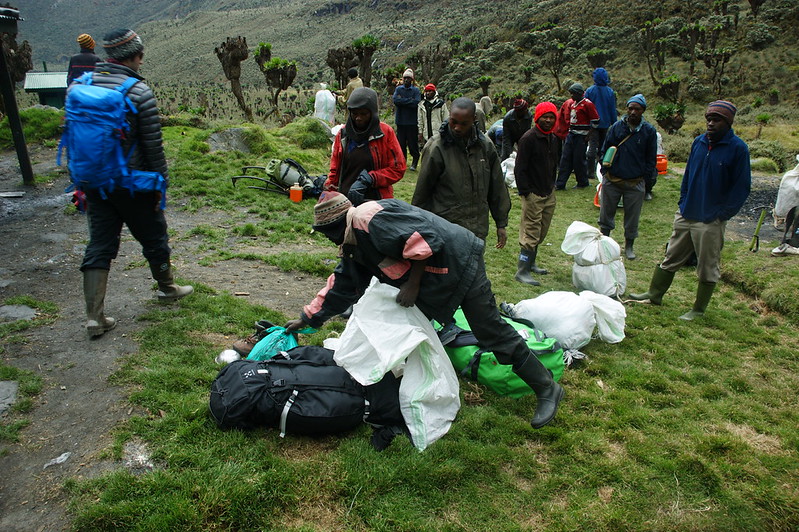
After breakfast and the short drive to Nyakalengija, the official entry point to Rwenzori Mountains National Park, you complete the Uganda Wildlife Authority permit formalities while your porter team assembles with the quiet competence of people who have been loading for these mountains since they were children. The Bakonjo porters of the Rwenzori are not just carriers, but also mountain interpreters. They are mountain interpreters, and the bond that forms between trekker and porter team over even three days on the Mahoma Loop is one of the experiences most commonly cited in our post-trek reviews.
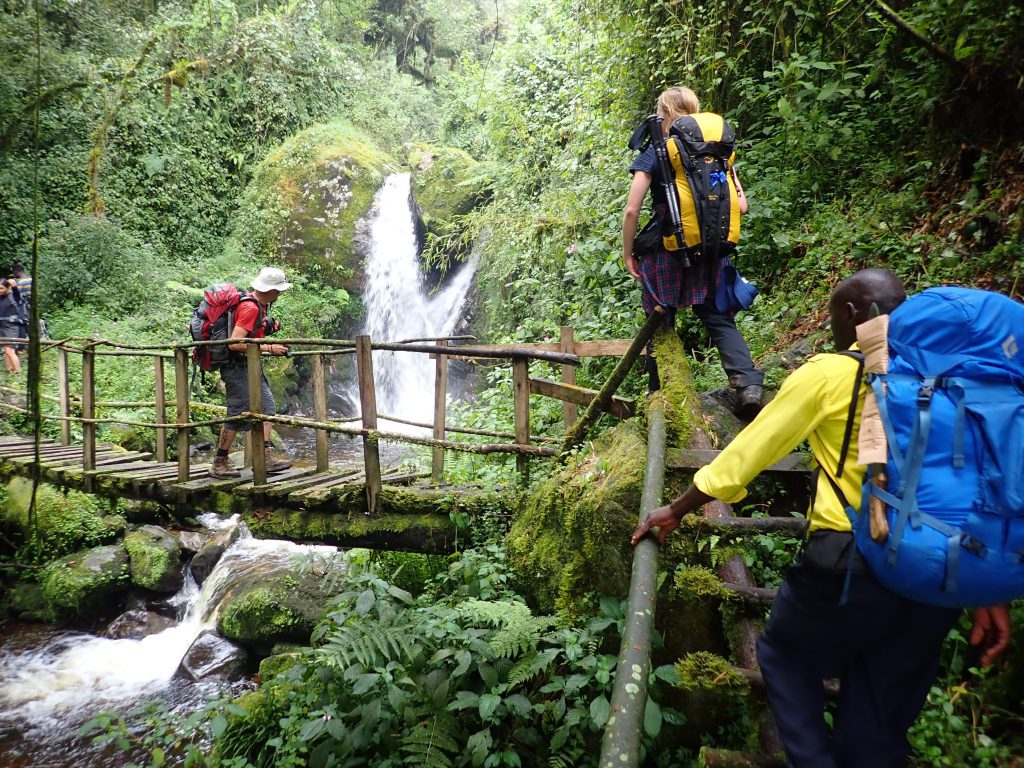
The trail enters the forest immediately and completely. Within the first hour, the Nyakalengija road is gone, the sound of the Mahoma River is constant, and the world has contracted to a green cathedral of Podocarpus, Prunus africana, and ancient Strombosia trees trailing moss and epiphytic ferns. The trail climbs steadily but never brutally; this is montane forest trekking at its most rewarding, the gradient consistent enough to feel purposeful without ever tipping into exhausting.
Birdlife on this section is extraordinary. The African green broadbill, an Albertine Rift endemic, haunts the mid-canopy. Rwenzori turacos flash copper-red between the branches. Handsome spurfowl call from the undergrowth. Your guide knows every call and every perch, and the early morning on this section of trail is, for birdwatchers, as productive as any birding experience in Uganda.
Sine Hut arrives in the mid-afternoon: a solid, weatherproof structure set in a forest clearing with bunk beds, a communal dining space, and the sound of the river as a permanent soundtrack. Your camp cook has arrived ahead of the main party, and dinner is hot, plentiful, and served with the particular satisfaction of food earned by six hours of forest walking. The evening, with mist settling into the forest canopy and the temperature dropping pleasantly, belongs to your guide’s storytelling, the history of the Bakonjo, the ecology of the Rwenzori, and the wildlife you may encounter tomorrow.
Day 3: Sine Hut → Lake Mahoma (2,068m) → Descent → Trailhead
The morning light in the Rwenzori forest arrives in stages: a gradual brightening through mist, then the first shafts of equatorial sun through the canopy, then the full, warm arrival of a mountain morning. Breakfast is taken at Sine Hut before the trail continues upward toward the lake, the forest character subtly shifting as altitude increases: the podocarpus giving way to giant heather, the undergrowth becoming more bamboo-rich, and the air cooler and clearer.
Lake Mahoma announces itself with a change in light and a sudden openness in the canopy. The forest rim parts, and there it is: a crater lake of extraordinary stillness, its surface catching the sky and reflecting the ring of heather and forest that surrounds it. The lake sits in what was once a volcanic crater, now long cold, filled with clear mountain water, and home to clawless otter, African fish eagles, and a range of waterbirds that your guide identifies with quiet expertise.
“Lake Mahoma is the kind of place that stops conversation. People stand at the shore and don’t say anything for a while. That’s the measure of a place.” — Senior Guide, Rwenzori Trekking Expeditions |
Time at the lake is unscheduled and generous. Those who wish to swim will find that the cold, utterly clear water is well worth it and that the experience resets something at a cellular level. Photographers discover compositions in every direction. Birdwatchers scan the heather margins. Others simply sit, which is often the most productive thing one can do at a lake in a UNESCO World Heritage Site at 2,068 meters above sea level.
The descent that follows is the long breath out of the expedition: the same forest re-traversed in reverse, familiar now, but different in the afternoon light and in the altered perspective of someone returning from somewhere meaningful. Nyakalengija is reached by late afternoon. Your dedicated vehicle is waiting. Cold drinks are in the cooler. The Rwenzori stands behind you, cloud-wrapped and silent, as your driver heads east toward Kasese and a final night before the return journey to Kampala.
About Lake Mahoma
Lake Mahoma is one of three crater lakes within the Rwenzori Mountains National Park and one of the least visited high-altitude lakes in East Africa. Formed by ancient volcanic activity within the Rwenzori basement complex, it occupies a circular depression at 2,068 meters on the southern slopes of the range, accessible only on foot via the Mahoma Loop Trail. Its waters are fed by the mountain’s prodigious rainfall; the Rwenzori receives in excess of 2,500 mm of precipitation per year, and they drain into the Mahoma River, which flows south toward the Kazinga Channel and eventually into Lake George.
The lake’s catchment forest is among the most intact montane forest ecosystems in Uganda, protected within the boundaries of the national park and managed under the conservation guidelines of the Uganda Wildlife Authority. The forest surrounding the lake harbors an extraordinary density of Albertine Rift endemic species, birds, plants, and small mammals found nowhere else on earth, making the Mahoma basin one of the most biologically significant areas in the Rwenzori Range.
For trekkers, Lake Mahoma is simply beautiful: a still, clear body of mountain water in a forest setting of surpassing tranquility. But its significance extends well beyond aesthetics. It is a functional ecosystem, a water tower, a wildlife sanctuary, and a living argument for the conservation of mountain forests in the face of climate change. The glaciers of the upper Rwenzori are retreating at pace. Lake Mahoma’s waters, fed by rainfall and forest moisture rather than glacial melt, will outlast them and remain, we hope, exactly as they are today.
How Difficult Is the Lake Mahoma Trek?
The Mahoma Loop Trail is classified as moderate and is the most accessible multi-day trek within the Rwenzori Mountains National Park. It is the trek our guides most frequently recommend to trekkers who are reasonably fit but new to mountain hiking, to families with older children (14+), and to travelers whose primary interest is wildlife and forest immersion rather than technical altitude challenges.
That said, the Rwenzori forest is not a park trail. The path is genuine mountain terrain: root-crossed, occasionally muddy, with stream crossings and some steeper sections in the upper approach to the lake. Gaiters are essential. Trekking poles are recommended. Waterproof boots that have been properly broken in are non-negotiable. The daily trekking time of three to five hours is manageable for most moderately active adults, with the understanding that forest terrain moves more slowly than open hills.
Altitude sickness is not a significant concern on the Mahoma Loop; the maximum elevation of 2,068 meters is below the threshold at which AMS typically becomes an issue for well-hydrated trekkers. Those with specific cardiovascular concerns should consult their physician before any mountain trek, but the Mahoma Loop presents no extraordinary altitude risk for healthy adults.
Category | Assessment |
Overall Difficulty | Moderate—accessible to fit beginners |
Daily Trekking | 3–5 hours per day |
Max Elevation | 2,068 m (Lake Mahoma) |
Terrain | Forest path — roots, mud, stream crossings |
Altitude Risk | Low — no significant AMS risk |
Technical Sections | None — no glacier or roped sections |
Minimum Fitness | Moderate — regular walking or light exercise |
Recommended Age | 14+ for children; no upper age limit for fit adults |
Key Equipment | Waterproof boots, gaiters, poles, waterproofs |
Day-by-Day Altitude Profile
Day | Location | Altitude |
Day 1 | Kasese (overnight) | ~1,000m |
Day 2 | Nyakalengija Gate → Sine Hut | 1,646m → 1,890m |
Day 3 | Sine Hut → Lake Mahoma → Nyakalengija | 1,890m → 2,068m → 1,646m |
Day 4 | Kasese → Kampala / Entebbe | ~1,000m |
Wildlife and Birdlife Along the Trail
The Mahoma Loop Trail passes through some of the most biodiverse montane forest in Africa, and the wildlife encounters it delivers are the defining feature of this trek for many who complete it. The Rwenzori Mountains lie at the heart of the Albertine Rift, one of the world’s biodiversity hotspots, and the forest between Nyakalengija and Lake Mahoma harbors a concentration of endemic species found nowhere else on earth.
Primates
The forest is home to two species of colobus monkey, the black-and-white colobus and the red-tailed monkey, both of which are regularly encountered at close range on the lower forest sections of the trail. Olive baboon troops cross the path at Nyakalengija with complete indifference to trekkers. The l’Hoest’s monkey, a rare Albertine Rift endemic, is occasionally sighted in the denser mid-forest sections.
Birds
The Rwenzori’s avifauna is the reason many visitors come to the mountain specifically rather than to Uganda’s better-known parks. The Mahoma Loop is one of the finest birding trails in the range, offering reliable sightings of the Rwenzori turaco, Rwenzori nightjar, African green broadbill, handsome spurfowl, African hill babbler, and a suite of sunbird species, including the golden-winged, Rwenzori double-collared, and purple-breasted sunbird. The lake itself is patrolled by African fish eagles and various herons. For birdwatchers, this trail is a genuine pilgrimage.
Mammals and Other Wildlife
Forest elephant tracks are occasionally found on the lower trail. Clawless otters inhabit the lake and river system and are sometimes seen at dawn. Giant forest hog signs are present throughout the forest, though the animals themselves are rarely seen. The forest is also home to the Rwenzori duiker, Rwenzori otter shrew, and various Albertine Rift-endemic rodents. Herpetologists will find the three-horned Rwenzori chameleon, a spectacular prehistoric-looking species, on vegetation along the upper forest trail.
Best Time to Hike Lake Mahoma in the Rwenzori Mountains
The Rwenzori Mountains receive rainfall throughout the year; this is a fact of the range’s geography and one of the qualities that makes it so extraordinary, so biodiverse, and so memorably atmospheric. The phrase “best time” in the Rwenzori context means relative reduction in rainfall rather than reliable dry conditions, and experienced trekkers often embrace the mountain’s mist and rain as integral to the experience rather than obstacles to it.
Primary Season: June to August
The East African long dry season, June through August, offers the most consistently navigable trail conditions and the clearest views of the lake. Rainfall decreases, trail mud is less severe, and the forest in this season has a golden-green luminosity that makes photography particularly rewarding. This is the most popular window for the Mahoma Loop, and places on guided departures fill several months in advance.
Secondary Season: December to February
Uganda’s short dry season provides a second excellent window, with trail conditions only marginally less favorable than the primary season. December and January in particular offer a combination of drier trails and the spectacular forest flowering that follows the short rains, making this a beautiful and underrated time to trek. January is also an excellent month for birdwatching, as many species are in breeding plumage.
Shoulder Seasons: March–May and September–November
The wetter shoulder seasons are not without their advocates. Trail mud is at its most characteristically Rwenzori deep, boot-swallowing, and entirely part of the mountain’s personality. Waterfalls are at full volume. The forest atmosphere is at its most primordial. Birdlife is often more active after rain. Trekker numbers are lower, and the mountain has a solitude in these months that the popular seasons cannot match. We guide year-round, with full disclosure of conditions at any time of booking.
How to Get to the Rwenzori Mountains
The Rwenzori Mountains National Park lies in western Uganda, approximately 370 kilometers from Kampala and 420 kilometers from Entebbe. The trek begins at Nyakalengija Gate, a short drive from the town of Kasese, which serves as the logistical base for all Rwenzori expeditions.
By air, the nearest international gateway is Entebbe International Airport (EBB), served by Kenya Airways, Ethiopian Airlines, Turkish Airlines, Qatar Airways, and RwandAir, among others. Aerolink Uganda operates domestic flights between Entebbe and Kasese Airport (approximately one hour), subject to schedule availability. All airport transfers, Entebbe to Kasese and return, are privately arranged by Rwenzori Trekking Expeditions in comfortable 4WD vehicles with experienced English-speaking drivers.
By road, the drive from Kampala or Entebbe to Kasese takes five to six hours, passing through some of Uganda’s most scenic territory: the equatorial landscapes of the central plateau, the Katonga wetlands, and the broad western rift valley with the Rwenzori rising on the horizon. Stops for the equator crossing, fuel, and refreshments are standard on all road transfers.
Safari Includes
The Lake Mahoma Trek is offered as a fully inclusive expedition; the price you pay covers everything from the moment your representative greets you on arrival to the moment you are delivered back to Entebbe or your Kampala hotel. There are no hidden extras, no unexpected gate fees, and no logistical surprises on the mountain.
Category | What Is Covered |
Transfers | Private return transfers: Entebbe/Kampala ↔ Kasese ↔ Nyakalengija |
Park Fees & Permits | Uganda Wildlife Authority entry and trekking permits for all days |
Guide Services | Certified lead guide throughout; assistant guides per group size |
Porter Team | Full Bakonjo porter team for group/communal equipment |
Accommodation | Sine Hut & Mahoma Hut (trekking nights) + Kasese guesthouse (Nights 1 & 3) |
Meals | Full board: breakfast, lunch, dinner and hot drinks on all trekking days |
Emergency Equipment | First aid kit, pulse oximeter, emergency communication |
Pre-Trek Briefing | Equipment check, route brief, and park orientation in Kasese |
Completion Certificate | Lake Mahoma Trek completion certificate |
Safari Excludes
Category | Notes |
International Flights | Arrange independently via your preferred carrier |
Uganda Visa | USD 50 on arrival or in advance at evisa. go.ug |
Travel Insurance | Required — must include medical evacuation cover |
Personal Porter | Available at additional cost — recommended for comfort |
Gratuities | For guides and porters—voluntary but culturally important |
Alcoholic Beverages | Not supplied at mountain huts |
Personal Gear | Your personal trekking equipment (see packing section) |
Pre/Post Accommodation | Hotel nights in Kampala or Entebbe before/after trek |
Safari Extensions | Gorilla trekking, game drives — arranged and quoted separately |
What to Pack for the Lake Mahoma Trek
The Rwenzori forest is wet. That sentence should guide every packing decision you make. The mountain generates its own weather; humidity is high, rain can arrive at any hour, and trail mud is a constant companion at any season. The reward for dressing correctly is extraordinary: waterproofed and layered, you move through the forest in complete comfort, noticing the wildlife and the light rather than your saturated socks.
Item | Notes |
Waterproof Boots | Ankle-support, broken in before the trek, non-negotiable |
Gaiters | Knee length strongly preferred for Rwenzori mud |
Waterproof Jacket | Full-coverage outer shell — Gore-Tex or equivalent |
Waterproof Trousers | For wetter conditions and cold mornings |
Base Layer | Moisture-wicking thermal top |
Mid Layer | Fleece or light down jacket for hut evenings |
Trekking Poles | Adjustable — strongly recommended for forest terrain |
Day Pack | 25–35 litres for personal items and layers |
Dry Bags | To protect electronics and sleeping kit |
Sleeping Bag | Lightweight — temperatures at huts: 12°C–18°C |
Headlamp | With spare batteries |
Water Bottles | 1–2 litres; purification tablets as backup |
Insect Repellent | DEET-based—for lower forest sections |
Sunscreen | SPF 30+ even in overcast conditions |
Binoculars | Essential for birdwatching—8×42 recommended |
Camera | A waterproof case or dry bag strongly recommended |
Personal First Aid | Blister care, personal medications, antihistamine |