5-Day Mount Speke Trek: Rwenzori Trekking Expeditions offers a 5-day Mount Speke Rwenzori trek to Vittorio Emanuelle Peak (4,890 m) via the Central Circuit trail, with expert guides. This 5-day Mount Speke trek is a challenging and technical expedition in Uganda’s Rwenzori Mountains, aiming to reach the summit of Vittorio Emanuele Peak (4,890 m). Beginning your journey at Nyakalengija, located 22 km from Kasese, you will navigate through five distinct ecological zones, necessitating the use of ice axes, harnesses, and the assistance of expert guides.
There are mountains you visit, and there are mountains that quietly recalibrate what you believed a mountain could demand of you. Mount Speke belongs unmistakably to the second category. Rising to 4,890 meters on the eastern flank of the Bujuku Valley, directly across from Mount Baker and beneath the towering western wall of Mount Stanley, its highest point, Vittorio Emanuele Peak, receives only a fraction of the trekking traffic that Margherita Peak sees each year. That relative obscurity is not a limitation of this itinerary; it is the very thing that makes it exceptional. You will walk the same Central Circuit Trail used by expeditions bound for Uganda’s highest summit, yet share it with almost no one, before turning off toward a mountain that has quietly named itself after an Italian king and asked, in return, for genuine mountaineering resolve.
Quick Facts About 5-day Mount Speke Trek via the Central Circuit
Duration | 5 days / 4 nights on the mountain |
Route | Central Circuit Trail: Nyabitaba Hut, John Matte Hut, Bujuku Hut, Vittorio Emanuele Peak |
Summit | Vittorio Emanuele Peak at 4,890 metres on Mount Speke, Africa’s fourth-highest summit |
Starting Point | Nyakalengija Trailhead, roughly 22km from Kasese, western Uganda |
Group Size | Private departures for solo trekkers, couples, families (experienced hikers 16+) and groups up to 8 |
Difficulty | Strenuous to technically demanding, a genuine mountaineering summit day with fixed ropes |
Best Season | December to February and June to August offer the most reliable summit conditions |
Guiding | Dedicated UWA-licensed lead guide, full porter team and cook throughout |
Technical Gear | Ropes, harness, ice axe and a helmet are provided as part of your summit package |
Price | Bespoke quotation, enquire for current rates and private departure dates |
This 5-day Mount Speke trek to Vittorio Emmanuelle Peak itinerary begins at the historic Nyakalengija Trailhead and climbs in three deliberate stages, through Nyabitaba Hut and John Matte Hut, to the high alpine camp at Bujuku, set beside a still glacial lake beneath three of the range’s towering massifs. From there, a pre-dawn summit push carries you up through Groundsel Gully, a narrow, rope-protected couloir named for the ancient giant groundsels that crowd its lower reaches, to a summit ridge where Mount Stanley’s remaining glaciers fill the western sky and Lake Bujuku glints, a dark mirror, nine hundred meters below. It is five days, four nights, and one summit that asks for everything you have and gives back a view hardly any people on this earth have ever seen.
Rwenzori Trekking Expeditions‘ 5-day Mount Speke Rwenzori Trekking itinerary is for the trekker who has already proven themselves on multi-day alpine terrain and wants a genuine, technically engaging African summit rather than another scenic walk; for the couple seeking a shared achievement that will outlast any ordinary honeymoon story; and for the small group of experienced friends who want a private departure and a guide who has climbed this specific gully more times than they can count. Families are welcome from age sixteen, with a firm, honest hiking background behind them. The mountain sets its terms here, and they are not negotiable; however, how you are prepared, equipped, and guided to meet them is certainly negotiable.
Itinerary at a Glance
Day 1 | Nyakalengija Trailhead to Nyabitaba Hut (2,651m), climbing through the Mubuku Valley’s dense montane forest |
Day 2 | Nyabitaba Hut to John Matte Hut (3,380m), through bamboo corridors and into the open heather zone |
Day 3 | John Matte Hut to Bujuku Hut (3,962m) via the Bigo Bog and the shores of Lake Bujuku |
Day 4 | Summit day — Bujuku Hut to Vittorio Emanuele Peak (4,890m) via Groundsel Gully, then descend to John Matte Hut |
Day 5 | John Matte Hut via Nyabitaba Hut back to the Nyakalengija Trailhead and private transfer to Kasese |
About Mount Speke: Africa’s Fourth-Highest Summit
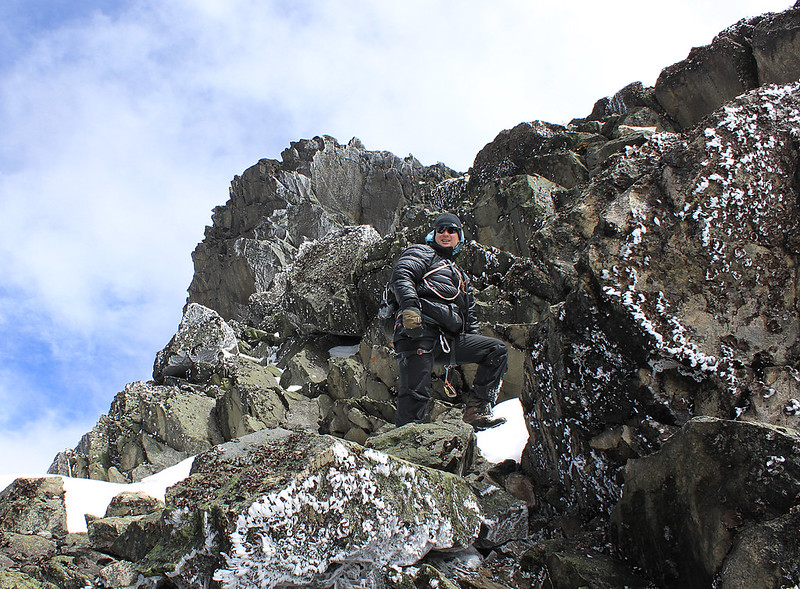 Mount Speke is the second-highest massif within Rwenzori Mountains National Park, surpassed only by Mount Stanley’s Margherita Peak at 5,109 meters. It is, in truth, a multi-summited mountain rather than a single point, carrying four distinct high points along its ridge: Vittorio Emanuele Peak at 4,890 meters, the objective of this itinerary and named for the Italian king by the Duke of Abruzzi’s pioneering 1906 expedition; Ensonga at 4,865 meters; Johnston at 4,834 meters; and the lower western summit of Trident at 4,572 meters. The mountain sits on the eastern side of the Bujuku Valley, facing Mount Baker directly across the water and watched over by the immense western face of Mount Stanley, a position that provides its upper slopes some of the most complete panoramic views available anywhere in the range.
Like every peak in this range, Speke carries the visible imprint of a warming climate. The glaciers that once wrapped its upper ridges in continuous ice have retreated dramatically over the past century, and what remains today is patchier, thinner snow and ice cover that nonetheless still turns the final approach into a genuine cold-weather mountaineering proposition, particularly in the couloir below the summit ridge. Climbing Mount Speke today is, in a real sense, climbing a mountain in visible transition, and every trekker who reaches Vittorio Emanuele Peak does so having witnessed a landscape that will look measurably different within a generation.
DAY 1: Nyakalengija Trailhead to Nyabitaba Hut
Elevation: 1,646m – 2,651m | Distance: 10km | Walking time: 5–6 hours | Zone: Afro-montane forest
Your Mount Speke expedition begins at the Uganda Wildlife Authority ranger post at Nyakalengija, a short private transfer from Kasese, where your dedicated guide leads a final briefing over tea, covering the days ahead, the summit protocol, and the technical equipment that comes into play on day four. Permits are checked and stamped, porters are loaded, and by mid-morning the trail drops away into the Mubuku River Valley, crossing a series of footbridges into dense Afro-montane forest that immediately sets the tone for the days ahead, with towering podocarpus and symphonia trees, every branch furred in moss and lichen, and the canopy alive with the calls of Rwenzori turaco and the occasional distant crash of a blue monkey troop overhead.
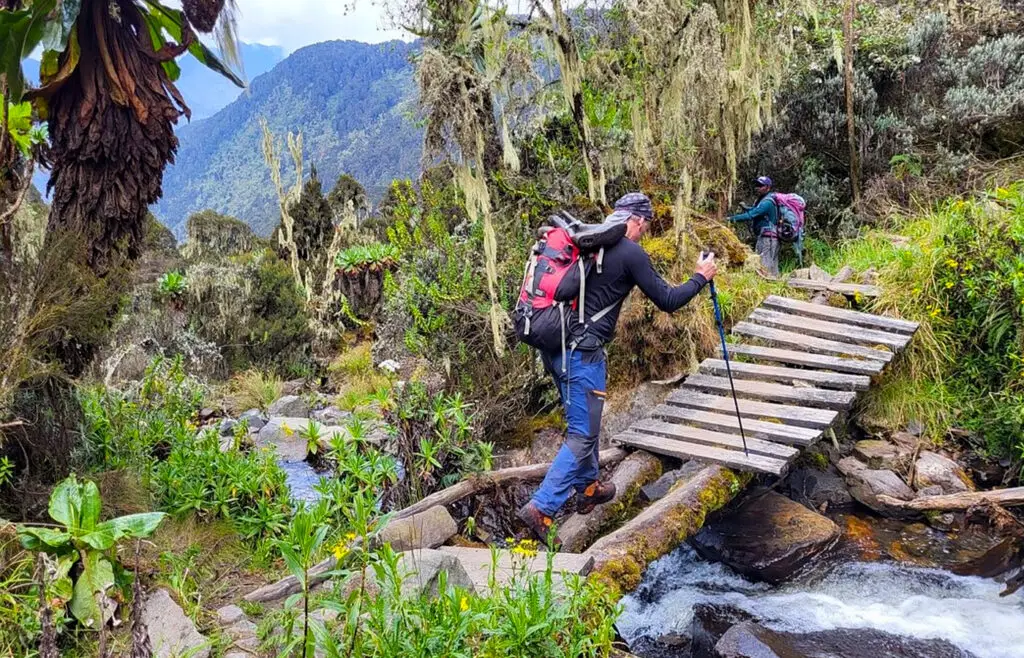
A wooden bridge carries you across the Mubuku itself, cold and fast over dark volcanic rock, before the trail begins its steady climb up the Nyabitaba ridge, where the forest grows wetter and quieter with each switchback. Nyabitaba Hut appears on a broad forested shoulder as the ridge levels out, with the first far-off silhouette of Mount Stanley visible on a clear afternoon from the short walk to the nearby Porter’s Rest viewpoint. Dinner is taken by lamplight, your guide talking through tomorrow’s push into the bamboo, and the forest’s night sounds settle in around a first, satisfying camp.
DAY 2: Nyabitaba Hut to John Matte Hut
Elevation: 2,651m – 3,380m | Distance: 11km | Walking time: 6–7 hours | Zone: Bamboo & heather
This is the longest day of the expedition by distance, and the Rwenzori’s character begins to transform from forest to something considerably stranger. Leaving Nyabitaba, the trail descends briefly to cross the Bujuku River before climbing steadily into bamboo forest, where dense stands of giant mountain bamboo close overhead and mute sound in a way that feels almost deliberate, the narrow path keeping the group in single file for long stretches. Rwenzori turacos are especially active here, their calls announcing them well before a flash of crimson wings confirms the sighting. Above the bamboo, the heather zone opens gradually, with isolated stands giving way to full heather forest, ancient trunks draped in sphagnum moss and old man’s beard lichen, until the true forest has retreated entirely and the first proper views of Mount Stanley’s face open from the ridge on a clear day. John Matte Hut sits on a broad, dramatically exposed plateau in the heather zone, and evenings here bring a genuinely spectacular sunset panorama over the valley. along with the first honest signs, for some, that altitude is now a real consideration. Your guide checks in carefully at this camp, encouraging steady hydration and an early night.
DAY 3: John Matte Hut to Bujuku Hut via the Bigo Bog
Elevation: 3,380m – 3,962m | Distance: 5.5km | Walking time: 4–5 hours | Zone: Afro-alpine bog & Lake Bujuku
Short in distance, this leg is arguably the most visually astonishing day of the entire expedition. The trail descends briefly from John Matte before crossing the Bujuku River and entering the Lower Bigo Bog, the range’s most photographed and most surreal landscape feature, a high-altitude wetland crossed via boardwalk sections and, in places, simply through ankle- or knee-deep mud, your guide directing footing with the ease of long familiarity while porters cross the same ground in gumboots with an unhurried, practiced grace. Giant lobelias rise from the bog in silver spires two to three meters tall, ancient plants shaped by thousands of years of equatorial mountain conditions into forms with no true parallel anywhere else on the planet, and giant groundsels begin to appear in dense colonies as the trail climbs beyond the bog’s edge. The path arrives at Lake Bujuku, a still, glassy alpine lake set in a glacially carved basin with Mount Baker rising to the south and Mount Stanley’s walls looming to the west, one of the most photographed views in the entire range, its surface a near-perfect mirror on calm mornings. Bujuku Hut sits just above the lake on a grassy rise, the air noticeably thin and the nights genuinely cold, with temperatures regularly approaching freezing or below. This day is the evening of the full summit briefing: equipment checks, the route through Groundsel Gully, expected timings, and turnaround protocol, all talked through carefully before an early, deliberate night.
DAY 4: Summit Day to Bujuku Hut to Vittorio Emanuele Peak, Descent to John Matte Hut
Elevation: 3,962m – 4,890m – 3,380m | Walking time: 9–11 hours | Zone: Technical alpine, Groundsel Gully, summit ridge
The wake-up call comes at three or four in the morning, and a hot breakfast is taken by headlamp while your guide runs a final equipment check: harness fit, ice axe grip, headlamp batteries, and emergency whistle. You leave Bujuku in full darkness, the path above the lake picked out by headlamp alone, the pre-dawn cold at nearly 4,000 meters biting in a way that focuses the mind completely on the task ahead.
The route climbs steeply from camp through the afro-alpine zone, giant groundsels standing in silhouette against a sky just beginning to lighten, before entering Groundsel Gully itself, a narrow, rope-protected couloir where your guide clips you in and walks you through the fundamentals: three points of contact at all times, the ice axe for balance, and steady and unhurried upward movement. The gully is genuinely exposed, though the rock underfoot is generally sound, and progress here is measured in careful meters rather than the pace you have kept on the trail below. As the sky lightens fully behind you, the summit ridge of Vittorio Emanuele Peak comes into view above the gully’s exit, a final steep but manageable push with the rope’s continued support. The summit itself, at 4,890 meters, arrives in full equatorial dawn light, Mount Stanley’s walls and remnant glacier filling the western sky, Lake Bujuku a dark mirror nine hundred meters below to the east, the plains of Uganda stretching south to the horizon, and the foothills of the Democratic Republic of Congo fading north. Few words are exchanged up here; most trekkers simply stand in the wind and the light for a few minutes before the descent, reversing the ropework through the gully, retracing the alpine slopes back to Bujuku to collect gear, and continuing on down to John Matte Hut for a well-earned, unhurried dinner.
DAY 5: John Matte Hut to Nyakalengija Trailhead—Departure
Elevation: 3,380m → 1,646m | Distance: 15km | Walking time: 6–7 hours | Zone: Return through heather, bamboo & forest
The final day is a long, sustained descent, retracing the heather zone, the bamboo corridor, and the lower montane forest that opened the expedition four days earlier, though everything feels different walked with a summit now behind rather than ahead. The mood among the group tends toward quiet reflection rather than celebration in the early hours, gradually lightening as the air thickens and the forest’s warmth and birdsong return in full. The bamboo zone on the way down often produces better wildlife sightings than the ascent, with turacos, sunbirds, and the occasional glimpse of a duiker moving through the undergrowth. A brief rest and packed lunch at Nyabitaba precedes the final push back to the Mubuku River bridge and the Nyakalengija ranger station, where completion certificates are issued and your guide and porter team are formally thanked for four days of quiet, expert care. Your private vehicle is waiting for the short transfer back into Kasese, where a hot shower, a proper bed, and a well-earned dinner close out one of the more demanding and quietly extraordinary weeks available to any traveler in East Africa.
Elevation, Distance & Difficulty Profile
The table below sets out each day’s technical demands precisely so that you and your guide can plan training and pacing with full knowledge of what lies ahead.
Day | Route | Elevation | Distance | Hiking Time | Difficulty |
1 | Nyakalengija – Nyabitaba Hut | 1,646–2,651m | 10 km | 5–6 hrs | Moderate |
2 | Nyabitaba – John Matte Hut | 2,651–3,380m | 11 km | 6–7 hrs | Strenuous |
3 | John Matte – Bujuku Hut | 3,380–3,962m | 5.5 km | 4–5 hrs | Strenuous |
4 | Bujuku – Speke Summit – John Matte | 3,962–4,890–3,380 m | ~16 km | 9–11 hrs | Very Strenuous (technical) |
5 | John Matte – Nyakalengija | 3,380–1,646m | 15 km | 6–7 hrs | Moderate–Strenuous |
Total distance across the expedition runs to approximately 51.5 kilometers, with roughly 3,250 meters of cumulative ascent and descent.
What’s Included
Every element of this itinerary, from the moment your private vehicle collects you in Kasese to when it returns you there, is arranged so that no logistical decision is left in your hands on the mountain.
- 4 nights accommodation in mountain huts along the Central Circuit Trail, as per itinerary
- All park entry and trekking permit fees for Rwenzori Mountains National Park
- Dedicated UWA-licensed lead guide throughout the trek, including the technical summit day
- Full porter and cook team, tents, cooking equipment and camp furniture
- All meals on the mountain from Day 1 lunch to Day 5 lunch, prepared fresh at each camp
- Technical summit equipment: rope, harness, ice axe and helmet for the Groundsel Gully ascent
- Private road transfers between Kasese and the Nyakalengija Trailhead
- Pre-trek briefing, equipment check, and summit completion certificate
What’s Excluded
A short list of items remain outside the package, generally by client preference or personal requirement rather than by necessity.
- International and domestic flights to and from Uganda
- Uganda visa fees and travel/medical/evacuation insurance
- Accommodation in Kasese or Kampala before and after the trek
- Personal hiking clothing and cold-weather gear not listed as rental items
- Tips and gratuities for guides, porters and cooks
- Alcoholic and bottled beverages beyond standard camp drinking water
Why the 5-Day Mount Speke Trek Is Worth Choosing
The Rwenzori already receive far fewer visitors annually than Kilimanjaro or Mount Kenya, and of the trekkers who do come, the overwhelming majority set their sights on Margherita Peak. Mount Speke, by comparison, is attempted by only a small handful of expeditions each year, which means that choosing this itinerary is choosing genuine solitude on a genuine high-altitude African summit, a trail that is unmistakably yours for the days you are on it, rather than one shared with a queue of other parties.
The second reason this trekking itinerary rewards serious consideration is its ecological completeness. In roughly two and a half days of ascent, the Central Circuit trail approach carries you through every one of the Rwenzori’s five major vegetation zones, a transition normally associated with traveling thousands of kilometers in latitude but compressed instead into the walls of a single mountain valley. By the time you reach Bujuku Hut on the third evening, you will have already passed through equatorial montane forest, dense bamboo corridors, the moss-draped heather zone, and the surreal giant lobelia fields of the Bigo Bog, a density of ecological transition that no other trekking itinerary in Uganda can match.
The third reason is the summit itself. Vittorio Emanuele Peak is not a walk-up in any sense of the term. The final approach from Bujuku, through the rope-protected Groundsel Gully, requires harness work, careful footwork on exposed rock and ice, and total concentration for several sustained hours. The reward, when it arrives, is one of the finest summit panoramas anywhere on the African continent: Mount Stanley’s western wall and glacier filling the sky, Lake Bujuku a dark mirror far below, and the foothills of the Democratic Republic of Congo fading into haze along the horizon. If you are weighing this expedition against a Margherita Peak climb, know that many serious mountaineers choose to attempt Speke first, precisely because of what it teaches about pacing, cold, and rope discipline before returning for the range’s higher summit.
Who Is This 5-day Rwenzori Trek to Mount Speke For?
This 5-day Mount Speke Trekking itinerary is built for experienced multi-day trekkers who have already completed at least one alpine route of four days or more above 3,500 meters and who are comfortable with genuinely technical terrain: steep scree, fixed ropes, ice axe use, and real exposure. It suits mountaineers using Mount Speke as deliberate preparation for a future Margherita Peak attempt just as well as it suits those for whom Vittorio Emanuele Peak is the standalone objective. Couples looking for a shared achievement unlike any conventional honeymoon adventure and small groups of experienced friends seeking a privately guided departure rather than a crowded fixed schedule both find this itinerary particularly rewarding. Families are welcome from age sixteen, provided every member carries a genuine background in multi-day hiking at altitude.
We say plainly that this is not the right first Rwenzori trek for a complete beginner, nor for a trekker without meaningful experience above 3,500 meters. The technical demands of the summit day are real, and we would rather direct an underprepared client toward one of our gentler itineraries, such as the 6-Day Trek to Hunwick’s Camp via the Kilembe Trail, than see them attempt Groundsel Gully without the fitness and prior experience this route genuinely requires.
How This 5-day Mount Speke Trek Compares to Our Other Rwenzori Routes
This 5-day Mount Speke trek itinerary uses the same Central Circuit trail approach as our Margherita Peak climbs but turns off toward Speke’s summit rather than continuing on to Mount Stanley, making it a faster, more technically concentrated expedition with no dedicated acclimatization rest day. Trekkers wanting a gentler altitude progression or the range’s higher summit should look instead to our 7-day Margherita Peak via the Central Circuit or our 9-day Full Central Circuit Trek. Mountaineers drawn to Speke specifically as preparation for a future summit push should note our 8-Day Triple Peaks itinerary, which combines Speke with ascents of Stanley and Baker in a single expedition. Those newer to high-altitude trekking, or seeking a non-technical introduction to the range, are better served by our 6-Day Trek to Hunwick’s Camp via the Kilembe Trail, and travelers wanting to fold this same climb into a wider Uganda journey should consider our 19-Day Uganda Grand Safari.
Every Vegetation Zone the Rwenzori Possesses
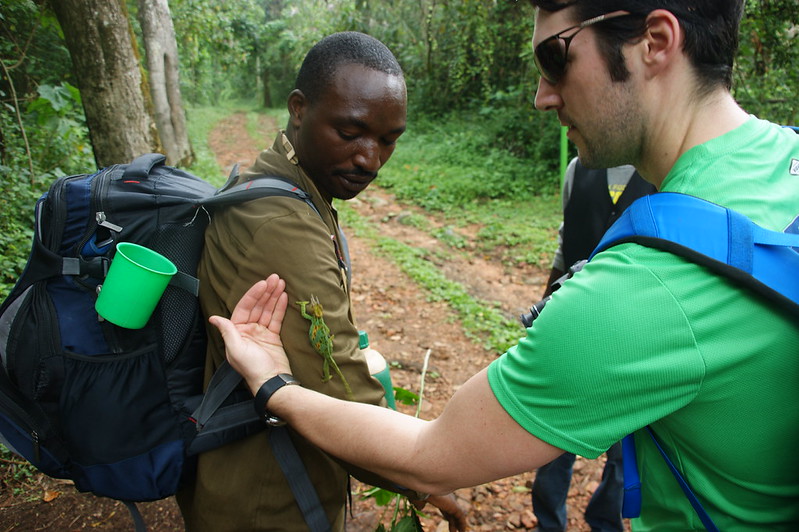
Few short expeditions anywhere in Africa pack so much ecological transition into so few days. The lower two days move through Afro-montane forest below roughly 2,800 meters, thick with podocarpus and symphonia trees and alive with blue monkeys, forest birds, and the endemic three-horned Rwenzori chameleon on low branches near the trail. Above this, dense bamboo corridors run from roughly 2,700 to 3,000 meters, giving way in turn to the heather zone between 3,000 and 3,800 meters, where towering tree heathers draped in moss and lichen dominate the landscape.
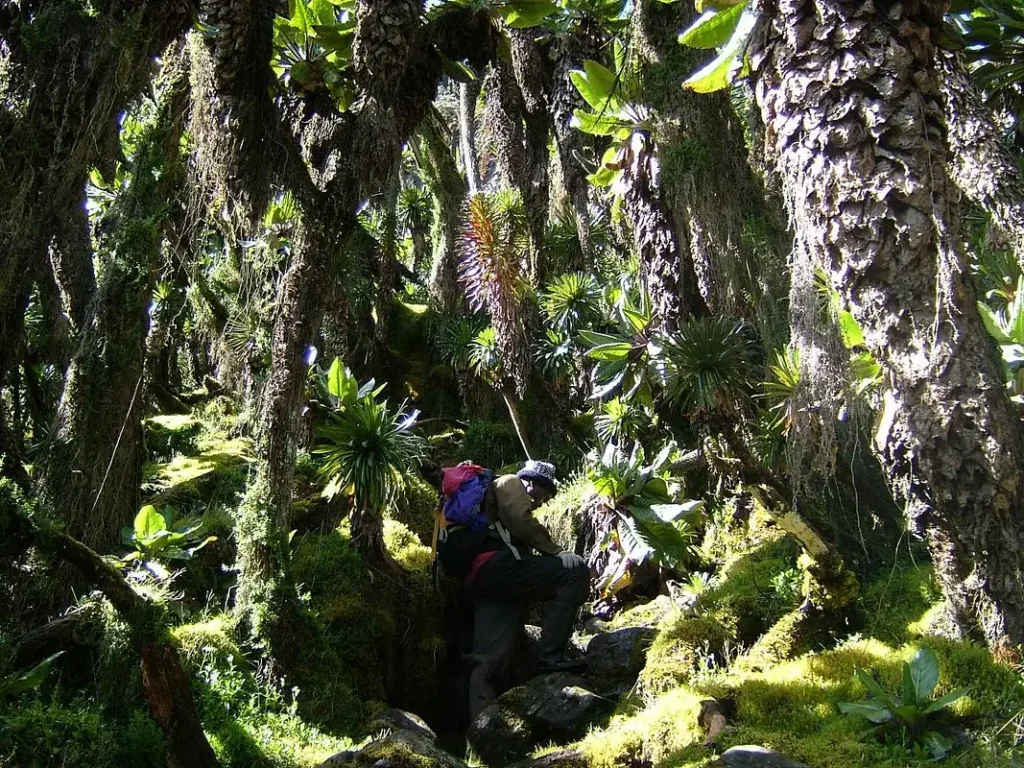
Above 3,400 meters, the Bigo Bog and its surroundings host the range’s most iconic flora, giant lobelias and giant groundsels, which are found at this precise combination of altitude and latitude nowhere else on Earth. The final approach to the summit crosses into the bare rock, scree, and remnant ice of the nival zone above roughly 4,200 meters, where almost no vegetation survives the frost line.
Best Time to Attempt the Mount Speke Trek
June through August offers the most reliable summit conditions of the year, with generally clearer mornings that reward trekkers with the fullest possible panorama from Vittorio Emanuele Peak and the firmest trail conditions across the Bigo Bog, though the bog itself never becomes entirely dry. This is the window we most often recommend for a first Mount Speke attempt, and it is worth booking three to six months ahead given demand. December through February is a close second and, for many, the quieter and more rewarding choice: huts are less crowded, wildlife viewing in the lower forest is excellent, and summit conditions in December and January are frequently outstanding, though temperatures in the upper zones run marginally colder, making a genuinely warm sleeping bag essential. We generally advise against attempting the summit during the wetter windows of March to May and September to November, when ice, mist, and unstable upper-mountain conditions meaningfully raise the risk of a summit attempt being turned back partway through Groundsel Gully; we can and do run this trek year-round for well-prepared clients, but we will always give you an honest, current assessment of conditions before you commit to dates.
How to Get to the Rwenzori Mountains
Almost every client on this itinerary begins their journey by flying into Entebbe International Airport, Uganda’s principal international gateway. From Entebbe, you will find the Nyakalengija Trailhead roughly 400 kilometers to the west, near the town of Kasese and in the shadow of the range. The private road transfer takes around 7 to 8 hours, and we typically break it with a stop at the equator crossing. Where the itinerary allows, we may also spend a night near Fort Portal or Queen Elizabeth National Park before continuing on. For those short on time, domestic flights connect Entebbe to Kasese airstrip in under an hour, considerably shortening the overland journey; we arrange these charters directly for clients who prefer to preserve trekking days over travel days. From Kasese, the final approach to Nyakalengija is a short thirty-to-forty-minute private drive, arranged as part of your itinerary.
Every transfer on this itinerary, from airport to trailhead and back, is arranged as a private vehicle with a dedicated driver, never a shared shuttle. For a broader look at logistics and planning across the range, our Rwenzori Mountains travel guide covers transport, permits, and regional context in more depth.
Level of Difficulty: What This 5-day Mount Speke Trek Actually Demands
We describe the 5-day Mount Speke trek honestly because the mountain deserves plain speaking: The 5-day Mount Speke trek is rated strenuous to technically demanding, making it one of the more challenging short-format itineraries available anywhere in the Rwenzori. Four consecutive days of ascent bring trekkers from 1,646 meters to 4,890 meters with no dedicated acclimatization rest day, and the summit day itself, running nine to eleven hours, involves genuine fixed-rope travel, ice axe use, and real exposure through Groundsel Gully.

Previous experience on multi-day alpine routes above 3,500 meters is strongly recommended, alongside a solid, well-established base of cardiovascular and leg-strength fitness built over at least twelve weeks beforehand. No prior technical climbing certification is required, our guides teach the necessary rope technique and basic ice-axe self-arrest practice directly on the mountain, calibrated to each client’s experience, but this is decidedly not a route on which fitness or comfort with exposure can be built during the trek itself.
Altitude is the other honest variable, and an aggressive one on this particular itinerary: the trek reaches 3,962 meters by day three and 4,890 meters on day four, without the buffer of an extra acclimatization day built into our longer Margherita Peak itineraries. Trekkers with any history of altitude sensitivity should discuss the use of acetazolamide with a physician well before departure and should seriously weigh whether one of our itineraries with a dedicated rest day might suit them better.
Our guides are trained to recognize and respond to early symptoms of altitude illness at every camp, and clients with any pre-existing respiratory or cardiac condition should consult a physician before booking; travel insurance covering high-altitude trekking and emergency evacuation to at least 5,000 meters is a condition of joining this expedition.
A Note on Technical Risk This information is presented to you honestly, not to alarm but to prepare: the rope-protected ascent through Groundsel Gully carries inherent risk even under expert guidance, particularly where ice conditions vary by season. Our guides carry full technical equipment, maintain conservative turnaround times, and will not hesitate to call a summit attempt if conditions demand it. Your safety takes precedence over any itinerary. |
Safety on the Mountain
Every guide and porter on this 5-day Mount Speke Rwenzori trekking expedition is trained in wilderness first aid and altitude illness recognition, and our lead guides carry a full first-aid kit and satellite communication for the duration of the trek. Daily health checks are standard practice from John Matte Hut onward, not an optional add-on, and our guides maintain firm, conservative turnaround times on summit day regardless of how close the ridge may feel, a discipline that keeps our summit record on this technically demanding route a genuinely safe one. Before every departure, we establish rescue and evacuation protocols with Rwenzori Mountains National Park authorities and regional medical services.
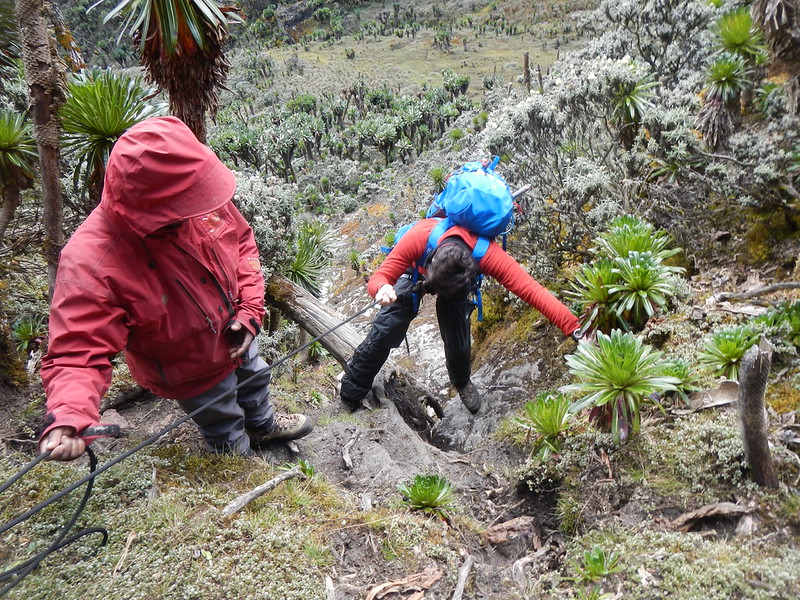
Guides with current technical mountaineering qualifications, not just general trekking licenses, teach and supervise the rope, harness, and ice axe technique used through Groundsel Gully.
What to Wear and Pack for Mount Speke
Layering is the single most important packing principle for this trek, given how far you move, within a single day, from warm lowland forest to the genuine cold of a near-4,000-meter camp and beyond. A technical base layer, an insulating mid-layer like fleece or light down, and a truly waterproof and windproof outer shell are the basic layers, while a heavier insulated down jacket is required at Bujuku Camp, where nighttime temperatures often reach or drop below freezing.
Footwear and Technical Gear
Sturdy, well broken-in waterproof mountaineering boots with a crampon-compatible sole and solid ankle support are essential given the bog, scree, and icy upper terrain this route crosses. Full-length neoprene gaiters make a genuine difference through the Bigo Bog, and free rubber gumboots are available at the Nyakalengija trailhead for the lower forest sections if preferred.
For the summit itself, technical equipment, rope, harness, ice axe, and helmet are provided as part of your package, so clients need not purchase specialist mountaineering gear they may use only once; crampons may also be required depending on seasonal conditions, and your guide will assess the situation directly at Bujuku Camp.
Other Essentials
- Waterproof hardshell jacket with sealed seams plus waterproof shell trousers
- Warm knit hat, insulated waterproof gloves, and a lighter liner glove for layering
- A sleeping bag rated to at least minus 5°C, plus a liner for warmth and hygiene
- Trekking poles, particularly valuable through the Bigo Bog and on both long descents
- A 2-litre hydration system or bottle, plus electrolyte mixes for summit day
- Headlamp with spare batteries, essential for the 3–4am summit start
- UV-rated sunglasses or glacier goggles, high-SPF sunscreen and lip balm
- Personal first-aid kit and, where discussed with a physician, altitude medication
Full technical gear rental, including sleeping bags, gaiters, and cold-weather layers beyond the rope and harness equipment included in your package, can be arranged in advance through our team; simply let us know your sizes when booking, or see our Rwenzori packing and gear rental guide for a complete breakdown of what to bring versus what to rent.