The 6-Day Rwenzori Trek to Hunwick’s Camp via the Kilembe Trail takes you through 5 vegetation zones of the Rwenzori Mountains, starting in the warm, bird-filled Afro-montane forest above Kilembe, then through the bamboo thickets and heather ridges of Kalalama and Mutinda, across the boggy, lobelia-studded moorland of Bugata, over the wind-scoured Bamwanjara Pass at 4,450 meters, and finally down into Hunwick’s Camp, a hut cradled at the base of Mount Stanley and Mount Baker, where the glaciers of Africa’s third-highest range hang close enough to touch the evening light. From there the route climbs once more toward Oliver’s Pass and the optional summit of Weismann’s Peak before descending, day by day, through the waterfall-laced Nyamwamba Valley back to solid ground. Six days, five vegetation zones, and one mountain range that most travelers to East Africa never even know exists, this is the trek we build for the hiker who wants the Rwenzoris done properly: privately guided, carefully paced, and free of the crowds that queue for Margherita Peak.
Six days. One historic trail. A climb from the smallholder farms above Kasese through montane rainforest, bamboo and giant heather into the strange, silver-lit world of Afro-alpine moorland, arriving at Hunwick’s Camp, 4,450 metres up the flank of Mount Stanley, before a long and equally spectacular descent back to the valley
Rwenzori Trekking Expeditions‘ 6-Day Trek to Hunwick’s Camp via the Kilembe Trail is the definitive short-format expedition into the Rwenzori Mountains for travelers who want the range’s full ecological experience without committing to a summit attempt on Margherita Peak. It begins at Kilembe, the old copper-mining settlement in the shadow of the range, and climbs in four deliberate stages, through Kalalama Camp and Mutinda Camp, over the boardwalks of the Bigo Bog to Bugata Camp, and finally onto the high alpine shoulder where Hunwick’s Camp sits, tucked beneath the hanging glaciers of Mount Stanley, before descending via Kiharo Camp back to the park gate. The trek runs at a genuinely challenging pace, gaining nearly 3,000 meters of elevation over four ascending days, and is designed for fit, well-prepared hikers rather than complete beginners, though no technical climbing skills are required at any point.
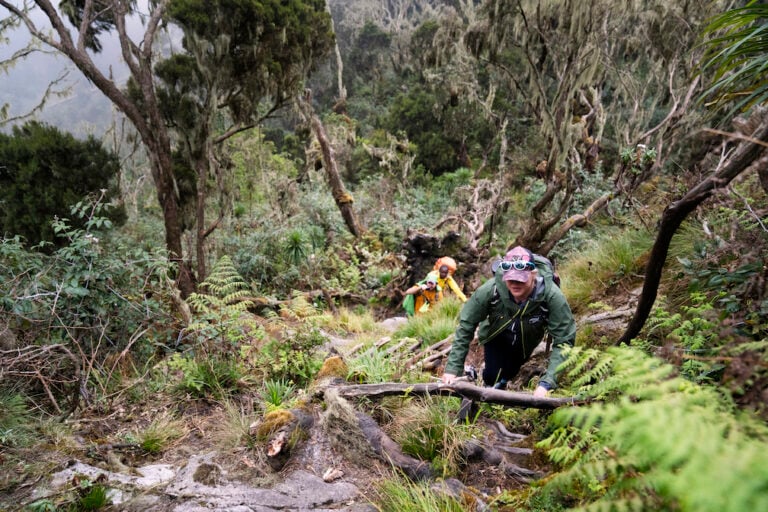 What makes this particular 6-day Hunwick’s Camp Trek via the Kilembe Trail route worth choosing is the sheer ecological range it compresses into less than a week. You pass through dense montane rainforest, where blue monkeys and turacos are active, then into cool, dripping bamboo forest; next, you see giant heathers draped in trailing moss; and finally, you reach the genuinely surreal terrain of Afro-alpine moorland, with giant lobelia and groundsel rising from bog and tussock grass, waterfalls threading down valley walls, and panoramic views across ridgelines that few travelers to East Africa ever witness. It is built for experienced hikers, adventure travelers, photographers, and birdwatchers who want a serious mountain objective; for couples seeking a shared physical achievement; and for small groups wanting a privately guided expedition rather than a crowded trail. Every day, your own dedicated guide and porter team walk with you, setting a pace around you, not a fixed departure schedule.
Quick Facts Of The 6-Day Trek to Hunwick’s Camp via the Kilembe Trail
Duration | 6 days / 5 nights on the mountain |
Route | Kilembe Trail: Kalalama Camp, Mutinda Camp, Bugata Camp, Hunwick’s Camp, Kiharo Camp |
Destination | Rwenzori Mountains National Park, western Uganda |
Highest Overnight Camp | Hunwick’s Camp at 4,450 meters, our verified current operating altitude |
Difficulty | Challenging, sustained high-altitude trekking on varied, often wet terrain |
Accommodation | Mountain huts and tented camps maintained along the Kilembe Trail |
Best Time | Generally drier in mid-December to mid-February and June to August, though Rwenzori weather is unpredictable in any month |
Starting Point | Kilembe, near Kasese, western Uganda |
Trail Status | Open and actively operated, we confirm current trail and camp conditions with Uganda Wildlife Authority before every departure |
Group Size | Private departures for solo trekkers, couples, families and small groups up to 8 |
Price | Bespoke quotation: Inquire for current rates and private departure dates |
Camp elevations reflect our most recently verified figures at time of writing. As with any mountain environment, we recommend confirming current operating details with our team before booking.
Why Hunwick’s Camp Is Special
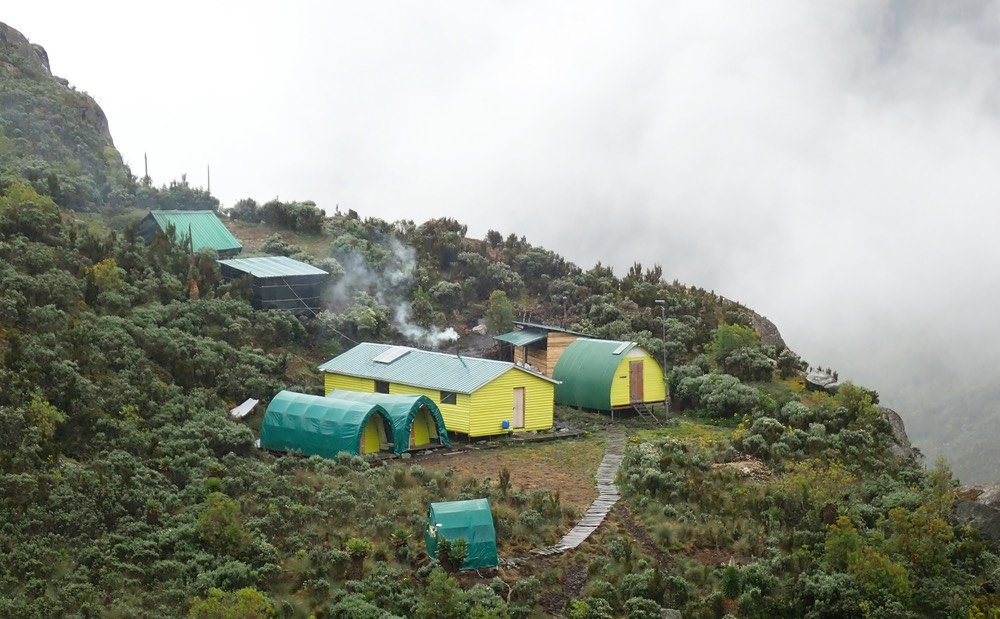 Hunwick’s Camp is not simply a stopping point; it is, for many trekkers, the emotional high-water mark of the entire Kilembe Trail experience. Set at 4,450 meters on the alpine shoulder below Mount Stanley, it occupies a position with a near-uninterrupted line of sight to the mountain’s remaining glaciers, ice that has retreated dramatically over the past century and that fewer travelers see with each passing year. The surrounding landscape is stark and dramatic: bare rock, hardy alpine cushion plants, and ridgelines that fall away into the valleys you have spent three days climbing out of. On a clear afternoon or early morning, the views from camp extend across layered ridges and into neighboring valleys in a way that consistently produces the trip’s most memorable photographs.
Hunwick’s Camp also plays a specific structural role for trekkers with ambitions beyond this 6-day Hunwick’s Camp Trek via Kilembe Trail itinerary: it is the standard staging camp used on longer expeditions that continue on to Margherita Peak itself, and reaching it on this six-day Rwenzori trek gives genuinely curious hikers a clear, honest sense of what a full summit attempt would demand without committing to the technical glacier travel that the peak requires. Ecologically, the camp sits within one of the best-preserved stretches of Afro-alpine moorland in the range, a habitat found in only a handful of locations on the African continent and one that our guides treat with particular care when routing trekkers through it.
Itinerary at a Glance
Day 1 | Trekkers Hostel, Kilembe (1,450m) to Kalalama Camp (3,134m): into the Afro-montane forest and the bamboo zone |
Day 2 | Kalalama Camp to Mutinda Camp (3,582m): the heather zone and an optional acclimatisation climb to Mutinda Lookout |
Day 3 | Mutinda Camp to Bugata Camp (4,100m): tussock moorland, giant lobelias, and the edge of the alpine zone |
Day 4 | Bugata Camp to Hunwick’s Camp (via Bamwanjara Pass, 4,450m): the roof of the trail and the base of Mount Stanley and Mount Baker |
Day 5 | Hunwick’s Camp to Kiharo Camp (11km, via Oliver’s Pass, with optional Weismann’s Peak summit at 4,620m) |
Day 6 | Kiharo Camp to the park gate and Trekkers Hostel (approx. 18.8km): the long, waterfall-lined descent home |
DAY 1: Kilembe to Kalalama Camp
Elevation: approx. 1,600 m-3,134 m | Walking time: 5–6 hours Zone: Montane rainforest & bamboo forest
Your expedition begins at the Kilembe trailhead, where your private guide completes final permit checks with park rangers while porters weigh and distribute the loads for the days ahead. The path drops away from the road almost immediately into dense montane rainforest, where tall podocarpus and fig trees close overhead, the air thick with the calls of Rwenzori turaco and the distant crash of a blue monkey troop moving through the canopy. A seasonal river accompanies much of the morning’s walk, its crossings arranged carefully by your guide, and lunch is taken streamside, where your cook team has gone ahead to have it waiting. The afternoon climbs steadily into bamboo forest, the light turning green and filtered, and the ground softening with fallen leaf litter underfoot.
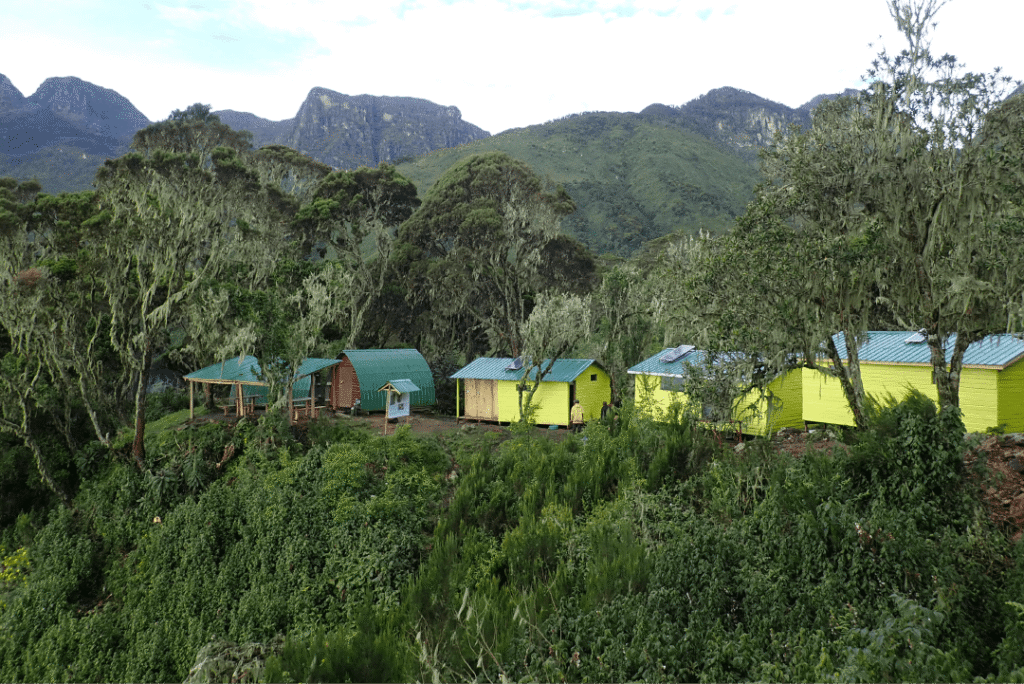
Kalalama Camp appears at 3,134 meters, set at the edge of the bamboo zone, and the evening brings the first genuinely cool mountain air of the trip, a fitting introduction to what the days ahead will demand and a useful early gauge of how your body is responding to the altitude gain.
DAY 2: Kalalama Camp to Mutinda Camp
Elevation: 3,134m – 3,582 m | Walking time: 5–6 hours Zone: Giant heather
Morning at Kalalama is quiet and mist-hung; coffee is poured strong as porters’ shoulder loads for the day’s climb. The trail continues its ascent through thinning bamboo before entering the giant heather zone in earnest, where gnarled trees drape trailing curtains of old man’s beard moss, their shapes turned spectral and grey in the persistent Rwenzori cloud. This morning is a day of genuinely rewarding birdwatching for those who pause to look as Albertine Rift endemics move through the heather canopy and sunbirds work the flowering understory with a persistence that rewards a patient eye. The trail underfoot grows wetter as the day progresses, occasionally boarded where the ground demands it, and your guide keeps a private pace suited to your fitness and the mountain’s mood that day.
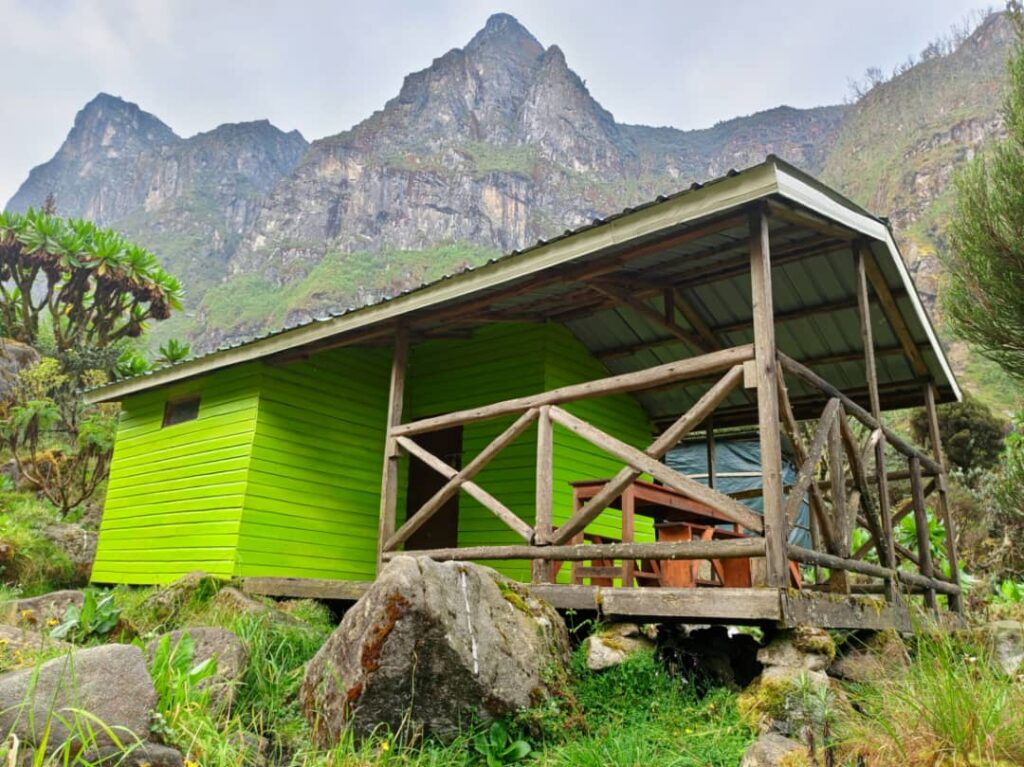
Mutinda Camp sits at 3,582 meters beneath the dramatic granite spires of the Mutinda group, peaks that catch the last available light in a way that regularly stops conversation mid-sentence at camp.
DAY 3: Mutinda Camp to Bugata Camp
Elevation: 3,582m – 4,100 m | Walking time: 6–7 hours | Zone: Afro-alpine bog & giant lobelia
This is, for most trekkers, the most visually astonishing day of the entire itinerary. Leaving Mutinda, the trail enters the Bigo Bog, a churned, boggy plateau crossed via a boardwalk of wooden planks that your guide navigates with the ease of long familiarity, occasionally directing a confident step between tussocks where the boards run out. Beyond the bog, the landscape shifts into genuinely surreal terrain: giant groundsel with cabbage-like rosettes balanced atop bare stalks and giant lobelia rising in silver spires from the moss, an assemblage of plant life found almost nowhere else on the African continent. Ridge walking follows, with views opening on clearer days across neighboring valleys and toward the higher massifs beyond. Bugata Camp arrives at 4,100 meters in a high valley beneath these giants, and the temperature drop after sunset is immediate and sharp; down jackets go on the moment the light fades, and dinner conversation turns naturally to tomorrow’s push toward Hunwick’s.
DAY 4: Bugata Camp to Hunwick’s Camp
Elevation: 4,100m → 4,450 m | Walking time: 5–7 hours | Zone: High alpine moorland
The climb out of Bugata is steady, the vegetation growing sparser and hardier with every switchback as the trail moves fully into Afro-alpine moorland, cushion plants and lichen-crusted rock replacing the giant lobelia gardens below. Views expand considerably through the morning, ridgelines and valleys stacking away in every direction, and the first clear sightings of Mount Stanley’s remaining glaciers typically arrive somewhere on this stretch, close enough now to make out individual crevasses on a good day.
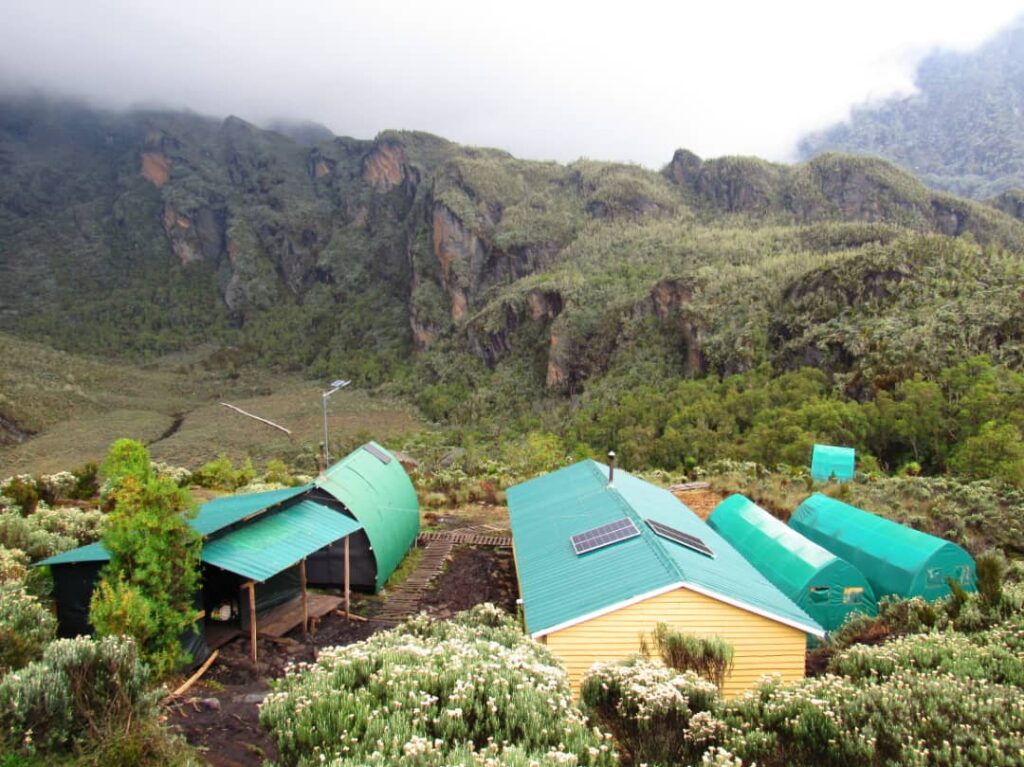
Hunwick’s Camp itself, reached by early-to-mid afternoon, sits on an alpine shoulder with an almost uninterrupted line of sight to the ice above; this location is the expedition’s high point, both literally and emotionally, and most trekkers spend the remaining daylight simply sitting with the view, cameras out, before the temperature drop sends everyone toward a warm dinner and an early night.
DAY 5: Hunwick’s Camp to Kiharo Camp
Elevation: 4,450m – approx. 3,460 m | Distance: 11 km | Walking time: 6–7 hours Zone: Return through alpine & heather zones
The descent begins in cool, clear morning air, retracing the alpine shoulder before dropping back through the terrain climbed over the previous two days, though everything feels different walking in the other direction, with Hunwick’s glaciers now behind rather than ahead. The 11-kilometer descent to Kiharo Camp moves back through Afro-alpine moorland into giant heather, with the temperature rising noticeably with every hour of lost altitude, and your knees and ankles working harder on the way down than they did while climbing up. This physical reality is worth being honest about, and your guide manages it carefully with a steady rather than rushed pace.
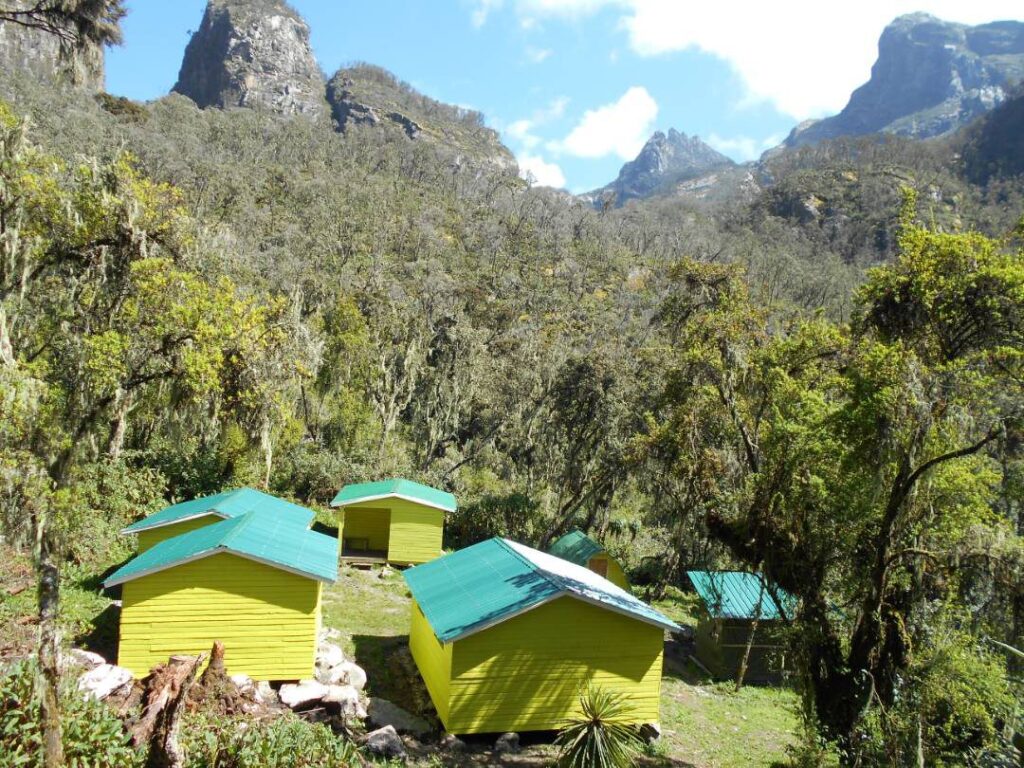
Kiharo Camp sits at a markedly warmer, lower elevation, and the relief of thicker air and a milder evening is immediate and welcome after four days spent above 3,000 meters.
DAY 6: Kiharo Camp to the Park Entrance Gate — Departure
Elevation: approx. 3,460m → 1,600 m | Walking time: 5–6 hours Zone: Return through bamboo & montane rainforest
The final day retraces the trail’s lower forested sections, bamboo giving way to true montane rainforest as the valley widens and the air thickens with lowland warmth once more. Muscles register five days of sustained effort, but the mood is invariably light, porters humming as they carry the last of the camp equipment, stories of the Bigo Bog and Hunwick’s glaciers retold before they have even properly become memories. At the park entrance gate, your private vehicle is waiting for the short transfer back into Kasese, where a hot shower and a proper bed await. Your guide closes the expedition here with a short debrief and, for those already curious about Margherita Peak, an honest conversation about what a summit attempt from Hunwick’s Camp would additionally demand.
What’s Included in the 6-Day Hunwick’s Camp Trek
Every element of this itinerary, from your private vehicle collecting you in Kasese to returning you there, is arranged so that no logistical decision is left in your hands on the mountain.
- 5 nights accommodation in mountain huts/tented camps along the Kilembe Trail, as per itinerary
- All park entry and trekking permit fees for Rwenzori Mountains National Park
- Dedicated UWA-licensed lead guide throughout the trek
- Full porter and cook team, tents, cooking equipment and camp furniture
- All meals on the mountain from Day 1 lunch to Day 6 lunch, prepared fresh at each camp
- Private road transfers between Kasese and the Kilembe trailhead
- Pre-trek briefing and complete safety and equipment orientation
What’s Excluded in the 6-Day Hunwick’s Camp Trek
A short list of items remain outside the package, generally by client preference or personal requirement rather than by necessity.
- International and domestic flights to and from Uganda
- Uganda visa fees and travel/medical/evacuation insurance
- Accommodation in Kasese or Kampala before and after the trek
- Personal hiking clothing and equipment not listed as rental items
- Tips and gratuities for guides, porters and cooks
- Alcoholic and bottled beverages beyond standard camp drinking water
Who Is This 6-Day Hunwick’s Camp Trek For?
This 6-day Rwenzori trek to Hunwick’s camp itinerary suits experienced hikers and adventure travelers who want a serious physical objective without the technical mountaineering demands of a Margherita Peak summit attempt. Nature photographers and birdwatchers find it particularly rewarding, given the trail’s ecological range and comparatively quiet conditions relative to the Central Circuit trail. It works well as a shared achievement for couples and as a bonding expedition for small groups of friends who value a privately guided departure over a fixed group schedule; families are welcome provided members are experienced hikers in reasonably strong physical condition, as the terrain and altitude do not accommodate complete beginners.
We say this honestly, because misjudging fitness on this trail helps no one: travellers with no prior multi-day hiking experience, significant joint or mobility limitations, or unmanaged cardiac or respiratory conditions are likely to find this 6-day Rwenzori trek to Hunwick’s camp itinerary considerably more demanding than they anticipated, and we would rather steer such travellers toward one of our shorter, lower-altitude itineraries, such as the 3-Day Lake Mahoma Trek or the 4-Day Rwenzori Waterfalls Hike, than see them struggle needlessly on the Kilembe Trail’s steeper sections.
Understanding the Kilembe Trail
The Kilembe Trail was developed as an alternative approach into the Rwenzori Mountains National Park, opening the range’s southern flank to trekkers and mountaineers seeking a different route to the Central Circuit’s long-established loop out of Nyakalengija. It begins at the town of Kilembe itself, a former copper-mining settlement whose access roads and community infrastructure now double as the trailhead’s support base, and climbs in four principal stages through Kalalama Camp, Mutinda Camp, Bugata Camp, and Hunwick’s Camp before either continuing on toward Margherita Peak or descending via Kiharo Camp, as this itinerary does.
The Kilembe trail’s elevation profile is genuinely dramatic for its length: from roughly 1,600 meters at the Kilembe trailhead to 4,450 meters at Hunwick’s Camp, trekkers gain close to 3,000 meters of net elevation across four ascending days, passing along the way several seasonal rivers and waterfalls that thread down from the high glaciers above. Vegetation zones change in a clear sequence: montane rainforest gives way to bamboo forest, then giant heather, then true Afro-alpine moorland, a compression of ecological zones rarely seen so distinctly over such a short distance anywhere else in East Africa.
Trail conditions vary considerably by season and by section: lower forest paths are generally firm underfoot, while the boggy plateau between Mutinda and Bugata camps is boardwalked in sections but remains genuinely muddy in wetter months, a condition every trekker on this route should expect rather than be surprised by.
Why Choose the Kilembe Trail
Travelers researching a Rwenzori trek almost always arrive at the same fork in the road: the Kilembe Trail or the older, more established Central Circuit Trail out of Nyakalengija. Neither is objectively superior; they are different journeys through the same range, and the right one depends on what you hope to find. While the Central Circuit trail is a loop, returning trekkers to their starting point, it tends to carry more traffic given its longer operating history; the Kilembe Trail is a single-direction traverse first developed to open the southern flank of the range, and it rewards trekkers with a noticeably quieter trail, a different sequence of vegetation zones, and direct access to waterfalls and valley views that the Central Circuit trail does not offer in quite the same arrangement.
What sets the Kilembe trail apart most distinctly is the pacing of acclimatization. Because the trail gains altitude in longer, well-spaced stages between Kalalama, Mutinda, and Bugata camps, trekkers typically find it easier to adjust to the altitude than on steeper alternative routes, while still enjoying the same scenic rewards. The route’s relative quiet also makes it a strong choice for serious photographers and birdwatchers, who benefit from fewer parties on the trail and more unhurried time at key viewpoints and waterfall crossings. Fewer crowds do not mean fewer highlights; if anything, the Kilembe Trail concentrates the Rwenzori’s most photogenic terrain, its bogs, ridges, and giant lobelia gardens, into a shorter, more efficient itinerary than some longer alternatives require.
Wildlife Along the Kilembe Trail Route
Montane Forest and Bamboo Zones
The lower forested stretches around Kilembe and Kalalama Camp offer the trip’s best wildlife viewing. Blue monkeys move through the canopy in loose, vocal troops, and black-and-white colobus monkeys are regularly spotted at rest in the higher branches during the quieter mid-morning hours.

The Rwenzori turaco, a striking, range-restricted bird, is a realistic sighting for attentive trekkers in this zone, alongside a range of Albertine Rift endemic species that reward those willing to pause and look rather than push straight through.
Heather and Alpine Zones
Above the bamboo, wildlife sightings shift toward smaller, hardier species better adapted to cold and altitude. Sunbirds work the flowering heather with persistence, chameleons are an occasional but memorable sighting among the lower branches, and various forest mammals leave tracks across the boggy plateau between Mutinda and Bugata camps more often than they show themselves directly.
As with any wild mountain environment, sightings cannot be guaranteed on any given day, but the ecological richness of this range means attentive trekkers rarely come away having seen nothing worth remembering.
The Changing Landscapes of the Kilembe Trail
Many short treks elsewhere in Africa compress less ecological change into a longer number of days. The trek begins in montane rainforest below 2,000 meters, a dense, moisture-laden world of fig and podocarpus alive with primates and forest birds. By the second day, the rainforest gives way to bamboo forest, its filtered green light and soft leaf-litter floor a distinct and often surprisingly peaceful stretch of the trail.
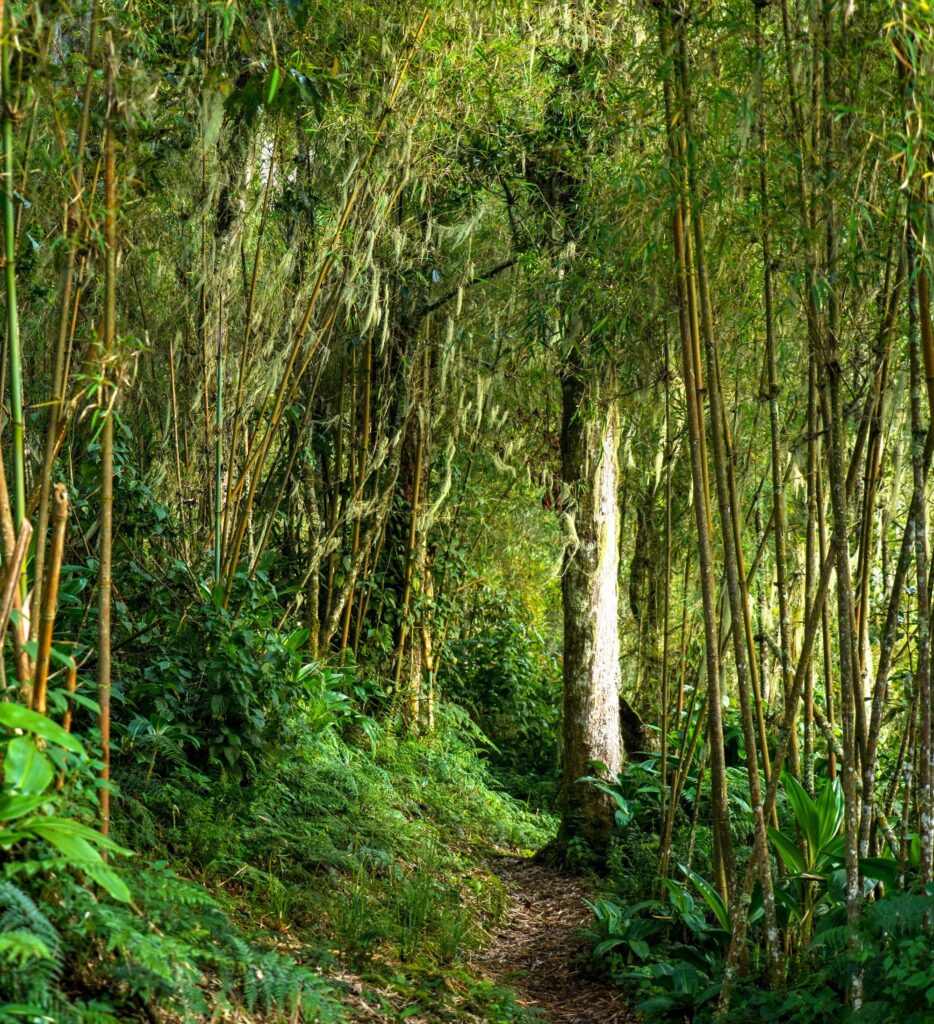
Above roughly 3,000 meters, bamboo yields to giant heather, gnarled and moss-draped, before the trail crosses fully into Afro-alpine moorland above 3,800 meters, a habitat defined by giant lobelia, giant groundsel, tussock grass, and cushion plants found in only a handful of high-altitude locations on the continent. Each zone carries its scenery, its plant life, and its own particular quality of light, and walking through all of them within a single week is, in itself, one of the trip’s principal rewards.
Wildlife Along the Route
Montane Forest and Bamboo Zones
The lower forested stretches around Kilembe and Kalalama Camp offer the trip’s best wildlife viewing. Blue monkeys move through the canopy in loose, vocal troops, and black-and-white colobus monkeys are regularly spotted at rest in the higher branches during the quieter mid-morning hours.
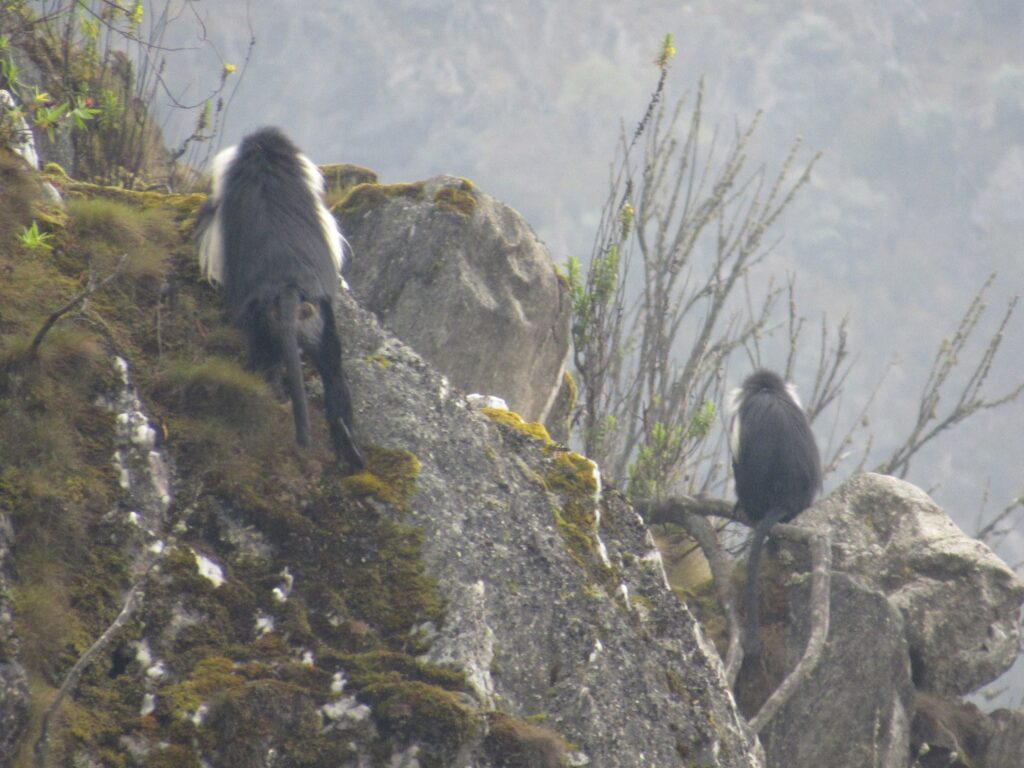
The Rwenzori turaco, a striking, range-restricted bird, is a realistic sighting for attentive trekkers in this zone, alongside a range of Albertine Rift endemic species that reward those willing to pause and look rather than push straight through.
Heather and Alpine Zones
Above the bamboo, wildlife sightings shift toward smaller, hardier species better adapted to cold and altitude. Sunbirds work the flowering heather with persistence, chameleons are an occasional but memorable sighting among the lower branches, and various forest mammals leave tracks across the boggy plateau between Mutinda and Bugata camps more often than they show themselves directly. As with any wild mountain environment, sightings cannot be guaranteed on any given day, but the ecological richness of this range means attentive trekkers rarely come away having seen nothing worth remembering.
The Physical Challenge, Honestly Assessed
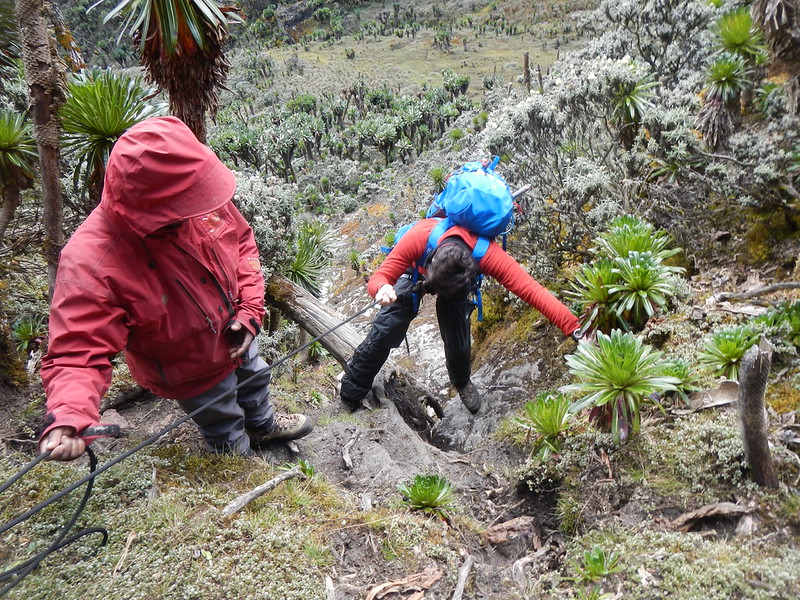
We would rather a prospective trekker overprepare than arrive underprepared, so we describe the trek honestly. Daily hiking hours range from five to seven, with the descent from Hunwick’s to Kiharo Camp covering a full 11 kilometers on weary legs. Underfoot conditions vary considerably: firm forest paths in the lower zones give way to genuinely muddy, occasionally waterlogged sections between Mutinda and Bugata camps, crossed via boardwalks that remain slippery in wet conditions regardless of season. Several stream and river crossings punctuate the lower days, generally manageable but requiring careful foot placement, particularly after rainfall. Steep, sustained ascents mark each of the first four days, and the cumulative altitude gain of nearly 3,000 meters over that stretch places a real, cumulative demand on both cardiovascular fitness and leg endurance. This is not a trek to arrive at undertrained; a solid base of regular hiking or cardiovascular fitness in the months beforehand makes a material difference to how much of the experience you are able to enjoy rather than simply endure.
Altitude and Acclimatisation
This itinerary’s four-stage ascent to Hunwick’s Camp is deliberately paced to support gradual acclimatization, with each night’s camp set at a manageable altitude increment above the last rather than compressing the gain into fewer, steeper days. Hydration matters more at altitude than most trekkers expect, and our guides encourage steady water intake throughout each walking day rather than only at rest stops. Recognizing the early symptoms of altitude illness, persistent headache, nausea, unusual fatigue, or disturbed sleep, is a core part of our guiding team’s training, and every guide on this route checks in with clients at each significant elevation change rather than waiting to be told something is wrong. We ask every client, in turn, to notify their guide immediately at the first sign of any of these symptoms; altitude illness responds far better to early, honest reporting than to symptoms pushed through in silence, and no camp target on this itinerary is worth risking a client’s safety to reach on schedule.
Level of Difficulty of the 6-Day Hunwick’s Camp Trek
The 6-day trek to Hunwick’s Camp via the Kilembe trail is rated “challenging,” and we use that word deliberately rather than as marketing shorthand. Four consecutive days of ascent, several exceeding six hours on uneven, often wet terrain, bring trekkers from roughly 1,600 meters to 4,450 meters, a gain that places real demand on cardiovascular fitness regardless of a trekker’s general athleticism. No technical climbing skill, rope work, or glacier travel is required anywhere on this route; that distinction belongs to our longer Margherita Peak summit itineraries, but a solid base of hiking fitness, built over months rather than weeks beforehand, makes a genuine difference to how comfortably the altitude gain and the long descent day are managed. Beginners to multi-day trekking can complete this route successfully provided their general fitness is strong, though we would not recommend it as a first mountain trekking experience for someone entirely new to hiking.
Safety on the Trail
Every guide and porter on this expedition is trained in wilderness first aid and altitude illness recognition, and our lead guides carry a full first-aid kit and satellite communication for the duration of the trek. We actively manage three risk factors: slippery terrain across the boggy sections, river crossings in the lower forest, and the cumulative effects of altitude, through careful route selection, conservative pacing, and continuous health check-ins at each significant camp. Rescue and evacuation protocols are agreed with Uganda Wildlife Authority and regional medical services ahead of every departure, and our guides hold current wilderness and high-altitude first-response qualifications rather than general trekking licenses alone. Clear, honest communication between client and guide is the single most effective safety tool on this route, and we brief every trekker on this expectation before setting out.
Conservation and Responsible Trekking
The Rwenzori Mountains have carried UNESCO World Heritage status since 1994, recognized for their exceptional biodiversity and the striking Afro-alpine habitats found along routes such as this one. The park is managed by the Uganda Wildlife Authority, whose permit fees directly fund ranger patrols, trail maintenance, and habitat protection across the range, and every trekker’s park fees on this itinerary contribute specifically to that work. We operate on strict Leave No Trace principles throughout, carrying out all non-biodegradable waste generated on the mountain and briefing every group on minimal-impact practice before departure. Climate change is a visible, ongoing concern here; the glaciers visible from Hunwick’s Camp have retreated significantly over the past century and continue to do so, and we treat the Afro-alpine moorland our trekkers pass through with particular care, keeping to established trail sections and boardwalks specifically to protect this rare, slow-growing habitat from the cumulative impact of foot traffic.
Practical Planning Information
- Park entry permits, camp fees, and Uganda Wildlife Authority trekking permits are all secured on your behalf ahead of departure; no separate arrangement is required from you.
- A dedicated lead guide, licensed by the Uganda Wildlife Authority, accompanies you throughout, supported by a full porter team and dedicated cook, all drawn from communities local to Kilembe.
- Accommodation is provided in the mountain huts and tented camps maintained along the route, with all meals prepared fresh at each camp from Day 1 lunch through Day 6 lunch.
- Private road transfers connect Kasese and the Kilembe trailhead at both ends of the trek.
- Group sizes on our departures run privately, from solo trekkers up to small groups of twelve, and we recommend this itinerary for hikers aged sixteen and above with a genuine hiking background, given the sustained physical demand involved; younger family members are better served by our shorter, lower-altitude itineraries.
- Travel insurance covering high-altitude trekking is a condition of joining this expedition, and we recommend beginning cardiovascular and hiking-specific fitness preparation at least two to three months ahead of your departure date.
How to Get to the Rwenzori Mountains
Most clients on this itinerary begin their journey by flying into Entebbe International Airport, Uganda’s main international gateway. From Entebbe, Kilembe lies roughly 400 kilometers west, near the town of Kasese in the shadow of the range. Most travelers cover this distance by private road transfer, a scenic drive of around 8 to 9 hours that we typically break at the equator crossing and, where the itinerary allows, with an overnight near Queen Elizabeth National Park before continuing on to Kasese and Kilembe. For those short on time, domestic flights connect Entebbe to Kasese airstrip in under an hour, considerably shortening the overland journey; we arrange these charters directly for clients who prefer to preserve trekking days over travel days.
Every transfer on this itinerary, from airport to trailhead and back, is arranged as a private vehicle with a dedicated driver, never a shared shuttle. Our Rwenzori Mountains travel guide provides a broader look at logistics and planning, covering transport, permits, and regional context in more depth.
Weather on the Kilembe Trail
The Rwenzori are among the wettest mountain ranges on the African continent, and no honest itinerary promises sunshine here. Rainfall is possible in any month; cloud cover builds most afternoons regardless of season, and temperatures swing dramatically with elevation and time of day, warm and humid in the lower forest, falling well below freezing overnight at Bugata and Hunwick’s camps. Wind picks up noticeably on exposed alpine sections above Bugata, adding a real chill factor even on days that feel mild at lower camps.
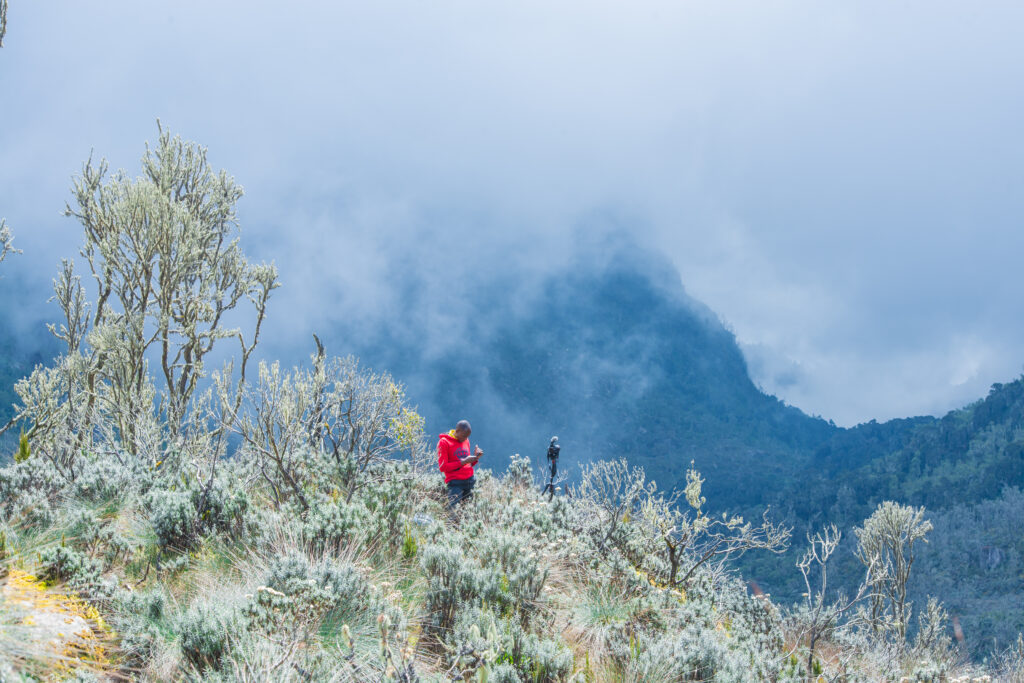
Seasonal variation shifts the balance of probability rather than offering any guarantee: the drier windows described below see meaningfully less rainfall and firmer trail conditions, but mountain weather in this range changes quickly and without much warning, and every trekker should pack, and mentally prepare, for wet conditions regardless of when they travel.
Best Time to Trek to Hunwick’s Camp
Two windows offer meaningfully firmer trail conditions on the Kilembe Trail: mid-December through mid-February and June through August. Both periods see reduced, though never absent, rainfall, firmer underfoot conditions across the boggy sections between Mutinda and Bugata camps, and a generally higher chance of clear views from Hunwick’s Camp toward Mount Stanley’s glaciers. Photography benefits noticeably during these windows, with better odds of clear morning light across the alpine zone, though wildlife sightings in the lower forest sections remain fairly consistent year-round regardless of season. Trekkers with flexible travel dates should favor these two windows; those constrained to other months can still complete this itinerary successfully, with the same guiding, pacing, and safety standards applied regardless of when you travel; only the underfoot conditions and the odds of a clear summit-facing view at Hunwick’s shift with the season.