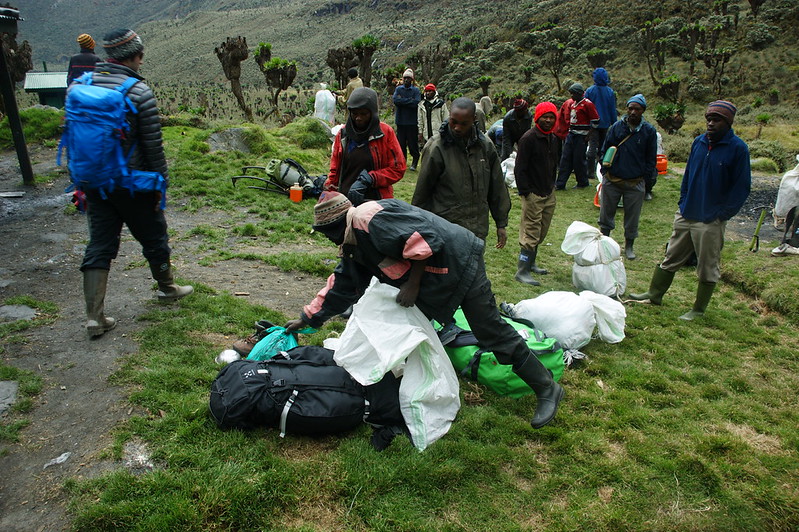
If you are planning a trek in the Rwenzori Mountains, you may be wondering, “What exactly does my porter carry, and what am I expected to carry myself?” On a typical multi-day Rwenzori expedition, porters help transport the agreed-upon overnight luggage, food, cooking equipment, camping supplies, and other group equipment needed for the trek. Travelers normally keep a smaller daypack containing essential items they need while walking, such as water, rain protection, warm layers, snacks, personal medication, and valuables. The exact porter luggage allowance depends on your itinerary, group size, route, equipment, and the porter-load policy of Rwenzori Treking Expeditions.
On a Rwenzori trek, a porter carries the expedition’s shared weight, your overnight duffel bag, a share of the group’s food and cooking equipment, tents and camping gear, and, on summit itineraries, technical climbing equipment, all within a carefully managed maximum load. You, the traveller, carry only a light daypack during the walking day, which holds water, rain gear, a warm layer, snacks, and anything else you might need before the group next stops. Every kilogram a porter carries on our expeditions is weighed, recorded, and kept within a defined limit before it ever leaves the trailhead, because a properly managed load is both a matter of safety and a matter of basic respect for the person carrying it. What follows is a detailed, practical breakdown that every traveller should read before packing for the Kilembe Trail, the Central Circuit Trail, or a Margherita Peak summit attempt.
What Is a Rwenzori Porter?
A Rwenzori porter is a trained member of the expedition support team responsible for carrying the equipment, food, and personal luggage that make a multi-day trek through this range physically possible. Most porters working on the Kilembe Trail and the Central Circuit come from Bakonzo communities living at the base of the mountain, and many carry a lifetime’s familiarity with this exact terrain layered on top of professional trekking experience. A porter is distinct from a guide, who leads navigation and safety decisions, and from the cook, who manages meals at camp; the porter’s role is specifically the movement of weight, skilfully, safely, and at a pace that keeps the whole expedition running on schedule.
What Does a Rwenzori Porter Actually Carry?
The honest answer is almost everything that is not on your back during the walking day. Understanding the six broad categories of loads that a porter manages makes the entire system of how a Rwenzori expedition moves through the mountains much clearer and less mysterious than it may seem before you book.

1. Traveller’s Overnight Luggage
Your main duffel bag, packed with the clothing, sleeping bag, and personal items you will not need again until camp, is carried by a porter for the entire day and is waiting for you, generally already inside your tent, by the time you arrive. This is the single largest item most travelers hand over, and it is precisely the weight that transforms a Rwenzori trek from an endurance exercise into an experience you can actually enjoy.
2. Food Supplies
Every meal for every day of your itinerary; breakfast, lunch, dinner, and the hot drinks and snacks in between, is carried in from the trailhead, since there is no resupply available once you are inside Rwenzori Mountains National Park. On longer summit itineraries this represents a substantial and steadily diminishing load, distributed across the porter team and consumed, quite literally, as the expedition proceeds.
3. Cooking Equipment
Pots, pans, stoves, cooking fuel, and the kitchen equipment needed to prepare hot meals at altitude are all carried by the porter team, along with water containers and the basic utensils that turn raw supplies into the calorie-dense meals your body needs for sustained effort at elevation.
4. Camping Equipment
Tents, sleeping mats, camp shelters, and, depending on the itinerary, portable seating or a mess tent are carried and set up ahead of the trekking group’s arrival wherever possible so that camp is functional, or close to it, by the time you reach it each afternoon.
5. Group Equipment
Ropes, first-aid kits, radios or satellite communication devices, and any shared safety equipment travel with the porter team rather than with any single trekker, ensuring this equipment is always present with the group regardless of which individual might need it.
6. Trekking Supplies
Technical summit equipment, crampons, ice axes, harnesses, and fixed-line hardware for a Margherita Peak or Mount Baker attempt, along with spare gaiters, rubber boots, and other route-specific supplies, is carried by designated porters and issued at the appropriate camp rather than hauled the full distance by the traveller themselves.
What Does the Traveller Carry?
On a standard Rwenzori itinerary with porter service included, you carry a single daypack throughout the walking day, and nothing more. This daypack holds water, a rain jacket, a warm mid-layer, snacks, your camera, personal medication, important documents, and sunscreen, everything you might reasonably need between the moment you leave camp and the moment you arrive at the next one, without waiting for a duffel bag carried elsewhere in the line to be unpacked. The daypack is yours to manage; the overnight bag is the porter’s responsibility, and this division is the single most important practical concept to understand before your trek begins.
Porter-Carried Bag vs. Daypack
Trekkers occasionally arrive expecting to hand over their entire pack and walk with nothing at all, or, at the other extreme, to carry their full kit themselves out of a sense that the latter is more authentic. Neither reflects how a well-run Rwenzori expedition actually works. The porter-carried bag holds everything you do not need until camp; the daypack holds everything you might need before then. Getting this division right, rather than either overloading your daypack with items that belong in your duffel or underpacking it and finding yourself without a rain layer an hour into a downpour, is one of the simplest ways to improve your comfort on the mountain.
How Much Can a Rwenzori Porter Carry?
A Rwenzori porter’s maximum load is set at approximately twenty to twenty-five kilograms, a limit established to protect porter health and safety on steep, wet, and often uneven terrain, and one that we enforce without exception on every departure we operate. This figure usually means the porter’s own carrying capacity for both client and shared equipment, and it is not a target to be filled regardless of necessity; loads are built around what an itinerary genuinely requires, then checked against the limit, rather than the limit being treated as an allowance to be used in full by default.
Rwenzori Porter Load Policy
Our policy is straightforward and, we believe, non-negotiable. Every porter’s load is weighed at the trailhead before departure, using a scale rather than an estimate. No porter carries in excess of the established maximum under any circumstances, including when a traveller’s personal luggage exceeds their allowance; in that situation, we arrange an additional porter rather than adding the excess to an existing load. Weight limits apply equally regardless of group size, season, or route, and any traveller is welcome to ask, at the trailhead, to see their porter’s load weighed before the trek begins.
What Should I Put in My Porter Bag?
Your porter-carried duffel should hold your sleeping bag and sleeping-related items, spare clothing for each day of the trek, sleepwear kept separate from trekking clothes, a wash kit and personal hygiene items, spare batteries or a power bank you do not need during the day, and any additional layers you are not actively wearing or likely to need before the next camp. Pack this bag with the same waterproofing discipline you would apply to any Rwenzori luggage, since even a bag riding on a porter’s back all day will meet the range’s rain at some point on most itineraries.
What Should NOT Go in a Porter Bag?
Anything you might need urgently during the day has no place in your porter-carried bag. This means your rain jacket, your primary water supply, personal medication you may need without warning, your passport and other essential travel documents, cash, and valuables should never be packed into the duffel a porter carries some distance ahead of or behind you on the trail. Fragile electronics you are actively using, and any item related to an emergency, a whistle, or a basic first-aid kit for personal use, should also stay with you rather than in luggage you will not see again until camp.
What Should I Keep in My Daypack?
Your daypack should always contain water, a packable rain jacket, one warm insulating layer, high-energy snacks, your camera or phone, personal medication, your passport or a copy of it along with any permits, sunscreen and a hat, and a headlamp as a sensible precaution on any day when timing might run later than expected. This kit keeps you comfortable and safe while walking, regardless of where your main luggage is on the trail.
Does the Porter Carry My Whole Backpack?
No, and this is worth stating plainly. The porter carries your overnight duffel bag, not the daypack you wear and manage yourself throughout the day. Some first-time trekkers assume porter service means walking entirely unburdened; in practice, a light daypack stays with you at all times, both for your comfort and so that essential items are never more than an arm’s reach away.
How Does Porter Luggage Work on the Kilembe Trail?
On the Kilembe Trail, porters carry client duffel bags, shared camping and cooking equipment, and food supplies from the trailhead near Kilembe town through each successive camp toward the higher reaches of the range. Because this route is notably wet even by Rwenzori standards, waterproofing your porter-carried bag matters more here than almost anywhere else on the mountain, and porters themselves are equipped with rubber boots and waterproof outerwear suited to the trail’s persistent mud and river crossings.
How Does Porter Luggage Work on the Central Circuit?
On the Central Circuit Trail, porter logistics follow the loop structure of the route, with equipment and luggage moved hut to hut, or camp to camp, around the historic circuit that rings the range’s core massifs. Load management here accounts for the circuit’s higher average camp altitude and the additional coordination required when a summit attempt on Margherita Peak is layered onto the standard loop, since porters supporting a summit stage carry a distinct set of technical equipment in addition to standard camping and food supplies.
What Happens During a Margherita Peak Summit?
A summit attempt on Margherita Peak introduces a further layer of load management beyond standard trekking logistics. Technical equipment, crampons, ice axes, ropes, and harnesses, is carried by specifically designated porters to the high camp nearest the glacier, where it is issued to trekkers ahead of the final summit push rather than carried the full distance by the climbing party themselves. Standard overnight luggage is typically left at a lower camp for this stage, since summit day itself is conducted with a stripped-down kit appropriate to technical glacier travel, and porters supporting this stage are selected specifically for their experience with high-altitude, technical terrain rather than assigned at random from the wider team.
How Porter Loads Are Managed
Load management on our expeditions begins well before the trailhead, with the total weight of client luggage, food, and equipment calculated against the specific itinerary, group size, and route, then divided across a porter team sized to keep every individual load within the established maximum. At the trailhead itself, every bag is weighed on a scale, not estimated by eye, and any traveller whose luggage exceeds their allocated allowance is asked either to reduce it or to engage an additional porter, since redistributing excess weight onto an already-loaded porter is never an acceptable solution. Throughout the trek, our guide team monitors load distribution and porter condition daily, adjusting arrangements if a porter shows signs of strain, illness, or difficulty, because a load limit observed only at the trailhead and ignored thereafter is not a genuine welfare standard.
Porter Safety and Welfare
Weight limits exist because overloading causes real physical harm, increased fall risk on steep and wet terrain, and long-term injury to the people whose livelihoods depend on their ability to keep working season after season. Beyond the load limit itself, our porters are provided with or required to have proper waterproof outerwear, appropriate footwear for the Rwenzori’s consistently wet terrain, and adequate sleeping equipment for cold camp nights, alongside nutritious meals and proper shelter throughout the expedition. A well-equipped and reasonably loaded porter works more safely, sustainably, and happily, and every traveller booking with us can expect this standard on their specific trek rather than as a general policy.
Responsible Trekking and Porter Loads
Responsible trekking on the Rwenzori is not an abstract ideal; it is expressed in specific, checkable decisions, whether a scale is actually used at the trailhead, whether a second porter is engaged rather than an existing load quietly increased, and whether porters have the equipment they need for the exact conditions they will face. Travellers who ask their operator directly about load policy before booking are asking exactly the right question, and the answer should be a specific, concrete policy, not a general reassurance. We would rather a prospective client compare our load policy directly against any other operator’s than simply take our word for it.
Example Packing Arrangement
The table below illustrates a typical division of luggage for a solo trekker on a standard Margherita Peak summit itinerary to make the daypack-versus-porter-bag distinction concrete rather than abstract.
Item | Carried By | Notes |
Sleeping bag and sleeping mat | Porter (duffel bag) | Not needed until camp each evening |
Spare clothing for each day | Porter (duffel bag) | Packed in a waterproof liner |
Rain jacket and rain trousers | Traveller (daypack) | Needed at short notice throughout the day |
Water (2-3 liters) | Traveller (daypack) | Refilled at camp each morning |
Passport, permits, cash | Traveller (daypack) | Never placed in porter-carried luggage |
Camera and personal electronics | Traveller (daypack) | Kept accessible and protected from rain |
Crampons, ice axe, harness (summit stage only) | Designated porter | Issued at the high camp before summit day |
Tent, cooking equipment, food | Equipment porters | Distributed across the porter team by weight |
Practical Porter-Luggage Checklist
Before you hand your duffel bag to a porter at the trailhead, confirm the following against your own packing.
Check | Why It Matters |
Bag weighed and within your agreed allowance | Prevents overloading and delays at the trailhead |
Bag waterproofed with a liner or dry bag | Protects contents through the Rwenzori’s persistent rain |
Bag clearly labelled with your name | Ensures fast, accurate distribution at each camp |
Essentials removed and placed in your daypack | Keeps documents, medication, and valuables with you at all times |
Fragile or urgently needed items excluded from the duffel | Avoids being without something you need mid-trail |
Confirmed personal porter arrangement if requested | Ensures dedicated support is in place before departure |