Explore the Diamond Trail of the Rwenzori Mountains, Uganda’s Primate Birding Trekking Trail with Chimpanzees, Colobus Monkeys, Rwenzori Turaco, and Albertine Rift Endemic Birds.
Most discussions about the Rwenzori Mountains start and end at 5,109 meters, at the glaciated summit of Margherita Peak, wrapped in mist, the last equatorial ice in Africa catching the morning light above the cloud line. And those conversations are right to start there, because Margherita is one of Africa’s genuinely remarkable summits. But the Rwenzori Mountains are not only a summit. They are a living ecosystem of extraordinary complexity, and the forest world that cloaks their lower slopes contains experiences as remarkable as anything waiting on the upper mountain, experiences that most summit-focused trekkers pass through without stopping. The Diamond Trail is built precisely for that stopping. It is the Rwenzori Mountains National Park’s designated wildlife and primate trekking route, running through the lower montane forest between approximately 1,600 and 2,600 meters above sea level, and it is where wild chimpanzees crash through the canopy above your head, where the Rwenzori Turaco launches in a flash of crimson and emerald from a branch three meters from where you stand, and where the forest’s extraordinary layered life reveals itself, hour by hour, to anyone willing to move slowly enough to receive it. Whether the Diamond Trail is the centrepiece of your Rwenzori visit or the perfect wildlife complement to a summit expedition on the Central Circuit or Kilembe Trail, this guide is the one that tells you everything you need to plan it, experience it, and understand why it is unlike any other wildlife trail in East Africa.
Diamond Trail: At a Glance
Feature | Detail |
Trail Type | Wildlife & Primate Trekking, forest-focused, non-summit route |
Location | Rwenzori Mountains National Park, Kasese District, Uganda |
Elevation Range | ~1,600 m – ~2,600 m above sea level |
Duration | 1 to 3 days (flexible; integrates into longer expeditions) |
Difficulty | Moderate, forest terrain, manageable for most fit adults |
Primary Draw | Wild chimpanzees, primate communities, and Albertine Rift endemic birds |
Primates Present | Chimpanzees, Black-and-White Colobus, L’Hoest’s Monkeys, Blue Monkeys |
Key Birds | Rwenzori Turaco, Handsome Francolin, Rwenzori Batis, Archer’s Robin-Chat |
Trailhead Access | Nyakalengija or Kilembe trailheads, Kasese District |
Guide Required | Yes, mandatory under Uganda Wildlife Authority regulations |
Best Season | Year-round; dry seasons (Dec–Mar & Jun–Sep) preferred for trail conditions |
Park Permit | Included in all Rwenzori Trekking Expeditions packages |
Best Pairing | Before or after a Margherita Peak or multi-day summit expedition |
What Is the Diamond Trail in the Rwenzori Mountains?
The Diamond Trail is the third major designated trekking route in Rwenzori Mountains National Park, alongside the Central Circuit Trail and the Kilembe Trail. While the other two routes are mainly summit routes that take trekkers through the mountain’s ecological zones and up to its glaciated peaks, the Diamond Trail has a different purpose: it is a wildlife-first trail that gives trekkers maximum access to the primate communities and endemic bird species in the lower montane forest zone of the national park.
The trail takes its name from the precision and focus of its purpose; it cuts through the mountain’s lower forest world with a single-minded clarity, directing all attention toward the forest’s most extraordinary inhabitants rather than the altitude above them. At elevations where the Central Circuit Trail and Kilembe Trail are merely passing through on their way to the high mountain, the Diamond Trail pauses, observes, and stays long enough for the forest to reveal what it actually contains. The result is a wildlife trekking experience of genuine world-class quality: wild chimpanzees in their natural habitat within a UNESCO World Heritage Site, a community of primate species moving through ancient equatorial forest, and a bird list that belongs among the finest available on any walking trail in East Africa.
The Diamond Trail is not a consolation prize for trekkers who cannot reach the summit. It is a deliberate, wildlife-focused experience in its own right, and it takes place in one of the most ecologically extraordinary mountain landscapes on the African continent, which gives every moment a context and weight that is absent from chimpanzee experiences in lowland forest reserves. Rwenzori Trekking Expeditions operates the Diamond Trail as a standalone itinerary, as an addition to summit expeditions, and as part of broader western Uganda wildlife combinations. For every version, the guide team brings the same depth of forest knowledge that makes the difference between a wildlife walk and a genuine wildlife encounter.
The Terrain and Landscape of the Diamond Trail
Entering the Montane Forest, the First Transformation
The Diamond Trail begins where the agricultural land ends and the forest begins, and the transition happens with a physical abruptness that first-time visitors consistently find remarkable. Within a hundred meters of entering the Rwenzori Mountains National Park boundary, the light changes, the temperature drops, the sounds of the outside world disappear behind a curtain of birdsong and running water, and the particular quality of air that belongs to an ancient equatorial forest settles around you. This experience is not a managed nature walk through secondary growth. The trees here are genuinely old, enormous Podocarpus and Symphonia rising twenty to thirty meters overhead, their trunks draped in epiphytic ferns and old man’s beard lichen, their root systems creating the entire topography of the path underfoot. The forest floor is damp in every season, crossed by clear-water streams that are tributaries of the Mubuku and Mahoma rivers flowing down from the peaks above.
The botanical complexity of this zone is one of the reasons Rwenzori Mountains National Park holds UNESCO World Heritage status. The park protects over 1,000 plant species, many of them endemic to the Albertine Rift, the extraordinary highland corridor running from northern Uganda through Rwanda and the DRC that contains more endemic vertebrate species per unit area than any other region in Africa. In the lower forest through which the Diamond Trail passes, this botanical diversity is not an abstract statistic. It is the specific architecture of the environment around you: the layered canopy that filters light into something green and diffuse, the understory palms and tree ferns, the moss gardens on every exposed surface, and the orchids in the canopy transition zones. The forest is doing its thing entirely, and you are simply moving through it, trying to see as much as the pace and the guide allow.
The Path and Its Demands
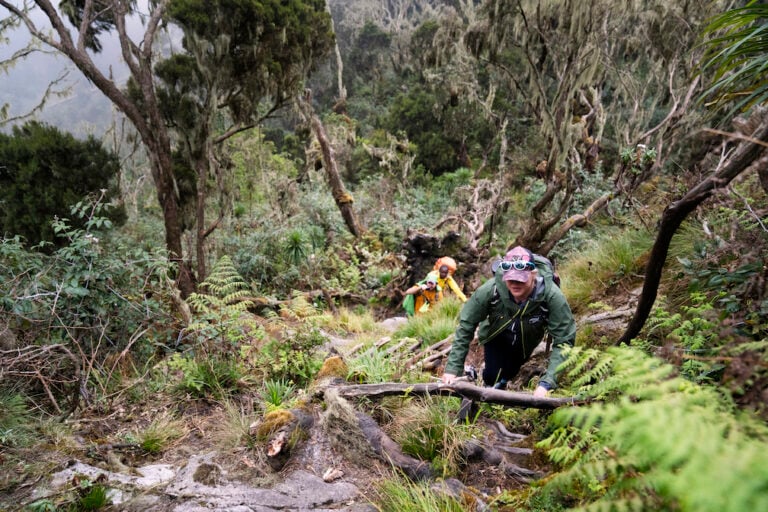
The Diamond Trail is rated moderate in difficulty, significantly less demanding than the upper sections of either the Central Circuit Trail or Kilembe Trail, but not a gentle nature path requiring ordinary footwear and casual attention. The forest trails involve root crossings that require attentive footwork, occasional steep sections on slopes made slippery by leaf matter and damp soil, and stream crossings on logs and stepping stones that are navigated more carefully in the wet season when water levels rise. Trekking poles reduce the effort on uneven terrain and are recommended. Waterproof boots are not optional; the forest is consistently damp, and the paths hold moisture even during the dry seasons.
The disposition that the Diamond Trail rewards above all others is patience. This trek is not a trail where covering distance is the measure of success. A trekking team that spends forty-five minutes covering three hundred meters because a chimpanzee group has settled in the canopy above and the guide has signalled for complete stillness has had a better Diamond Trail morning than a team that covered six kilometers of forest path in the same time. Your dedicated Rwenzori Trekking Expeditions guide sets the pace based on what the forest is showing in real time, which trees are bearing fruit, where the previous day’s chimpanzee groups were last observed, and which sections of the trail are currently most productive for specific bird species, and that intelligence-driven pace is the single factor that most determines the quality of wildlife encounters on any given day.
Wildlife on the Diamond Trail (What the Forest Contains)
Chimpanzees: The Trail’s Central Purpose
The chimpanzees of Rwenzori Mountains National Park are the primary reason the Diamond Trail was established, and an encounter with them in this setting carries a specific quality of wildness that separates it from the more managed chimpanzee experiences available elsewhere in Uganda. These are not habituated primates in a purpose-built tourism program; they are wild chimpanzees moving through the actual lower montane forest of a UNESCO World Heritage Site, tracked by guides who have built their knowledge of specific group movements over years of daily presence in this forest. The difference between the Diamond Trail’s chimpanzee experience and Kibale Forest’s famous program is not a difference in quality but a difference in character: here, the encounter has the particular unpredictability and rawness of finding wild animals in their environment, with all the patience and fortune that requires.
When the encounter happens, with experienced guides working the Diamond Trail, the probability of seeing chimpanzees is meaningfully high, and the sounds arrive before the sight. A branch displaced overhead. A rapid series of whoops and crashes as a group member moves position. The low conversational calls of a group at rest in the midcanopy, grooming and feeding with the domestic ease of animals entirely comfortable in their environment. Then the visual confirmation: dark shapes in the branches above, the characteristic forward stoop of a large male descending to ground level, and the wide-eyed curiosity of a juvenile watching the quiet group of humans below. These encounters last anywhere from ten minutes to an hour, and the guide team has cultivated the skill of positioning the trekking group at the precise distance and angle that maximizes observation without disturbance. The instruction during a chimpanzee encounter is consistent: stay quiet, stay still, follow the guide’s positioning exactly, and allow the forest its own timeline.

The Full Primate Community
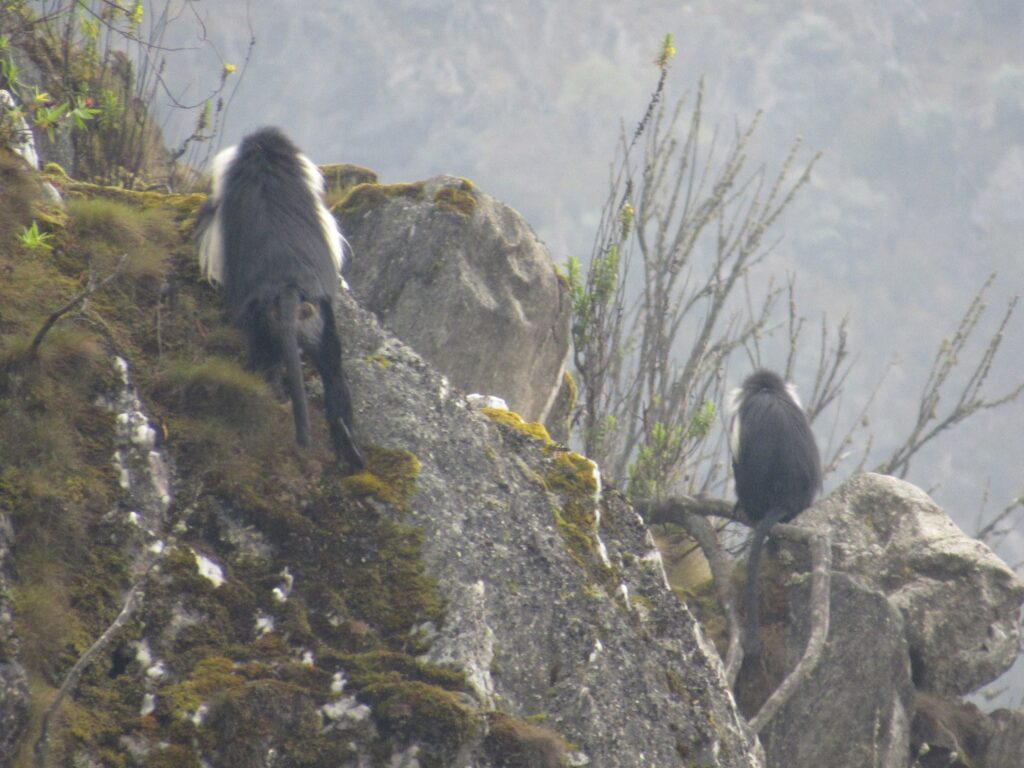
Chimpanzees share the Diamond Trail’s forest with a rich community of other primate species, each occupying a distinct vertical niche in the forest’s layered architecture. Black-and-White Colobus Monkeys are among the most visually spectacular, their long white capes catching the light as they leap between canopy branches with an effortlessness that makes the distances involved seem impossible, their sonorous morning calls echoing through the forest before the first human footstep on the trail. L’Hoest’s Monkeys, strongly associated with the montane forests of the Albertine Rift and rarely seen outside this highland corridor, move in family groups through the understory with a quiet purposefulness that makes them harder to spot than their larger relatives but no less remarkable when found, their dark faces and distinctive white beards giving them an appearance that experienced observers consistently describe as patrician. Blue monkeys, more tolerant of human presence than most species and often encountered around fruiting trees, offer the closest and most sustained visual access to the primate community for attentive trekkers.
The combination of multiple primate species across multiple forest levels, observable within a single trail day by a patient trekking team guided at observation pace, makes the Diamond Trail one of the finest primate experiences available in East Africa, not merely a chimpanzee encounter in a forest, but a genuine window into the social and ecological complexity of an intact primate community in one of Africa’s most ecologically significant mountain ecosystems.
Birdwatching: A World-Class Albertine Rift Checklist
For ornithologists and serious birdwatchers, the Diamond Trail is not a secondary attraction alongside the chimpanzee experience, it is a primary destination. The Rwenzori Mountains support over 217 bird species, of which 37 are Albertine Rift endemics found nowhere else on Earth. The lower montane forest zone through which the Diamond Trail passes concentrates the highest number of these endemics in the most accessible and productive habitat within the national park.

The Rwenzori Turaco is the signature species, a large, crested, iridescent-green frugivore with crimson wing-patches of an intensity that photographs consistently fail to capture adequately and that produces an involuntary reaction of astonished delight in virtually every first-time observer when it launches from a branch overhead. The Handsome Francolin, beautifully marked and strongly associated with the mountain forest floor, is encountered regularly by trekkers moving slowly through the right habitat. The Rwenzori Batis, a small, precise, black-and-white flycatcher endemic to the Albertine highlands, hunts insects in the mid-canopy with the characteristic Batis habit of hanging briefly upside-down at the end of a branch before snapping at its prey. Archer’s Robin-Chat, one of the Albertine Rift’s most celebrated and sought-after endemics, occupies the understory and forest floor with a rich, varied song disproportionate to its small size. The long-eared owl, rare across its range, is a genuinely exciting find in the Diamond Trail’s forest-edge zones.
For dedicated birding trekkers, Rwenzori Trekking Expeditions can add a specialist birding pace and focus to any Diamond Trail itinerary, with guides trained specifically in identification, behavioral interpretation, and micro-habitat knowledge to make a forest walk a productive species-listing session. A Diamond Trail birding day can realistically deliver fifteen to twenty-five Albertine Rift endemic species with an experienced naturalist guide working at observation pace.
Other Forest Wildlife
The Diamond Trail’s forest carries a wider fauna than its primary primate and bird attractions. Forest elephants are present in the lower montane zone; their sign is frequently encountered on the trail in the form of enormous footprints in the damp soil, fresh browse at the forest margin, and the lingering distinctive smell of a group that has moved through recently. Direct encounters on the trail are infrequent, and the guide team monitors elephant activity within the forest and adjusts approach routes accordingly. The three-horned Rwenzori Chameleon, one of the Albertine Rift’s most celebrated endemic reptiles, inhabits the bamboo and forest-edge transition zones at the upper margin of the Diamond Trail’s range. A close sighting of this extraordinary creature, still as carved stone with its turret eyes tracking you from a branch at arm’s length, is among the most memorable wildlife moments the trail delivers. Forest duikers move quietly through the understory in the early morning and late afternoon. Giant Forest Hogs leave their characteristic rooting sign at the trail margins. Rock hyraxes are heard at the trail’s upper end as the vegetation transitions toward the heather zone.
Vegetation Zones Along the Diamond Trail: An Ecological Journey
Zone 1: The Afro-Montane Forest (1,600–2,200 m)
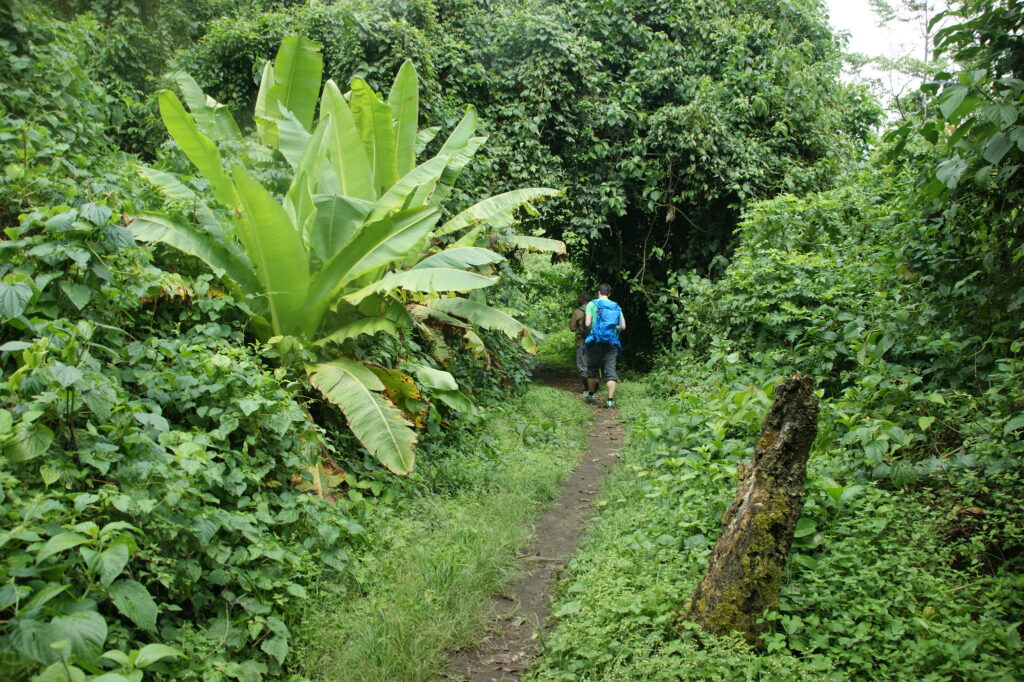
The Diamond Trail opens in the deepest, richest part of the Rwenzori’s Afro-montane forest, the ecological zone that supports the largest and most diverse animal communities on the mountain and has made Rwenzori Mountains National Park a globally recognized center of Albertine Rift biodiversity. The canopy here reaches twenty to thirty meters, its architecture created by ancient Podocarpus, Symphonia globulifera, Ficalhoa laurifolia, and Hagenia abyssinica, each species occupying a slightly different position in the forest’s vertical structure and supporting a different suite of dependent animals. Every trunk and branch is upholstered in moss, liverwort, and epiphytic fern. Every rock surface disappears beneath a layer of bryophytes so thick that the forest floor appears padded, its surfaces soft and absorbent. The light at the forest floor is the filtered green of an aquarium, diffuse, cool, and gently moving as the canopy shifts in the mountain wind above.
This area is where the primates are most reliably found, where the Rwenzori Turaco’s call is closest and most frequent, and where the forest’s ancient, unhurried character is most complete. The path through the lower forest is the slowest section of any Diamond Trail day, and appropriately so. The guide’s pace here is dictated entirely by what the forest is offering in real time, and the instruction is consistent: look up as much as down, listen more than you speak, and allow the guide’s knowledge to direct attention to what would otherwise remain invisible.
Zone 2: The Bamboo Transition (2,000–2,500 m)
Above the core Afro-montane forest, the Diamond Trail enters a transitional zone where Giant Mountain Bamboo, Arundinaria alpina, begins to appear at the forest margin and progressively takes over the understory. The bamboo zone proper begins at approximately 2,200 meters and changes the Diamond Trail’s character completely: the open canopy of the hardwood forest is replaced by the dense, pale-stemmed corridor of eight- to twelve-meter bamboo, its filtered green light different in quality from the forest below, and its acoustic environment muffled and specific. The trail through the bamboo is where the three-horned Rwenzori Chameleon is most reliably found, its lateral compression and bark-like texture making it almost perfectly camouflaged against the bamboo stems until the guide stops and directs your gaze to the exact spot where it has been sitting motionless for the past ten minutes.
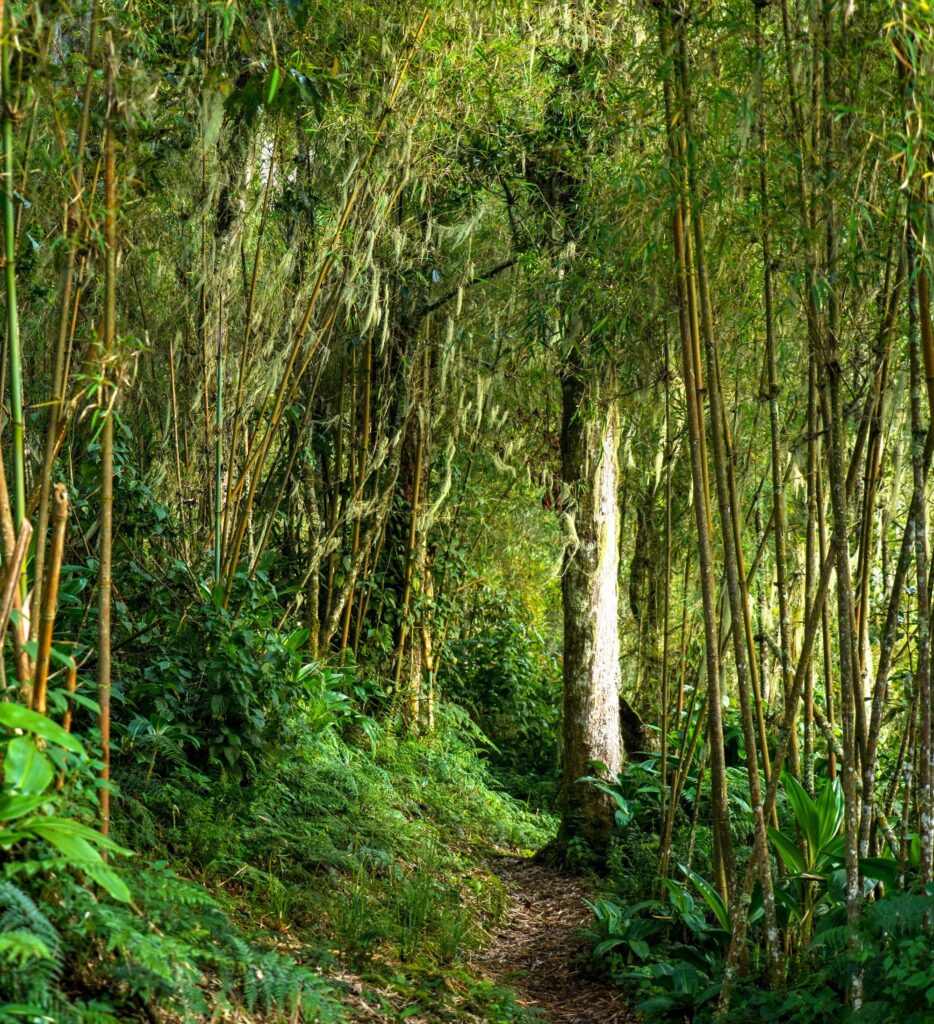
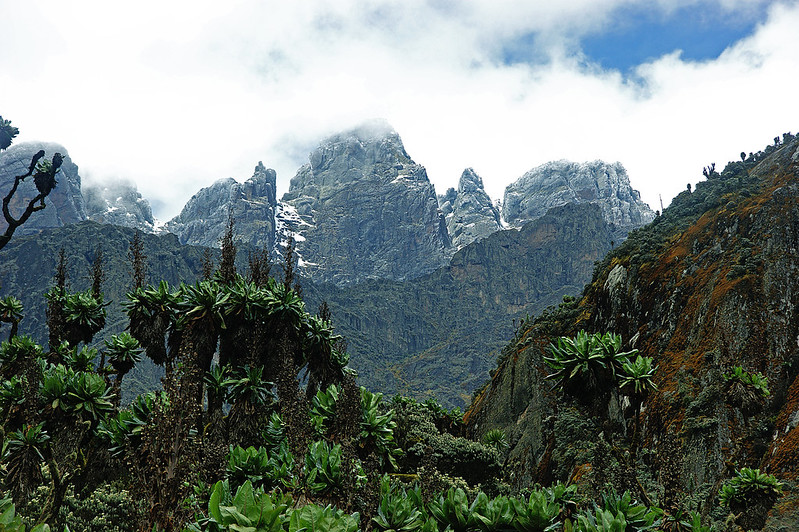
The bamboo zone also marks the transition zone where some of the Diamond Trail’s most specialist Albertine Rift birds occur. The Rwenzori Batis is particularly active in the bamboo-forest ecotone, and the Rwenzori Double-Collared Sunbird moves between the flowering plants of the transition zone with the hovering, probing efficiency of a specialist nectarivore. At the upper margin of the bamboo zone, the first giant heather trees begin to appear, their silver-lichened trunks marking the beginning of the Heather-Rapanea zone above, and from this transition point on clear days, the first views of the upper mountain become possible, with the peaks of Mount Stanley and Mount Speke occasionally visible through gaps in the vegetation above.
Zone 3: The Lower Heather Transition (~2,500–2,600 m)
At the Diamond Trail’s upper elevation limit, the bamboo gives way to the giant heather zone, the ecological community that defines the Rwenzori’s middle mountain and whose fifteen-meter heather trees draped in Usnea lichen create the otherworldly forest character that trekkers on longer routes associate with the approach to the high camps. The Diamond Trail typically reaches this transition zone at the end of a Day 1 ascent, with camp at Nyabitaba Hut on the Central Circuit side or Sine Hut on the Kilembe Trail side providing an overnight position at the ecological boundary between the forest below and the heather world above. From camp at this elevation, when the evening cloud clears, views up toward the Rwenzori peaks can be extraordinary, the snow-streaked upper massif of Mount Stanley visible above the cloud line, the entire forest world below laid out in a panoramic sweep that contextualizes the trail’s ecological journey within the mountain’s full vertical range.
Accommodation Along the Diamond Trail
Nyabitaba Hut, 2,651 m (Central Circuit Access)
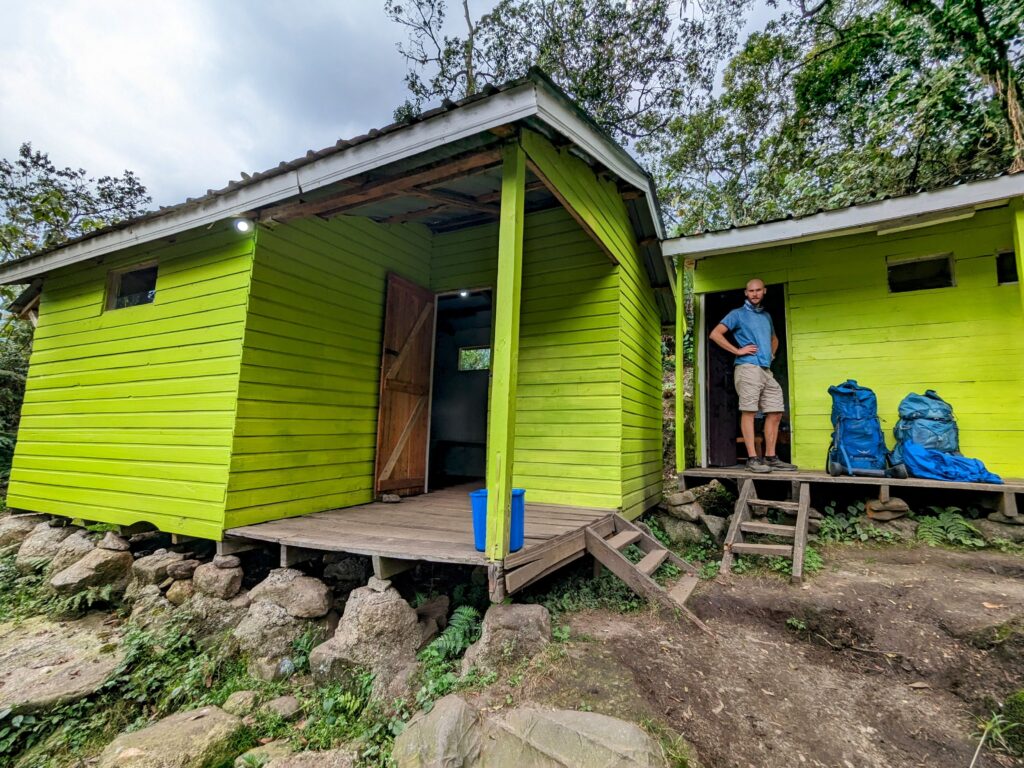
For Diamond Trail trekkers approaching from the Nyakalengija Central Circuit trailhead, Nyabitaba Hut at 2,651 meters serves as the natural overnight camp at the upper end of the trail’s forest zone. The hut occupies a ridge position above the confluence of the Mubuku and Bujuku rivers, with views southward across the lower valley and northward toward the ridges of the upper mountain. The Uganda Wildlife Authority wooden mountain hut provides bunk sleeping with foam mattresses, a kitchen and dining shelter staffed by your dedicated mountain cook, and basic toilet facilities. The forest immediately surrounding Nyabitaba is among the richest bird habitat on the lower Central Circuit trail, and the morning birding session from the hut perimeter before departure, or before returning down the trail, is particularly productive for Albertine Rift endemics in the canopy transition zone.
Sine Hut: 2,596 m (Kilembe Trail Access)
For Diamond Trail trekkers approaching from the Kyanjuki Kilembe Trail trailhead, Sine Hut at 2,596 meters serves as the upper-end camp. The hut sits on a narrow forested ridge above the Nyamwamba Valley, where the upper Afro-montane forest meets the bamboo zone. You can hear Enock’s Falls, a spectacular multi-tiered cascade, long before you arrive, and you can see it by taking a short two-hundred-meter side trail from camp. Sine Hut offers the same wooden hut infrastructure as Nyabitaba, bunk sleeping, mountain cook, and basic facilities, with the added sensory bonus of the falls’ sound as the constant auditory backdrop to the overnight stay. The forest immediately around Sine Hut in the early morning, before the valley mist rises, is particularly productive for primate activity.
Pre- and Post-Trail Accommodation in Kasese
For Diamond Trail trekkers based in Kasese before and after the trail, Rwenzori Trekking Expeditions recommends the Mountains of the Moon Hotel, the Rwenzori Travellers Inn, and the Margherita Hotel as comfortable midrange options within easy reach of the Nyakalengija and Kyanjuki trailheads. For trekkers combining the Diamond Trail with a summit expedition via Fort Portal and Kibale Forest, the Rwenzori View Guesthouse and Chimpanzee Forest Guesthouse in Fort Portal offer quality accommodation between destinations. Rwenzori Trekking Expeditions coordinates all pre- and post-trail accommodation logistics as part of every itinerary package.
Diamond Trail Itinerary Options From One Day to Multi-Day Combinations
Option 1: One-Day Diamond Trail Wildlife Experience
A single full day on the Diamond Trail, entering the forest at dawn when primate activity is highest and returning to the trailhead by mid-afternoon, is the minimum unit of experience that does the trail genuine justice. Departure from Kasese accommodation by 5:30 AM ensures arrival at the trailhead before first light, with the guide team leading the forest entry in the pre-dawn quiet when chimpanzee groups are most predictable in their positions and most active in their morning feeding behavior. The day’s structure follows the forest’s own rhythm: early morning for primate tracking, mid-morning for bird observation in the canopy transition zones, a packed lunch at a natural clearing or stream crossing, and a slower return through the afternoon forest with attention directed at whatever the trail is offering in the different light of the descent. This option is best suited to trekkers with limited time who want a focused, expert-guided wildlife day in the Rwenzori forest, and it is a genuinely complete experience within its single-day structure.
Option 2: Two-Day Diamond Trail with Forest Overnight
Adding an overnight camp at Nyabitaba Hut or Sine Hut transforms the Diamond Trail from a wildlife day into a forest immersion, and the transformation is significant. Two days in the forest provides morning and evening wildlife activity windows, which are the most productive periods for both chimpanzee tracking and bird observation. Day 1 follows the ascent into the forest, spending the morning and afternoon in the core montane forest zone and arriving at camp by late afternoon. The evening at camp, cool and quiet, the forest adjusting to nightfall around the hut, and the Rwenzori Nightjar beginning its call as the light fades, has a specific quality of mountain intimacy that the single-day experience cannot provide. Day 2 opens with the finest birdwatching window of the entire trail: the hour before and after dawn from the hut perimeter, when the forest canopy is at its most active and the endemic species that spent the day hidden in the mid-canopy are moving and calling at accessible heights. The return descent through the morning forest, now familiar and therefore more deeply observed, completes a two-day experience that is significantly richer than the sum of its individual parts.
Option 3: Three-Day Diamond Trail with Extended Forest Time
Three days on the Diamond Trail allows for a complete forest experience, ascending on Day 1, spending Day 2 entirely in the forest zone with morning and afternoon wildlife sessions and the midday hours used for botanical exploration, bird identification, and the particular quality of rest that a forest clearing at 2,400 metres in the Rwenzori provides, before descending on Day 3. This option is specifically recommended for dedicated birdwatchers who want to maximize their species count, for photographers who need multiple light conditions and multiple wildlife encounters to build a complete photographic record, and for trekkers whose primary motivation is the depth of the forest experience rather than summit achievement. Three days in the Diamond Trail’s forest is enough time for the forest to become genuinely familiar, enough time to recognize individual bird calls, to begin reading the patterns of primate movement, and to experience the forest not as a backdrop for wildlife viewing but as a coherent ecosystem in which you are temporarily a participating observer.
Option 4: Diamond Trail Combined with a Summit Expedition
The most complete version of any Rwenzori expedition incorporates Diamond Trail time alongside a summit bid, giving the full vertical range of the mountain’s experience, from the forest floor to the glaciated summit, as a single coherent journey. Adding one or two Diamond Trail days before a 7-day Central Circuit or Kilembe Trail summit expedition provides both a gentle physical warm-up before the harder climbing days and an ecological introduction to the mountain’s lower world that makes the transition through the vegetation zones on the summit approach feel earned and contextualized rather than merely observed. Adding Diamond Trail days after the summit return produces a different and equally valuable effect: the descent from cold, exposed alpine terrain back into the warmth and richness of the forest has an emotional quality that experienced guides consistently describe as one of the most affecting moments of any complete Rwenzori expedition, the forest receiving you back after the mountain has tested you, its warmth and abundance a contrast with the stark beauty of the upper zones that amplifies both experiences.
Combination | Total Duration | Highlights |
Diamond Trail only (1 day) | 1 day | Chimpanzees, forest birds, morning forest wildlife |
Diamond Trail + overnight (2 days) | 2 days | Dawn & dusk wildlife, forest overnight, Enock’s Falls |
Diamond Trail extended (3 days) | 3 days | Birding focus, deep forest immersion, full primate community |
Diamond Trail + 7-day Central Circuit | 9 days | Full forest to Margherita glacier experience, 3 Rwenzori peaks |
Diamond Trail + 7-day Kilembe Trail | 9 days | Full forest + Kilembe traverse + Margherita Peak |
Diamond Trail + Gorilla Trekking + Rwenzori | 12–14 days | Complete western Uganda primate circuit |
Diamond Trail + safari + gorillas + Rwenzori | 16–19 days | Full Uganda wildlife and mountain grand tour |
What Is Included in a Diamond Trail Package?
Every Diamond Trail itinerary operated by Rwenzori Trekking Expeditions is fully inclusive within the mountain section of the trip. The following gives a transparent account of what is and is not covered in the standard package price.
What Is Included
Every package includes Uganda Wildlife Authority national park entry permits for the full duration of the Diamond Trail. Your certified, English-speaking Rwenzori mountain guide with specialist wildlife tracking and ornithological knowledge accompanies the team throughout every trail day. A porter carries communal equipment and personal bags within the standard load allocation. Your dedicated mountain cook provides a full board from the first trail lunch through the final trail lunch; all meals on the mountain are prepared at camp and at designated rest points on the trail. Mountain hut accommodation at Nyabitaba Hut or Sine Hut (for overnight itineraries) is pre-booked and confirmed. Private 4WD vehicle transfer between Kasese and the trailhead is included. A comprehensive first aid kit is carried by the guide throughout.
What Is Not Included
International and domestic flights to Uganda are not included. The Ugandan tourist visa, USD $50 for most nationalities, available on arrival at Entebbe International Airport or through the Uganda e-Visa portal, is arranged independently by each trekker. Travel insurance, which must include emergency medical evacuation cover, is mandatory and not provided. Personal trekking clothing, waterproof boots, trekking poles, and binoculars are the trekker’s own responsibility, though a full gear guidance list is provided to every confirmed guest upon booking. Guide and porter gratuities are not included in the package price; guidance on appropriate amounts is provided upon booking confirmation. Pre- and post-trail accommodation in Kasese is not included unless specifically added to a combined itinerary package.
Best Time to Trek the Diamond Trail
The Diamond Trail operates year-round within Rwenzori Mountains National Park, and the forest’s wildlife, particularly its primate communities, is resident and active in every month. What changes between seasons is not wildlife presence but trail comfort, underfoot conditions, and the quality of visibility in the forest canopy.
Dry seasons, June to August and December to February
The two dry seasons provide the most comfortable Diamond Trail conditions: firmer forest paths, drier undergrowth, and generally clearer canopy visibility for both bird observation and primate tracking. June through August is the primary recommended window, aligning with Uganda’s main tourism season and providing the best combination of dry conditions, cooler temperatures in the forest, and high bird activity as resident species respond to the drier-season food availability. December through February, particularly January and February, offers the year’s second-most-reliable conditions, with morning forest clarity that photographers specifically seek and a quieter trail than the peak July–August window.
Wet Seasons, March to May and September to November
The wet seasons change the Diamond Trail’s character rather than diminishing it, and experienced trekkers who are equipped for wet conditions find the wet-season forest among the most extraordinary natural environments in East Africa. The lower montane forest in full wet-season expression reaches a depth of green and biological intensity that the drier months cannot replicate, the moss gardens are saturated and vivid, the waterways run full and clear, the forest floor is carpeted with newly fruiting fungi and botanical activity, and the birdsong is more continuous and varied as species take advantage of the increased insect populations. Trail surfaces are muddier, and stream crossings require more care, making appropriate footwear and trekking poles more important. Chimpanzee and primate activity is not significantly reduced by the rains, the forest’s resources are actually more abundant in the wet season, and primate groups tend to be larger and more active in response.
Getting to the Diamond Trail: Kasese, Uganda
The Diamond Trail is accessed from Kasese District in western Uganda, following the same approach routes as all Rwenzori Mountains National Park trekking. The Nyakalengija trailhead (Central Circuit access) is 22 kilometers from Kasese, approximately twenty to thirty minutes by private vehicle. The Kyanjuki trailhead (Kilembe Trail access) is 35 kilometers from Kasese, approximately thirty-five to forty-five minutes. Rwenzori Trekking Expeditions arranges all trailhead transfers as part of every package.
From Entebbe International Airport, the journey to Kasese covers approximately 430 to 460 kilometers via the Kampala–Mbarara–Kasese highway, six to seven and a half hours by private vehicle. Domestic charter flights from Entebbe to Kasese Airport reduce the duration to approximately one hour. The Diamond Trail is especially easy to combine with Queen Elizabeth National Park (45–60 minutes east of Kasese), Kibale Forest National Park (1.5–2 hours north via Fort Portal), and Bwindi Impenetrable National Forest (3–4 hours south), all of which are natural companions for a Diamond Trail focused on the full western Uganda primate experience.
What to Pack for the Diamond Trail
The Diamond Trail’s forest environment, damp year-round, with sudden light showers possible in any month, requires specific gear choices distinct from higher-altitude Rwenzori trekking. A full itemized packing list is provided to every confirmed Rwenzori Trekking Expedition guest, but the core requirements are as follows.

Essential Gear
Waterproof hiking boots with ankle support and deep-lugged soles are the single most important item; the forest trails are rooted and occasionally steep, and wet-season mud on these paths is unforgiving on inadequate footwear. A waterproof jacket that you can reach quickly is essential; even in the dry season, forest microclimates produce brief showers regardless of the weather below. Trekking poles are strongly recommended for the rooted sections and for the stream crossings. Long-sleeved shirts and long trousers protect against forest nettles, insect activity, and the temperature drop that occurs when the afternoon cloud arrives. Quality binoculars (8×42 or 10×42) are the tool that most significantly determines the quality of the birding experience; they transform a bird heard in the canopy into a bird seen, identified, and understood. A camera with a telephoto or zoom lens is the standard approach for wildlife photography in the filtered light of the forest interior. Insect repellent is useful for the lower forest sections in the wet season.
The Diamond Trail in the Context of a Western Uganda Primate Safari
The Diamond Trail occupies a specific and complementary position within western Uganda’s extraordinary portfolio of primate experiences. Understanding how it relates to the other major primate destinations helps in designing an itinerary that delivers the full range of what this region offers.
Kibale Forest National Park, about two hours north of Kasese via Fort Portal, is Uganda’s best-known chimpanzee trekking destination. It is a lowland forest reserve with a well-managed habituated chimpanzee program that reliably provides high-quality encounters with a large, behaviorally rich community. The Diamond Trail’s chimpanzee experience is genuinely distinct from Kibale’s: the setting is a UNESCO World Heritage mountain range, the primates are wild rather than habituated, and the solitude and ecological context are fundamentally different. For trekkers who complete both, the two experiences are complementary rather than duplicative, each offering a different window into the same species in a different landscape and at a different level of wildness.
Bwindi Impenetrable National Park, three to four hours south of Kasese, needs no introduction for primate travellers: it is one of the world’s most celebrated gorilla trekking destinations and home to approximately half of the world’s remaining mountain gorillas. A western Uganda itinerary that moves from Bwindi’s mountain gorilla encounter to the Diamond Trail’s wild chimpanzee experience and then to Kibale’s habituated chimpanzee community, with Queen Elizabeth National Park’s tree-climbing lions and the Kazinga Channel boat cruise as additional wildlife components, represents one of the finest wildlife itineraries available anywhere in Africa. Rwenzori Trekking Expeditions coordinates all inter-destination logistics for combined packages of this kind.
Why the Diamond Trail Is Unlike Any Other Wildlife Experience in East Africa
Three qualities separate the Diamond Trail from comparable wildlife trekking routes in East Africa, and they deserve to be stated directly rather than wrapped in promotional language.
The setting. You are not trekking through a lowland forest reserve or a managed habituation zone on flat ground. You are in a 995-square-kilometer UNESCO World Heritage Site at altitude, on the lower flanks of Africa’s third-highest mountain range, in a forest that has existed in its current ecological state for thousands of years. The biological complexity that surrounds every moment of the Diamond Trail experience, the Albertine Rift endemics, the ancient hardwood trees, the primate community that has occupied this forest across geological time, is the reason for the UNESCO designation, and it is the context that gives every wildlife encounter on the Diamond Trail a weight and meaning that encounters in more accessible or more heavily managed environments cannot provide.
The solitude. The Rwenzori Mountains National Park receives a fraction of the visitor numbers of Kilimanjaro, Bwindi, or Kibale. The Diamond Trail sees fewer trekkers in a week than Kibale sees in a single morning. A Diamond Trail day is conducted in genuine quiet, the particular silence of a mountain forest where the only sounds are those the forest makes itself, and that solitude is not an absence but a presence, the condition under which wildlife observation and genuine attention to an extraordinary place become possible in a way that crowds prevent.
The integration. The Diamond Trail is not a separate attraction bolted onto a mountain expedition for commercial reasons. It occupies the ecological zone that every summit trekker passes through but few spend real time in, and walking it with expert wildlife guidance gives the Rwenzori’s full vertical range, from forest floor to glacier, a coherent experiential logic that neither the forest nor the summit provides alone. The two experiences complete each other, and you should experience the Mountain of the Moon as a whole.