DETAIL | INFORMATION |
Trek Duration | 10 Days (8 days on the mountain + 2 travel days) |
Summit Altitude | 5,109 m / 16,762ft — Margherita Peak, Mount Stanley |
Route | Central Circuit Trail (complete loop) |
Trail Difficulty | Challenging to Strenuous — prior high-altitude experience recommended |
Maximum Altitude Gain (single day) | ~1,200m (Day 4: Bigo Hut to Elena Hut) |
Start/End Point | Nyakalengija Village, near Kasese, Western Uganda |
Group Size | Private — your dedicated guide and porter team |
Best Season | January–February and June–August |
Accommodation on Mountain | Staffed mountain huts with beds and meals |
Minimum Age | 16 years (under 18 requires guardian consent) |
Porter Ratio | 1 porter per trekker (additional available on request) |
Physical Preparation Required | Yes, see difficulty section below |
Summit Gear Required | Crampons, ice axe, harness (provided by RTE) |
Why Trek Margherita Peak via the Central Circuit Trail?
The Central Circuit Trail is the complete Rwenzori trekking experience, and there is simply no better way to experience these mountains. Unlike the shorter Kilembe Trail, which approaches the summit from the south via the Kilembe copper-mining region, the Central Circuit trail loops the entire high massif, immersing you in every ecological transition the Rwenzoris have to offer: from the dense montane forest of the lower slopes, fragrant with wild orchids and alive with Rwenzori turacos, through the surreal giant heather moorlands of 3,000 to 3,800 meters, into the otherworldly Afro-alpine zone where giant lobelias tower like alien sentinels and the silence is broken only by the creak of glaciers above.
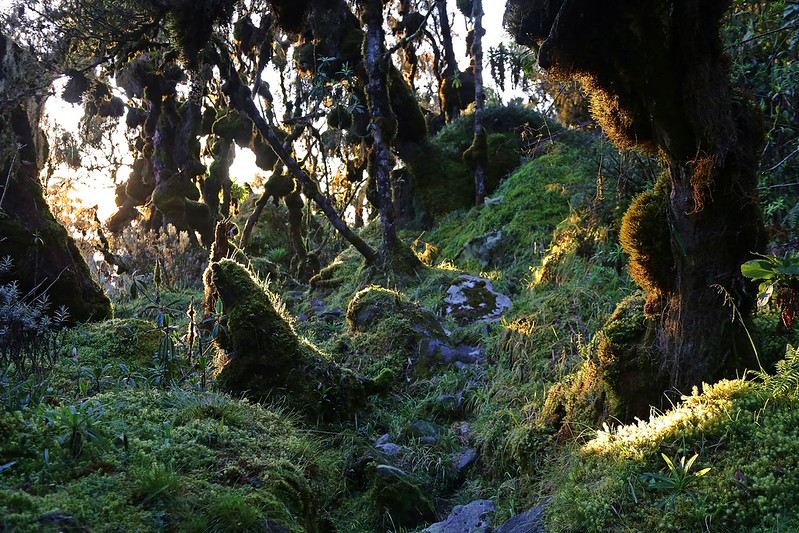
The 10-day Rwenzori trek to Margherita via the central circuit trail traces its way across ridge lines with views into the Democratic Republic of Congo, descends through bog-garden valleys filled with everlasting flowers, and circumnavigates Lac du Mauvais Pas before the final technical push to the summit ridge of Mount Stanley. The Central Circuit trail also offers the finest acclimatization profile, a critical advantage when your goal is standing at 5,109 meters without the discomfort of altitude sickness.
Central Circuit Trail vs. Kilembe Trail — At a Glance
FEATURE | CENTRAL CIRCUIT TRAIL | KILEMBE TRAIL |
Duration | 8–10 days | 7–9 days |
Starting Point | Nyakalengija (1,646m) | Kilembe (1,440m) |
Summit Access | Via Elena Hut / Stanley Glacier | Via Weismann’s Pass |
Ecological Diversity | Maximum — all 6 zones | Good — 4–5 zones |
Acclimatisation Quality | Excellent (gradual gain) | Moderate (steeper profile) |
Scenery Variety | Exceptional | Very Good |
Technical Difficulty | Moderate-High | Moderate-High |
Best For | First-time Rwenzori trekkers wanting the full experience | Repeat visitors or those on tighter schedules |
Altitude Profile of the 10-day Margherita Central Circuit Trail
CAMP / HUT | ALTITUDE | ECOLOGICAL ZONE |
Nyakalengija (Trailhead) | 1,646m / 5,400ft | Cultivation / Forest Edge |
Sine Hut (Night 1) | 2,560m / 8,399ft | Montane Forest |
Nyabitaba Hut (Night 2) | 2,652m / 8,701ft | Montane Forest |
John Matte Hut (Night 3) | 3,414m / 11,201ft | Giant Heather / Bog |
Bigo Hut (Night 4) | 3,450m / 11,319ft | Giant Heather Moorland |
Elena Hut (Night 5 & 6) | 4,541m / 14,900ft | Afro-Alpine / Glacial |
Margherita Peak (Summit) | 5,109 m / 16,762ft | Summit / Glacial |
Guy Yeoman Hut (Night 7) | 3,261 m / 10,699ft | Heather Moorland |
Nyabitaba Hut (Night 8) | 2,652m / 8,701ft | Montane Forest |
Nyakalengija (Exit) | 1,646m / 5,400ft | Forest Edge |
Itinerary at a Glance: 10-Day Rwenzori Trek to margherita Peak
DAY | SUMMARY |
Day 1 | Arrival at Entebbe International Airport — Private Transfer to Kasese (approx. 6–7 hours) |
Day 2 | Kasese to Nyakalengija Trailhead — Trek to Sine Hut (2,560m) — 4–5 hrs |
Day 3 | Sine Hut to Nyabitaba Hut (2,652m) — Forest & Waterfall Walking — 3–4 hrs |
Day 4 | Nyabitaba Hut to John Matte Hut (3,414m) — Into the Heather Zone — 6–7 hrs |
Day 5 | John Matte Hut to Bigo Hut (3,450m) — Bog Gardens & Valley Moorland — 4–5 hrs |
Day 6 | Bigo Hut to Elena Hut (4,541m) — The Great Ascent — 5–6 hrs |
Day 7 | Summit Day — Elena Hut to Margherita Peak (5,109m) and return to Elena Hut — 8–10 hrs |
Day 8 | Elena Hut to Guy Yeoman Hut (3,261m) — Descent through the Southern Circuit — 5–6 hrs |
Day 9 | Guy Yeoman Hut to Nyabitaba Hut (2,652m), Forest Return, 5–6 hrs. Exit to Nyakalengija, Drive to Kasese |
Day 10 | Kasese to Entebbe / Kampala — Departure or Onward Safari |
Detailed 10-Day Margherita Peak Trek Itinerary
DAY 1 | Arrival at Entebbe — Transfer to Kasese Entebbe → Kasese | 370km | Approx. 6–7 Hours by Private Vehicle |
Your Rwenzori adventure begins the moment you step off the plane at Entebbe International Airport. A member of the Rwenzori Trekking Expeditions team will be waiting in arrivals, not with a generic sign and a shared minibus, but with a private vehicle arranged specifically for your group and a journey briefing that sets the tone for everything that follows. The drive to Kasese, your gateway to the Mountains of the Moon, is a journey in itself. You cross the equator at Kayabwe, watch Uganda’s equatorial greenery deepen into the papyrus fringes of Lake Victoria, and then climb through the rolling hills of Mbarara before the Rwenzoris appear on the western horizon, a wall of cloud-draped peaks that seem to belong to a different world entirely.
By evening, you settle into your pre-trek accommodation in Kasese town, where your lead guide joins you for a full equipment check and trek briefing over dinner. Questions are answered, packs are weighed, and the plan is set. Tonight, sleep comes easily, though the mountains are already calling.
Accommodation Margherita Hotel, Kasese — or equivalent lodge | Meals: Dinner included | Transfers: All private |
DAY 2 | Kasese to Nyakalengija — First Steps into the Forest Trek Start: Nyakalengija (1,646m) → Sine Hut (2,560m) | 4–5 Hours | 6km |
Morning in Kasese smells of woodsmoke and wet earth. After an early breakfast, your dedicated vehicle carries the team the 22 kilometers to Nyakalengija, the quiet village at the edge of Rwenzori Mountains National Park where every central circuit expedition begins. Park registration is handled smoothly by your guide while you take your first photographs: the emerald slopes rising impossibly above the banana plantations and the porters heaving loads with a practiced ease that speaks to generations of mountain knowledge.
The trail enters the forest immediately, and you feel the transformation. Within minutes of the trailhead, the sounds of village life are replaced by the chorus of Rwenzori turacos, olive sunbirds, and the distant percussion of waterfalls. The path winds upward through ancient Hagenia trees draped in old-man’s-beard lichen, crossing the Mubuku River on a wooden bridge before climbing steadily to Sine Hut, perched above the valley floor with the forest closing in on all sides.
This first afternoon is gentle by design. Your body begins its introduction to altitude, your boots find their rhythm on the Rwenzori earth, and your guide begins to reveal what makes these mountains unlike anywhere else on the planet, including the remarkable fact that the Rwenzoris receive over 200 days of rainfall per year, yet their summit glaciers are retreating, a visible consequence of climate change unfolding at 5,000 meters above sea level.
Accommodation Sine Hut (2,560 m), staffed mountain hut | Meals: Breakfast, Lunch, Dinner | Walking Time: 4–5 hrs |
DAY 3 | Sine Hut to Nyabitaba Hut — The Waterfall Trail Sine Hut (2,560m) → Nyabitaba Hut (2,652m) | 3–4 Hours | ~5km |
The second day on the mountain is intentionally measured, an acclimatization day that offers more forest immersion than elevation gain, a gift to your physiology that pays dividends on the higher reaches. The trail contours along the valley side, crossing streams on log bridges that require a quiet focus, passing stands of tree ferns and the occasional giant Dombeya with flowers bright as snow. The mist that is the Rwenzoris’ near-permanent companion drifts through the canopy in soft columns.
The highlight of the morning is Mubuku Waterfall, where the river drops 30 meters into a froth of white against dark basalt. Your guide knows exactly where to stand for the full drama of it. By early afternoon, Nyabitaba Hut materializes in a clearing, a solid stone structure with a wide veranda from which the view down the Mubuku Valley, and on a clear afternoon, all the way to the plains of western Uganda, is simply breathtaking. This evening, the cook prepares a warming three-course meal, the porters gather around their own fire, and the stars above the Rwenzoris, when they emerge through a gap in the cloud, are the kind that stop conversation dead.
Accommodation Nyabitaba Hut (2,652m) | Meals: Breakfast, Lunch, Dinner | Walking Time: 3–4 hrs |
DAY 4 | Nyabitaba Hut to John Matte Hut — Into the Giant Heather Nyabitaba (2,652m) → John Matte Hut (3,505 m) | 6–7 Hours | ~9km |
Today the mountain reveals its second personality. Below the 3,000-meter mark, the forest begins to thin, and the first stands of tree heather, Erica arborea growing to eight meters and draped in hanging mosses, announce the transition into the zone that defines the Rwenzori’s middle mountain. The trail crosses the Bujuku River and steepens considerably, and the effort of each step is now measured against the thinning air.
The reward for this exertion is extraordinary. By midday, you walk through corridors of giant heather so otherworldly that many trekkers stop mid-stride simply to stare. The ground underfoot turns to a deep, root-laced bog, and your guide points out the telltale pressure points that minimize the risk of sinking shin-deep. This is where walking poles, strongly recommended by the team at Rwenzori Trekking Expeditions, prove their value. Giant groundsels, Senecio trees that grow only in a handful of equatorial African mountain ranges, begin to appear on the valley edges, their cabbage-like heads atop thick, corky trunks a vision straight from a Jurassic landscape.

John Matte Hut sits in a meadow clearing at the convergence of two valleys and offers the first serious mountain views if the afternoon cloud cooperates. The hut is named for the Rwenzori guide who led countless expeditions through this terrain in the early twentieth century. Sleeping here, with the giants of the upper mountain looming somewhere above the mist, is to feel genuinely remote and genuinely alive.
Accommodation John Matte Hut (3,414m) | Meals: Breakfast, Lunch, Dinner | Walking Time: 6–7 hrs | Altitude Note: Some trekkers experience mild headaches; report to guide |
DAY 5 | John Matte Hut to Bigo Hut — Bog Gardens and Open Moorland John Matte (3,414m) → Bigo Hut (3,450m) | 4–5 Hours | ~6km |
The elevation gain today is modest, barely 40 meters, but the terrain is the most uniquely Rwenzori experience you will find anywhere on earth. The Bigo Bog is a high-altitude wetland unlike anything in the Himalaya or the Andes: a vast, spongy tapestry of sedge, moss, and everlasting flowers threaded by streams of extraordinary clarity. Giant lobelias, Lobelia wollastonii, stand sentinel at the bog edges, their meter-tall flower spikes rising from rosettes of waxy, silver-green leaves. The sky, when it opens, seems impossibly blue at this altitude.
Your guide knows the bog’s hidden pathways, the firm routes through the morass that generations of Rwenzori porters have mapped through accumulated knowledge. The crossing requires concentration but offers, in return, a feeling of profound intimacy with this landscape, a sense that the mountain is admitting you into something it does not show to casual visitors. By early afternoon, Bigo Hut stands above a stream junction, a solid refuge at the threshold of the high mountain.
Today is also a crucial physiological preparation day. At 3,450 meters, with Elena Hut at 4,541 meters ahead, your guide will conduct a careful wellness check: oxygen saturation readings, headache assessment, and appetite and sleep quality review. The team at Rwenzori Trekking Expeditions carries both a pulse oximeter and a Gamow bag for emergencies, a standard kit on every expedition, because responsible guiding is the non-negotiable foundation of everything they do.
Accommodation Bigo Hut (3,450m) | Meals: Breakfast, Lunch, Dinner | Walking Time: 4–5 hrs | Medical Check: Daily O₂ saturation monitoring |
DAY 6 | Bigo Hut to Elena Hut — The Great Ascent Bigo (3,450m) → Elena Hut (4,541m) | 5–6 Hours | ~8km | Altitude Gain: +1,091m |
This trek is the day the Rwenzoris take on their most dramatic form. The trail climbs out of the bog garden and enters the Afro-alpine zone above 4,000 meters, a landscape so stark and beautiful it borders on hallucinatory. Giant groundsels now reach five meters in height. The sky deepens to an indigo that only altitude produces. The air bites with a cold that has nothing to do with latitude and everything to do with elevation. The glaciers, those ancient rivers of ice that have given the Rwenzoris their snowfields since the last ice age, first come into view around the bend above Lac Kitandara — two still, dark alpine lakes sitting beneath the southern faces of Mounts Baker and Luigi di Savoia, their surfaces mirroring the sky and peaks above.

The final climb to Elena Hut is steep and unrelenting, the trail switching back across broken rock and the edges of the Luigi Glacier. At 4,541 meters, Elena Hut is one of the highest staffed mountain refuges in Africa, a stone and timber hut with gas heating, metal bunks, and a cook who somehow produces hot soup and pasta at an altitude where water boils at 85 degrees Celsius. The light at this elevation is crystalline, the shadows knife-sharp. Tonight, the briefing for tomorrow’s summit push is thorough, quiet, and serious. Your crampons are fitted. The route is explained in detail. Sleeping as much as altitude permits is the priority.
Accommodation Elena Hut (4,541m) — highest serviced hut on the route | Meals: Breakfast, Lunch, Dinner | Summit Gear Check: Crampons, ice axe, harness fitting | Walking Time: 5–6 hrs |
DAY 7 | SUMMIT DAY — Elena Hut to Margherita Peak and Return Elena Hut (4,541m) → Margherita Peak (5,109m) → Elena Hut | 8–10 Hours | The Pinnacle |
The alarm sounds in the dark, 3:00 AM, and for a moment, the warmth of the sleeping bag makes the summit feel entirely optional. Your guide’s knock is quiet but certain. Headtorches come on. The cook has hot tea and porridge waiting. By 4:00 AM, the team steps out onto the frozen ground beneath a sky so dense with stars it seems solid, and the climb begins.
The first section traverses the Stanley Plateau, a snowfield that at this hour is hard-frozen and requires crampons from the first step. Your guide moves with the unhurried precision of someone who has climbed many times, reading the ice, choosing the line, and always keeping the team together and the pace sustainable. The wind, if it comes, can be significant above 4,800 meters. The cold is real. But the darkness also brings a strange intimacy with the mountain, just the crunch of boots on ice, the pool of light ahead, and the slow revelation of the ridge above.
The final approach to Margherita Peak involves a technical scramble across the Albert-Margherita col, a narrow ridge with exposure on both sides and the Congo Basin opening into darkness below. Your guide clips the rope. The last ten meters are hands-on-rock, and then you reach the summit. The highest point in Uganda. The third highest point in Africa. It is a place where the wind scours a horizon that encompasses two countries, three mountain massifs, and the curvature of the earth itself.
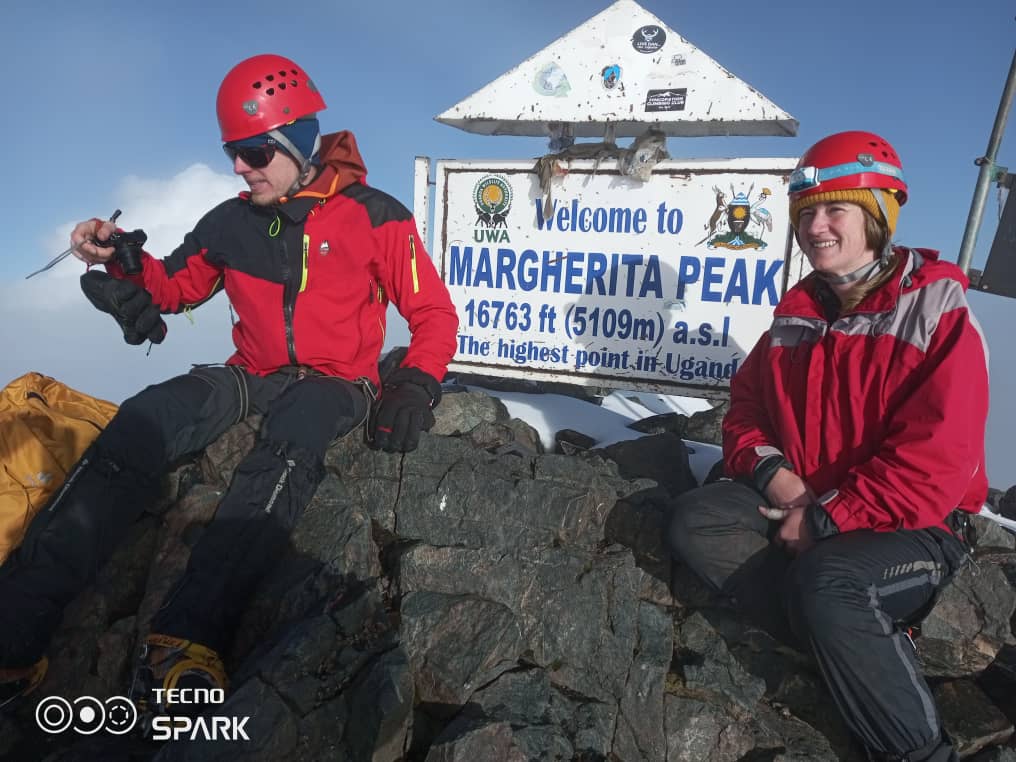
The moment on top, however long the weather and your physiology allow, is one of the most profound silences most climbers ever experience. Then the descent begins: careful, methodical, guided with the same precision as the ascent. By early afternoon, you are back at Elena Hut, tea in hand, boots off, with the mountain below your feet at last. This evening, dinner feels like a celebration, and it is one.
Accommodation Elena Hut (4,541m) — second night | Meals: Breakfast, Packed Lunch, Dinner | Technical Requirement: Crampons, ice axe, fixed rope on summit approach | Summit Probability: ~85% in optimal season |
DAY 8 | Elena Hut to Guy Yeoman Hut — The Southern Descent Elena Hut (4,541m) → Guy Yeoman Hut (3,261m) | 5–6 Hours | ~10km |
The descent from Elena Hut follows the southern arm of the Central Circuit trail, the Freshfield Pass route, into terrain that contrasts dramatically with the northern approach. The Freshfield Glacier, visible from the trail, is a study in slow-motion loss: a river of ice that has retreated perhaps 500 meters in the last century, its lateral moraines now exposed as raw, grey scree. Your guide speaks about the glacier with the quiet authority of someone who has watched it change season by season. It is one of the most vivid, immediate encounters with climate change available anywhere on the planet.
The trail drops through the Kitandara Valley once more, passing the lakes from a different angle before climbing briefly to Freshfield Pass at 4,282 meters, a final high point with views back to Margherita and ahead to the lower valleys of the southern circuit. The descent from the pass is steep but well managed, with the heather closing in above 3,500 meters and the air growing measurably warmer and richer with every 100 meters of descent. Guy Yeoman Hut, nestled in its clearing at 3,261 meters, feels luxurious by comparison with Elena, which is to say, warm, dry, and generous.
Accommodation Guy Yeoman Hut (3,261m) | Meals: Breakfast, Lunch, Dinner | Walking Time: 5–6 hrs |
DAY 9 | Guy Yeoman Hut to Nyabitaba Hut — Forest Return and Exit Guy Yeoman (3,261m) → Nyabitaba Hut (2,652m) → Nyakalengija → Kasese | 5–6 Hours Trek + Transfer |
The final morning on the mountain arrives with birdsong rather than alarm clocks, or so it feels. The trail descends through lower moorland, re-enters the montane forest with its familiar canopy of Hagenia and Podocarpus, and brings the team back to Nyabitaba Hut for a final rest stop and lunch. The forest feels different on the way down, greener, warmer, and almost tropical by comparison with the high mountain’s austerity and teeming with the birdlife that the upper zones don’t permit.
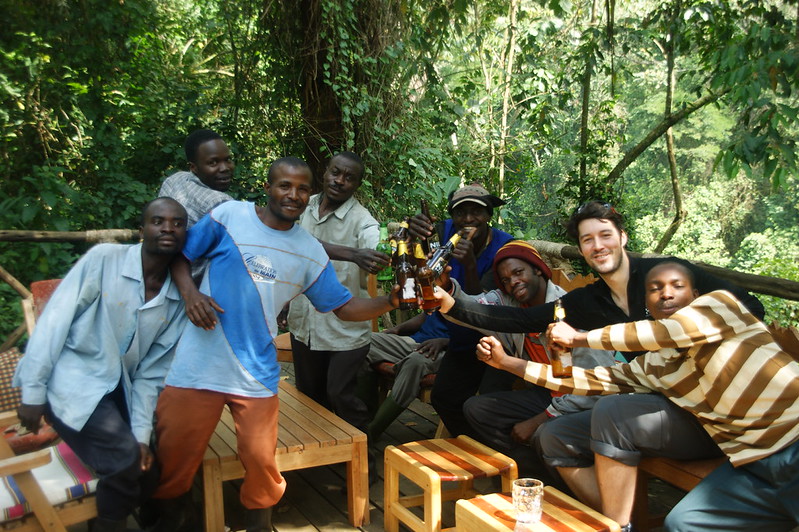
The afternoon sees the full circuit completed as the trail emerges at Nyakalengija, where the porters’ extended families gather at the trailhead and the air smells of cooking fires and sweet potato. There are handshakes, photographs, and a ceremony of tipping and thanks that is one of the most quietly moving moments of any Rwenzori expedition. Your private vehicle is waiting. The drive back to Kasese takes less than an hour, but the distance between who you were when you first drove this road and who you are now is immeasurable.
Accommodation Margherita Hotel, Kasese (or equivalent) | Meals: Breakfast, Lunch, Dinner | Porter Tip Ceremony: Handled with discretion and guidance by your lead guide |
DAY 10 | Kasese to Entebbe / Kampala — Departure or Onward Safari Drive: Kasese → Kampala/Entebbe | Approx. 6–7 Hours | Private Vehicle |
The final day is transition, but it need not be merely logistical. Many trekkers choose to break the drive at the Queen Elizabeth National Park viewpoint above the Kazinga Channel, where the savanna landscape is below: Hippos in the water, elephants at the treeline, fish eagles overhead, feels almost surreally pastoral after ten days of high-altitude focus. Others prefer to return directly to Kampala or Entebbe, arriving in time for a final evening of Ugandan cuisine and the quiet satisfaction of checking the summit photograph once more.
For those wishing to extend their Uganda experience, the Rwenzoris sit within reach of some of East Africa’s finest wildlife destinations. Rwenzori Trekking Expeditions can seamlessly arrange onward transfers to Bwindi Impenetrable Forest for gorilla tracking, Queen Elizabeth National Park for game drives, or the Kibale Forest for chimpanzee habituation. Every detail, every transfer, every accommodation upgrade is arranged with the same care that governed each day on the mountain.
Transfer Private vehicle: Kasese to Entebbe/Kampala or onward destination | All arrangements handled | Onward safari extension available on request |
How Difficult Is the Margherita Peak Trek?
The 10-day Margherita Peak Trek via the Central Circuit Trail is rated as challenging to strenuous and requires genuine physical preparation. The terrain combines high-altitude bog traversal, steep rocky ascents, glacier crossing, and technical rope sections on the summit approach. The Rwenzoris are not a Kilimanjaro walk-up; this is mountain climbing in the fullest sense, and the team at Rwenzori Trekking Expeditions will be candid about what that demands.
What Makes the Rwenzoris Physically Demanding
The bog terrain of the middle mountain (Days 4 and 5) requires sustained balance, core stability, and psychological resilience; the Bigo Bog in particular demands constant attention to foot placement. The altitude gain on Day 6 (over 1,000 meters from Bigo to Elena Hut) is one of the steepest sustained ascents in East African trekking. And the summit push, beginning at 3:00 AM from 4,541 meters, crossing a glacier, and ascending a rocky ridge with rope sections, requires a level of fitness and mental determination that only trekkers who have invested seriously in preparation will find manageable.
Recommended Fitness Preparation
At least three months before departure, your training program should include regular cardiovascular exercise (running, cycling, or swimming at sustained effort), weighted hiking on uneven terrain with the pack you intend to carry, and, if possible, two or three days of high-altitude exposure above 3,000 meters. The Rwenzori Trekking Expeditions guides strongly recommend yoga or Pilates sessions that target core strength and ankle stability. Upon booking confirmation, the team provides a detailed pre-trek fitness guide.
Altitude and Acclimatisation
Acute Mountain Sickness (AMS) is a genuine consideration above 3,000 meters and a serious risk above 4,000 meters. The Central Circuit Trail’s gradual acclimatization profile, with no single-day gain exceeding 1,100 meters and two nights at Elena Hut before the summit push, is the most conservative and safest approach to Margherita Peak available. Your guide conducts daily oxygen saturation monitoring and applies the internationally recognized acclimatization protocol: if symptoms of AMS develop and do not resolve with rest and hydration, descent is mandatory. There are no exceptions. The mountain will be there next season; your health is irreplaceable.
What Is Included in the 10-Day Margherita Peak Trek?
Every element of the Rwenzori Trekking Expeditions experience is designed to remove the planning burden from you so that you can focus entirely on the mountain. What follows is the full scope of what your expedition encompasses.
Included in Your Expedition
Your package includes all accommodation on the mountain in staffed huts with meals and hot drinks; pre- and post-trek hotel accommodation in Kasese with dinner on arrival and breakfast on departure;
All meals on the trail from breakfast on Day 2 through lunch on Day 9.
All park entrance fees and Rwanda Mountains National Park permits; your certified lead guide with summit experience; a dedicated porter team (one porter per trekker as standard, with additional porters available);
All technical summit equipment, including crampons, an ice axe, and a harness; a comprehensive pre-trek medical kit, including a pulse oximeter, a Gamow bag for high-altitude emergencies, and first-aid supplies; and all private road transfers between Entebbe and Kasese.
Comprehensive trek briefing, fitness guidance documents, and a packing list are provided upon booking confirmation.
Not Included
International and domestic flights to and from Uganda fall outside the package, as does travel insurance, which is absolutely mandatory and must include high-altitude mountain rescue and emergency evacuation coverage to a minimum altitude of 5,500 meters.
The package does not include personal tipping for guides and porters, personal equipment like trekking poles, personal clothing and sleeping bags (sleeping bag hire is available), alcoholic beverages, or any additional nights in Kasese or Kampala.
A detailed excluded-items list is provided with your booking documentation.