Discover the complete Rwenzori trekking tipping guide covering trekking guides, porters and cooks, when to tip, how much to give, tipping etiquette, and practical advice.
Tipping on a Rwenzori trek is a customary way for travelers to recognize the service provided by guides, porters, cooks, and other members of the trekking team. There is no single universal tip that applies to every Rwenzori expedition because the appropriate amount can depend on the trek duration, group size, level of service, number of staff, and the traveler’s satisfaction. The Rwenzori Trekking Expeditions Tipping Policy is always transparent, voluntary, and separate from fair wages paid to the trekking team.
On a standard Rwenzori trek, a fair total tip works out to roughly $15 to $25 per trekker, per day, shared across the whole support team, guides, porters, and cooks combined. In practical terms, that means budgeting around $10 to $15 per day for a lead guide, $8 to $10 per day for an assistant guide or cook, and $5 to $8 per day for each porter, adjusted for group size, trek length, and the quality of service you actually receive. Tips are given at the end of the trek, in cash, ideally in a small ceremony where every member of staff is thanked by name. The rest of this guide explains exactly how to calculate that figure for your trip, who should receive what, when to hand it over, and why we treat tipping as a genuine act of gratitude rather than a quiet way of covering wages that should already be fair.
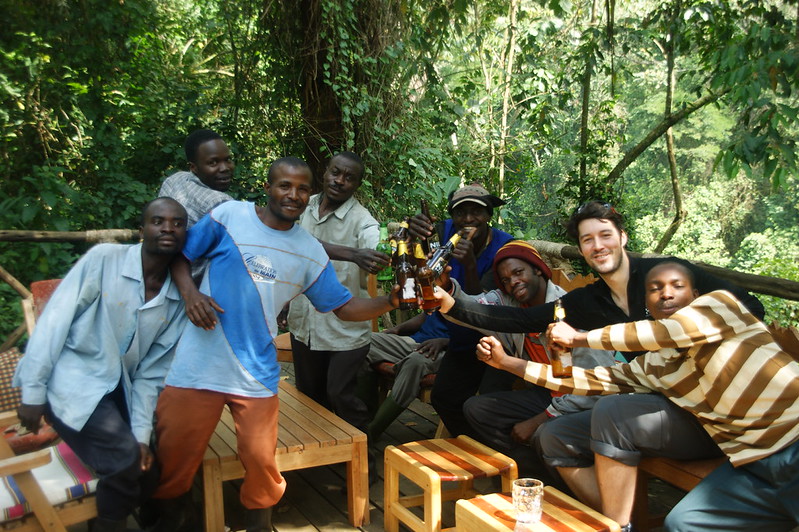
Quick Tipping Guide: Rwenzori Trekking Staff at a Glance
These figures reflect the general range followed across Rwenzori Mountains National Park and are reviewed regularly against current local guidance. Treat them as a sound starting point, then adjust for the specifics of your trek.
Trekking Staff | Suggested Tip (USD/day) | Notes |
Lead Guide | $10–15 | Per guide, per day of trekking, reflecting the highest level of responsibility on the mountain. |
Assistant Guide | $8–10 | Per assistant guide, present on larger groups or technical summit days. |
Cook | $8–10 | Per cook, recognizing the skill of producing hot, varied meals at altitude. |
Porter | $5–8 | Per porter, per day, for carrying communal and camp equipment across demanding terrain. |
Support Staff | $5–7 | Camp assistants, waiters, and other support roles present on larger or luxury expeditions. |
How Much Should I Tip On A Rwenzori Trek?
Rather than guessing at a single number, we encourage every trekker to work from a simple formula that scales naturally to any group size, route, or duration.
Total Tip Budget = (Recommended Amount per Staff Member × Number of Trekking Staff × Number of Service Days), adjusted for the operator’s current guidance and the quality of service received.
This formula does the real work of tipping calculation for you. Once you know how many days you trekked, how many staff supported your group, and the going rate for each role, the arithmetic is straightforward; the only part that requires judgment is the adjustment at the end, and it is worth understanding properly.
The Variables That Shape Your Tip Budget
Trek Duration
A four-day Diamond Trail wildlife trek and a nine-day Central Circuit summit expedition involve a completely different number of service days, and your tip total should scale accordingly. Duration is usually the single biggest driver of the final figure.
Staff Numbers
Larger groups and longer summit routes require more porters, sometimes an assistant guide, and occasionally additional camp support staff. A bigger support team means a larger total tip pool, even if the per-person daily rate stays the same.
Level of Service
The suggested ranges in the table above are exactly that, ranges. A team that goes well beyond the ordinary, carrying extra weight in difficult weather, keeping spirits high on a hard summit night, or simply showing exceptional care, deserves the upper end of the range or slightly above it. Adequate, professional service sits comfortably in the middle. Tipping should reflect the service actually given, not an automatic maximum regardless of experience.
Group Size
Solo travellers often assume that a smaller group means a smaller tip obligation, but the staffing ratio on Rwenzori treks does not shrink proportionally; a solo trekker may still need a lead guide, a cook, and two or three porters. Larger groups, by contrast, can pool tips more efficiently, since the per-person contribution toward a shared staff team decreases as the group grows.
A group tipping pool can be divided among staff according to the operator’s policy, which is why we recommend agreeing on a per-person contribution as a group early in the trek rather than improvising on the final morning. Our group trekking guide covers how we structure larger expeditions.
How to Calculate Your Tip Budget, Step by Step
- Confirm your trek duration in days, including any summit extension.
- Ask your guide or our office for the exact staff count assigned to your group: lead guide, assistant guides, cooks, porters, and any support staff.
- Multiply each role’s suggested daily rate by the number of staff in that role, then by the number of trekking days.
- Add the totals for each role together to reach your overall tip budget.
- Adjust the total modestly upward or downward based on the quality of service your group actually experienced.
- Withdraw the total in small denominations of Ugandan shillings or US dollars before you leave Kasese or Kampala, since change is not always readily available on the mountain.
Who Should I Tip on a Rwenzori Trek?
Every member of your support team plays a distinct role, and understanding what each of them actually does on the mountain makes the tipping decision far more intuitive.
Lead Guides
Your lead guide carries the greatest responsibility on the mountain: route-finding, pacing, safety decisions, wildlife and weather judgement, and the overall wellbeing of your group from the trailhead to the summit and back. This experience and responsibility is reflected in the higher end of the tipping scale, typically $10 to $15 per day.
Assistant Guides
On larger groups or technical summit days, an assistant guide supports the lead guide, often taking responsibility for a smaller cluster of trekkers, assisting with rope work near Margherita Peak, or managing the pace of slower members of the group. A daily tip of $8 to $10 recognizes this genuine share of the guiding workload.
Porters
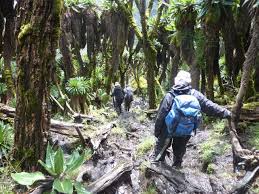
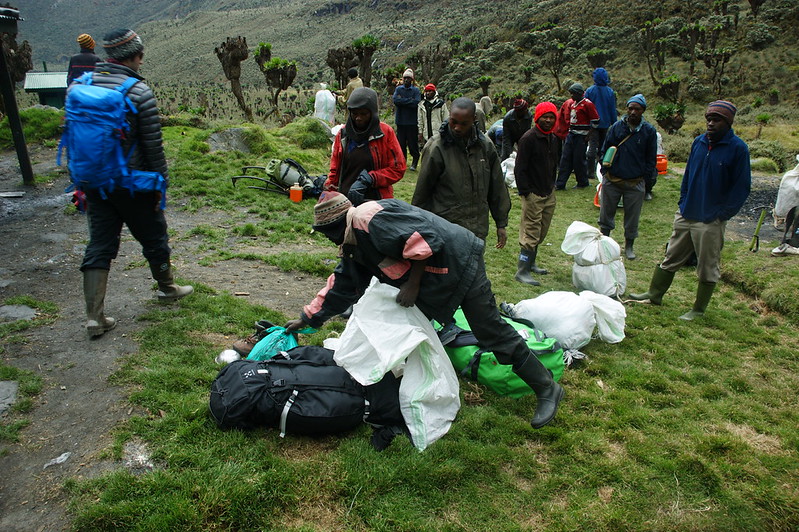
Porters carry communal equipment, food, tents, and group supplies across some of the most demanding terrain on the mountain, often moving faster than the trekking group itself to camp ready on arrival. Their work is physically the hardest on the expedition, and $5 to $8 per porter, per day, is the standard fair range, multiplied, of course, by however many porters are assigned to your group.
Cooks
Producing hot, nourishing, genuinely good meals at altitude, in a small kitchen tent, after carrying the ingredients there themselves, is a skill that deserves real recognition. Cooks typically receive $8 to $10 per day, reflecting both their specialist role and the degree to which good food shapes morale on a multi-day expedition.
Support Staff
On larger or more luxury-oriented expeditions, additional camp assistants, waiters, or specialist staff may be present. A rate of $5 to $7 per day is appropriate for these support roles, adjusted for the specific responsibilities involved.
Guide vs. Porter Tipping: Understanding the Difference
Guides and porters are tipped at different rates for good reason, and it is worth understanding why rather than simply following a chart. Guides carry formal training, certification, language skills, and safety responsibility; their role is closer to that of a professional leading a technical activity than of manual support. Porters carry the physical weight of the expedition, often the single most demanding job on the mountain, but without the same formal qualification requirements or decision-making authority. Both roles are essential, and neither should be tipped as an afterthought, but it is fair and standard practice for guide tips to sit somewhat higher than porter tips, precisely because the responsibilities differ.
When Do You Tip Rwenzori Guides and Porters?
The standard and most widely respected practice is to tip once, at the end of the trek, rather than piecemeal throughout. This is typically done on the final morning or evening, once your group has returned to the trailhead or the final overnight lodge, in a short, informal gathering where the whole team is present.
Should I Tip Daily?
We do not recommend daily tipping as standard practice. Tipping at the end of the full trek allows the amount to reflect the entire journey rather than a single day’s impression, avoids the awkwardness of repeated cash handovers each evening, and matches the custom followed by the great majority of operators across the Rwenzori and East Africa generally. The exception is a very short one- or two-day trek, such as a standalone Diamond Trail outing, where a single end-of-trip tip naturally covers the whole experience regardless.
Group Tipping on a Rwenzori Trek
When trekking as part of a group, whether a family, a set of friends, or an organized departure, the simplest and fairest approach is a shared tipping pool. Each trekker contributes an agreed amount per day to a communal fund, which is then presented as a single total at the end of the trek and distributed among staff according to role and seniority. This avoids the discomfort of uneven individual contributions and ensures the full staff team, including those trekkers who may not interact directly with camp-based cooks, are properly included. Our family and group trekking guide includes a simple worksheet for agreeing to the amount in advance.
Direct vs. Organized Tipping: Which Is Better?
There are two broad models for handing over tips: presenting the full amount to the lead guide for internal distribution among the team or paying certain individuals, particularly porters, directly. Both are practiced across the Rwenzori, and each has advantages.
Should I Tip the Porter Directly?
Direct tipping to porters is entirely acceptable and, in our experience, often appreciated, since it removes any uncertainty about whether a tip has reached its intended recipient. If you choose this approach, we recommend still routing the guide and cook portions through the standard end-of-trek presentation and letting your lead guide know your intentions in advance so nothing is duplicated or missed. If you prefer a simpler process, an organised pool handled by the lead guide, with a transparent breakdown by role, works just as well and is the approach we generally recommend for larger groups.
What Currency Should I Use for Rwenzori Tips?
US dollars and Ugandan shillings are both widely accepted for tipping across the Rwenzori. If using US dollars, notes should be in good condition, ideally printed in 2013 or later, since older or damaged notes are sometimes refused by local banks and exchange bureaus. Ugandan shillings are equally welcome and avoid any currency exchange friction for the recipient, so many experienced trekkers prefer to tip in shillings collected in Kasese or Kampala before setting out.

How to Prepare Your Tip Money
- Withdraw or exchange your total tip budget before leaving Kasese or Kampala, since ATMs and exchange facilities are not available near the trailhead.
- Break large denominations into smaller notes in advance, since staff cannot always provide change on the mountain.
- Keep tip money in a dedicated, easily accessible pouch or envelope, separate from your main travel funds.
- Consider preparing individual envelopes labelled by role or by name once your final staff list is confirmed, for a cleaner and more personal presentation.
Tipping Is Not a Substitute for Fair Wages
This point matters enough to state plainly. A tip is a voluntary thank-you for good service, offered directly by a trekker who wishes to show appreciation. It is not, and should never be, treated as a way for an operator to underpay guides, porters, and cooks and rely on client generosity to make up the shortfall. At Rwenzori Trekking Expeditions, every member of our trekking staff is paid a fair, agreed wage for their work regardless of whether a client tips at all, in line with responsible practice across Rwenzori Mountains National Park. Tips supplement that fair wage; they do not replace it. When choosing any operator for a Rwenzori expedition, we would encourage every traveller to ask directly how porters and guides are paid, since an operator that depends on tips to deliver a living wage to its staff is not one we consider ethical, however competitive its headline price appears.
Do I Have to Give a Large Tip?
No. The ranges in this guide represent a fair, standard scale followed across the Rwenzori, not a minimum floor designed to create pressure. A tip at the lower end of the suggested range, given for competent, professional service, is entirely appropriate and will be received with genuine thanks. Generosity beyond the standard range is always welcome for exceptional service, but it is neither expected nor required as a baseline.
Should I Tip If I Am Unhappy With the Service?
Tipping should reflect the service actually provided. If a specific issue arose during your trek, the most constructive first step is to raise it directly and calmly with your lead guide or with our office while you are still on the mountain or shortly afterwards, since most concerns can be addressed in real time. Where service has fallen genuinely and clearly short despite that conversation, it is reasonable to tip toward the lower end of the range rather than the standard midpoint, though most travelers find that raising concerns promptly resolves the issue well before the trek concludes.
Ethical Porter Treatment on the Rwenzori
Porter welfare is one of the most important ethical questions in mountain trekking anywhere in the world, and the Rwenzori is no exception. Fair treatment means an agreed maximum carrying weight per porter, proper waterproof clothing and footwear provided or required by the operator, adequate food and shelter at camp, and a wage that does not depend on tips to reach a livable level. As a traveller, you can support ethical practice by simply asking your operator these questions before booking and by choosing to trek with a company that answers them without hesitation. Our own porter welfare commitments are outlined in full in our responsible trekking policy.
Tipping on Short vs. Long Treks
A short trek, such as a one- to three-day Diamond Trail wildlife excursion, involves a smaller staff team and fewer service days, and the total tip naturally scales down accordingly using the same formula. A longer expedition toward Margherita Peak, spanning seven to nine days or more, involves a larger team supporting the group across multiple huts and a summit push, and the cumulative tip total is correspondingly higher. In both cases, the calculation method is identical; only the inputs change.
Tipping on a Margherita Peak Expedition
Expeditions to Margherita Peak typically involve an extended staff team across the full duration of the climb, plus, on many itineraries, specialist summit guides who join the group for the final technical stages above the glacier. Given the additional skill, risk management, and physical demand involved in this stage of the climb, it is standard practice to tip summit-specialist guides at the higher end of the guide range, occasionally slightly above it, reflecting the particular expertise this stage of the mountain requires.
Tipping by Rwenzori Route
The Rwenzori route you choose determines the size of your support team, the number of service days, and your final tip budget. The table below offers a general guide.
Route | Typical Duration | Tipping Consideration |
Diamond Trail | 1–3 days | Smaller staff team, shorter duration; tip totals are proportionally lower but calculated the same way. |
Central Circuit Trail | 7–9 days | Larger staff team across multiple huts; the most common route for a full tipping calculation. |
Kilembe Trail | 8–9 days | Similar staffing to the Central Circuit, with its own hut network and porter team. |
Margherita Peak Summit Add-on | +1–2 days | Specialist summit guides supporting the final ascent are typically tipped at the higher end of the guide range. |
Tipping on Private and Luxury Rwenzori Treks
Private and fully personalized expeditions often involve a larger and more specialized support team relative to group size: dedicated guides, additional camp staff, and occasionally a private cook assigned solely to your party. The same formula applies, but because the staff-to-trekker ratio is typically higher on private treks, the total tip budget per trekker tends to be somewhat greater than on a standard shared-group departure, simply because more people are directly supporting a smaller number of clients. Travellers booking a private or luxury itinerary with us can ask our team for the exact staffing breakdown in advance, so the tip budget can be planned with complete confidence well before departure.
Common Rwenzori Tipping Mistakes
Assuming one flat tip covers everyone
A single lump sum handed to the lead guide without a clear breakdown by role risks an uneven or unintended distribution. Agree on the breakdown by role before presenting the total.
Forgetting camp-based staff
Cooks and camp assistants who spend most of their day at the campsite rather than on the trail are sometimes overlooked simply because trekkers see less of them directly. Their contribution to a successful expedition is just as significant as the guides walking beside you.
Arriving without small denominations
Large notes that cannot be broken down create real logistical difficulty at the end of a trek. Prepare smaller denominations in advance rather than assuming change will be available.
Treating the suggested range as a fixed obligation
The ranges in this guide are a fair standard, not a rigid rule. Adjust thoughtfully within the range based on group size, duration, and the service actually received, rather than defaulting mechanically to the top or bottom figure.
Tipping instead of asking about wages
The most meaningful thing a traveller can do for porter and guide welfare happens before the trek even begins: choosing an operator that pays a fair, transparent wage regardless of tips, rather than assuming generous tipping alone solves a wage problem.
Example Tip Calculation
Consider a group of four trekkers on a seven-day Central Circuit Trail expedition, supported by one lead guide, one assistant guide, one cook and four porters.
- Lead guide: $12/day × 1 guide × 7 days = $84
- Assistant guide: $9/day × 1 guide × 7 days = $63
- Cook: $9/day × 1 cook × 7 days = $63
- Porters: $6/day × 4 porters × 7 days = $168
Total tip pool: $378, or approximately $95 per trekker across the four-person group. This example uses mid-range figures for solid, professional service; adjust upward for an exceptional team or downward for a shorter, smaller expedition.
Pre-Trek Tipping Checklist
- Confirm your trek duration and staff count with our team before departure.
- Calculate your tip budget using the formula above before you begin trekking.
- Withdraw or exchange cash in Kasese or Kampala, in small denominations.
- Agree on a group tipping pool with fellow trekkers, if applicable, early in the trip.
- Prepare labelled envelopes by role or by name once your final staff list is confirmed.
- Plan a short, end-of-trek presentation where the whole team can be thanked together.
Our Tipping Policy
Every guide, porter, and cook working with Rwenzori Trekking Expeditions is paid a fair, agreed wage that does not depend on client tips to reach a livable standard. We provide every trekker with an accurate staff count and role breakdown before departure, so your tip budget can be calculated with confidence rather than guesswork. We do not set a mandatory tipping amount, and we never pressure trekkers toward a specific figure; we simply aim to make sure every traveller has clear, honest information so that any tip given is a genuine, informed thank-you. For the full detail of how we support our team beyond wages and tips, see our responsible tourism policy.