Attractions in the Rwenzori Mountains for Beginners includes: Beautiful sceneries, such a glacial lakes, glacial rivers, snow-capped peaks, tumbling waterfalls, hot springs, endemic birds, butterflies, insects, and reptiles, among many others
The Rwenzori Mountains are an iconic geographical feature located in Uganda, East Africa, renowned for their extensive diversity of ecosystems and rich cultural legacy. 
Rwenzori Mountains National Park is home to Africa’s third highest peak, Margherita, renowned for its glacier, and also features a range of other summits that soar high into the clouds. The Rwenzori Mountains include numerous attractions, hosting a diverse array of plant types and wildlife within their proximity. Rwenzori National Park features varied landscapes that transition from dense rainforests to glacial zones, each characterized by various plant and animal species. In the Rwenzori Mountains, visitors can expect to see a variety of sceneries, such as glacial lakes, glacial rivers, snow-capped peaks, tumbling waterfalls, hot springs, endemic birds, butterflies, insects, and reptiles, among many others.
In addition to its natural beauty, the Rwenzori mountains have a rich cultural legacy and a noteworthy past that hikers can learn about from the legends that the inhabitants have about them.
Rwenzori summits
The Rwenzori mountains known as the Rwenzori ranges is a home to a number of Peaks which collectively create the Rwenzori mountains.

The peaks are breathtakingly beautiful, but they are also difficult and demand hikers’ physical Strength. Margherita Peak is the tallest peak on the Rwenzori Mountains, rising a breathtaking 5109 meters above sea level. It is the most renowned peak that attracts hikers year-round, adorned with snow, drawing visitors globally to explore its breathtaking beauty and uniqueness. Mount Speke, standing at 4,890 meters above sea level, is the second highest peak in the Rwenzori Mountains, with Victoria Emmanuel being the highest point. The summit features jagged peaks and challenging rocky terrain, offering stunning vistas. Mount Baker’s Edward Peak rises to an elevation of 4,844 meters above sea level; it presents a challenge suitable for hiking without the necessity for technical equipment, unlike Margherita Peak. It presents stunning landscapes with remarkable views. Mount Stanley features more than four peaks, including the notable Alexander Peak, Albert Peak, and Cheptegei Peak. Mount Emin is another notable summit in the Rwenzori Mountains, offering superb vistas, followed by Mount Gessi. The mountain features numerous accessible summits, inviting hikers to explore the splendor of the Rwenzori mountains.
Abundant Historical Heritage and Cultural Significance
The history of the Rwenzori Mountains is linked to the indigenous Bakonzo people residing in the region. For ages, they have inhabited the mountains, believing that these peaks had spiritual importance in their lives. They link their tradition to myths and gods, as well as spirits inhabiting the peaks and foothills of the Rwenzori Mountains. The Rwenzori Mountains have historically held considerable cultural significance, as the local population believes they are central to the ceremonies and customs of the Bakonjo. They think that the gods of the mountains are responsible for their crops’ plentiful rains and that their prayers are answered by them. Additionally, the mountains are connected to fertility and good fortune by the inhabitants. Infertile ladies think that going to the mountains and praying to the gods can benefit them.

Additionally, some plant species are claimed to provide women with the fruit of their wombs if they use them. Furthermore, once you visit, the residents are incredibly hospitable and friendly.
Through their ancient music and dances, the Bakonjo will welcome you into their rich culture. As you immerse yourself in the rich cultural history of the Bakonjo people around the mountains, those who have the time will share stories and myths about the Rwenzori mountains.An ecosystem with diverse plants and animals
The Rwenzori Mountains are an ecological hotspot with numerous Plants and Animals. The Rwenzori mountains are home to a wide variety of ecosystems, which makes them a popular destination for researchers, photographers, filmmakers, mountain hikers, and nature lovers. The Rwenzori Mountains‘ vegetation is arranged in a very distinctive district zone, each with its own distinct plant species and animals that can adapt to the varying temperatures and elevations. At lower altitudes or at the foothills of the mountains, flora such as Prunus africana and Magavu trees are present in the tropical forest. The bamboo zone comprises bamboo trees, while the heather zone is characterized by giant heather trees. Additionally, the Alpine zone features giant lobelias, groundsels, and everlasting flowers. Hardy plants such as lichens and mosses are able to endure the severe weather conditions found in the rock and glacier zone.
The colobus and blue monkeys are among the animals found in the Rwenzori Mountains. The three-horned chameleon is found in forested regions, while Dickers can be observed in the Alpine zone. Numerous species of birds, including the distinguished Rwenzori turaco and the malachite sunbird, can be observed in the very first vegetation zones of the mountain. The Rwenzori Mountains are home to more than 217 different bird species, making them an ideal location for birdwatchers.
Glacial Lakes
The Rwenzori mountains’ lakes are the result of glacial processes, specifically the melting of ice at their summits. The lakes are well-known for their pristine waters and beautiful scenery. The most notable lakes in the Rwenzori Mountains are Kitandara Lakes, which are twin lakes in the alpine zone and are renowned for their turquoise blue waters, and Lake Bujjuku, which is situated in the Bujjuku triangle. The Mahoma route, which is located in the mountain’s lower elevations, leads to Lake Mahoma. The other large lake is Irene Lake, which is surrounded by mountain rocks. The glacial lakes provide a necessity for maintaining the mountain’s vegetation.
Glacial Rivers
The rivers come from the melting glaciers of the Rwenzori Mountains‘ high summits. Rivers that run by the mountains provide a plentiful supply of clean, pure water to the communities surrounding them.
The River Mubuku, which originates from the glacier melting of the Mount Stanley peaks, is one of the biggest rivers in the Rwenzori mountains. It serves as a primary water source for both home and agricultural purposes, passing through gorges and valleys. The River Nyamwanba is a remarkable river traversing the Kilembe communities from the steep mountain ranges. Its origins are from Mount Luigi di Savor and Baker. The river is essential for the residents of Kasese, supplying water for domestic and agricultural use; nonetheless, it is notorious for overflowing its banks, resulting in flooding and deaths in Kilembe. From Lake Bujjuku, the River Bujjuku meanders through heathers before joining Mubuku at Kurt Shafer Bridge, where it combines into a one river.

The river Nyamugasani, which boasts amazing waterfalls and quick-moving waters, rises from the western slopes of the Rwenzori mountains. It additionally provides water for the community. The Ruimi River is another notable river in the Rwenzori Mountains, characterized by its fresh and pristine waters.
Furthermore, when in the Rwenzori highlands, one may observe numerous rivers and countless streams that make their way through the Rwenzori trekking routes.
Rwenzori Waterfalls
The Rwenzori mountains are home to an abundance of waterfalls, yet the majority of which can be found along the Kilembe route. They offer picturesque vistas for trekkers, with certain locations being highly accessible, allowing hikers to swim during their expedition.
Enock Falls are the first falls seen from Sine Camp and are located in the mountain’s forest montane zone. Cathy’s falls are more spectacular and forceful, coming from the glacial waters of the Rwenzori mountains. The area around these falls is sometimes hazy, which adds to their beauty. The Nyamwamba waterfalls, which come from the Nyamwamba River, are surrounded by thick vegetation. They provide stunning vistas as their waters cascade into numerous streams. The Plozza waterfalls are remarkable, including many streams cascading over various rocks before descending into a huge pool. Engwe Falls are located among the tall trees of the deep forests, and they drop over a wide cliff. Kamalha Falls is one of the most powerful waterfalls along the Kilembe routes, situated at high altitudes, producing deafening roars and enveloped in mist.
Diverse Climatic conditions and vegetation zones
The Rwenzori Mountains exhibit numerous vegetation zones and diverse climatic conditions, impacted by varying altitudes, each possessing special features. The tropical montane forest zone, situated at altitudes of 1800m to 2500m, is the initial zone on the slopes of the Rwenzori Mountains, distinguished by its lush forest cover. Beyond 2500m is the bamboo zone, characterized by tall, dense bamboo trees, extending up to 3000m.
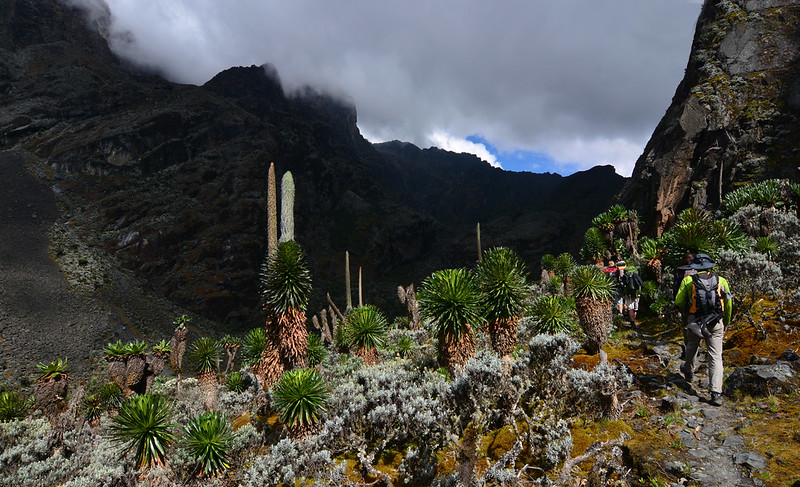
The heather zone, which stretches from 3000 to 4000 meters above sea level, is distinguished by heather trees. The Alpine zone, ranging from 4000m to 4500m, is characterized by huge lobelias, giant groundsels, and everlasting flowers. Above 4500m lies the rock and glacier zone, which is inhospitable to flora and fauna; however, moss and lichen are present in this region. The region is characterized by severe weather and extremely cold temperatures.
Glacier and icy rocks
The Rwenzori Mountains are among the rare locations in the Equatorial region where the peaks are covered in glaciers. Although the glaciers on certain peaks of the Rwenzori Mountains have decreased over the years, they remain mostly intact; yet, climate changes and global warming significantly contribute to their continued melting.

The Rwenzori Mountains consist of massive boulders frequently adorned with moss and lichens, often capped with a thin layer of ice at higher elevations. The rocks and glacier collectively create a remarkable landscape in the Rwenzori Mountains. Despite the glacier’s gradual retreat, it continues to supply all the lakes, rivers, streams, and other water bodies in the Rwenzori region.
The rocks serve as a reminder of how the Rwenzori mountains were formed, which was caused by up thrust forces pushing the block and sculpting the rangers into the present-day ranges.
Rwenzori Birds
The Rwenzori mountain is home to more than 217 different species of birds, including endemic species within the area. The mountain is an ideal location for birdwatchers seeking to observe rare bird species while also experiencing the thrill of hiking across the various terrains of the mountains.

Among the rare species found in the Rwenzori mountains are the Rwenzori turaco, Shelley’s crimsoning, dwarf honeyguide, and malachite sunbird. Bird species inhabit the deep forest zone, extending to the heather zone and some in the Alpine zone, providing hikers with an extraordinary experience throughout their excursions.
Concluding Remarks
The Rwenzori Mountains embody a fusion of natural beauty and profound cultural heritage. The majestic peaks that constitute the block mountain of the Rwenzori ranges serve as a significant attraction, drawing hikers from around the world to explore their breathtaking beauty.
The Rwenzori Mountains host a diverse ecosystem, with numerous plant species and animals that thrive in this environment. In addition to the unique vegetation that varies with altitude, the mountains are a prime location to experience a variety of climate variations due to their various climatic conditions that fluctuate with altitude levels. With more than 51 lakes, the Rwenzori Mountains boast a multitude of water features, including lakes, rivers, and waterfalls, providing hikers with a plethora of breathtaking vistas and sights to take in on their journey.
The Bakonjo people, who have endured and resided near the Rwenzori Mountains, possess a rich and historically significant culture linked to the presence of these mountain ranges.
The Rwenzori mountains are a hidden gem with untamed beauty that offers a truly unforgettable experience, allowing trekkers to not only meditate on its beauty but also immerse themselves in this great challenge and become one of the many heroes who have conquered it. This is true whether you want to explore Margherita Peak, discover the glacier on the peaks, or even see the cascading waterfalls.