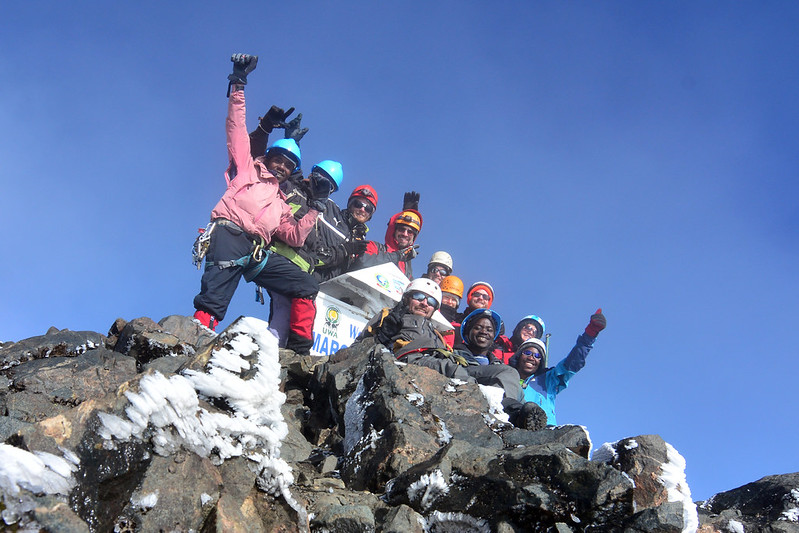
Margherita Peak at 5109m On Mount Stanley Of Rwenzori Mountains
Margherita peak, at 5,109M, is the highest point on Mount Stanley of the Rwenzori Mountains in Rwenzori Mountains National Park and the third-highest mountain in Africa. The highest peak of the high-altitude Rwenzori Range starts in the beautiful forests at the base and ascends above the clouds to Margherita’s glacial Peak.
Margherita Peak is the tallest summit in Uganda. The peak was first ascended in 1906 by the Duke of Abruzzi, J. Petigax, C. Ollier, and J. Brocherel.
The trail used by those pioneers all those years ago is the same as the one that many guides take, via Elena Hut. The glaciers in the Rwenzoris are swiftly decreasing due to significant ice melting over the past decade attributed to global warming—visit promptly before it is too late.
The low altitude treks generally span 3-4 days and attain a maximum elevation of approximately 3,100 meters. The high-altitude hikes last from 5 to 12 days, with peak elevations of 4,600 meters and above. Summiting Margherita Peak requires a minimum of 7 days in the Alps, culminating at an elevation of 5,109 meters.
The climb will lead you past the outhouse and south past Elena Hut to a split in the road. This ascent can be accessed from the Moraine Hut in the Democratic Republic of the Congo (DRC); but, political instability in the area frequently results in the route being closed with little warning. From this divergence, multiple paths can be taken to the Stanley Plateau.
One alternative is to go directly through crevices and gorges, progressing westward along a series of steep rock formations to gentler inclines above.
An alternative route is to proceed south from the little pond towards the sheer cliffs of Kitasamba and the Coronation Glacier, culminating in a prominent westward turn that ascends the slabs towards the glaciers of the Rwenzoris.
Upon reaching the glacier, ascend the steep snow or ice to access the more moderate inclines beyond, leading to the Stanley Plateau, located just northwest of this location.
Views from the summit are typically restricted by meteorological conditions, since much of the area northwest of the Stanley Plateau is obscured by dense fog.
Should you observe the peaks ahead, the nearest on the left is Alexandra Peak. The breathtaking Afro Montane forest is located below, where a cascading waterfall cascades over the far rocks.
Preparing for the peak ascent
Reaching Margherita Peak entails traversing icy trails, rocky outcrops, and steep inclines with gradients of up to 60%. Since it’s usually regarded as more difficult than Kilimanjaro, it’s crucial that you are physically fit and have some prior experience hiking at high elevations.
Margherita Peak is now officially a technical climb, however that label only applies to the last day of the hike, when you really reach the peak.
An experienced mountaineering team fro Rwenzori Trekking Expeditions will accompany you, and all necessary equipment will be provided (with the exception of crampons, which you should bring yourself or sometimes hire).
In contrast to the more well-known Kilimanjaro or Mount Kenya, which are isolated mountains with a comparatively easy ascent and descent, the Rwenzoris are Africa’s highest mountain range, and as such, there are multiple climbs and descents required to reach the peaks. Trekking the Rwenzori Mountains is considered Africa’s best trekking experience because of its stunning landscape, abundant species, substantially lower costs, and reduced tourism.
Margherita Peak, located on Mount Stanley in the Rwenzori Mountains, stands at 5,109 meters and is the third highest mountain in Africa. However, the true beauty is in the ascent via the Kilembe Trail/route, with its woods and valleys. Along the way, you’ll encounter various vegetation, including gigantic heather trees and valleys of ferns. Climbing of Margherita Peak has become complicated owing to the proliferating amount of crevasses. The actual ascent to the peak is more of a scramble than a climb, and it gets much more difficult in the snow. But the payoff is worth it when you reach the peak and take in the breathtaking views of the Rwenzori Mountains to the east, as well as Albert Peak to the DRC (Congo).
The Margarita Peak Ascent provides the chance to reach Mount Stanley, the tallest mountain in the Rwenzori Mountains, for seasoned climbers looking for a challenge.
Technical climbing abilities, including as rock scrambling and glacier navigation, are required for the ascent, which usually takes 5 to 7 days.
Trekkers must overcome difficult terrain, such as rocky slopes, snowfields, and steep ridges, in order to reach Margarita Peak’s summit.
The climb, which is led by trained mountain guides, calls for the right gear and time to adjust to the high altitude.
The ultimate mountaineering challenge in the Rwenzori Mountains National Park is the Margherita Peak Ascent. It entails conquering Margherita Peak, the peak of the Rwenzori Range and the third-highest summit in Africa. Here is a closer look at the components of the Margherita Peak Ascent:
Duration and Difficulty:
The Margherita Peak Ascent is regarded as a difficult ascent that is appropriate for skilled climbers with technical climbing abilities.
Depending on the weather, group pace, and acclimatization, the ascent usually takes 5 to 7 days to finish.
Rwenzori Trekking Routes:
Typically, the climb to Margherita Peak starts in the headquarters of the Rwenzori Mountains National Park and proceeds to the upper altitudes via the Central Circuit Trail or the Kilembe Trail.
After then, climbers go through a variety of zones, such as alpine meadows, heather zones, bamboo forests, and rainforests, before arriving at the glacier-covered peak.
Required Technical Skills:
Hiking Margherita Peak necessitates technical abilities such rock scrambling, glacier trekking, and negotiating exposed and steep terrain.
Mountaineers should know how to use climbing gear such helmets, ice axes, crampons, ropes, and harnesses.
Acclimatization and Altitude:
Margherita Peak has a standing height of 5,109 meters (16,763 feet) above sea level.
Climbers must adequately acclimate to high altitudes to minimize the risk of altitude sickness and guarantee a safe and successful climb.
The ascent is typically divided into multiple stages, incorporating rest days and acclimatization hikes within the itinerary.
Guidance and Assistance:
Hiring knowledgeable porters and mountain guides to help with the climb is strongly advised.
Guides possess expertise in topography, meteorological circumstances, and route navigation, thereby reinforcing safety and awareness during climbs.
Porters can assist with carrying equipment and supplies so that climbers can concentrate on the climb rather than carrying heavy loads.
Climatic Conditions:
The Rwenzori Mountains can have irregular weather, with higher elevations potentially experiencing snow, rain, and strong winds.
Climbers should have the right gear and clothes to suit the variety of weather conditions they may encounter.
A gratifying summit experience
Notwithstanding the difficulties, climbing Margherita Peak is a fulfilling and remarkable experience.
In addition to a sense of achievement for reaching one of Africa’s highest peaks, climbers are rewarded with breathtaking sweeping views of the surrounding mountains, glaciers, and valleys.
All things considered, the Margherita Peak Ascent provides an exhilarating experience for competent climbers looking to test their abilities and scale the Rwenzori Mountains. Climbers who have the right planning, technical know-how, and assistance can set out on an incredible adventure to reach Margherita Peak and take in the breathtaking views of this isolated and unspoiled mountain range.For additional details regarding what to pack, preparation methods, and selecting the appropriate Rwenzori hike, consult our comprehensive guide to the Rwenzori Mountains.