The Rwenzori Mountains have six distinct zones from valley floor to summit ice: grassland/foothill, Afro-montane forest, bamboo, giant heather–Rapanea, Afro-alpine moorland, and the nival rock-and-glacier zone. The varying climatic conditions of the Rwenzori Mountains determine the vegetation zones in Rwenzori Mountains National Park. Given the altitude and the hiking route, you may find yourself surrounded by either lush rainforest or ice. The Kilembe trail is regarded as somewhat more difficult, yet the central circuit trail is deemed the most attractive and diverse Rwenzori trekking route.
Quick Facts Of The Vegetation Of The Rwenzori Mountains
| Total vegetation zones | Six distinct zones from valley floor to summit ice: grassland/foothill, Afro-montane forest, bamboo, giant heather–Rapanea, Afro-alpine moorland, and the nival rock-and-glacier zone |
| Elevation span | Roughly 1,000m at the park’s lower boundary to 5,109m at Margherita Peak’s summit |
| Fastest transition | The Rwenzori’s zones change abruptly rather than gradually, often within a single day’s walk. |
| Best zone for wildlife | The Afro-montane forest zone (roughly 1,800–2,500m), home to colobus and blue monkeys, forest birds, and duikers |
| Best zone for iconic flora | The Afro-alpine moorland (roughly 3,800–4,500 m), home to giant lobelias and giant groundsels found only on East Africa’s highest mountains |
| Routes that cross all zones | Both the Central Circuit Trail and the Kilembe Trail traverse every zone; the Central Circuit Trail is considered the more scenically varied of the two. |
| Best season for zone photography | June–August and December–February for clarity; March–May and September–November for mist and saturated color in the heather zone |
| Ideal for | Families, couples, solo trekkers, and groups who want to understand and see for themselves one of Africa’s most complete altitudinal ecosystems |
Rwenzori Mountains: A Mountain That Changes Its Mind Six Times
 Set out from Nyakalengija Gate in the morning, and you begin under a canopy so dense with moss and epiphytes that the light itself turns green. By the following afternoon you are ducking under towering bamboo. A day after that, the bamboo has vanished entirely, replaced by gnarled, lichen-draped heather trees that feel lifted from an illustrated fairy tale. Climb higher still, and the trees disappear altogether, giving way to giant lobelias and groundsels standing sentinel over bog and tussock, and finally to bare rock, snow, and the memory of glaciers that once covered far more of this range than they do today.
This is what guides me when they discuss the Rwenzori’s vegetation zones: not a single, static backdrop, but six living ecosystems stacked one on top of the other, each governed by altitude, rainfall, and temperature, and each so distinct that trekkers frequently describe the day’s walk as passing through several different countries. It shapes what you pack, how you pace each day, what you will see, and why the Rwenzori remains, in our honest professional opinion, built over years of guiding this mountain, one of the most complete wilderness experiences left in East Africa.
What Are the Vegetation Zones of the Rwenzori Mountains?
Rwenzori Mountains National Park rises from roughly 1,000 metres at its lower boundary to 5,109 metres at the glaciated summit of Margherita Peak on Mount Stanley, and this extraordinary altitude range, combined with the park’s position almost directly on the equator and its exceptionally high rainfall, produces a sequence of vegetation belts that are recognised as among the most complete and least disturbed in Africa. UNESCO’s own assessment of the park singles out its Afro-alpine moorland and heath communities as among the rarest vegetation types on the continent, and the range’s status as a World Heritage Site rests substantially on this ecological completeness.
From lowest to highest, the six Rwenzori vegetation zones a trekker will move through are the grassland and cultivated foothill zone, the Afro-montane forest zone, the bamboo–Mimulopsis zone, the giant heather, Rapanea zone, the Afro-alpine moorland, and finally the nival zone of rock, snow, and glacier. Each has its soil, its own rainfall pattern, its own plant community, and, critically for the trekker, its own trail conditions, temperature range, and packing requirements. Unlike a mountain such as Kilimanjaro, where the zones shift gradually across a very long approach, the Rwenzori’s compact footprint means these transitions arrive quickly, sometimes within a single afternoon.
Grassland and Foothill Vegetation (Roughly 1,000–1,800 m)
Before the true forest begins, trekkers pass through a lower belt of open grassland and cultivated foothill country, shaped as much by generations of Bakonzo farming as by the mountain’s natural climate. Dominant grass species here include cymbopogon and pennisetum, interspersed with acacia and combretum shrubs, and the terrain rolls gently through gardens, banana groves, and smallholdings before the national park boundary and the true wilderness begin.
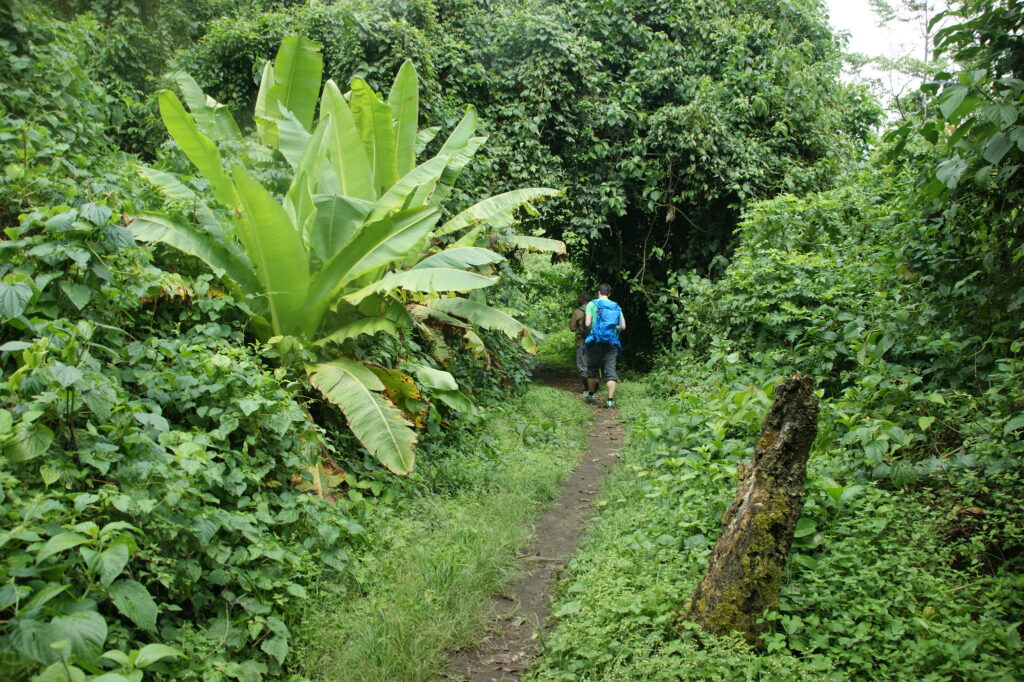
For trekkers arriving from Kasese or Kilembe, this zone offers the last clear views back across the Rift Valley floor before the canopy closes overhead.
The Afro-Montane Forest Zone (roughly 1,800–2,600 m)
This is the Rwenzori at its most immediate, obviously alive. Towering hardwoods — red stinkwood, yellowwood, Symphonia globulifera, and Podocarpus milanjianus among them — form a closed canopy hung with moss, lichen, and vine, while the understorey is crowded with begonias, balsams, and ferns that thrive in the near-constant humidity. This zone is also the best for wildlife on the entire trek: black-and-white colobus monkeys move through the upper canopy in family troops, blue monkeys and occasionally L’Hoest’s monkeys forage lower down, three-horned chameleons cling to trailside branches, and the calls of the Rwenzori turaco, one of the range’s signature birds, carry through the trees. Nyabitaba Hut, the first overnight stop on both the Central Circuit and several Kilembe itineraries, sits at the upper edge of this zone.
The Bamboo–Mimulopsis Zone (Roughly 2,500–3,000m)
Within a single day’s climb above Nyabitaba, the hardwood forest gives way — often quite suddenly — to dense stands of bamboo, particularly on the gentler, better-soiled slopes around Nyabitaba and Guy Yeoman camps. The forest floor here carries a thick litter of bamboo leaves, and on steeper or rockier ground the bamboo yields to a tangle of Acanthus-type shrubs, luxuriant lobelia forms, and Mimulopsis elliotii, especially in the wetter, boggier hollows.
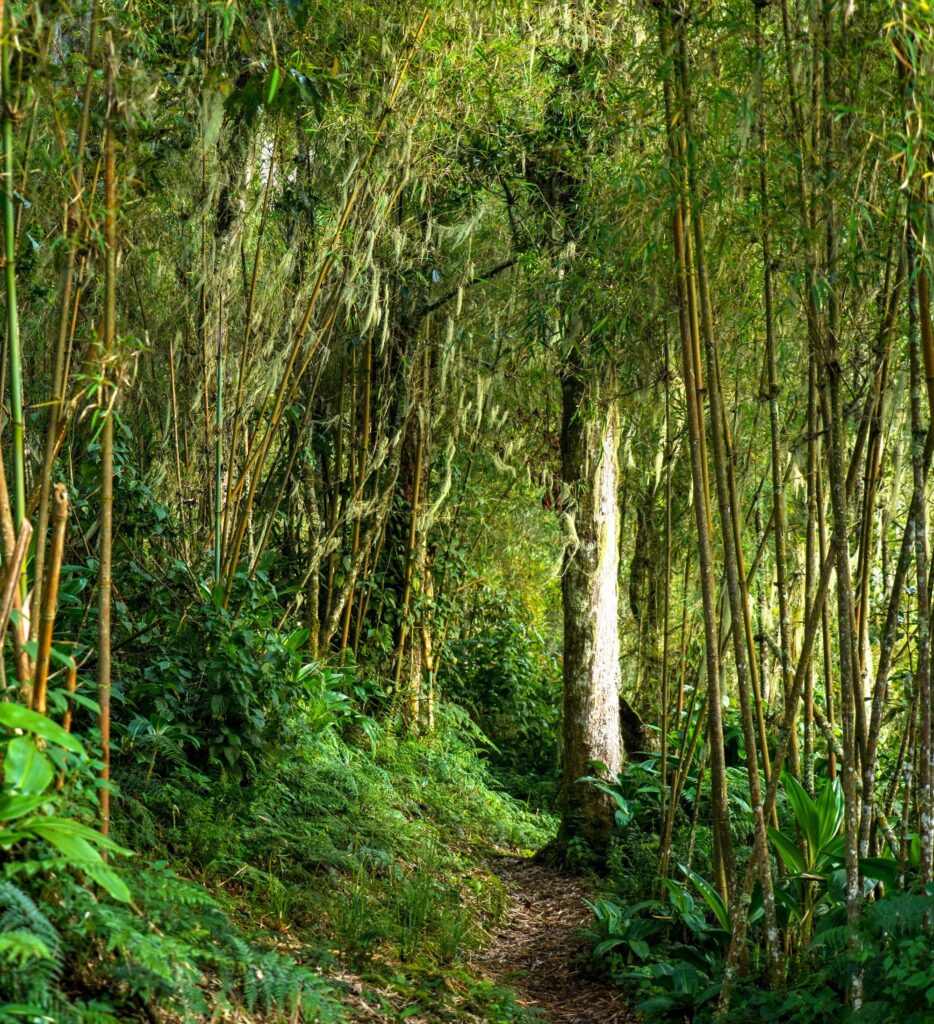
Bamboo in the Rwenzori flowers only once every several decades, a phenomenon that guides us to consider themselves fortunate to witness even once in a career, and the zone’s thick, springy leaf litter underfoot is a welcome contrast to the mud that often follows in the zones above.
The Giant Heather–Rapanea Zone (Roughly 3,000–3,800m)
Most landscapes do not prepare a trekker for the heather zone. Erica and Philippia trees, ordinarily low shrubs in temperate climates, grow here into gnarled, moss-draped giants ten meters tall or more, their branches hung with curtains of old man’s beard lichen that seem to glow faintly in the persistent mist. This area is also where the trail turns notoriously boggy — the Rwenzori’s famous mud belt — crossing the Bigo bog and stretches along the Bujuku River on sections of boardwalk built specifically to spare trekkers the worst of it. As altitude increases through this zone, the density of Erica gradually thins, and the first giant lobelias and groundsels of the zone above begin to appear at the margins, a visible preview of what’s coming.

The Afro-Alpine Moorland (roughly 3,800–4,500 m)
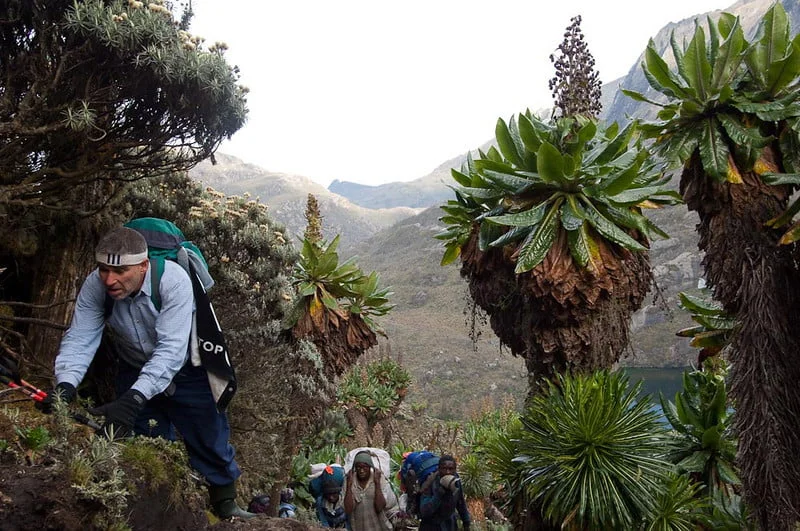
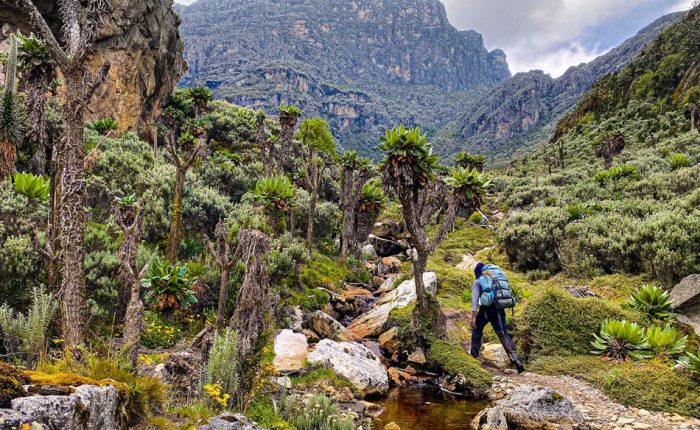
This is the zone most trekkers picture when they imagine the Rwenzori, and rightly so; it is one of the rarest plant communities on the African continent. Giant groundsels (Dendrosenecio species) and giant lobelias rise several meters from rosettes of thick, waxy leaves adapted to survive nightly frost and searing equatorial sun within the same twenty-four hours, a phenomenon botanists call the diurnal freeze-thaw cycle. Tussock grasses such as Carex runssoroensis carpet the boggier hollows, everlasting flowers (Helichrysum species) cling to drier rock, and the overall effect — mist drifting between giant plant forms found nowhere else on Earth in this configuration — is why photographers and naturalists alike consider this zone the single most extraordinary stretch of any Rwenzori trek.

It is also within this zone, on the approach to Kitandara Lakes and beyond, that summit candidates for Weismann’s Peak spend their final acclimatisation nights.
The Nival Zone—Rock, Snow, and Glacier (4,500 m and Above)
Above the moorland, vegetation finally gives out almost entirely, leaving bare rock, scree, permanent snowfields, and on Mount Stanley, Mount Speke, and Mount Baker — the Rwenzori’s fast-retreating glaciers, among only three glaciated massifs remaining on the African continent. Weismann’s Peak, at 4,620 metres, sits at the lower edge of this zone: high enough for dramatic views across the glaciated summits of Stanley, Speke, and Baker, but reached without the crampon and rope work that a Margherita Peak summit demands. Trekkers on the final approach to Weismann’s Peak cross open, rocky, tussock-strewn ground with red duikers and rock hyraxes sometimes visible among the boulders, before a short, steep final push to a summit that, on a clear day, delivers one of the finest panoramas in the entire range.
Wildlife Across the Rwenzori Vegegation Zones
The Rwenzori’s altitudinal range supports an unusually rich fauna for its size, including an internationally significant small-mammal community, dozens of rodent and shrew species, several found nowhere else on Earth outside the Albertine Rift — alongside more visible highlights such as forest elephants and chimpanzees at the lowest elevations, black-and-white colobus and blue monkeys through the montane forest, and the endemic Rwenzori black-fronted duiker and L’Hoest’s monkey at mid-elevations.
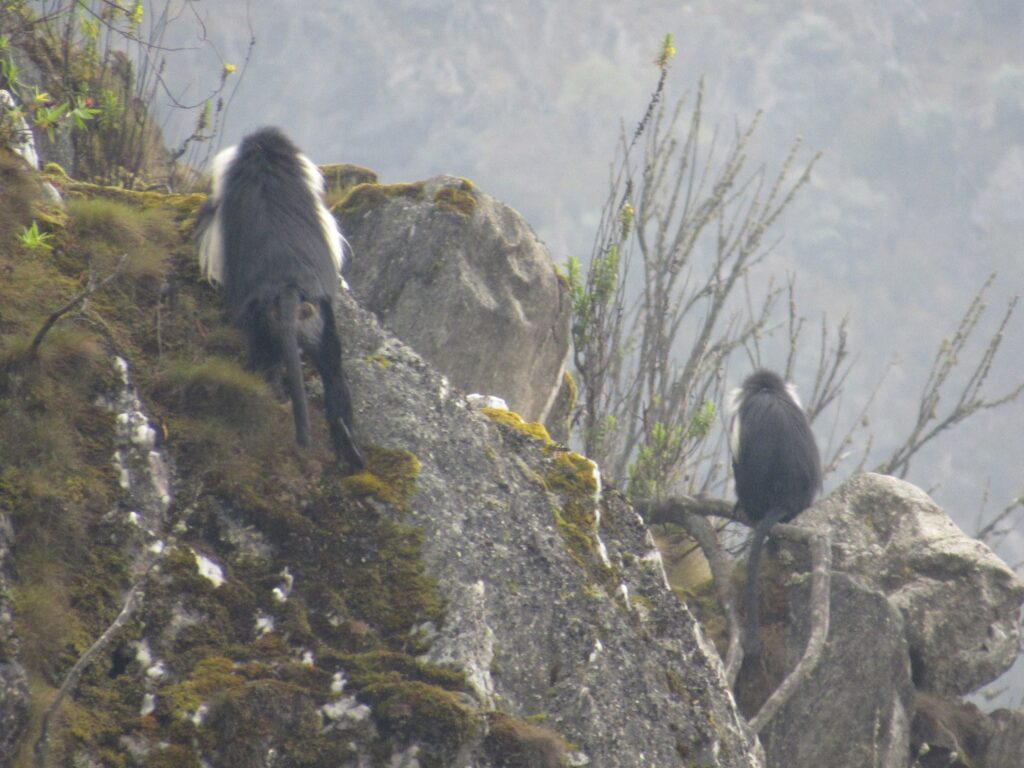
Birdwatchers should keep both eyes and ears open throughout: the range’s bird list exceeds 170 species, a meaningful number of them Albertine Rift endemics found on no other mountain in the world.
Vegetation Zones on the Central Circuit vs. the Kilembe Trail
Both principal routes of the Rwenzori Mountains, the Central Circuit Trail and the Kilembe Trail, cross all six Rwenzori vegetation zones described above, but the pacing and character of each crossing differ. The Central Circuit trail, considered the more scenically varied of the two, moves through the montane forest and bamboo zones relatively quickly via Nyabitaba and Guy Yeoman before settling into an extended, atmospheric stretch of heather and moorland around the Bigo bog, Bujuku Lake, and Kitandara. The Kilembe Trail, by contrast, is generally regarded as the more physically demanding of the two routes, with a longer initial climb through montane forest from the Kyanjuki trailhead near Kasese and a correspondingly longer, more gradual transition through bamboo and heather before reaching its high moorland camps at Bugata and Bujuku.
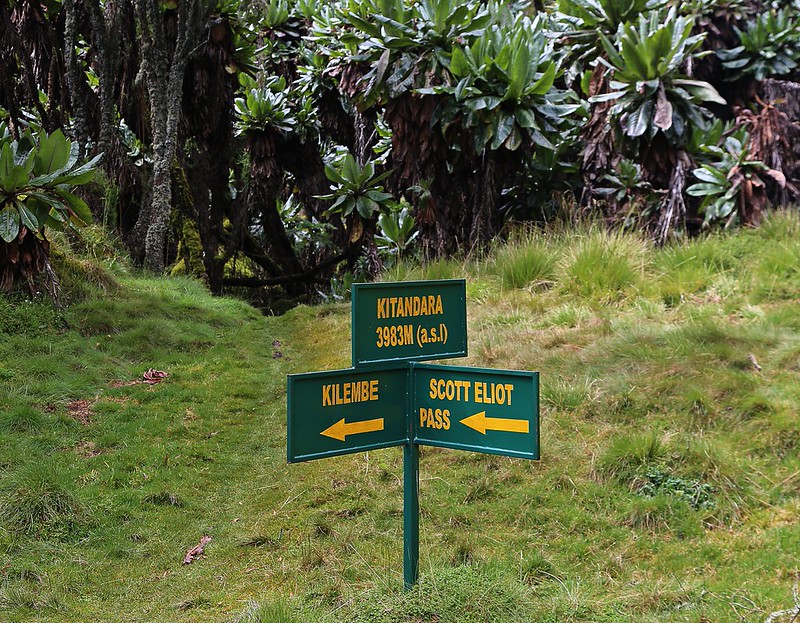
Neither route shortcuts the ecology; the choice between them is really a choice of physical profile and camp style, not of which zones you will see.
Best Time to Experience the Rwenzori Vegetation Zones
The Rwenzori’s vegetation zones look and feel different depending on the season, and the best time to visit genuinely depends on what you most want from the trek. For clearer skies, drier trails through the bamboo and heather bogs, and the best chance of unobstructed views from Weismann’s Peak across the glaciated massifs, the best times to visit are June to August and December to February, which match the wider dry-season guidance for Rwenzori trekking. For photographers and naturalists, however, the wetter shoulder months of March–May and September–November bring the montane forest to its most lush, swell every waterfall along the route, and saturate the heather zone’s moss and lichen into colours the dry season simply cannot match, many of our most experienced repeat clients now deliberately choose the wet season for exactly this reason. Families traveling with school-age children tend to prefer the July–August and December windows to align with school holidays and drier underfoot conditions, while solo trekkers and couples seeking a quieter trail often choose January or June, just outside the busiest weeks of peak season.
What’s Included and What’s Excluded
Every vegetation zone trek and Weismann’s Peak itinerary we run, whether via the Central Circuit trail or the Kilembe Trail, is organized so that nothing is left for you to piece together once you arrive in Uganda. The specifics below set out exactly what that means.
What’s Included — Park entry, camping, and hut fees inside Rwenzori Mountains National Park — A dedicated ranger-guide and porter team drawn from the local Bakonzo community — All trail meals, prepared fresh by your camp cook at each zone’s camp — Hut or camping accommodation at each stage of the route — Private transfer between Kasese/Kilembe and the trailhead — Pre-trek briefing, kit check, and post-trek transfer back to your lodge | What’s Excluded — International and domestic flights — Visa fees and travel insurance — Personal trekking gear (boots, jackets, sleeping bag—see our packing list) — Tips and gratuities for guides and porters — Alcoholic and premium bottled beverages — Optional extensions such as gorilla tracking or a Queen Elizabeth National Park safari |
What to Pack for a Rwenzori Trek Through All Six Zones
Because a single day’s walk can move you from humid rainforest to near-freezing moorland, your kit needs to bridge that entire range. We recommend waterproof, well broken-in hiking boots with ankle support for the mud of the bamboo and heather zones, a breathable base layer for the humid montane forest, an insulating mid-layer and proper waterproof shell for the cold, wet heather and moorland zones, gloves and a warm hat for summit morning on Weismann’s Peak, gaiters for the boggy tussock ground, and trekking poles for the steep, root-laced sections below Nyabitaba. Our complete Rwenzori packing list runs through every layer in detail, and our team reviews your kit with you before departure so nothing is missing once you are on the trail.
What You Need to Do Before Climbing the Rwenzori Mountains
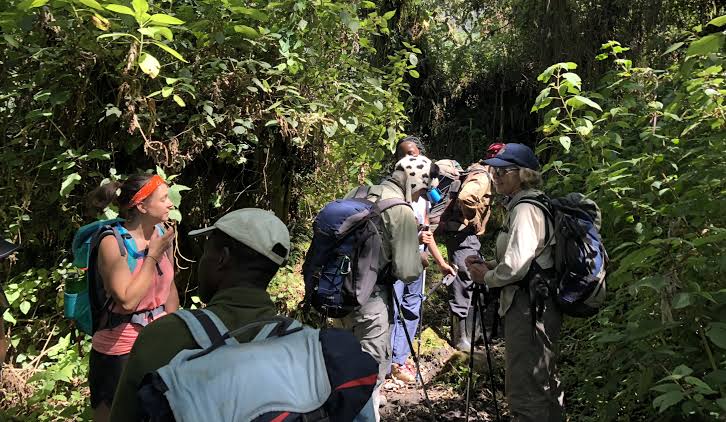
Preparation for a trek through these six zones is less about technical climbing skills and more about sustained fitness and sensible acclimatisation. We recommend building a base of regular hiking or equivalent cardiovascular training in the two to three months before departure, ideally including hill walking with a loaded daypack to simulate trail conditions. A basic medical check-up is worthwhile for anyone with underlying cardiovascular or respiratory conditions, given the altitudes involved above the heather zone, and travel insurance that explicitly covers trekking above 4,000 metres is essential rather than optional. Beyond fitness, the most useful preparation is simply informational: understanding the rules and regulations of Rwenzori Mountains National Park, reviewing our packing list, and discussing your specific fitness level and goals with our team so your itinerary and pace is matched to you rather than to a generic template.
How to Get to the Rwenzori Mountains
Most trekkers reach Rwenzori Mountains National Park via Kasese, approximately four to six hours by road from Kampala through Mbarara or Fort Portal, or by a shorter charter flight from Entebbe to Kasese airstrip followed by roughly an hour’s drive to the park gate. We arrange every transfer privately as part of your itinerary, whether you start at Nyakalengija for the Central Circuit trail or Kyanjuki for the Kilembe Trail, depending on your route. Full details on road conditions, flight options, and combining your trek with other southwestern Uganda destinations are set out in our guide to getting to Rwenzori.
Cost of Trekking Through the Rwenzori’s Vegetation Zones
Trekking costs across the zones are shaped chiefly by route choice, trip length, group size, and the number of porters engaged, a six-day Weismann’s Peak itinerary through all six Rwenzori Vegetation Zones is generally more accessible than the longer, technical expeditions to Margherita Peak, since it requires no glacier equipment or specialist ice guiding. For a transparent breakdown of what drives Rwenzori trekking costs across all our itineraries, see our Rwenzori cost guide, or get in touch directly and we will tailor a quote to your exact party and route.
Related Rwenzori Itineraries Through These Zones
If a six-day Weismann’s Peak trek through all six zones appeals, several of our other itineraries traverse the same ecological ground at different lengths and intensities. Our 1-day trek to Nyabitaba Hut is the gentlest introduction to the montane forest zone, ideal for families wanting a taste of the mountain without a multi-day Rwenzori trek commitment. Trekkers wanting to continue beyond the heather and moorland zones into full glacier terrain can extend onto our 7-day Margherita Peak trek, while those drawn to the Kilembe side of the range can follow the same six zones via our 8-day Kilembe Trail trek. Groups wanting to combine this ecological journey with East Africa’s wildlife highlights often extend into our 12-day Rwenzori and gorilla trekking safari, pairing the moorland’s giant lobelias with a very different, but equally unforgettable, encounter in Bwindi’s forest.
Attractions of the Rwenzori Mountains Beyond the Trail
Beyond the vegetation zones themselves, the Rwenzori rewards travelers with glacial lakes such as Bujuku and Kitandara, waterfalls including the Samalira, Nyamwamba, and Bridal Falls along the Kilembe side of the range, and a living Bakonzo culture in the foothill communities that supply the guides, porters, and cooks who make every trek possible. Many trekkers pair their Rwenzori vegetation-zone trek with time spent exploring these lower-altitude attractions before or after their summit push, adding depth to a trip that is already, day for day, one of the richest ecological journeys available anywhere in East Africa.
Frequently Asked Questions
How many vegetation zones does the Rwenzori Mountains have?
The Rwenzori Mountains have six recognized vegetation zones from base to summit: grassland/foothill, Afro-montane forest, bamboo, giant heather, Rapanea, Afro-alpine moorland, and the nival rock-and-glacier zone.
What is the most famous vegetation zone in the Rwenzori?
The Afro-alpine moorland, roughly 3,800 to 4,500 metres, is the most famous, known for its giant lobelias and giant groundsels, plants found in this form on only a handful of East Africa’s highest mountains.
Which route shows the best vegetation zones, Central Circuit or Kilembe Trail?
Both routes cross all six Rwenzori Vegetation Zones. The Central Circuit Trail is generally considered the more scenically varied, while the Kilembe Trail is regarded as the more physically demanding of the two.
What wildlife can I see in the Rwenzori’s vegetation zones?
Black-and-white colobus and blue monkeys, three-horned chameleons, and the Rwenzori turaco are common in the montane forest zone; red duikers and rock hyraxes appear in the higher moorland and nival zones.

How high is Weismann’s Peak, and which zone is it in?
Weismann’s Peak stands at 4,620 metres on Mount Luigi di Savoia, sitting at the boundary between the Afro-alpine moorland and the nival rock zone.
Do I need technical climbing skills to reach Weismann’s Peak?
No. Weismann’s Peak is reached on foot with some steep, rocky sections near the summit, but without the rope work, crampons, or glacier travel required for Margherita Peak.
When is the best time to see the Rwenzori’s vegetation zones?
June to August and December to February offer the clearest, driest conditions; March to May and September to November bring more rain but the most vivid color in the forest and heather zones.
Why does the Rwenzori have so many vegetation zones in such a short distance?
The combination of an extreme altitude range (roughly 1,000 m to 5,109 m), an equatorial location, and exceptionally high rainfall compresses ecological zones that would normally spread across a much longer distance into a comparatively compact mountain range.