The 14-day Rwenzori trekking & Mount Karisimbi hike climbs Margherita Peak in Uganda’s Rwenzori Mountains and Mount Karisimbi in Rwanda’s Volcanoes National Park on this 14-day adventure, featuring alpine trekking, wildlife, and breathtaking scenery. This 14-day Rwenzori trekking & Mount Karisimbi hike offers a 7-day Central circuit trek Marherita Peak in Uganda’s Rwenzori Mountains National Park & a 2-day Mount Karisimbi Hike in Rwanda’s Volcanoes National Park
Across the 14 days of the Rwenzori trekking & Mount Karisimbi hike, you will cross two countries, Uganda and Rwanda, connected by a single overland border crossing through the Virunga foothills. You will reach two summits: Margherita Peak at 5,109 meters, the third-highest point in Africa and the highest point reachable without technical Himalayan-grade climbing on the continent, and Mount Karisimbi at 4,507 meters, Rwanda’s highest mountain and the tallest of the eight Virunga volcanoes. Between them lie six distinct vegetation zones, two national park systems, one UNESCO World Heritage Site, and roughly 10 days of trekking at altitudes most travelers never experience in a lifetime. The days demand genuine fitness, sound acclimatization discipline, and a tolerance for cold, mud, and long hours on foot, and they reward it with something very few travelers on this continent ever see with their own eyes.
The reward is the promise of the 14-day Rwenzori Trekking and Mount Karisimbi Hike: not two unrelated mountain holidays stitched together by a flight but a single, deliberately sequenced expedition across the Albertine Rift, East Africa’s great fracture zone where the earth itself is pulling apart. You begin among Uganda’s glaciated block mountains, the fabled Mountains of the Moon that Ptolemy described in the second century and that European explorers spent decades trying to prove existed. You finish among Rwanda’s young volcanoes, still warm at their roots, cloaked in Hagenia woodland and giant lobelia moorland, where the last mountain gorillas on Earth make their home. Few travelers, and fewer operators, understand both ranges intimately enough to link them into one coherent story. We do, because we have guided both for years.
Quick Tour of the 14-day Rwenzori Trekking & Mount Karisimbi Hike
Feature | Details |
Duration | 14 Days / 13 Nights |
Countries | Uganda & Rwanda |
Main Peaks | Margherita Peak (Rwenzori) & Mount Karisimbi (Virunga) |
Highest Elevation | Margherita Peak, 5,109 metres |
Trek Difficulty | Challenging — for experienced, fit hikers only |
Accommodation | Mountain huts, a volcano camp, and comfortable lodges |
Best For | Experienced hikers, mountaineers, adventure photographers, couples, and private groups |
Group Size | Private departures — your own guide, your own pace |
Starts / Ends | Entebbe, Uganda / Kigali, Rwanda |
This 14-day Rwenzori Trekking and Mount Karisimbi Hike itinerary is built for experienced hikers, serious mountaineers, and committed adventure travelers who have already proven their fitness on multi-day treks and want the complete Albertine Rift experience rather than a single summit tick. It suits couples seeking a shared expedition rather than a lodge holiday and small private groups of friends or climbing partners who want their pace, their guide, and their own itinerary rather than a fixed departure. It is not a beginner’s introduction to trekking, and Rwenzori Trekking Expeditions says so plainly, because an honest answer here protects your 14 days and your safety far more than a marketing promise ever could.
Itinerary at a Glance: 14-day Rwenzori Trekking & Mount Karisimbi Hike
Day | Route |
Day 1 | Arrival in Entebbe, Uganda |
Day 2 | Road transfer to Kasese Nyakalengija, gateway to the Rwenzori |
Day 3 | Nyakalengija to Nyabitaba Hut (2,650m) |
Day 4 | Nyabitaba to John Matte Hut (3,505m) |
Day 5 | John Matte to Bujuku Hut (3,977m) |
Day 6 | Bujuku to Elena Hut (4,541m) via Scott Elliott Pass |
Day 7 | Summit day: Margherita Peak (5,109m), descend to Kitandara (4,023m) |
Day 8 | Kitandara to Guy Yeoman Hut (3,505m) via Freshfield Pass |
Day 9 | Guy Yeoman’s descent to Nyabitaba Hut |
Day 10 | Exit the park: overland border crossing to Rwanda |
Day 11 | Rest day near Volcanoes National Park; optional activities |
Day 12 | Mount Karisimbi trek to high camp (approx. 3,700m) |
Day 13 | Sunrise summit of Mount Karisimbi (4,507m); descend to lodge |
Day 14 | Transfer to Kigali International Airport; departure |
Day 1: Arrival in Entebbe
Your expedition begins the moment you step off the jet bridge at Entebbe International Airport, where your private guide is waiting with a printed name card and, more usefully, an easy familiarity with exactly which immigration queue moves fastest at that hour. A dedicated vehicle carries you the short distance along the shore of Lake Victoria to your hotel, where the evening is left unhurried, a chance to shake off the flight before the mountains begin to matter.
Later, over an early dinner, your guide runs through the expedition briefing: the route ahead, the altitude progression day by day, the equipment you have brought, and the equipment you still need. This period is also when Kit gets its first real inspection, boots, layers, sleeping bag liner, and trekking poles, because a boot that fits poorly on day one is a problem best solved in Entebbe, not at 4,500 meters. You will spend the night in Entebbe, in comfortable lodge accommodation on the lakeshore.
Day 2: Transfer to Nyakalengija, Kasese
The drive west from Entebbe to Kasese is, by itself, one of Uganda’s most remarkable overland journeys, and we treat it as such rather than as a logistical inconvenience to be endured. The road climbs steadily through the tea estates of Fort Portal, a landscape of impossibly even green rows folding over low hills, before the crater lakes of the western Rift begin to appear, small, still, and volcanic in origin, and, on a clear afternoon, the Rwenzori’s snow-streaked ridgeline finally breaks the horizon far ahead. Many itineraries include a brief stop at the equator crossing near Kayabwe, where you can stand with one foot in each hemisphere, a small ceremony that never quite loses its charm.
Arrival in Kasese comes in the late afternoon, with time in hand for the final trek preparations: porter and gear allocation, a last equipment check, and an early night. This evening is the last night with a proper bed and a hot shower before the mountain, and your guide will make sure you use it well. Overnight in Kasese.
Day 3: Trek to Nyabitaba Hut (2,650m)
Registration at the Rwenzori Mountains National Park headquarters at Nyakalengija is unhurried and thorough; park rangers verify permits, porters are weighed and briefed, and your guide uses the wait to talk you through the trail ahead in plain, practical terms rather than brochure language. Then the forest closes over the trail, and the Central Circuit trail begins in earnest.
The climb to Nyabitaba runs through lower montane rainforest, dense, humid, and alive; blue monkeys and black-and-white colobus move through the canopy overhead, and the calls of the Rwenzori turaco and a dozen sunbird species thread through the undergrowth. The gradient is honest without being brutal, a fair introduction to what the days ahead will ask of your legs. Nyabitaba Hut sits on a forested ridge above the confluence of the Mubuku and Bujuku rivers, and the view from its porch at dusk, valley mist rising below two rivers meeting, is many trekkers’ first indication that this range deserves its reputation. Overnight at Nyabitaba Hut.
Day 4: Nyabitaba to John Matte Hut (3,505m)
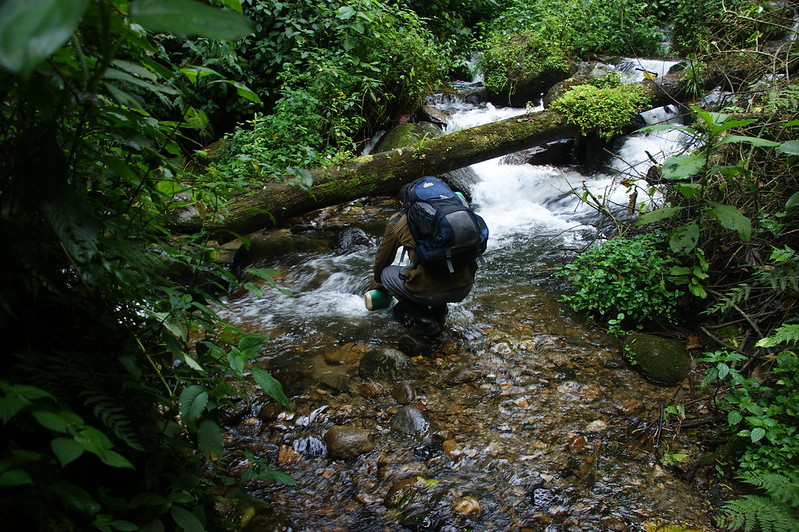
The trail drops briefly to cross the Kurt Schafer Bridge over the Bujuku River before climbing into a bamboo forest, then into the heather zone proper, a landscape unlike anything most travelers have walked through before, where heather that would stand knee-high in a European garden grows into gnarled, moss-draped trees twelve meters tall. The path threads through several stream crossings, some requiring careful footwork on wet rock, and the vegetation begins its characteristic Rwenzori transformation: familiar plant families growing to improbable, giant scales in response to the equatorial highland climate.
By the time John Matte Hut comes into view, perched above the Bujuku Valley with Mount Stanley’s glaciated flanks occasionally visible through the cloud, the giant groundsels have begun to appear along the trail edges, one of the first true signals that you are entering the Rwenzori’s famous afro-alpine zone. Overnight at John Matte Hut.
Day 5: John Matte to Bujuku Hut (3,977m)
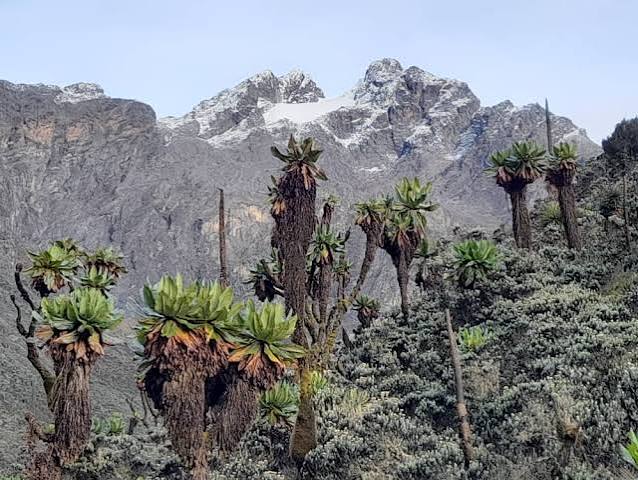
This is, for many trekkers, the single most photographed day of the Rwenzori crossing. The trail enters the Bigo Bog, a notoriously boggy stretch where a boardwalk of half-submerged logs threads between tussocks, muddy, occasionally comic, and entirely worth it for what follows. Beyond the bog, the Bujuku Valley opens into a landscape that genuinely looks otherworldly: giant lobelias standing sentinel in their thousands, rosettes closed tight against the cold, silhouetted against Mount Baker on one side and Mount Stanley’s glaciers on the other.
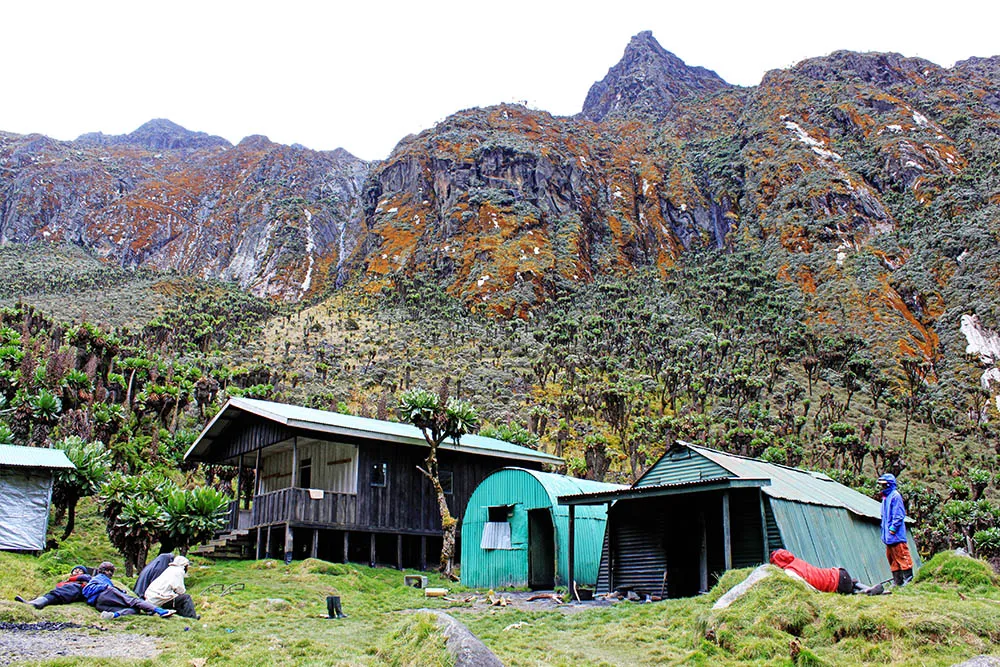
Lake Bujuku itself, a still, dark tarn cupped directly beneath the range’s three highest massifs, is where most trekkers stop simply to look for a while before continuing the final short climb to Bujuku Hut. The hut sits at the convergence point of the Stanley, Baker, and Speke massifs, arguably the single best-positioned accommodation in the entire park, and the cold here is a first real preview of what altitude means in the Rwenzori. Overnight at Bujuku Hut.
Day 6: Bujuku to Elena Hut (4,541m, via Scott Elliott Pass)
The day begins with a steep, sustained climb to the Scott Elliott Pass at approximately 4,372 meters, the col between Mount Baker and Mount Stanley and one of the most physically demanding stretches of trail on the entire circuit; loose rock, occasional scrambling, and thinning air conspire to slow even strong hikers here. Your guide manages the pace deliberately, because this is the day acclimatization discipline matters more than summit ambition.
From the pass, the trail descends briefly before climbing again toward Elena Hut, and the landscape shifts decisively from vegetated alpine terrain to true high-mountain ground, bare rock, scree, and, close above, the visible ice of the Stanley Glacier system.
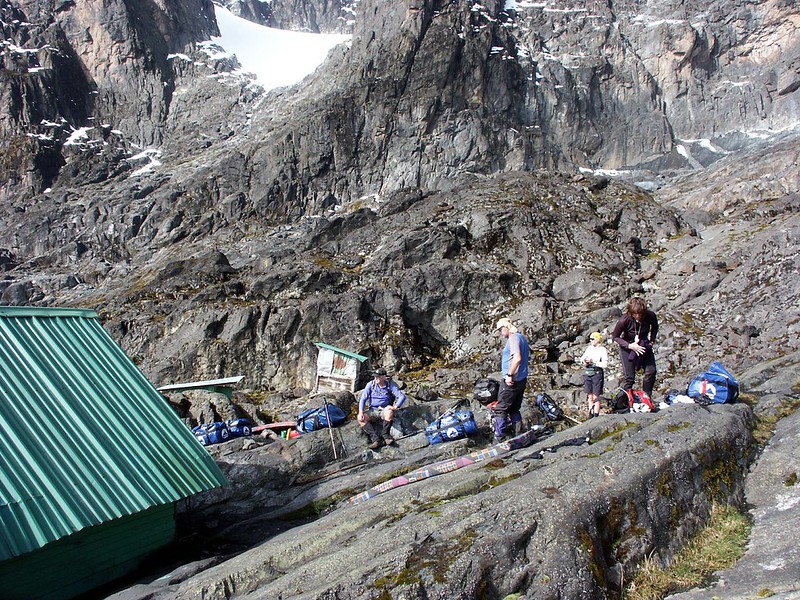
Elena Hut itself is basic and cold by design, a functional shelter rather than a comfortable one, because everything about this stop exists in service of the following morning. The afternoon is given over to summit preparation: gear laid out, crampons checked, an early dinner, and an early attempt at sleep that altitude will make only partially successful. Overnight at Elena Hut.
Day 7: Margherita Peak Summit – Kitandara (5,109m)
You leave Elena Hut in full darkness, headlamps picking out a route across the lower Stanley Glacier, which has been retreating for decades and which your guide has watched change year after year. The climbing here is genuinely technical by Rwenzori standards, with fixed ropes, crampons, and short sections of rock scrambling on the final approach to Margherita Peak, and it demands full concentration rather than romantic distraction, however extraordinary the pre-dawn light becomes on the ice around you.

The summit itself, at 5,109 meters, is a small, exposed platform, and the view from it on a clear morning is arguably unmatched anywhere in East Africa: the Congo basin’s endless green stretching west, Lake Edward glinting to the south, and the sun rising directly over the Virunga volcanoes. You will be standing on it again in exactly one week. There is time for photographs; for a private moment your guide will know instinctively when to interrupt and when to let it run long; and then there is the careful, technical descent back to Elena Hut and onward, considerably lighter in mood and pack, down to Kitandara Hut beside its twin glacial lakes. Overnight at Kitandara Hut.
Day 8: Kitandara to Guy Yeoman (3,505m, via Freshfield Pass)
The Freshfield Pass climb out of Kitandara delivers, for many trekkers, the finest single mountain panorama of the entire circuit, Mount Baker’s ice fields rising close on one side, the full sweep of the Bujuku Valley falling away behind, and the Kitandara lakes catching the early light directly below the trail. The gradient is demanding, but the reward is immediate and constant, a genuinely alpine ridge walk rather than a slog.
The descent beyond the pass drops back through heather woodland toward Guy Yeoman Hut, set beside the Bujuku River, and the change is palpable: thicker air, warmer evenings, and the particular relief of a body that has spent a week above four thousand meters finally being given room to recover. Overnight at Guy Yeoman Hut.
Day 9: Guy Yeoman to Nyabitaba
The final full trekking day inside the park is, by design, a gentler one, a long, steady descent that retraces the ecological zones you climbed through in reverse, heather giving way to bamboo, bamboo giving way to the dense rainforest canopy of the lower slopes. It is a day for noticing what the ascent’s effort and the summit’s adrenaline may have crowded out: birdsong returning in volume, the particular green of equatorial rainforest after days of alpine rock and ice, and the quiet satisfaction of legs that know the hardest climbing is behind them. Overnight at Nyabitaba Hut, your last night on the mountain.
Day 10: Exit the Park – Transfer to Rwanda
The descent to Nyakalengija completes the Central Circuit, and a short debrief with your guide and the park rangers closes out the Rwenzori chapter of the expedition properly, with certificates, if you have summited, and a genuine, earned sense of completion. A private vehicle then carries you south and west, through Kabale and the terraced hills around Lake Bunyonyi, toward the Katuna–Gatuna border post, the principal overland crossing between Uganda and southwestern Rwanda.
The crossing itself is straightforward for prepared travelers: have your passport, visa documentation, and yellow fever certificate to hand, and allow a little patience at the immigration windows on both sides. Travelers with the East Africa Tourist Visa, which allows multiple entries across Uganda, Kenya, and Rwanda within ninety days, usually find this the easiest route; those without it should check in advance that they have valid, separate entry documents for both Uganda and Rwanda, as border officials on both sides are now more careful about matching paperwork to travel plans. From the border, it is a short, scenic run into the volcanic foothills near Musanze and Volcanoes National Park. Overnight at a comfortable lodge near the park.
Day 11: Rest & Volcanoes National Park
This rest day exists for a specific and unapologetic reason: nine days of trekking, a summit above five thousand meters, and a border crossing are a serious physical accumulation, and Karisimbi deserves a body that has recovered rather than one running on residual fatigue. The day is intentionally unstructured. Sleep late. Have the lodge’s kitchen fuss over you a little.
For travelers who want to stay active, several optional activities can be arranged, and we are careful to be precise about what is included in your package and what is booked separately: a gentle nature walk through the foothill farmland and forest edge near the lodge is generally included, while a visit to a nearby community project or cultural center and any add-on activity such as golden monkey tracking or a Dian Fossey gravesite hike is arranged as an optional extra at additional cost. Your guide will confirm exact inclusions against your specific booking. The afternoon is given over to final gear preparation for Karisimbi; porters and camping equipment are organized, and your guide reviews the volcano’s very different demands compared with the Rwenzori crossing you have just completed. You will spend the night at your lodge near Volcanoes National Park.
Day 12 : Mount Karisimbi Trek to Camp (approx. 3,700m)
The Karisimbi trek begins early at the Rwanda Development Board’s Kinigi Park headquarters, where rangers conduct a permit check and a safety briefing before your armed ranger guide, a legal requirement inside Volcanoes National Park, joins your private guide for the ascent. The lower slopes climb through cultivated farmland into dense bamboo forest, terrain shared with several of the park’s mountain gorilla families, including the Susa and Karisimbi groups, and your guide will point out fresh feeding signs or nest sites where the forest offers them, without ever promising a sighting that only the mountain can deliver.
Beyond the bamboo, the trail enters Hagenia-hypericum woodland, gnarled and moss-hung, before opening into a moorland of giant senecios strikingly reminiscent of the Rwenzori’s own giant groundsels, a small, quiet reminder that these two ranges, for all their geological differences, share a botanical language shaped by the same equatorial highland conditions. High camp is reached in the mid-afternoon and pitched in a clearing within the moorland zone, and the evening is spent at a considerably gentler altitude than Elena Hut, with a proper camp dinner prepared by your expedition cook. Overnight camping at high camp, roughly 3,700 meters.
Day 13: Karisimbi Summit—Return (4,507m)
The final push begins before dawn, climbing through alpine desert and increasingly loose volcanic scree toward Karisimbi’s fractured summit crater. The going is steep and physically demanding in a different register than the Rwenzori’s technical ice climbing; no ropes or crampons here, but a relentless, lung-testing gradient on unstable ground that rewards a slow, disciplined pace over a fast, reckless one.
The summit, at 4,507 meters, delivers one of the most stunning volcanic panoramas of Africa: the full Virunga chain marching away in both directions; Bisoke’s near-perfect cone to the west; Mikeno and the Nyiragongo caldera visible across the Congolese border on a clear morning; and the whole sweep of country you crossed nine days earlier folded into the haze far to the north. The descent retraces the ascent route back through the vegetation zones to the trailhead, where your private vehicle is waiting, and the transfer to your lodge near Musanze brings a hot shower, a proper meal, and the particular satisfaction of two summits completed inside a single expedition. Overnight at your lodge.
Day 14: Departure
A relaxed morning precedes your private transfer to Kigali International Airport, timed against your specific flight, with a final debrief along the way — a chance to talk through what you have just done, because two summits and two countries in fourteen days rarely feel fully real until someone else reflects it back at you. Your guide sees you through check-in formalities before saying goodbye, and your expedition concludes exactly as it began: attended to, unhurried, and entirely in hand.
What’s Included / What’s Excluded
Inclusions
We handle every detail of the mountain days for you, so you can enjoy the trail without leaving any decisions to chance. Your package includes private airport transfers in both Entebbe and Kigali; all private ground transportation between destinations, including the border transfer; Rwenzori Mountains National Park permits and entry fees; your Mount Karisimbi hiking permit and the associated ranger escort required by Rwandan law; professional, English-speaking mountain guides throughout; all accommodation as specified, from lodges to mountain huts to the Karisimbi camp; all meals from dinner on Day 1 through breakfast on Day 14; porter services for both the Rwenzori and Karisimbi treks; treated drinking water throughout the trekking days; and full summit support, including safety equipment for the Margherita glacier crossing.
Exclusions
Not included are your international flights to and from East Africa; Uganda and Rwanda visa fees, including the East Africa Tourist Visa if you choose that route; travel and medical evacuation insurance, which we require of every trekker; personal trekking equipment such as boots, clothing, and sleeping bags, though rental is available on request; alcoholic beverages; gratuities for your guides, porters, and camp crew; and personal expenses such as phone charges, laundry, and souvenirs. Optional add-on activities mentioned on your rest day, such as golden monkey tracking or a community visit, are also excluded unless specifically added to your booking.
Why Choose This Expedition
The Rwenzori and the Virunga volcanoes are frequently mentioned in the same breath by East African tourism boards, but they are, geologically and experientially, almost opposites, and that contrast is precisely what makes traveling between them so rewarding. The Rwenzori is a block mountain range thrust upward along a fault line rather than built by eruption; its rock was folded and metamorphosed over millions of years, and its upper slopes were carved by ice rather than lava.
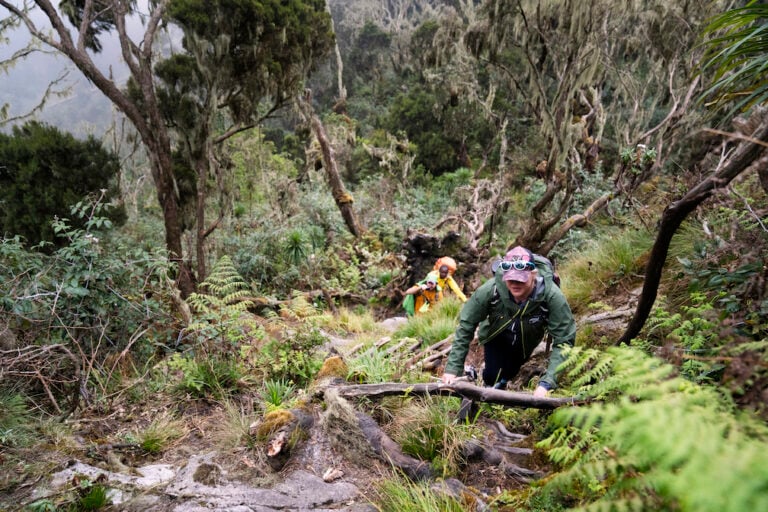
Karisimbi, by contrast, is a shield volcano, its slopes built layer upon layer from ash and lava flows over a comparatively recent geological span, its soils dark and fertile where the Rwenzori’s are thin and rocky. To trek both within a fortnight is to read two entirely different chapters of the same rift valley story.
Uganda’s Rwenzori range carries UNESCO World Heritage status, inscribed for the extraordinary endemism of its afro-alpine ecosystem and for a biodiversity gradient that runs from lowland rainforest to permanent glaciers within a single national park boundary. Nowhere else in Africa will you find equatorial glaciers, ice fields sitting almost exactly on the equator, a geographical improbability that drew European explorers for a century before Luigi Amedeo di Savoia’s expedition finally mapped the range’s true summits in 1906. Those glaciers are retreating quickly, and Margherita Peak is, quite simply, a summit that fewer people will be able to reach in the same way you will.
Rwanda’s contribution to this expedition is extraordinary in a different way. Volcanoes National Park sits within the Virunga Massif, a chain of eight volcanoes shared between Rwanda, Uganda, and the Democratic Republic of Congo and home to the densest population of mountain gorillas remaining on Earth. Karisimbi’s lower slopes pass through bamboo forest where gorilla family groups, including the Susa and Karisimbi groups, are known to range before climbing through Hagenia-hypericum woodland and giant senecio moorland into a genuinely volcanic alpine desert near the summit. The trek is physically shorter than the Rwenzori crossing but no less serious, with steep pumice slopes, thin air, and unpredictable mountain weather of its own.
Combine the two and you have engineered something genuinely rare: a cross-border, cross-ecosystem expedition through the heart of the Albertine Rift, seen by almost no other operator as a single coherent product. Where others sell you a Rwenzori trek and, separately, a Rwanda volcano hike, we have built the connective tissue between them: the transfer logistics, the acclimatization sequencing, and the rest days positioned exactly where your body will need them, so that the fourteen days read as one expedition, not two holidays glued together by an airport.
Trek Difficulty
Honesty about difficulty is not a disclaimer we attach to protect ourselves; it is a core part of how we design every itinerary, and this expedition asks more of you than almost anything else in our catalogue. The two mountains test you in genuinely different ways, and it is worth understanding each on its own terms.
The Rwenzori Challenge
The honest core of the Rwenzori Challenge consists of nine consecutive days on foot, with six days above 3,500 meters and two days above 4,500 meters. Expect persistent mud on the lower trails regardless of season; long hiking days of six to eight hours; sudden mountain weather that can turn a clear afternoon into driving rain within twenty minutes; and a genuine, technical summit day involving glacier travel, fixed ropes, and rock scrambling above 5,000 meters. Altitude is the deciding factor for most trekkers who do not summit, not fitness alone, but how well the body tolerates thinning air, which is why this itinerary paces its ascent so carefully.
The Karisimbi Challenge
Karisimbi is shorter but no less serious. The trail climbs relentlessly over two days on loose volcanic scree and compacted ash, with no technical climbing equipment required but a sustained, high-altitude gradient that punishes an undisciplined pace. High camp itself sits above 3,700 meters, and the final summit push begins in genuine cold well before dawn. Trekkers who arrive fatigued from the Rwenzori section without adequate rest are, in our experience, the ones who struggle most on Karisimbi, which is precisely why Day 11 exists.
A note on sequencing We have deliberately built the itinerary so the technical, glacier-based Rwenzori summit comes first, while your legs are freshest, and the sustained but non-technical Karisimbi climb comes second, after a full rest day. Reversing this order is possible on request, but we do not recommend it. |
Who Is This Trip Suitable For?
This expedition is built for experienced hikers who have completed at least one multi-day, high-altitude trek before and know, from firsthand experience, how their own body responds to sustained effort above 3,500 metres. It suits mountaineers looking to add two distinctive African summits to a wider record, and active beginners are welcome only if their general fitness is genuinely strong and they arrive having trained specifically for sustained days on steep, uneven terrain — general gym fitness is not, on its own, sufficient preparation for this itinerary.
Adventure photographers consistently rate this as one of the finest itineraries we run, given the range of light, landscape, and vegetation across both mountain systems. It works well for couples wanting a genuinely shared physical challenge rather than a parallel lodge holiday, and for private groups of friends or climbing partners who prefer their own pace and their own guide over a fixed group departure. We do not recommend this itinerary for first-time trekkers, for travelers without recent high-altitude experience, or for anyone hoping for a guaranteed summit — the mountains, and the weather, always retain the final word.
If this itinerary feels more ambitious than your current experience or timeframe warrants, our 4-Day Rwenzori Waterfalls Hike and 3-Day Lake Mahoma Trek.
Continue exploring.
If you would like to research the individual pieces of this expedition in more depth before booking, we recommend our 7-Day Margherita Peak Trek, Central Circuit Trail Guide, Rwenzori Trek Difficulty Guide, Altitude Sickness guide, Best Time to Visit the Rwenzori Mountains and Volcanoes National Park Guide.
Travelers looking to extend their time in the region afterward often add Uganda Gorilla Trekking and Rwanda Gorilla Trekking.
How We Manage Your Safety and Comfort
Day 11’s rest day is not filler — it is the single most important piece of acclimatization engineering in this itinerary. Nine days of trekking followed immediately by a demanding volcano ascent is, in our experience, the single most common reason travelers underperform on Karisimbi when following poorly sequenced itineraries elsewhere. Building in a genuine recovery day before the second summit attempt costs you one day of your fortnight and returns it many times over in how strong you feel on Karisimbi’s steep pumice slopes.
Throughout the Rwenzori section, your guide actively monitors acclimatization rather than simply following a fixed schedule — watching pace, appetite, sleep quality, and the early signs of altitude illness at each hut, and adjusting rest breaks or, when necessary, the day’s plan itself in response. We are equally transparent that both the Rwenzori and Karisimbi sections of this itinerary can be adjusted in the field due to weather, trail conditions, or safety considerations flagged by park rangers or your guide; a delayed summit attempt or an altered descent route is always possible, and always explained to you in real time rather than left unaddressed.
Accommodation and support, honestly described The Rwenzori huts are basic mountain shelters, not lodges — expect functional rather than comfortable conditions above 2,650 metres. Karisimbi’s high camp is genuine expedition camping. Both sections are fully supported by professional guides, licensed porters, and, on Karisimbi, an armed park ranger required by Rwandan regulation — but neither section should be mistaken for a soft-adventure holiday. |
Accommodation: 14-day Rwenzori trek & Mount Karisimbi Hike
Uganda
Inside Rwenzori Mountains National Park, accommodation is entirely in the Central Circuit’s mountain huts, Nyabitaba, John Matte, Bujuku, Elena, Kitandara, and Guy Yeoman, simple, weatherproofed shelters with bunk-style sleeping platforms, shared common areas, and pit latrines. They are functional rather than comfortable, warmed by little more than a wood stove and your own layers, and that is by design at this altitude. Before and after the trek, in Entebbe and Kasese, you stay in comfortable, well-appointed lodges with hot showers, proper beds, and a kitchen that understands what a hungry trekker needs.
Rwanda
Near Volcanoes National Park, you stay in a comfortable lodge with private rooms, hot water, and mountain views across the Virunga foothills, a deliberate contrast to the huts you have just left behind. The Karisimbi trek itself involves one night of proper expedition camping at high camp, with tents pitched by your porter team ahead of your arrival and a hot camp dinner prepared by a dedicated expedition cook. It is basic by lodge standards and entirely comfortable by mountain camping standards.
Meals
On the mountain, meals are hearty, carbohydrate-focused, and designed around what a body burning several thousand calories a day on foot actually needs: porridge and eggs to start; energy-dense trail lunches of bread, cheese, avocado, and fruit; and a hot, substantial dinner of stew, rice, or pasta at each hut or camp. Off the mountain, in Entebbe, Kasese, and near Volcanoes National Park, meals are taken at your lodge and reflect a broader, more varied East African and international menu.
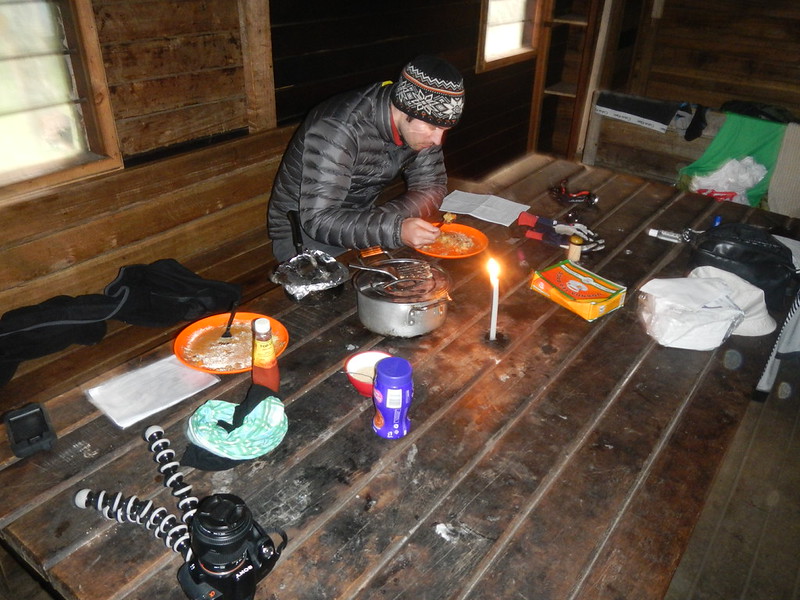
Dietary requirements, such as vegetarian, vegan, gluten-free, or specific allergies, are accommodated throughout when flagged to us in advance; our mountain cooks are experienced at adapting trail meals without compromising the calories you need. Drinking water on the trek is drawn from mountain streams and treated or boiled by your crew before it reaches your bottle, and energy snacks, nuts, dried fruit, chocolate, and glucose tablets are provided throughout each trekking day and are worth supplementing with your own favorites.
Transportation
Every transfer in this itinerary is private and arranged for you specifically, not shared with other travelers or bolted together from public transport. Airport transfers on arrival in Entebbe and on departure from Kigali use a dedicated vehicle and driver-guide. Within Uganda, the road transfer from Entebbe to Kasese and the subsequent drive to the Rwanda border are covered in a private 4×4 vehicle suited to the region’s road conditions, and within Rwanda, transfers between the border, your lodge, Kinigi park headquarters, and Kigali airport are similarly private throughout.
The Uganda–Rwanda border crossing itself is handled overland, most commonly through the Katuna–Gatuna post south of Kabale, the principal tourist crossing between southwestern Uganda and northern Rwanda. Your guide manages the practical side of the crossing — knowing which queue to join, what documentation officers will ask to see first, and how long a typical crossing takes — but the documents themselves remain your responsibility, and we cover exactly what you need in the FAQ section below.
Best Time to Go
The two drier windows, December through February and June through August, offer the most reliable trekking conditions across both mountain ranges — firmer trails, longer clear spells, and better visibility from the high passes and both summits. December to February tends to bring crisper, colder mornings on the Rwenzori’s upper slopes, while June to August often delivers the most consistent multi-day visibility for photography on Karisimbi’s summit.
Outside these windows, rain becomes more frequent and trails through the Rwenzori’s bog sections in particular become considerably heavier going, though the range is trekkable year-round for well-prepared parties. We say this every time we are asked, because it deserves repeating: mountain weather in both ranges is unpredictable in any season, and a forecast clear morning can turn to driving rain, hail, or near-zero visibility within the hour on either mountain. Your itinerary is built with this in mind, and your guide will not hesitate to adjust pacing or, in genuine safety situations, turn back, regardless of the season on the calendar.